September 9, 2026 · Texas Autopsy Services
Chain of Custody Form: Template and How to Complete It
A complete chain of custody form template with field-by-field explanations, Texas legal rules for affidavits, and court-admissible documentation practices.
On this page
- What a Chain of Custody Form Is and Why It Matters
- Anatomy of a Court-Defensible Chain of Custody Form
- How to Complete the Form Step by Step
- Texas Rule for Chain of Custody Affidavits
- Chain of Custody for Bodies and Anatomical Specimens in Texas
- Common Pitfalls and How to Prevent Them
- Beyond the Paper Form, Storage, Imaging, and Integrity Controls
- Quick Reference Checklist
A family may be arranging an independent autopsy while an attorney is already asking whether tissue, toxicology samples, photographs, or digital records can be presented in court. At that point, a chain of custody form is more than paperwork. It's the written record that connects the original item to every person, place, transfer, examination, storage event, and final disposition.
At Texas Autopsy Services, we treat custody documentation as part of the forensic examination itself. Every examination is performed by a forensic pathologist certified by the American Board of Pathology, and our team records the movement and handling of bodies, specimens, records, and related evidence with the precision required for an independent autopsy, a second opinion autopsy, or a cause of death investigation.
- A chain of custody form records who handled evidence, when, where, and under what conditions.
- A defensible form normally includes a case identifier, item description, collector information, transfer history, seal details, signatures, and final disposition.
- Texas rules differ depending on whether the material is physical evidence in a criminal case or a body or anatomical specimen handled under administrative requirements.
- A paper form is only one layer of protection. Secure storage, access records, imaging, and digital integrity controls also matter.
- Families, attorneys, agencies, and county officials should review the documentation before relying on an item in a hearing or trial.
A complete record won't answer every legal question by itself. It does, however, give the court a clear way to evaluate whether the item presented is the same item collected and whether its condition remained substantially accounted for throughout the process.
What a Chain of Custody Form Is and Why It Matters
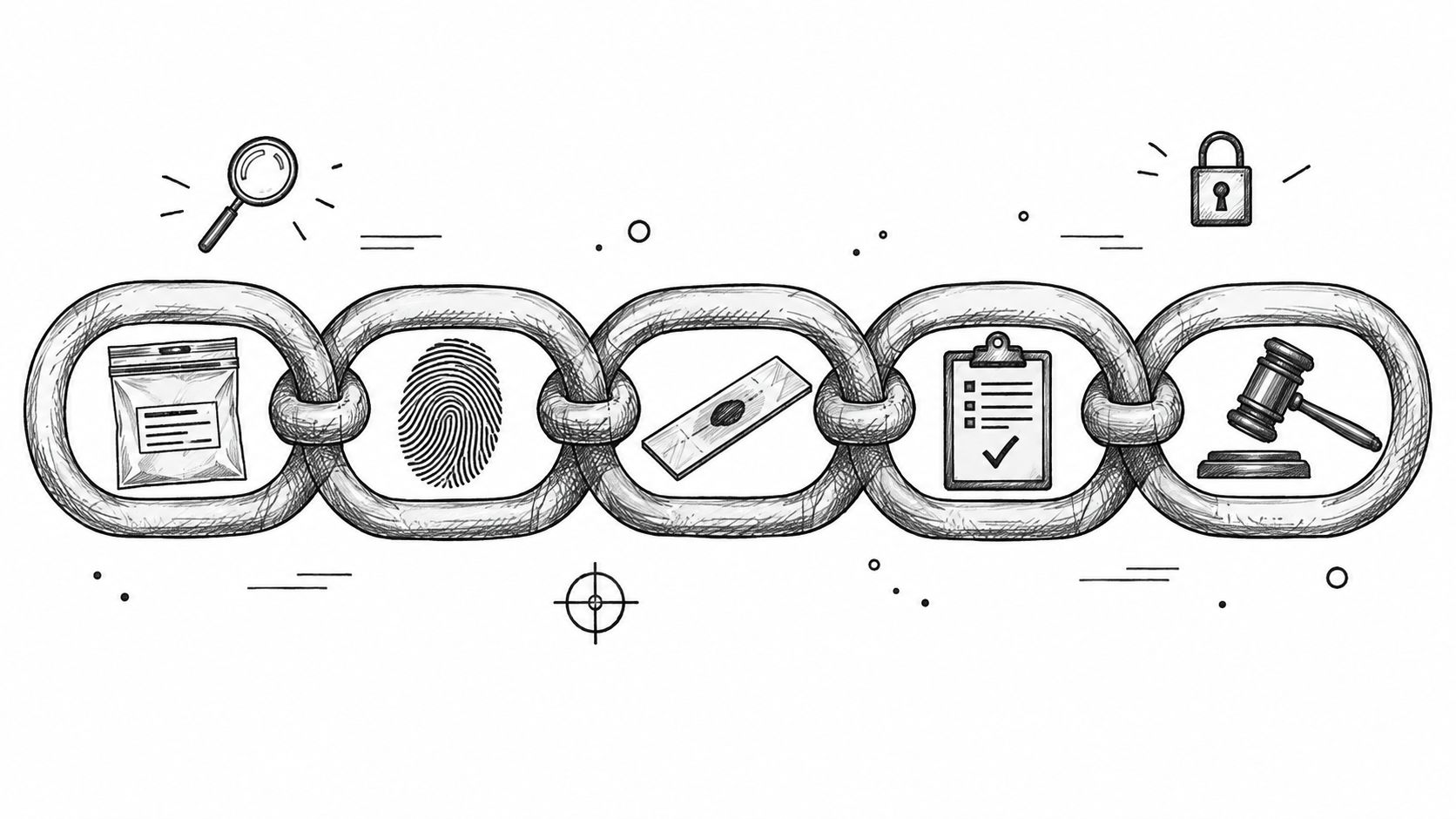
A chain of custody is the chronological record of an item from collection through transfer, analysis, storage, and final return or disposal. The form is the physical or electronic record that captures that history. Modern forensic references treat it as a key document for showing who handled an item and when, while forensic guidance expects each person who touches evidence to create a sign-off trail. The National Center for Biotechnology Information describes chain of custody as the record that supports evidence integrity and admissibility.
The form should answer five practical questions:
- Who collected or received the item?
- What exactly was collected?
- When did each event occur?
- Where was the item kept or transferred?
- How was it packaged, sealed, stored, examined, or disposed of?
Four field groups protect four courtroom answers
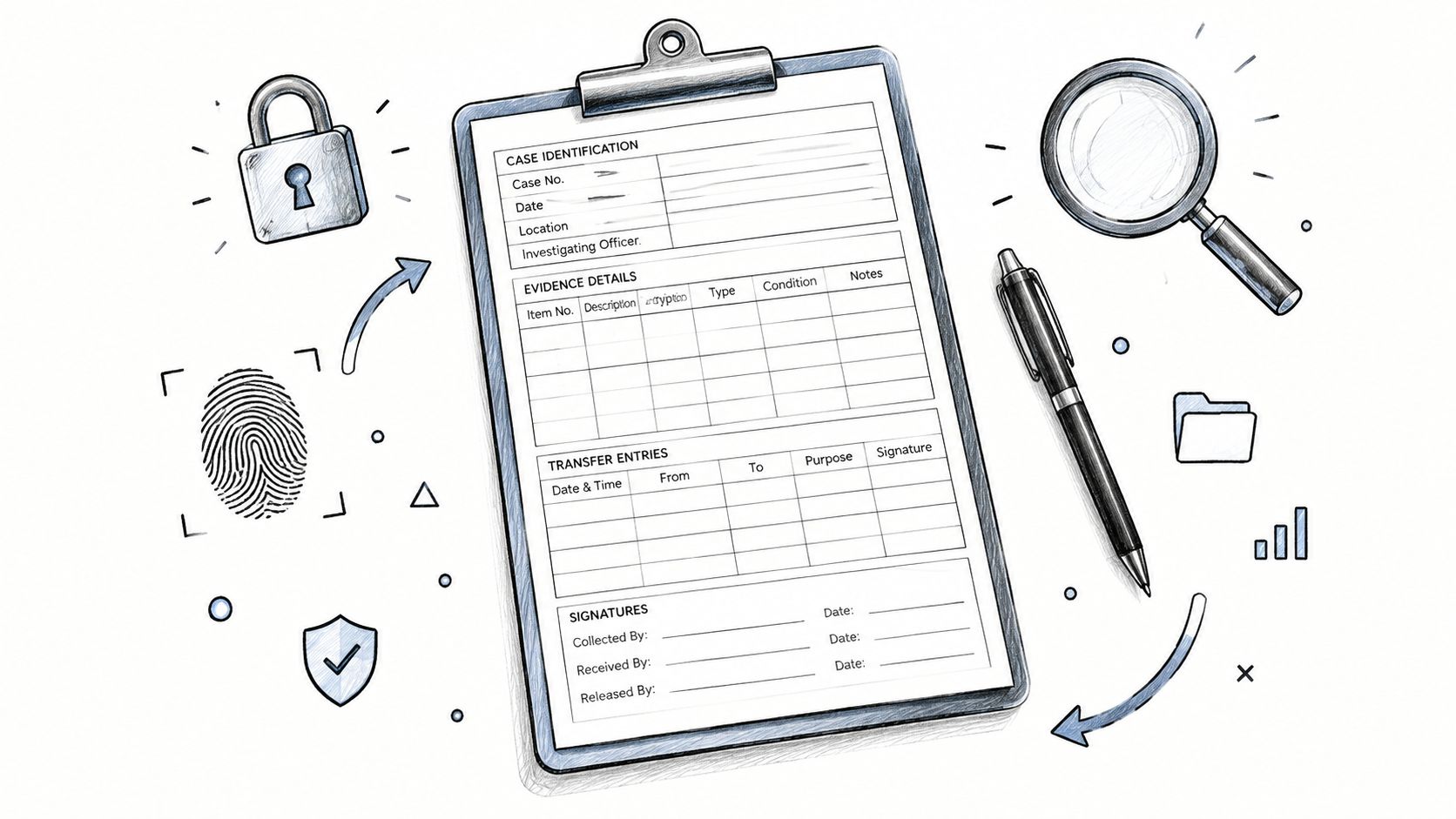
Case identification connects the item to the correct investigation. This usually includes a case number, agency or submitting organization, and the name of the decedent or subject when appropriate. Without that connection, a signature may show that someone handled a package, but not which case the package belongs to.
Evidence description identifies the item itself. The description should state the item number, type, quantity, unique identifier, container, and seal condition. “Evidence bag” is not enough. A reviewer should be able to distinguish the item from other material in the same investigation.
The transfer log records every change in possession or location. It should show the releasing custodian, receiving custodian, date, time, reason for transfer, seal condition, and signatures. A transfer entry is not an administrative courtesy. It identifies the person responsible for the item during the next stage.
Custodian verification closes each event with a clear acknowledgment. Printed names, titles, agency affiliations, contact information when required, and signatures help convert a written entry into evidence that a particular person accepted responsibility.
Practical rule: If a field exists to identify an item, person, time, place, condition, or action, complete it as though the person reading it has never seen the case before.
There isn't one universal form for every forensic setting. Guidance recognizes that multiple registers and formats can be acceptable, but modern workflows still need core information such as a unique identifier, signer identity, contact details, sample details, and requested analysis. This documentation guide from Recepta.ai can help teams think more carefully about how records support a defensible process.
Anatomy of a Court-Defensible Chain of Custody Form
A useful form follows the movement of the evidence. It begins with the case and collection event, identifies the item, records each handoff, and closes with final disposition. For specimen-based work, forensic laboratory guidance also expects the documentation to show that the specimen came from the named source, that the specified laboratory handled the analysis, and that everyone who possessed it before analysis is listed. CLSI guidance on specimen chain-of-custody documentation explains why source attribution and continuity must remain visible.
Header and collection block
The header should include the case number, agency or submitting organization, decedent or subject name when applicable, collection date and time, and collector's printed name and badge or credential number. The collector's signature confirms who made the initial entry, while the date and time establish the beginning of the recorded history.
Evidence and transfer blocks
The evidence block should include the item number, item type, quantity, unique identifier, container, and seal description. The transfer log should provide a sequential history, including the releasing and receiving custodians, the date and time, the purpose of transfer, seal condition, and both signatures.
The disposition block records the final location and the method of return, destruction, or long-term storage. It shouldn't be left blank because a case is still active. It should remain open until the item's final status is known.
| Form Section | Field | Data Captured | Standard Satisfied |
|---|---|---|---|
| Header | Case number and agency | Investigation identity and responsible organization | Links the item to the correct matter |
| Collection | Collector name and credential | Identity of the person who collected the item | Establishes the first custodian |
| Collection | Date, time, and location | When and where the item entered custody | Starts the chronological record |
| Evidence | Item number and description | Specific identity, type, and quantity | Distinguishes the item from other evidence |
| Evidence | Unique identifier | A traceable reference assigned to the item | Supports specimen and evidence attribution |
| Packaging | Container and seal description | How the item was enclosed and secured | Allows later comparison of condition |
| Transfer | Releasing and receiving custodians | Responsibility before and after the handoff | Documents continuity of possession |
| Transfer | Date, time, purpose, and seal condition | Why the item moved and how it appeared | Explains movement and possible changes |
| Disposition | Final location and method | What happened to the item at the end | Closes the lifecycle record |
A form shouldn't be designed only for the person filling it out. It should also be understandable to a judge, opposing counsel, laboratory reviewer, or family attorney who later needs to reconstruct the item's history. Teams comparing paper and electronic options may find this overview of compliance forms from BoloSign useful when evaluating how signatures and audit records are captured.
How to Complete the Form Step by Step
Begin the form at collection, not after the item reaches the laboratory or morgue. Use a consistent date format, such as MM/DD/YYYY, and record time in a 24-hour format so that morning and evening events can't be confused. Write the collector's printed name immediately above the signature, and include the credential or agency information required by the organization's procedure.
The description should be completed while the item is in view. Record the container, the seal type, the identifying marks, and the item's condition. If evidence is photographed before sealing, preserve that photographic record with the case file and identify it in the supporting documentation.
Complete the first seal entry carefully
Describe the tape, bag, vial, box, or other container used. If initials cross the seal and continue onto the container, record that practice in the seal description. The purpose is to make later inspection meaningful. A later custodian should be able to compare the recorded seal with the package received.
At every transfer, the releasing custodian signs out before the receiving custodian signs in. The two entries shouldn't be completed as though they're one undifferentiated event. Both people should print their names and identify their titles and agency affiliations. The transfer purpose should be specific, such as laboratory analysis, secure storage, court presentation, or return to the submitting agency.
Correct errors without hiding the original entry
Never erase, use white-out, or overwrite an original entry. Make a single-line strikethrough, write the corrected information nearby, and add the initials and date of the person making the correction. The original entry should remain readable.
The final disposition entry is completed only when the item is destroyed, returned, or transferred to long-term storage. The final custodian signs the closing entry, records the destination or method, and confirms that the chain has reached its documented endpoint.
Texas Rule for Chain of Custody Affidavits
Texas uses a specific statutory process for certain chain-of-custody affidavits. Texas Code of Criminal Procedure Article 38.42 requires the affidavit to be sworn and to identify the affiant by name and address. It also calls for a description of the evidence and container, the employer's name, the date, method, and source of receipt, the date, method, and recipient of each transfer, and a statement that the item remained in the same condition except for minor changes caused by field or laboratory testing. The Texas statute sets out these affidavit requirements.
The affidavit must be filed with the court clerk and served on the opposing party no later than 20 days before trial when the evidence will be introduced. The statutory text also addresses admissibility and the opportunity to challenge the affidavit. A properly completed affidavit can establish the chain for physical evidence without requiring every custodian to appear personally, although a defective or challenged record can create a need for live testimony.
A chain-of-custody affidavit doesn't repair a missing transfer. It presents the documented history in sworn form.
The affidavit and the underlying form serve different functions. The form records events as they happen. The affidavit later states, under oath, what the affiant knows about receipt, transfers, condition, and identification. The person signing should have firsthand knowledge of the facts being sworn to. Legal counsel should confirm the current filing and service requirements before relying on the affidavit in a particular proceeding.
| Affidavit Element | What It Must Contain | Matching Form Field |
|---|---|---|
| Affiant identity | Name and address | Custodian identification block |
| Employer | Employer's name | Agency or organization field |
| Receipt | Date, method, and source of receipt | Initial receipt entry |
| Evidence identity | Description of evidence and container | Evidence description and packaging block |
| Transfers | Date, method, and recipient for each transfer | Sequential transfer log |
| Condition | Substantially unchanged condition, subject to minor testing changes | Seal and condition entries |
| Sworn statement | Affiant's sworn certification | Notarization and affidavit signature |
| Trial notice | Filing and service before introduction when required | Litigation preparation record |
For a related discussion of Texas chain-of-custody requirements, attorneys and agencies should review the underlying case facts rather than assuming that a familiar form automatically satisfies every proceeding.
Chain of Custody for Bodies and Anatomical Specimens in Texas
Texas administrative requirements for bodies and anatomical specimens operate alongside, but aren't identical to, criminal-procedure affidavit requirements. Under the Texas administrative rule addressing bodies and anatomical specimens under Health and Safety Code Section 691.031, the commission-prescribed form begins with the entity that first acquires the body or specimen. Section A includes a unique identifier assigned under the commission's naming system. The Texas Register rule describes the initiation and transfer requirements.
At each transfer, the releasing and receiving parties complete and sign the custody-transfer entries in Section B. The original form, or a complete copy, moves with the body or specimen at each transfer. This creates an operational record for remains and postmortem material, including specimens that may move between an investigating agency, an autopsy facility, a laboratory, and a storage location.
The criminal affidavit rule addresses the later use of physical evidence in a criminal proceeding. Section 691.031 focuses on administrative custody and transfer of bodies and anatomical specimens. The same case may require both types of documentation, but one shouldn't be substituted for the other without legal review.
| Custody Requirement | Section 691.031 for Bodies and Specimens | Criminal Affidavit Rule |
|---|---|---|
| Starting event | Initiated by the first entity acquiring the body or specimen | Begins with documented receipt of evidence |
| Identifier | Unique identifier assigned under the commission's naming system | Evidence and container description |
| Transfer record | Releasing and receiving parties complete Section B | Date, method, and recipient of each transfer |
| Form movement | Original or complete copy moves with the body or specimen | Affidavit supports courtroom proof |
| Main purpose | Administrative custody and continuity | Admissibility of physical evidence |
| Signature function | Confirms each transfer between parties | Supports sworn testimony by affidavit |
| Final use | Remains and specimens are tracked through handling | Evidence is presented, challenged, or disposed of |
The practical details of labeling, storage, preservation, and specimen handling should be documented in the case record as well as the custody form. Our guide to forensic specimen preservation in Texas provides additional context for teams managing postmortem material.
Common Pitfalls and How to Prevent Them
Small omissions can create large questions. During internal quality review and external peer review, Texas Autopsy Services focuses on whether a reader can reconstruct the item's history without relying on memory or informal explanations.
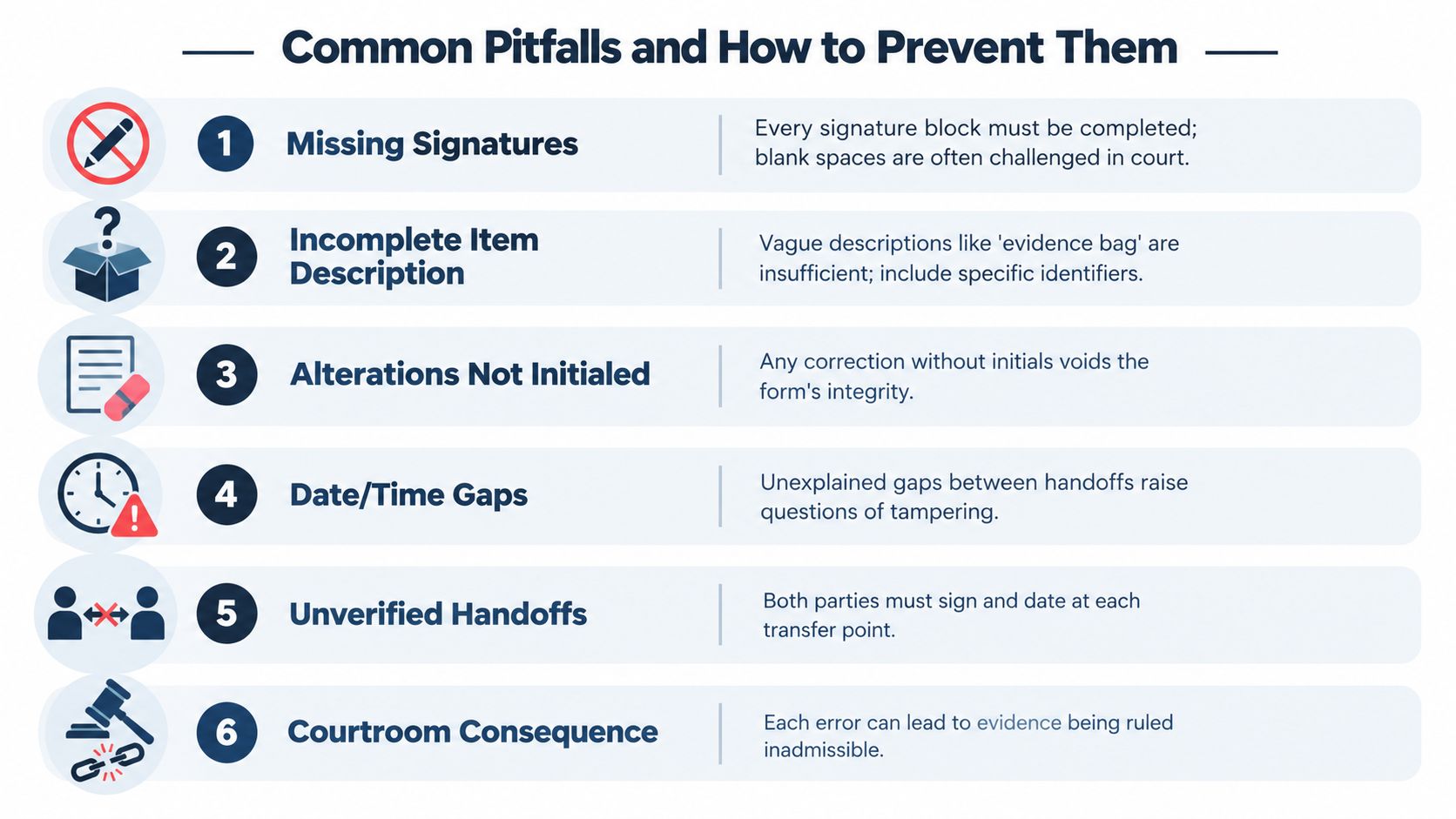
- Incomplete date and time entries: A missing date or partial time makes the sequence difficult to establish. Complete the collection and transfer fields at the time of the event.
- Illegible signatures: A signature that can't be connected to a known custodian weakens identity verification. Print the name above the signature and include the title and agency.
- Unrecorded seal condition: If a seal is opened without documenting its condition first, a later reviewer can't tell whether the package arrived intact. Describe the seal before breaking it and again after resealing.
- Missing transfer purpose: “Transferred” doesn't explain why the item moved. State whether the reason was analysis, storage, transport, court presentation, or another specific action.
- Unrecorded storage changes: A move between refrigerators, freezers, evidence rooms, or laboratories should appear in the transfer or storage record. If a temperature deviation occurs, document the event and response rather than leaving an unexplained gap.
- Affiant without firsthand knowledge: A person who didn't receive, transfer, or observe the evidence shouldn't swear to details they can't personally support. Select an affiant whose knowledge matches the statement.
A daily review that catches defects early
Review the form before the item leaves the current custodian. Confirm that the item identifier matches the container, all required signatures are present, the times follow a logical sequence, and the seal description matches what is visible. Then compare the form with transport records, laboratory receipts, storage logs, and photographs.
A second reviewer can identify an incomplete field before the case reaches a hearing. That review should correct the record through a transparent amendment process, never by rewriting history or filling gaps from memory.
Beyond the Paper Form, Storage, Imaging, and Integrity Controls
The paper form is the visible layer of custody. It can show who signed for an item, but it can't independently prove where the item stayed, who entered the storage area, whether a digital image changed, or whether a specimen remained under the required conditions.
Secure physical storage should limit access to authorized personnel. Biological specimens may require segregated refrigeration or freezing, with temperature records that can be compared with transfer and access timestamps. Those records answer a direct question: where was the specimen while it wasn't in someone's hands?
Imaging creates another layer. Evidence can be photographed at intake, while radiologic images may carry custody-related information within DICOM headers. Digital files should be preserved in systems that record access and detect unauthorized changes. Modern forensic literature discusses immutable logging and tamper-evident tracking as controls being explored for digital evidence, including evidence handled across cloud environments. The review of digital chain-of-custody systems explains why a signature trail alone may not establish complete digital provenance.
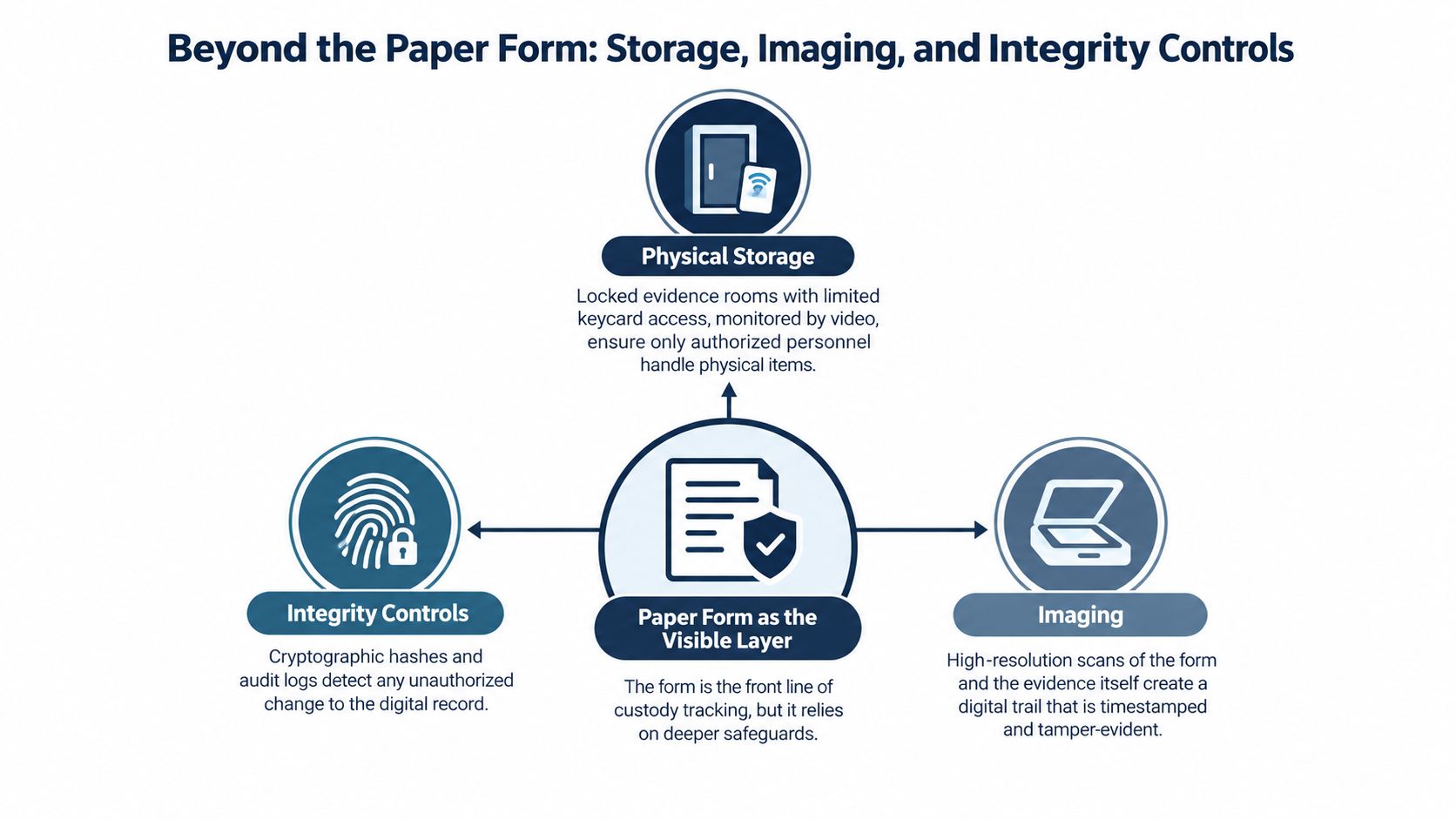
Access logs should mirror the paper record. Sensitive materials may require two-person verification, while audit trails can be reviewed on a scheduled basis. Teams that need to preserve related electronic communications can also consult this practical resource on how to save business text messages, provided the process is adapted to the applicable privacy and evidence requirements.
For secure facility practices in a postmortem setting, see the Texas Autopsy Services guidance on secure storage facility procedures. The precise controls will depend on the evidence type, agency policy, laboratory requirements, and applicable Texas law.
Quick Reference Checklist
Keep the following checklist beside the workstation where evidence is received, transferred, analyzed, or stored. It supplements case-specific legal review. It doesn't replace it.
Must-have fields
- Case identifier: Use the unique case or investigation number that connects the form to the correct file.
- Item description: Record the specific type, quantity, condition, container, and unique identifier.
- Collector identity: Include the collector's full printed name, credential or badge information, title, and agency where required.
- Collection date and time: Record the actual date and time, including the applicable time zone when the workflow requires it.
- Seal information: Describe the container and seal, including identifying marks and condition.
- Every handoff: Record the releasing and receiving custodians, date, time, purpose, condition, and signatures.
- Final disposition: Document the final location, return, destruction, or long-term storage and obtain the final custodian's signature.
Errors to prevent
- Blank fields: Mark a field as not applicable when permitted by procedure, rather than leaving uncertainty.
- Post-dated entries: Record events when they occur and explain any later administrative correction.
- Illegible signatures: Print names and include titles or agency affiliations.
- Mismatched seal descriptions: Compare the written description with the package before opening or resealing it.
- Missing affidavit blocks: Confirm that sworn statements, signatures, and notarization are complete when an affidavit will be used.
- Unexplained gaps: Reconcile transport, storage, laboratory, and access records before the file is closed.
Texas review points
Texas custody work may involve different legal and administrative requirements depending on the evidence and proceeding. Article 38.42 has specific affidavit filing and service requirements, while body and specimen handling may fall under administrative rules connected to Health and Safety Code Section 691.031. Retention of autopsy material and records should also be reviewed under the applicable agency procedures, Texas Funeral Service Commission requirements, Texas Health and Safety Code Chapters 711, 716, and 651, and the facts of the case.
The strongest checklist is the one used with the underlying records, not in place of them. Attorneys, agencies, and families should obtain case-specific legal guidance before making decisions about release, destruction, transfer, or courtroom use.
Texas Autopsy Services provides private autopsy services Texas families, attorneys, healthcare professionals, and county officials can use when an independent cause of death investigation or second opinion is needed. Our team serves all 254 Texas counties from Elgin, provides in-house licensed transport, and maintains documented custody of bodies and specimens. If you need help reviewing an autopsy-related custody record, visit Texas Autopsy Services to contact the team directly and discuss the next appropriate step.