August 1, 2026 · Texas Autopsy Services
Secure Storage Facility: Post-Mortem & Forensic Guide
What defines a secure storage facility for post-mortem remains and forensic material, including chain-of-custody, temperature control, and Texas compliance.
A family often learns about storage only after the hard part has already happened. The autopsy is authorized, the examination is complete, and now the practical question is simple and serious, where are the remains held, who can access them, and what records prove that nothing was altered before final release.
Forensic storage is not just a matter of keeping a door locked. It is part of the evidentiary path, part of the dignity owed to the deceased, and part of the legal record that families, attorneys, and county officials may later rely on. A facility that looks orderly during business hours can still fail if its access logs, environmental controls, or transfer documentation are weak after midnight.
Why Storage Standards Matter After a Forensic Examination
A common point of confusion comes right after the examination ends. A family may assume the remains go straight to release, or that any refrigerated room is acceptable for the short wait before burial, cremation, or another lawful disposition. In practice, that waiting period is part of the record, and the way a facility handles it can matter just as much as what happened during the autopsy itself.
The hours after examination are still part of the evidence path
When remains stay in secure storage after a forensic examination, the facility is responsible for more than simple safekeeping. It has to protect identity, condition, and documentation until the next lawful handoff. That includes controlling access, limiting handling, and preserving the physical state of the body and any retained samples.
A secure storage facility differs from a basic holding room. A room can be locked and still be weak if nobody can prove who entered it, when temperature drifted, or whether a transfer was logged correctly. In forensic work, the record is part of the protection.
Practical rule: if a facility cannot show who touched the remains, when they were moved, and under what conditions they were held, the storage process is weaker than the brochure makes it look.
The broader storage industry shows why this matters. In the United States, self-storage is now a mature market, with annual revenue estimated at $46.5 billion in 2022 and projected to reach $61.2 billion by 2027 at a 5.2% CAGR (WorldMetrics). That scale has pushed operators toward tighter access control and surveillance. For forensic material, the expectations are even higher because the stakes include dignity, chain of custody, and potential courtroom scrutiny.
Families and attorneys should view post-examination storage as part of the same process, not a separate administrative step. If the storage conditions are inadequate, the cleanest autopsy report can still be harder to defend.
What Defines a Secure Storage Facility for Forensic Material
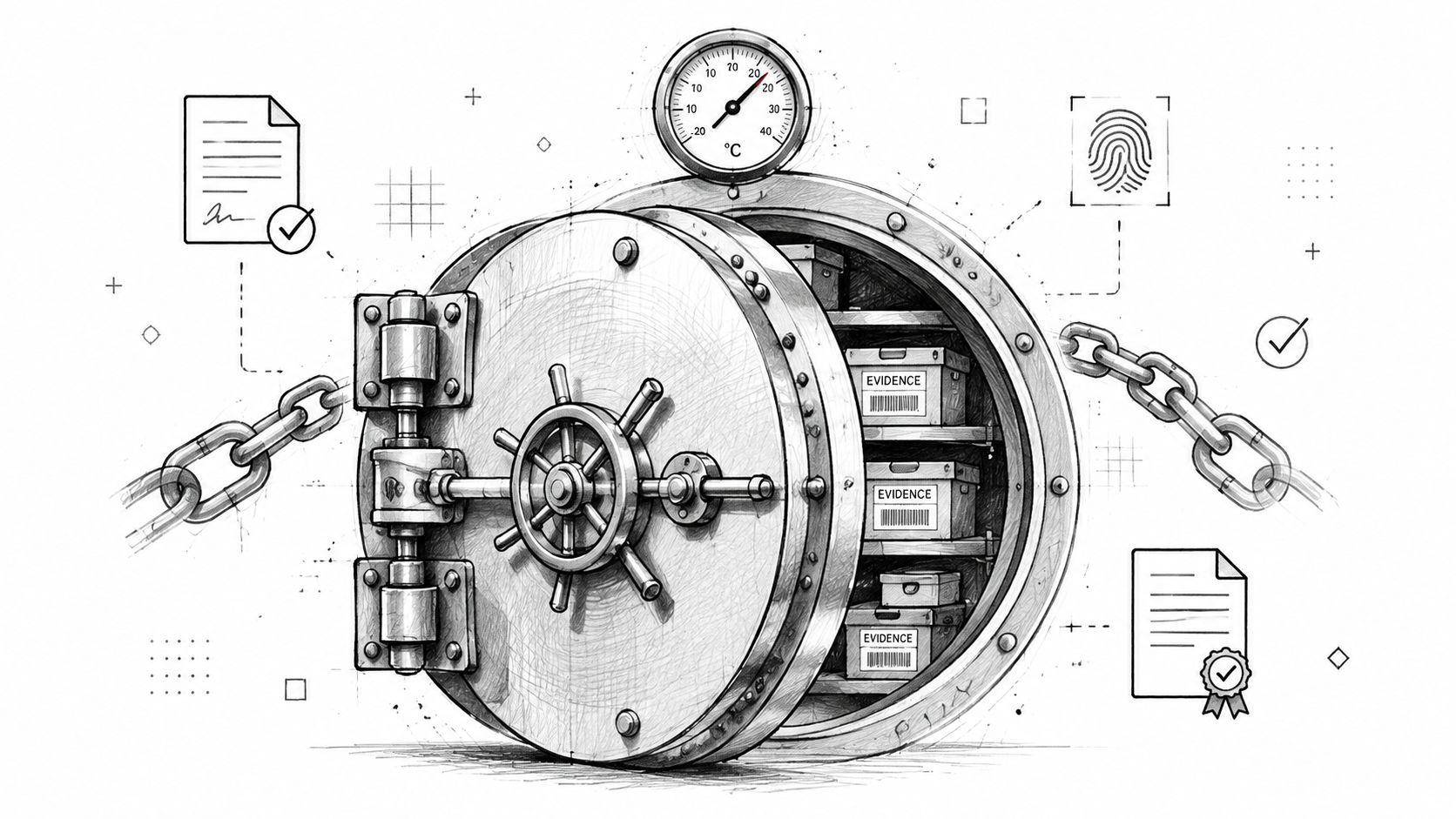
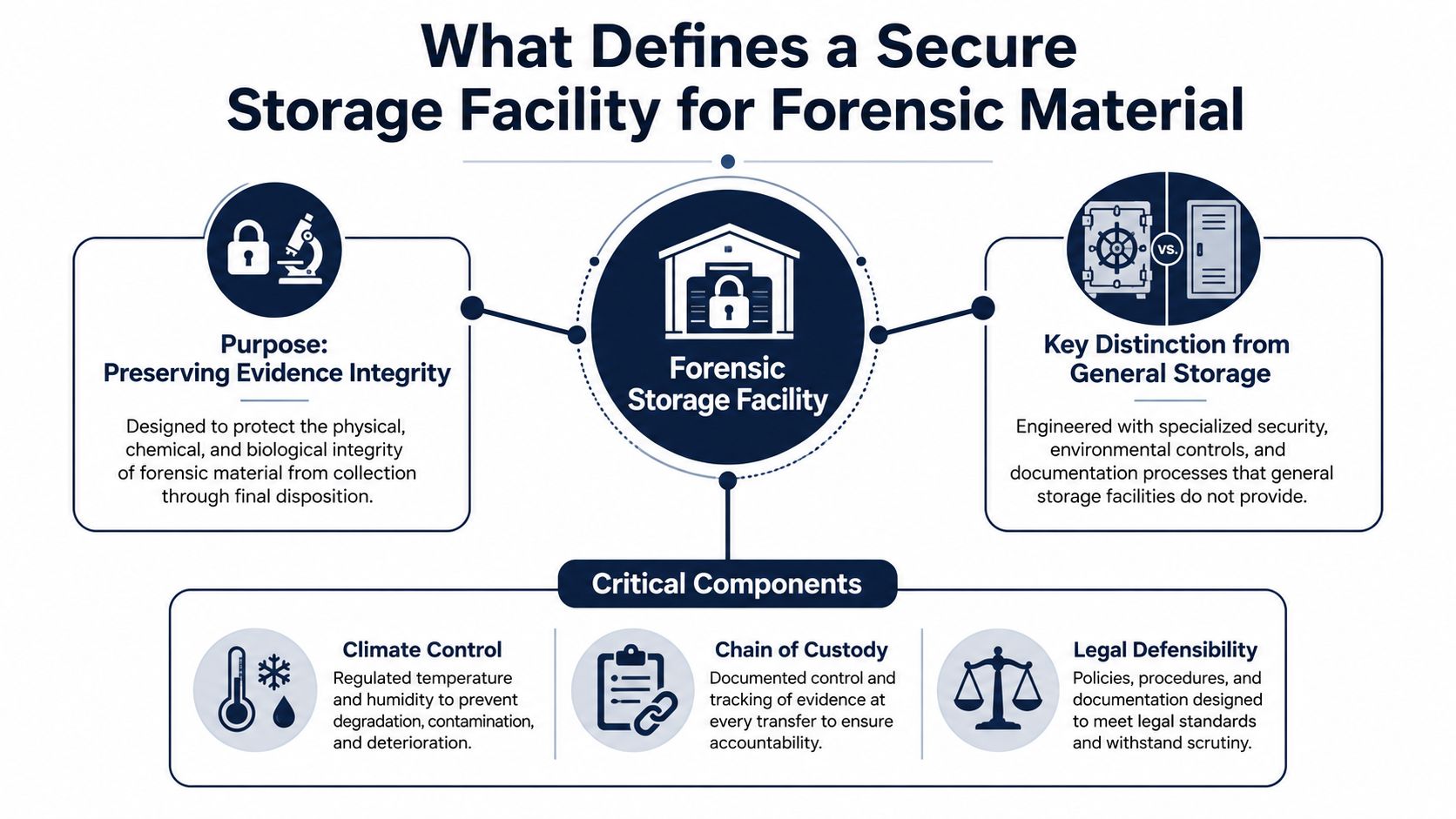
A secure storage facility for forensic material is a controlled environment where remains and related evidence are protected through three linked systems, physical security, environmental control, and documentation. It is built for custody, not convenience. A locked room does not meet that standard by itself, and a general self-storage unit cannot replace the procedures, monitoring, and legal recordkeeping that forensic material requires.
Purpose and key distinctions
The purpose of forensic storage is to preserve evidence integrity. That means the facility has to support cause of death findings, which identify the medical reason death occurred, and manner of death findings, which describe the classification of death, such as natural, accident, suicide, homicide, or undetermined. It also has to preserve chain of custody, the documented trail showing every transfer, access event, and condition change from intake to release.
General storage can be secure without being forensic-grade. A refrigerated holding room may keep remains cool, but it may not provide the access logs, audit trail, or legal defensibility needed when a case later faces review by attorneys or a court. The same is true of self-storage. Even with controlled access, it is designed for property, not human remains or evidentiary material.
A useful comparison appears in facility maintenance guidance for other regulated storage settings, as shown in this guide to commercial facility upkeep. Off-site records centers are usually designed with controlled access, environmental controls, and chain-of-custody tracking, because sensitive material loses value if it cannot be shown intact. In some regulatory environments, that layered approach is reflected in the WA security compliance guide. The same principle applies here, preserve condition and preserve proof.
What to expect in practice
A forensic-grade facility usually combines:
- Restricted entry with accountability for each access event.
- Temperature management for remains and samples.
- Documented transfers from intake through final release.
- Emergency procedures for power loss, equipment failure, or delayed retrieval.
A facility can look modern and still be inadequate if those four elements are missing. A written policy matters, and so does operational discipline. That is why facilities such as Texas Autopsy Services maintain secure, temperature-controlled storage as part of the forensic process, not as an afterthought.
One practical way to think about it is this. If a facility cannot explain how it protects the body, the samples, and the paperwork at the same time, it does not yet function as a secure forensic storage facility.
Physical Security and Access Control Standards
The strongest storage plans use layers, not a single barrier. Industry security data show how common that approach has become in self-storage generally, with 91% of U.S. self-storage facilities offering smart locks, 65% of tenants using mobile keys, 63% of facilities having mobile apps, and video surveillance installed at 98% of self-storage facilities (GITNUX). Those figures are for a broader market, but they show a clear trend toward access accountability rather than simple key control.
For forensic storage, that layered model should be more disciplined than what a tenant sees in a commercial storage lobby. Gated access, surveillance, and individual authorization are only the start.
Structural security matters as much as cameras
Federal vault standards show why the enclosure itself matters. U.S. specifications for vault construction require at least 8 inches of reinforced concrete or equivalent masonry, with reinforcement tied on 6-inch centers, and the door and frame must resist specific levels of surreptitious entry, forced entry, lock manipulation, and radiological attack (International Vault). The point is not that every forensic storage room has to be a federal vault. The point is that delay is security.
The Whole Building Design Guide makes a similar point about secure spaces. In an open storage area with intrusion detection, personnel should respond within 15 minutes if security-in-depth is present, or within 5 minutes if it is not, and vault walls should use reinforced concrete with a minimum thickness of 8 inches (WBDG secure spaces guide). That timing matters because a door, wall, or access control layer buys responders time.
A camera alone records an event. A barrier slows the event down enough for the record to matter.
What families and attorneys should look for
A real forensic storage setup should answer these questions without hedging:
- Who can enter? Access should be limited to authorized staff.
- How is entry recorded? Logs should show the person, time, and purpose.
- Is surveillance active continuously? A tour-time demonstration is not enough.
- Are there separate zones? Handling areas should not double as public access areas.
For a practical access-control reference, security system guidance such as GM GROUP Services' top access control picks can help readers understand the difference between perimeter convenience and real accountability. The core lesson is simple. If a facility cannot explain its layers of control, it is relying on trust where it should be relying on evidence.
Temperature Control and Environmental Safeguards
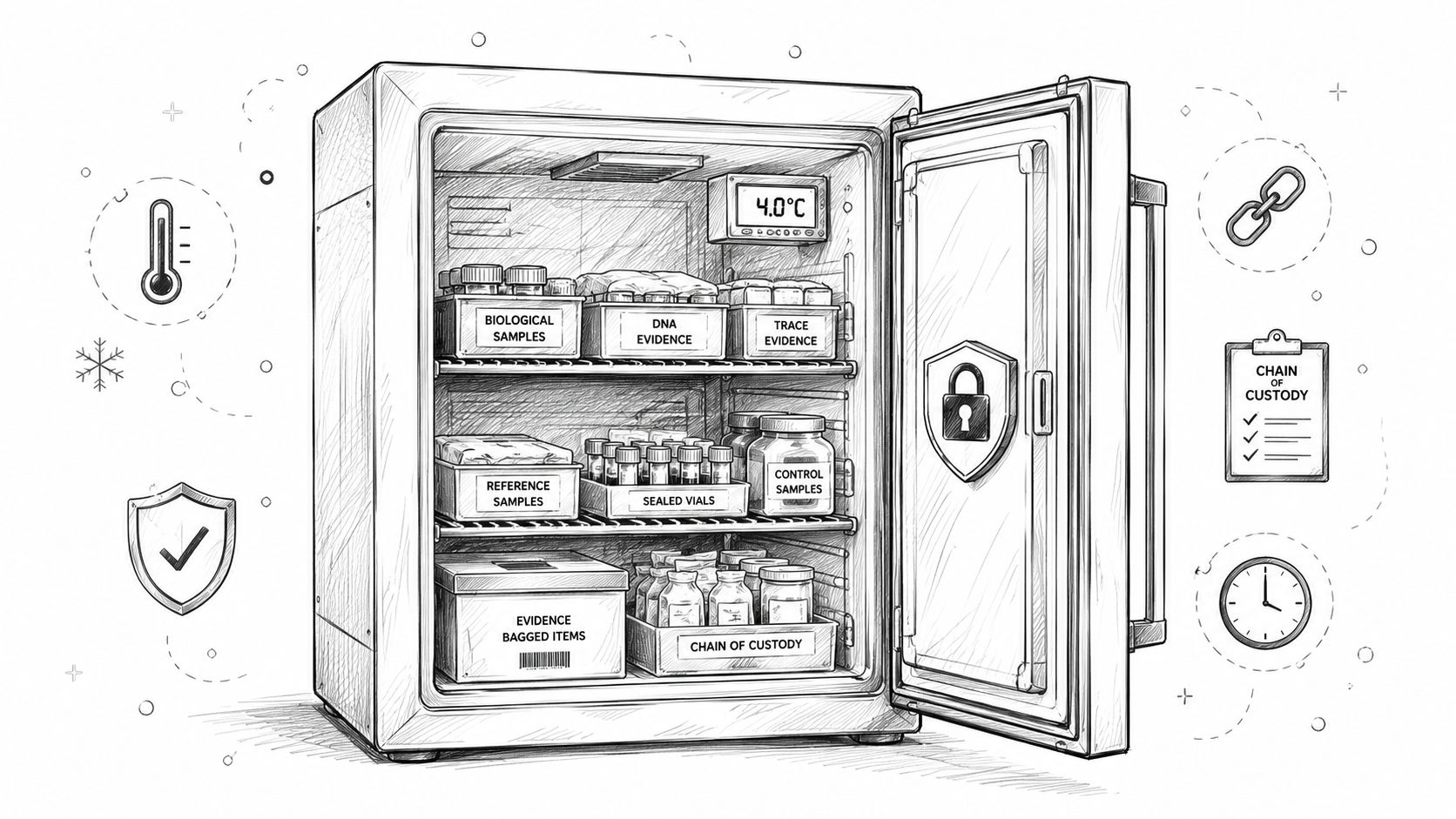
A body held in storage is still undergoing change. Temperature control slows that process, protects tissue integrity, and helps preserve toxicology relevance until release or further testing. The facility also has to protect retained samples and any associated evidence from avoidable environmental drift.
What good environmental control looks like
Short-term holding usually depends on refrigerated conditions, while longer storage may require a more controlled approach depending on the body, the samples, and the case requirements. The critical issue is not a single number read once on a thermostat. It is continuous control with documented monitoring, alarm thresholds, and a response plan when something drifts.
Facilities should be able to show:
- Continuous digital logging rather than occasional manual checks.
- Alarm response procedures for temperature excursions.
- Backup power or contingency planning for equipment failure.
- Humidity management where materials or equipment are sensitive.
- Pest control and sanitation to prevent contamination.
- Fire suppression planning that does not create avoidable secondary damage.
The same logic appears in secure records storage, where environmental controls help protect long-term material from temperature, humidity, and fire risk. In forensic storage, the margin for error is narrower because biological material can degrade and samples can become harder to interpret.
A useful industry reminder comes from secure-storage consumer guidance, which stresses that storage protects against both criminal and non-criminal hazards, including fire, water, pests, and climate exposure (SelfStorage.com guide). That same reality applies here. A perfectly locked room is still a poor storage environment if it is too warm, too humid, or too vulnerable to equipment failure.
What to ask for in writing
Request the facility's temperature monitoring policy, not just a verbal assurance. Ask whether logs are retained, how often alarms are reviewed, and who responds after hours. If the provider cannot explain its escalation process, the environmental control is more fragile than it should be.
For a practical example of temperature-controlled storage in a forensic setting, see our internal discussion of temperature-controlled storage. The main point is unchanged. Environmental safeguards protect both the remains and the defensibility of the record.
Chain of Custody and Legal Compliance in Texas
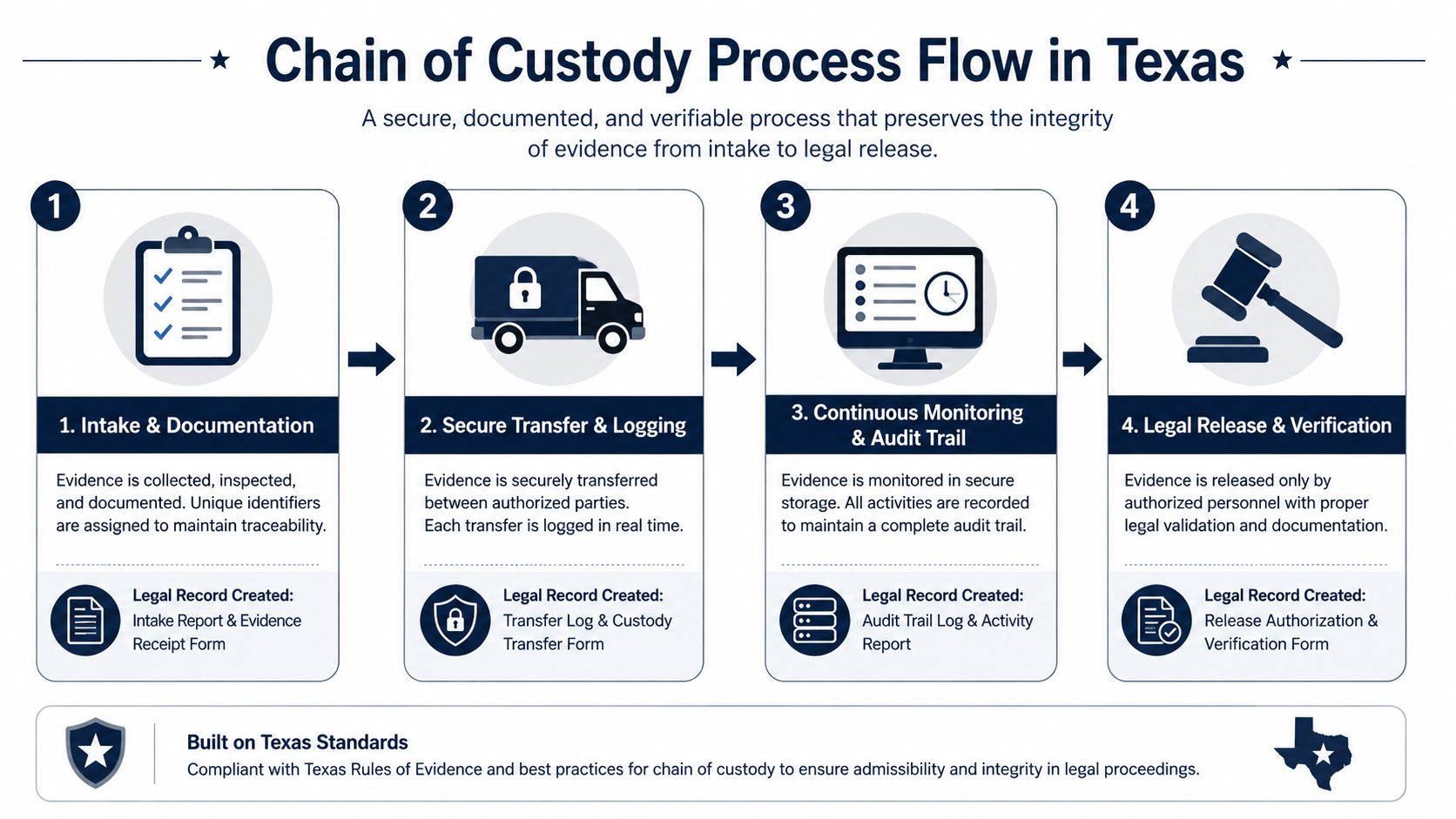
Physical security and temperature control only become legally meaningful when the documentation is tight. That is the function of chain of custody, the written and time-stamped record showing every handoff, every access event, and every condition change from intake to final release.
Why paperwork is part of the security system
A well-run facility records identity at intake, transfer history, access permissions, and release authorization. If a condition changes, that change should be documented. If a body moves from one room to another, that movement should be logged. If a sample is removed for testing, the record should show who removed it and where it went.
HIPAA still matters in post-mortem settings because health information can remain protected after death when it is handled by covered entities or their business associates. In Texas, handling also sits within a broader legal framework that includes Texas Health and Safety Code Chapters 711, 716, and 651, along with regulation and oversight tied to the Texas Funeral Service Commission. Those statutes and regulatory duties affect how remains are handled, transported, and released.
Federal records storage standards offer a useful parallel. They cap one storage area at 250,000 cubic feet for federal records, require non-combustible materials, and require floor load limits to be established by a licensed structural engineer and posted conspicuously (National Archives storage standards). Those are records rules, not mortuary rules, but they show the same legal principle, storage is not just physical space, it is controlled custody.
If the record trail breaks, the facility has a documentation problem even if the refrigerator never failed.
What attorneys should verify
Attorneys should ask whether the provider keeps a full audit trail, how long records are retained, and whether release paperwork links directly to the same intake record. Families should ask for plain-language confirmation that the remains were held under documented conditions from arrival through release.
For more detail on the paper trail itself, our internal guide on chain of custody procedures explains how a defensible transfer record is built. The essential idea is straightforward. A secure storage facility must be able to prove not only where the remains were, but who controlled them at every step.
How to Evaluate a Secure Storage Facility
A site visit can be useful, but only if the questions are specific. Families and attorneys should compare providers on structure, access, environmental management, and recordkeeping instead of relying on a clean lobby or a reassuring brochure.
Minimum compliance versus stronger practice
Minimum compliance means the facility follows the law and keeps the door locked. Stronger practice means it can document that security, temperature, and transfers are controlled all day, all night, and during staff changes. The difference shows up most clearly when something unusual happens, an equipment alarm, a delayed pickup, an after-hours request, or a dispute over a transfer record.
A careful review should include:
- Reinforced construction or secure enclosure design where relevant.
- Access logs that show who entered and when.
- Video surveillance that is monitored and retained under policy.
- Real-time temperature monitoring with alarms and response steps.
- Backup power or contingency planning for critical equipment.
- Chain-of-custody procedures that tie intake, storage, and release together.
- Compliance records that show how the facility aligns with Texas requirements.
Facilities built around generic storage often stop at basic lock control. Forensic storage has to do more. In the records world, off-site centers often use controlled access and digital retrieval support because sensitive materials require traceability as well as protection. The same standard should guide a forensic provider.
A practical decision rule
If a provider can demonstrate its controls on paper and in practice, that is a good sign. If the answer is always “we've never had a problem,” that is not enough. Systems matter most when they are tested, not when they are assumed to work.
Texas Autopsy Services offers one example of how this can be done in practice, with secure temperature-controlled storage, in-house licensed transport, and direct team communication. That is not a substitute for your own review, but it is the kind of operational structure families and attorneys should expect to see explained clearly.
For a separate technical reference on facility credentialing, our guide to laboratory accreditation standards can help readers think about oversight in a broader forensic context. The main point remains the same. Good storage is measurable, not assumed.
Questions to Ask Your Forensic Storage Provider
The right questions force a facility to show its actual process. Ask them before you agree to storage, not after a problem has already occurred.
How do you document intake and release?
A strong answer includes identity verification, transfer logs, and a release record tied to the same case file.Who can access the storage area after hours?
You want a clear explanation of restricted access, not a vague assurance that staff are “always around.”How do you monitor temperature and what happens if it drifts?
The provider should describe continuous logging, alarm thresholds, and who is called when limits are exceeded.How are remains transported into and out of the facility?
In-house licensed transport is a strong operational sign because it reduces handoff gaps and preserves custody.Who reviews the forensic process?
Every examination should be performed by a board-certified forensic pathologist certified by the American Board of Pathology, and the storage process should sit under the same clinical oversight.What is included in pricing?
Flat-rate, all-inclusive pricing is easier for families and counsel to understand than layered add-ons that appear later.How quickly do you complete most cases?
If a provider discusses timing, “most cases within 24 to 48 hours” is a reasonable operating range to hear, but it should still depend on case complexity and testing needs.
A facility's answers should sound operational, not promotional. If the explanation is full of marketing language and short on records, logs, or named procedures, keep asking.
Contact Texas Autopsy Services for Guidance
When families, attorneys, or county officials are trying to make a careful decision about post-mortem care, direct guidance matters. Texas Autopsy Services operates from Elgin, TX with secure temperature-controlled storage, in-house licensed transport across all 254 Texas counties, and every examination performed by a forensic pathologist certified by the American Board of Pathology.
We're available 24/7 at (806) 230-1889. You can call with questions even if you haven't chosen a provider yet, and you'll speak directly with our team rather than a call center.
If you need help evaluating a secure storage facility for a forensic case, we can explain the storage, transfer, and documentation steps in plain language. Visit Texas Autopsy Services or call (806) 230-1889 to speak with our team about secure, documented handling that respects both the deceased and the people relying on the record.