May 11, 2026 · Texas Autopsy Services
A Guide to Forensic Pathology Labs in Texas
Explore forensic pathology labs with a Texas-based expert. Understand private autopsies, cause of death investigations, and how to find answers.
On this page
- TL;DR
- When You Need Answers More Than Anything
- What Are Forensic Pathology Labs
- An Overview of Core Services
- Understanding Accreditation and Quality Indicators
- A Step-by-Step Guide for Families and Attorneys
- Navigating Autopsy Procedures in Texas
- Frequently Asked Questions About Private Autopsies
- Finding Clarity and Compassionate Answers
When a death is sudden, the hardest part is often the uncertainty. A family may have a death certificate in hand and still not understand what happened. An attorney may have a report but still need to know whether the findings are complete, well supported, and fit the medical facts. In those moments, forensic pathology labs matter because they turn unanswered questions into documented medical findings.
At Texas Autopsy Services, every examination is performed by a board-certified forensic pathologist experienced in medicolegal death investigations. Our work centers on one principle: follow the evidence carefully, explain it plainly, and treat the deceased and their family with respect.
TL;DR
A family may have only a few hours to decide whether to request a private autopsy before burial plans move ahead. An attorney may need an independent medical review before records, specimens, or imaging become harder to obtain. Timing matters.
- Forensic pathology labs are medical facilities built for postmortem examination, including autopsy, tissue sampling, toxicology coordination, and formal documentation.
- A private autopsy, also called an independent autopsy, can help when no public investigation will be performed, when hospital autopsy access is limited, or when counsel or family members need an objective second review.
- Good work depends on specific safeguards: board certification, accreditation, specimen tracking, chain of custody, and facility standards designed for postmortem medicine.
- The current shortage of forensic pathologists can affect access and timing, especially when families need answers quickly.
- In Texas, autopsy decisions often involve legal requirements, release procedures, and close coordination with funeral homes and transport teams.
- Families and attorneys need findings that are medically precise, clearly explained, and delivered with respect for the person who died.
When You Need Answers More Than Anything
A family calls after an unexpected death at home. They've heard different explanations from different people. One relative was told it may have been the heart. Another thinks medication played a role. Someone else wonders whether an injury was missed. What they're really asking is simpler than the medical record makes it sound. They want the truth, stated plainly and respectfully.
That's where my work begins. In forensic pathology, the task isn't to confirm a theory or support a narrative. It's to examine the body, review the history, study the available records and specimens, and determine what the medical evidence does and does not show.
I meet people at a difficult point in their lives. Grief often comes with pressure to make decisions quickly, coordinate with a funeral home, and sort through legal or insurance concerns while still trying to understand the loss itself. A sound autopsy process doesn't remove grief, but it can replace uncertainty with medically grounded answers.
There's also a system-wide reality behind many of these calls. In the United States, there are about 750 full-time forensic pathologists, while the estimated need is at least 1,500, according to Forensic Magazine's reporting on the forensic pathologist shortage. That shortage affects access, especially when families or counties need timely examinations and public offices are stretched.
A cause of death is not just a line on a certificate. For many families, it is the first stable fact in a period of confusion.
A forensic pathology lab should bring order to that confusion. The best ones do it with science, documentation, and restraint.
What Are Forensic Pathology Labs
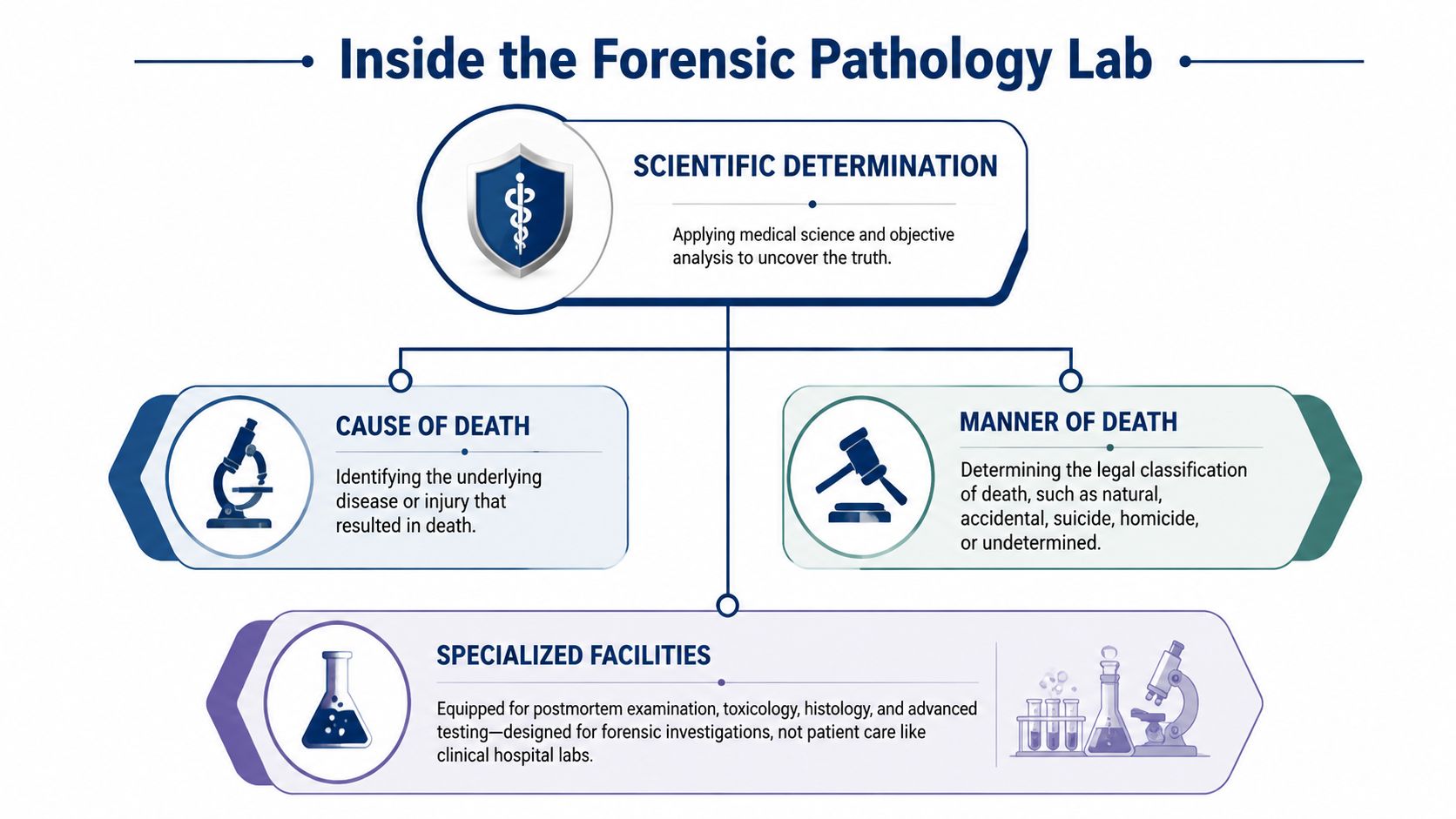
A forensic pathology lab is a specialized medical setting where a pathologist investigates death through postmortem examination. The work includes external examination, internal examination when indicated, specimen collection, photography, evidence handling, histology, and coordination of toxicology or other testing. The purpose is to determine cause of death and, when appropriate, manner of death.
Cause of death means the disease or injury that started the fatal process. Manner of death is the classification used in medicolegal practice, such as natural, accident, suicide, homicide, or undetermined.
Public offices and private labs
A public medical examiner or coroner system handles deaths that fall under legal jurisdiction. That often includes violent deaths, suspicious deaths, certain unattended deaths, and deaths in custody or involving public interest. Those offices serve an essential public function.
A private lab serves a different need. Families, attorneys, physicians, and agencies may seek an independent examination when a public office does not take jurisdiction, when a hospital autopsy is unavailable, or when an existing opinion needs review. In those situations, an independent autopsy through private autopsy services in Texas can provide a separate medical assessment based on the available facts and specimens.
Why demand keeps rising
Public forensic systems are under real strain. From 2015 to 2017, toxicology analysis costs in public labs rose 25%, contributing to a $640 million national resource gap, as summarized in the Royal College of Pathologists pathology facts and figures page. In practice, that kind of pressure can affect turnaround, staffing, and the ability to absorb difficult caseloads.
That doesn't mean public work is unreliable. It means volume, staffing, and resources matter. A private forensic pathology lab can help absorb some of that pressure by giving families and attorneys another medically legitimate path to answers.
Practical rule: The right lab is not the one with the broadest claims. It's the one that can explain exactly who performs the examination, how specimens are handled, and what the final report will address.
An Overview of Core Services
Not every case needs the same level of examination. Good forensic practice starts with the question being asked, then matches the scope of the work to that question.
Full autopsy and limited autopsy
A full autopsy usually includes an external examination, internal examination of the major organ systems, specimen collection, and documentation. This is the broadest approach when the cause of death is uncertain or multiple possibilities need to be evaluated.
A limited autopsy narrows the examination to a specific issue. That might involve one region of the body, one organ system, or a focused concern such as the heart, brain, lungs, or evidence of trauma. Limited exams can be useful when the family has a defined question, but they also have limits. If the wrong scope is chosen, an important finding can remain outside the field of review.
Histology and microscopic review
Histology is the microscopic examination of tissue. It often answers questions that gross examination alone cannot. Tissue review may support myocarditis, pneumonia, liver disease, scarring, certain infections, tumor involvement, or subtle injury patterns. In some cases, it helps distinguish a natural disease process from a traumatic one.
This work takes patience. Microscopic findings need to be interpreted in context, not read as isolated fragments.
Toxicology and related testing
Toxicology looks for alcohol, medications, drugs, and other substances that may have contributed to death. It can clarify overdose, impairment, drug interactions, or whether a substance was present but not fatal. It's one of the most commonly misunderstood parts of the autopsy process because a positive test result is not the same thing as a cause of death.
For families trying to understand these reports, a plain-language explanation helps. I've written separately about reading postmortem testing through this example toxicology report guide, because numbers and analyte names by themselves rarely answer the underlying question.
Second opinion review
A second opinion autopsy or postmortem review is often requested when the first examination leaves important concerns unresolved. That can involve re-review of the autopsy report, photographs, tissue slides, toxicology, scene history, medical records, or retained specimens. Sometimes the original conclusion is well supported. Sometimes the issues involve interpretation, documentation, or incomplete correlation of findings.
Here is where a second opinion is often useful:
- Civil litigation: Questions about medical care, injury causation, or whether a finding was overcalled or undercalled.
- Family clarity: The report may be technically correct but hard to understand, especially when several conditions are listed.
- Insurance or estate matters: A precise explanation of the death sequence can matter beyond the certificate itself.
- County or agency review: An outside pathologist may be asked to assess a difficult or sensitive case.
A sound second opinion is not adversarial by default. It is independent.
Understanding Accreditation and Quality Indicators
When people ask whether a lab is trustworthy, I don't start with branding. I start with systems. In forensic pathology labs, reliability comes from facility design, specimen handling, documentation, and professional qualifications.
What quality looks like in practice
A proper autopsy suite isn't just a room with a stainless table. The physical environment affects safety and evidence integrity. According to the Office of Justice Programs facility guidance for forensic laboratories, autopsy suites require specialized HVAC design with negative pressure in the range of -0.01 to -0.05 in. w.g. to exhaust airborne pathogens and reduce cross-contamination. That matters for staff safety, but it also matters for the reliability of collected specimens and observations.
Other quality indicators are less visible to families but just as important:
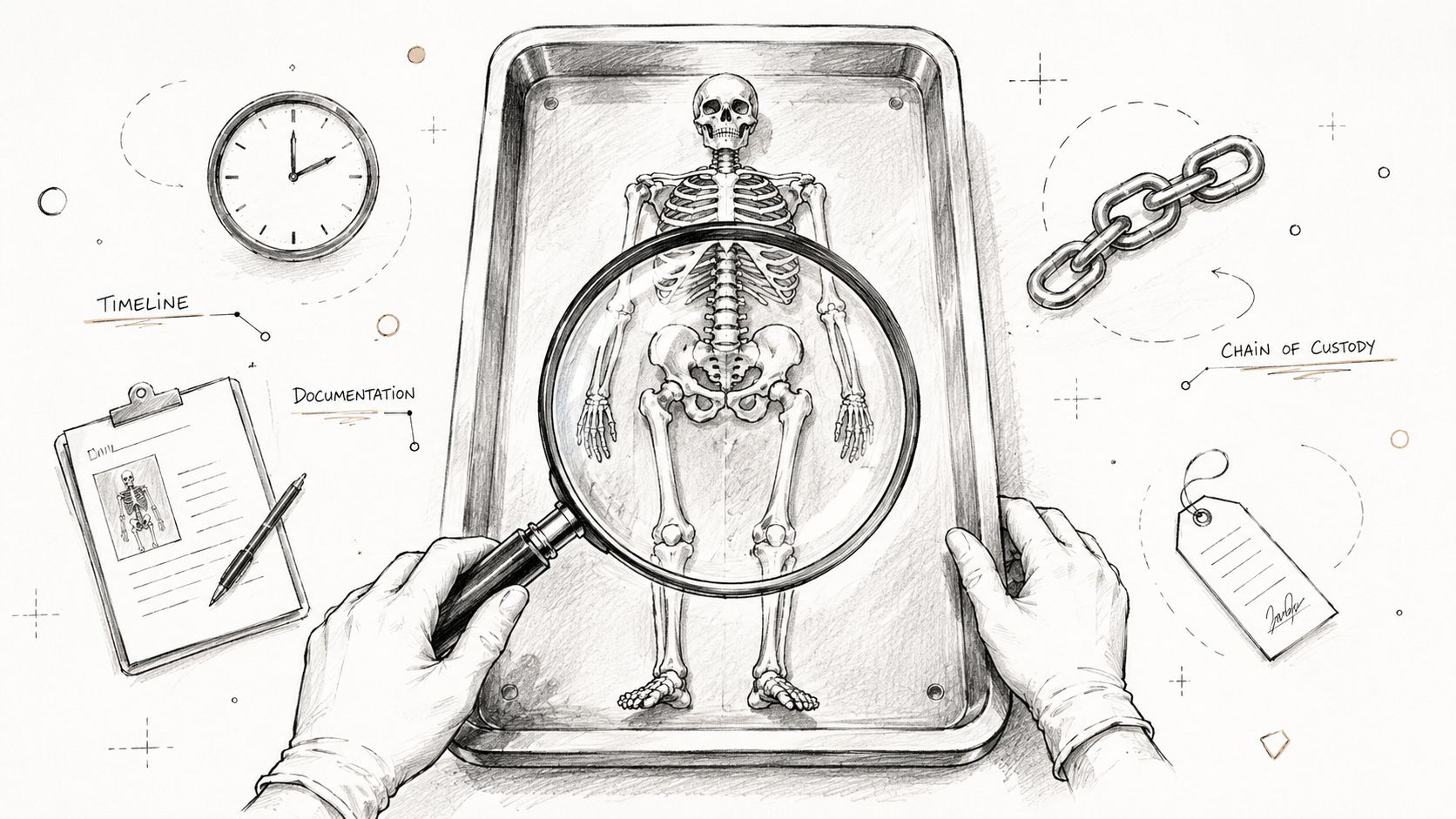
- Chain of custody procedures: Every specimen, photograph, and retained item should be tracked from collection to storage to release.
- Clear labeling and storage: Mislabeling is not a minor clerical problem in forensic work. It can alter legal interpretation.
- Photographic documentation: Images should record findings accurately, not selectively.
- Written protocols: A defensible lab can explain how cases are received, examined, sampled, reviewed, and reported.
Board certification and standards
I'm often asked what board certification means in practical terms. It means a physician completed formal specialty training and met examination standards through the American Board of Pathology in the relevant disciplines. If you'd like a plain-language explanation of why that matters, I've addressed it in more detail in this guide to board certification in pathology.
Accreditation standards also matter. In forensic settings, organizations such as NAME set expectations for documentation, procedures, staffing, and case review. Accreditation doesn't make a lab infallible, but it does show that the work is being measured against an external standard.
For readers who are also thinking about confidentiality after death, digital handling matters too. Medical records, photographs, and reports should be transmitted and stored with the same seriousness given to physical evidence. This overview of securing patient data on medical sites is helpful because it explains why privacy protections have to extend beyond the exam room.
A short visual overview can help make these standards more concrete.
The lab environment is part of the medical opinion. If the room, storage, or tracking system is weak, the final conclusion is weaker too.
A Step-by-Step Guide for Families and Attorneys
A family may call within hours of an unexpected death, trying to understand what happened before funeral arrangements move ahead. An attorney may call with the same urgency, but with a different concern: whether the medical evidence will stand up to scrutiny later. In both situations, the process works best when each step is handled in the right order.
Step 1 through Step 3
Make the initial call
The first conversation should establish the basic facts quickly. I want to know where the decedent is being held, whether a medical examiner or justice of the peace has declined or completed jurisdictional review, what records are available, and what question needs to be answered. For a family, that may be, “Did we miss something?” For counsel, it may be, “Can the findings support or challenge a legal claim?”Confirm legal authorization
Before any private autopsy is scheduled, the legally authorized person must give permission. In practice, that means confirming who has authority over the remains and whether any legal or procedural barrier would prevent a private examination. Delays often happen here, not because the medicine is unclear, but because consent and custody have not been sorted out.Coordinate transport and facility logistics
The body may need transfer from a hospital, funeral home, morgue, or another holding site to the examination facility. This step sounds administrative, but it affects timing, preservation, cost, and access to the decedent. Families often benefit from understanding how pathology and mortuary services intersect, especially through a resource like the Waterloo Mortuary pathology partnership.
What happens during the examination
Once the decedent arrives, the case begins with identification, intake documentation, and review of the known history. The examination itself may include an external exam, internal exam, photography, specimen collection, and retention of tissues or fluids for histology, toxicology, or other laboratory testing. The exact scope should match the question being asked. A suspected medication reaction, an in-custody death, and a possible traumatic injury do not call for the same emphasis.
Chain of custody matters at every stage.
In plain language, chain of custody is the written record showing who handled each specimen or item, when it was handled, where it went, and why. Families may hear that phrase and think it only matters in criminal court. It matters there, but it also matters in civil litigation, insurance disputes, and any case where a later reviewer may ask whether the samples and records were preserved correctly.
Questions you should ask any provider
Ask direct questions. A qualified provider should answer them plainly.
Who will perform the autopsy
Ask whether a board-certified forensic pathologist will personally perform the examination and sign the opinion.What is included in the scope
The answer should separate the body examination from histology, toxicology, consultation, organ review, and the written report.How are specimens tracked
A lab should be able to explain its chain-of-custody process without hesitation.What records should I provide
Emergency department notes, hospital records, prescription history, witness statements, and scene information can materially affect the opinion.How will findings be communicated
Families usually need clear language and time for questions. Attorneys usually need clear language, precise terminology, and a timeline for preliminary and final reporting.
Attorneys should also examine the documentation trail outside the autopsy suite. In some civil cases, identity questions, social media records, and image provenance become part of the broader evidentiary picture. Tools used for reverse image search for online dating serve a different purpose, but the underlying lesson is sound. Verify digital material before treating it as reliable evidence.
The goal is not to make the process feel less serious. It is serious. The goal is to make each step understandable, so families can make informed decisions and attorneys can evaluate the medical work on solid ground.
Navigating Autopsy Procedures in Texas
Texas cases add another layer of complexity because medical questions and legal authority don't always travel together. A family may want answers immediately, but the first issue is often whether the death falls under a county medical examiner or justice of the peace process, whether a private examination is legally permitted, and who may authorize it.
Authority and legal framework
In Texas, postmortem decision-making is shaped by Texas Health & Safety Code, including Chapters 711 and 716, along with related procedures that affect disposition, consent, and postmortem handling. The Texas Funeral Service Commission also plays an oversight role in parts of the funeral and disposition process. For that reason, a medically appropriate request still has to be operationally and legally correct.
Families often ask where an autopsy can physically occur. The answer depends on jurisdiction, provider availability, transport, and facility arrangement. I've outlined that practical side separately in this discussion of where autopsies are done.
Why Texas geography matters
Texas has 254 counties, and the accessibility of forensic pathology services in rural and underserved areas remains a serious problem, as discussed in the ASCP note on underserved forensic pathology rotations. Distance affects transport, timing, body storage, and whether a family can realistically obtain an independent examination without extensive delay.
For county officials, the issue is often practical rather than theoretical. Some jurisdictions don't have a local medical examiner infrastructure and must rely on contracted or regional support. That is one reason independent forensic pathology can be important for counties seeking medically sound examinations and reports. For officials evaluating options, our county forensic autopsy services for Texas jurisdictions outlines the type of support an outside forensic pathologist may provide.
Rural access changes the stakes. In some cases, the difference between getting an answer and not getting one is simply whether qualified help can reach the case.
Frequently Asked Questions About Private Autopsies
Can a private autopsy still help if another autopsy was already done
Yes. A second opinion may involve review of the original report, photographs, toxicology, tissue slides, retained specimens, and medical records. In some cases, the original conclusion is confirmed. In others, the issue is whether the explanation was complete, clearly supported, or medically persuasive.
Demand for private forensic pathology review in second opinion and civil matters has grown, and one factor is instability in staffing. A cited discussion of contract pathology pressures notes that locum tenens physicians make up 14% of pathologists in some areas, which can contribute to continuity concerns and increase the value of consistent independent review for attorneys and families in select settings, as referenced in this NIJ-related discussion on forensic pathology staffing and contract work.
Will a private autopsy change the death certificate
Not automatically. A private autopsy provides a medical opinion. Whether an official death certificate is amended depends on the applicable authority, the existing certification, and the procedural path for correction or reconsideration.
What is chain of custody in simple terms
It is the record showing how evidence and specimens were collected, labeled, stored, transferred, tested, and reported. If a toxicology tube or tissue block changes hands, the record should show who handled it and when. For attorneys, that documentation can be as important as the conclusion itself.
Do families need to have every answer before calling
No. It's common to call while the facts are still incomplete. A useful initial discussion can identify what records exist, what legal permissions are needed, and whether the question is best addressed by full autopsy, limited autopsy, records review, or second opinion consultation.
Can a private autopsy answer every question
No honest pathologist should suggest that. Some deaths remain undetermined even after careful examination. The standard is not certainty in every case. The standard is a careful, objective opinion based on the available evidence, with clear acknowledgment of what the evidence can and cannot support.
Finding Clarity and Compassionate Answers
The work done in forensic pathology labs is technical, but the reason people seek it is profoundly human. Families want to understand a loss. Attorneys need conclusions they can examine and rely on. County officials need findings that are medically grounded and legally defensible.
My role is to provide that clarity with discipline and respect. That means careful examination, plain communication, and the willingness to say both what is known and what remains uncertain. In death investigation, honesty is part of compassion.
If you're facing a recent loss or reviewing a difficult case, it helps to speak with someone who can explain the options in clear terms and guide the next step without pressure.
If you need help understanding whether a private autopsy, second opinion autopsy, or county forensic review is appropriate, you can contact Texas Autopsy Services for a direct conversation about the circumstances, the legal process, and the medical questions involved.