September 27, 2026 · Texas Autopsy Services
Forensic Toxicology Expert Witness in Texas
Learn how a forensic toxicology expert witness reviews lab data, writes reports, and testifies. Understand qualifications, fees, and how to engage one in Texas.
On this page
- What a Forensic Toxicology Expert Witness Does
- Qualifications and Credentials That Hold Up in Court
- Inside the Evidence Chain a Witness Reviews
- Fact Testimony Versus Opinion Testimony
- Reports, Depositions, and Courtroom Logistics
- Working With Texas Autopsy Services
- Common Questions About Engaging a Toxicology Witness
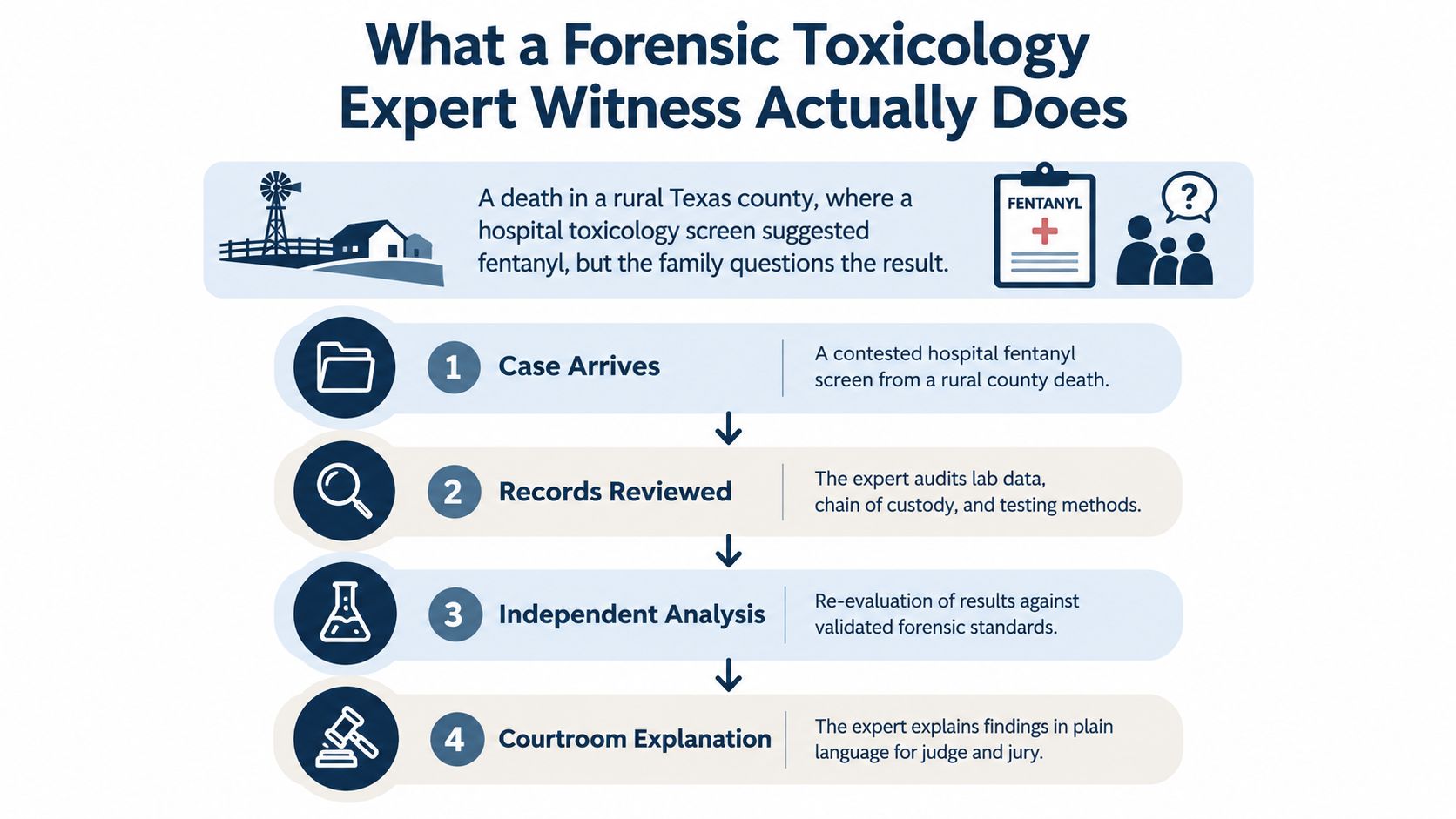
A death occurs in a rural Texas county, and an initial hospital screen suggests fentanyl. The family questions what that result means, whether the test was confirmed, and whether it explains the death. Those concerns require more than a glance at a toxicology report. They require a careful review of the specimen, laboratory method, medical history, autopsy findings, and documented evidence chain.
A forensic toxicology expert witness helps attorneys, families, courts, and agencies understand that evidence. The specialist may interpret drugs, alcohol, poisons, and other toxic substances in biological samples, review laboratory data, prepare opinions, and testify in court. The most reliable work connects scientific findings to the complete case record rather than treating a concentration as standalone proof.
- The role is broader than reading a lab number. A toxicology witness evaluates methods, specimen integrity, documentation, and the medical context.
- Fact testimony and opinion testimony are different. One describes what happened in the laboratory. The other explains what the findings may mean.
- Postmortem results need context. Redistribution after death, decomposition, treatment, specimen source, and timing can affect interpretation.
- A courtroom-ready opinion depends on records. Chain-of-custody documents, chromatograms, quality controls, validation materials, and audit trails may all matter.
- Texas cases require careful coordination. A private autopsy, second opinion autopsy, or toxicology review should respect the applicable Texas laws and the role of the responsible agency.
What a Forensic Toxicology Expert Witness Does
A contested drug case may begin with a reported positive result, but that result is only the starting point. A hospital screening test can suggest a substance class, while confirmation requires a separate analytical process. The witness asks which specimen was tested, which method was used, whether confirmatory testing followed, and whether the records support the reported finding.
Our board-certified forensic pathologists place toxicology within the broader cause of death investigation. A forensic toxicology expert witness reviews drug-testing data from an autopsy or independent laboratory, considers pharmacology and postmortem science, and explains technical findings to attorneys, judges, and juries. The witness provides scientific interpretation, not partisan advocacy, and states the limits of the available evidence.
The three recurring tasks
First, the witness scrutinizes the result. The review may compare an immunoassay screen with confirmatory testing, check reported units and calculations, and assess whether the method suited the substance and specimen.
Second, the witness evaluates specimen integrity. Blood or tissue source, collection conditions, storage, decomposition, treatment history, and documentation all affect interpretation. Central and peripheral blood can carry different evidentiary meaning after death.
Third, the witness explains significance. The legal question may involve impairment, contribution to death, possible overdose, or whether the result supports a particular conclusion. A detected substance may matter without being the sole cause of death.
Practical rule: A toxicology concentration is evidence to interpret, not an automatic verdict about impairment, overdose, or cause of death.
Postmortem redistribution can raise central blood concentrations after death as drugs move from organs such as the liver, lungs, and heart into nearby blood. As explained in forensic toxicology expert witness guidance, an autopsy concentration may overstate the antemortem level. Specimen source, decomposition, treatment history, and the choice between peripheral and central blood can materially change the opinion.
The witness connects laboratory findings with the courtroom record. A defensible conclusion rests on validated methods, specimen integrity, and case-specific timing. That connection also helps the court distinguish what the laboratory established from what an expert reasonably infers.
Qualifications and Credentials That Hold Up in Court
A person who operates a laboratory instrument isn't automatically qualified to offer every toxicology opinion. Attorneys should examine education, scientific training, professional certification, experience with medicolegal cases, and the witness's ability to explain methods without overstating conclusions.
The credential review should also distinguish a laboratory analyst from an expert who can interpret postmortem findings. Relevant preparation may include advanced study in toxicology, pharmacology, chemistry, or a related biomedical field, along with board certification through the American Board of Forensic Toxicology or a comparable credentialing organization. The precise credential should be verified rather than assumed from a job title.
What judges and attorneys examine
Texas courts apply evidence rules that require a reliable foundation for expert opinion. Under Texas Rule of Evidence 702 and the principles associated with Daubert review, a judge may examine the expert's methodology, supporting literature, peer review, potential error, acceptance within the field, and application to the specific evidence.
A courtroom-ready file should make it possible to answer practical questions:
- Training: What scientific education prepared the witness to interpret the substance and specimen?
- Certification: Is the relevant board status current and directly related to forensic toxicology?
- Methods: Were the analytical procedures validated for the matrix and analyte?
- Documentation: Can the witness show how the opinion was formed from the records?
- Limits: Does the report identify uncertainty, missing information, and alternative explanations?
Our team reviews credentials and case materials before defining a scope of work. We don't treat prior testimony as a substitute for scientific competence, and we don't treat a title as proof that a witness can answer every medical or legal question.
| Credential | Minimum Standard | Courtroom-Ready |
|---|---|---|
| Scientific education | Relevant toxicology, pharmacology, chemistry, or biomedical training | Education connected to the disputed substance, specimen, and question |
| Professional certification | Certification through a relevant forensic toxicology organization or analogous body | Current status, verified scope, and clear explanation of what it does and doesn't establish |
| Laboratory knowledge | Familiarity with screening, confirmation, calibration, and quality control | Ability to connect records and methods to the reported result |
| Legal preparation | Understanding of expert disclosure and evidence requirements | Clear report, transparent limitations, and testimony grounded in disclosed methods |
Counsel handling a technology-heavy case may also find a video evidence authentication guide useful when preparing broader expert-witness authentication questions. For a related discussion of professional review, see our guidance on expert witness qualifications.
Inside the Evidence Chain a Witness Reviews
A toxicology opinion begins with provenance. The witness needs to know who collected each specimen, when and where it was collected, under whose authority, and how it moved from collection to laboratory intake. Those details are recorded through accession logs, transfer documents, seals, and chain-of-custody forms.
Chain of custody means the documented history of an item from collection through storage, testing, reporting, and disposition. It doesn't prove that a result is correct by itself, but it helps establish that the specimen tested is the specimen associated with the case and that handling was controlled.
From specimen collection to laboratory analysis
The review commonly follows this sequence:
- Accession and custody records: The witness checks identifiers, collection details, signatures, dates, and transfer points.
- Transport and storage: The review considers container type, seal condition, temperature records, intake procedures, and storage duration.
- Screening data: Immunoassay results are compared with the substance classes the method can detect and the limitations stated by the laboratory.
- Confirmation data: Chromatograms, spectra, calibration curves, ion ratios, internal standards, controls, and blanks help show how a reported analyte was identified and measured.
- Quality and reporting records: Validation materials, standard operating procedures, analyst notes, technical review, maintenance records, corrective actions, and electronic audit trails may reveal whether the final report is supported.
Postmortem redistribution complicates a simple blood-to-cause-of-death inference. Drugs such as fentanyl, diphenhydramine, or methamphetamine may move between tissues and nearby blood after death. Decomposition, resuscitation, hospital treatment, and the location of the specimen can further affect interpretation.
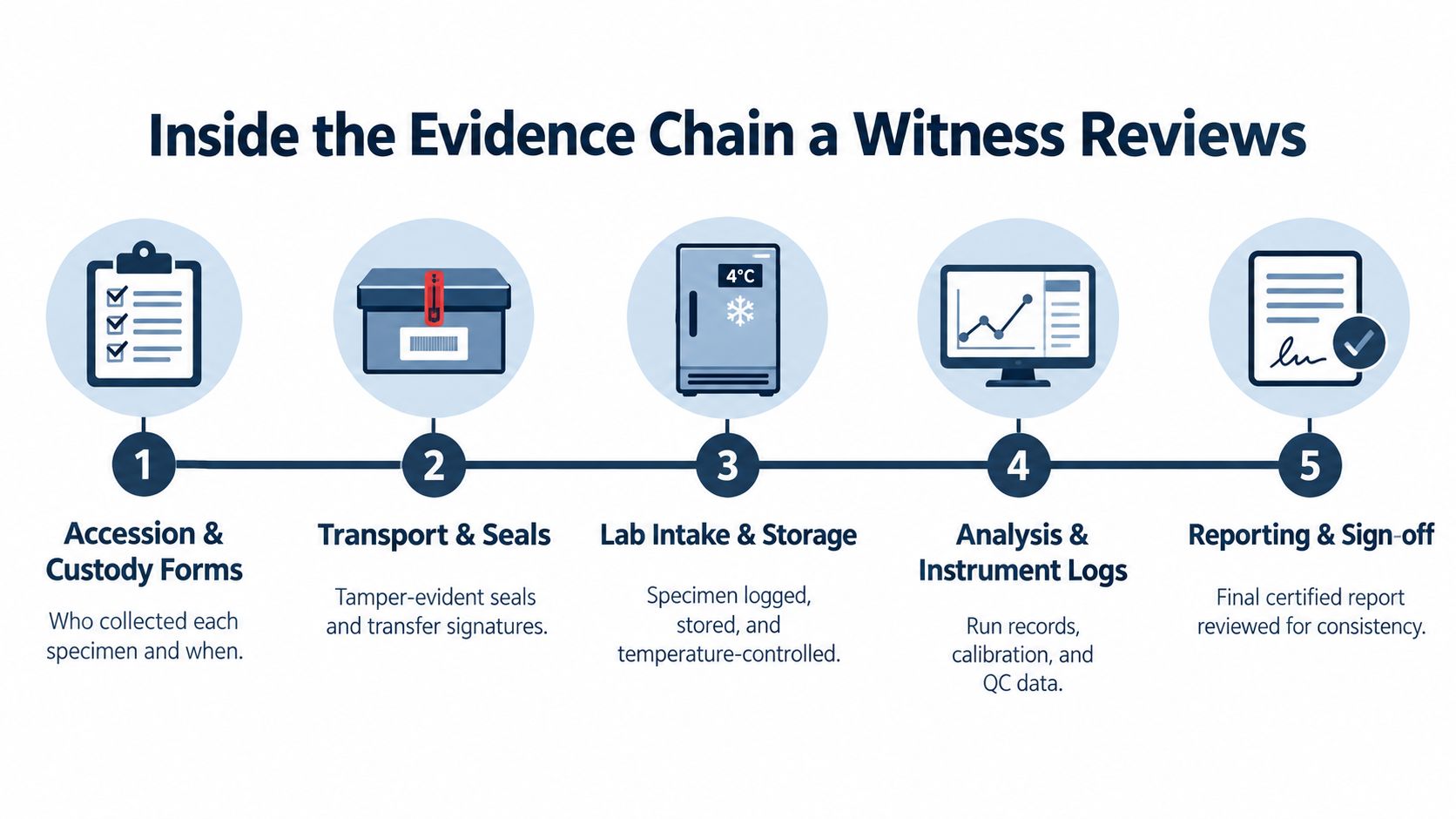
The witness assembles these records into a defensible narrative. Missing signatures, inconsistent identifiers, unsupported quantitation, unexplained changes in storage, or a mismatch between the laboratory's accreditation scope and the case can limit the weight of the opinion.
A laboratory used for court or cause-of-death work should have ISO/IEC 17025 accreditation with a forensic-specific scope. The actual scope document should be checked to confirm that it covers the relevant analytes, matrices, and methods. A general accreditation statement isn't enough, as explained in forensic toxicology laboratory accreditation guidance.
The following resource addresses the documentation that supports a custody review: chain-of-custody form guidance.
The laboratory record is only one part of the evidence. The autopsy findings, scene information, medical history, treatment records, and circumstances of death must also be considered before an opinion is formed.
Fact Testimony Versus Opinion Testimony
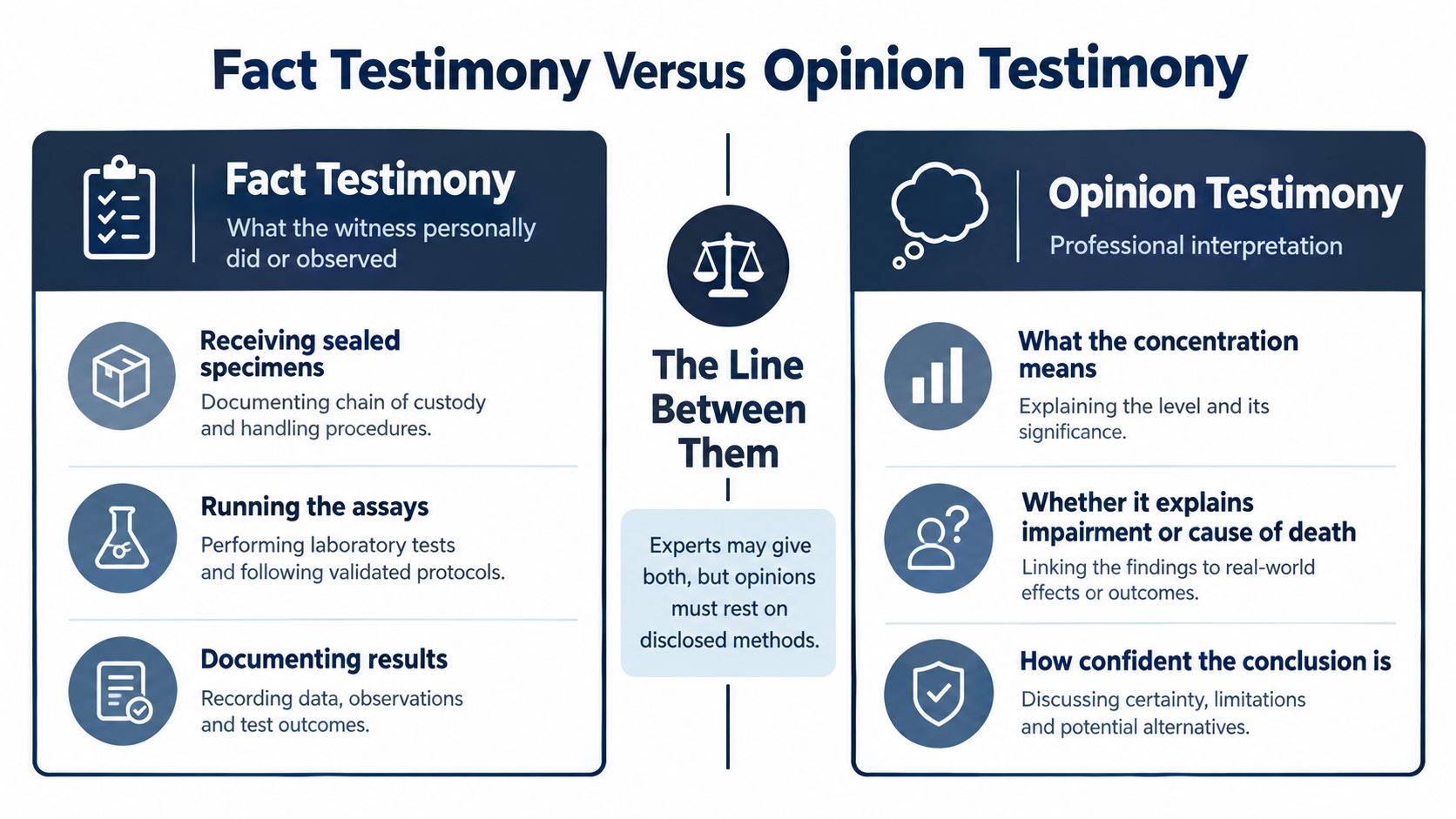
The distinction is straightforward. Fact testimony describes what the witness personally did, observed, or recorded. Opinion testimony applies specialized knowledge to those facts and reaches an interpretation.
A laboratory witness may testify that sealed specimens arrived, that an extraction was performed, that an instrument produced a chromatogram, or that a report was signed after technical review. Those statements concern laboratory activity and records. They can be authenticated through the evidence chain and the witness's personal knowledge.
Opinion testimony asks a different question. It may address whether a detected substance is consistent with a particular exposure, whether findings support impairment, or whether a drug could have contributed to death. That opinion must account for the specimen, timing, pharmacology, autopsy findings, scene evidence, treatment history, and documented medical history.
Why the line matters
A statement such as “the laboratory reported fentanyl in the submitted specimen” is factual if the record supports it. A statement that the result caused the death is an opinion. The second statement requires a broader foundation and may not be supportable if the specimen source, timing, or surrounding evidence is incomplete.
The same distinction applies to a reported concentration. The number itself may be a laboratory fact. Its medical significance is an interpretation, not a self-executing conclusion.
A postmortem number can inform an opinion, but it can't supply every fact needed to make that opinion reliable.
Authoritative testimony guidance emphasizes that toxicologists shouldn't state an absolute cause of death or infer a precise dose from postmortem concentrations alone. The limits are especially important in cases involving redistribution, tolerance, combined substances, treatment, or competing causes.
A witness may provide both fact and opinion testimony, but the opinions must rest on disclosed methods and sufficient case facts. When those foundations aren't available, the appropriate conclusion may be narrower, such as identifying what the laboratory established while declining to infer impairment, exact dose, or causation.
Reports, Depositions, and Courtroom Logistics
A useful expert engagement defines the work before testimony begins. The written report should identify the case, list the specimens, describe the custody history, state the analytical methods, explain relevant limits of quantification, present results, discuss interpretation, and identify limitations. A signature page and curriculum vitae may be supplied according to the engagement and disclosure requirements.
The report should separate reported laboratory facts from the expert's opinions. That format helps counsel prepare questions and helps the court see which conclusions depend on additional assumptions.
What the engagement may include
The financial structure depends on the assignment. Possible components include hourly record review, a flat-fee written report, separate deposition or trial-day charges, and travel billed at cost. The exact arrangement should appear in the engagement letter rather than being inferred from a general website statement.
| Deliverable | Format | Typical Billing |
|---|---|---|
| Record and laboratory review | Secure document review with written notes | Hourly review or agreed project fee |
| Expert report | Signed report with findings, reasoning, and limitations | Flat-fee report writing or project fee |
| Deposition preparation | Counsel conference and focused document review | Hourly preparation |
| Deposition testimony | Remote or in-person testimony under oath | Separate deposition charge or hourly billing |
| Trial testimony | Direct and cross-examination with exhibits | Separate trial-day charge, with travel terms stated in advance |
Preparation commonly includes reviewing the disclosed records, discussing the disputed issues with counsel, and organizing exhibits such as annotated chromatograms or custody timelines. Direct examination usually establishes the witness's qualifications, records reviewed, methods, findings, and opinions. Cross-examination may challenge accreditation, validation, calibration, specimen handling, assumptions, or the reasoning connecting a result to causation.
Counsel arranging testimony through more than one language may also need a legal interpreter for depositions, with coordination handled early enough to protect accuracy and confidentiality. Our related resource addresses deposition preparation.
Families should ask what the report will answer and what it won't. Attorneys should confirm the disclosure deadline, available records, specimen access, anticipated testimony, and whether the witness is being retained for fact testimony, opinion testimony, or both.
Working With Texas Autopsy Services
A toxicology-focused review begins with a short intake call. Our team confirms the case type, Texas jurisdiction, parties involved, current stage of the matter, and records already available. We also identify whether the need is a private autopsy, an independent review, a second opinion autopsy, county forensic support, or expert testimony related to an existing examination.
Records that help start the review
Before retention, counsel or a family may gather:
- Autopsy materials: The autopsy report, photographs or imaging where available, and the stated cause and manner of death.
- Laboratory records: The toxicology report, chromatograms, spectra, chain-of-custody documentation, and relevant quality records.
- Investigation materials: Scene notes, investigative reports, medication information, and medical history.
- Existing opinions: Prior expert reports, agency findings, and communications identifying the disputed issue.
Every examination performed through our practice is performed by a board-certified forensic pathologist certified by the American Board of Pathology. A toxicology review may involve the pathologist's assessment of how laboratory findings fit with the postmortem examination and the circumstances of death. It doesn't replace the laboratory's technical record or authorize conclusions beyond the available evidence.
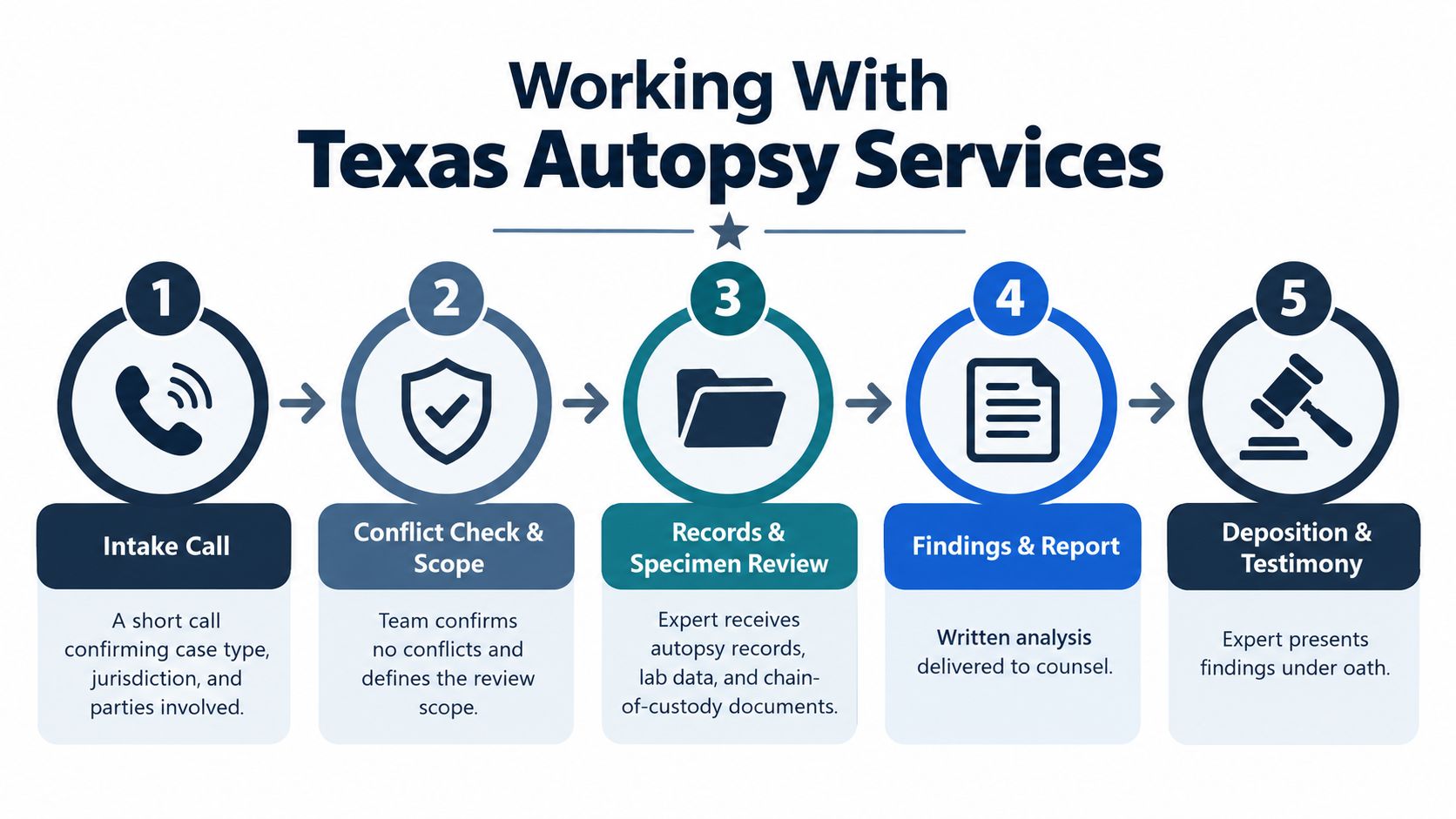
After the initial review, our team identifies analytical or interpretive gaps and proposes a defined scope. The engagement letter states the assignment, communications process, fees, records required, and anticipated deliverables. Once the engagement and retainer are completed, the review proceeds through the agreed work plan.
Our practice serves all 254 Texas counties, with in-house licensed transport available for private autopsy matters. Families and attorneys communicate directly with the team, and the process includes chain-of-custody documentation, secure handling, written reporting, deposition preparation, and testimony when the assignment requires it.
Texas death and disposition issues sit within Texas Health and Safety Code Title 8, including Chapters 711 through 716, with the Texas Funeral Service Commission forming part of the regulatory context. The responsible county or agency may have authority over a particular death investigation, so a private review should be coordinated without interfering with official procedures. For county needs, our County Forensic Autopsies page describes the relevant service pathway.
Common Questions About Engaging a Toxicology Witness
How quickly can a witness review a case?
The answer depends on the volume and quality of the records, whether original laboratory data is available, the need for specimen review, and the legal deadline. An intake call can identify missing documents and clarify whether counsel needs a preliminary assessment, a written report, deposition preparation, or trial testimony.
What should be sent first?
Start with the autopsy report, toxicology report, specimen inventory, chain-of-custody records, chromatograms or spectra, scene materials, medical history, and any prior expert reports. If only a summary report is available, send that first and identify which underlying records remain outstanding.
Can a postmortem result establish an exact dose?
Usually, a postmortem concentration alone can't establish an exact dose. Redistribution, specimen source, decomposition, timing, treatment, tolerance, and incomplete exposure history can all limit what the number supports. A witness may be able to interpret the result while explaining why a precise dose or absolute cause of death isn't established.
What happens if the chain of custody has a gap?
The gap should be described precisely, not treated automatically as proof that the result is invalid. The witness can identify what the records establish, what remains uncertain, and whether the missing information affects specimen identity, handling, reliability, or the weight of the opinion.
Is a screening result the same as a confirmed quantitative result?
No. A screening immunoassay is generally designed to flag a drug class or possible substance for further evaluation. A confirmed quantitative result requires an appropriate confirmatory method, supporting analytical records, and a report that identifies what was measured and how. The two results shouldn't be presented as interchangeable.
A toxicology witness may decline testimony when the available records don't support a reliable opinion, when the requested conclusion exceeds the science, or when the assignment falls outside the witness's qualifications. That restraint protects the integrity of the evidence and gives families and attorneys a clearer understanding of what the record can show.
Texas Autopsy Services provides independent postmortem reviews, private autopsy services, toxicology-focused analysis, and forensic pathology support for families, attorneys, healthcare professionals, and Texas counties. If you need help understanding a toxicology report or deciding whether an independent examination or expert review is appropriate, contact Texas Autopsy Services directly for a confidential discussion of the records and next steps.