August 9, 2026 · Texas Autopsy Services
Expert Witness Qualifications: A Complete Guide for 2026
Understand expert witness qualifications and how courts evaluate expertise. Learn to vet the right forensic pathologist.
On this page
- Why Expert Witness Qualifications Matter Before You Retain Anyone
- The Federal Baseline Under Rule 702 and Daubert
- The Credentials Courts Actually Inspect
- Texas Specific Standards for Physician Experts
- How Voir Dire Works and How to Vet an Expert Before You Hire
- Preparing Reports and Testimony That Hold Up Under Cross Examination
- Key Takeaways for Attorneys Families and County Officials
When a case turns on a death investigation, the hardest part isn't always the medicine. It's the first judgment call, whether the person you're considering can testify with authority, survive voir dire, and help the court understand what happened. Families, attorneys, and county officials often feel pressure to move quickly, but the expert's qualifications are not a branding exercise. They're the filter that decides whether the opinion belongs in the record.
Why Expert Witness Qualifications Matter Before You Retain Anyone
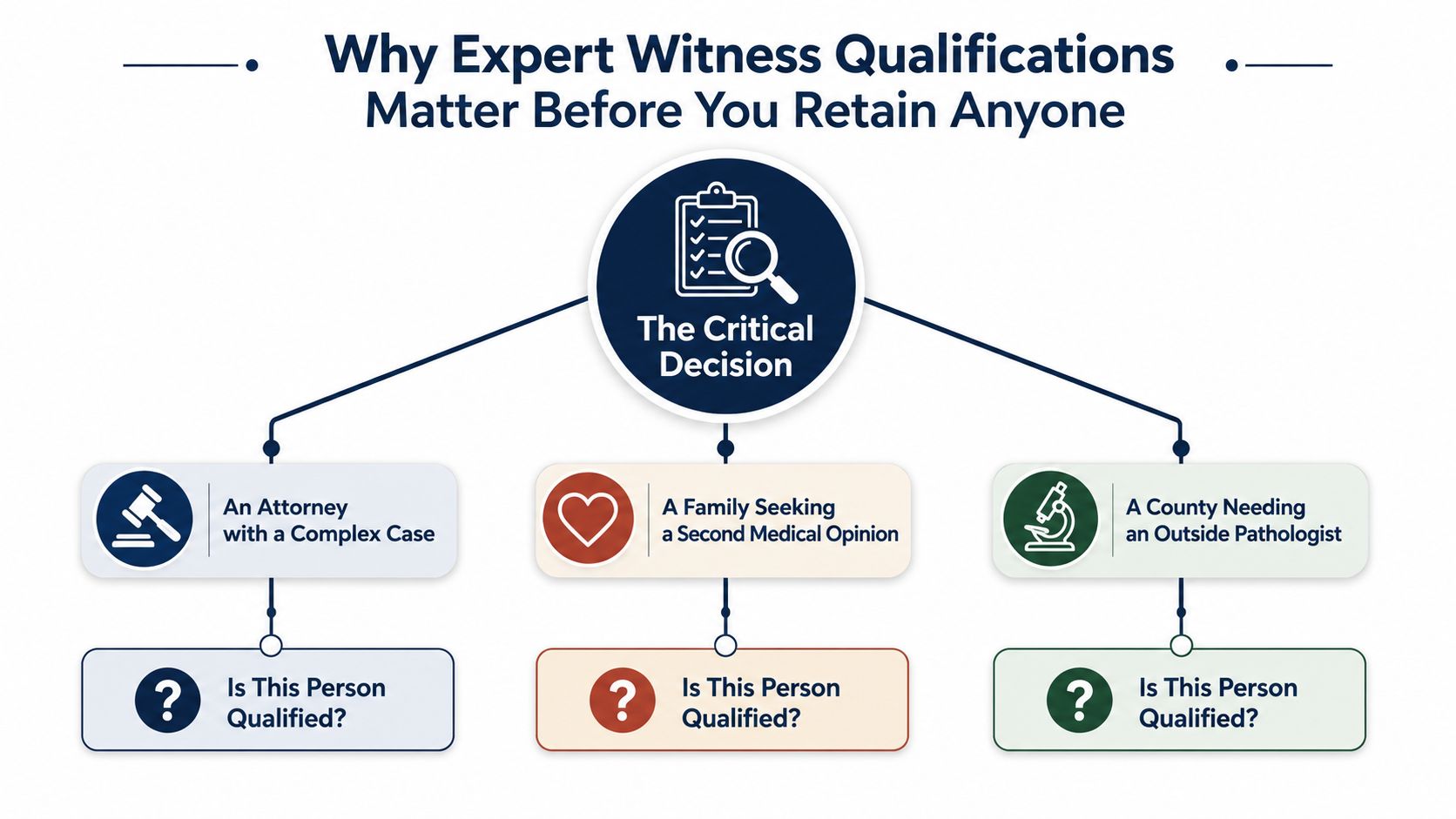
A family calls after a death and wants a second opinion. An attorney has a difficult causation dispute. A county needs an outside forensic pathologist because the local resources are limited. In each situation, the same question comes up fast, is this person qualified to testify. That question matters before anyone signs a retainer, because a weak foundation can lead to excluded testimony, wasted deposition time, and avoidable damage to credibility.
Read the law before you read the CV
In federal court, Rule 702 is the central qualification standard for expert witnesses. It asks whether the witness has the right mix of knowledge, skill, experience, training, or education, and whether the opinion is based on sufficient facts, uses reliable methods, and applies those methods reliably to the case. In plain English, the court doesn't stop at “this person has a medical degree” or “this person has testified before.” It asks whether the person can help the jury with a reliable opinion tied to the facts at issue. The Federal Rules text makes that structure clear in Rule 702.
That's why the qualification question is a legal filter, not a marketing claim. A polished résumé can still fail if it doesn't connect to the actual issue in the case. For a plain-language overview of how lawyers think through the selection process, a useful outside resource is the expert witness testimony guide 2026, which fits well with the practical questions attorneys ask before hiring.
Practical rule: start with the opinion you need, then work backward to the qualifications that support it.
![infographic omitted]
For families, this often means asking whether a proposed expert can speak to cause of death with current, relevant authority. For attorneys, it means deciding whether the expert's background matches the exact issue before the court, not just the broad specialty. For county officials, it means finding someone whose methods and records will hold up if the report later becomes part of a formal proceeding. That first screen is where strong cases start.
The Federal Baseline Under Rule 702 and Daubert
The modern federal standard didn't grow out of credentials alone. It changed after the 1993 Daubert v. Merrell Dow decision, which moved judges from a passive role to an active gatekeeping role on expert testimony. That shift made reliability part of admissibility, so the court now looks at whether the expert's methods are scientifically sound and relevant to the issue before the jury.
What the judge is really screening for
A judge isn't trying to decide whether the expert sounds smart. The judge is checking whether the opinion rests on a method that can be trusted in the courtroom. In everyday terms, the court wants to know whether the expert used a sound process, applied it correctly, and stayed within the limits of what the data supports. That's especially important in forensic and medical testimony, where a confident answer can sound persuasive even when the analysis is thin.
The reliability focus also explains why credentials alone no longer carry the day. A person may be trained, licensed, and experienced, but still fail if the reasoning doesn't fit the facts. That's one reason courts in major U.S. markets have treated this combination of legal and scientific review as foundational to credibility.
Why forensic and medical opinions get extra scrutiny
Forensic pathology and medical causation opinions often affect both family understanding and litigation strategy. A court may therefore ask not just whether the witness knows the field, but whether the opinion is connected to the records, the examination, and the question the jury must answer. The result is a higher level of scrutiny around method, relevance, and fit.
Reliability is not a side issue. In court, it's part of the doorway.
For attorneys and families, the practical lesson is simple. The expert should be able to explain what was done, why it was done, and how the conclusion follows from the evidence. If the explanation feels vague, the gatekeeping function is exactly where that weakness shows up.
The Credentials Courts Actually Inspect
Judges usually look at a cluster of qualifications, not one single credential. That cluster often includes education, board certification, publication history, prior testimony, accreditation, and proficiency testing, especially in forensic science settings. The point isn't to build a trophy shelf. It's to show that the witness's background and methods line up with the opinion being offered.
What a strong record looks like
For a forensic pathologist, a strong record usually reads like a chain, not a pile. Training supports the specialty. Specialty certification supports current expertise. Publications or prior testimony can show familiarity with the field's standards. Accreditation and proficiency testing can support the reliability of the practice environment, especially when the testimony touches technical or lab-based issues. Courts care because that combination of legal and scientific review is tied to credibility, not just status.
| Credential Category Courts Examine for Medical and Forensic Experts | What the Court Looks For | What a Weak Record Looks Like |
|---|---|---|
| Education and training | Formal preparation that matches the opinion | General education with no link to the issue |
| Board certification | Relevant specialty certification | Memberships or labels that aren't actual certification |
| Clinical or forensic experience | Recent, hands-on work with the same type of question | Distant experience or work in a different field |
| Publication history | Familiarity with accepted methods and debate | No writing at all, or writing unrelated to the case |
| Prior testimony | Experience explaining opinions under oath | No deposition or trial history, or inconsistent testimony |
| Accreditation | A setting that follows recognized standards | No clear quality controls or documentation |
| Proficiency testing | Evidence the expert's work is checked against standards | No external verification of performance |
A thick CV can still be weak if it belongs to the wrong specialty. A long list of memberships can also backfire if those memberships are presented as if they were certifications. Cross-examination tends to expose that quickly.
Why fit matters more than volume
The court is looking for the right match, not the longest biography. A person can have years of experience and still be the wrong witness if the opinion strays outside the actual area of practice. That's why attorneys and families should score candidates by fit first, then by polish.
Texas Specific Standards for Physician Experts
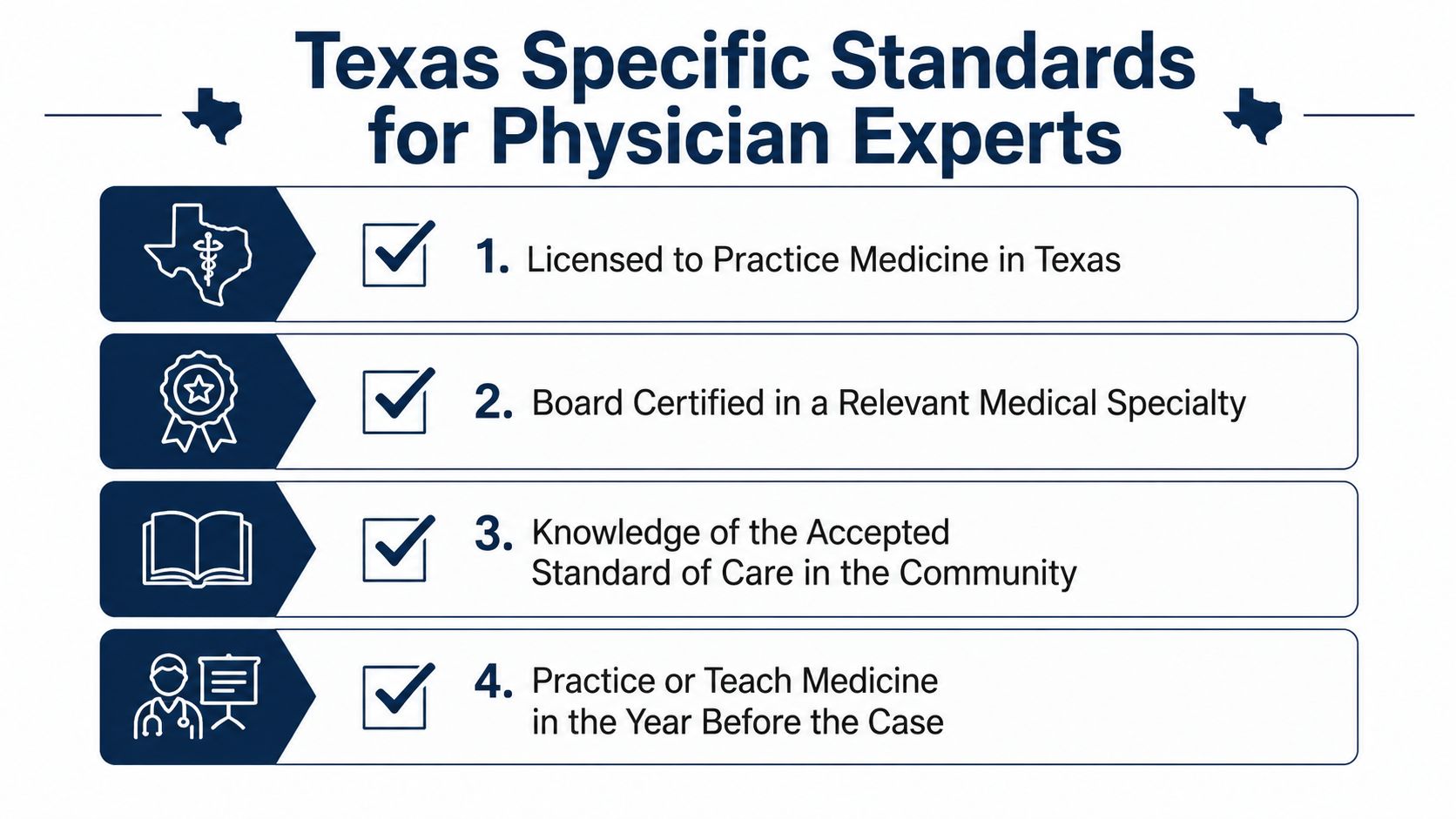
Texas adds another layer in medical liability cases. In this state, the offering party must show that the physician expert is practicing medicine at the time of testimony or when the claim arose, knows the accepted standard of care for the diagnosis or treatment at issue, and is qualified through training or experience to opine on that standard. In other words, Texas doesn't just ask whether the witness is generally smart or medically trained. It asks whether the witness is current, relevant, and tied to the type of care being challenged.
How Texas tightens the screen
This state-specific standard sits alongside the broader federal reliability framework. It doesn't replace Rule 702, it narrows the practical field for physician testimony in medical liability matters. The effect is that out-of-state or nonpracticing physicians can face extra scrutiny if their recent work doesn't line up with the standard of care issue in the case.
That's why board certification and current clinical practice are treated as markers of authority. They connect the opinion to recent, hands-on work instead of treating expertise as a static credential. For attorneys, that means qualification should be checked early, not after the report is already drafted.
A useful Texas-focused discussion of the role of a pathology expert witness is available in our own pathology expert witness overview, which sits in the same practical space as these qualification questions.
The Texas framework in plain language
The statutory screening in Texas medical liability matters is commonly described as a four-part framework. The witness must be a physician, must have been practicing medicine at the relevant time, must know the applicable standard of care, and must be qualified to discuss that standard through training or experience. That structure helps explain why a strong résumé alone doesn't settle the issue.
For families and county officials, the takeaway is direct. A Texas court wants current competence, not just historical prestige. If the expert's real-world practice and the case facts don't line up, the qualification challenge is much easier to make.
How Voir Dire Works and How to Vet an Expert Before You Hire
Voir dire is the courtroom method lawyers use to qualify an expert through direct questioning. The idea is simple, even if the legal effect is serious. The attorney asks questions that bring out the facts needed to show the witness satisfies the qualification standard, and opposing counsel gets a chance to test those answers.
The courtroom process in plain language
The American Bar Association describes voir dire as the procedure by which a lawyer qualifies an expert witness through direct examination to elicit the facts needed for qualification. That means the witness has to answer clearly, consistently, and in a way that matches the report. If the answers wobble, the court notices.
For physician experts, StatPearls reports that the witness should hold a current, valid, unrestricted medical license in the state where they practice and be certified by a relevant board recognized by the American Board of Medical Specialties or the American Osteopathic Association. For some specialties, the guidance also calls for at least 3 years of active clinical practice immediately before the event at issue. For attorneys working outside medicine, a useful contrast can be found in this accident reconstruction expert witness resource, which shows how different fields still turn on the same core vetting logic.
A practical pre-hire checklist
- Confirm the license: verify that the medical license is current and unrestricted where the expert practices.
- Check specialty certification: confirm the board certification is real and relevant to the opinion.
- Review recent practice: make sure the witness's work is current enough to support the case issue.
- Look at prior testimony: read a few transcripts or reports to see whether the witness stays consistent under pressure.
- Scan for discipline: any disciplinary history should be understood before retention, not after.
- Match the opinion to the role: a witness should be able to explain exactly why their experience fits this case.
Practical rule: the cheapest expert on a list is rarely the least expensive once a thin record gets exposed in front of the judge.
For those looking at forensic science specifically, our expert witness forensic science overview is a useful reference point for how records, methods, and testimony fit together.
Preparing Reports and Testimony That Hold Up Under Cross Examination
A witness doesn't become credible in the courtroom by accident. The strongest testimony usually starts long before the deposition, with a careful examination, full documentation, and a report that explains both the findings and the reasoning behind them. The American Bar Association's guidance on voir dire lines up with that reality, since the same rigor needed to survive questioning should already be built into the report itself through reliable methods and complete documentation.
What a solid report needs to show
A usable forensic report should tie each conclusion to the underlying facts. That means clear chain of custody, consistent terminology, and enough detail that another qualified professional can follow the reasoning. If the report jumps from observation to conclusion without showing the path in between, cross-examination will usually find that gap.
In our own practice, that standard shapes the work from the beginning. Texas Autopsy Services provides court-admissible reporting and, when needed, expert testimony, and every examination is performed by a forensic pathologist certified by the American Board of Pathology. The point isn't promotion. It's traceability, so the opinion can be explained, reviewed, and defended when the court asks hard questions.
What preparation looks like before testimony
- Method review: the pathologist confirms that the examination and documentation support the opinion being offered.
- Record review: prior medical records, scene information, and testing results are checked for consistency.
- Language control: technical terms are translated into plain English without losing accuracy.
- Limitation review: the expert should be ready to acknowledge what the evidence does and doesn't prove.
- Testimony alignment: the report, deposition, and trial answers need to tell the same story.
A witness who can explain the limits of an opinion often looks more credible than one who sounds certain about everything. Juries usually trust that restraint. So do judges.
For readers who want a deeper look at preparation, our expert witness preparation article covers how reports, records, and testimony should stay aligned from the start.
Key Takeaways for Attorneys Families and County Officials
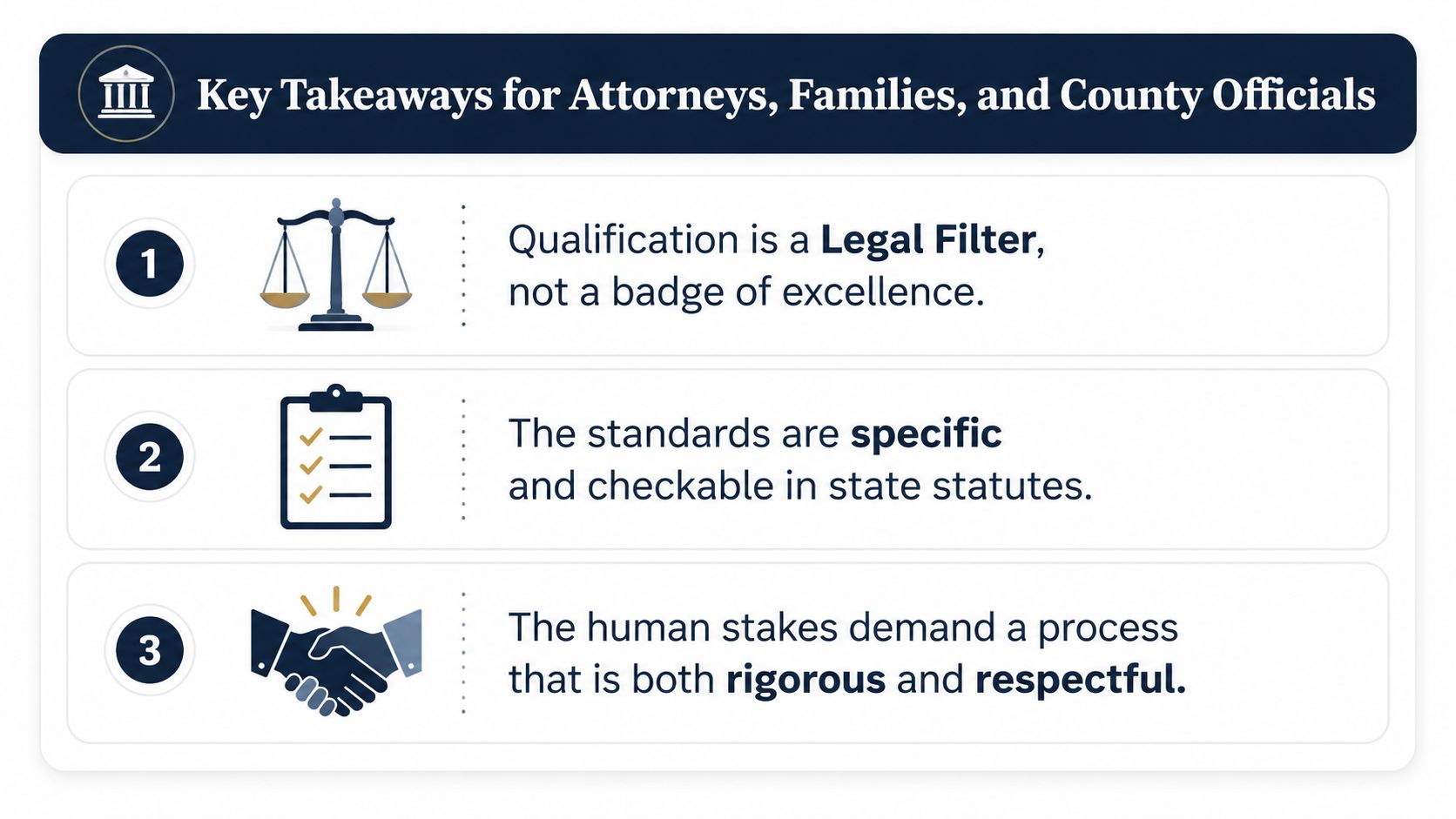
The modern standard for expert witness qualifications is not a popularity contest. It's a legal filter that asks whether the witness has the right background, uses reliable methods, and can connect the opinion to the facts in a way the court can trust. In federal practice, Rule 702 and Daubert make that clear, and Texas adds extra screening in physician cases where current practice and knowledge of the standard of care matter.
What matters most
- Qualification is a legal filter, not a badge of excellence.
- Current, relevant experience matters more than credentials alone.
- Board certification and methodical documentation carry real weight in forensic testimony.
The 2024 guidance highlighted by the American Psychological Association reflects a problem many readers already sense, courts can still over-rely on credentials instead of method and fit. The better question is whether the expert can show current, relevant, and reliably applied expertise for the exact opinion being offered. That framing serves families who want answers, attorneys who need admissible evidence, and county officials who need dependable outside review.
When the stakes are this personal, the process should be rigorous and respectful. The right expert doesn't just have a strong title. The right expert can explain the findings clearly, defend the method, and stand up to careful questioning without drifting outside the evidence.
If you need an independent forensic pathology review, a second opinion autopsy, or help understanding whether a proposed expert fits a Texas case, Texas Autopsy Services can talk through the qualifications, the records, and the next steps with you directly. Visit Texas Autopsy Services to connect with our team and discuss whether our services are the right match for your situation.