September 26, 2026 · Texas Autopsy Services
Why Get a Second Opinion on Cause of Death
Why Get a Second Opinion. Discover why families, attorneys, and officials pursue a second opinion autopsy in Texas. Learn the process, outcomes, and when
On this page
- Why Diagnostic Changes Matter
- Texas Legal Standards for Second-Opinion Autopsies
- How Independent Pathologists Review Prior Findings
- The Value of Objective Forensic Review
- When to Pursue a Private Second Opinion
- Real Scenarios Where Second Opinions Help
- Getting Your Second Opinion Through Texas Autopsy Services
Second opinions frequently change or sharpen the original diagnosis. In a 2017 Mayo Clinic study, only 12% of second-opinion cases matched the initial diagnosis, while 66% were clarified or redefined and 21% were completely different, meaning 88% led to some diagnostic change.
A family may receive a death certificate, an autopsy report, or a brief explanation that appears conclusive, yet still feel that important questions remain unanswered. The concern may involve an unclear cause of death, a manner-of-death classification that doesn't fit the known history, or findings that seem inconsistent with photographs, medical records, toxicology, or witness information.
A second opinion doesn't automatically mean the first pathologist was careless or wrong. In forensic pathology, an independent review often means reconstructing a conclusion from evidence that may be incomplete, altered, or interpreted differently. That process can clarify what the evidence supports, identify what remains uncertain, and give families, attorneys, healthcare professionals, and officials a more reliable basis for decisions.
Why Diagnostic Changes Matter
The strongest reason to seek a second opinion is simple. Independent review can change the medical conclusion in a meaningful way. The Mayo Clinic study described above found that only 12% of cases matched the initial diagnosis, while 66% were clarified or redefined and 21% were completely different. The findings are summarized in the Mayo Clinic discussion of second opinions.
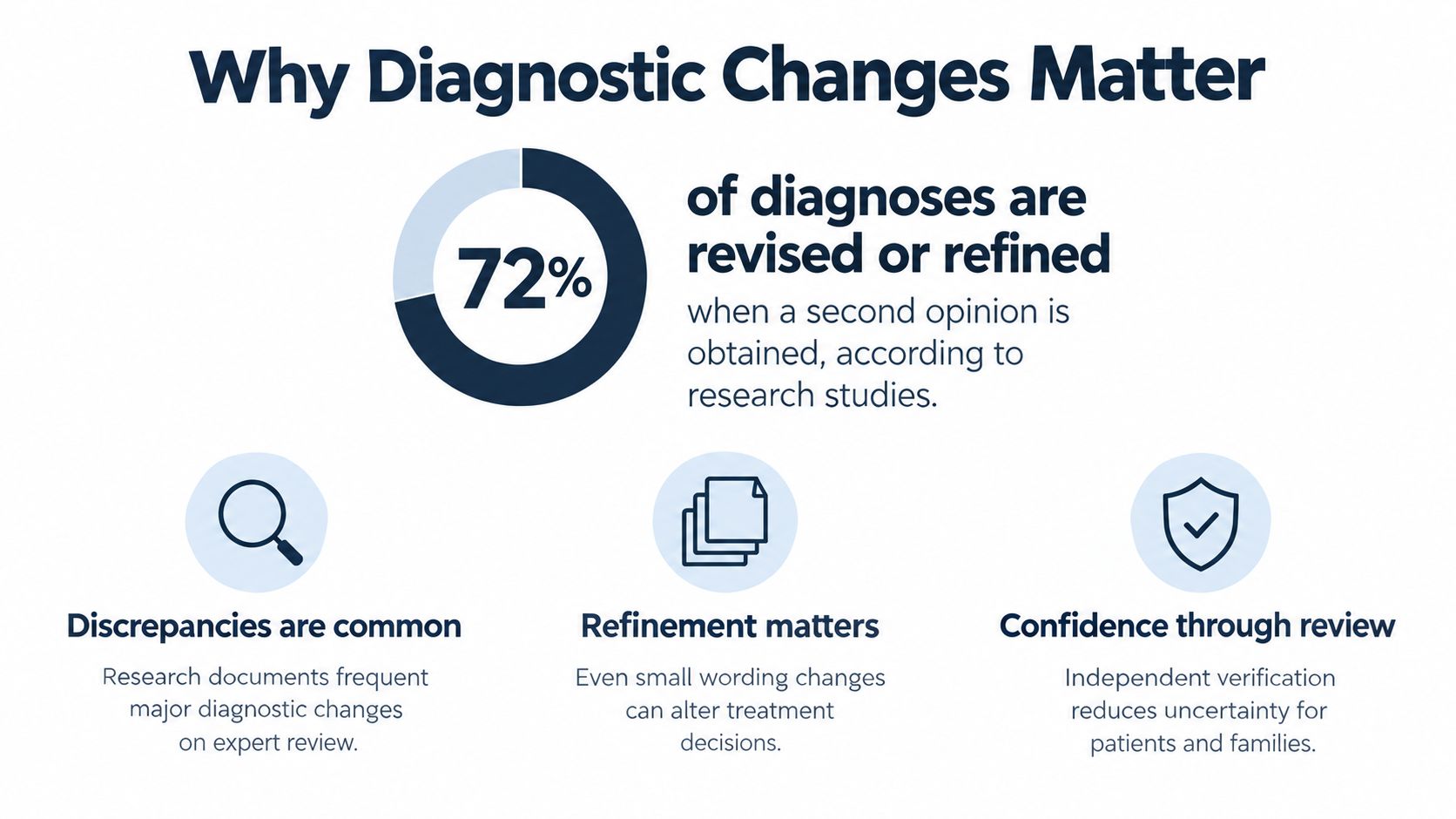
These numbers don't mean every second opinion overturns a conclusion. They show that review often adds information. A report may identify the same broad disease process while refining the mechanism of death, distinguishing a contributing condition from the primary cause, or explaining why the evidence doesn't justify a firm conclusion.
A safeguard against uncertainty
Medical literature has estimated that about 1 in 20 patients are misdiagnosed, and some studies have placed diagnostic error between 10% and 15% of cases. In a stylized model discussed in that literature, one second opinion reduced an initial error rate from 50.1% to 25.8%, two reduced it to 16.0%, and a third reduced it to 9.9%. These figures come from the medical literature review on diagnostic second opinions, not from a guarantee about any individual autopsy.
Postmortem review has a similar quality-control purpose. Families may need clarity before accepting a conclusion. Attorneys may need to understand whether documented findings support a wrongful death claim, including the elements of a Texas wrongful death case. County officials may need an independent assessment when a case presents unusual medical or legal questions.
Practical rule: A second opinion should identify both what the evidence supports and what it cannot establish.
The value is therefore not measured only by disagreement. A conclusion that remains unchanged after an independent review may carry greater practical weight when the reviewer has examined the underlying materials and documented the reasoning. A changed conclusion may prevent a family, court, insurer, agency, or licensing body from relying on a classification that the evidence doesn't support.
Texas Legal Standards for Second-Opinion Autopsies
A private or second-opinion autopsy in Texas operates within legal rules governing consent, transportation, preservation, identification, and documentation. The first question is usually authority. When a decedent's own written consent isn't available, Texas law places the spouse first in the consent hierarchy, followed by a guardian, executor, or administrator, then adult children, parents, and adult siblings. That order appears in Texas Health and Safety Code Chapter 691.
Consent doesn't erase the authority of a justice of the peace, medical examiner, law-enforcement agency, or other legally responsible office. A private review must be coordinated with the agency holding the body and evidence. Families and attorneys should establish who controls the remains, whether an official investigation remains open, and what materials can legally be released.
Chain of custody is part of the opinion
Chain of custody means the documented history of who possessed evidence, when it was transferred, how it was identified, and how it was preserved. Texas requirements address transportation, labeling, custody forms, and transfer records for bodies and anatomical specimens. Each custodian must complete and retain the relevant documentation before transferring responsibility, as reflected in Texas Attorney General guidance on body and specimen handling.
Preservation also matters. Texas administrative guidance states that a human body may not be held more than 24 hours after death unless it is kept between 34°F and 40°F, embalmed by a licensed embalmer in an approved manner, or sealed in a container that prevents seepage and odors. The Texas Attorney General opinion on preservation requirements explains why temperature and containment are compliance issues rather than optional preferences.
Who pays for transportation
County payment isn't automatic. Texas Attorney General guidance states that a commissioners court may pay transportation costs when a body isn't claimed for burial or will be buried at public expense, and when the Anatomical Board doesn't require the body. Otherwise, transportation to the final destination is generally the responsibility of the person who has the legal duty to inter the deceased, according to Texas Funeral Service Commission information about funeral responsibilities.
For families and attorneys, early coordination prevents avoidable problems. A clear record of consent, custody, transport, storage, and evidence transfer supports a defensible review and helps the final report remain useful in administrative or legal proceedings. Our discussion of reasonable medical certainty in forensic reporting provides related context about how conclusions should be expressed.
How Independent Pathologists Review Prior Findings
A second-opinion autopsy usually isn't a fresh examination of an unchanged body. It's often a constrained reconstruction. The independent forensic pathologist may work from the original autopsy report, investigative records, photographs, radiology, toxicology, histology slides, retained tissue, medical records, and scene information.
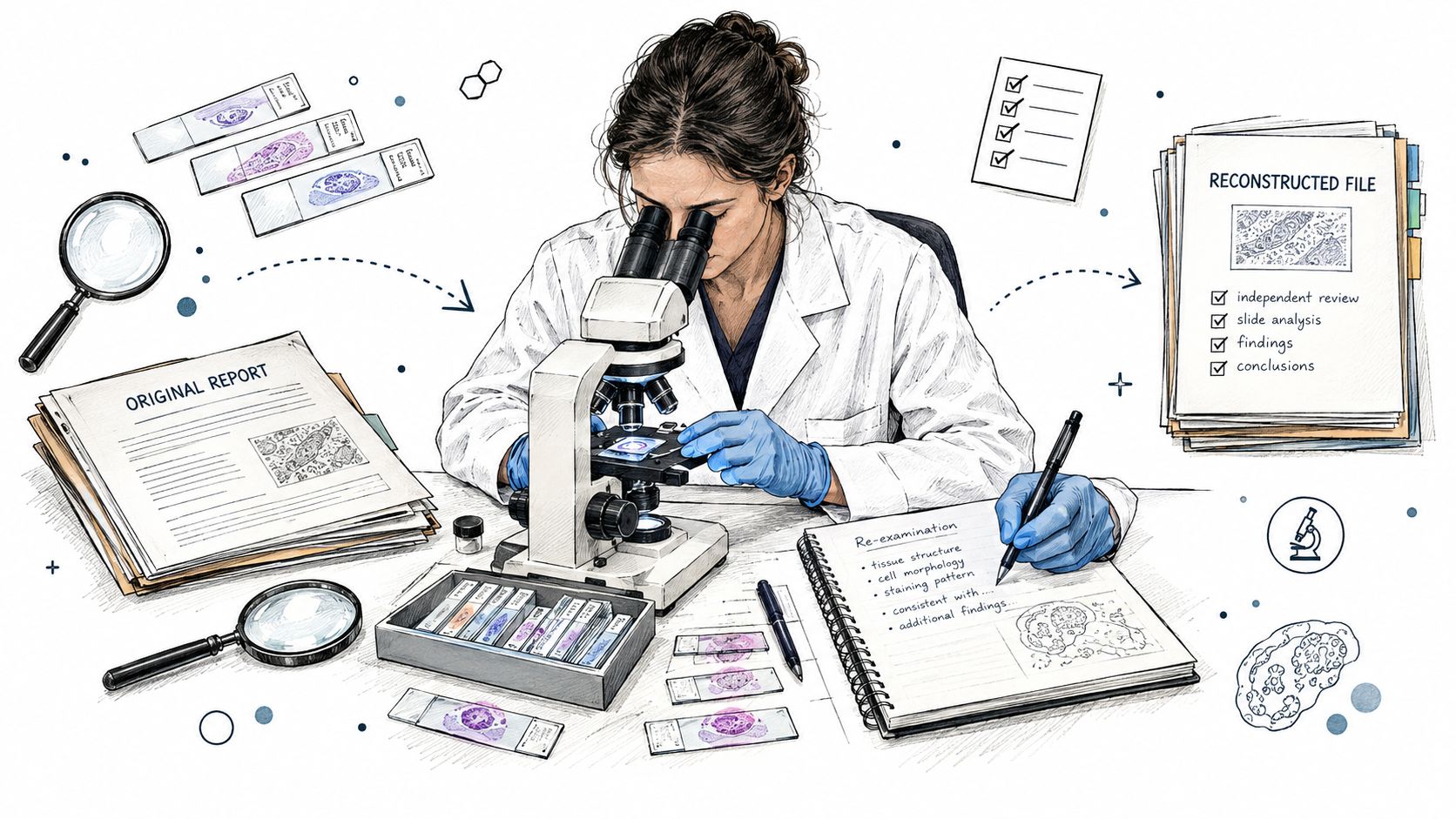
The body may already have been buried, cremated, embalmed, altered by decomposition, or released with only selected specimens retained. Some tissue may have been consumed by testing or discarded under applicable retention policies. A reviewer must therefore distinguish between direct observation and information inherited from earlier documentation.
What the review examines
Our board-certified forensic pathologists evaluate whether the stated cause and manner of death are supported by the complete record available. The review may address:
- Original findings: Whether the report accurately describes injuries, disease, toxicology, histology, and other documented observations.
- Evidence consistency: Whether the medical findings fit the investigative history, photographs, radiology, and known circumstances.
- Diagnostic language: Whether the report separates cause of death from contributing conditions and avoids conclusions stronger than the evidence permits.
- Missing material: Whether absent slides, photographs, specimens, records, or scene information limit certainty.
- Alternative explanations: Whether another cause, mechanism, or manner of death remains reasonably supported.
A cause of death is the disease, injury, or event that produced death. A manner of death describes the circumstances, commonly classified as natural, accident, suicide, homicide, or undetermined by the responsible authority. These are related but different questions, and a second review may affect one without changing the other.
Why limitations belong in the report
A careful report doesn't hide uncertainty. It identifies which evidence was available, which evidence was missing, and how those limitations affect the conclusion. The National Library of Medicine reference on second autopsy review describes this as a reconstruction based on prior findings, investigative information, images, and remaining tissue.
This approach matters in court. A defensible opinion explains not only the conclusion but also the route taken to reach it. Our medical records review and expert consultation services are designed around that distinction between documented fact, professional interpretation, and unresolved limitation.
The Value of Objective Forensic Review
Independence matters because the purpose of a second opinion isn't to produce agreement. It's to test whether the conclusion survives review by a qualified professional who wasn't responsible for the original interpretation.
Pathology studies show why that test can be important. Major diagnostic discrepancy rates have ranged from about 3% to 9% in some specimen groups. Other expert second-opinion series reported discrepancies of 38% overall, with major errors affecting management in 25% of cases. These findings are discussed in the independent pathology review literature.
Avoiding anchoring
Anchoring occurs when an early conclusion influences later interpretation, even when new information deserves independent consideration. In a death investigation, anchoring can affect how later reviewers read photographs, toxicology, tissue findings, or witness accounts. A reviewer who starts with the original conclusion may unconsciously treat it as a fixed point rather than one interpretation of the evidence.
An independent forensic pathologist should instead ask:
- What findings are directly documented?
- Which findings are independently verifiable?
- Does the proposed cause explain the known evidence?
- Does the manner of death follow from the medical findings and investigative facts?
- What alternative explanations remain?
- How certain can the conclusion reasonably be?
That structure supports objectivity without assuming misconduct. Two qualified pathologists can interpret difficult evidence differently because the evidence is incomplete, the findings are subtle, or the available information supports more than one explanation.
Decisions affected by classification
A cause-of-death opinion can influence estate administration, insurance review, civil litigation, criminal investigation, employment or licensing decisions, and family understanding. A small change in wording may alter whether an event is considered disease-related, injury-related, accidental, or undetermined.
The independent review is most useful when it connects the medical conclusion to the actual record. A report should not merely state that the original opinion is wrong. It should explain the specific evidence supporting a different conclusion, identify contradictions, and state whether the available materials permit a firm opinion or only a qualified one.
For that reason, objectivity is more valuable than confirmation. Confirmation has meaning only when the reviewer has tested the conclusion.
When to Pursue a Private Second Opinion
A private second opinion is appropriate when the existing conclusion leaves a material question unresolved and sufficient evidence remains available for meaningful review. It can be requested by a family, retained by an attorney, or arranged by an agency that needs specialized forensic pathology input.
Common reasons include:
- Unclear certification: The death certificate or autopsy report uses broad language that doesn't explain the medical mechanism.
- Conflicting evidence: The documented findings don't appear to fit the history, photographs, toxicology, or known circumstances.
- High legal stakes: An attorney needs an independent assessment before filing, negotiating, or presenting a case.
- Limited official capacity: A county or justice of the peace needs outside forensic pathology support for a complex matter.
- Incomplete communication: The family received a conclusion but not a clear explanation of how it was reached.
Private review compared with an official autopsy
| Issue | Private second-opinion review | Mandated medical examiner or justice-of-the-peace autopsy |
|---|---|---|
| Primary purpose | Independently assess existing findings and evidence | Investigate a death under official legal authority |
| Initiated by | Family, attorney, healthcare professional, or agency | The responsible public authority |
| Evidence access | Depends on consent, custody, releases, and retained materials | Governed by the investigating agency's authority and procedures |
| Reporting role | Provides an independent forensic opinion and documented limitations | Creates the official investigative record and certification process |
| Best use | Clarifying disputed conclusions or supporting legal review | Establishing the official investigation of a reportable death |
A private review doesn't replace the legal authority of the official investigating agency. It also can't recreate evidence that no longer exists. If tissue was not retained, photographs are unavailable, or the body has been substantially altered, the pathologist must say so.
The literature also leaves an important question open. A systematic review found no studies reporting cost-effectiveness, and another review concluded that evidence remains limited, heterogeneous, and insufficient to identify which patient groups benefit most. The BMJ Open systematic review of second opinions supports a careful decision based on the facts of the case, not an assumption that every review will produce a better outcome.
Real Scenarios Where Second Opinions Help
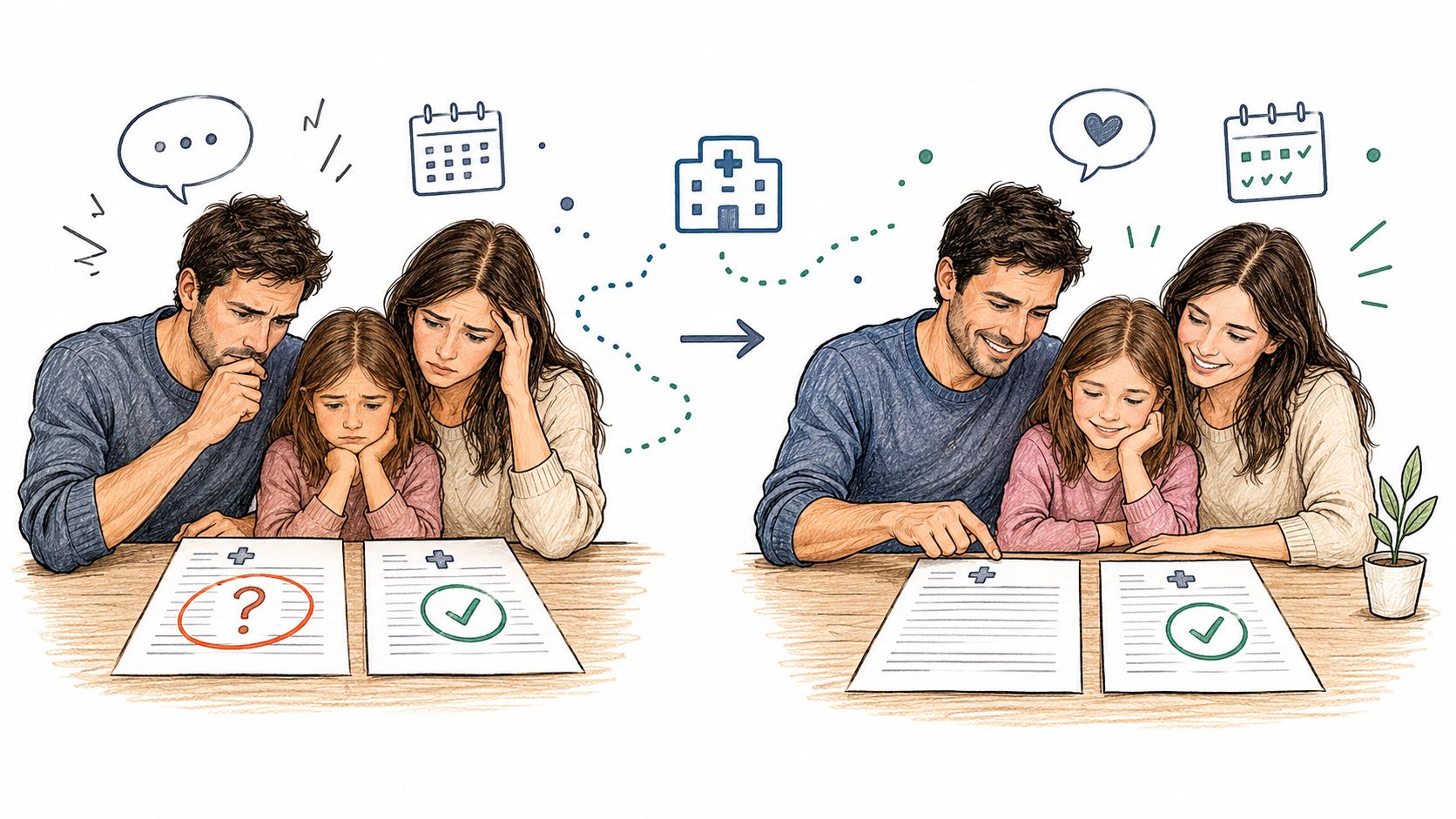
A family receives an autopsy report that lists a broad cause of death but doesn't explain how the findings support it. An independent reviewer examines the report, photographs, toxicology, and medical records, then separates established findings from assumptions. The result may be a revised opinion, or it may be a clearer explanation of why the original conclusion remains supported.
An attorney may face a different need. The question may not be whether the family believes the report, but whether the medical evidence can support a claim involving negligence, an unsafe product, a workplace event, or another disputed circumstance. An independent forensic pathology report can identify weaknesses, clarify causation, and explain limitations before testimony or settlement discussions.
A county official may request consultation when a death presents complex medical findings and local resources are limited. The reviewer can assess whether the documented cause and manner are medically coherent, identify additional materials that would help, and provide a written opinion that preserves the distinction between forensic evidence and legal conclusions.
The following video offers additional context for families considering a second medical review.
These examples are representative, not promises of a particular result. A second opinion may confirm the original finding, refine it, identify a different explanation, or conclude that the available evidence cannot resolve the dispute. Its value lies in making that answer transparent.
Getting Your Second Opinion Through Texas Autopsy Services
We begin by listening to the specific question. Our team then identifies what materials exist and whether the body, slides, tissue, photographs, toxicology, imaging, investigative records, and medical records can be obtained.
The process generally follows these steps:
- Initial consultation: We clarify the concern, legal status, consent authority, and agency involvement.
- Evidence collection: We request available reports, images, specimens, records, and chain-of-custody documentation.
- Independent review: Every examination is performed by a board-certified forensic pathologist certified by the American Board of Pathology.
- Limitations analysis: We document missing evidence, altered conditions, and factors affecting certainty.
- Written reporting: We provide a detailed opinion explaining the findings, reasoning, cause of death, manner of death when appropriate, and limitations.
Texas Autopsy Services is based in Elgin and serves all 254 Texas counties, with licensed in-house transport and temperature-controlled storage. Families and attorneys communicate directly with our team, and the practice uses flat-rate, all-inclusive pricing. Related forensic consultation options are described in forensic consultant services.
Most cases are completed within 24–48 hours when the necessary materials and access are available, though timing depends on evidence transfer, laboratory testing, agency cooperation, and the condition of the remains. We also provide guidance about private autopsies through Private Autopsies, county support through County Forensic Autopsies, and logistics through our Waterloo Mortuary Partnership.
Common questions
Does a second opinion mean the first autopsy was wrong?
No. It may confirm the conclusion, refine its wording, identify a different interpretation, or explain why the evidence is insufficient for certainty.
Can a second opinion be completed after burial?
Often, a records-based review is possible, but the answer depends on what was documented and what specimens, photographs, and tissue remain. Exhumation is a separate legal and logistical process.
What records should a family request?
Ask for the autopsy report, death certificate, toxicology, histology information, photographs, radiology, medical records, investigative materials, and documentation showing where specimens were transferred and stored.
Who decides the official manner of death?
The responsible public authority makes the official determination under applicable Texas law. An independent forensic pathologist can provide an expert medical opinion, but that opinion doesn't replace the authority of the investigating agency.
Does a second opinion guarantee closure?
No. It can provide a clearer explanation and identify whether the evidence supports the original conclusion, but some cases remain limited by missing or altered evidence.
Texas Autopsy Services provides independent second-opinion autopsy reviews, forensic pathology consultations, licensed transport, and court-admissible reporting for families, attorneys, healthcare professionals, and Texas counties. If you need help understanding a cause-of-death finding or deciding whether the available evidence supports further review, visit Texas Autopsy Services to contact our team directly and discuss the circumstances with compassion and clarity.