January 24, 2026 · Texas Autopsy Services
What Families Should Know About Post Mortem Reports in Texas
Learn to understand post mortem reports with this clear guide. I explain key sections, legal terms, and next steps for families and attorneys in Texas.

On this page
- Why a Post Mortem Report Is So Important
- Understanding the Sections of an Autopsy Report
- Cause, Manner, and Mechanism: The Three Pillars of a Death Investigation
- The Science Behind Toxicology and Histology
- How to Get and Understand an Autopsy Report in Texas
- Frequently Asked Questions About Post Mortem Reports
As a forensic pathologist, my work begins when families and attorneys need clarity after a death. A death certificate is the official record, but a post mortem report—often called an autopsy report—tells the complete story. The death certificate is the headline; the autopsy report is the detailed article explaining how we arrived there.
- A post mortem report provides an independent, objective cause of death investigation based on medical facts.
- The examination and final report are prepared by a board-certified forensic pathologist, ensuring precision and adherence to Texas legal standards.
- Families receive a transparent, comprehensive document that explains the medical findings clearly.
- The process is confidential, respectful, and fully compliant with the Texas Health & Safety Code.
Why a Post Mortem Report Is So Important
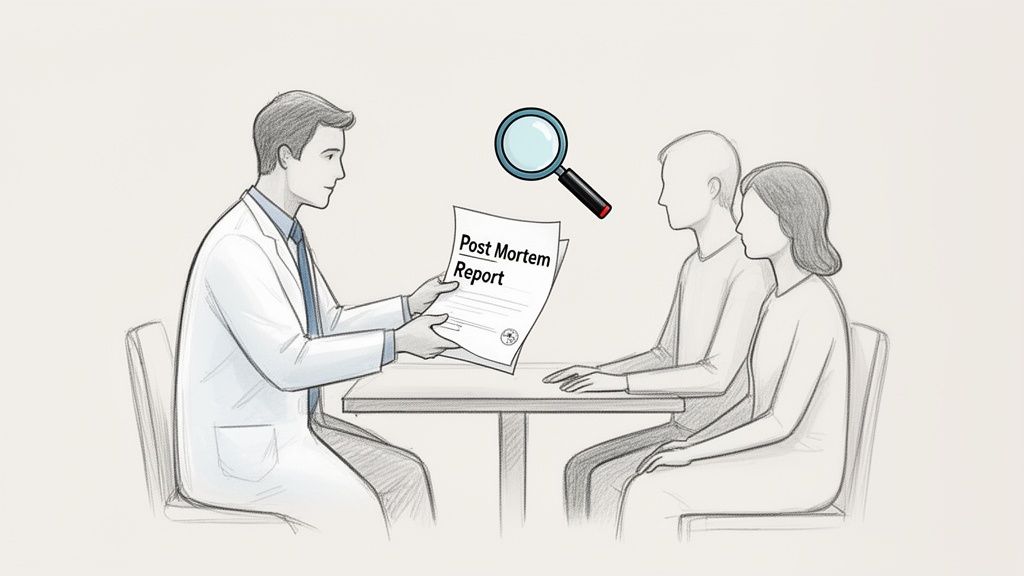
At its core, a post mortem report establishes the cause and manner of death with medical and scientific certainty. It’s designed to answer the two biggest questions: "why" and "how" a person died. It moves past a simple summary to provide a complete, evidence-based narrative.
This document is much more than a routine medical file. For families, it can be a source of truth that finally provides closure and answers lingering questions. For attorneys, it’s a critical piece of evidence that can influence legal proceedings, insurance claims, or workers' compensation cases. My role is to deliver these answers with both precision and compassion, making sure every detail is accounted for.
The Foundation of Truth and Clarity
An autopsy report provides an objective, factual record based on a meticulous physical examination and specialized tests. It can confirm a suspected illness, uncover a previously unknown medical condition, or document the precise extent of injuries.
This clarity is powerful and serves several key purposes:
- Closure for Families: Understanding the medical facts can help lift the fog of uncertainty and provide a sense of finality.
- Legal Evidence: In court, the report stands as an unbiased expert document, essential for civil or criminal litigation.
- Public Health Insights: In aggregate, data from these reports helps epidemiologists track mortality trends and protect community health.
For instance, in 2023, the United States recorded over 3 million deaths. Postmortem data was essential for understanding national health shifts. Reports from agencies like the CDC, which showed heart disease as the leading cause, are built on accurate information gathered from individual cause-of-death investigations. You can discover more insights about these national mortality trends directly from the CDC.
In my experience performing over 1,000 autopsies, I’ve seen firsthand how a detailed, accurate report brings quiet comfort. It replaces speculation with certainty, giving families and legal teams a solid foundation to move forward.
Whether an autopsy is conducted for a county medical examiner or as part of private autopsy services, the mission is the same. The report must be thorough, objective, and clear—a commitment to finding the truth.
Understanding the Sections of an Autopsy Report
When you first receive an autopsy report, it can feel overwhelming. These documents are packed with technical medical terms and can seem intimidating, especially during a difficult time. I want to help break it down so it makes sense.
Think of the report as a final case file. It’s a structured story of an investigation, with each section logically building on the last to give a complete picture. The format is deliberate; it ensures every examination is thorough and systematic. Once you understand how the pieces fit together, you can navigate the report with more confidence.
Let’s go through the main components.
The Clinical Summary or History
This is where the story begins. This section sets the stage by summarizing what we knew about the person before the examination started. It provides crucial context about their medical background and the circumstances of their death, based on information from family, medical records, or first responders.
This section usually includes:
- Past Medical History: A summary of known illnesses, previous surgeries, or major health problems.
- Medications: A list of prescriptions the person was taking.
- Circumstances of Death: A short description of where, when, and how the person was found. This helps frame the scene and understand initial observations.
This background information is incredibly important. It guides my physical examination, pointing me toward potential areas of concern and helping connect my findings with the person's life and health history.
The External Examination
After reviewing the background, the physical investigation starts with the external examination. This is a careful, head-to-toe inspection of the body. I document everything, from basic identifying features—height, weight, hair and eye color—to specific markers like scars, tattoos, or medical devices like a pacemaker.
More critically, this is where I look for any visible signs of injury or disease on the skin. I meticulously note any bruises, cuts, or other forms of trauma. It’s a methodical process because clues on the surface can point to what happened internally. For example, the specific pattern of an injury might suggest the nature of an accident or a fall.
The Internal Examination
The internal examination is the core of a post mortem report. It involves a systematic dissection and inspection of every organ system. I examine the organs first as they are in the body, and then I remove them to be weighed, measured, and inspected up close for any abnormalities, signs of disease, or injury.
I often explain this process as a comprehensive health audit. Each organ—from the brain to the heart, lungs, and liver—is evaluated for its structure, color, and texture. This allows me to identify conditions like heart disease, tumors, infections, or internal bleeding that were not visible externally.
The findings for each organ system are documented in their own subsections. For example, under "Cardiovascular System," I would note the weight of the heart, the condition of the coronary arteries, and the appearance of the heart valves. This level of detail is necessary to build a complete and accurate medical picture.
A typical autopsy report is organized to be comprehensive and clear. The table below breaks down the standard sections and what you can expect to find in each one.
| Report Section | Purpose and Information Included |
|---|---|
| Clinical Summary/History | Provides background context, including the decedent's medical history, medications, and the known circumstances surrounding the death. |
| External Examination | A detailed head-to-toe description of the body's exterior, noting identifying features, scars, tattoos, and any signs of external injury. |
| Evidence of Injury | A specific section detailing any trauma found, both externally and internally. This is crucial in cases of accidents, falls, or assaults. |
| Internal Examination | A systematic, organ-by-organ description of the findings from the internal dissection. Each organ is weighed, measured, and examined for disease or injury. |
| Microscopic Findings (Histology) | The results from examining small tissue samples under a microscope. This reveals cellular-level details of disease, inflammation, or damage. |
| Ancillary Studies (e.g., Toxicology) | Includes results from specialized tests like toxicology (for drugs/alcohol), microbiology (for infections), or genetic testing. |
| Final Anatomic Diagnoses | A summary list of all the medical conditions and injuries identified during the autopsy, ranked in order of significance. |
| Cause and Manner of Death | The final conclusion, stating the specific disease or injury that caused death and classifying the manner as Natural, Accident, Suicide, Homicide, or Undetermined. |
This structure ensures that every piece of evidence is documented logically, leading from broad observations to specific conclusions.
Microscopic Findings and Specialized Tests
Sometimes, the most important answers aren't visible to the naked eye. That’s why we collect small tissue samples from each major organ during the internal exam. These samples are sent to a lab to be prepared on slides and examined under a microscope—a process called histology. This cellular-level view can reveal subtle evidence of disease like inflammation, chronic damage, or even early-stage cancers that would otherwise be missed.
In addition to histology, we often rely on other specialized tests:
- Toxicology: This is the analysis of blood, urine, or tissue to check for alcohol, prescription medications, illegal drugs, or poisons.
- Microbiology: We may take cultures to see if an infection from bacteria or a virus played a role.
- Genetic Testing: In some cases, genetic analysis can identify inherited conditions that may have led to a sudden death.
These tests provide hard data that can either confirm what I see during the physical exam or bring new information to light. Every piece of this puzzle is essential for telling the complete and accurate story in the final report.
Cause, Manner, and Mechanism: The Three Pillars of a Death Investigation
When I prepare a post mortem report, my ultimate goal is to provide clear, definitive answers. To do that, I rely on three core concepts: the cause, manner, and mechanism of death. People often use these terms interchangeably, but in forensic pathology, they each have a very specific meaning.
Getting these right isn't just an academic exercise. For families, lawyers, and insurance companies, understanding the distinction is crucial. It’s the bedrock of a thorough and accurate report.
Cause of Death: The "Why" Behind It All
The cause of death is the specific injury or disease that started the chain of events that ultimately led to death. It’s the direct answer to the question, "What, medically, happened?"
Think of it as the foundational reason. A few examples I often see include:
- Coronary Artery Atherosclerosis: A technical term for the hardening and narrowing of the heart's arteries.
- Gunshot Wound to the Head: A direct, fatal injury.
- Lung Cancer: A chronic disease that progressed to a terminal stage.
This is a purely medical determination, based entirely on the evidence I uncover during the autopsy. On a larger scale, getting the cause of death right is vital for public health. For example, the Global Burden of Disease 2023 analysis, which estimated 10.4 million cancer deaths worldwide, leans heavily on this kind of postmortem data to track health trends. You can read more about how postmortem data informs global cancer statistics to see how this works in practice.
Manner of Death: Classifying the Circumstances
Unlike the cause, the manner of death isn't a medical diagnosis. It's a legal classification that describes the circumstances surrounding the death. In Texas, and across the U.S., we work with five recognized categories. My job is to sift through all the evidence and determine which one fits.
The five manners of death are:
- Natural: Death resulting solely from disease or the natural aging process.
- Accident: An unforeseeable, unintentional event causes the death, like a car crash or a fall.
- Suicide: The death was caused by a purposeful, self-inflicted act.
- Homicide: Another person’s actions led to the death.
- Undetermined: There isn’t enough evidence to confidently place the death into one of the other four categories.
This classification carries enormous weight. It can influence everything from life insurance payouts to criminal proceedings. It’s a conclusion I never reach lightly, and only after weighing all the facts.
Mechanism of Death: The Final Physiological Step
Last is the mechanism of death. This describes the direct physiological event or biochemical failure that brings life to an end. It's the body's final "shutdown" process.
Some common mechanisms include:
- Ventricular Fibrillation: A chaotic, fatal heart rhythm.
- Hemorrhage: Massive, uncontrolled blood loss.
- Respiratory Arrest: Breathing stops completely.
It’s crucial to remember that the mechanism is always a consequence of the cause. A heart attack (cause) could trigger ventricular fibrillation (mechanism). A stab wound (cause) could lead to hemorrhage (mechanism).
Putting It All Together
Let's use a simple scenario: someone falls from a ladder.
- The Manner is Accident.
- The Cause is the blunt force head trauma from hitting the ground.
- The Mechanism is the resulting cerebral hemorrhage (bleeding in the brain).
This framework creates a clear, logical path from the circumstances to the specific injury and, finally, to the physiological event that ended life.
The diagram below shows how all the different parts of an autopsy—the external and internal exams, plus lab tests—are synthesized to build the final report.
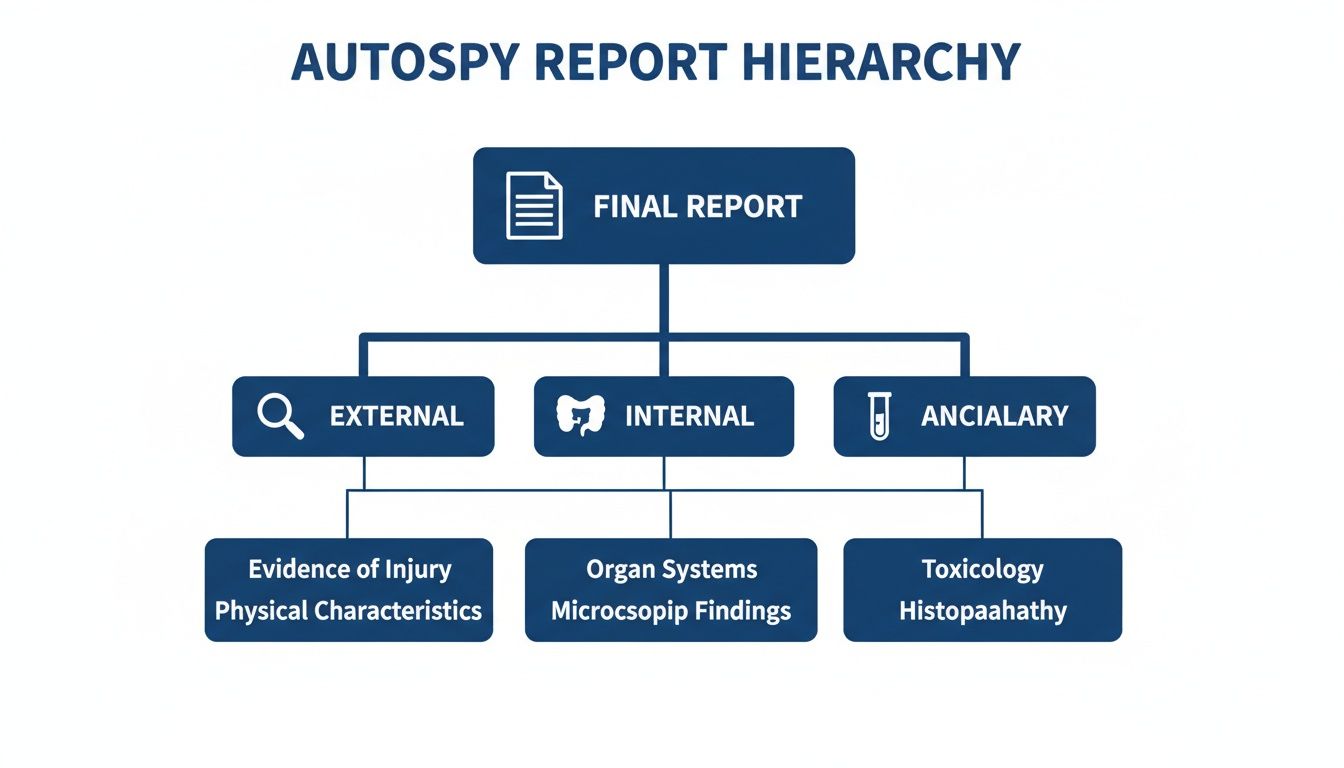
This structured approach ensures that every piece of evidence contributes to a solid conclusion. By carefully defining the cause, manner, and mechanism, I can provide the complete story that grieving families and the legal system need to move forward.
The Science Behind Toxicology and Histology
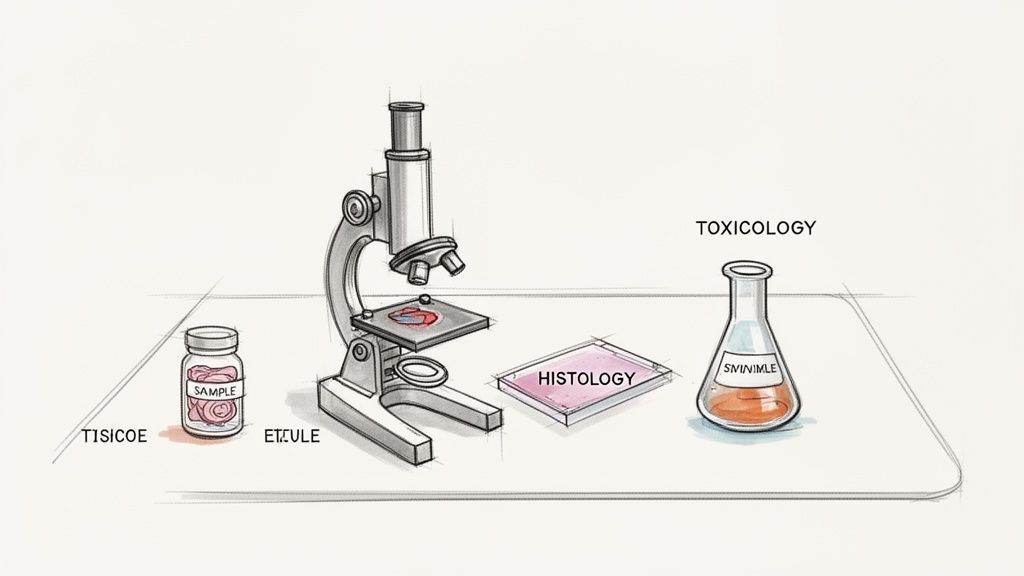
Sometimes, the most important answers can't be seen with the naked eye. The physical examination gives me the broad strokes of the story, but the hard evidence often comes from scientific analysis of tissues and fluids. This is what makes a post mortem report truly conclusive.
That’s where toxicology and histology come into play. These studies let me dig much deeper, providing objective data that can confirm what I see, clarify a confusing situation, or even point the investigation in a new direction. They are fundamental to reaching a thorough and medically sound conclusion.
Uncovering the Chemical Story with Toxicology
Toxicology is the science of identifying drugs, alcohol, chemicals, and other substances in the body. It tackles a critical question: did any foreign substance play a role in the death? This isn't just about looking for illegal drugs; it’s a full screen for everything from prescription and over-the-counter medications to environmental toxins and alcohol.
For instance, someone with known heart disease may appear to have died from a natural heart attack. But toxicology might reveal that an incorrect dose of their prescription medication was a contributing factor, completely changing the context.
The process involves analyzing samples of blood, urine, and sometimes tissues from organs like the liver. The results give us a detailed chemical snapshot at the time of death, helping to either confirm or rule out an overdose, poisoning, or impairment. You can learn more about the specifics of post-mortem toxicology in our dedicated article.
In my experience, toxicology is one of the most important tools for giving families a complete picture. It can explain sudden behavioral changes or clarify circumstances that otherwise make no sense, offering a path to understanding.
This work is also critical for public health. A 2023 forensic toxicology report from Norway found that substances were detected in 79% of the 2,664 autopsy cases analyzed. This data points to a global issue, showing how essential postmortem toxicology is for understanding drug-related deaths. You can read the full research about these toxicology findings to see the scope of this work.
Examining the Cellular Blueprint with Histology
While toxicology is about chemicals, histology looks at the body's own tissues under a microscope. During the internal examination, I take small, carefully chosen tissue samples from all the major organs. These samples are preserved, sliced incredibly thin, stained to highlight different structures, and then examined on glass slides.
I often think of histology as looking at the body’s cellular blueprint. It allows me to spot the subtle signs of disease that are completely invisible during the physical examination.
This microscopic analysis can reveal:
- Inflammation or Infection: We can pinpoint pneumonia in the lungs or myocarditis (inflammation) in the heart muscle.
- Chronic Disease: This helps identify long-term damage, like liver cirrhosis or kidney damage from chronic high blood pressure.
- Subtle Injuries: It's possible to detect microscopic damage to brain tissue or heart muscle fibers after an accident.
- Early-Stage Cancer: We can find cancerous cells that hadn't yet grown into a visible tumor.
Histology provides the definitive proof needed to confirm a suspected diagnosis or uncover an unexpected condition. It validates what I observe in the internal exam and ensures the final cause of death rests on the most detailed evidence possible.
Together, toxicology and histology are the cornerstones of a modern, comprehensive autopsy. They provide the scientific certainty that every family and investigation deserves.
How to Get and Understand an Autopsy Report in Texas
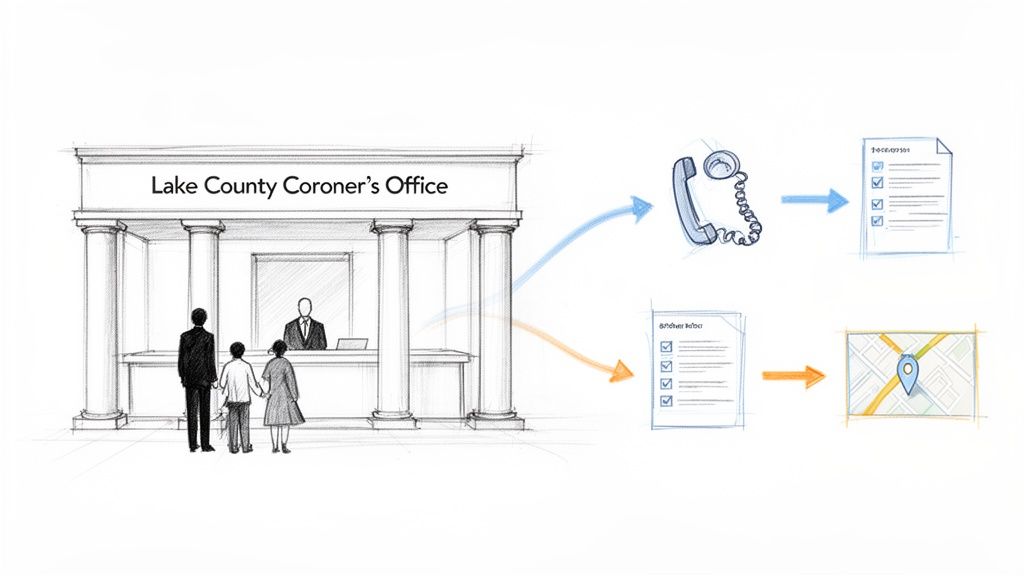
Figuring out how to get a copy of a post mortem report in Texas can feel overwhelming. But knowing the right steps can make all the difference. The process is different depending on who performed the autopsy—a county Medical Examiner or a private service like ours.
If a county M.E. handled the autopsy, the report falls under the Texas Public Information Act. This means the report is usually a public record, though sensitive information might be redacted to protect personal privacy.
A report from a private autopsy service, however, is a completely confidential medical record. We release it only to the person who legally authorized the autopsy, like the next-of-kin or the family's attorney. This keeps everything strictly private.
Who Can Legally Request the Report?
Texas law is specific about who can ask for and receive an autopsy report to protect the dignity of the deceased and the privacy of their family.
The Texas Health & Safety Code gives this right to the legal next-of-kin, following a clear order:
- The surviving spouse
- Any surviving adult children
- The surviving parents
- Any surviving adult siblings
If you’re an attorney working for the family, you can request the report with written permission from the next-of-kin. For a deeper dive into these initial steps, our guide on how to request an autopsy report in Texas can walk you through it.
Making Sense of the Findings
When you have the report, my best advice is to take your time. Read it through once to see the layout. Then, go back and focus on the Final Anatomic Diagnoses and the official Cause and Manner of Death. This is where you'll find the core conclusions.
It’s normal to need to look up medical terms. But a good pathologist is there to help connect the dots. The language is technical for medical and legal accuracy, but that shouldn't stop you from getting clear answers. I always make myself available to the families I work with to go over the report and clarify anything that’s confusing.
My primary goal is to provide clarity, not confusion. A report should be a source of answers. If you read a report and are left with more questions, the job isn't done.
If anything in the report doesn't make sense, or if the conclusions don't seem to line up with what you know, it's time to ask questions. You have every right to fully understand the report. Sometimes it’s a simple explanation of a complex medical term. Other times, it might be a signal that a second opinion autopsy is a good idea.
Frequently Asked Questions About Post Mortem Reports
Over my years as a forensic pathologist, I've noticed that families and attorneys often share the same questions when they first encounter a post mortem report. Here are some clear, straightforward answers.
How Long Does It Take to Receive a Final Post Mortem Report in Texas?
I know the waiting can be incredibly difficult. While we can sometimes provide preliminary thoughts within a few days, the final, comprehensive report often takes several weeks or even months to complete. This delay is due to the meticulous work behind specialized tests like toxicology and histology. Getting those results back and interpreting them correctly takes time. Rushing these steps would risk the accuracy of the entire report. At Texas Autopsy Services, we are committed to medical precision and always aim to keep families updated on the timeline.
Is an Autopsy Report a Public Record in Texas?
The answer depends on who did the autopsy. Reports from a county Medical Examiner's office are typically considered public records under the Texas Public Information Act. They will usually redact sensitive personal information to protect privacy. On the other hand, a report from a private autopsy is a completely confidential medical document. We release it only to the person who arranged for the service, such as the legal next-of-kin or their attorney. This approach gives your family total control over the information.
What Should I Do If I Disagree with the Official Autopsy Findings?
It’s not uncommon to have doubts about an official report. The best first step is to ask for a meeting with the pathologist who wrote it. A direct conversation can often clear up confusing medical terms. But if you've had that conversation and still feel that something isn't right, you have the right to seek a second opinion from an independent, board-certified forensic pathologist. A second opinion provides a fresh, impartial set of eyes on the case to give you confidence in the final answers.
Can an Autopsy Be Performed After Embalming?
Yes, a skilled pathologist can still conduct a meaningful autopsy after a body has been embalmed. The process changes tissues and can make some toxicology tests more difficult, but we know how to work around those challenges. We can still uncover vital information about injuries, diseases, and organ damage. However, performing the autopsy before embalming is always best. This leaves tissues and fluids in their natural state, allowing for the most thorough and accurate analysis.
I know this is a lot to take in during an already overwhelming time. Navigating the complexities of a post mortem report can feel like another heavy burden. If you have more questions or believe a private autopsy is the right path for your family, please reach out to my office. At Texas Autopsy Services, we are here to provide answers with both professionalism and compassion.