October 4, 2026 · Texas Autopsy Services
Forensic Pathology Review: A Guide for Families
A forensic pathology review explains the cause of death for legal cases. Learn what families and attorneys should expect from this critical process.
On this page
A family may receive an autopsy report that lists a natural cause of death, even though the medical history offers no clear explanation. An attorney may find that the stated manner of death conflicts with toxicology, photographs, witness accounts, or investigative records. A county may seek an outside opinion when a case is disputed or local resources are limited.
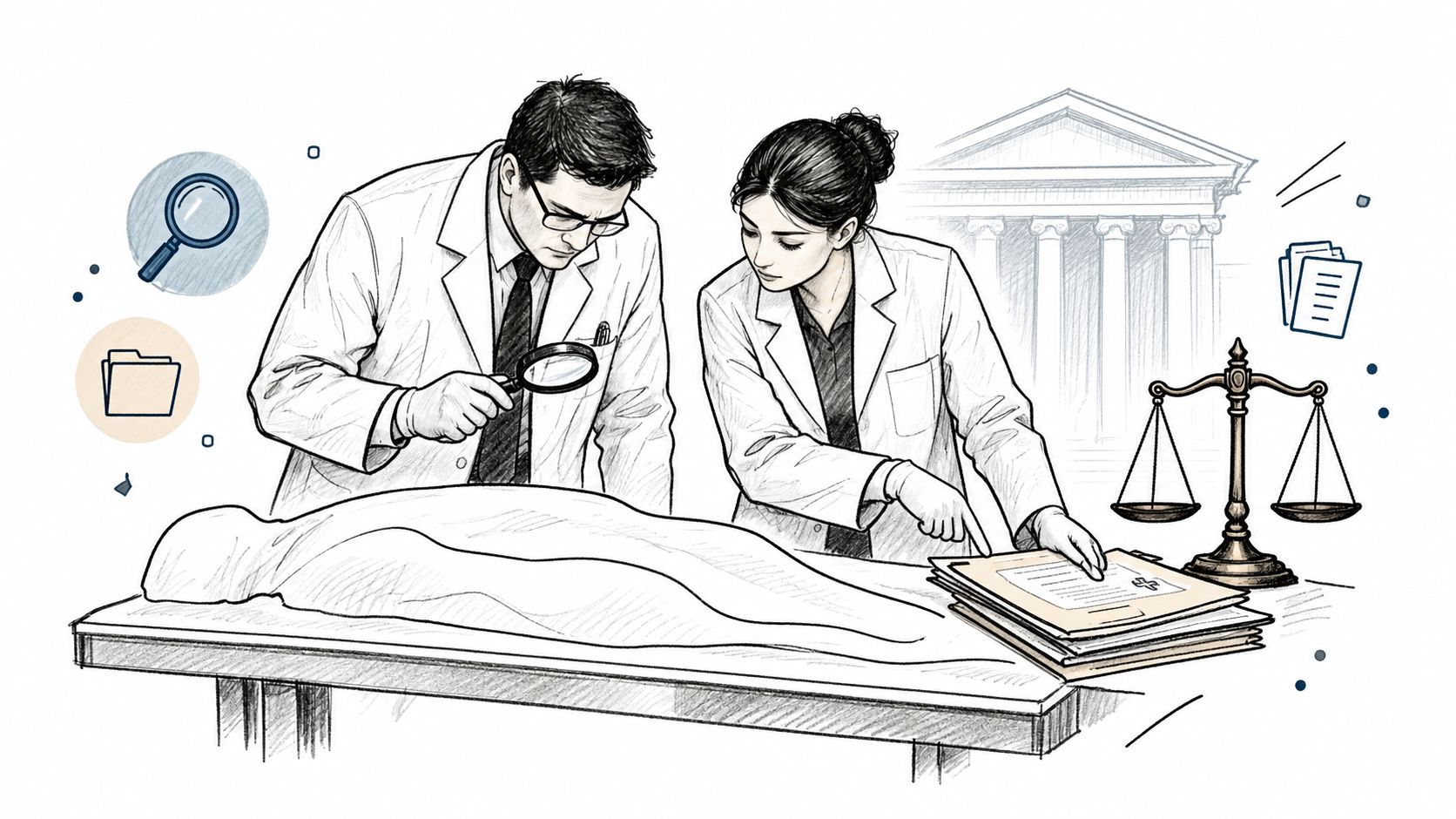
A forensic pathology review is an independent second opinion. The reviewer compares the original conclusion with the evidence available at the time and identifies material that was overlooked, incomplete, or open to another interpretation. Peer review programs in other jurisdictions demonstrate that structured review is a routine, time-sensitive process, including in Ontario's public forensic pathology service (Ontario forensic pathology timeline). That experience supports the value of applying a similarly organized approach to Texas cases.
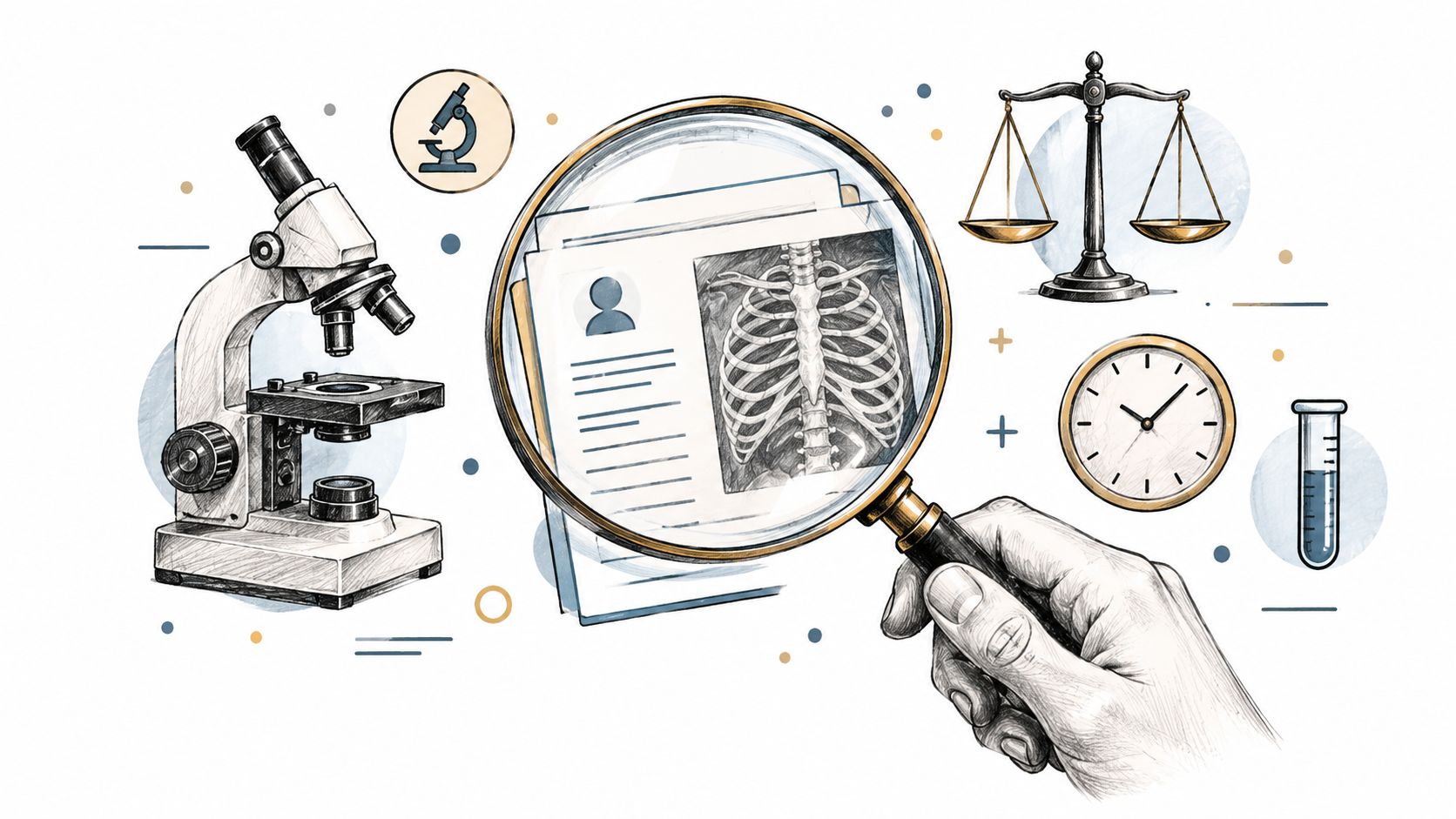
The file may include the autopsy report, medical records, toxicology, histology slides, photographs, radiology, investigative reports, and death-scene information. Retained tissue or other physical evidence can support ancillary testing or a closer clinical pathology assessment.
Cause of death identifies the disease, injury, or condition that led to death. Manner of death describes the circumstances, such as natural, accident, suicide, homicide, or undetermined, when supported by the evidence. A review may also assess whether the reasoning fits Texas medicolegal requirements and whether the opinion is explained clearly enough for court. It does not automatically require a new dissection. A written report should state the conclusion, supporting findings, limitations, and unresolved uncertainty.

Cause and manner are different opinions
The cause of death is the medical explanation. Examples include a disease, traumatic injury, poisoning, or a combination of conditions. The manner of death addresses the circumstances surrounding that cause. A toxic substance may be the cause, while the manner could depend on whether the evidence supports an accident, suicide, homicide, or an undetermined classification.
A review doesn't exist to replace one conclusion with another just because someone disagrees. It tests whether the clinical history, gross findings, microscopic findings, laboratory results, and investigative record support the original opinion. The history of autopsy medicine shows why that testing matters. Hospital autopsy studies have found clinically missed diagnoses in at least 25% of autopsies, while hospital autopsy rates in the United States declined from about 50% in the 1950s to 7.4% by 2020 (review of autopsy practice and forensic pathology).
Families seeking a plain-language explanation can also review our discussion of medical case review. The process is especially useful when the original report is incomplete, the findings are internally inconsistent, or an important question was never addressed.
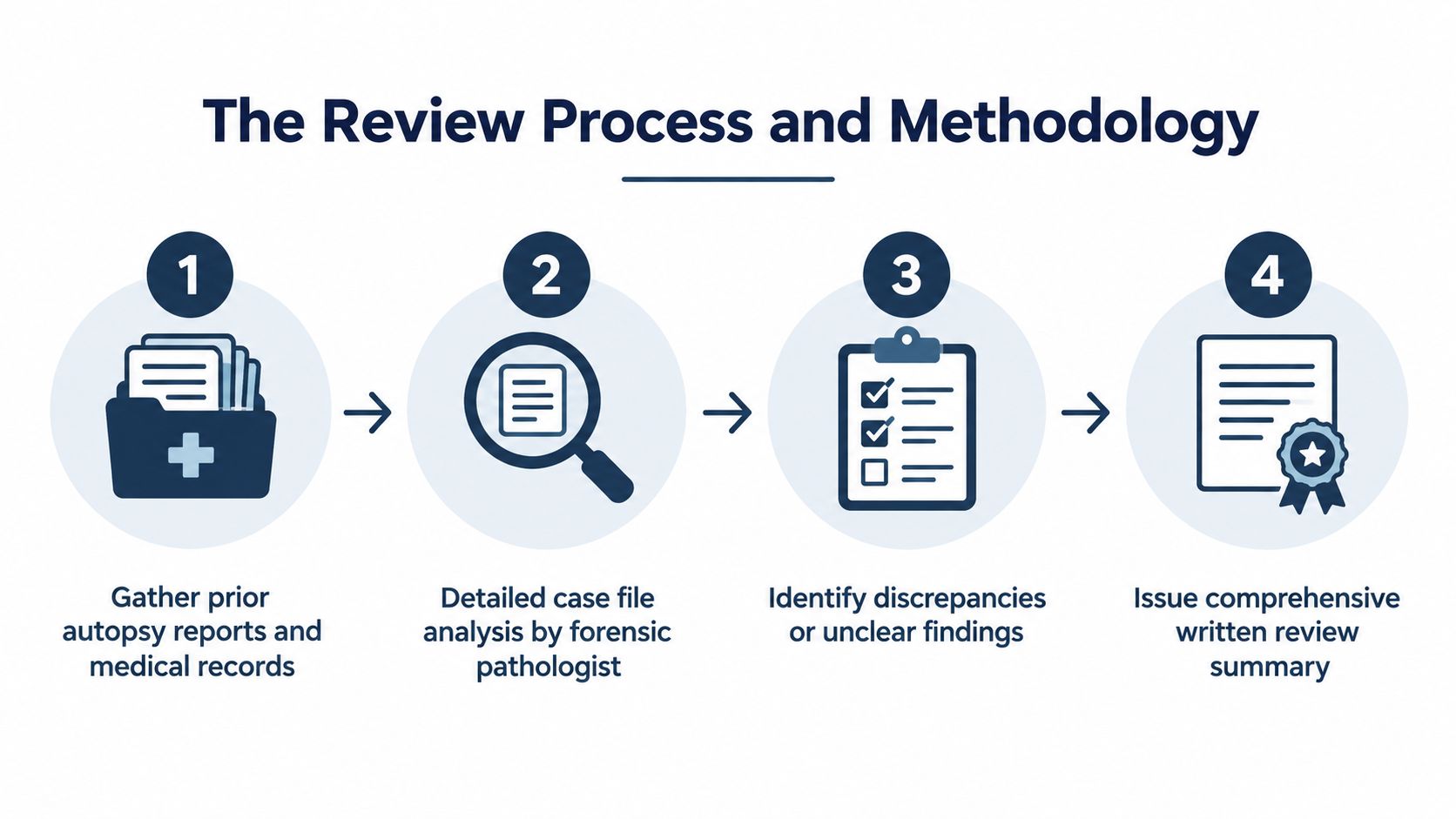
The Review Process and Methodology
A family may receive an autopsy report that seems clear until one sentence conflicts with the medical history, photographs, or laboratory results. An attorney may face the same problem while preparing a case. A forensic pathology review treats the report like a chain of reasoning: each conclusion must connect to documented evidence, and each missing link must be identified.
Step one gathers the case file
The reviewer begins by identifying what exists, who holds it, and whether the record is complete. The file may contain the original autopsy report, scene and investigative reports, medical records, death certificate, toxicology, histology, radiology, photographs, hospital records, and relevant communications. Families and attorneys should preserve original documents rather than relying only on summaries. Missing material can narrow the opinion a reviewer can responsibly provide.
Step two tests the original reasoning
The forensic pathologist compares the reported findings with the medical history and investigative account. The reviewer asks whether the stated cause follows from the gross examination, whether microscopic findings support it, and whether toxicology was interpreted in context. This is a second opinion, not a preferred answer chosen in advance.
Discordance deserves focused attention. Across autopsy studies, reported discrepancy rates have ranged from about 10% to 30%, depending on the organ system and study design. Missed causes have included infection, pulmonary embolism, and cardiac conditions (autopsy diagnostic discrepancies).
Step three evaluates tissue and additional testing
If slides are available, the reviewer compares the histology with the written description. Microscopy may clarify inflammation, infection, heart disease, malignancy, or another finding that gross examination alone does not resolve. Depending on the question, the review may consider additional toxicology, histopathology, molecular testing, or other ancillary studies.
Imaging, digital pathology, and virtual review can provide further context. A 2025 systematic review recommended traceable, auditable processes and external validation testing before these systems are used in court-defensible work. A separate 2025 review found that only 23% of analyzed forensic pathology AI studies used datasets larger than 1,000 samples, limiting how confidently results can be generalized (digital pathology and forensic AI review).
Clinical records and physical evidence answer different questions in assault investigations. Attorneys can consult emergency-room evidence in assault cases when assessing how treatment documentation may connect with a later forensic review and Texas medicolegal analysis.
The medical case review process explains how a reviewer separates documented findings from assumptions and states limitations clearly. That distinction helps families and attorneys understand what the evidence supports, what requires further testing, and what remains unresolved.
Who Should Consider a Second Opinion
A family receives a cause-of-death finding that does not fit the known history. An attorney sees a conclusion that may affect a lawsuit or insurance claim. A hospital or county faces a different question: what can this case teach about gaps in practice or available resources? A second opinion applies the same evidence to the concern that prompted the review.
| Person or organization | A review may be appropriate when | The review can help clarify |
|---|---|---|
| Family members | The certified cause seems inconsistent with the history or circumstances | Whether the report answers the family's main medical questions in understandable terms |
| Attorneys | The cause or manner is disputed in litigation, an insurance matter, or an administrative proceeding | Whether the opinion follows from the records, testing, and documented findings |
| Healthcare professionals | A case reveals possible disagreement between clinical care, documentation, and postmortem findings | Whether the case points to a quality-improvement gap in diagnosis, treatment, communication, or recordkeeping |
| County officials | A jurisdiction lacks staff, facilities, or specialized access for a needed forensic assessment | Whether local resources are sufficient and whether an outside review can support a defensible medicolegal conclusion |
Families may request an independent autopsy or records review because they need a clear explanation. That request does not mean they have decided the original pathologist was wrong. A respectful reviewer may confirm the original conclusion, identify a reasonable alternative, or explain why the available evidence cannot resolve the question.
Attorneys usually need a defined question. They may ask the reviewer to examine a particular injury, toxicology result, timing issue, or manner-of-death classification. A focused request separates the disputed issue from background material and helps prevent conclusions that extend beyond what the evidence supports.
Published guidance reports that expert review changed the cause of death in 22% of cases and the manner of death in 19% of cases (NCBI guidance on second autopsy and forensic review). These figures do not predict an individual result. They show why an independent opinion can matter when medical findings affect legal, insurance, or administrative decisions.
Healthcare organizations can use review findings for training, documentation changes, or process improvement. Counties may use them to assess whether limited personnel, testing access, or regional capacity affects case handling. In every setting, the reviewer should follow the evidence rather than work toward a preferred outcome.
Deliverables and Legal Admissibility
The main deliverable is a detailed written forensic pathology report. It should explain what the reviewer examined, what the records show, what findings support or challenge the original opinion, and what limitations affect the conclusion.
A complete report commonly addresses:
- Materials reviewed, including reports, photographs, slides, imaging, toxicology, and medical records.
- External and internal observations, when a physical examination or prior findings are available.
- Histopathology and ancillary testing, including whether those results support the proposed mechanism of death.
- Cause of death, stated in medically appropriate terms.
- Manner of death, when the evidence permits a responsible opinion.
- Limitations, such as missing slides, incomplete records, degraded specimens, or unresolved contradictions.
- Reasoning, so a reader can follow the path from evidence to conclusion.
A court does not treat every report as admissible merely because it was prepared by a physician. Attorneys must still address the applicable rules of evidence, disclosure requirements, expert qualifications, methodology, and the connection between the opinion and the facts of the case. A forensic pathology report should therefore be written for review by opposing counsel, a judge, a jury, an insurer, or an administrative decision-maker.
The American Board of Pathology defines a forensic pathologist as a physician who investigates sudden, unexpected, suspicious, and violent deaths, including medicolegal autopsies for coroners and medical examiners (American Board of Pathology information). Board certification is a concrete credential tied to this specialized role. The Board also requires applicants for forensic pathology certification to complete at least 30 autopsies before submitting an application, with a training log documenting details such as age group, sex, primary diagnosis, and training year (American Board of Pathology certification FAQ).
When testimony is needed, the expert should explain the opinion in plain language and distinguish established findings from interpretation. No reviewer should promise a particular legal outcome.
Common Misconceptions About Autopsy Reviews
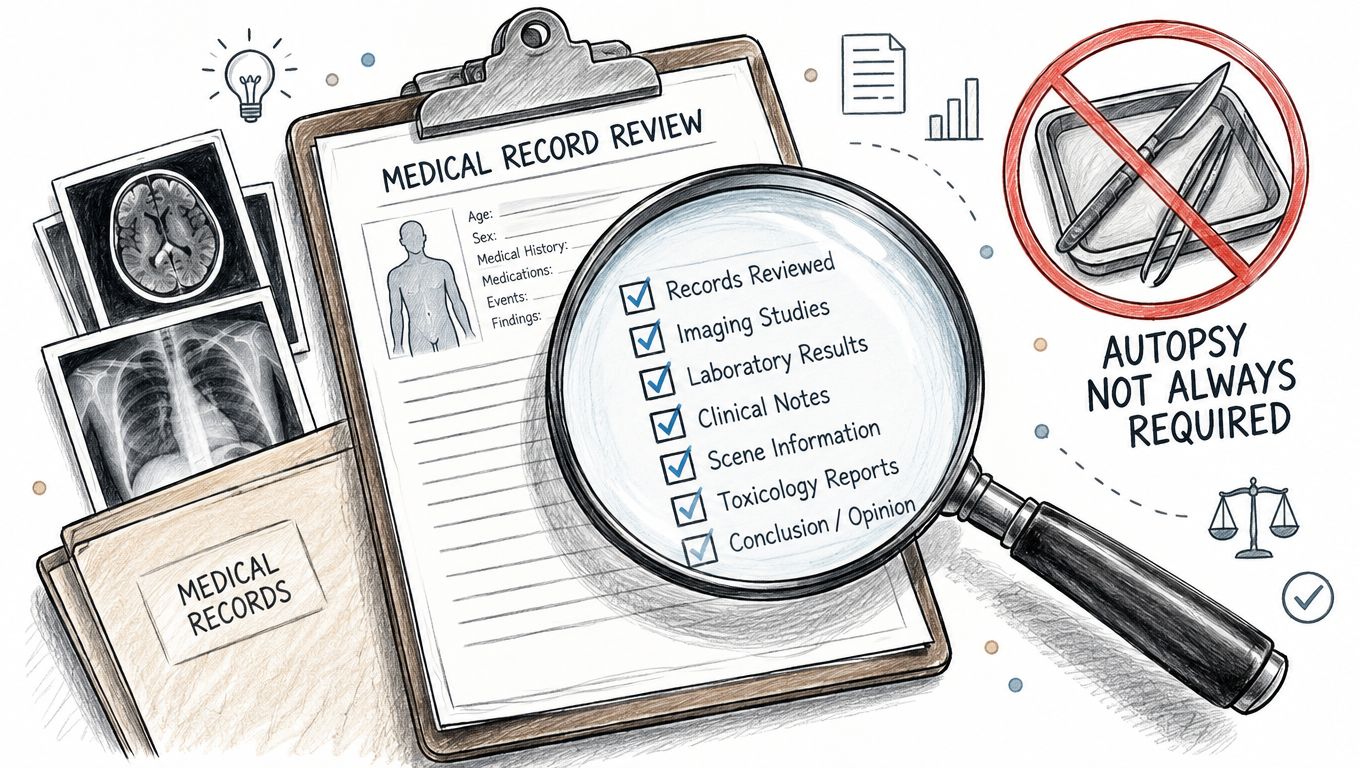
A review always requires another dissection
A second-opinion review often begins with the existing evidence: the autopsy report, photographs, imaging, medical records, toxicology, and preserved histology. If the body or retained tissue remains available, another examination may be considered. The appropriate method depends on the medical question and the material that can be examined.
A records-based review can still help after the body has been released, cremated, or buried. Tissue slides and blocks may add information, but their value depends on what was collected, preserved, labeled, and made available.
Requesting a review means someone did something wrong
An independent review does not establish negligence, misconduct, or an incorrect original opinion. It functions as a quality-control step, much like having a second specialist examine a difficult clinical case. Ontario's forensic pathology service used peer review routinely within its public death-investigation system. In one period, each reviewing pathologist completed about 10 reviews per year, and in a later period, about 12 (Ontario forensic pathology timeline).
A second opinion must reach a different conclusion
Agreement can be the useful result. A reviewer may support the original cause and manner of death while explaining the evidence more clearly, addressing unresolved questions, or identifying why an alternative interpretation is weaker. That explanation may also help an attorney assess whether the opinion fits Texas medicolegal requirements and the evidence expected in court.
Digital tools can replace the autopsy
Digital pathology, imaging, and AI-assisted analysis can supplement physical evidence and ancillary testing. They do not remove the need to preserve specimens or apply professional judgment. Current reviews describe a combined approach using conventional autopsy, imaging, molecular diagnostics, and digital pathology (digital pathology and forensic AI review).
How to Order a Review with Texas Autopsy Services
Start with a direct conversation about the question that needs an answer. Families may want clarification of the certified cause of death. Attorneys may need an opinion on a defined medical or forensic issue. County officials may need a structured service for a medicolegal case.
Gather the available material
Useful records may include:
- The original autopsy report and death certificate.
- Toxicology, histology, and laboratory reports.
- Medical records and hospital documentation.
- Autopsy photographs, radiology, and scene photographs.
- Law-enforcement, investigator, or witness materials relevant to the medical opinion.
- The contact information for the agency, funeral home, laboratory, or custodian holding physical evidence.
Don't alter, relabel, or discard slides, tissue blocks, specimens, photographs, or sealed containers. A chain of custody is the documented history of who collected, transferred, stored, examined, and returned evidence. Clear documentation helps show that the material reviewed is the same material collected in the case.
Our team can explain which records are necessary before the review begins and identify gaps that may limit the opinion. Families and attorneys can also read our guidance on reviewing an existing case before sending documents.
Establish the scope and communication plan
The referral should identify the questions to be answered without directing the conclusion. We discuss whether the assignment is a records review, a tissue review, a new examination, or a combination. We also explain what testing is available, what material must be requested from another agency, and what the final report will address.
Every examination is performed by a forensic pathologist certified by the American Board of Pathology. The practice serves all 254 Texas counties, operates from Elgin, Texas, and uses in-house licensed transport when transportation is part of the assignment. Flat-rate, all-inclusive pricing and direct communication with the team help families and attorneys understand the expected scope before work begins.
Texas law also matters. Autopsy authority can rest with a medical examiner, justice of the peace, or county judge depending on the circumstances, and Texas law provides procedures for authorized autopsies and physician opinions about whether an autopsy is necessary (Texas Code of Criminal Procedure Chapter 49). The Texas Funeral Service Commission and Texas Health & Safety Code also govern relevant funeral, disposition, and cremation matters. The responsible agency and applicable statute should be confirmed for the specific case.
Frequently Asked Questions
How long does a forensic pathology review take?
There isn't a universal turnaround time. The scope, completeness of the records, availability of slides and specimens, need for additional testing, and legal deadlines all affect the schedule. We discuss the expected sequence before accepting the assignment rather than making an unconditional promise.
Is a second opinion autopsy the same as a new autopsy?
No. A second opinion may be based entirely on existing records and tissue. A new examination is a separate physical procedure that may be considered when the body remains available and the circumstances support it.
Can a review change the cause of death?
It can confirm the original conclusion, identify a different cause, or determine that the evidence is insufficient for a more specific opinion. An expert analysis reported changes to the cause of death in 22% of reviewed cases and to the manner of death in 19% (NCBI guidance on second autopsy and forensic review).
What should a family preserve?
Keep the original reports, photographs, laboratory results, medical records, and contact information for the agencies holding tissue or specimens. Don't move or alter sealed evidence. Ask the custodian how a formal transfer can be documented.
Can the reviewer testify?
A forensic pathology reviewer may be asked to explain the written opinion in a deposition, hearing, or trial. Testimony depends on the assignment, the evidence, the court's requirements, and the expert's availability.
Texas Autopsy Services provides independent forensic pathology reviews, private autopsy services, evidence coordination, and written cause-of-death opinions for families, attorneys, healthcare professionals, and Texas counties. Contact our team to discuss the records, questions, and chain-of-custody needs in your case, then visit Texas Autopsy Services for a confidential starting point.