October 10, 2026 · Texas Autopsy Services
Chain of Custody Report: Essential Fields and Evidence
Understand a chain of custody report step by step. Learn required fields, timestamps, signatures, sample templates, and how Texas Autopsy Services ensures
On this page
- Understanding the Chain of Custody Concept
- The Five Core Risks Chain of Custody Prevents
- Required Fields in a Complete Chain of Custody Report
- Reading Timestamps and Signature Trails
- Evidence Logs and Sample Templates
- Digital Evidence and Derivative Files
- Evaluating Legal Strength and Evidentiary Value
- How Texas Autopsy Services Ensures Compliance
- Using the Report in Investigations and Litigation
- Quick-Reference Summary of Key Requirements
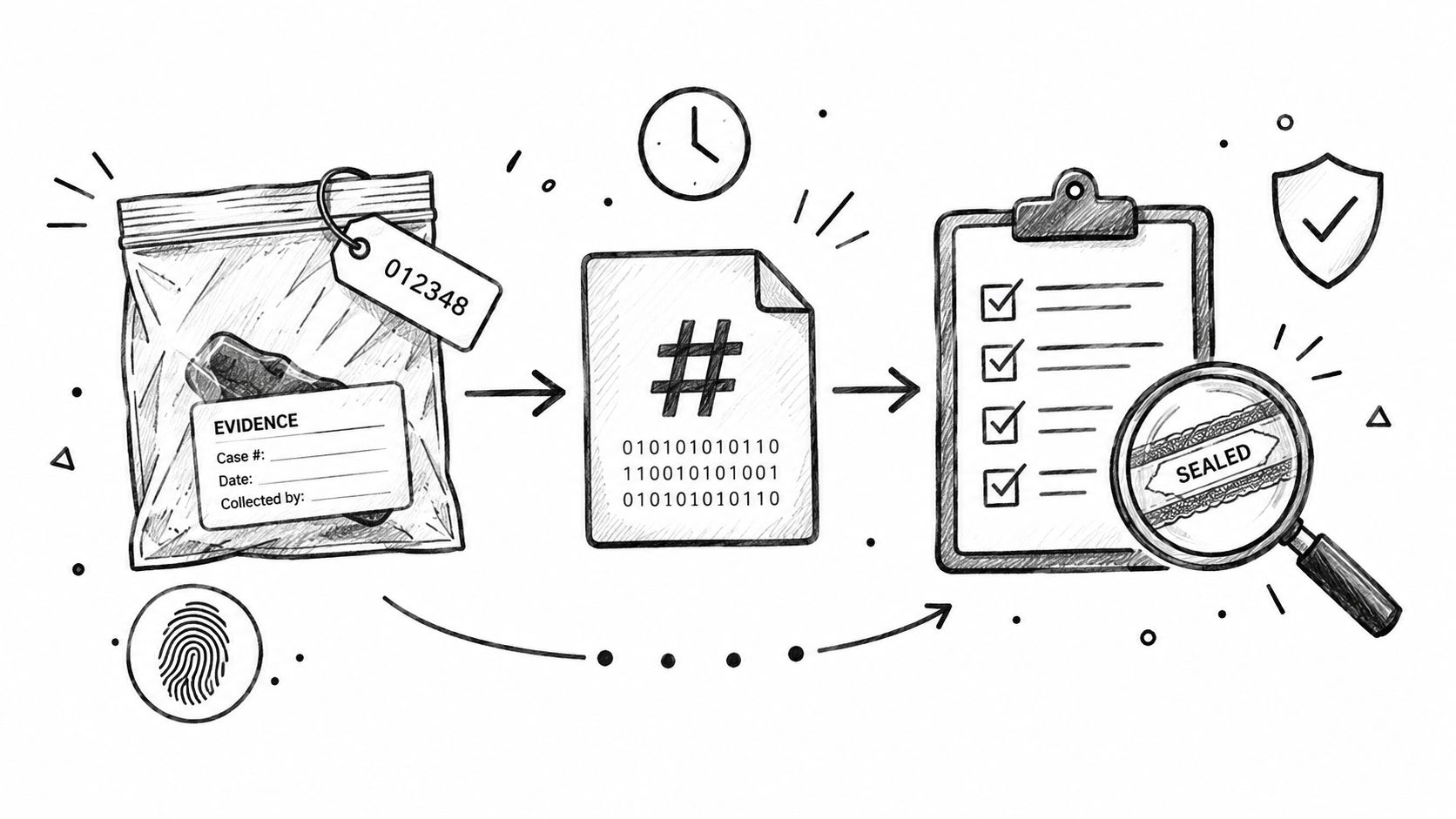
A chain of custody report is a chronological record tracking physical evidence from collection through court presentation, identifying every person who handled it. It documents each item's location, condition, packaging, transfer, storage, examination, and final disposition so others can evaluate whether the evidence remained authentic and intact.
A family may request an independent autopsy after receiving a death certificate that leaves important questions unanswered. An attorney may need to determine whether tissue, toxicology samples, photographs, or prior medical records can support a legal claim. In either situation, the medical findings matter, but so does the documented history of every item used to reach those findings.
- Purpose: Shows where evidence went and who controlled it.
- Risk control: Helps prevent substitution, tampering, mistaken identity, damage, contamination, loss, and falsification.
- Required detail: Includes identifiers, condition, packaging, dates, times, custodians, transfer reasons, storage, testing, and disposition.
- Digital protection: Preserves original files, hashes, metadata, access records, and the relationship between original and working copies.
- Legal value: A complete record can support authenticity, while unexplained gaps may reduce evidentiary weight or create admissibility challenges.
Understanding the Chain of Custody Concept
A private autopsy specimen may begin as a tissue sample collected during examination. It can then move into a sealed container, licensed transport, secure storage, laboratory intake, testing, resealing, return, and final disposition. If the record jumps from collection directly to laboratory results, an attorney or family may not be able to determine who controlled the specimen during the missing interval.
That gap doesn't automatically prove that anyone altered the sample. It does create an unanswered question about authenticity, contamination, degradation, or loss. The National Institute of Justice guidance on chain of custody explains that the record should identify where evidence was found, who collected it, how it was packaged and sealed, and every person who later received or transferred it.
Why the record matters to families
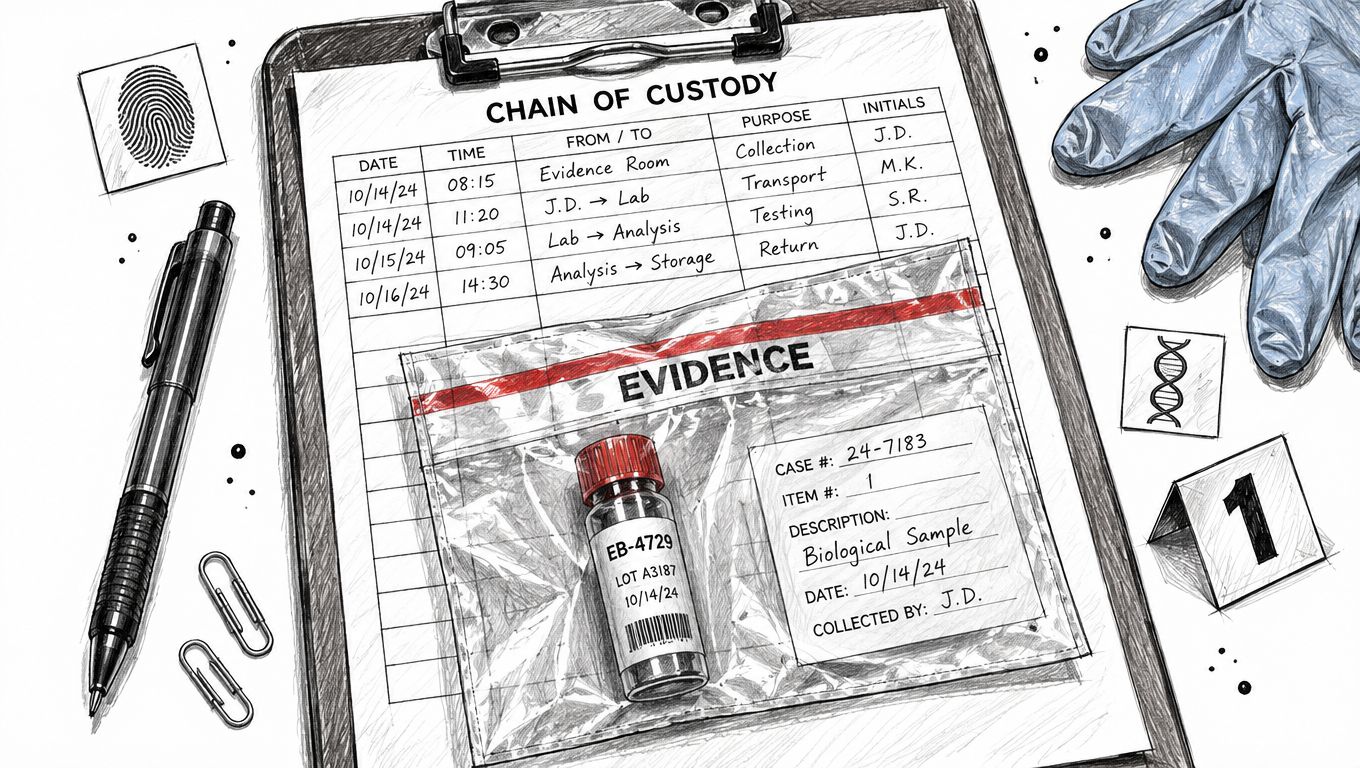
For families, chain-of-custody documentation supports confidence that the laboratory result belongs to the deceased person and the identified specimen. For attorneys, it helps reconstruct the handling history and identify whether a custody interval deserves further investigation.
The same principle applies to blood, urine, toxicology materials, clothing, personal effects, slides, radiology, photographs, medical records, and electronic files. A reliable report follows each item through collection, sealing, transport, storage, examination, testing, reporting, and disposition.
Practical rule: A chain of custody report should allow another person to reconstruct what happened without relying on memory or assumptions.
The Five Core Risks Chain of Custody Prevents
The NIJ identifies five core risks that a properly documented process is designed to prevent: substitution, tampering, mistaken identity, damage or alteration, and contamination. The guidance also addresses evidence being misplaced or falsified. These are separate risks because each can affect an autopsy material in a different way.
Substitution occurs when one item is replaced with another. A unique specimen identifier, matching seal information, and documented handoffs help show that the tested material is the material collected.
Tampering concerns intentional interference with the item or its packaging. Seal condition at collection, receipt, opening, resealing, and later transfer can reveal whether the package remained protected.
Mistaken identity arises when specimens are confused. This can occur when multiple tissue containers, slides, toxicology tubes, or personal effects move through the same practice or laboratory. Item numbers, descriptions, labels, and condition records reduce that risk.
Damage or alteration may result from improper handling, transport, storage, or processing. A report should identify relevant storage conditions and record examination, repackaging, or other changes.
Contamination occurs when an outside substance or material affects the specimen. Documented packaging, restricted access, controlled storage, and clear laboratory intake records help establish how contamination risks were managed.
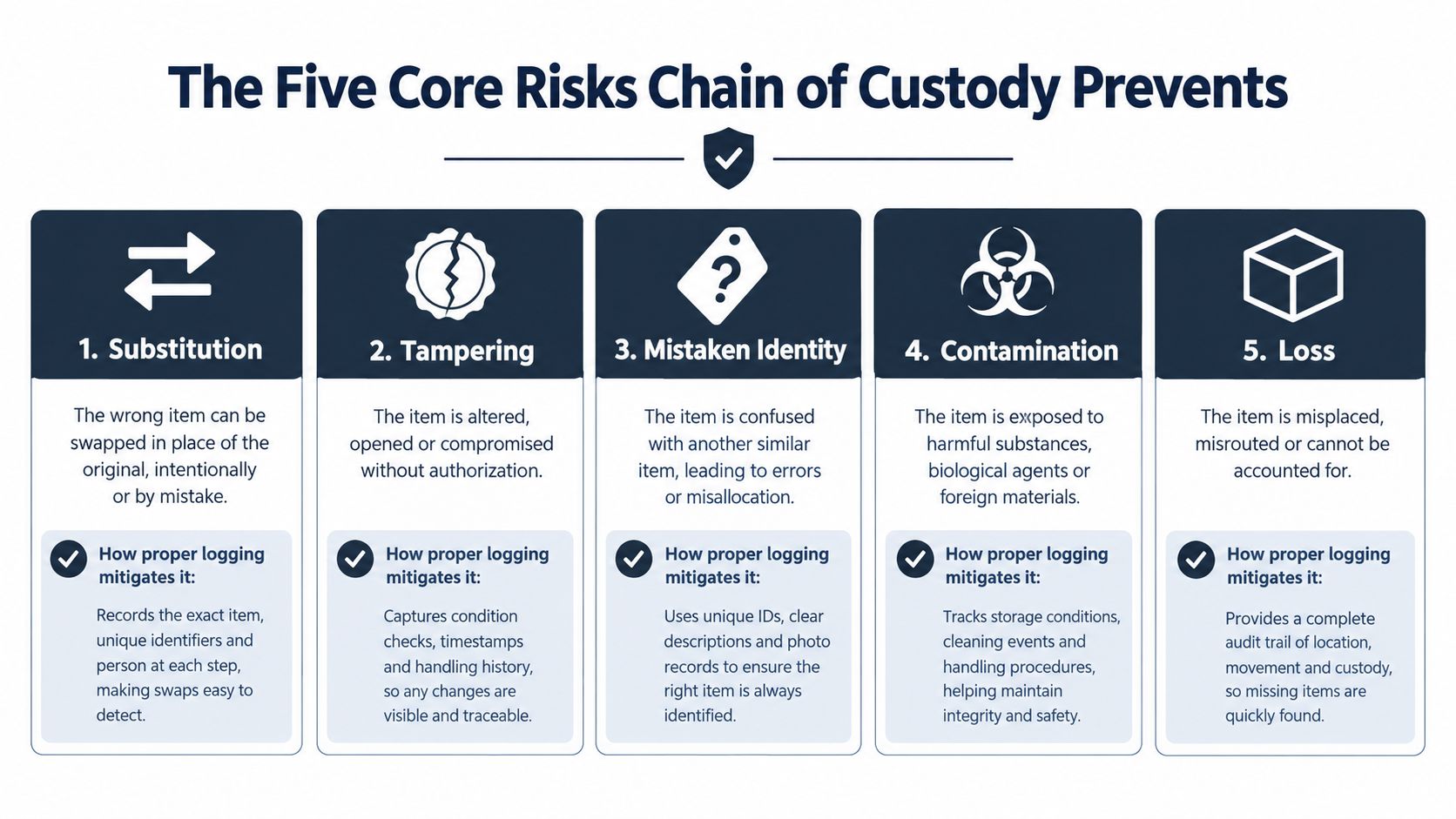
A missing transfer time may matter because it leaves the custody interval unclear. An unidentified storage period may matter because the reviewer can't determine where the specimen was held or who could access it. The report's value comes from addressing these risks through a continuous record, not from using a particular form design.
Required Fields in a Complete Chain of Custody Report
A complete report should describe an item from recovery through final disposition. ISO 21043 defines chain of custody as a chronological, auditable record covering collection, identification, custody, control, transfer, handling, storage, examination, return, and disposal. The ISO 21043 standards overview from NIST places chain of custody within the broader forensic process from recognition and recording through courtroom presentation.
The practical checklist
At minimum, review the report for:
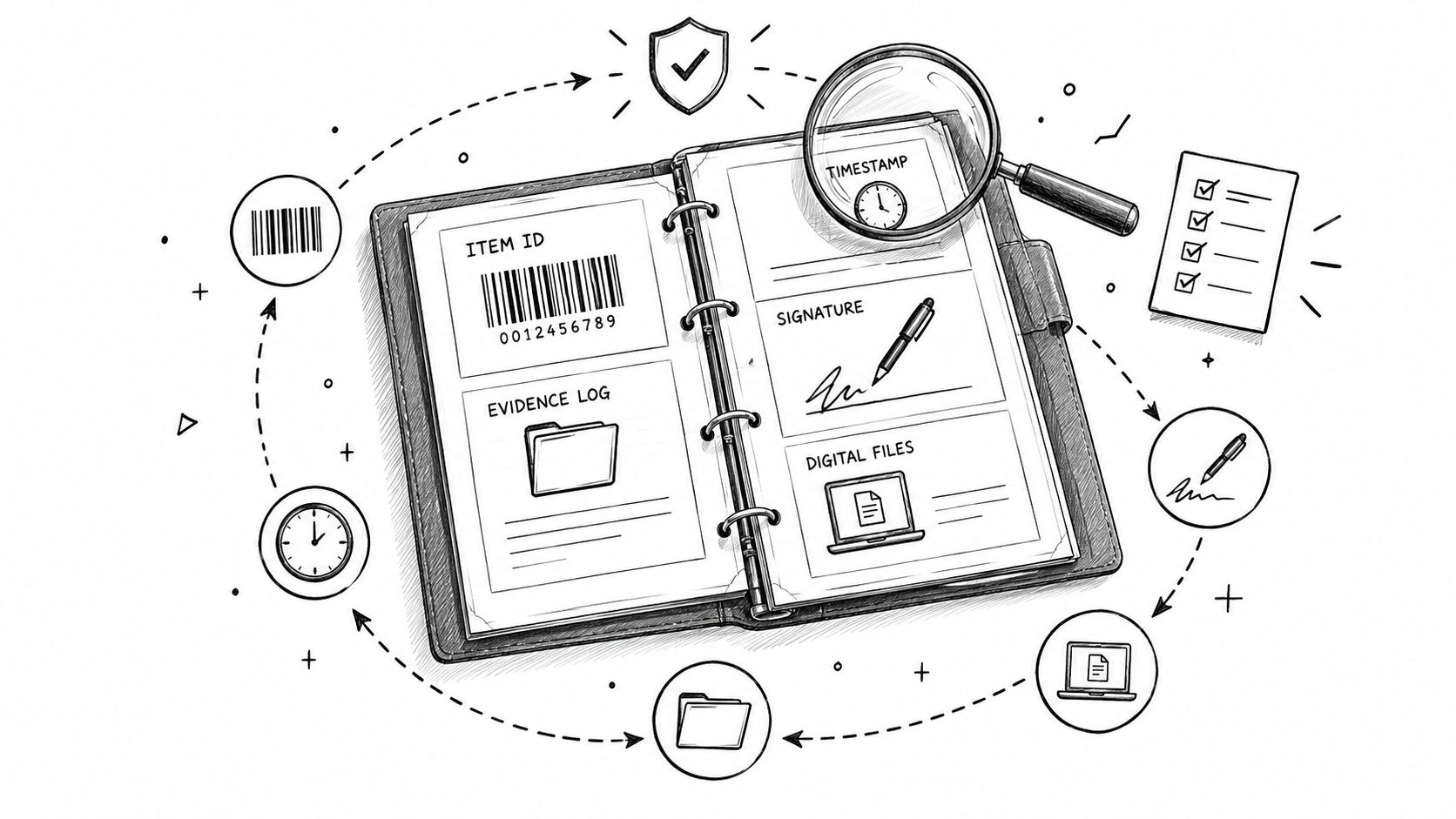
- Unique identifier: A case, item, specimen, or exhibit number that distinguishes the material from every other item.
- Recovery details: The date, time, and location where the item was collected or received.
- Item description: The type of material, quantity or identifying features when relevant, and the condition at intake.
- Packaging and seal condition: The container, seal, closure, and any visible damage or change.
- Custodian identity: The name, signature, initials, or approved electronic equivalent of each person releasing or receiving the item.
- Transfer details: The date, time, destination, purpose, and method of every handoff.
- Storage information: The location and relevant conditions during controlled storage.
- Testing and handling: Laboratory intake, examination, opening, repackaging, resealing, and return.
- Final disposition: The current location, return, release, retention, or disposal of the item.
| Field Category | Purpose | Example Entry |
|---|---|---|
| Item identification | Connects the record to the correct specimen | Tissue specimen, case item number, container identifier |
| Collection and condition | Establishes the starting point | Collection location, date, time, sealed condition |
| Custody transfer | Shows who controlled the item | Released by, received by, date, time, purpose |
| Storage and examination | Accounts for custody intervals | Secure storage location, laboratory intake, examination |
| Disposition | Closes the record | Returned, retained, transferred, or disposed of |
A report may contain additional context, such as shipment tracking or storage-condition documentation. For a practical example of the paperwork and fields used in this setting, review the chain of custody form for autopsy materials.
Reading Timestamps and Signature Trails
A custody record should read like a relay handoff log. One person releases the item, the next person receives it, and the time sequence shows whether control stayed continuous. Start at the first entry and follow the item forward. Each line should connect cleanly to the next, with no handoff that appears to come from nowhere and no recipient who cannot be identified.
In autopsy-related evidence, that timeline often moves through collection, sealing, transport, receipt, controlled storage, laboratory intake, examination, resealing, return, and final disposition. The wording and layout can vary by agency or laboratory, but the sequence still has to be easy to reconstruct. The NIJ guidance on maintaining chain of custody states that each person who handles evidence should make a log entry or sign a receipt.
When lawyers or families review a report, the strongest pages usually answer four quiet questions without forcing the reader to guess: Who had the item, when did they have it, why did it move, and what condition was it in at the time?
Problems usually appear in patterns. An unexplained interval means the location or custodian is missing for part of the timeline. A signature mismatch means the named recipient does not match the signature, initials, or electronic record. Timestamp conflicts put entries out of order. Unclear corrections hide the original entry instead of preserving it and showing who made the change, when, and why. A shipment entry without receipt information leaves the transfer unfinished on paper.
Some defects are minor. A typographical error may be administrative if the item identifier, specimen description, transfer details, and surrounding records still show what happened. A gap in custody is harder to dismiss because it blocks any reliable assessment of control during that period.
Digital files need the same disciplined reading. Photographs, scans, and derivative image files may contain metadata about source, creation, and handling, but that information also has to be preserved and interpreted carefully. For a practical primer, attorneys and families can review how to read image metadata.
Evidence Logs and Sample Templates
A good evidence log reads less like a checklist and more like a chain map. If a family member asks where a ring went, or an attorney asks who opened a toxicology vial, the answer should be traceable on the page without stitching together vague references. That is why autopsy materials are logged as separate records. A slide, a sealed specimen container, clothing, personal effects, and photographs may come from one examination, but each item needs its own identifier and its own history.
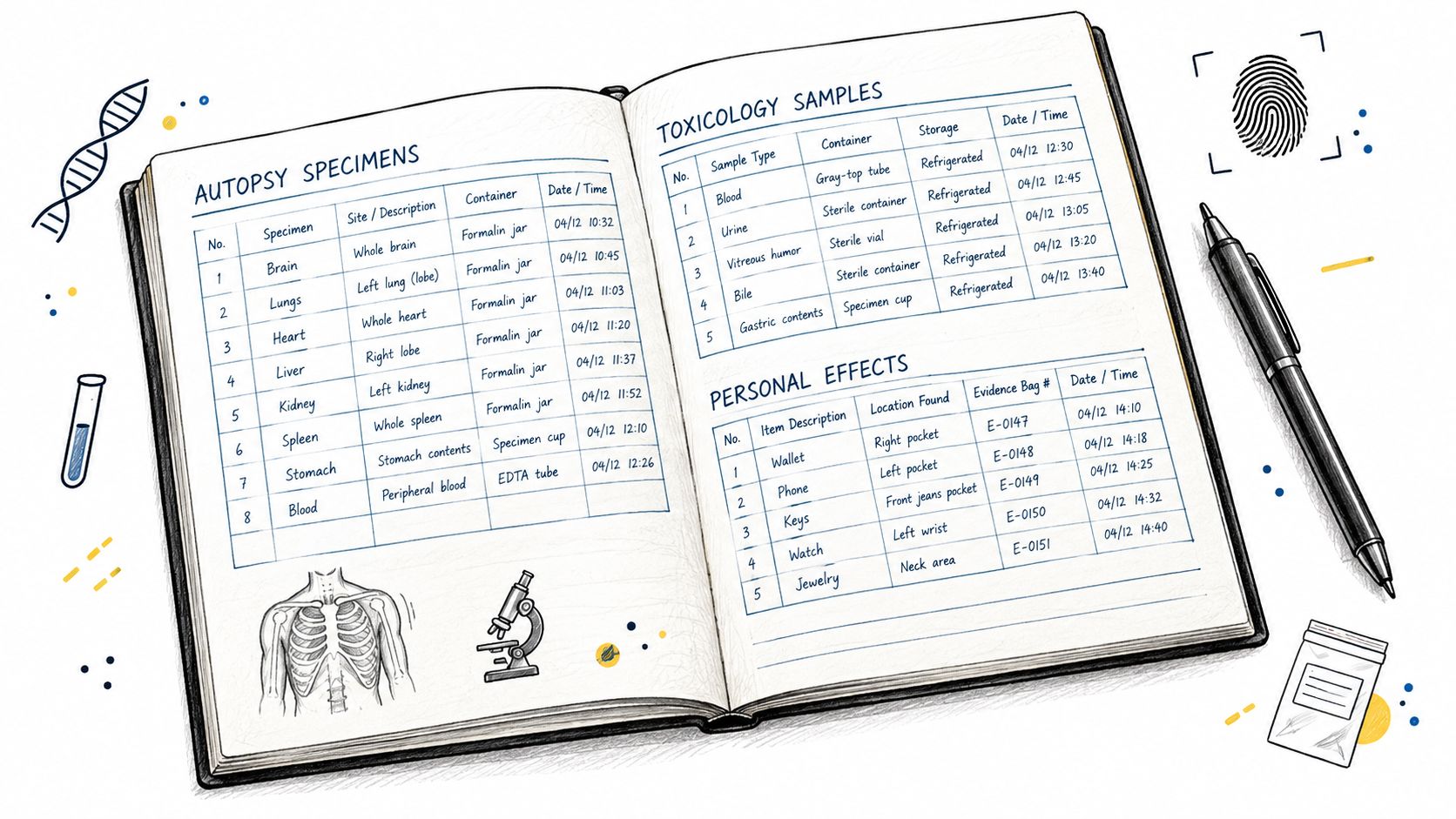
One practical way to build the page is to follow the item through its life cycle. Start with collection details: the identifier, description, where it was collected, its condition, packaging, seal, date, and time. Then record the handoff, who released it, who transported it, where it was sent, and whether receipt was documented. After that, the log should show laboratory intake, including condition on arrival, inventory check, receiving custodian, and storage location. If the item is opened, examined, repackaged, or resealed, that action needs its own entry. The record closes with retention, return, release, or disposal.
A sample entry helps clarify the difference between a template and a finished report. “Item T-04, sealed tissue container, collected during examination, released by the examining custodian for licensed transport, received by the laboratory intake custodian, stored in the assigned secure location, opened for examination, resealed, and returned for retained storage.” That sentence gives the sequence. A legally useful report adds the missing proof points: dates, times, signatures, conditions, and matching identifiers.
Templates help people record the same fields in the same order, which reduces avoidable omissions. Digital tools can organize those entries, and an AI documentation features overview shows how structured documentation systems can support that process. The custodian still has to confirm that the entry is correct.
Packaging also matters. Different containers call for different handling and labeling practices, as explained in this chain of custody bags guide. The template is only a frame. The legal strength comes from whether every item can be followed, line by line, from collection to final disposition.
Digital Evidence and Derivative Files
A tissue container shows tampering when a seal is broken. A digital autopsy file may show nothing at all. That difference is why digital chain of custody needs its own rules for photographs, radiology images, scanned records, electronic medical records, laboratory data, report revisions, and transmitted files.
With physical evidence, the eye often helps. With digital evidence, integrity has to be proved from the record. NIST explains that the file's source, method of creation, transfer path, and integrity checks should all be documented in a way another reviewer can follow later in court or consultation (forensic guidance on digital image integrity).
A strong file history usually answers a practical question: what was the original, what changed, and who did it? For that reason, the original file should be preserved as read-only or otherwise protected, and any working version should stay separate. At intake or acquisition, the custodian should record the acquisition date, the device or system source, file format, examiner, and any software used for conversion or review. Hash values and digital signatures help show that a file remained unchanged, especially when the file is transferred, exported, or later offered as an exhibit.
Derivative files need their own paper trail. An annotated image, compressed copy, screenshot, exported report, or presentation exhibit may be useful, but it is not automatically the same as the original. The report should connect each derivative back to the source file and explain the reason for the change, such as enhancement for review or format conversion for disclosure.
Access controls matter too. Individual authentication, role-based permissions, audit logs, and sound cybersecurity considerations for chain of custody help show who opened, copied, revised, or transmitted a file.
Evaluating Legal Strength and Evidentiary Value
A chain-of-custody report can be present yet still be weak. Legal strength depends on whether the record connects the specific evidence to its collection, accounts for every custody interval, identifies each custodian, and explains storage, testing, and disposition. The question is not only whether a form exists, but whether another person can reconstruct the item's history from it.
A minor clerical imperfection may not undermine an otherwise continuous record. For example, a typographical error in a specimen description may be clarified by the case identifier, matching seal, laboratory intake record, and surrounding entries. By contrast, an unexplained period with no identified custodian may permit an authenticity, contamination, degradation, or tampering challenge.
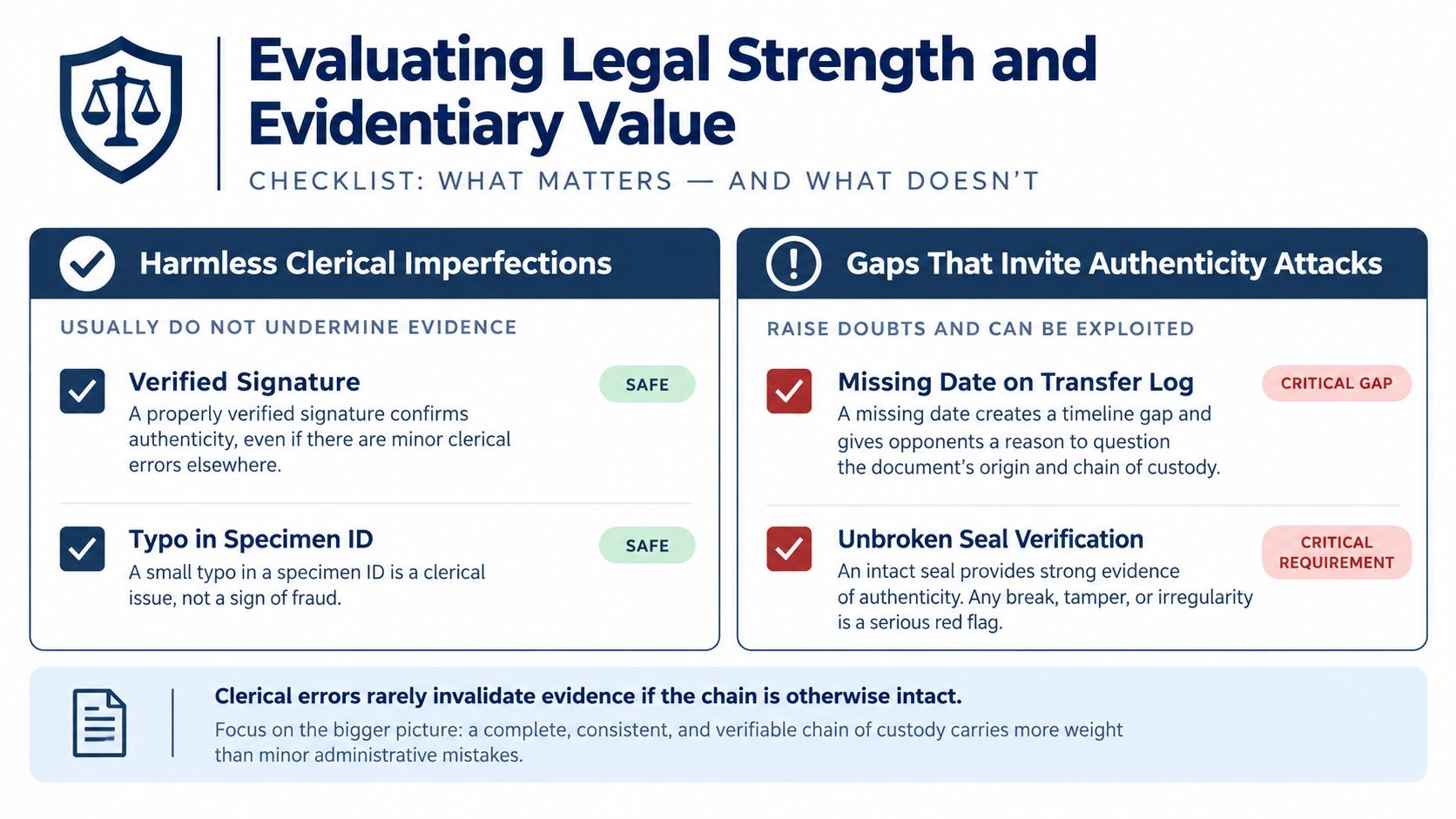
A practical comparison
| Stronger record | More vulnerable record |
|---|---|
| Unique identifier matches the inventory and laboratory result | Specimen description changes without explanation |
| Every transfer has a releasing and receiving custodian | A handoff appears without a receiving person |
| Dates and times form a continuous sequence | Storage begins or ends without a recorded event |
| Seal condition is documented at relevant stages | Packaging changes with no reason or signature |
| Original digital files and hashes are preserved | Only an edited copy or screenshot remains |
| Final disposition is recorded | The current location is unknown |
In private autopsy work, custody may involve a family, funeral home, transport provider, pathology practice, outside laboratory, and legal team. Each additional participant creates a need for a clear handoff. A defect doesn't automatically prove alteration, but it may affect credibility, admissibility, or the weight a judge or jury gives the evidence.
How Texas Autopsy Services Ensures Compliance
Texas Autopsy Services is an independent private autopsy and forensic pathology practice based in Elgin, serving all 254 Texas counties. Our team uses documented handling for transport, secure storage, examination, laboratory transfer, digital imaging, and reporting. Every examination is performed by a board-certified forensic pathologist certified by the American Board of Pathology.
The process is designed around the same core principles described by ISO, NIST, NIJ, and FBI quality-assurance guidance. Each relevant item receives an identifier, condition and packaging details are recorded, custody changes are documented, and final disposition is reconciled with the examination inventory.
What the workflow addresses
- Transport: In-house licensed transport records the movement of remains and materials between locations.
- Storage: Secure, controlled-access and temperature-controlled storage supports preservation of biological materials.
- Laboratory transfer: Tissue, fluids, toxicology specimens, slides, and retained samples are documented when released and received.
- Digital materials: Photographs, imaging, reports, and related files are linked to physical evidence identifiers when appropriate, with controls for originals and working copies.
- Reporting: HIPAA-compliant reporting connects circumstances, examination findings, laboratory data, and the cause-of-death opinion.
- Communication: Families, attorneys, healthcare professionals, and county officials communicate directly with the team rather than relying on an anonymous call center.
A forensic report should distinguish cause of death, the disease, injury, or condition that produced death, from manner of death, the classification describing how the death occurred, such as natural, accident, suicide, homicide, or undetermined when applicable. These opinions require medical and forensic analysis, and they shouldn't be inferred from a custody form alone.
Using the Report in Investigations and Litigation
Begin with the item inventory, not the conclusion. List every specimen, slide, photograph, record, personal effect, and digital file relied on by the autopsy or laboratory work. Then compare each item against the chain-of-custody entries to determine whether the identifier, condition, transfer history, and disposition match.
A review method for counsel
- Map the custody sequence: Put collection, transport, storage, intake, examination, testing, resealing, and disposition in chronological order.
- Identify each custodian: Confirm who released, transported, received, opened, examined, stored, and returned the item.
- Compare related records: Check the chain against laboratory accessions, shipping records, examination notes, photographs, and the final report.
- Separate errors from gaps: Ask whether a clerical mistake can be resolved from surrounding documentation or whether an entire interval is unaccounted for.
- Frame focused questions: Ask when the item was received, where it was stored, who had access, whether the seal was intact, and what changed during examination.
Counsel may use these answers when deciding whether to seek additional records, request testimony, challenge authenticity, or argue that evidence should receive reduced weight. A custody issue doesn't decide the legal outcome by itself. The significance depends on the missing information and the applicable court rules.
Legal teams may also use administrative support, including hire virtual paralegals for organizing records and building a chronology. That work should preserve original documents and clearly distinguish source records from summaries or attorney-created working files.
Quick-Reference Summary of Key Requirements
The following table provides a compact reference for reviewing a chain of custody report connected to an autopsy or forensic examination.
| Review area | What the report should show | Why it matters |
|---|---|---|
| Identification | Unique case and item identifiers | Connects each result to the correct evidence |
| Collection | Location, date, time, collector, condition | Establishes the starting point |
| Packaging | Container, seal, and condition | Helps address substitution and tampering |
| Transfers | Releasing and receiving custodians, date, time, purpose | Accounts for every handoff |
| Storage | Location and relevant conditions | Explains custody between active events |
| Examination | Opening, testing, handling, repackaging, resealing | Shows what happened to the item |
| Digital files | Source, original preservation, hash, metadata, access history | Supports integrity and reproducibility |
| Disposition | Return, retention, transfer, or disposal | Closes the custody record |
| Legal evaluation | Continuous intervals and explained corrections | Distinguishes clerical issues from material gaps |
A sound record should also connect physical and digital evidence. The photograph, laboratory result, tissue specimen, interpretation, and final report version should be traceable to one another without relying on informal explanations. When the record is complete, families and attorneys can assess not only what the forensic examination concluded, but how the underlying evidence was protected.
Texas Autopsy Services provides independent autopsy, second-opinion, transport, storage, laboratory coordination, and chain-of-custody documentation for families, attorneys, healthcare professionals, and Texas counties. If you need help preserving or reviewing evidence after a death, contact Texas Autopsy Services to discuss the circumstances and available next steps with our team.