October 8, 2026 · Texas Autopsy Services
Chain of Custody Bags: What They Are and Why They Matter
Learn what chain of custody bags are, how they preserve evidence integrity, and how Texas Autopsy Services uses secure packaging and in-house transport.
On this page
- A Quiet Scenario That Shows Why Packaging Matters
- What a Chain of Custody Bag Actually Is
- Standard Features That Make a Bag Defensible
- How Evidence Is Handled Step by Step
- Matching the Right Bag to the Right Specimen
- How Texas Autopsy Services Closes the Custody Loop
- When a Sealed Bag Has to Be Opened
- Common Questions and How to Reach Our Team
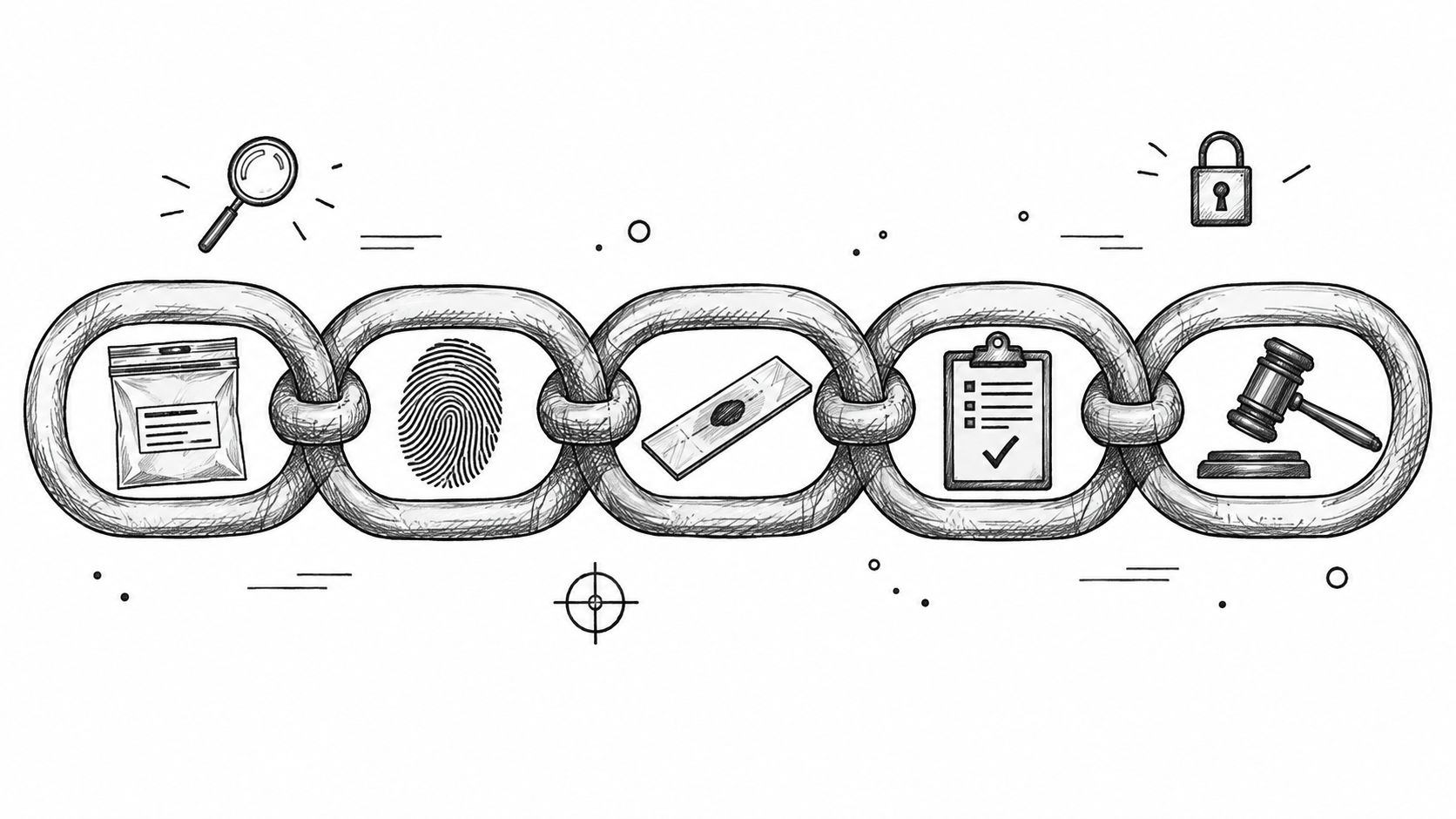
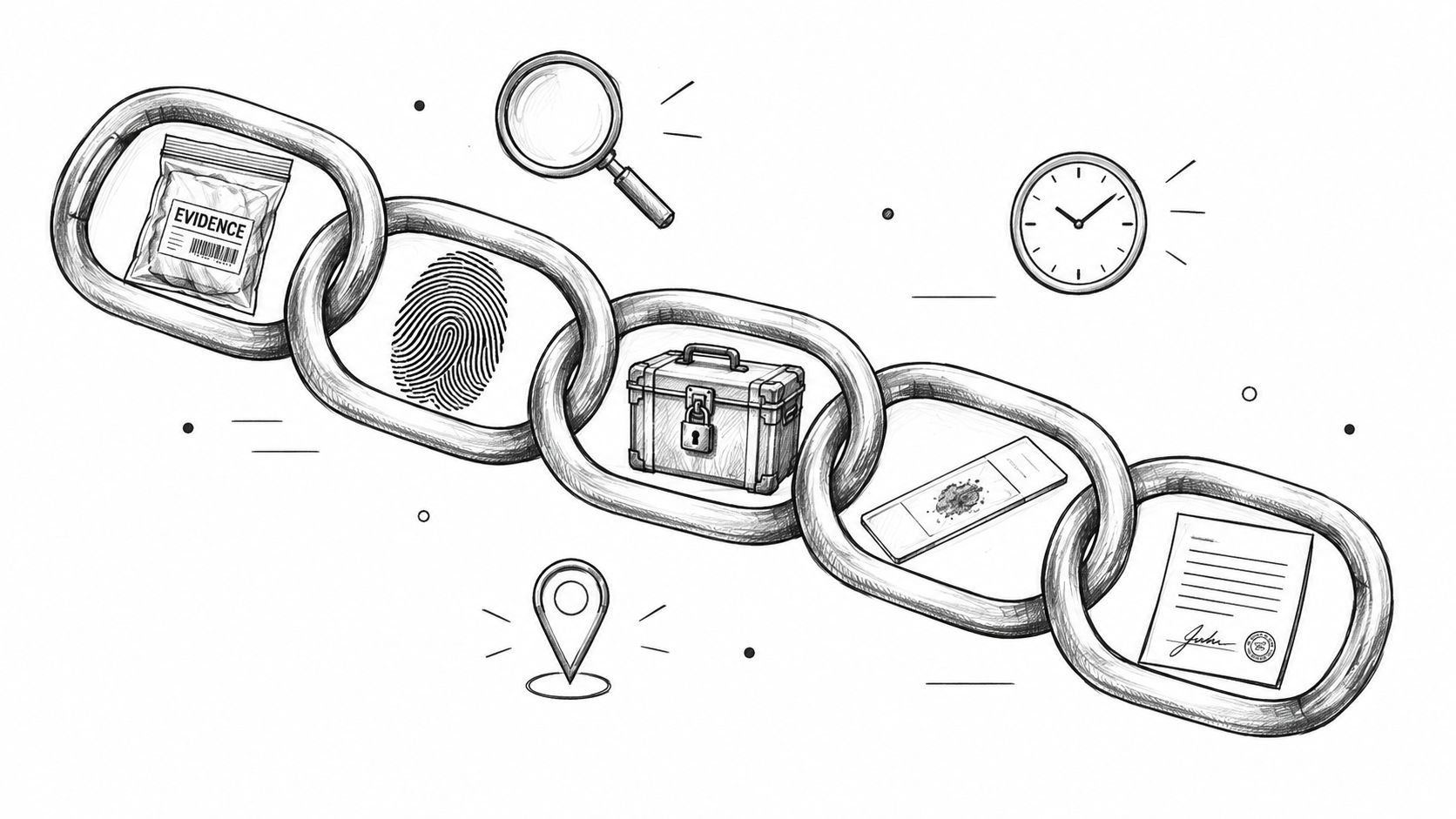
A chain-of-custody bag is more than a sealed container. It's one visible part of a larger system that connects a specimen to its case, documents every handoff, and helps show that the item examined is the same item collected. For families, attorneys, medical professionals, and Texas County officials, that distinction matters when a private autopsy, cause of death investigation, or second-opinion autopsy may later support legal review.
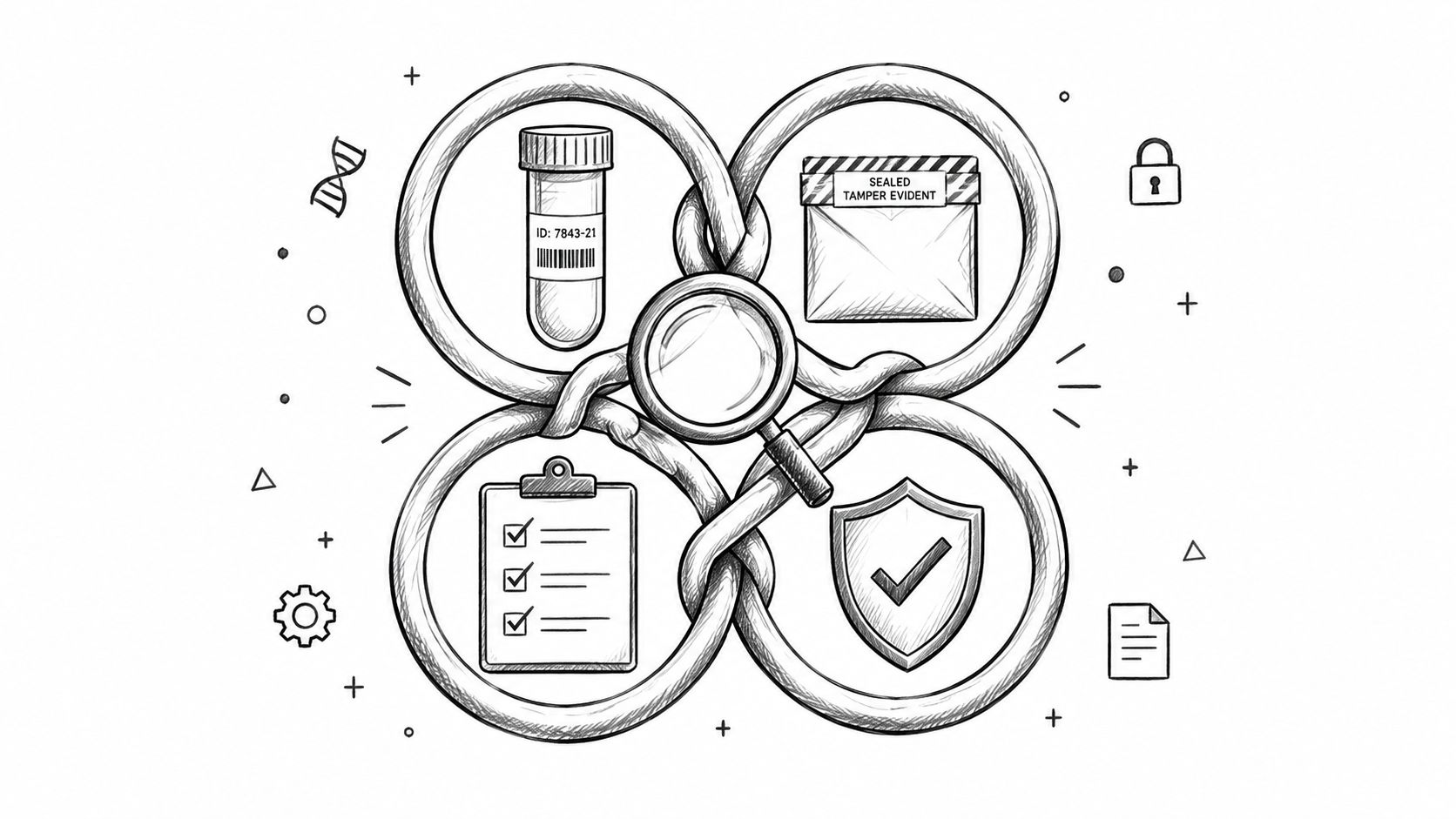
- The bag, seal, label, and custody record work together.
- Specimen type determines the appropriate packaging. Wet biological evidence, dried tissue, clothing, toxicology specimens, sharps, and human remains don't all belong in the same kind of container.
- A chain of custody begins at collection and continues through storage, transport, testing, reporting, and final disposition.
- Opening a sealed package isn't automatically a failure, but the reason, person, condition, and resulting transfer must be documented.
- Texas Autopsy Services applies these principles through licensed transport, secure storage, specimen documentation, and reporting by a forensic pathologist certified by the American Board of Pathology.
A Quiet Scenario That Shows Why Packaging Matters
A family arranges an independent examination after a death and asks that clothing, personal effects, and specimens remain available for additional testing. The body arrives for examination in a sealed transport pouch. Smaller items arrive in labeled containers, each with a closure that shows whether it has been opened.
At first, the process may look straightforward. A team member receives the package, checks the seal, records its condition, and transfers it to secure storage or the examination area. Later, an attorney asks a practical question: Who had possession of this item between transport and examination, and what happened during that handoff?
If the answer depends only on memory, the process has a weakness. A package can appear untouched while the paperwork fails to show when it moved, who received it, why it was opened, or where it was stored. The problem isn't limited to obvious tampering. An unclear label, missing transfer entry, or unexplained change in packaging can make it harder to establish the item's identity and continuity.
That's why we treat chain-of-custody bags as part of a documentation system, not as a product category. The seal helps reveal an unauthorized opening. The label connects the physical item to a case. The custody record explains who possessed it and when. Storage and transport records account for what happened between those points.
For a private autopsy practice, the system can include remains, clothing, tissue, swabs, toxicology specimens, photographs, and personal effects. Each item may have a different packaging need, but every item requires a traceable relationship to the case and a documented history. The purpose is not to create drama around an ordinary handoff. It's to make the handling process understandable and defensible when families, counsel, laboratories, agencies, or courts need answers.
What a Chain of Custody Bag Actually Is
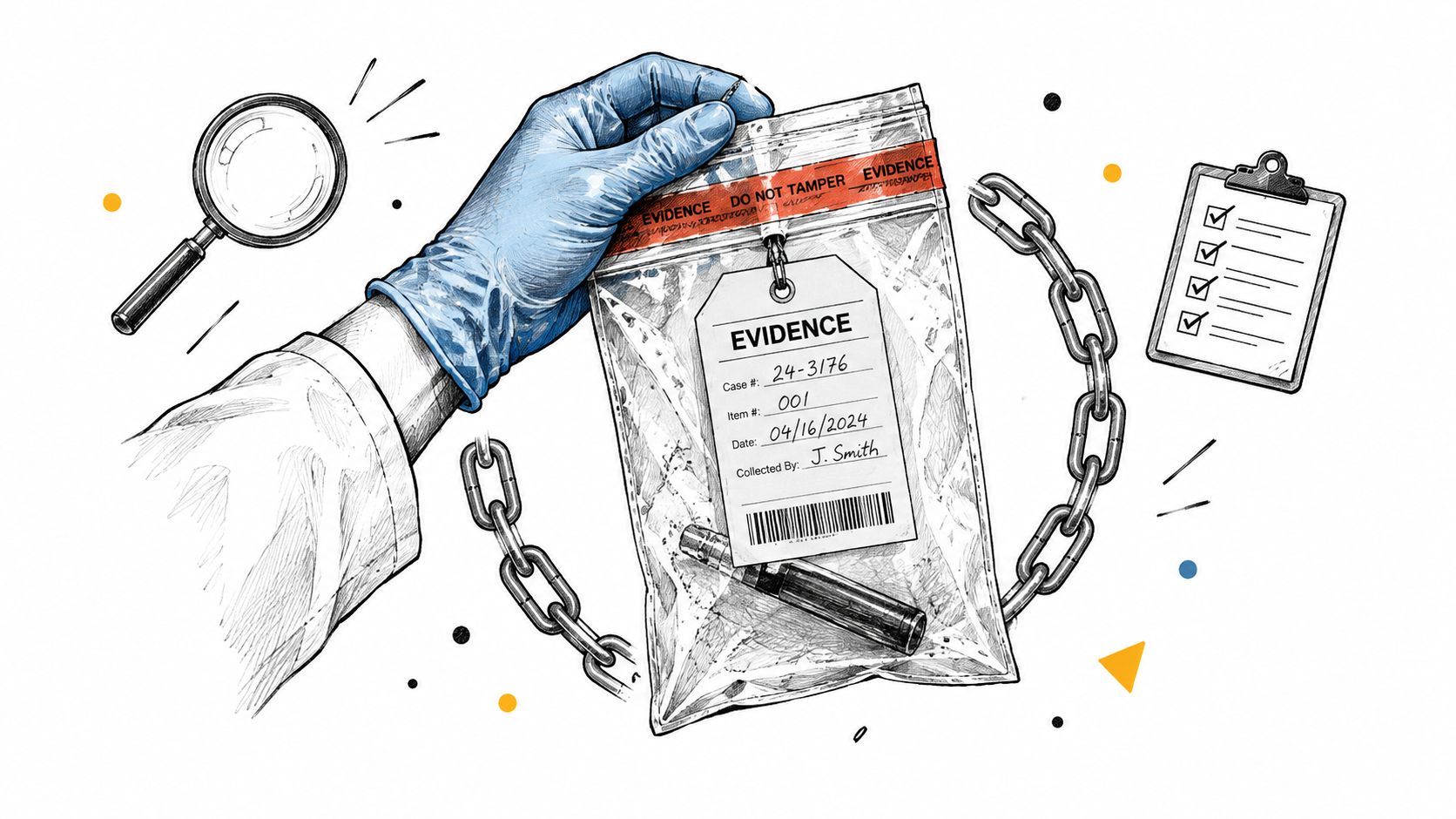
A chain-of-custody bag is a sealed and labeled evidence container used within a larger custody process. The bag protects its contents, the seal indicates whether the package has been breached, and the label connects the item to a case-specific record. None of these parts can replace the others.
A chain of custody is the chronological history of an item from collection through final disposition. NIST guidance on trace evidence recovery states that the chain begins when evidence is collected and continues until it's admitted in court, the case is otherwise resolved, or the item is no longer needed. Records should identify the evidence description, unique case identifier, collection location, storage locations, every person who possessed the item, the purpose of each transfer, and any action performed.
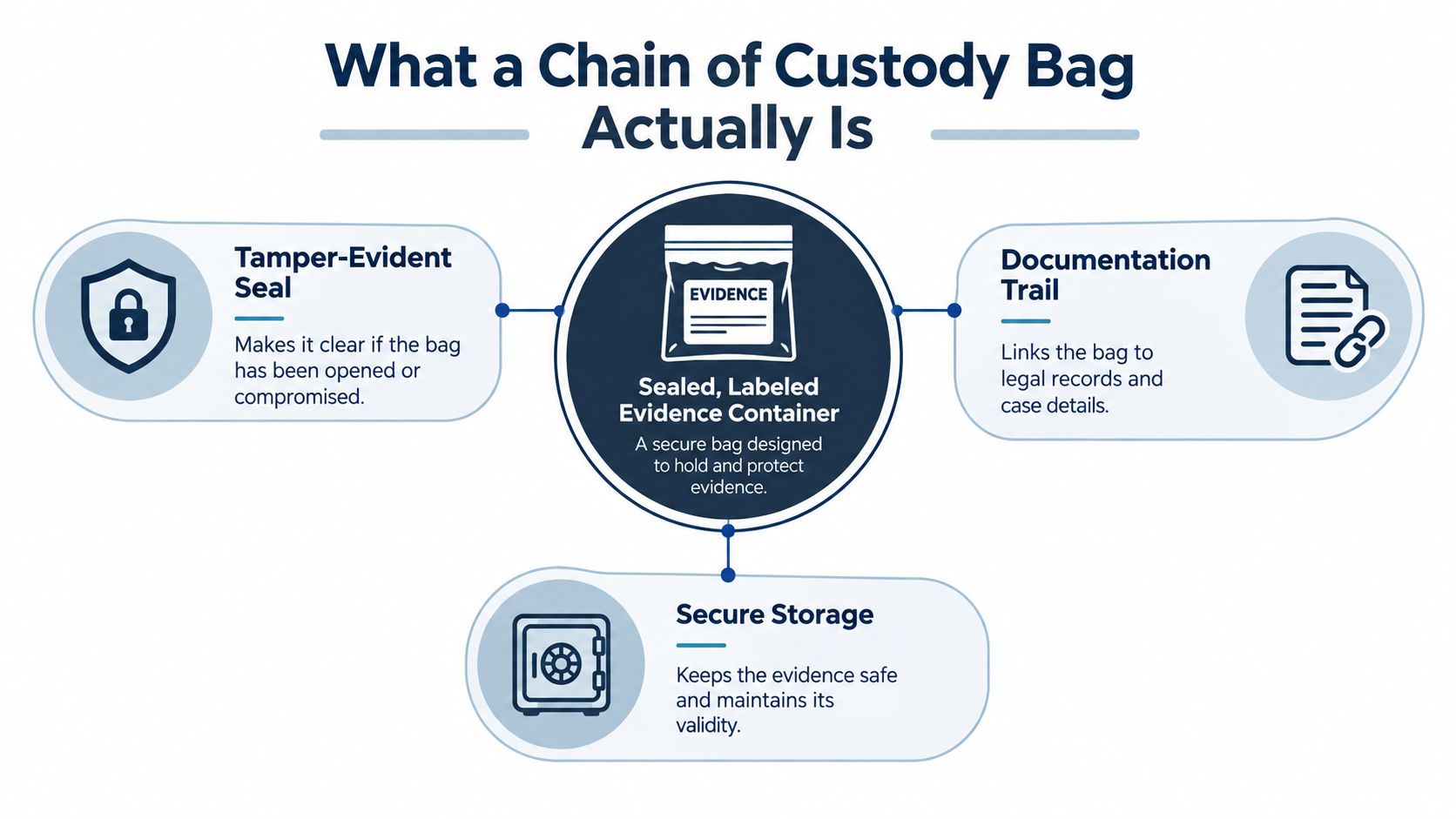
The seal is the closure that helps show whether a package was opened. The label records information such as an evidence identifier, case number, date, collector, or exhibit reference. The custody record captures each change in possession, storage location, transfer purpose, and action such as analysis or repackaging. Secure storage protects the item between documented events.
The terms cause of death and manner of death describe different findings. Cause of death identifies the disease, injury, or combination of conditions that resulted in death. Manner of death classifies the circumstances surrounding death, such as natural, accident, suicide, homicide, or undetermined, when the available evidence supports that classification. Packaging doesn't determine either finding. It helps preserve the materials a forensic pathologist may evaluate when forming an opinion.
Practical rule: A signed bag doesn't prove the entire chain. It proves only one part of the handling history.
Standard Features That Make a Bag Defensible
A reliable bag should allow another person to understand what it contains, who sealed it, and whether the closure has been disturbed. The design should serve the documentation process rather than merely look secure.
A useful inspection begins with the unique identifier. This may be an evidence number, case number, barcode, exhibit number, or another identifier that links the physical package to the relevant records. The number needs to remain legible and durable throughout storage and transport.
The writing surface or printed label should resist ordinary handling. It should provide enough space for essential information without forcing staff to write across a seam or on a portion likely to tear. A package can be physically intact yet difficult to identify if the label is incomplete or unreadable.
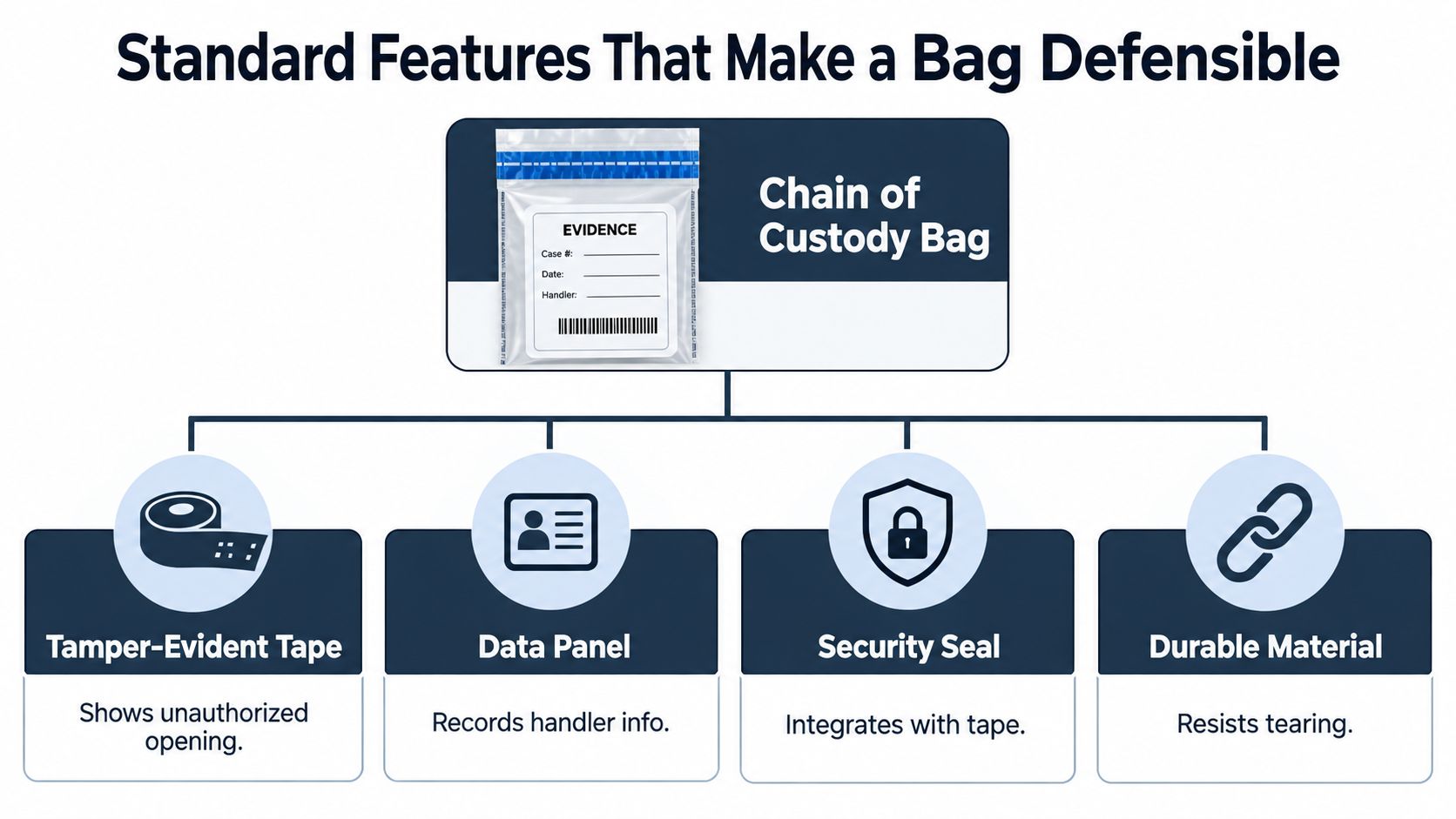
The closure should be tamper-evident, meaning an attempted breach produces visible damage or another clear indication. The Organization of Scientific Area Committees standard, available through NIST's physical evidence preservation standard, defines proper sealing through three criteria:
- Sealer identification: The sealer's initials or unique identifier must be recorded on or across the seal.
- Containment: The package must prevent its contents from escaping.
- Visible breach: Any opening must produce obvious damage to the package or seal.
The signature or initials crossing the closure matter because they connect the person completing the seal to the package itself. A barcode or exhibit field can improve the link between the physical item and an electronic or paper record, but it doesn't replace the transfer history.
The package's material also has a practical role. It must be strong enough for the item, appropriate for its moisture or hazard profile, and compatible with the storage and testing process. FBI laboratory guidance requires sealed inner containers to go inside clean, dry outer containers, with the outer package completely sealed so tampering would be evident. The FBI Handbook of Forensic Services also describes custody records that include signatures from the initial collector or seizing person, the evidence-control technician, and later employees who assume custody until disposal.
How Evidence Is Handled Step by Step
Good evidence handling is built through a sequence of small decisions. The sequence starts before a bag is selected.
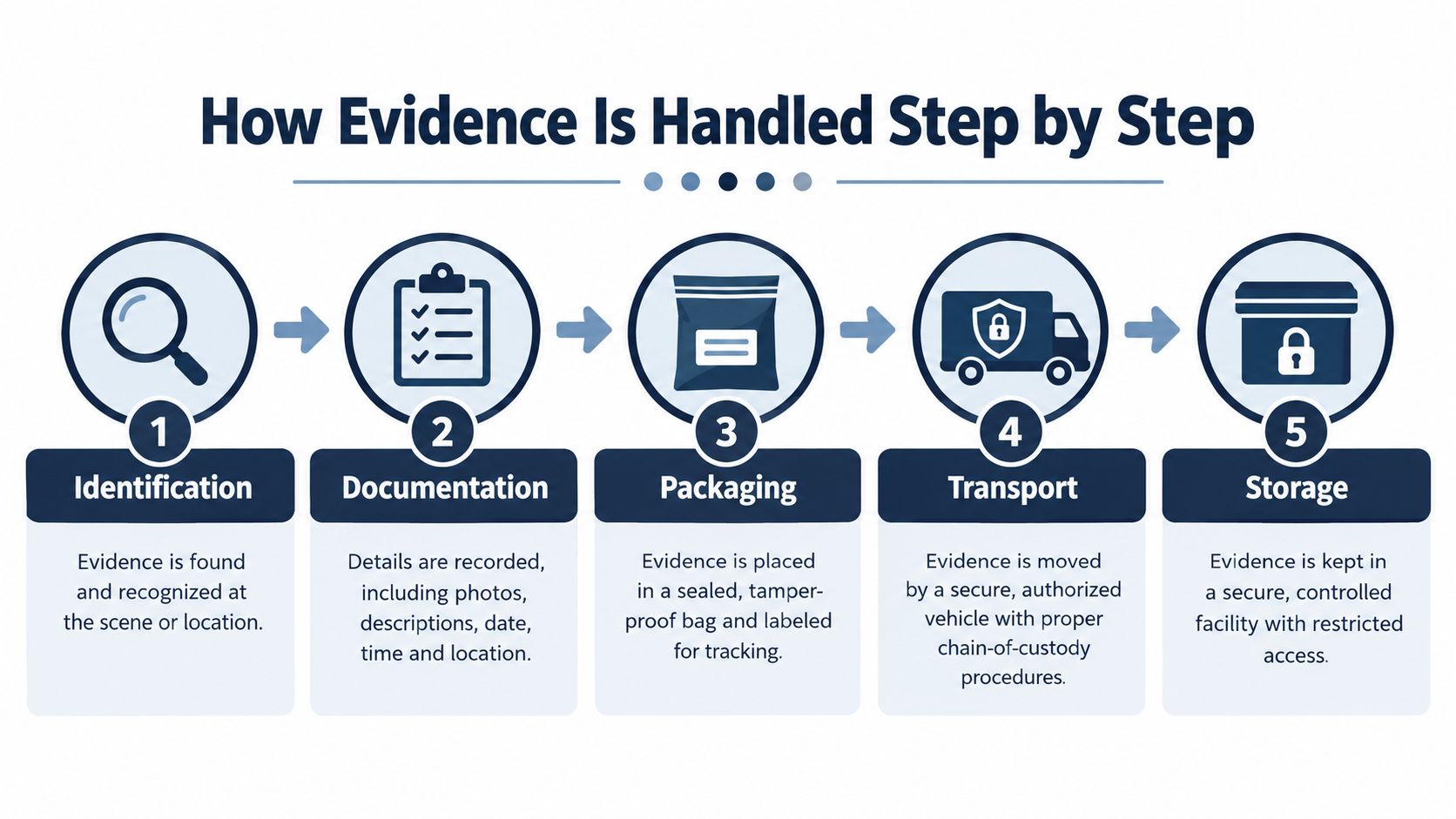
Document the item before sealing
Staff should record where the item was recovered or received, the date and time, its description, condition, and unusual markings or alterations. Moisture, damage, staining, broken components, or an existing seal should be noted before packaging changes the item's condition.
Isolate items from one another
Individual items are generally packaged separately to reduce commingling and cross-contamination. If two items were recovered in direct contact and that relationship has evidentiary significance, the handling record should explain why they remain associated.
Dry biological material when appropriate
Biological or organic evidence should be dried before final packaging and sealing. If an item remains wet, NIJ evidence collection guidance states that it should first go into a temporary container until drying can occur. Separate packages shouldn't contact one another because moisture can promote transfer between items.
Select packaging based on the specimen
Paper, plastic, rigid containers, and specialized packaging serve different purposes. The choice should consider moisture, leakage, volatility, fragility, sharp edges, contamination risk, and the analysis that may follow.
Seal, identify, and store
After the item is placed in the appropriate container, staff should close it with a tamper-evident seal, record the sealer's initials or identifier across the closure, and label the package with the relevant case information. Each transfer should be recorded at the time it occurs, not reconstructed from memory later.
For a broader explanation of how custody records support claim and litigation reviews, attorneys and officials may also find these commercial property adjuster insights useful because they address documentation, evidence preservation, and investigative handling in another professional setting.
Our own explanation of the paperwork is available in the chain-of-custody form guide, which helps families and legal teams understand why the form must travel with the item's history rather than exist as an isolated signature sheet.
Matching the Right Bag to the Right Specimen
A sealed bag can still be the wrong container. Packaging must preserve the material inside it, prevent leakage or contamination, protect handlers, and support later examination.
Wet biological material requires particular care. Federal procedures state that wet bloodstained clothing and other transportable items should be allowed to dry indoors before placement in paper bags or envelopes. NIJ guidance on biological evidence states that wet blood should never be sealed in plastic because decomposition can occur rapidly.
Dried blood and dried tissue are generally placed in paper packaging because airflow helps avoid the moisture problems associated with impermeable containers. Clothing may require a paper bag after drying. Trace material may require packaging that reduces loss or contamination. Liquids and volatile substances call for nonporous containers, while glass, sharps, or pills may require crush-resistant protection.
A mortuary bag is different from a small evidence bag. The mortuary bag is designed for transporting human remains. Smaller evidence containers may hold tissue, swabs, clothing, personal effects, or other material retained for examination. The presence of a tamper-evident closure doesn't make those containers interchangeable.
| Specimen Type | Preferred Packaging | Key Handling Note |
|---|---|---|
| Wet biological material | Temporary container, followed by appropriate breathable packaging after drying | Don't trap wet blood or tissue in plastic |
| Dried blood or dried tissue | New paper bag or envelope | Keep items separately packaged |
| Clothing with biological material | Paper bag after indoor drying | Record condition before sealing |
| Trace evidence | Porous or other suitable packaging based on material | Prevent loss and cross-contamination |
| Liquids or volatile substances | Nonporous, leak-resistant container | Match the container to the hazard |
| Glass, sharps, or pills | Crush-resistant container | Protect the specimen and handlers |
| Human remains | Mortuary bag for transport, separate evidence containers for smaller items | Don't confuse remains transport with specimen packaging |
The right seal can reveal an opening, but it can't correct moisture damage caused by the wrong container.
How Texas Autopsy Services Closes the Custody Loop
At Texas Autopsy Services, packaging and paperwork are treated as one continuous process. Our team supports families, attorneys, healthcare professionals, and Texas County officials across all 254 Texas counties, with in-house licensed transport, secure temperature-controlled storage, digital imaging, testing coordination, and HIPAA-compliant reporting.
When remains or specimens move, our documentation records the sending and receiving parties, the transfer time, and the condition of the seal. At the Elgin facility, secure storage helps protect items between documented handling events. Clothing, tissue, toxicology specimens, photographs, and personal effects are not treated as interchangeable materials. The packaging choice follows the item's condition and intended examination.
Every examination is performed by a forensic pathologist certified by the American Board of Pathology. Our team may coordinate toxicology and molecular testing partnerships when those examinations are appropriate, and reports are prepared with the custody history needed to connect the findings to the material examined.
The FBI's packaging model illustrates why layered containment matters. Its laboratory guidance requires sealed inner containers to be placed inside clean, dry outer containers, and the outer package must be completely sealed so tampering would be evident. The associated custody record accounts for the people who collected, stored, and later possessed the item.
These controls remain relevant when a case involves an independent autopsy, a county forensic autopsy service, litigation support, or a second opinion based on existing materials. Our private autopsy services include direct communication with our team, flat-rate all-inclusive pricing, and documented handling from transport through reporting. County officials can review the practice's county forensic autopsy services, while families may also encounter the Waterloo Mortuary Partnership when planning related arrangements.
When a Sealed Bag Has to Be Opened
A package may need to be opened for toxicology, DNA testing, imaging, repackaging, or an independent review. Opening it isn't automatically a chain-of-custody failure. The problem arises when the opening is unexplained or the resulting handling can't be reconstructed.
Before opening, the responsible team should identify the authorization and reason. The record should name the person opening the package, describe the condition of the original seal, and identify what was removed or examined. If only part of the material is taken for testing, the quantity and destination should be recorded.
The remaining material needs new packaging or a new seal with its own identifying information. The record should account for the return, transfer, storage, or disposal of the removed portion and any analytical by-products. Repackaging isn't a footnote. It's a new event in the item's custody history.
NIJ crime-scene procedures require documentation of the recovery location, date and time, item description, condition, and unusual markings. They also state that transfers must include the date and time and track movement from an investigator to another person, location, or agency.
What the record should answer
- Who opened it: Identify the person and organization responsible.
- Why it was opened: State the authorized purpose, such as testing or review.
- What the seal looked like: Record whether it was intact, damaged, or already compromised.
- What changed: Describe the material removed, examined, repackaged, or returned.
- Where it went: Identify the laboratory, reviewer, storage area, or other destination.
- How continuity resumed: Record the new package, seal, identifier, and next custodian.
A visually impressive bag can't cure missing documentation. A plain package with an honest, complete record may be more defensible than expensive packaging supported by unexplained gaps. The strength of the chain comes from continuity and transparent exception handling.
Common Questions and How to Reach Our Team
How do families request a private autopsy in Texas?
Families or their attorneys can contact Texas Autopsy Services directly to discuss the circumstances, location, transport needs, and available records. A private autopsy is separate from an examination controlled by a medical examiner or justice of the peace, and the responsible agency may govern access to remains or evidence in a particular case.
What happens to clothing and personal effects?
The team documents their condition, separates items when appropriate, chooses packaging based on the material, and records each transfer. Personal effects may require a different handling path from specimens intended for laboratory analysis.
How long do most cases take?
Most cases are completed within 24–48 hours, although the practical timeframe depends on the examination, transport, testing, records, and reporting required. We don't promise a result before the necessary work is complete.
Can an attorney request a second opinion?
Yes. A second-opinion autopsy review may examine an existing report, medical records, photographs, laboratory findings, and available specimens. Our chain-of-custody questions guide addresses common concerns about documentation, transfers, and opened packages.
Families, attorneys, and county officials can contact our team directly at (806) 230-1889, available 24/7. We'll explain what records and arrangements may be needed without assuming that every situation requires the same service.
Texas Autopsy Services provides independent autopsy and forensic pathology services, including licensed transport, secure specimen handling, and documented chain-of-custody procedures across Texas. If you need guidance after a death, please visit Texas Autopsy Services to speak with our team about the appropriate next step.