November 4, 2026 · Texas Autopsy Services
What a Medical Malpractice Lawyer Does in Texas
Learn what a medical malpractice lawyer does in Texas, including claim proof, filing deadlines, expert reports, and when forensic pathology helps.

On this page
- The Four Things a Malpractice Claim Must Prove
- Texas Deadlines a Malpractice Lawyer Tracks First
- What the Lawyer Does Before a Case Is Filed
- Expert Testimony and Forensic Pathology in Death Claims
- How Texas Damages Caps Shape Settlement Value
- Choosing a Texas Malpractice Lawyer and Understanding Fees
- Act Early to Protect Evidence Before Cremation
A family leaves a hospital with more questions than answers. Care seemed rushed, symptoms were not taken seriously, and a loved one is now seriously injured or has died. It's natural to ask whether different care would have changed the outcome. A medical malpractice lawyer helps test that question against medical records, expert review, and Texas law. We work with families and attorneys who need clear medical facts before anyone decides what a claim can or cannot prove.
- A bad outcome alone isn't a claim. Texas law requires proof of duty, breach, causation, and damages.
- Deadlines come first. A missed date can end a claim regardless of its medical merit.
- Expert review is central. Most cases turn on whether care met the standard and whether a deviation caused harm.
- Death claims need precise language. Cause, mechanism, and manner of death mean different things.
- Evidence has a short window. Decisions about examination should be made before cremation or burial when possible.
The Four Things a Malpractice Claim Must Prove
Say a patient reports worsening abdominal pain after surgery. Staff reassure the family, no imaging is ordered, and days later doctors find a bowel perforation with sepsis. The family believes the warning signs were dismissed. That concern deserves review, but it isn't, by itself, a legal claim. A lawyer must connect the timeline to four required elements, and the claim fails if any one element can't be supported.
Four plain questions
Duty asks whether a provider-patient relationship existed. Charts, consent forms, appointment records, and admission notes usually answer this quickly.
Breach asks whether care fell below the accepted standard for that specialty. This isn't judged by outcome alone. A lawyer compares what the record shows with accepted clinical protocols, usually through an expert in the same field. Readers who want a plain explanation of this burden can review why malpractice lawsuits are difficult before they assume a poor result proves negligence.
Causation asks whether the breach caused the injury or death. This is often the hardest element because natural disease, a known complication, medication effects, or a condition present before treatment may explain part or all of the outcome.
Damages asks what losses followed. Those may include medical bills, lost wages, funeral costs, future care needs, pain, and loss of companionship.
Claim elements and the proof each one usually needs
| Element | Question to answer | Typical proof |
|---|---|---|
| Duty | Did a provider-patient relationship exist? | Chart, consent forms, appointment and admission records |
| Breach | Did care fall below the accepted standard for that specialty? | Complete records and an expert review of clinical protocols |
| Causation | Did the breach cause the injury or death? | Clinical timeline, imaging, pathology findings, ruling out other causes |
| Damages | What losses followed the injury or death? | Medical bills, wage records, funeral costs, evidence of pain and loss |
A useful first check: Write down which element you can already document and which records are missing. That gap usually tells a lawyer where screening must start.
A case can be medically concerning and still fail. Care may have been poor communication without a provable breach, or a breach may have occurred after an injury was already unavoidable. Honest screening identifies that weakness early, before a family spends heavily on a theory the evidence can't carry.
Texas Deadlines a Malpractice Lawyer Tracks First
A treatment timeline can include many appointments, but the legal clock may turn on a particular act, the end of a course of treatment, or another rule. Texas medical liability claims are governed mainly by Chapter 74 of the Civil Practice and Remedies Code. A lawyer first identifies which dates apply, because a claim that otherwise has merit can be barred if it is filed too late.
Dates that shape the case calendar
Key Texas malpractice deadlines and notice rules
| Deadline or rule | What it requires |
|---|---|
| Limitation period | Generally, file within two years of the breach or the end of treatment |
| Statute of repose | Generally, an outer limit of ten years from the act or omission, subject to exceptions |
| Pre-suit notice | Send written notice at least 60 days before filing, with a medical authorization |
| Notice tolling | Proper pre-suit notice can extend the deadline by up to 75 days |
| Expert report | Serve an expert report within 120 days after each defendant files an original answer |
| Minors and wrongful death | Start dates and related rules can differ, so confirm the applicable deadline |
The 60-day pre-suit notice must be sent before filing and accompanied by a medical authorization that lets the provider obtain relevant records. Notice may affect the deadline, but the timing depends on the case. A lawyer should calculate the dates from the full record rather than assume the notice period preserves a particular claim.
The 120-day expert report deadline begins after each defendant files an original answer. The report must address the defendant's conduct, the applicable standard of care, how the care allegedly fell short, and causation. Identifying an appropriate expert before filing gives counsel time to assess this requirement.
Families comparing counsel in North Texas might consult a Fort Worth medical negligence attorney and ask how the firm calculates Chapter 74 deadlines for the providers and events involved. The same question matters anywhere in Texas.
Claims involving minors or wrongful death may have different start dates or related rules. The date of treatment, date of death, claimant's age, and defendants named can all affect the calculation. Counsel must confirm the applicable deadlines for the specific case.
What the Lawyer Does Before a Case Is Filed
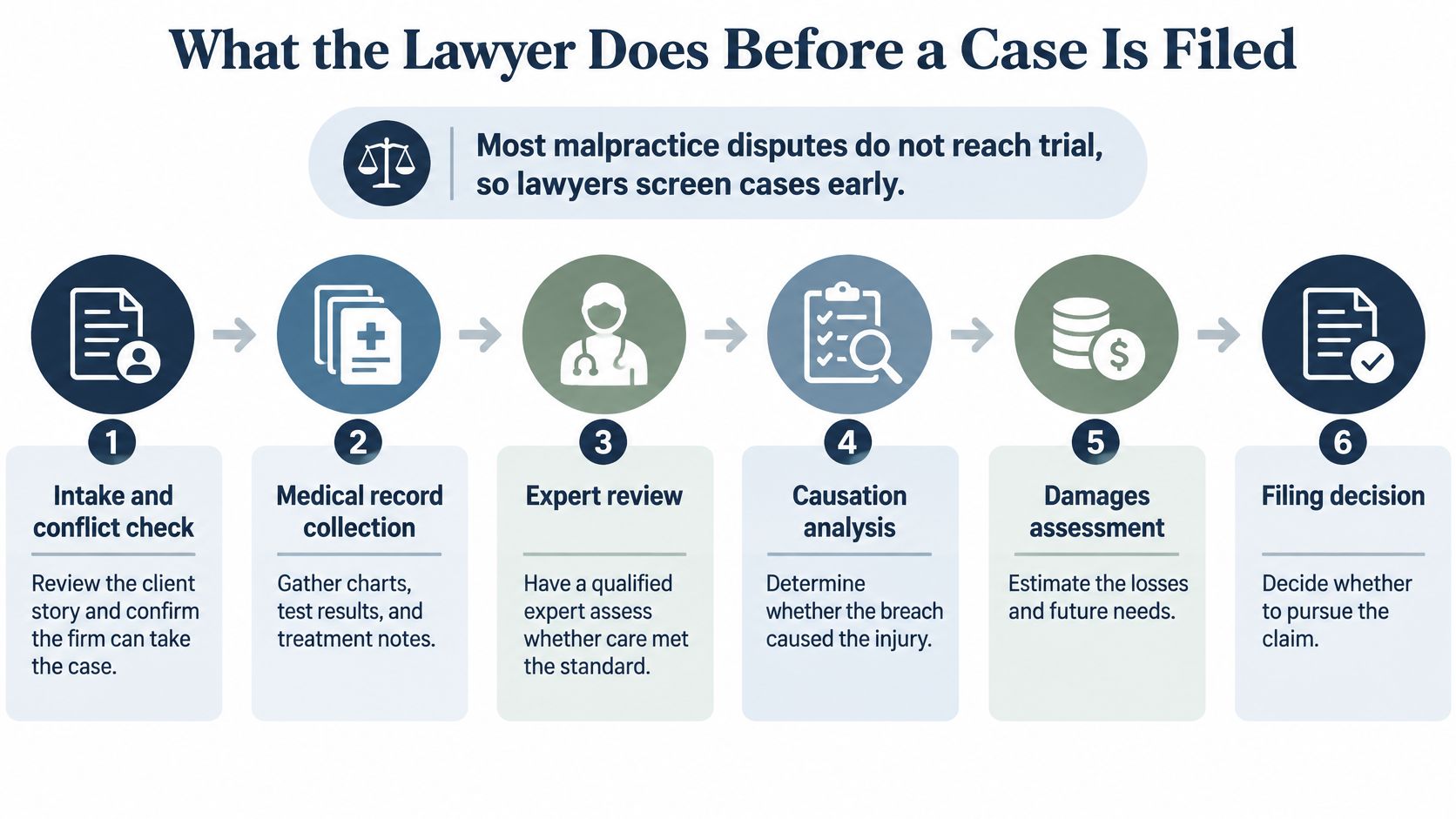
A family may have a detailed medical chart and still not know whether the care caused a preventable injury or death. Before filing, a lawyer tests that question against the records, the timeline, and qualified medical review. Screening matters because a lawsuit needs evidence for each required element, not just a troubling outcome.
The pre-filing sequence
- Intake and conflict check: The firm records the basic facts, providers, and key dates, then checks whether it can represent the family. Missing dates can make it harder to assess the case and applicable deadlines.
- Records request: Counsel seeks the relevant chart, including nursing notes, medication logs, imaging, laboratory data, operative reports, and any autopsy or death records. A medical records request should aim to collect the full record, since a missing result or note can change how a decision appears.
- Timeline reconstruction: Symptoms, orders, results, consultations, and interventions are placed in sequence. The timing can help show whether a delay mattered or whether the outcome may have occurred despite appropriate care.
- Preliminary merit review: A consulting clinician examines whether the evidence supports both a departure from the standard of care and a connection between that departure and the harm. Alternative explanations matter. If the records do not support both elements, the claim may be weak.
- Pre-suit notice: If the lawyer concludes that a claim is supportable, the lawyer sends written notice with the required medical authorization and observes the statutory waiting period.
- Settlement discussions or filing: Counsel may seek a resolution or file a petition and serve the defendants, depending on the evidence and circumstances.
- Expert report: After a defendant answers, the statutory deadline for the expert report begins. Work done during screening helps the expert address the care at issue and the alleged connection to the injury or death.
Early screening is a test of the evidence, not a promise that a case will be filed. An independent forensic review may help clarify a death when the cause remains uncertain, but it cannot by itself establish that a provider was negligent. The honest conclusion may be that the available evidence does not support a strong claim. A lawyer should explain which part of the proof is missing, rather than treat a family's understandable questions as proof of malpractice.
Expert Testimony and Forensic Pathology in Death Claims
Jurors aren't expected to judge surgical technique, medication dosing, or diagnostic protocols from common knowledge. A peer-reviewed review in PMC explains that expert testimony is nearly always necessary because a plaintiff generally must establish the applicable standard of care, a deviation from that standard, medical causation, and damages. Credentials matter, but they aren't enough. The opinion must connect to contemporaneous records, objective findings, accepted protocols, and a defensible causal pathway.
The following image reflects the joint records review that often precedes a formal expert opinion.

Three questions every expert must answer
- What standard applied: What would a reasonably careful provider in that specialty have done under similar circumstances?
- What deviation occurred: Which specific act or omission fell below that standard, and where does the record show it?
- What harm followed from that deviation: How did the deviation cause or materially contribute to injury or death, and what other explanations were ruled out?
A Texas expert report must address each defendant's conduct. A report that criticizes a hospital in general terms, relies on incomplete records, or assumes causation from a bad outcome can end the case early. Our discussion of the medical malpractice expert witness role explains why method and record support matter as much as the conclusion.
Death claims add a forensic layer. Families most often request a private autopsy when the medical examiner declined the case, when they want an independent second opinion, or when the cause of death was left unclear or unexplained. When a case has been declined by a county, we can still examine the body and explain the findings to the family. A private autopsy is authorized by the legal next of kin or their designated representative, and families can learn how Private Autopsies are arranged before they authorize final disposition. Every examination we perform is conducted by a forensic pathologist certified by the American Board of Pathology.
The short video below provides additional context on how forensic findings are reviewed and communicated.
Consider a bowel perforation after abdominal surgery. The perforation may allow infection to spread, leading to sepsis, septic shock, and multi-organ failure. Those terms are related, but they don't mean the same thing, and confusing them weakens both family understanding and legal analysis.
Death terms a malpractice case relies on
| Term | Meaning | Example in a claim |
|---|---|---|
| Cause of death | The disease or injury that started the fatal chain of events | Untreated infection that followed a delayed diagnosis |
| Mechanism of death | The physiological process that stopped the body from functioning | Septic shock leading to organ failure |
| Manner of death | The classification of how the death occurred | Natural, accident, homicide, suicide or undetermined |
| Chain of custody | The documented record of who handled tissue, samples and remains | Signed logs for toxicology and tissue samples |
An independent autopsy or second opinion autopsy may add histology, toxicology, imaging review, photographs, and documented handling of tissue and samples. Those materials help counsel test whether an injury, medication, delayed diagnosis, procedure, or underlying disease caused or contributed to death. Families evaluating filing a wrongful death claim should understand that pathology findings clarify medical facts, but they don't by themselves prove breach or damages.
An independent examination isn't automatically favorable to a claim. A defensible opinion may support the original cause of death, narrow the causal theory, or state that the evidence can't support a reliable conclusion.
That neutrality is the value of a forensic pathology expert. We preserve competing explanations and state the limits of the evidence, so a lawyer can decide whether the medical cause of death supports litigation or whether the honest answer is that negligence cannot be proven.
How Texas Damages Caps Shape Settlement Value
Texas voters approved Proposition 12 in 2003, authorizing a $250,000 cap on most medical malpractice noneconomic damages, according to the Insurance Information Institute. A medical malpractice lawyer applies that cap during screening, not after a jury returns a verdict, because it changes settlement value from the start.
Economic damages are measurable losses such as medical bills, lost earnings, and future care costs. The noneconomic cap doesn't limit those losses under the same rule. Noneconomic damages cover pain, suffering, mental anguish, and loss of companionship. Those losses are real, but Texas law limits recovery for them in most medical liability cases.
Two worked examples
Say Case A involves $600,000 in economic losses and $900,000 in noneconomic harm against one physician. If the noneconomic amount is held to $250,000, the recoverable total is about $850,000 before other reductions, fees, and case costs.
Say Case B involves $80,000 in economic losses and $200,000 in noneconomic harm. The noneconomic amount falls under the cap, so the total remains $280,000 before other reductions. The practical difference is clear. Strong proof of bills, wage loss, and future care carries more settlement weight because it isn't compressed by the same cap.
Chapter 74 also has a structure with a per-physician limit, a higher combined limit across physicians, and a separate limit for institutions. Current figures and exceptions should be confirmed for the defendants in a specific case. During early screening, a lawyer compares likely recoverable damages with the cost of experts and litigation. A case with clear fault but limited recoverable losses may still be difficult to pursue on a contingency basis, and families deserve that explanation early.
Choosing a Texas Malpractice Lawyer and Understanding Fees
Families usually ask two questions first. Who should handle the case, and what will it cost? A medical malpractice lawyer should be able to answer both in plain language before anyone signs an agreement. Comparing two or three firms is reasonable, and the State Bar of Texas licenses attorneys and offers a public directory for checking licensure and disciplinary history.
Questions to ask on the first call
- Chapter 74 experience: Does the firm handle Chapter 74 claims in the county where the care occurred?
- Fee calculation: How is the fee calculated, and is the arrangement stated in a signed agreement?
- Case costs: Who advances the cost of records, consulting clinicians, expert reports, and forensic pathology review, and what happens to those costs if the case doesn't succeed?
- Day-to-day contact: Who handles the case each day, and how often will the family receive updates?
- Merit review timing: How soon can the firm complete a preliminary merit review, and what records does it need first?
A contingency fee often means the client pays no attorney fee unless there's a recovery. That doesn't always mean the client pays nothing if the case fails. Expert charges, records costs, filing fees, and deposition expenses may be advanced by the firm and repaid from a recovery, or they may remain the client's responsibility under the agreement. The contract controls, so families should read the cost section as carefully as the fee percentage.
Ask for the screening plan, not an outcome prediction. No lawyer can responsibly promise a settlement or verdict from a first conversation.
Early screening is itself a useful service. It may confirm a viable claim, identify a missing record, or show that causation can't be proven. Each answer helps a family decide whether to proceed, seek another opinion, or stop before costs rise.
Act Early to Protect Evidence Before Cremation
If a family is considering an autopsy after a death, the timing of cremation matters. Cremation can permanently end the possibility of examining the body later. Under Texas Health and Safety Code Chapter 716, a crematory generally must receive a cremation authorization signed by an authorized agent and a death certificate or other death record stating that the remains may be cremated, subject to statutory exceptions. Our guide to cremation in Texas explains the process and the decisions families may need to address.
Actions to take before final disposition
- Contact counsel and discuss an independent examination. If a medical cause of death may be disputed, speak with a medical malpractice lawyer and a forensic pathologist before cremation or burial. An early legal review can help determine whether the available evidence may support a claim, while a forensic review can assess whether an examination could clarify the medical facts. Sometimes the evidence cannot establish negligence, and the honest conclusion is that a claim is weak.
- Request relevant records. Ask for hospital, clinic, pharmacy, imaging, and emergency records. Depending on the case, medication administration logs and audit trails may also help establish what care was provided and when.
- Keep personal evidence intact. Preserve patient portal messages, discharge papers, prescription bottles, devices, and written communications. Avoid editing or discarding materials that could help establish the timeline.
- Document who has custody of the remains. Keep track of who authorized movement and which funeral provider or authority supervised transport. These details can help clarify the chain of custody.
- Ask about options after burial. If burial has already occurred, ask counsel and our team whether exhumation is feasible and what evidence may still be available.
A private autopsy is authorized by the legal next of kin or their designated representative. If you are unsure whether you have authority, contact us. We can explain the process and help arrange an examination quickly. When a county declines a case, a family may still request an independent private autopsy. Funeral homes can coordinate directly with our team on transport and arrangements, and we will work with the funeral provider handling the remains.
Texas Autopsy Services serves families, attorneys, and counties across all 254 Texas counties. Every examination is performed by a board-certified forensic pathologist, and our team contacts the family with preliminary findings within 24 hours of the examination. The same pathologist prepares the written report and explains the findings to the family. Our county forensic autopsy services support justices of the peace and county offices.
If a cause of death remains unclear, or a medical examiner declined the case, an independent examination may help answer medical questions relevant to a potential claim. Contact Texas Autopsy Services to discuss authorization, timing, records, and next steps. We are available 24/7 at (806) 230-1889.