October 31, 2026 · Texas Autopsy Services
Cremation Texas Laws, Costs, and the 48-Hour Rule
Cremation Texas families face a 48-hour wait, a signed authorization, and 2026 prices from about $1,700. Here is what the law requires first.
On this page
A family may be arranging cremation while still waiting for answers about how a loved one died. The funeral home may be ready to collect paperwork, but if identity, authorization, or the cause of death is still uncertain, signing too soon can close off the chance for a physical examination. Knowing which steps Texas law requires, and which funeral options are choices, can help families and attorneys make decisions with care.
- Texas cremation requires specific records, a valid authorizing agent, and documented identification.
- The 48-hour wait starts at the time of death recorded on the death certificate, not when the funeral home receives the body.
- A ceremony, casket, or embalming isn't automatically required for direct cremation.
- An inquest is a county investigation, while an autopsy is a postmortem medical examination.
- If questions about identity or cause of death remain, raise them before cremation.
Papers and the 48-Hour Wait
Texas law generally requires a crematory to wait 48 hours from the time of death recorded on the death certificate before cremating human remains. The clock doesn't start when the funeral home receives the body. A justice of the peace or medical examiner for the county where the death occurred may waive the wait, but the waiver must be in writing. The Texas Health and Safety Code, Chapter 716 also requires the crematory to have a signed cremation authorization and a death certificate or other death record that allows cremation.
Treat the paperwork as a packet to review before anyone schedules the cremation. A phone call or verbal yes doesn't replace the required authorization. If a death is under investigation, or the family is considering a physical examination, this waiting period may be the time to raise that request. Once cremation occurs, a later physical examination of the body is no longer possible.
| Requirement | Source | Who acts | Waiver or limit |
|---|---|---|---|
| 48-hour wait from the time of death on the death certificate | Health and Safety Code Chapter 716 | Crematory must wait | Written waiver only by the justice of the peace or medical examiner in the county of death |
| Signed cremation authorization | Chapter 716 | Authorizing agent under Section 711.002 | No verbal substitute |
| Death certificate or other death record allowing cremation | Chapter 716 | Funeral provider and vital records | Crematory needs a record that says cremation may occur |
| Identification of the decedent | Chapter 716 | Authorizing agent or representative, in person or by photograph | Identification right may be waived |
| Implant and valuables notes on the authorization | Chapter 716 | Authorizing agent and funeral provider | Pacemakers and similar devices must be addressed before cremation |
Review the packet before scheduling
Check that the authorization names the correct person and recipient, and that the death record permits cremation. Make sure the identification step and any implant or valuables information are accounted for. If a death certificate is still pending, our plain-language guide to pending death certificates and cremation paperwork explains why document status can affect the next steps.
Practical rule: If a medical or legal question is unresolved, tell the funeral provider and the investigating authority in writing before authorizing cremation.
Who May Authorize Cremation
A family may agree that cremation is the right choice and still need to determine who can legally authorize it. Texas Health and Safety Code Section 711.002 sets the priority order for who controls disposition, while Chapter 716 requires a valid cremation authorization from someone with that authority. The current text of Section 711.002 also addresses responsibility for arranging interment and its reasonable cost.
Read the order from the top and stop at the first person with the right and ability to act. If several people share a class, such as adult children, any one of them may act under the law's priority. Agreement among relatives can still help prevent a disagreement from delaying arrangements.
| Order | Person with the right | Practical note |
|---|---|---|
| 1 | Person named in a written instrument signed by the decedent | Written directions come first |
| 2 | Surviving spouse | Next when no written designation controls |
| 3 | Any one surviving adult child | One adult child may act, so siblings should agree in writing |
| 4 | Either surviving parent | Either parent in this class |
| 5 | Any one surviving adult sibling | One adult sibling may act |
| 6 | A qualified executor or administrator of the estate | Estate authority, not a distant relative's preference |
| 7 | An adult in the next degree of kinship in the order named by law to inherit | Used when no one above can act |
Confirm the signer before transport
Bring any written disposition directions to the funeral provider. Ask whose name will appear on the authorization before transport is scheduled. A power of attorney generally does not settle the question after death in the same way an executor's estate authority may. For help understanding the difference, read the Law Office of Bryan Fagan's guidance on powers of attorney and executors, then clarify the situation with a legal adviser.
A disagreement about who may sign is separate from the cremation waiting period. The crematory still needs valid authorization. Texas law also limits when a crematory may dispose of unclaimed cremated remains, so families should confirm in advance who will receive them.
Texas Cremation Prices in 2026
A 2026 state price comparison reported a median Texas direct-cremation price of $1,700 and a median of $5,800 for cremation with a service, according to Funeral Cost Analyzer's state comparison. A separate 2026 pricing survey reported an average Texas direct-cremation price of $2,018 in its Texas cremation cost survey. These figures describe statewide price points, not a quote for a particular city or provider.
Direct cremation commonly refers to care and transportation, an alternative container, cremation, and return of the remains without a ceremony. A service arrangement may add a visitation or gathering. What's included in a quoted amount can differ, so a low advertised price isn't necessarily the total a family will pay.
| Arrangement | 2026 reported price | What it usually covers | Not legally required |
|---|---|---|---|
| Direct cremation, median | $1,700 | Removal, alternative container, cremation, return of remains | Casket or embalming |
| Direct cremation, survey average | $2,018 | Same basic path, totals vary by county | Funeral ceremony |
| Cremation with a service, median | $5,800 | Ceremony or visitation plus cremation | A specific urn or package |
Separate legal requirements from optional choices
The Federal Trade Commission's Funeral Rule requires itemized pricing and prohibits providers from falsely saying a casket, embalming, or another product is legally required for direct cremation. Providers offering direct cremation must make alternative containers available. Families can ask for the General Price List and a written, all-in estimate that says whether transportation, refrigeration, permits, certified death certificate copies, witnessing, and an urn are included. The FTC's Funeral Rule guidance explains consumers' choices and providers' pricing duties.
Before comparing prices: Ask each provider to list included services and optional charges in writing. A clear comparison is more useful than comparing advertised starting prices alone.
Families weighing how to cover end-of-life expenses may also find it helpful to review guidance on estimating life insurance for final expenses. For more context on comparing providers and arrangements, see our guide to funeral homes in Texas.
Inquests, Autopsies, and the Timing of Cremation
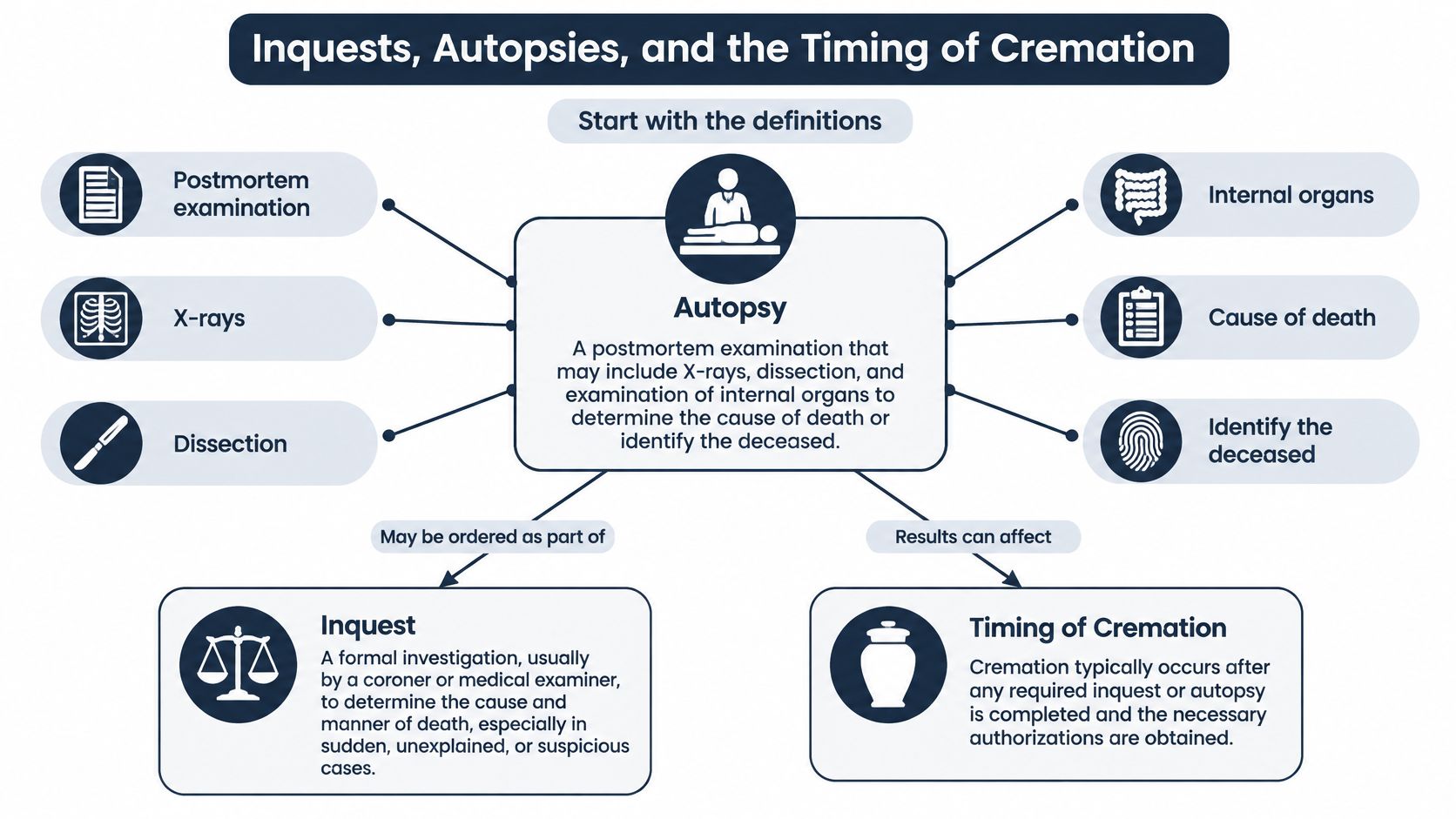
An autopsy is a postmortem examination that may include X-rays, dissection, and examination of internal organs. It can help determine the cause of death or identify changes that contributed to death. Cause of death means the injury or disease that led to death. Manner of death is the classification of the death, such as natural, accident, suicide, homicide, or undetermined.
An inquest is broader than an autopsy. It investigates the cause and circumstances of a death, including whether an unlawful act or omission caused it. Texas generally requires a justice of the peace to conduct an inquest in certain circumstances, including an unnatural death other than legal execution and specified deaths in custody. The Texas Code of Criminal Procedure provisions on inquests describe the justice of the peace's role.
Official review and independent examination
A justice of the peace may order an autopsy when it's needed to determine or confirm the cause of death. Chapter 49A also identifies circumstances involving a child younger than six whose death is unexpected or determined to result from abuse or neglect, and a direction from the district attorney, criminal district attorney, or, where neither exists, the county attorney. The Chapter 49A provisions on autopsy orders explain these official authority triggers.
A private autopsy doesn't replace a county inquest. If an inquest is open, an independent examination must be coordinated with the official authority. A chain of custody is the documented record of who handled the body or specimens and when. That record helps show how evidence was preserved and transferred.
The 48-hour wait can be waived only through written action by the justice of the peace or medical examiner for the county of death. Families should raise any request for an independent review while the body remains available. A private autopsy is authorized by the legal next of kin or their designated representative. If a county declines a case, families can still request an independent examination. Our guide to when an autopsy is required by law offers further context, and our pages explain private autopsies and county forensic autopsies. This is general education, not a diagnosis or legal advice.
Identification from Release to the Chamber
A body may be released for cremation while questions about identity or cause of death remain open. In that situation, ask who is responsible for the next handoff and what records must be complete before cremation proceeds. Texas law sets requirements for authorization and identification. The Texas cremation authorization requirements also address implants, valuables, and the person designated to receive the cremated remains.
Follow the records through each handoff
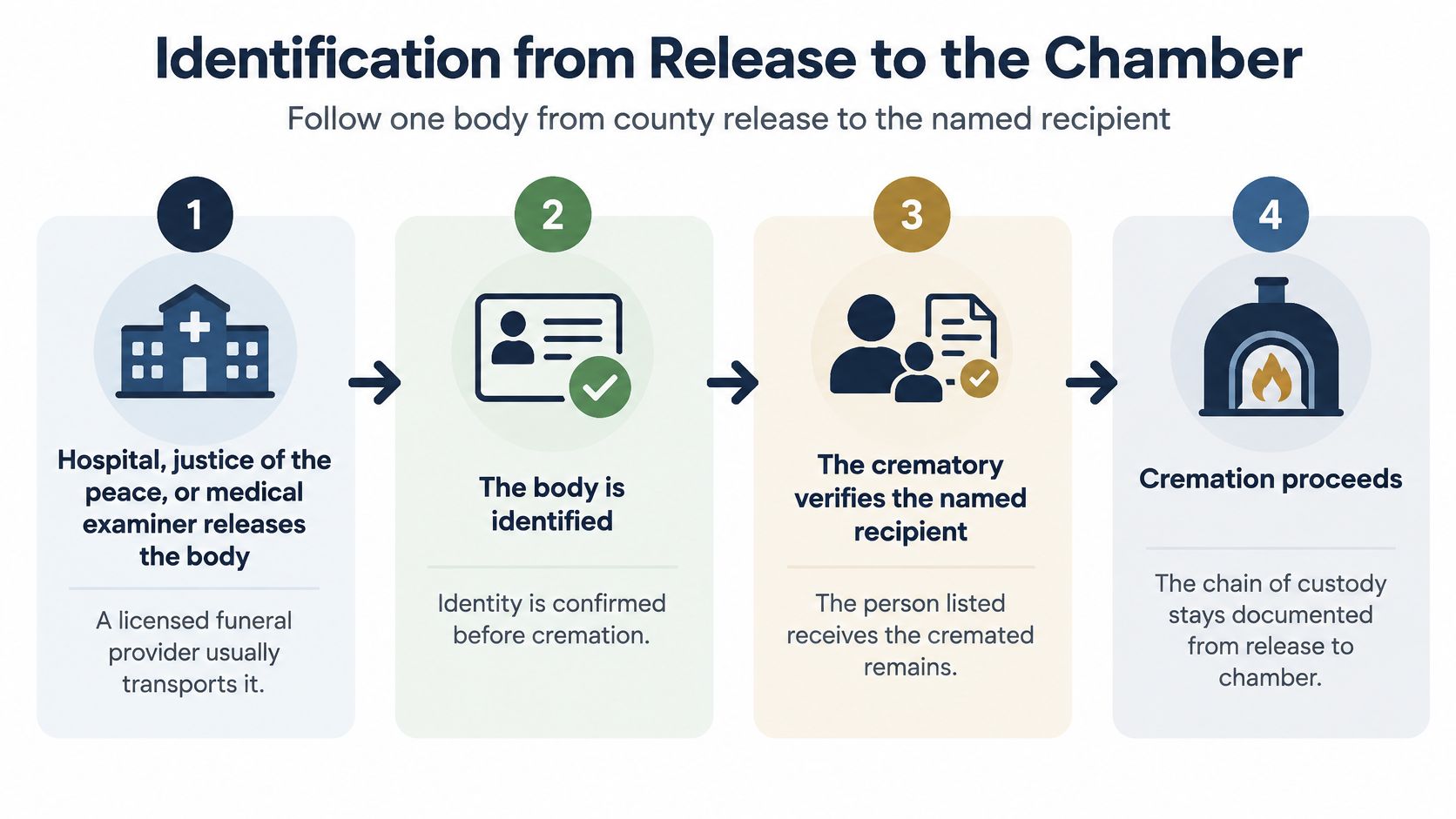
- The body is released. A hospital, justice of the peace, or medical examiner releases the body. A licensed funeral provider usually arranges transportation.
- The paperwork is checked. The funeral provider confirms that the signed authorization and death record are on file before proceeding.
- The decedent is identified. The authorizing agent or an authorized representative makes a positive identification in person or by photograph, unless that right is waived.
- Relevant details are recorded. The authorization addresses potentially hazardous implants, including pacemakers, and records valuables delivered with the body.
- Identification is maintained through placement. Chapter 716 requires the crematory to keep the decedent identified through placement in the cremation chamber. Families can ask the provider to explain how identification is maintained at each handoff.
- The designated recipient receives the remains. The authorization names the person who will receive them. If the remains are not claimed, applicable law limits when the crematory may dispose of them.
Keep the authorization, identification record, death record, transport papers, and implant notes together. They work like a map of the handoffs, showing what was recorded as the body moved from release to cremation.
If identity or a medical question remains unresolved, ask the provider in writing where the body will be held and who may view the identification photograph. Cremation should wait until the appropriate questions have been addressed.
Questions Families Ask About Texas Cremation
Is a funeral ceremony legally required?
No. Chapter 716 doesn't require a funeral ceremony. Families may choose direct cremation without a gathering, or arrange a service before or after cremation.
Can cremated remains be scattered anywhere?
No. Scattering on private land requires the landowner's permission. Public land and some cemeteries may have separate rules, so families should check the requirements for the specific place.
Are cremated remains kept separate from other cases?
The crematory's identification procedures are intended to track the remains to the recipient named on the authorization. Families can ask the provider to explain how identification is maintained from receipt through processing and return.
Does a Texas Funeral Service Commission license make an add-on mandatory?
No. The Texas Funeral Service Commission regulates funeral establishments, but a license doesn't make a particular merchandise item or service legally required. If a provider says a purchase is required, ask which statute or operating rule applies and request the explanation in writing.
Grief can affect people in different ways, and families may need support beyond funeral arrangements. This guide to recognizing when to seek help for grief may help identify when additional support could be useful.
Pause Before You Sign If the Death Is Unclear
If a death was sudden, unattended, or medically unclear, cremation can make a later examination impossible. Before signing an authorization, ask whether the case is still with a justice of the peace or medical examiner, and contact that office about the investigation's status. Any waiver of the waiting period must come in writing from the proper authority.
If no autopsy was requested, or a county declined the case, a family may still request an independent examination while the body is intact. The legal next of kin or their designated representative must authorize a private autopsy. This can help clarify what options remain before cremation.
Texas Autopsy Services operates under the legal name Waterloo Mortuary, LLC. Every examination is performed by a board-certified forensic pathologist, certified by the American Board of Pathology. We serve all 254 Texas counties, coordinate directly with funeral homes, and offer flat-rate pricing. We can coordinate the examination so funeral services are not delayed, and our team can explain the process without pressing a family toward a particular disposition.
Families can learn about private autopsies and county forensic autopsies. To discuss what questions to resolve before cremation, call (806) 230-1889 or contact Texas Autopsy Services.