October 17, 2026 · Texas Autopsy Services
When Is Autopsy Required by Law in Texas
When Is Autopsy Required by Law. Learn when an autopsy is required by law in Texas, who orders it, and what families and attorneys can do when a private second
On this page
- The Legal Trigger for an Autopsy in Texas
- Categories of Death That Require an Inquest
- Who Orders an Autopsy and How Authority Works
- Government Ordered Autopsy Versus Private Autopsy
- Family Rights, Consent, and When Objection Is Overridden
- What a Texas Autopsy Report Includes and When It Is Filed
- Jurisdiction, Reporting, and Coordination With Donation
- Frequently Asked Questions and a Compassionate Next Step
A family often starts asking about autopsy after the first call from a hospital, coroner, or justice of the peace. The body may not be released yet, the cause of death may still be uncertain, and everyone wants to know who has authority to decide what happens next. In Texas, that answer turns on the legal trigger, not on family preference alone.
- Texas law starts with an inquest, then moves to an autopsy only when the facts require it under Chapter 49 of the Texas Code of Criminal Procedure.
- Not every inquest becomes a full autopsy. Some cases end with records review, external examination, toxicology, or limited sampling.
- Certain deaths trigger mandatory review, including custody deaths, unexplained deaths, suspected suicide, and qualifying child deaths.
- Family objection doesn't always stop a legally authorized autopsy, especially when a prosecutor, justice of the peace, or medical examiner must act.
- Private autopsy and government autopsy are different paths, and a private review can help after the official process is complete.
When is autopsy required by law in Texas? The short answer is that the law requires a medicolegal investigation first, then an autopsy only if the investigation can't establish a defensible cause of death or if the case falls into a category that calls for one. That distinction matters because families often assume every unusual death automatically leads to dissection, when Texas law gives the official investigator room to use the least invasive method that still answers the legal question.
The Legal Trigger for an Autopsy in Texas
A family may be waiting for answers while the legal process is still deciding whether the state must perform a closer examination. In Texas, the starting point is an inquest, the official review of a death by a justice of the peace or, in some counties, a medical examiner under Texas Code of Criminal Procedure Article 49.04. That review does not automatically mean an autopsy will follow. The autopsy becomes required only when the investigator needs it to determine or confirm the cause and manner of death, or when another statutory rule makes one mandatory.
Key terms that shape the process
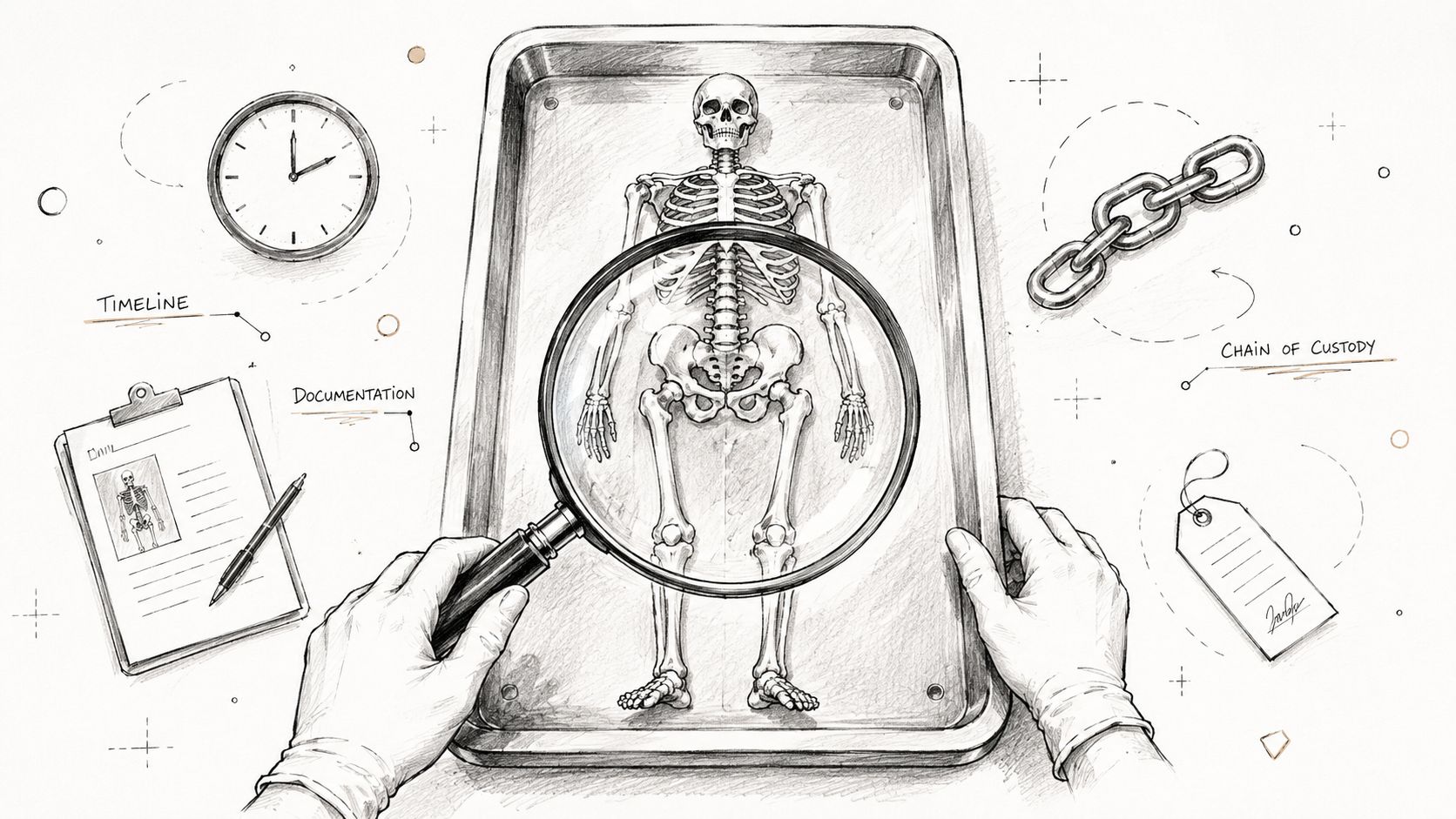
Cause of death is the medical reason a person died, such as a fatal injury, disease process, or poisoning. Manner of death is the legal classification, such as natural, accident, suicide, homicide, or undetermined. An inquest is the official review that decides whether more investigation is needed. Chain of custody is the documented path showing who handled the body, samples, photographs, and records, so the findings can hold up in court.
That chain matters because the result can affect death certification, criminal review, insurance questions, and later testimony. Once a death enters the medicolegal system, a private attorney, family member, or funeral director cannot replace the state's legal authority.
A simple way to separate the paths is this: the official autopsy serves the public investigation, while a private autopsy serves the family's separate need for an independent medical review. They can overlap in subject matter, but they do not serve the same legal purpose.
Practical rule: if the death is unexplained, potentially unlawful, or tied to an institution or custody setting, the legal question comes first and the family's private preferences come second.
When a death sits inside a broader injury claim, the timing of an autopsy can affect the evidence trail; a plain explanation from consult Nares Law Group LLC can help families frame that overlap.
Categories of Death That Require an Inquest
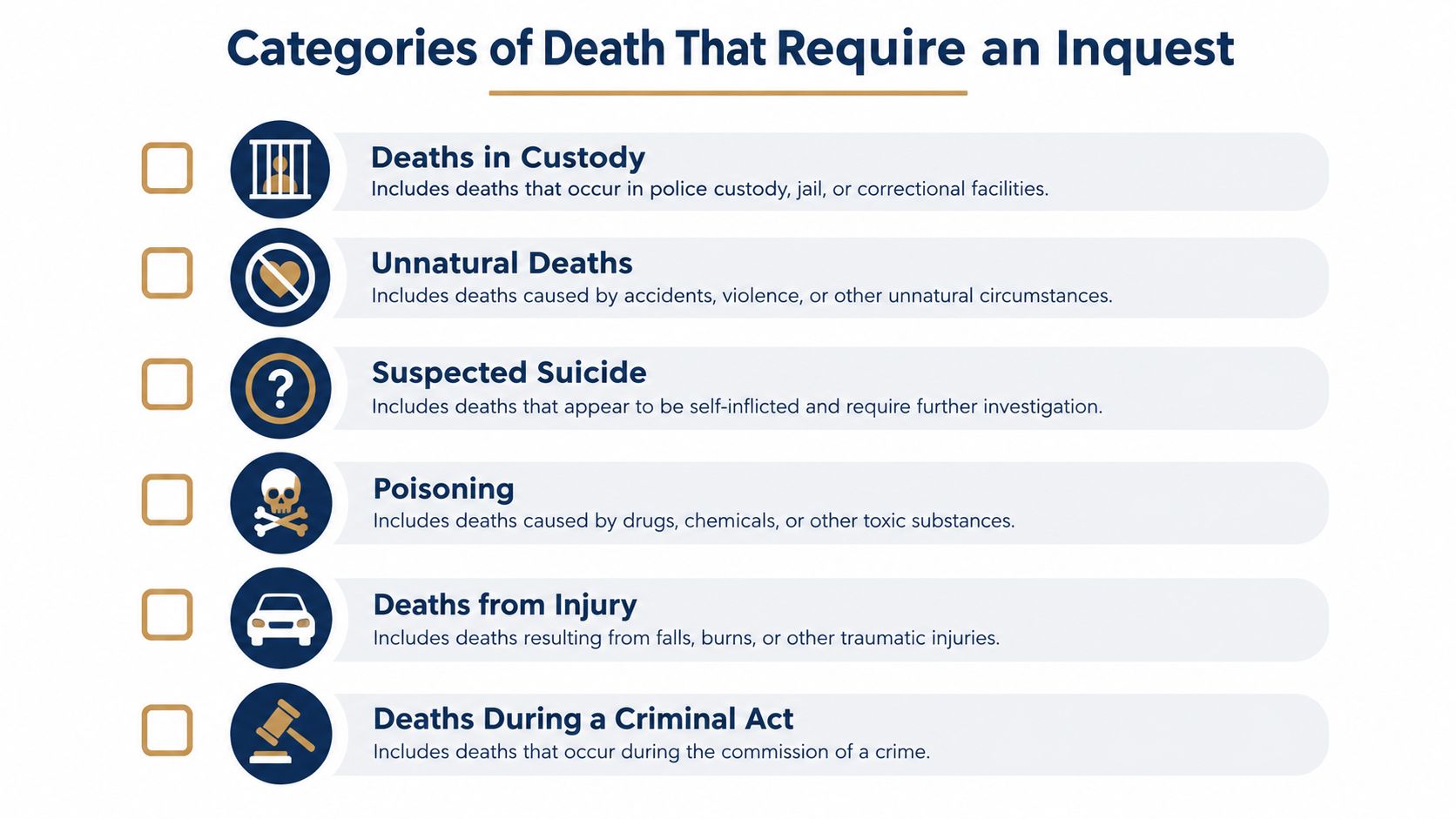
Texas law does not use one single marker, like the age of the person or the place of death. It looks at the circumstances that surround the death. The statute directs an inquest when a death occurs in jail or prison, when the death is unnatural other than a lawful execution, when the body is unidentified or the cause or circumstances are unknown, when the death is suspected to be unlawful, when suicide is suspected, when the person died without physician attendance, or when the attending physician cannot certify the cause. Texas law also includes certain deaths involving children younger than 6 years old. See the statutory inquest framework in the Texas Code of Criminal Procedure chapter index and related provisions. Texas Code of Criminal Procedure Article 49.04
[]
Why the inquest is the gateway
An inquest does not always end with a full autopsy. The official reviewer may have enough from the scene, medical records, and an external examination to make a supportable determination. In other cases, the facts point to toxicology, tissue sampling, or a broader internal examination before the cause can be settled.
That is why the statutory trigger reaches beyond obvious violence. A death can enter the medicolegal system because of the surrounding conditions alone, before anyone has confirmed suicide, abuse, homicide, or another manner of death. The official job is to test the facts first, then decide what level of examination the case requires.
A family may see one event. The law sees the set of conditions that decides whether the state must investigate.
In medical examiner jurisdictions, the same basic result follows. The official system takes custody of the case, and the legal process, not the family, controls whether the examination stays external, becomes limited, or moves to a complete autopsy.
Who Orders an Autopsy and How Authority Works
An autopsy order in Texas follows the authority attached to the case, not the wishes of any one person. In justice of the peace counties, the justice may ask a physician for an opinion about whether an autopsy is needed, and must order one when it is necessary to determine or confirm the cause and nature of death. In medical examiner counties, the medical examiner holds that role, and the prosecutor may also direct an autopsy when Article 49.10 gives that office authority to act. Texas Code of Criminal Procedure Article 49.10
The decision path
Texas law allows different levels of examination, and each one answers a different question. An official may begin with an external examination if the visible facts are enough. If the cause still is not clear, the review can expand to records, toxicology, or a limited autopsy that uses blood, body-fluid, tissue, or organ samples. A complete autopsy comes into play when the cause cannot be established any other way, or when the law or prosecutor requires that fuller review.
That sequence matters because a full dissection is not the automatic result in every case. The standard is necessity. If the official can establish the cause of death through investigation and examination, the case may be documented without internal dissection. If the facts remain incomplete, the autopsy becomes part of the official finding.
Families often ask a simpler question: who has the legal key. The answer is the person or office the statute authorizes, not necessarily the next of kin. A private request does not stop a state inquiry, and the official order does not wait for agreement. For a related explanation of the roles involved, see our guide to the difference between a coroner and a medical examiner.
Bottom line: authority comes from the statute and the type of case, not from family preference.
Texas law also lets a prosecutor request an autopsy directly. That means a death can move into the legal process for official reasons even when the family would rather avoid it, especially in cases that may involve crime, institutional oversight, or child-death review.
Government Ordered Autopsy Versus Private Autopsy
A government ordered autopsy and a private autopsy serve different purposes. The first belongs to the legal investigation, and it may proceed without family consent when the law requires it. The second is requested by the family or a legal representative and usually depends on lawful control of the remains. Texas Code of Criminal Procedure Article 49.10
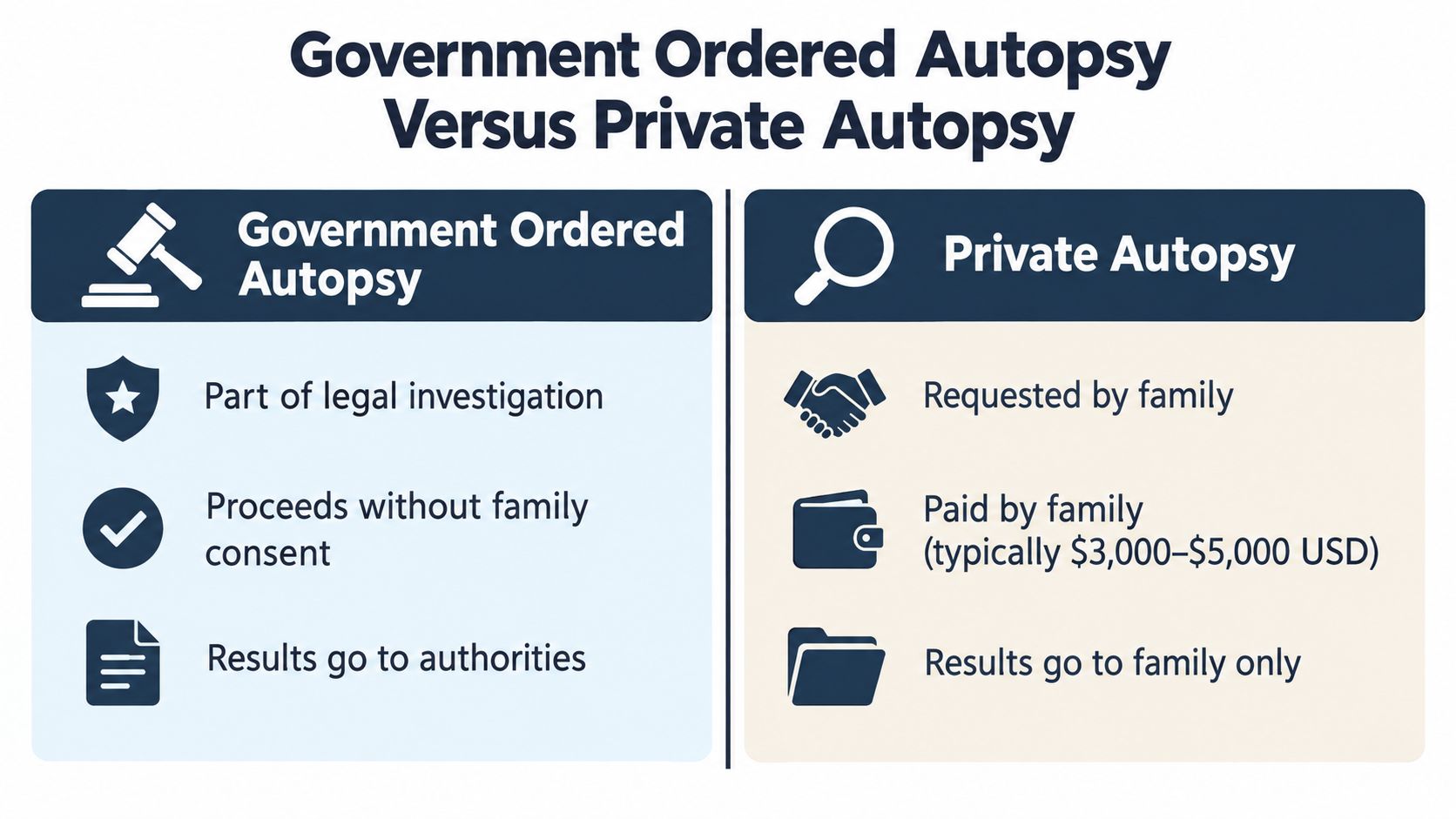
Where each path fits
A private autopsy is often appropriate when the medical examiner declined the case, when a family wants a second opinion on prior findings, or when an attorney needs independent pathology for litigation. It can also help when the family needs a clearer explanation after a hospital or outside examiner has already issued a report.
A government autopsy, by contrast, serves the public process. It preserves evidence, supports legal certification, and answers the state's question about what happened. A private review cannot replace that duty if the official case is still open.
A private exam can add clarity, but it cannot stop the state's investigation.
The timing question matters most. Before arranging an independent examination, families and counsel should determine whether the case is still under county jurisdiction, then decide whether a private autopsy belongs after the official process ends. That keeps evidence handling in order and avoids conflict between the two paths.
Family Rights, Consent, and When Objection Is Overridden
Many families assume refusal is enough to stop an autopsy. In Texas, that's not always true. When the death is sudden, unexplained, suspicious, potentially criminal, or otherwise within the medicolegal system, a medical examiner, justice of the peace, or prosecutor may order the procedure over family objection. The law gives public authority priority where the investigation requires it. Wex on autopsy rights
The public health pathway
Texas also recognizes a separate public-health route. An attending physician or health authority may request an autopsy when additional information is needed to protect public health, and if the death involves a reportable or communicable disease and survivors withhold consent, the health authority may order it. That is a different legal basis from a criminal inquest, but the result is similar. The state can override objection when the statutory standard is met. Texas public health autopsy authority
Religious concerns still matter, and they should be raised as early as possible with the official authority handling the case. The legal system may consider them, but it doesn't create a universal right to refuse an examination that the law requires. That's why the right question is jurisdiction, not preference.
For families dealing with facility neglect concerns, the same authority issue often appears in a different form. A care-home case may involve documents, reporting lines, and a later wrongful-death claim, and a plain discussion of those responsibilities can be useful. A practical resource on the civil side is the nursing home negligence lawsuit guide, especially when the facts overlap with a reportable death and a possible autopsy review.
For a closer look at who may request an exam in Texas, our internal guide on who can request an autopsy provides additional context.
What a Texas Autopsy Report Includes and When It Is Filed
A Texas autopsy report is a defined record set, not just a narrative summary. Under the state's definition, it can include the postmortem examination report, X-rays, photographs taken during the actual examination, toxicology results if they exist, and other reports about internal organs and structures after dissection. Material the physician only reviewed to help determine cause of death is not part of the report itself. Texas autopsy report definition
Families often ask for “the autopsy,” but the law treats the file more precisely. That matters when a lawyer, insurer, or family member wants to separate the formal record from background materials that informed the examiner's opinion.
The filing deadline is separate from the contents. For autopsies required by state law, the designated physician generally must file the report with the office named in the order no later than the 30th day after the request date, unless a statutory exception applies. The deadline applies to the report, not necessarily every follow-up test result. Texas autopsy report filing deadline
Our internal overview on what a report of autopsy typically contains explains how those records are usually organized after an examination.
The report serves as the official record for certification, review, and later legal use.
Families and attorneys should ask early which office will hold the report, because that determines where the request goes. If a private second opinion is later considered, the formal report and its attachments become the starting point for that review.
Jurisdiction, Reporting, and Coordination With Donation
Texas law also creates reporting duties that help move a case into the right office. Under Health and Safety Code §672.012, any person who knows of an adult death, or circumstances indicating suicide, family violence, or abuse, must immediately report it to the medical examiner in the county where the death occurred. If there's no medical examiner's office and no district, the report goes to the justice of the peace. Texas Health and Safety Code §672.012
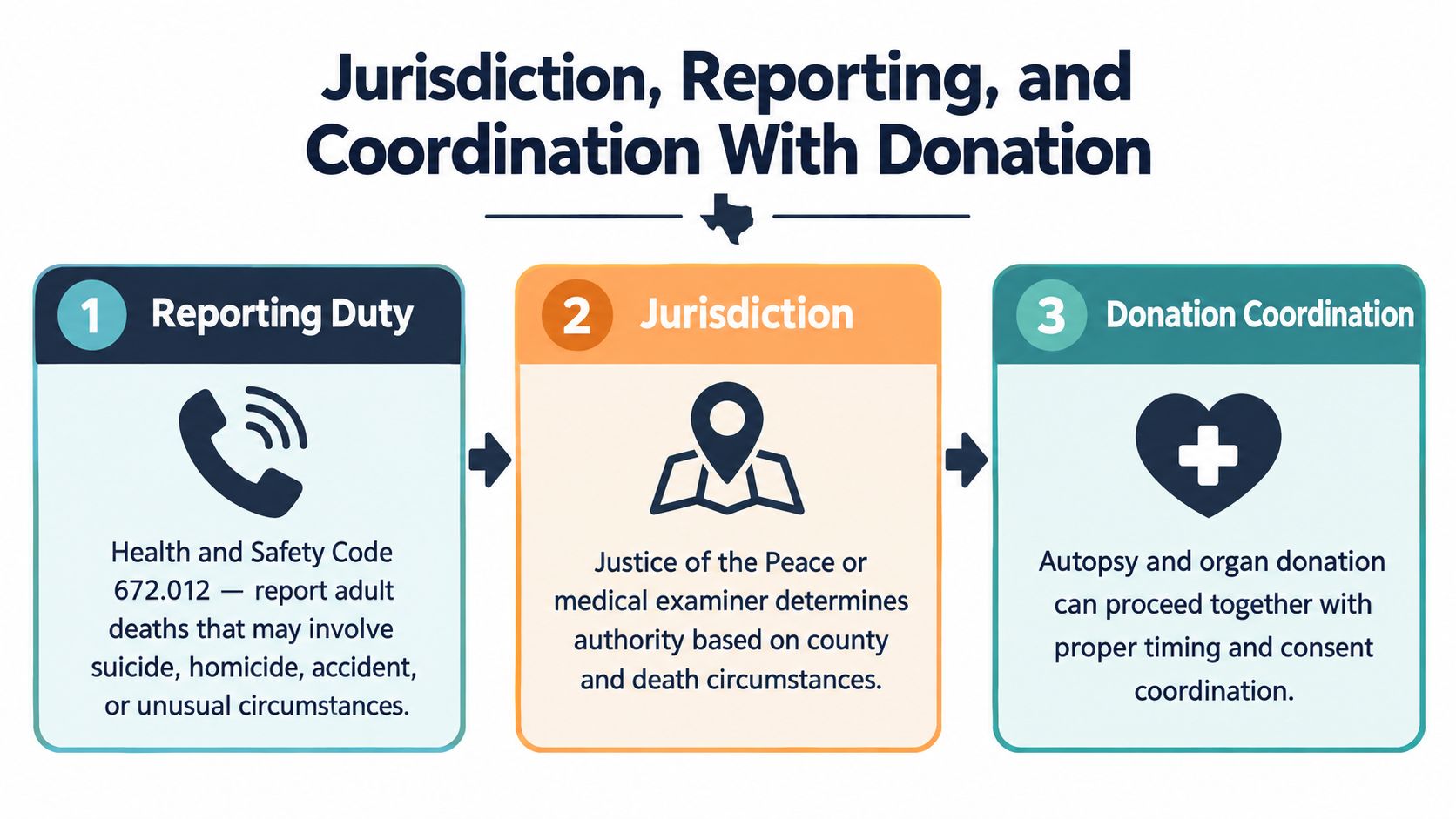
Donation and autopsy can proceed together
Organ donation doesn't cancel a required autopsy. Under Chapter 693 of the Health and Safety Code, the official authority must first determine that organ removal won't interfere with the later investigation or autopsy. If that determination is made, the organs are released in a timely manner, and the autopsy follows in a timely manner after removal. Texas organ donation and autopsy coordination
That coordination is practical, not optional. It protects the investigation while still allowing donation when the law says the two can be managed together. Chain of custody remains important throughout, especially if a later private or second-opinion review is expected.
The first step in any unclear case is identifying the correct county authority. Once the wrong office is contacted, families can lose time they don't have, especially in a case involving custody, abuse, or an unexpected death.
Frequently Asked Questions and a Compassionate Next Step
Can a family request an autopsy if the medical examiner declines the case?
Yes, a family can usually seek a private autopsy if the remains are under lawful control and no official investigation blocks it. That private path is separate from the state process and works best after the county authority has finished or released jurisdiction.
What records help with a private second opinion?
The most useful records are the official autopsy report, death certificate if it's available, hospital records, toxicology results, scene information, and any photographs or imaging that belong to the formal file. The statutory report definition matters because not every document reviewed by the physician is part of the report itself.
How long does a private second opinion take?
Timing depends on the case, the records available, and whether additional testing is needed. In practice, most straightforward reviews move faster than complex cases, but the timeline should never be promised without first reviewing the materials.
How do I confirm whether a death is under county jurisdiction?
Contact the county medical examiner, justice of the peace, or the office handling the inquest and ask which authority has the file. If you're unsure, start with the county where the death occurred, because that's the place Texas law uses for the initial reporting duty.
Can religious objections stop a required autopsy?
Not always. Texas law allows public officials to require an examination when the statute calls for one, even if family members object, so the issue is one of legal authority, not simple preference.
Families, attorneys, and county officials often need the same thing first, a clear answer about who has authority and what happens next. When the law, the records, and the circumstances don't line up cleanly, that answer should come from a forensic pathologist who can explain the options without pressure or guesswork.
Texas Autopsy Services provides independent autopsy and second-opinion pathology for families, attorneys, and county officials who need clarity on cause of death, jurisdiction, and evidence handling. Every examination is performed by a board-certified forensic pathologist, and our team can help coordinate the records, transport, and reporting needed for a careful review. If you need guidance on when an autopsy is required by law or whether a private examination is appropriate after the official process, visit Texas Autopsy Services to contact our team directly.