April 22, 2026 · Texas Autopsy Services
Pending Death Certificate What Texas Families Should Know
A pending death certificate in Texas can be confusing. We explain why it happens, typical timelines, and steps you can take to find answers.
On this page
- TL;DR
- An Unexpected Word on a Final Document
- What a Pending Death Certificate Legally Means in Texas
- Why a Cause of Death Investigation Takes Time
- The Forensic Pathologist’s Search for the Causal Chain
- How Families and Attorneys Can Navigate a Pending Status
- When an Independent Autopsy Can Provide Answers
- Frequently Asked Questions
- A Final Word on Finding Closure
By the time a family sees a death certificate, they usually need it for something practical right away. A bank account needs attention. Life insurance paperwork is waiting. Funeral arrangements are moving forward. Then one word appears where a clear answer was expected: pending.
At Texas Autopsy Services, every examination is performed by a board-certified forensic pathologist experienced in medicolegal death investigations. Our work centers on one principle: follow the evidence carefully, explain it plainly, and treat the deceased and their family with respect.
TL;DR
A family may be ready to handle funeral plans, insurance forms, and probate, then hit an unexpected delay because the death certificate says pending. I explain this often in practice. The document usually confirms that the death has been legally recorded, while the medical cause and manner of death are still under review.
- A pending death certificate in Texas is often usable for immediate legal and administrative needs, even before the cause of death is finalized.
- Pending status usually means the certifier needed more evidence before signing a medical opinion. That may include toxicology, microscope slides, scene investigation, medical records, or identity work.
- From a forensic pathologist’s perspective, delay is often the price of accuracy. A premature cause of death can create problems for families, attorneys, insurers, and the court record.
- Families and lawyers usually get farther by asking which office currently has the case, what specific items are still outstanding, and whether an amended certificate will be issued after the investigation is complete.
- While waiting, it helps to gather practical paperwork such as the documents needed to open probate and to understand when a death certificate is issued in Texas.
- If the official process leaves major questions unanswered, an independent autopsy or expert review may help clarify what happened.
An Unexpected Word on a Final Document
A family member dies. The funeral home gathers information. Certified copies of the death certificate are requested because everyone understands they’ll be needed soon. Then the certificate arrives and the cause of death does not list a final diagnosis. It says pending investigation or pending.
I’ve seen how unsettling that moment is. To a family, the death certificate feels final by definition. Seeing an unresolved word on a final document can seem contradictory, even careless. Attorneys often react the same way for a different reason. They know the document may affect probate, insurance, litigation, and timing.
What I tell people is simple. Pending does not mean no one knows what they’re doing. It usually means someone is taking care not to guess.
A cause of death investigation isn’t a single event. It’s a process. The body may need an autopsy. Tissue may need microscopic examination. Blood and other samples may be sent for toxicology. Investigators may need scene information, medical records, or witness accounts. Sometimes the early picture points in one direction, but the final evidence points somewhere else.
A pending entry is often the medical system’s way of saying, “We know a death occurred. We are not willing to certify the cause until the evidence supports it.”
That distinction matters. Families deserve an answer grounded in fact, not an assumption entered too early because paperwork was moving faster than science.
What a Pending Death Certificate Legally Means in Texas
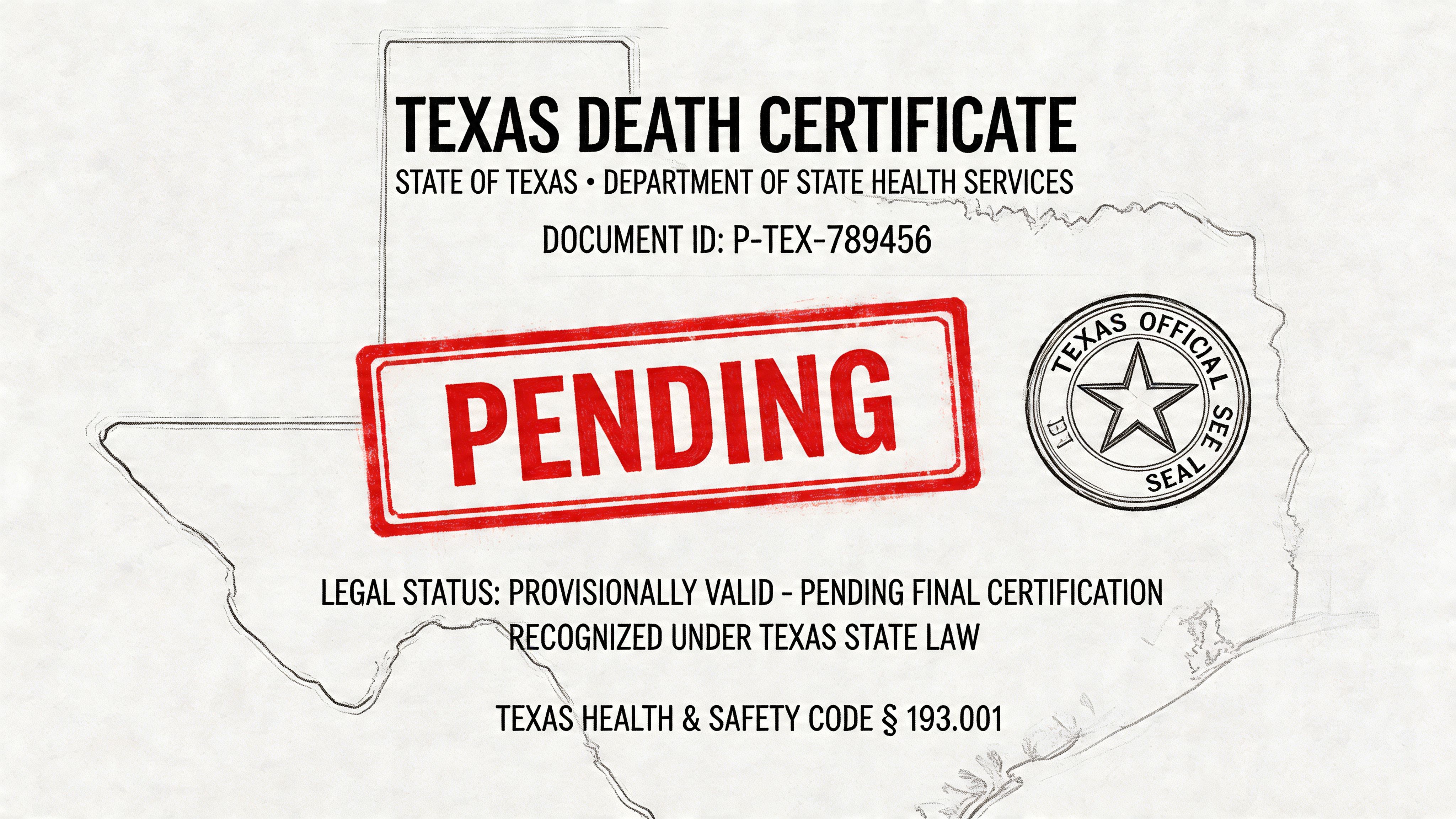
A pending death certificate is best understood as a legally valid record with an unfinished medical conclusion. The death itself has been legally documented. What remains open is the final cause-of-death determination.
When a death certificate lists the cause as pending, that status functions as a procedural placeholder. Death certificates must be ordered within 72 hours of death, but the medical examiner’s investigation may continue for weeks or months. A certificate issued with a pending cause of death still retains full legal validity for estate access, asset transfer, and arranging disposition services. The same source also notes that approximately 8% of all deaths undergo autopsy examination, with roughly half conducted for forensic purposes (explanation of pending cause-of-death status).
What the document does and does not mean
A pending certificate usually means three things are true at once:
- The death has been legally recorded so the family is not left waiting for basic administrative recognition.
- The medical cause is still under review because key evidence is not back yet or the findings are incomplete.
- The record can be amended later when the certifying physician or medical examiner has enough information to sign a final cause.
That is why I don’t describe a pending death certificate as defective. It is more accurate to call it provisional on the medical side and complete on the legal side for many immediate purposes.
Why this matters for probate and family logistics
Families often worry that “pending” means they cannot begin estate work. In practice, many early tasks can still move forward. If you’re trying to understand the papers commonly gathered at the start of an estate matter, this guide to documents needed to open probate offers a useful overview from the probate side.
The more practical issue is not usually whether the certificate exists. It is whether a particular institution will accept the pending version for the step you need to take. Some will. Some may ask for the amended certificate later.
Practical rule: Ask the bank, insurer, or court clerk whether they need proof of death now, a certified copy now, or the final amended certificate later. Those are not always the same requirement.
A Texas-specific point families often miss
In Texas, people often focus on the final medical wording and overlook the first step, which is issuance. If you need background on the timing of issuance itself, I’ve addressed that in more detail in when a death certificate is issued.
The short version is this. The state does not want families blocked from basic post-death tasks while laboratory work is still pending. The law and the death investigation process are built around that reality.
Why a Cause of Death Investigation Takes Time
A family may hear on Monday that the autopsy is complete, then learn on Friday that the death certificate is still pending. That feels contradictory. In practice, it usually means the physical examination is finished, but the medical conclusion is not ready to be signed.
I explain this often in my own cases. The delay is usually not idle time. It is the time required to test, compare, verify, and rule out reasonable alternatives before a physician certifies the cause and manner of death.
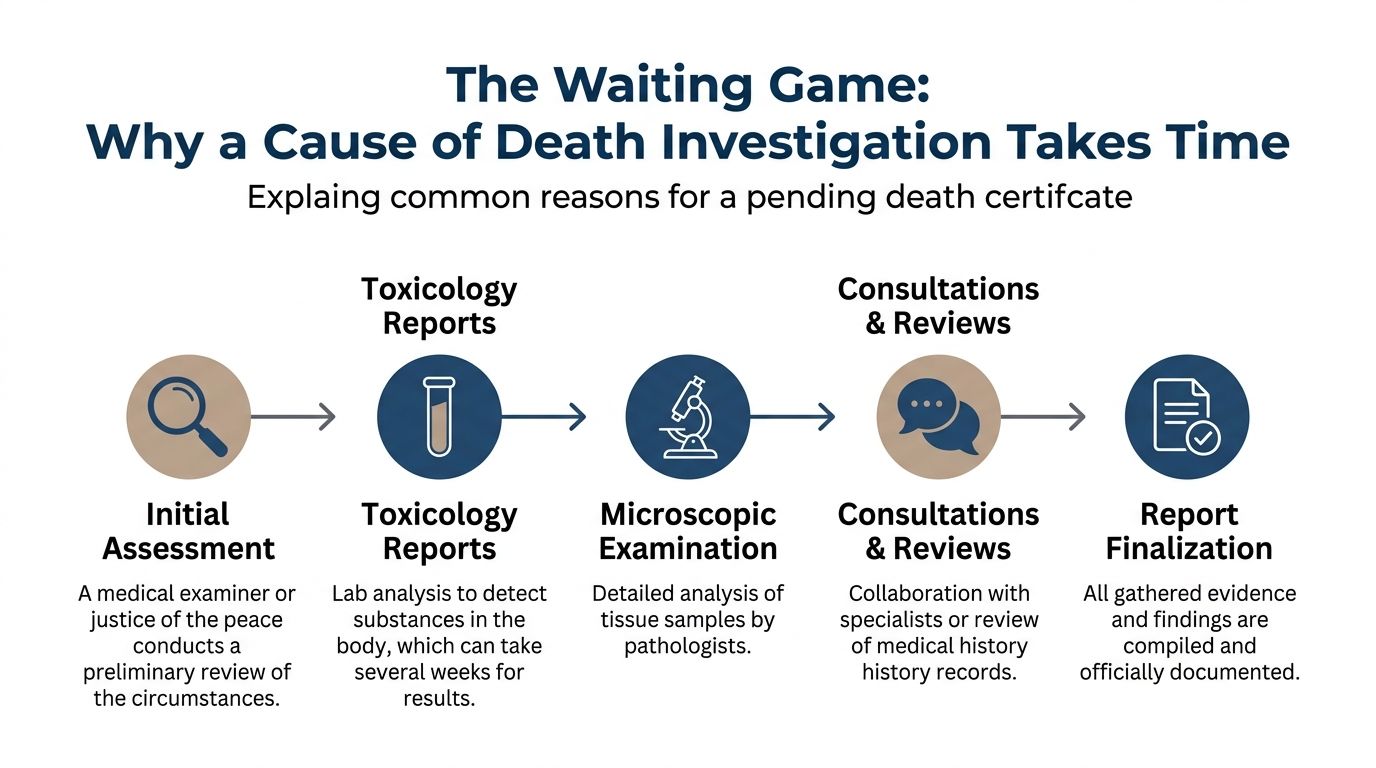
The five common reasons a case stays pending
Toxicology is still in process
This is one of the most common reasons for delay. Some deaths leave no obvious anatomic cause at autopsy. Others raise concern for prescription medications, alcohol, illicit drugs, carbon monoxide, or a combination of substances.
Toxicology is more than a yes-or-no screen. The laboratory may need to identify the substance, measure the level, check for metabolites, and determine whether the finding fits the scene, the medical history, and the autopsy findings. A positive result does not always explain the death. A negative result does not always end the inquiry.
I would rather tell a family, "We are still waiting," than sign a certificate that later proves wrong.
Microscopic tissue examination is not back
Autopsy includes what the eye can see and what the microscope can confirm. Tissue samples from the heart, lungs, liver, brain, and other organs may show myocarditis, pneumonia, early infection, seizure-related changes, or subtle injury that was not clear during the gross examination.
Sometimes the reverse happens. A finding that looked important at first turns out to be incidental under the microscope. That distinction matters, especially when the wording on a death certificate may later affect insurance, litigation, public health reporting, or a criminal case.
The scene and the body are telling different stories
A cause of death cannot be certified from anatomy alone. Circumstances matter.
A person may have severe natural disease and still die from an overdose, a fall, neglect, or another external event. Or the scene may look suspicious, while the medical findings point toward a natural death. In those cases, the certifier may need EMS records, hospital charts, police reports, witness statements, prescription history, or photographs from the scene before reaching a defensible conclusion.
This part of the process often takes longer than families expect.
Identity or timing still needs confirmation
Some cases arrive without every fact settled. Identity may need formal confirmation. The timeline may be uncertain. The decedent's last known well time, recent symptoms, medications, and prior diagnoses may all change how the death is certified.
These are not clerical loose ends. They can determine whether the cause is natural, accidental, suicidal, homicidal, or undetermined.
The office is handling real workload limits
Even careful offices can be slowed by caseload volume, laboratory turnaround times, and staffing shortages. Death certification systems across the country regularly query vague or incomplete certificates and revise them after follow-up, which is one reason final wording may take longer than families expect, as noted earlier in the article.
That pattern does not mean anyone is ignoring the case. It usually means the office is trying to get the answer right before it becomes part of the permanent record.
What helps, and what usually does not
Families and attorneys often ask me whether frequent calls will speed the case. Usually, they do not. What helps is targeted communication.
- Ask a specific question: Is the case waiting on toxicology, histology, medical records, investigator review, or physician certification?
- Choose one spokesperson: One family contact or one attorney reduces conflicting messages and duplicate calls.
- Request the right document: Ask what can be released now, what requires final certification, and whether an amended certificate will be issued later.
What usually slows things down is pressure for a conclusion before the evidence is complete, reliance on an early verbal impression as if it were final, or assuming that "pending" means neglect.
For a more detailed explanation of the testing and reporting timeline, see why autopsies take so long.
The trade-off is straightforward. A faster answer may relieve anxiety for a few days. An accurate answer is more likely to withstand legal, medical, and family scrutiny later.
The Forensic Pathologist’s Search for the Causal Chain
When I certify a death, I’m not trying to place a single dramatic phrase on a form. I’m trying to reconstruct the causal chain that medically explains how this person died.
That chain matters because death certificates are not supposed to stop at the final collapse of the body. The guidelines require a structured approach that separates the immediate cause, the intermediate cause, and the underlying cause. Certifiers should not list terminal events such as cardiac arrest without identifying their etiology. If renal failure is the immediate cause, its underlying cause, such as Type I diabetes, should also be reported. This structure allows the certificate to be amended properly when forensic evidence arrives (guidance on cause-of-death documentation).
Why “cardiac arrest” is usually not enough
Every person who dies has a final cardiac arrest. That phrase alone usually tells us almost nothing. It describes the end point, not the disease or injury that set the process in motion.
Here is the difference in plain language:
| Term | What it means |
|---|---|
| Immediate cause | The final disease or condition directly causing death |
| Intermediate cause | A condition that led from the underlying cause to the immediate cause |
| Underlying cause | The disease or injury that started the fatal sequence |
A pending case often exists because one part of that chain is still uncertain. I may know the immediate event with reasonable confidence, but I may not yet know whether the underlying driver was natural disease, intoxication, trauma, complication of treatment, or something else.
How the pieces come together
In practice, I look at several categories of evidence at once:
- Autopsy findings: What the body shows on external and internal examination
- Microscopy: What tissue sections show at a cellular level
- Toxicology: Whether substances are present and medically relevant
- Investigative context: Scene findings, witness accounts, and records
- Medical history: Prior diagnoses, treatment, and recent symptoms
No single category should dominate the case unfairly. A severe disease may be present but unrelated to the death. A drug may be detected but not causal. An injury may be obvious but incomplete as an explanation without context.
My job is not to produce a quick answer. My job is to produce the most accurate answer the evidence can support.
Why this matters to families and attorneys
A precise causal chain affects more than medical wording. It can influence public health records, legal interpretation, insurance disputes, and civil claims. For families, it also affects something less formal but just as important. It gives a truthful account of what happened.
That is why a pending death certificate should not be read as hesitation for its own sake. It often reflects disciplined restraint until the chain is complete.
How Families and Attorneys Can Navigate a Pending Status
While individuals cannot speed up a forensic investigation, they can make the process easier to follow. The key is to work with the right office, ask the right questions, and prepare for the practical issues that continue while the case remains open.
A 2023 National Vital Statistics System study analyzed 3,135,301 death records from the United States and Puerto Rico. It found that, on average, 53.6% of death certificate records were available by 2 weeks, 85.3% by 4 weeks, and 97.3% by 8 weeks. The same study noted that injury-related deaths, which often involve pending status, have longer lag times, and that complex cases can take 3-6 months to finalize (national data on death certificate timeliness).
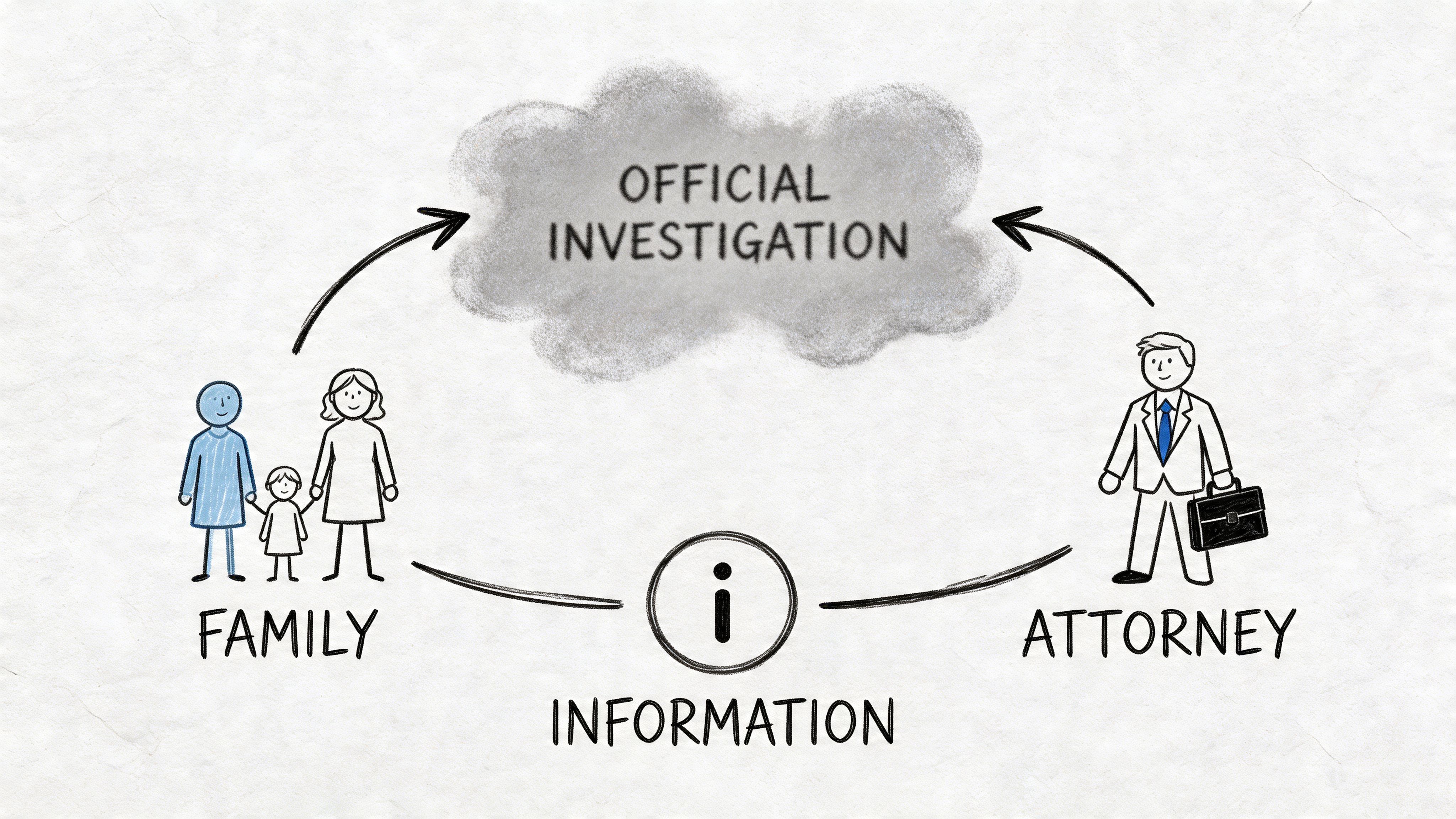
Who to contact first
In most pending cases, the best first contact is one of these:
- The medical examiner’s office, if that office accepted jurisdiction.
- The justice of the peace or coroner-equivalent local authority, if applicable in the county involved.
- The funeral home, for status on filing, certified copies, and administrative routing.
- Your attorney, if litigation, probate, or a records request is already in motion.
Different offices control different parts of the process. Families are often told “the death certificate is pending” without knowing whether the delay is medical, legal, or administrative. That distinction is worth clarifying early.
Questions that usually get better answers
A broad request for “everything” often produces very little. Narrower questions usually work better.
Try questions like these:
- Is the case waiting on toxicology, microscopic examination, records review, or certification?
- Has the death certificate already been filed with the cause pending, or is filing itself still in progress?
- Who will amend the certificate when the final cause is ready?
- Can our family obtain an investigative report now, or only after the case closes?
- Should future status requests come from one designated family member or counsel?
Ask for the current stage of the case, not a prediction of the final answer. Offices are usually more comfortable answering that accurately.
What to gather while you wait
The waiting period is easier to manage when the practical file is already organized. I usually suggest gathering:
- Certified copies already issued
- The decedent’s identification documents
- Insurance policies and claim forms
- Estate planning documents
- Hospital records or medication lists, if relevant
- Contact information for one family representative
- Any questions that need a written answer for legal use
This is also the right time for attorneys to preserve records and calendars. If a civil matter may develop, preserving documents early is often more important than obtaining an immediate final cause statement.
Communication habits that reduce confusion
One problem I see often is fragmentation. A sibling calls one office. Another relative emails another office. The funeral home hears a third version. An attorney receives a fourth.
That pattern creates unnecessary friction. A single point of contact is better. Written follow-up is better than memory. A respectful, concise message is better than repeated urgent voicemails.
When an Independent Autopsy Can Provide Answers
An official investigation and an independent review serve different purposes. The official system works for the public and follows statutory duties. An independent autopsy works for the party that requests it and focuses on the questions that remain unanswered for that family or legal team.
That distinction matters in several common situations. The state may decline to perform an autopsy. The official autopsy may answer the broad question of cause of death but leave narrower questions unresolved. Sometimes a family accepts the official findings but still wants a second opinion because the death was unexpected, contested, or likely to have legal consequences.
Situations where independence matters most
An independent forensic pathologist can be especially useful when:
- No government autopsy was performed, but the family still has unanswered questions
- The official opinion is disputed, whether medically or legally
- There may be civil litigation, including matters involving wrongful death lawsuits in Texas
- A second opinion is needed on autopsy findings, records, toxicology, or the certified cause of death
In those settings, a private review may involve a full examination, a record review, or re-evaluation of existing autopsy materials. The exact scope depends on what is available and what question needs to be answered.
What independent work can and cannot do
Independent review can provide clarity. It can identify issues that deserve closer scrutiny. It can support or challenge an earlier conclusion. It can also help attorneys understand whether the medical evidence is likely to support a claim.
It cannot guarantee that every uncertainty will disappear. Some cases remain medically indeterminate even after careful review. Good forensic practice includes saying that plainly when the evidence stops short.
For families trying to understand what a full postmortem evaluation involves, I’ve outlined the steps of autopsy in plain language. The process is structured, methodical, and designed to preserve both dignity and evidentiary value.
Why timing matters
If an independent examination is being considered, earlier discussion is often better than later discussion. The body may still be available for examination, and records or specimens may be easier to obtain while the case is active.
That does not mean families should feel rushed into a decision. It means they should understand that some options narrow with time.
Frequently Asked Questions
| Question | Answer |
|---|---|
| Can funeral or cremation arrangements move forward with a pending death certificate? | Often, yes, because a pending certificate can still be legally valid for arranging disposition. The exact next step may depend on the local authority, funeral home, and whether any additional authorization is required in that case. |
| Will a pending death certificate stop probate or insurance claims? | Not always. Many institutions can begin processing once they have proof of death, but some may later request the amended certificate with the final cause listed. It helps to ask each institution what stage of documentation they require. |
| Who updates the certificate when the final cause of death is known? | The certifying physician or medical examiner typically amends the record through the state vital records process after the investigation is complete. Families usually do not rewrite the cause themselves. |
| How do I get the final amended death certificate? | In most cases, you request it through the same vital records channel or funeral home process used for earlier certified copies. If you are represented by counsel, your attorney may also help track when the amended record becomes available. |
A few practical clarifications
A pending death certificate does not mean the investigation has stalled. It means the certifier has not yet signed a final medical conclusion.
It also does not automatically mean foul play, negligence, or a hidden issue. Many pending cases involve natural disease, but the diagnosis still requires confirmation.
If you need the final amended certificate for a specific deadline, tell the relevant office what the deadline is. They may not be able to accelerate the science, but they can sometimes clarify the administrative path.
For attorneys, it helps to separate three different requests that often get blended together: the death certificate, the autopsy report, and the investigative file. Those are related, but they are not the same document and they may not become available on the same schedule.
A Final Word on Finding Closure
Waiting on a final cause of death is difficult because it delays both paperwork and peace of mind. Even so, careful delay is often better than a premature answer that later proves wrong. A pending death certificate usually reflects an effort to get the facts right.
If you’re facing that uncertainty in Texas, seek information from the investigating office, keep your records organized, and ask direct questions. Clarity often comes step by step.
If you need guidance on what a pending death certificate means, whether an independent review may help, or what options exist under Texas law, you can contact Texas Autopsy Services. My office is available to help families, attorneys, and county professionals understand the process with clarity, respect, and medical precision.