October 28, 2026 · Texas Autopsy Services
Funeral Homes Texas How to Check Licenses and Costs
How funeral homes Texas families verify a TFSC license, compare itemized prices, and time cremation before an autopsy.

On this page
Choosing a funeral home while a hospital is arranging release can leave little time to think. At Texas Autopsy Services, we help families, attorneys, and county officials separate funeral arrangements from decisions about preserving the opportunity for a cause-of-death examination.
Author Texas Autopsy Services, an independent private autopsy and forensic pathology practice based in Elgin, Texas.
- Verify the people and the place. A funeral establishment's license and the credentials of the person performing regulated work are separate checks.
- Request itemized prices before transfer. Compare the full arrangement, including transportation, storage, and third-party charges.
- Confirm custody and care. Record where your loved one will be kept, who is responsible, and how identification is maintained.
- Resolve examination questions before cremation. A waiting period doesn't automatically reserve time for an independent autopsy.
- Keep funeral planning and medical review separate. A family can want cremation and still request an examination beforehand.
Why the First Funeral Home Call Matters
A Central Texas family receives a call from the hospital asking which funeral home should collect their loved one. A relative is gathering paperwork, another is planning a memorial, and no one feels ready to authorize anything. The immediate task is choosing a safe place for care, not settling every funeral decision.
Texas doesn't treat funeral homes as ordinary shops. Under Texas Occupations Code Chapter 651, the Texas Funeral Service Commission, or TFSC, licenses funeral establishments, funeral directors, embalmers, and crematories; licensed establishments and crematories must undergo inspection at least once every three years, unless a statutory exception applies. People and businesses providing funeral services or goods for compensation must be licensed.
Separate the decisions
A funeral-home license doesn't cover every death-care product. Prepaid funeral arrangements and cemeteries can involve separate permits or certificates of authority. Families should verify the current license, obtain prices before transfer, identify optional charges, and decide whether an examination is wanted before authorizing cremation.
Cause of death means the disease or injury that led to death. Manner of death is the classification, such as natural, accident, suicide, homicide, or undetermined. These are different questions, and an unexpected death doesn't by itself establish a particular manner.
Practical rule: Authorizing transportation shouldn't be confused with authorizing embalming, cremation, or every service in a funeral package.
Memorial planning can continue separately. For families arranging photographs, tribute ideas from Photo for Video offer a practical resource without requiring an immediate disposition decision.
Our guidance is educational, not medical advice or case-specific legal advice. Timing depends on the county, the funeral home, and whether an official investigation remains open.
Checks Before a Funeral Home Takes Custody
What to verify before transfer in Texas
| Check | Texas requirement | What to ask or record |
|---|---|---|
| Establishment license | TFSC establishment license required; TFSC establishment licensing guidance states that licenses are valid for 12 months | Current license number and expiration before transfer |
| Person who embalms or directs | Licensed funeral director or embalmer, or provisional license holder or qualified student under required supervision | Name and license type of the person who will embalm |
| Facility and care | Pre-license inspection; preparation room; compliance with building, fire, and health rules | Where refrigeration is and how identification is logged |
| Retail prices | Current prices by phone or in person; FTC itemized General Price List | Date of the General Price List and whether it was offered before transfer |
| Cremation waiting period | Generally no cremation within 48 hours unless a justice of the peace, medical examiner, or court waives it | Whether anyone has requested a waiver |
| Cremation papers | Signed authorization by the agent under Health and Safety Code Section 711.002, plus a death record allowing cremation | Who the authorizing agent is and whether the death record is in hand |
Complete the license and care checks
Begin with the establishment's legal name and address. Compare those details with the current TFSC record rather than relying on an old certificate, a directory entry, or a business name alone. If another facility will provide preparation or cremation, record that facility's name too.
Next, identify the person responsible for the regulated work. Ask who will perform embalming and whether that person holds an embalmer license or works under an authorized supervised arrangement. A receptionist arranging collection may not be the practitioner who prepares the body.
The facility check is about actual care, not whether a building looks well maintained. Before licensing, TFSC inspects for applicable state and local building, fire-safety, and health requirements, including an equipped preparation room. Ask where refrigeration will occur, whether your loved one will be moved elsewhere, and how identifying information accompanies each movement.
Record the answers in the same place as the hospital release notes. A notebook or shared document is sufficient, provided the family or responsible official can retrieve it.
Complete the price and authorization checks
Ask for telephone price information if you can't attend in person, and request a copy of the General Price List before agreeing to the arrangement. Note its effective date and which services the proposed transfer charge includes. Don't assume that collection, storage, preparation, and disposition are a single authorization.
For cremation, identify whether a waiver has been requested and who is handling the authorization documents. A waiting period and a signed form serve different purposes. Neither answers whether an independent examination is still being considered.
- Record custody responsibility. Write down the name of the person accepting responsibility for care and the receiving facility's address.
- Limit the initial authorization. Make clear which actions you approve now and which require a separate decision.
- Keep confirmation in writing. Save emails, release documents, and the proposed service statement with the license number and price-list date.
For hospitals, attorneys, and county offices, this creates a usable transfer record. For families, it reduces the chance that different relatives will receive different explanations about what has been approved.
Who May Direct Embalm or Cremate
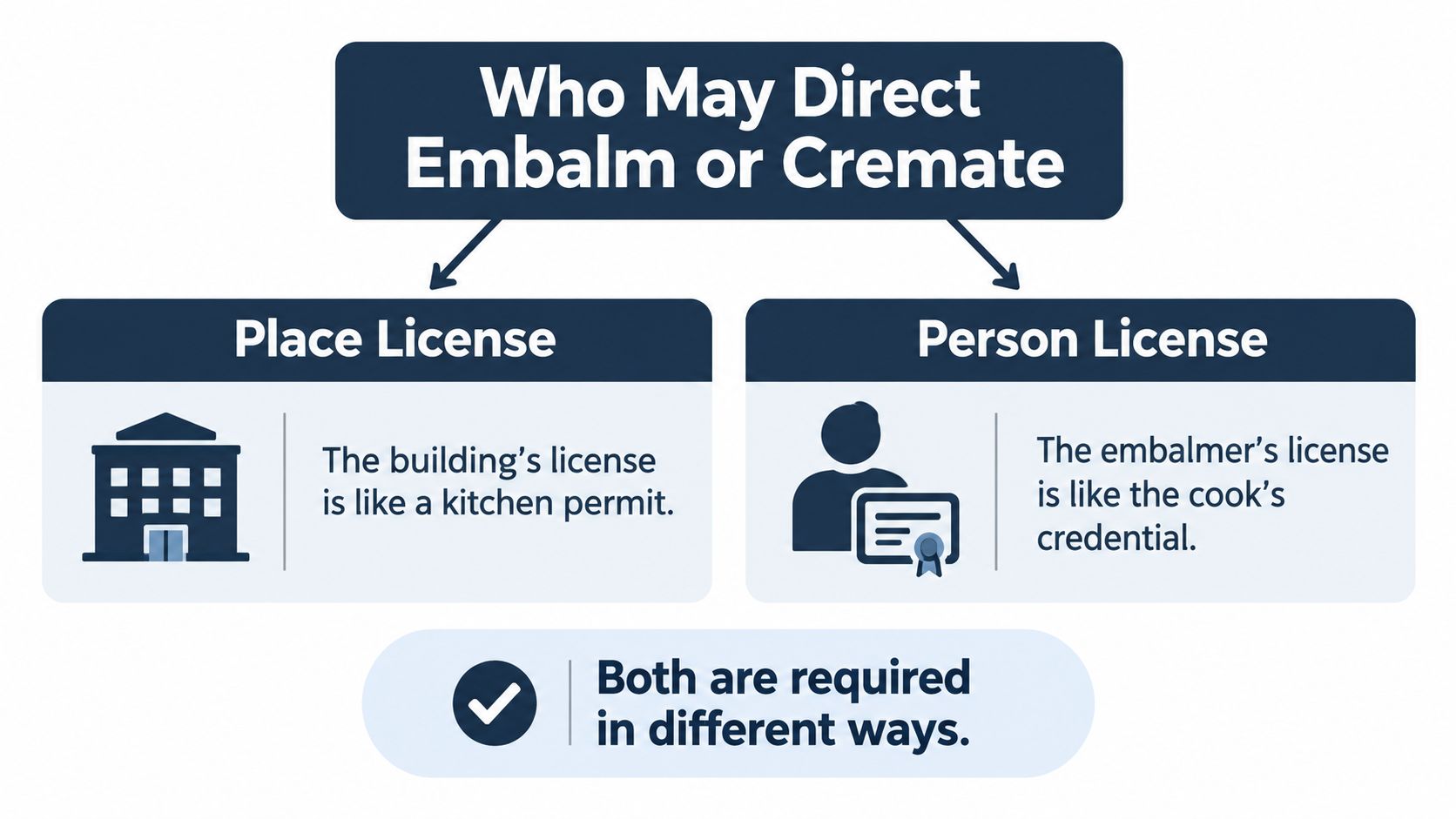
A place license and a person license answer different questions. The building's license is like a kitchen permit; the embalmer's license is like the cook's credential. Approval of the premises doesn't establish that everyone working there may perform the regulated tasks.
Individual qualifications and supervision
According to TFSC's guidance on becoming licensed, funeral-director and embalmer applicants generally must be at least 18, complete high-school-level education, graduate from an accredited mortuary-science program, complete the applicable provisional pathway unless reciprocity applies, and pass the National Board Examination and Texas Mortuary Law Examination, for which the commission identifies a 75% passing grade.
Provisional applicants work under the direct instruction and supervision of a Texas-licensed funeral director or embalmer and undergo an FBI criminal-background check. Supervision is an operating safeguard, not a description of someone's training status. It identifies the licensed professional responsible for instruction during regulated work.
For a family, the useful distinction is whether embalming will be performed by a licensed embalmer or through a legally authorized provisional or student arrangement. For an attorney or hospital, the practitioner's name and credential should remain with the identification, transportation, and release records.
Crematory licensing and professional accountability
A crematory business needs a separate crematory-establishment license. The Texas Occupations Code provisions governing the commission also establish seven governor-appointed members, including two people licensed as both embalmers and funeral directors for at least five years, one crematory owner or operator, and public members, with regular meetings in Austin at least quarterly.
That structure brings practitioner, crematory, and public representation into professional regulation. It doesn't mean a family should accept an undocumented transfer or preparation decision. Accountability still requires knowing which establishment and which practitioner handled the work.
Chain of custody means a written record of who had the body, when custody changed, and where the body was stored. When specimens or other evidence are collected, their handling also needs documentation.
A facility license, an individual credential, and a custody record prove different things. Keep them together rather than treating any one document as a substitute for the others.
Funeral directing, embalming, crematory operation, and postmortem medical examination are distinct functions. A funeral-service credential doesn't identify the qualifications of the person performing an autopsy.
How to Read the Funeral Price List
The General Price List works like a menu with every item priced separately, and you are entitled to see it before you order anything. Ask for it before your loved one is moved. If you are arranging care by telephone, request price information during that call and ask the funeral home to send the written list. Telephone disclosure does not commit you to a package before you review the details.
The Federal Trade Commission's Funeral Rule compliance guide requires accurate, itemized prices and disclosures explaining which goods and services consumers may decline. Read the list as a set of individual decisions, and the arrangement you want becomes easier to separate from services offered as additions.
Mark the services you actually want
Start with the disposition choice. Price-list categories include direct cremation, immediate burial, transportation, embalming, use of facilities, and other services. Check whether a package includes an item you do not want, and whether selecting services separately changes the total.
One line item confuses families more than any other: the basic services fee for the funeral director and staff. It is often non-declinable, and it generally covers administrative and coordinating work rather than every physical service performed on the body. Ask how it is included in the proposed arrangement so you do not count it twice when comparing packages against itemized selections.
Embalming is not automatically required for every Texas death, although a funeral home may require it for certain public viewings. A casket is not required for direct cremation, and many facility uses can be declined when a simpler disposition is chosen. Knowing which lines are optional is what turns the list from a bill into a set of choices.
Our explanation of a mortuary versus a funeral home can help families interpret different business labels. The meaningful comparison is the actual care, services, and charges, rather than the wording on the sign.
Separate provider charges from outside costs
Cash advances are items the funeral home purchases from others on your behalf, such as death certificates, clergy, flowers, or an outer burial container obtained from an outside supplier. Ask which amounts are estimates and whether the funeral home adds a service charge for obtaining them.
A low advertised cremation price can exclude transfer, storage, permits, or identification-related charges, so compare the full written arrangement rather than the headline figure. If an independent examination is being considered, identify any additional storage or transportation costs before authorizing it, since those line items affect both the total and the timeline.
Price-list note: A lower total is not a complete comparison unless the custody, refrigeration, and services included are also clear.
Price transparency tells you what a funeral home charges. It does not tell you how it cares for the person in its custody. Ask where refrigeration occurs and who is responsible for the remains, not just what cremation costs.
If a provider refuses to give prices or claims embalming is always required, pause and request the explanation in writing. Preserve the correspondence. Pricing concerns can be directed to the FTC, while Texas licensing and professional-conduct concerns belong with TFSC.
Finish by marking:
- Chosen items. Identify the services and goods you authorize.
- Declined items. Note optional services you do not want.
- Outside estimates. Flag amounts payable to someone else and any added charge.
Cremation or Burial and the 48 Hour Wait
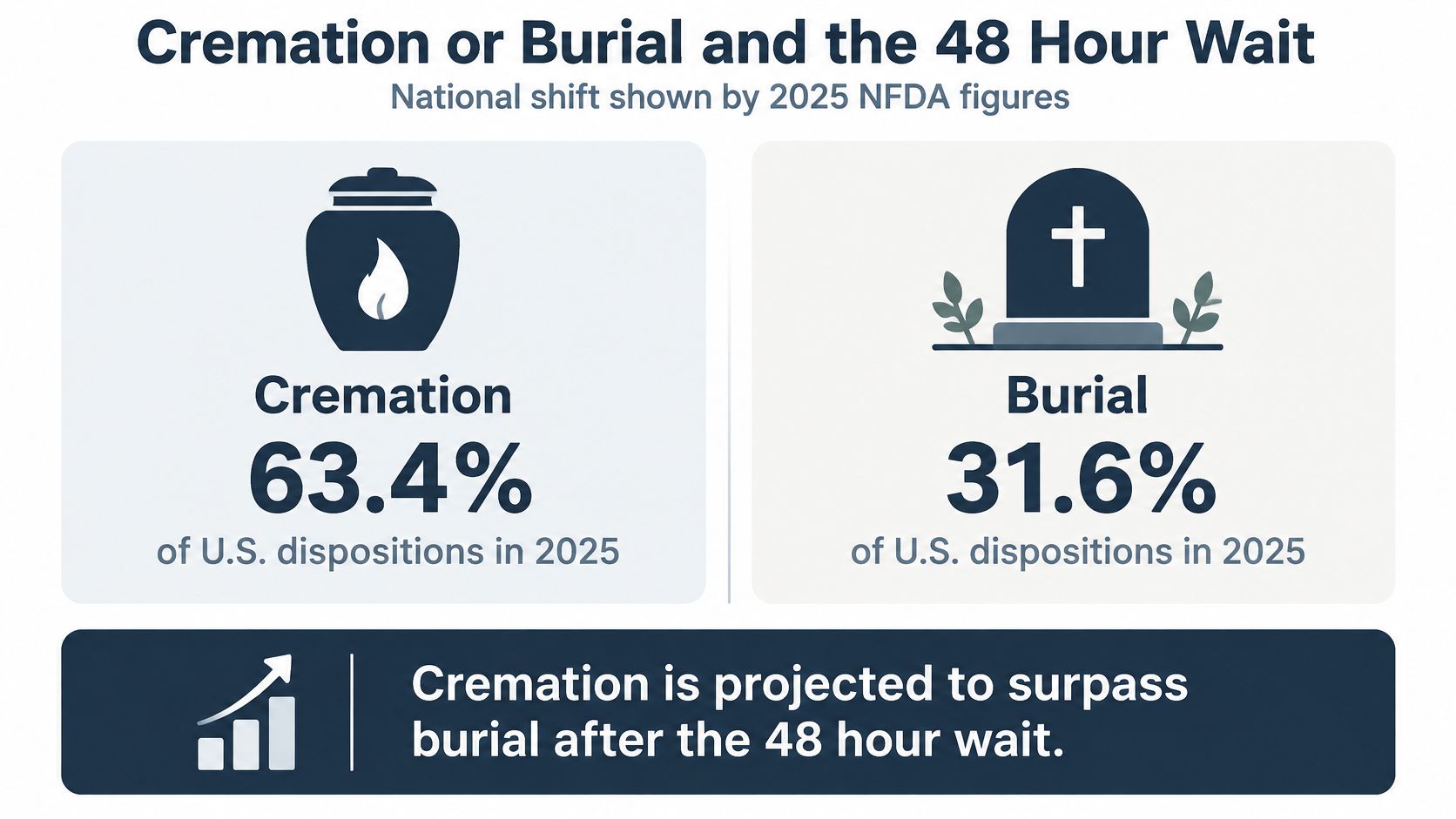
Cremation can be an appropriate choice and often costs less than arrangements involving burial. The 2025 National Funeral Directors Association report projected cremation at 63.4% of U.S. dispositions in 2025, compared with 31.6% for burial, and forecast cremation reaching 82.3% by 2045. These are national projections, not measured Texas rates.
The waiting period doesn't reserve an examination
Under Texas Health and Safety Code Chapter 716, a crematory generally may not cremate human remains within 48 hours of the time of death shown on the death certificate, unless the justice of the peace or medical examiner in the county of death waives the period in writing, or a court orders a waiver. The crematory must also receive a signed cremation authorization and a death certificate or other death record indicating that the remains may be cremated.
The clock runs from death, not from the funeral home's collection or the family's first call. It isn't a promise that an examination can be arranged during the remaining time. If an exam is being considered, tell the funeral home in writing before cremation is scheduled, and request confirmation that the decision remains on hold.
Cremation prevents a later conventional examination of the body. Burial doesn't destroy the body in the same way, but exhumation requires a separate lawful process, and changes after death can limit what an examination establishes.
Compare the choices beside the examination decision
Cremation and burial choices beside an exam
| Choice | Viewing | Embalming | Price pattern | Exam of the body later |
|---|---|---|---|---|
| Direct cremation | Usually none | Usually declined | Often the lowest advertised price, plus transfer and permits | Generally not possible after cremation |
| Funeral then cremation | Possible | Often chosen for a public viewing | Facility, staff, and casket or rental casket added | Possible only before cremation |
| Immediate burial | Usually none | Often declined | Casket and cemetery costs added to basic services | Possible later only through lawful exhumation |
| Burial with visitation | Common | Commonly used for an open casket | Highest typical combination of funeral and cemetery charges | Possible later only through lawful exhumation |
These are common arrangement patterns, not price guarantees. Our explanation of how cremation is performed in the United States provides further process context.
The Chapter 716 authorization provisions link the authorizing agent to the person entitled to control disposition under Section 711.002 and require a signed statement disclosing the final disposition of cremated remains, if known. That agent is responsible for their disposition.
An independent examination isn't a funeral service and doesn't replace a county medical examiner or justice of the peace when the law gives that office authority over the case. The waiting period shouldn't discourage a wanted cremation; it should prompt a clear decision about unanswered questions.
Coordinating the Funeral Home and an Autopsy
A justice of the peace declines an official autopsy, but a family still has questions about the cause of death. The funeral home is caring for their loved one, and the family wants to understand whether an independent examination can happen without disrupting the planned farewell.
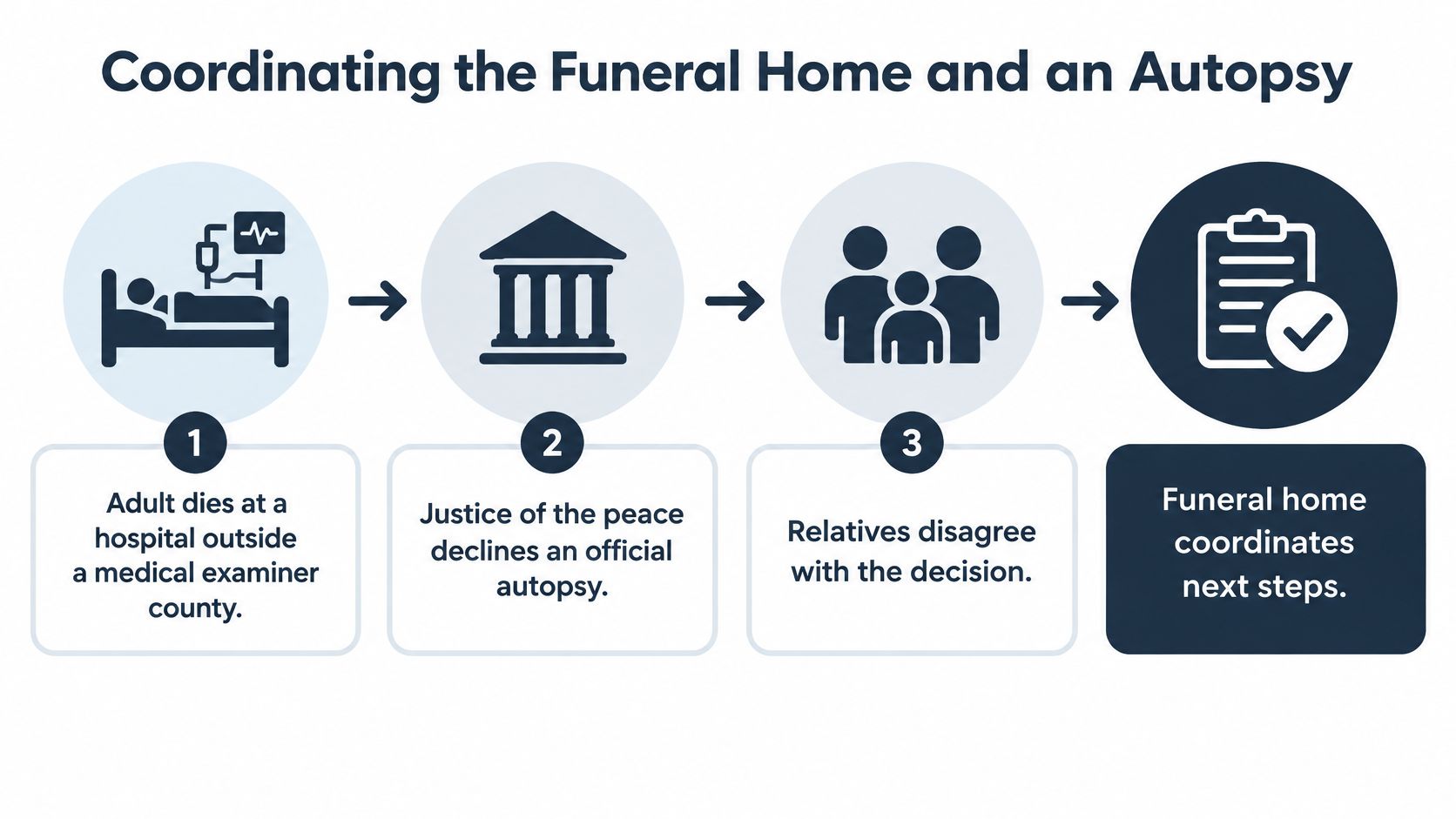
From authorization to examination
The Texas Code of Criminal Procedure's definition of an autopsy describes a postmortem examination that may include X-rays and examination of internal organs and structures after dissection to determine the cause of death or identify pathological changes that contributed to it. Reviewing records alone is different: it does not involve examining the body.
Texas Health and Safety Code Section 711.002 sets a legal priority for who may control disposition. The person who makes the first call may not have that authority. Authorization for a private examination is a separate matter from funeral paperwork, so we help families understand what consent and documentation are needed before proceeding.
Once the family authorizes the examination, we coordinate directly with the funeral home and receive the loved one into our care within 24 hours. A private examination is typically completed within 24–48 hours, with the funeral services in mind. County holds, identification questions, and case complexity can affect timing; laboratory testing may take longer to produce final conclusions.
Examination, reporting, and return
Every examination is performed by a board-certified forensic pathologist certified by the American Board of Pathology, supported by licensed professionals handling transport, logistics, and family communication. We coordinate directly with funeral homes statewide so the examination does not delay the family's services.
Our facility is at 744 Lower Elgin Rd, Elgin, TX 78621. We operate under the legal name Waterloo Mortuary, LLC, doing business as Texas Autopsy Services, and are licensed in Texas. In-house transport and direct coordination help manage the transfer into our care and the return to the funeral home.
Our founders spent years caring for families in funeral homes. That experience showed them how a routine autopsy could make an open-casket farewell difficult, which is why we use restoration-conscious examination practices with the funeral that follows in mind. The examination is thorough, while preserving the possibility of the farewell the family hoped for.
Families can learn about private autopsies, county officials can review county autopsy services, and funeral homes can read about services for funeral-home partners.
Frequently asked questions
Can an autopsy be performed after embalming?
It may still be possible, though embalming can alter findings and complicate some testing. Read our explanation of whether an autopsy can be performed after embalming for more about why the examiner needs details about preparation before assessing what remains possible.
Does an independent autopsy guarantee an answer?
No. An examination may clarify questions, but it cannot guarantee a definitive conclusion. Findings should reflect the evidence, not a preferred outcome.
Can an attorney use the report in court?
County autopsy services include court-ready reporting. Whether a report is admissible in a particular case is a legal determination, not something a forensic pathologist can guarantee.
Does an “autopsy near me” search require a nearby examiner?
Not necessarily. For families comparing private autopsy services in Texas, transport and coordination with the funeral home may matter more than the examiner's proximity. We serve families across Texas from our Elgin facility, while the funeral home can continue local arrangements.
Call Before Cremation Is Scheduled
If the license is current, the price list is in hand, and your family still wants answers about the death, tell the funeral home before cremation is scheduled. Don't assume that a hospital discussion, a relative's message, or unsigned paperwork has communicated that decision. Ask the person responsible for care to acknowledge your examination request in writing.
For a cause of death investigation, our role is to explain what can be examined, what authorization is needed, and what limitations may remain. We communicate with medical precision and compassion, and we don't promise a particular finding. This is postmortem guidance, not medical advice for living relatives.
Direct communication and a defined fee
Our flat-rate private autopsy fee is $5,795. It covers the full examination by a board-certified forensic pathologist, histology and laboratory analysis by Clinical Pathology Laboratories, a complete written autopsy report, a personal consultation, direct coordination with the funeral home, and transportation within 40 miles of Elgin, Texas. Payment plans are available for private autopsies.
The included transportation area isn't the same as our statewide service area. Transportation beyond 40 miles costs $2.50 per mile, calculated from the pickup address and shown before payment. We explain those arrangements directly rather than leaving the family to infer them from the examination fee.
- Speak with our team. We don't use a call center.
- Send written questions. Our support address is support@texasautopsyservices.com.
- Include the responsible parties. Families, attorneys, medical professionals, and county officials can contact us about authorization and coordination.
We recognize that this can be a difficult call. Asking a funeral home for an itemized price list and time to decide is reasonable. No outcome or turnaround is guaranteed; for direct guidance, call (806) 230-1889, answered 24 hours a day.
We offer independent postmortem examination and coordinate custody, transport, and release with Texas funeral homes. If your family or office needs help preserving the opportunity for an examination before cremation, visit Texas Autopsy Services and contact our team to discuss the next step.