November 1, 2026 · Texas Autopsy Services
Shipping Human Remains Legally from Texas, Step by Step
Learn how shipping human remains works in Texas and abroad, with documents, packaging, carrier rules and timelines explained step by step.
On this page
A loved one is being cared for outside your home county, and you need to arrange an independent examination before funeral services. Someone asks for a receiving address; someone else asks whether the body has been embalmed. Before booking anything, we recommend settling a more important question: what is the purpose of the transfer, and who will receive the remains?
At Texas Autopsy Services in Elgin, Texas, we approach transportation as part of a documented medical-legal process. Shipping human remains for burial, returning cremated remains, and transferring a body for autopsy aren't interchangeable tasks.
- Start with purpose and destination. These determine which authorities, documents, and receiving arrangements apply.
- Separate preservation from carrier acceptance. A legally acceptable preservation method may not satisfy an airline's requirements.
- Confirm documents before release. A death certificate isn't automatically the complete document set.
- Maintain identification through every handoff. Record release, transport, receipt, and any return transfer.
- Plan for interruptions. Name the person responsible for storage, redirection, and communication if transport is delayed.
Requirements by Shipment Type at a Glance
Find your shipment type first, then confirm the requirements for its specific destination.
| Shipment type | Governing rules | Container | Carrier or handling notes |
|---|---|---|---|
| Intact remains moved within Texas | Texas preservation requirements for transported remains or remains held beyond the applicable holding period | Embalming, refrigeration, or a leak- and odor-proof container | Common carriers may require embalming before accepting a body |
| Intact remains moved to another state by ground | Rules of both states; Texas allows families to manage transport without a funeral director | Refrigerated transport or a leak- and odor-proof container, subject to destination requirements | Check the destination state's entry and disposition rules |
| Cremated remains shipped in the United States | USPS rules; USPS is the only authorized U.S. courier for cremated remains | Sealed, sift-proof primary container inside the Priority Mail Express Cremated Remains box | Priority Mail Express only; retain tracking information |
| Cremated remains sent abroad | USPS Priority Mail Express International where accepted, plus origin- and destination-country laws | Strong, durable, sealed, sift-proof container cushioned against breakage | Confirm destination acceptance before mailing |
| Intact remains flown internationally | Airline acceptance requirements informed by IATA guidance; destination laws; CDC, TSA, and CBP requirements for U.S. entry | Leak-proof inner containment and compliant outer packaging | Obtain written carrier acceptance before tendering cargo |
| Remains moved for autopsy or examination | Texas preservation rules for Texas transport; CDC oversight for international entry or transit | Leak-proof containment with appropriate preservation | Confirm the receiving facility's eligibility, acceptance, and document requirements before dispatch |
The Texas Funeral Service Commission's Facts About Funerals explains that bodies held more than 24 hours or transported must be embalmed, refrigerated, or placed in a leak- and odor-proof container. The commission also distinguishes Texas law from carrier policy: Texas doesn't itself require embalming, but common carriers frequently require it.
State compliance and carrier acceptance are separate
A refrigerated ground transfer for examination may satisfy the applicable Texas preservation requirement without embalming. An airline may nevertheless decline the same preparation under its own acceptance policy. Neither approval substitutes for the other.
The commission also explains that a family may manage disposition activities, including out-of-state transport, without using a funeral director or funeral establishment. Businesses providing funeral services or goods for compensation must be licensed. Permission for a family to act doesn't remove destination requirements or authorize release from an official investigation.
Practical rule: Choose the legal pathway before choosing the container or booking the vehicle.
Destination-state or destination-country requirements remain part of every cross-border arrangement. For families considering cremation in Texas, the decision about examination should also be resolved before cremation, because cremated remains can't undergo an intact-body autopsy.
A final distinction matters: CDC import oversight isn't the rulebook for an ordinary transfer between Texas counties. International entry and domestic transportation require separate checks, even when the receiving facility is the same.
Step-by-Step Procedure and Required Documents
We recommend assigning one coordinator to maintain the release instructions, document packet, receiving contact, and transport record. This prevents different parties from working from conflicting versions of the arrangements.
The checklist below organizes the transfer from authorization through receipt.
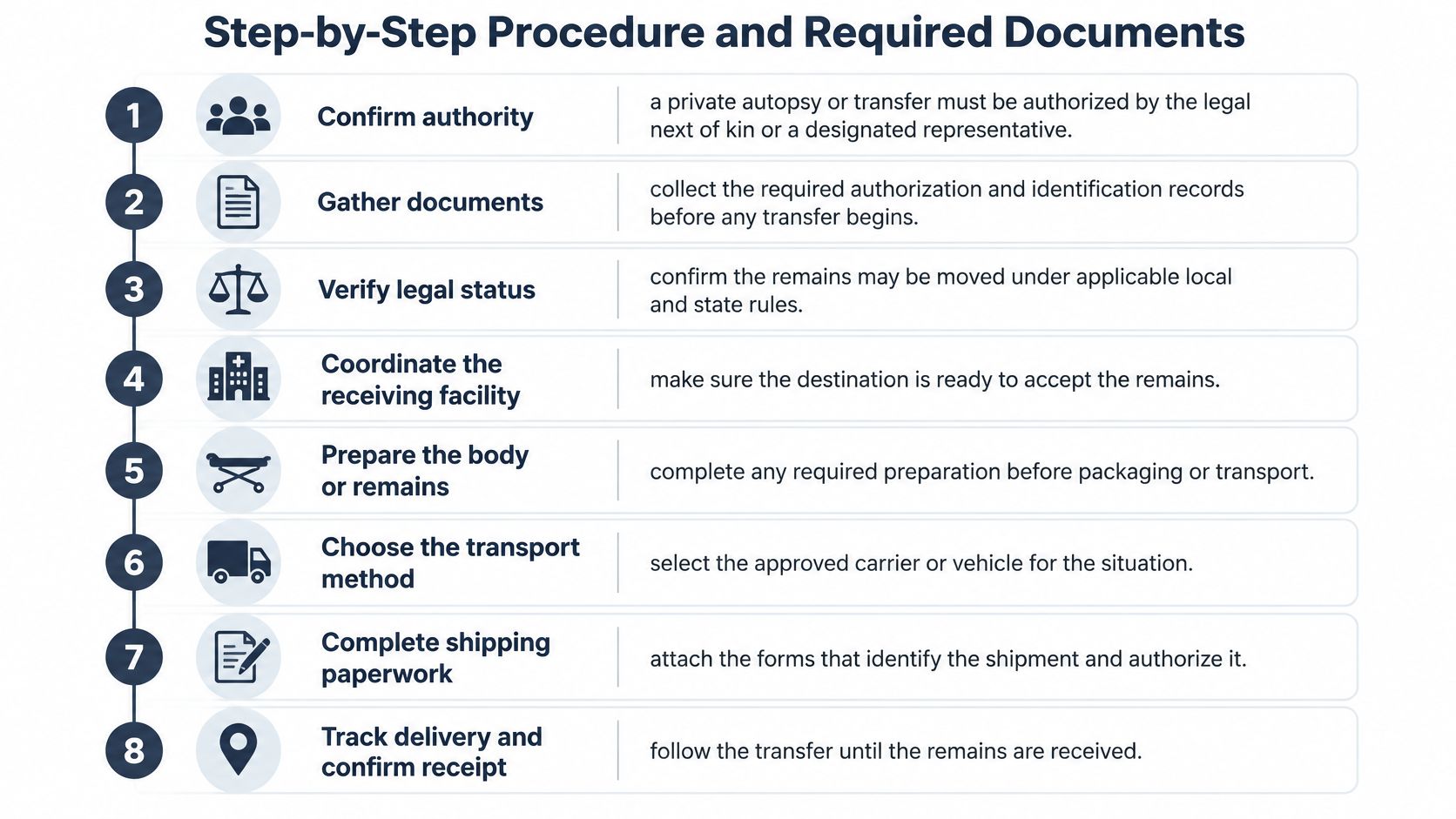
Establish authority and the receiving purpose
Confirm authority. A private autopsy must be authorized by the legal next of kin or their designated representative. For the transfer itself, verify the signer's authority and obtain any necessary release from the current custodian or responsible public official.
Authorization to request an examination doesn't automatically establish that the body is available for release. Our team can help families understand what must be resolved before arrangements proceed.
Name the purpose and destination. Write down whether the shipment is for final disposition, autopsy, another medical examination, research, or return of cremated remains. Identify the receiving organization, physical address, responsible contact, and intended activity.
The purpose determines the regulatory review. A shipment intended for burial shouldn't be described that way if it is going to an examination facility.
Identify the form of the remains. Record whether the remains are intact, embalmed, unembalmed, or cremated, and tell the receiving facility about preparation already performed. These facts affect both acceptance and the examination plan.
For example, a family arranging a cause of death investigation should discuss proposed preparation with the receiving pathologist before authorizing additional treatment.
Arrange preservation before movement. Select the preservation and containment method that satisfies the applicable jurisdiction, receiving facility, and carrier. For an autopsy transfer, coordinate preparation with the examining facility rather than assuming that a funeral transport arrangement fits the examination.
Preservation must cover waiting periods and handoffs, not just the time spent inside the vehicle.
Assemble the document packet
- Gather the documents required for the purpose. Use the table as a screening checklist, not a statement that every shipment requires every document. Ask the responsible authority and carrier to confirm the applicable set before release.
The CDC's human-remains importation guidance distinguishes final-resting imports from shipments involving other purposes or infectious-disease concerns. For final-resting imports of non-cremated, non-embalmed remains, it requires a death certificate stating the cause of death, with accepted alternatives when the certificate is incomplete or unavailable.
Documents by purpose and issuer
| Document | Required when | Issued or checked by |
|---|---|---|
| Death certificate stating cause of death | Final-resting imports of non-cremated, non-embalmed remains | Issuing death-registration authority; checked under CDC importation rules |
| Alternative certification or consular documentation | Death certificate is incomplete or delayed and an accepted substitute is needed | Accepted alternative certifier or consular officials |
| Consular mortuary certificate | Remains of a U.S. citizen who died abroad, where consular documents are required | U.S. embassy or consulate |
| CDC permit or importer certification | Required under the applicable infectious-agent or non-final-resting import pathway | CDC; importer supplies certification where applicable |
| Cremation certificate | Required by the applicable postal or destination rules for cremated remains | Issuing crematory |
| Customs declaration | International postal shipment of cremated remains | Sender, following applicable customs requirements |
| Authorization from the legal next of kin | Private autopsy or transfer for examination | Legal next of kin or designated representative; checked by the receiving practice |
Cause of death means the disease or injury responsible for death. Manner of death describes the circumstances surrounding the death, such as natural death or accident; it isn't interchangeable with the medical cause.
An unclear cause on a certificate shouldn't be replaced with a family member's interpretation. The coordinator should ask which official certification or alternative documentation the reviewing authority will accept.
Secure acceptance and document every handoff
Book the carrier and obtain acceptance in writing. Provide the shipment's purpose, preparation, container description, documents, and receiving arrangements. Written confirmation should identify the service being accepted, rather than merely acknowledge that a booking inquiry was received.
For funeral-home coordination, our guide to funeral homes in Texas offers context for the respective roles involved in care and release.
Pack and label to the applicable standards. Match the deceased person's identification, receiving address, shipment description, and handling instructions across the paperwork and outer markings. Have the transport coordinator resolve discrepancies before the carrier receives the shipment.
Labels should allow handlers to identify the shipment correctly while preserving respectful, discreet handling.
Open a chain-of-custody record at release. Chain of custody is the written record of who handles or takes custody of the remains, with the date, time, location, and purpose of each transfer. Keep it through confirmed receipt and any subsequent return.
Record the releasing and receiving parties, the identifier used, and any condition concerns. A delivery notification alone isn't a complete custody record for an examination.
Resolve exceptions before dispatch
A death certificate isn't automatically sufficient, and embalming doesn't resolve every infectious-disease question. The import purpose, suspected infectious agent, and applicable government requirements may still trigger additional review or permitting.
For international arrangements, the CDC's guidance on death during travel explains that U.S. entry must also satisfy origin-country, airline, TSA, and U.S. Customs and Border Protection requirements. CDC doesn't directly regulate exports from the United States, but destination-country, state, local, and carrier requirements still apply.
A receiving address isn't the same as authorization to receive the shipment. Confirm both before release.
Before departure, establish who responds if airline cargo is rejected, customs holds the shipment, or the receiving destination changes. The contingency plan should identify the authorized decision-maker, temporary holding facility, document contact, and party responsible for storage or redirection charges.
Shipping Cremated Remains Through USPS
A family mailing cremated remains within the United States should select the postal service first: USPS instructions require Priority Mail Express. The USPS pathway applies to cremated remains, not intact bodies.
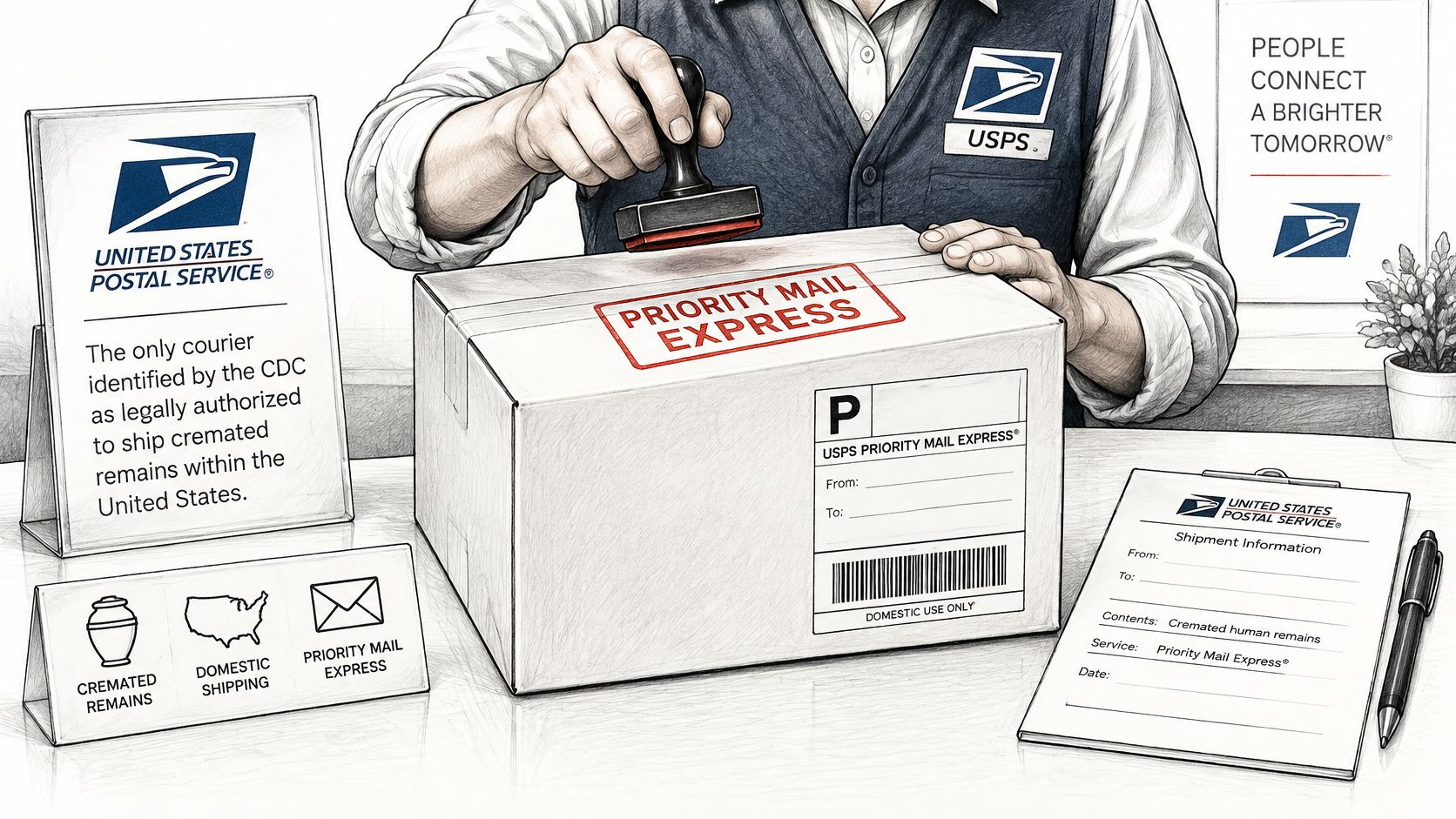
Under the USPS instructions for shipping cremated remains, senders must use the Priority Mail Express Cremated Remains box for human and animal shipments. The inner container must be strong, durable, sealed, and sift-proof, so fine particles cannot escape through seams or closures.
Pack, identify, and cushion the container
A decorative urn may need extra protection before mailing. Check that its closure is secure, then cushion it inside the required outer box so it cannot shift or break. Add complete return and delivery addresses, and confirm the recipient is prepared to receive the package.
For background on the process before mailing, read this explanation of how cremation is done in the United States.
The video below offers additional visual context for mailing arrangements.
Confirm international acceptance separately
For international shipments, USPS specifies Priority Mail Express International, subject to the destination country's rules. Check that cremated remains are allowed and confirm required paperwork, which may include a cremation certificate, permits, and a customs declaration describing the contents.
Before visiting the post office, check each item:
- Service confirmed. Verify that the selected service accepts cremated remains on the intended route.
- Container secured. Seal the primary container and protect it from movement.
- Box and identification correct. Use the required packaging and complete the addresses and markings.
- Documents ready. Check destination paperwork before mailing.
- Recipient informed. Share the tracking information and confirm the delivery address.
Packing, Timelines and Costs to Plan For
Before packing, have the coordinator compare the container, document packet, carrier booking, and receiving instructions. Each should describe the same shipment and destination.
- Contain the remains appropriately. Intact remains need leak-proof, fully contained inner packaging for the applicable route; cremated remains need sift-proof containment and cushioning.
- Check every identifier. Resolve differences in names, reference numbers, addresses, or shipment descriptions before sealing the outer package.
- Pre-clear acceptance. Send documents for review and obtain written carrier confirmation.
- Prepare the receiving handoff. Arrange appropriate temperature-controlled receiving and an authorized contact.
- Assign delay costs. Record who can approve and pay for holding or redirection.
This planning checklist separates physical preparation from scheduling and financial responsibilities.
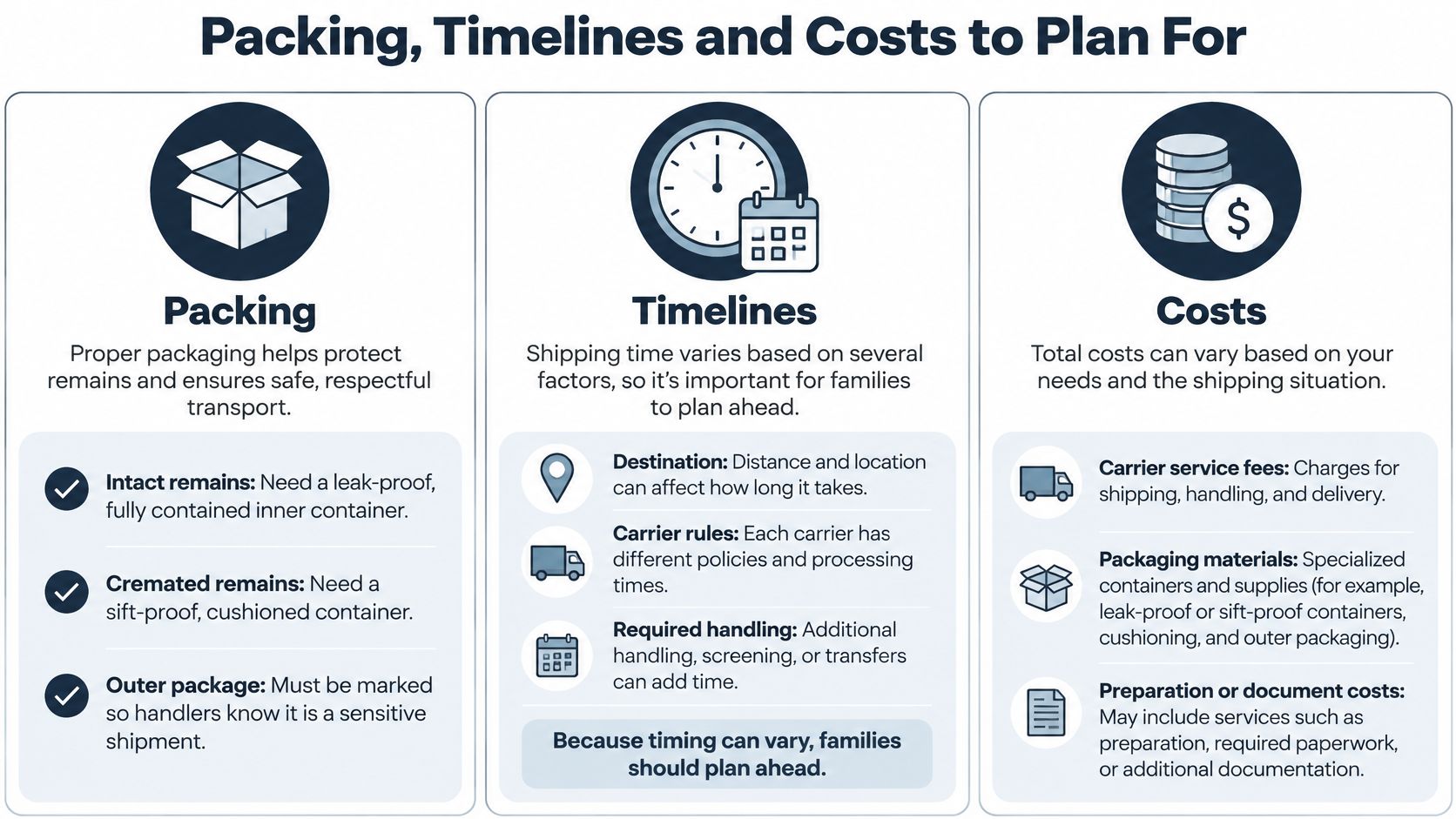
Airline cargo requires coordinated preparation
The International Air Transport Association's special-cargo guidance treats human remains as specialized cargo whose handling can require specific packaging, labeling, documentation, and temperature or security controls. Its Compassionate Transportation Manual consolidates airline acceptance and carriage requirements, including government documentation and guidance for infectious remains.
IATA guidance doesn't replace national law or a carrier's acceptance decision. The sender, funeral operator, cargo agent, airline, authorities, and receiving party must each complete their part before dispatch.
For examination transfers, explain the intended work to the receiving facility before preparation is finalized. This is educational guidance, not a case-specific medical or legal determination; the appropriate preparation must be assessed for the actual circumstances.
Separate transit estimates from the complete schedule
A carrier's travel estimate doesn't include every release, document review, customs decision, or receiving arrangement. No complete transport timeline can be guaranteed. Carrier rejection, missing authorization, inconsistent paperwork, and customs holds can interrupt an otherwise prepared shipment.
The IATA Compassionate Transportation Manual addresses the coordinated acceptance, handling, documentation, and government requirements that make advance planning necessary. We recommend identifying a holding arrangement and an escalation contact before transport begins, rather than trying to organize them after a refusal.
Budget safeguard: Obtain written responsibility for delay charges, not just a quotation for the planned journey.
Cost lines to quote before booking
| Cost line | What drives the amount | Quote from |
|---|---|---|
| Carrier or postal fees | Service level, weight, route, destination | Carrier or USPS |
| Documents and certificates | Number of certificates, permits, and issuing offices | Issuing office |
| Storage during delay | Days held, temperature control, facility rates | Holding facility |
| Redirection | New destination or receiving facility | Carrier and receiving party |
| Funeral or transport service | Scope of licensed provider services | Licensed provider |
Ask each quotation to distinguish included preparation and packaging from additional charges. Also establish whether the quote covers pickup, terminal handling, destination collection, and return transportation where needed.
An apparently lower transport quote may cover only one leg of the journey. Compare the same scope of work before authorizing payment, and keep written approvals with the shipment records.
Confirm Your Shipment Before You Book Transport
A shipment's legal purpose and destination determine which requirements apply. Before booking, confirm that the receiving party can accept the remains for the stated purpose and that the person authorizing release has the proper authority.
Work through these checks:
- Purpose and destination: Tell the receiving party whether the transfer is for disposition or examination, and confirm that it can accept the shipment.
- Signing authority: Have the authorized person complete the required release and examination forms. If you are unsure who may authorize a private autopsy, contact Texas Autopsy Services for help understanding the process.
- Documents: Ask the relevant authorities and carrier to confirm which paperwork they require.
- Preparation and containment: Confirm that the arrangements meet the route's requirements and the receiving facility's instructions.
- Written acceptance: Get the carrier's agreement to handle the shipment as described.
- Contingency responsibility: Identify who will arrange storage or redirection and pay any related costs if the shipment is delayed.
Brief answers for families and attorneys
Can remains go directly to an autopsy facility?
The facility, destination requirements, release arrangements, and applicable import pathway must all be confirmed. Naming an autopsy facility as the consignee does not by itself establish that the shipment can proceed.
Can a family request an examination after a county declines the case?
Yes. A family can request an independent private autopsy when a county declines a case. The examination is arranged and paid for by the family or requesting party. See Private Autopsies for details. County or medical examiner autopsies ordered under their jurisdiction are covered by the government.
What if we're unsure who may authorize the examination?
Contact Texas Autopsy Services before signing transport instructions. A private autopsy is authorized by the legal next of kin or their designated representative. If you are unsure whether you have that authority, our team can walk you through the process and help arrange the examination.
For questions about rules governing a shipment, contact the Texas Funeral Service Commission or the relevant destination officials. Their guidance can help clarify which requirements apply to your particular transfer.
If release, authorization, or receiving arrangements remain unclear, contact Texas Autopsy Services before booking transport. Every examination is performed by a board-certified forensic pathologist, and our team coordinates the autopsy with the funeral home so planned services are not delayed. We provide in-house transport and serve families across all 254 Texas counties. Visit Texas Autopsy Services or call (806) 230-1889 to discuss the examination's purpose, the remains' current location, and next steps.