September 28, 2026 · Texas Autopsy Services
HIPAA Reporting Requirements for Texas Forensics
Understand HIPAA reporting requirements for Texas forensic services. Learn breach timelines, notification steps, and secure chain-of-custody protocols.
On this page
- Why Privacy Rules Matter in Death Investigations
- Understanding the Federal Breach Notification Timelines
- Assembling the Required Elements for Individual Notice
- Connecting Federal Standards to Texas Chain of Custody
- Navigating the Complaint Filing Window and Resolutions
- How Our Practice Ensures Compliant Forensic Reporting
When a county official, attorney, or family member requests sensitive autopsy records, the request often arrives while the cause of death is still being examined and emotions are raw. Toxicology results, medical histories, photographs, and draft findings can affect a legal proceeding, a benefits claim, or a family's understanding of what happened. A release made to the wrong person, or a record transferred without documentation, can compromise both privacy and evidence.
For Texas Autopsy Services, HIPAA reporting requirements are part of a larger duty. We treat protected health information, physical evidence, and chain-of-custody records with the same care applied to the postmortem examination itself. Our team is based in Elgin, serves all 254 Texas counties, and communicates with families, attorneys, healthcare professionals, and county officials in precise, plain language.
- The federal rule has two reporting tracks. Breaches affecting 500 or more individuals follow an immediate federal reporting path, while smaller breaches are reported annually. HHS explains the federal breach reporting tracks.
- The clock begins at discovery. A complete forensic investigation doesn't postpone the reporting deadline.
- Individual notices require specific content. They must describe the breach, information involved, protective steps, mitigation efforts, and contact information. HHS outlines the required notice elements.
- Privacy and evidence integrity are connected. Secure transport, controlled access, and documented transfers help prevent a disclosure before it becomes a reportable breach.
- Texas law still matters. HIPAA requirements operate alongside the Texas Health & Safety Code and applicable Texas Funeral Service Commission standards.
Why Privacy Rules Matter in Death Investigations
Requests for preliminary findings often arrive before an investigation is complete. County officials may need information after a body is transferred, while attorneys may seek photographs or toxicology records for a family. Before releasing anything, the practice must verify the requester's authority, identify the records involved, and confirm that the disclosure is permitted.
That discipline protects more than confidential information. It supports the reliability of a medicolegal death investigation. An unauthorized disclosure can cause unnecessary distress, expose private medical details, and raise questions about whether evidence was altered, incomplete, or mishandled. In independent forensic pathology, privacy controls therefore support the chain of custody and preservation of evidence.
Privacy begins before examination
Protected health information, or PHI, generally includes individually identifiable health information created, received, maintained, or transmitted by a covered entity or business associate. In a forensic setting, relevant material may include medical records, laboratory findings, postmortem photographs, correspondence, and reports connecting information to a particular decedent or family.
A breach under the federal rule is generally an impermissible acquisition, access, use, or disclosure of PHI that compromises privacy or security, as defined in the federal breach notification framework. The practical question is whether information was handled outside the authorized process, not just whether a document left the office.
Practical rule: Verify authority before discussing a case, not after sending the report.
Safeguards include controlled record access, direct communication with authorized parties, secure storage, and documented transfers. Physical remains and associated records require different handling methods, yet both must remain traceable from intake through final reporting. A misplaced file, unsecured image, or undocumented handoff can affect both confidentiality and the credibility of the investigative record.
Respect for families and legal process
Death investigations involve people who deserve clear information without unnecessary exposure. Avoid casual discussions, unverified conclusions, and broad distribution of sensitive material. Board-certified forensic pathologists prepare unbiased, court-admissible reports, while licensed professionals support logistics, transport, and family communication.
Healthcare or forensic organizations should also review relationships with vendors and business associates. The overview of BAAs and HIPAA compliance with Technovation LLC can help identify responsibilities when outside providers access, store, or transmit protected information.
Understanding the Federal Breach Notification Timelines
A misplaced case file, exposed image, or unauthorized disclosure can trigger HIPAA reporting duties before a forensic review is complete. The reporting clock begins with discovery, so the practice must preserve evidence, contain access, and assess the event at the same time. Waiting for every investigative question to be resolved can leave too little time to prepare accurate notices.
For a breach affecting 500 or more individuals, the HHS Secretary and affected individuals must receive notice without unreasonable delay and no later than 60 calendar days after discovery. If more than 500 residents of a state or jurisdiction are affected, media notice is also required. For a forensic practice, “without unreasonable delay” means beginning assessment and notice drafting during the same week the exposure is identified, rather than treating the federal deadline as the target.
The two reporting tracks
Breaches affecting fewer than 500 individuals remain reportable. The HHS Secretary generally receives those filings within 60 days after the end of the calendar year in which the breach was discovered. That later federal filing milestone does not reduce the practice's immediate responsibilities. The team still must investigate, document the affected records, control further disclosure, and address potential harm.
| Breach size | Federal filing milestone | Individual notice |
|---|---|---|
| 500 or more individuals | Without unreasonable delay, no later than 60 calendar days after discovery | Without unreasonable delay, no later than 60 days after discovery |
| Fewer than 500 individuals | Within 60 days after the end of the calendar year of discovery | Without unreasonable delay, no later than 60 days after discovery |
The two tracks affect federal filing priority, not the standard of care for the underlying investigation. A larger incident requires prompt federal visibility. A smaller incident still demands a defensible record showing what happened, which records were involved, and how the practice responded.
Why discovery matters
Discovery is not necessarily the date a forensic investigation ends. It occurs when the organization knows, or should reasonably know, that an impermissible acquisition, access, use, or disclosure may have occurred. A preliminary indication can therefore require action before the team has established the full scope.
The first operational response should preserve access logs, secure affected records, restrict additional access, and assign responsibility for the assessment. Document each handoff and preserve the original evidence. Those controls support both timely HIPAA decisions and the reliability of the medicolegal record, particularly when county officials or attorneys later need to understand how information was handled. HHS describes these reporting obligations and deadlines
Assembling the Required Elements for Individual Notice
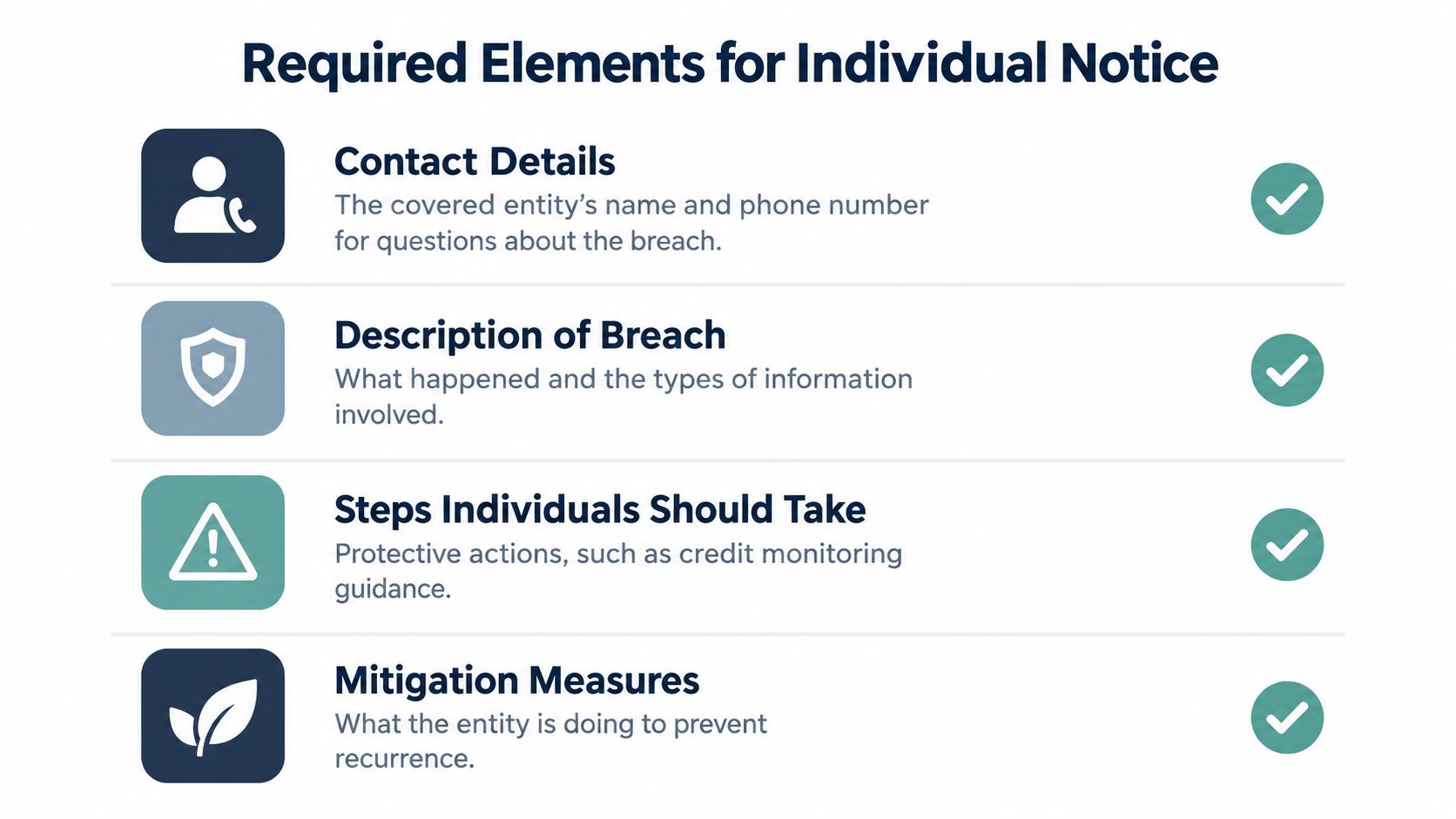
A lawful notice must do more than meet the reporting deadline. It should explain what happened, identify the information involved, describe practical protective steps, summarize the investigation and mitigation work, and provide a reliable contact route. These elements give affected individuals enough information to understand the incident and decide what to do next.
For an independent forensic pathology practice, assembling the notice requires careful record review. Relevant information may sit in an intake file, imaging system, laboratory documentation, correspondence, or release log. Staff must identify the affected population while limiting access to personnel who need the records for the assessment.
What the notice must accomplish
A useful notice answers five practical questions:
- What happened? State the known circumstances without speculation.
- What information was involved? Identify the categories of PHI affected.
- Who may be affected? Confirm the population against documented records.
- What should recipients do? Provide reasonable protective steps.
- How is the organization responding? Describe investigation and mitigation measures, then give recipients a contact route for questions.
The wording should separate confirmed facts from matters still under review. Families and attorneys need a clear account of what is known, what remains uncertain, and which controls the practice has already applied. Vague language can create confusion, while unsupported conclusions can compromise both the notice and the death investigation.
Why forensic records require careful assembly
A release log can show who requested a report, what authority was provided, which records were disclosed, and when the transfer occurred. Access logs may show who viewed electronic files. Physical evidence records can establish whether a document, image, or specimen moved between authorized custodians.
These records support the breach assessment and help protect the underlying death investigation from claims that evidence was mishandled. Texas Autopsy Services describes HIPAA-compliant release of information for autopsy reports through documented authorization and controlled disclosure.
What works and what fails
A written incident pathway gives staff clear instructions on whom to notify, how to preserve the original record, and where to document each action. Informal conversations, shared credentials, untracked attachments, and verbal approvals do not create the same defensible record.
Documentation should capture the date of discovery, records involved, people who accessed or received them, containment steps, and the reasoning behind the final notice. Keep that record separate from unsupported assumptions about cause of death or legal responsibility. Clear separation preserves the integrity of both compliance decisions and medicolegal evidence.
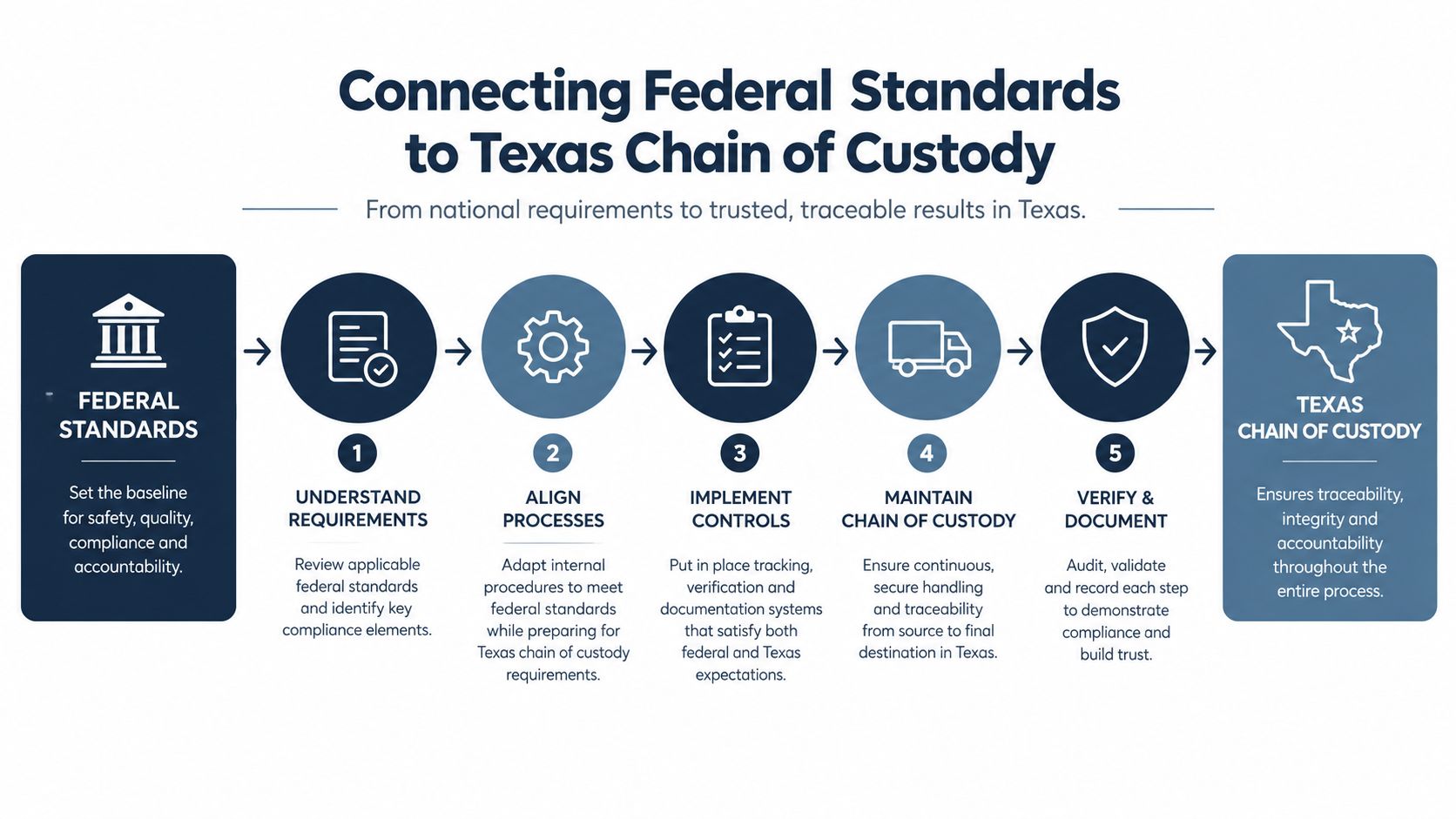
Connecting Federal Standards to Texas Chain of Custody
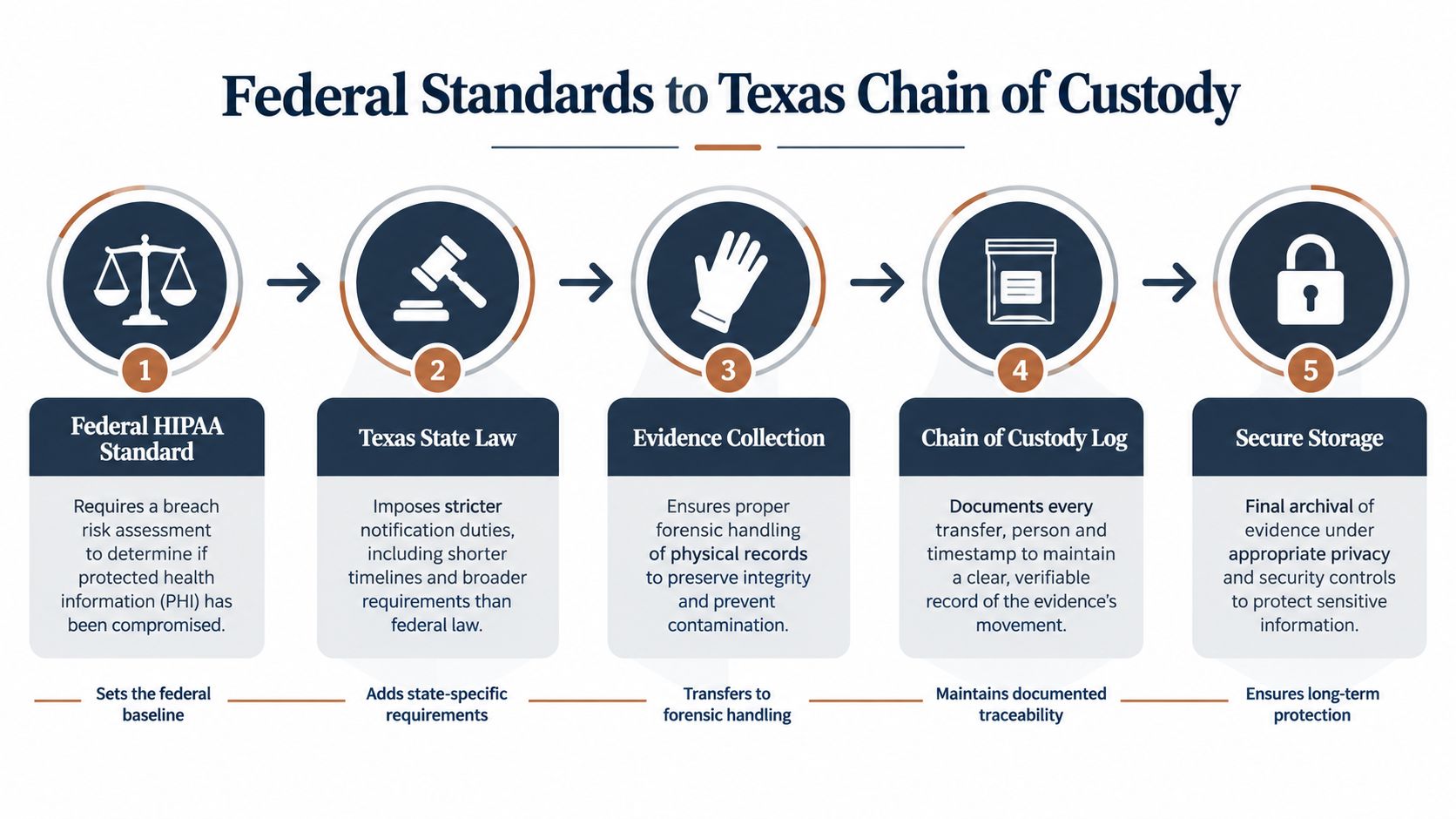
HIPAA addresses privacy and security, while a chain of custody addresses control and traceability. In medicolegal death investigations, the two concerns meet whenever protected information is attached to physical evidence, digital images, laboratory results, or a report intended for court.
The historical federal framework created a public breach reporting system through HHS. The OCR Breach Portal publicly posts breach reports under the HIPAA Breach Notification Rule and treats a breach as an impermissible acquisition, access, use, or disclosure of PHI that compromises privacy or security. The OCR Breach Portal explains the federal reporting structure.
Physical control supports privacy
An unbroken chain of custody records who possessed evidence, when possession changed, and how the material was secured. It doesn't replace HIPAA compliance, but it makes unauthorized access easier to detect and harder to conceal.
Our operations include in-house licensed transport across Texas, secure temperature-controlled storage, digital imaging, toxicology tracking, and controlled reporting from our Elgin facility. Each function addresses a different risk. Transport protects the transfer, storage protects the remains and materials, imaging preserves examination documentation, and reporting controls the distribution of findings.
Texas requirements remain part of the analysis
Texas Health & Safety Code Chapters 711, 716, and 651, together with applicable Texas Funeral Service Commission standards, form part of the legal environment for handling human remains, funeral-related activities, and professional responsibilities. The governing agency or statute may differ depending on the record, the remains, the type of examination, and the party requesting information.
County officials should define responsibilities before an examination begins. That includes identifying the authorizing authority, confirming transport arrangements, documenting evidence transfers, and establishing who may receive preliminary and final reports. Attorneys should also clarify whether a request concerns a private autopsy, a county forensic autopsy, a second opinion, or records held by another agency.
Our chain-of-custody form guidance addresses the importance of recording each transfer rather than relying on memory. Good documentation protects the deceased, the family, the county, and the credibility of later testimony.
Navigating the Complaint Filing Window and Resolutions
A breach report filed by an organization and a complaint filed by an individual are different procedures. The organization must assess and report a discovered breach under the applicable federal track. An individual who believes a HIPAA violation occurred may ask the HHS Office for Civil Rights to review the concern.
A HIPAA complaint generally must be filed within 180 days of when the complainant knew or should have known the act or omission occurred. HHS may extend that deadline for good cause. HHS explains the HIPAA complaint process and filing window.
Two clocks, two responsibilities
| Procedure | Who acts | Timing |
|---|---|---|
| Breach notification | Covered entity or applicable business associate | Based on discovery and the size of the affected population |
| HIPAA complaint | Individual or representative | Generally within 180 days of knowing, or reasonably knowing, about the act or omission |
The 60-day breach notification deadline is proactive. It requires the organization to act after discovering a qualifying exposure. The 180-day complaint window is reactive. It gives a person a defined period to seek federal review after learning of a possible violation.
A complaint isn't a substitute for internal incident response. Nor does an organization's decision to investigate internally eliminate an individual's ability to contact OCR. These routes can exist at the same time.
Direct communication can prevent confusion
Families often need to know who received a record, why a disclosure occurred, and what authorization supported it. Attorneys may need a complete release history rather than a general assurance that the file was handled appropriately.
We respond to these concerns by reviewing the authorization, identifying the records at issue, preserving the relevant disclosure documentation, and communicating in plain language. Questions about the public status of an autopsy report can also involve Texas law and the responsible agency. Our discussion of whether an autopsy report is a public record in Texas explains why the answer depends on context and custodianship.
How Our Practice Ensures Compliant Forensic Reporting
Compliance must work at the point where records are created, transferred, reviewed, and released. At Texas Autopsy Services, every examination is performed by a forensic pathologist certified by the American Board of Pathology. Licensed professionals support transport, logistics, and family communication, while our reporting process connects medical findings with documented evidence handling.
When a family member or county official calls (806) 230-1889, the conversation goes directly to our team rather than a call center. That matters because an early conversation can identify the authorizing party, the type of examination requested, the location of the decedent, and the records that may later require controlled disclosure.
Controls that support defensible reporting
Our workflow includes:
- Authorized intake: We identify the requester and clarify whether the matter involves a private autopsy, county forensic autopsy, second opinion, or records review.
- Licensed transport: Our team coordinates in-house licensed transport, including one-way and round-trip statewide arrangements.
- Evidence documentation: We maintain chain-of-custody records for transfers involving remains, specimens, images, and associated documentation.
- Controlled reporting: Findings are assembled into thorough reports designed for medical, family, and legal review.
- Testing coordination: Toxicology and molecular testing are tracked with the case record, so results remain connected to the correct examination.
- Direct communication: Families, attorneys, healthcare professionals, and county officials can communicate with our team about authorization and release questions.
Flat-rate, all-inclusive pricing also helps separate the financial arrangement from the evidentiary record. It doesn't replace legal review or agency authority, but transparent terms reduce avoidable confusion about what services are being requested and what documentation will be produced.
Privacy is part of forensic quality
A cause-of-death investigation identifies the disease, injury, or condition that initiated the sequence leading to death. The manner of death describes the classification of how the death occurred, such as natural, accidental, suicide, homicide, or undetermined, when the authorized authority makes that determination. These terms shouldn't be treated as interchangeable, and they shouldn't be assigned beyond the scope of the postmortem examination and governing authority.
Chain of custody means the documented history of an item from collection through storage, transfer, examination, and disposition. In our practice, privacy controls and evidence controls reinforce one another. Organizations reviewing their broader information safeguards may also find practical value in guidance on compliance steps for IT managers, particularly for secure handling and disposal of electronic systems.
We provide independent autopsy services, second-opinion autopsy reviews, county forensic autopsies, and related forensic pathology support across Texas. If you need to discuss authorization, secure transport, chain of custody, or HIPAA-compliant reporting, visit Texas Autopsy Services and contact our team for a direct, confidential conversation about the next appropriate step.