August 15, 2026 · Texas Autopsy Services
What Is Organ Transplant Rejection? Recovery Insights
Understand what is organ transplant rejection, its symptoms, and how it affects recovery. Get essential insights for patients and caregivers in 2026.

On this page
- Understanding What Organ Transplant Rejection Really Means
- How the Immune System Recognizes a Transplant as Foreign
- Types of Organ Transplant Rejection and When They Occur
- Signs Symptoms and How Rejection Is Diagnosed
- Prevention Treatment and New Directions in Monitoring
- What Rejection Means After Death and How Forensic Review Helps
- Next Steps and When to Contact Texas Autopsy Services
Organ transplant rejection is the recipient immune system identifying donor HLA as foreign and attacking the graft. It's classified as hyperacute within minutes to hours, acute in weeks to months, and chronic over months to years.
For a family waiting through the early weeks after transplantation, a new laboratory change or unexpected symptom can be frightening. A transplant may be functioning well while the recipient's immune system is already reacting to donor tissue. Rejection isn't just a surgical failure, and it doesn't always begin with obvious pain, fever, or visible changes.
- Rejection is an immune response, caused when recipient immune cells recognize donor tissue as foreign.
- Hyperacute, acute, and chronic rejection differ in timing, mechanism, and effect on graft function.
- Acute rejection is often treatable, but it remains an important early complication.
- Chronic rejection can develop and is a major cause of long-term graft loss.
- Blood tests, molecular markers, imaging, and biopsy can help clinicians identify injury before symptoms become obvious.
- After death, a careful medical and forensic review can help distinguish rejection from infection, medication effects, surgical complications, and other causes of graft failure.
Understanding What Organ Transplant Rejection Really Means
A person may return home after transplantation focused on medicines, follow-up visits, fluids, and energy levels. Then a test shows that the transplanted organ is not working as expected. Families may ask whether the operation failed, a medicine caused the problem, or the body is rejecting the donor organ.
Organ transplant rejection is the immune system's response to transplanted tissue. The recipient's defenses identify features of the donor organ as foreign and begin reacting against the graft, the transplanted organ or tissue now living inside the recipient.
Rejection can begin even after technically successful surgery. Blood vessels may be connected correctly, the organ may initially appear well perfused, and the recipient may follow every medication instruction. Injury can still develop at microscopic level, involving inflammatory cells and the lining of small blood vessels before organ dysfunction becomes clear. The underlying process is described in this review of transplant rejection mechanisms.
Why rejection matters
Graft injury can affect early recovery and long-term organ function. Acute rejection is often seen early after surgery. One authoritative medical review describes historical overall acute rejection incidence in the range of 50% to 70%, while more recent summaries place acute rejection in the 10% to 20% range within the first year for many solid-organ recipients as modern immunosuppression has reduced rates substantially (NCBI Bookshelf).
Kidney transplantation shows how reported rates have changed. Center data found acute rejection in 6.2% of transplants within 6 months and 8.4% within 12 months, with annual 12-month rates decreasing from 9.9% in 2012 to 7.1% in 2017. These figures cannot predict an individual outcome. They explain why clinicians continue surveillance even when current treatment has lowered rejection rates.
Rejection may also be quiet. Blood tests, molecular markers, imaging, and biopsy can reveal injury before symptoms become obvious. Chronic injury can narrow or scar small vessels over time, gradually reducing graft function. After death, review of the medical record, medications, laboratory findings, imaging, biopsy material, and autopsy findings can help distinguish rejection from infection, medication effects, surgical complications, or other causes of graft failure.
Grief and uncertainty can make information difficult to organize. Families may use an anxiety checklist to record questions and symptoms while speaking with the transplant team. It does not replace medical care, but can separate confirmed findings from fears and unanswered questions.
How the Immune System Recognizes a Transplant as Foreign
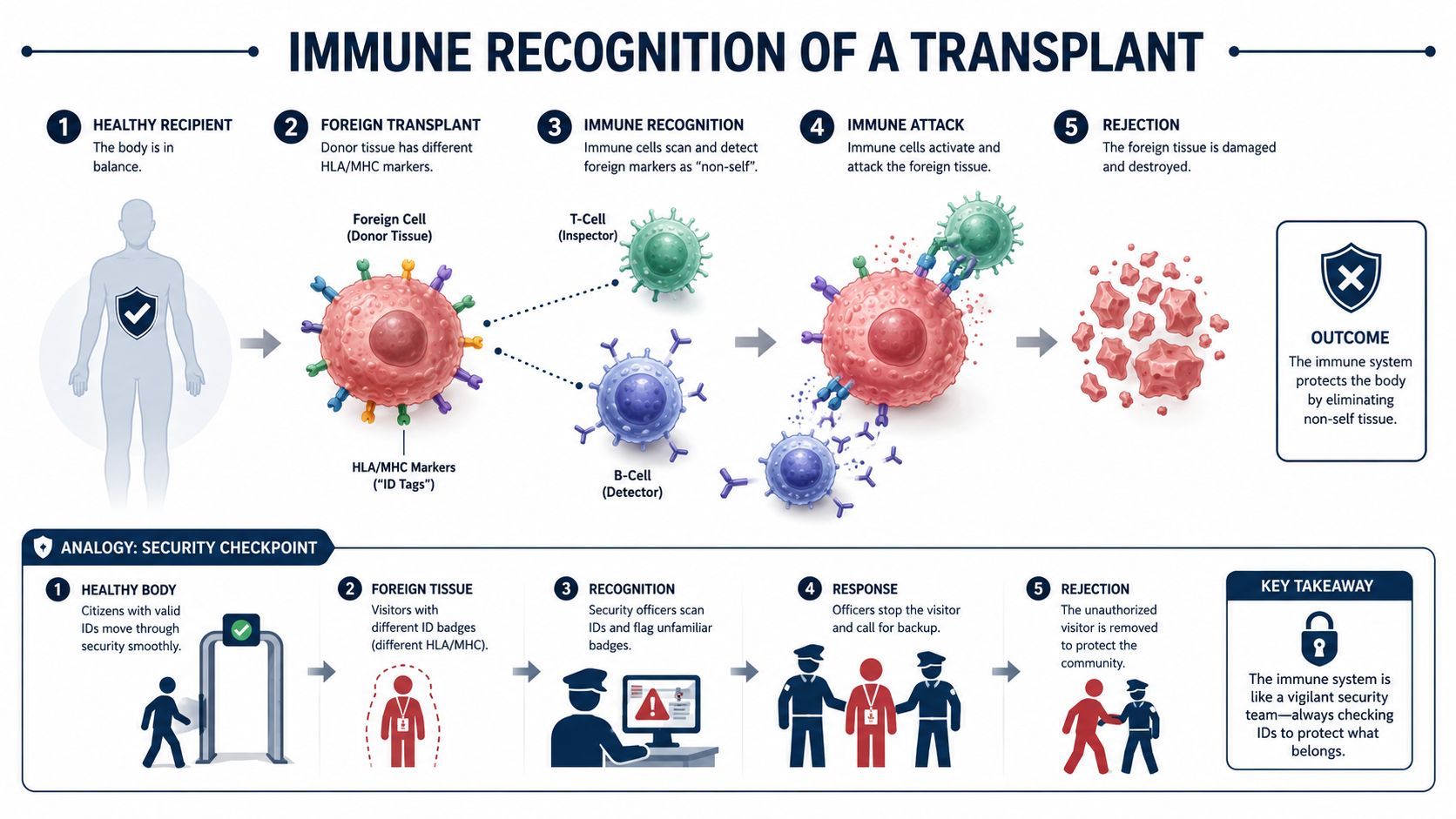
The immune system works partly like a security checkpoint. Cells carry identifying markers on their surfaces. The recipient's immune system is accustomed to the recipient's own markers, but donor cells display different versions of important identification proteins.
These proteins include human leukocyte antigens, or HLA, which are part of the broader major histocompatibility complex, commonly called MHC. Recipient immune cells can interpret donor HLA or MHC molecules as foreign. This recognition is called allorecognition.
The immune response in practical steps
Recognition begins. Recipient T cells encounter donor HLA or MHC markers and interpret them as a potential threat.
T cells multiply and activate. CD4+ and CD8+ effector T cells expand. CD4+ cells help coordinate inflammation, while CD8+ cells can injure target cells directly.
Other immune cells join the response. Macrophages contribute to inflammation and tissue damage. B cells can mature into antibody-producing cells that create antibodies directed at donor targets.
Antibodies and complement cause additional injury. Alloantibodies can attach to structures in the graft, particularly vascular surfaces. Complement activation can intensify endothelial injury and inflammation.
The graft's small vessels and tissue become damaged. Cytotoxic activity, inflammatory cytokines, antibody effects, and complement-mediated injury can interfere with the organ's ability to function.
Practical point: A graft can look adequately perfused while microscopic immune injury is already developing.
That point helps explain why symptoms alone cannot reliably rule rejection in or out. Histologic damage may begin with lymphocyte infiltration and endothelial activation before a patient develops clear graft tenderness, fever, swelling, or measurable organ dysfunction. The immune response may therefore be active before the recipient or family notices a visible change.
The term immune-mediated injury also matters because rejection isn't one single pathway. T-cell activity is important, but antibody-producing B cells, macrophages, complement, blood-vessel changes, and local tissue conditions can all contribute. This complexity is one reason clinicians combine symptoms, laboratory results, imaging, molecular testing, and tissue examination rather than relying on one finding.
Types of Organ Transplant Rejection and When They Occur
A graft may begin failing within hours of implantation, or lose function gradually over years. Clinicians group rejection into hyperacute, acute, and chronic forms according to timing and dominant mechanism. These categories can overlap, so the label does not describe every immune process occurring in one patient.
| Feature | Hyperacute Rejection | Acute Rejection | Chronic Rejection |
|---|---|---|---|
| Typical timing | Minutes to hours after transplantation | Often the first weeks or months | Months to years after transplantation |
| Main mechanism | Preexisting antibodies, complement activation, and neutrophil recruitment | Commonly T-cell-mediated and antibody-mediated injury | Ongoing immune injury, vascular changes, fibrosis, and tissue remodeling |
| Clinical pattern | Rapid and severe graft dysfunction | New or worsening graft dysfunction, sometimes with few symptoms | Gradual loss of graft function, sometimes clinically silent at first |
| General significance | Immediate graft-threatening reaction | Often treatable, but important for later graft health | Major cause of long-term graft loss |
Hyperacute rejection
Hyperacute rejection develops within minutes to hours. Antibodies already present in the recipient recognize donor targets, activate complement, and recruit neutrophils. The resulting vascular injury can sharply reduce blood flow, causing severe graft dysfunction soon after implantation. This timing distinguishes hyperacute rejection from immune injury that develops later.
Acute rejection
Acute rejection most often appears during the first weeks or months, although timing varies. Recipient T cells, antibodies, or both may injure the graft. Treatment depends on the mechanism, severity, organ, and clinical findings, and an episode may be manageable when detected early.
Acute rejection can also be quiet. A recipient may have little outward change while surveillance testing or tissue examination identifies developing injury. That is why follow-up continues even when the patient feels well.
Chronic rejection
Chronic rejection unfolds over months to years. Persistent immune injury affects small vessels and surrounding tissue, encouraging vascular narrowing, fibrosis, and structural remodeling. The graft may lose function slowly, with damage remaining clinically silent at first. Chronic rejection is described as the major cause of long-term graft loss and the leading cause of organ transplant failure in the medical review summarized by MedlinePlus.
Kidney transplant research also examines de novo donor-specific antibodies, or dnDSAs. One review reports dnDSAs in about 7% of previously nonsensitized adult renal recipients by 5 years and nearly 20% by 10 years. It reports that 40% of patients lose their renal allografts within 5 years after dnDSAs appear. These population findings do not predict one person's outcome.
The absence of symptoms does not prove that a graft is unaffected. Clear communication helps recipients and families understand surveillance results, treatment choices, and uncertainty. For people with hearing loss, real-time translation for hearing loss may support participation in these discussions.
Signs Symptoms and How Rejection Is Diagnosed
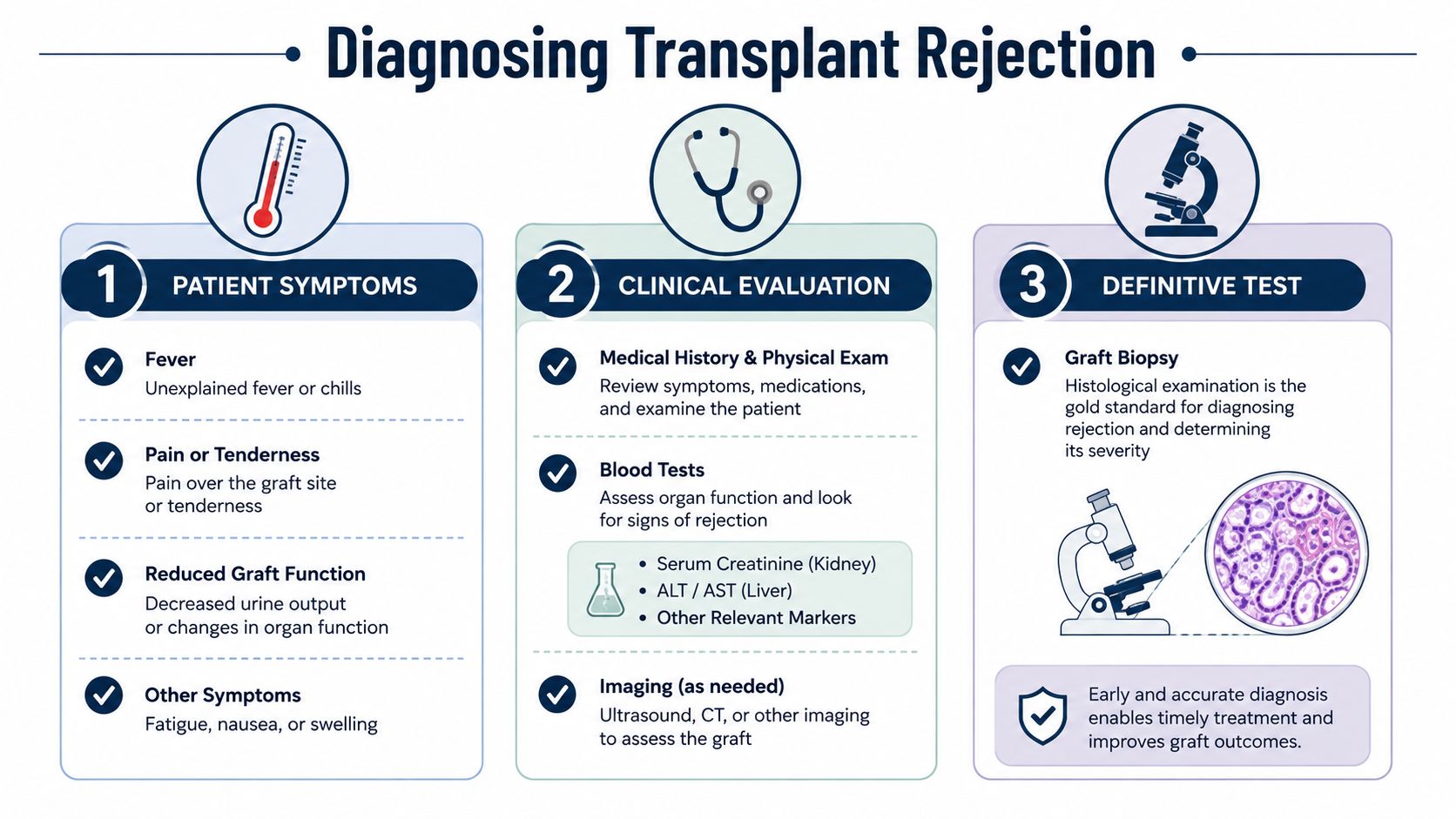
Rejection can produce symptoms, laboratory changes, or both. The pattern varies by organ and by the degree of injury. Some recipients may develop graft tenderness, fever, swelling, reduced urine output, fatigue, or a change in organ-specific function. Others may have no noticeable symptoms while testing reveals an abnormality.
A patient with a kidney transplant may show a change in kidney function, while someone with a liver transplant may show abnormal liver-related laboratory results. These findings aren't specific to rejection. Infection, medication toxicity, dehydration, obstruction, vascular problems, and other complications can create similar changes.
Why silent rejection matters
Rejection can happen before symptoms appear. This is often called subclinical rejection. The term means that immune injury is present even though the patient has no obvious clinical symptoms or the organ's routine function tests have not yet changed substantially.
That possibility has changed the emphasis of post-transplant care. Clinicians don't wait only for fever, pain, or visible swelling. They compare trends in laboratory testing, medication levels, organ function, antibody testing, imaging, and other surveillance results.
A normal day for the patient doesn't always mean a normal day for the graft.
The diagnostic sequence
Clinical review begins with the transplant history, medication adherence, recent illness, symptoms, vital signs, and laboratory trends. A single abnormal result may be less informative than a persistent or progressive change.
Laboratory and molecular testing can provide earlier clues. Donor-derived cell-free DNA, or dd-cfDNA, measures genetic material released from donor tissue into the recipient's bloodstream. Transcriptomic signatures examine patterns of gene activity associated with immune injury. These tools can help clinicians risk-stratify patients and decide whether further testing is needed.
Imaging may help evaluate blood flow, obstruction, fluid collections, or structural changes. Newer imaging approaches are also being used to assess fibrosis without relying solely on an invasive procedure.
Biopsy remains important when tissue is needed to identify the type and severity of injury. In kidney transplantation, standardized Banff pathology criteria are used to classify rejection. Molecular or blood-based markers may detect concern before histology is fully diagnostic, but they don't eliminate the need for clinical judgment and, when indicated, tissue examination. Families who want plain-language background on tissue findings can review microscopic examination.
Prevention Treatment and New Directions in Monitoring
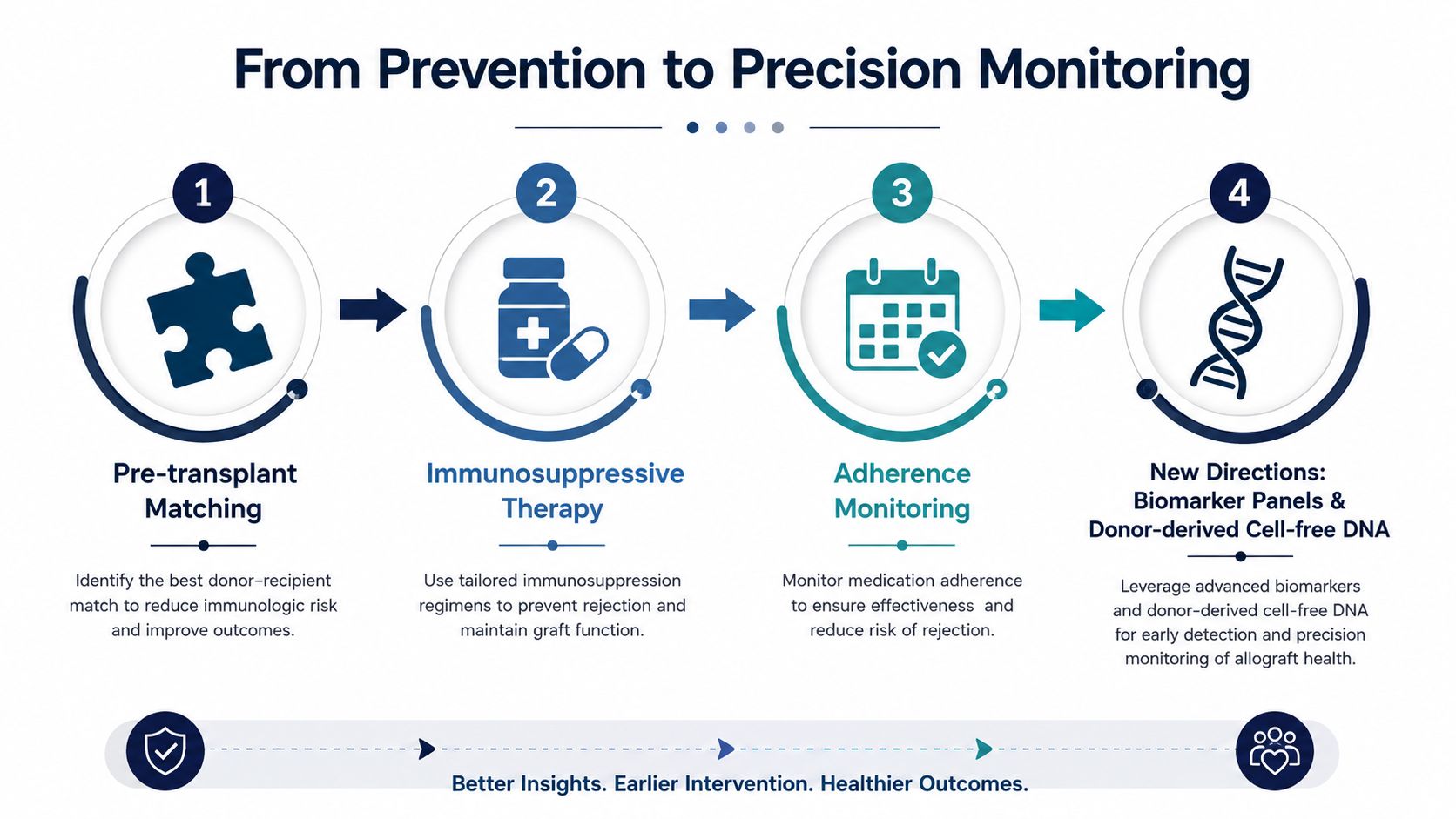
Prevention begins before transplantation with donor-recipient assessment, compatibility testing, and a plan for immunosuppressive therapy. After transplantation, recipients take prescribed medicines to reduce immune activation. The transplant team adjusts treatment while balancing two competing risks: too little immunosuppression may permit rejection, while too much can increase susceptibility to infection or medication toxicity.
Medication adherence remains important, but correct adherence doesn't make rejection impossible. The immune response can involve pathways that extend beyond a simple mismatch between donor and recipient. Antibodies may develop later, tissue damage may alter local immune signaling, and chronic injury may involve blood vessels, lymphatic drainage, fibrosis, and changes in the graft's surrounding microenvironment.
Why chronic rejection remains difficult
Recent work has drawn attention to lymphatic drainage problems and hyaluronan buildup as contributors to chronic rejection. Hyaluronan is a substance in the tissue environment that can accumulate during injury and influence immune-cell movement and inflammation. This focus shifts part of the discussion from broad systemic suppression toward local tissue remodeling.
The National Institutes of Health describes research directions that include microenvironment remodeling, targeted biologic treatments, and metabolic or epigenetic interventions (NIH Research Matters). These approaches remain areas of scientific development, not guaranteed treatments for every recipient.
Monitoring is becoming more precise
Donor-derived cell-free DNA and transcriptomic signatures can supplement standard blood testing and biopsy. Researchers are also studying macrophages, innate immune brakes such as Siglec-7 and Siglec-9, and receptor mismatches involving SIRP-alpha. These findings broaden the biological picture beyond T cells alone.
The practical aim is earlier and more specific detection. A molecular result may indicate graft injury before a routine function test changes, but clinicians still need to interpret it alongside symptoms, imaging, medication history, and, when necessary, histology. Patients shouldn't change immunosuppressive medicines based on a test result without direct instruction from the transplant team.
For readers who want to understand how laboratory methods can examine genetic or molecular signals, molecular testing provides additional background.
What Rejection Means After Death and How Forensic Review Helps
After a transplant recipient dies, the question may not be whether rejection occurred. A careful review asks what injuries were present, when they developed, and whether they caused or contributed to death. Rejection may coexist with infection, medication toxicity, vascular complications, surgical problems, or unrelated disease.
A postmortem examination can include review of transplant records, medication history, laboratory trends, imaging, prior biopsy reports, and hospital documentation. Depending on the circumstances, examination may include graft evaluation, histology, toxicology, microbiology, and molecular testing. The findings must be interpreted in context because postmortem changes can complicate tissue assessment.
Definitions families and attorneys need
Cause of death means the disease, injury, or complication that initiated the sequence leading to death. In a transplant case, that might involve rejection, infection, a cardiovascular event, medication toxicity, or another condition, depending on the evidence.
Manner of death describes the broad circumstances of death, such as natural, accident, suicide, homicide, or undetermined. The manner isn't the same as the medical cause.
Chain of custody is the documented record showing who handled evidence, when it was transferred, how it was stored, and how its integrity was protected. It matters when records, specimens, medications, or other materials may later be used in legal proceedings.
An independent autopsy or second-opinion review may be appropriate when the family has unresolved questions, when a prior examination didn't address the transplant history fully, or when attorneys need an objective medical interpretation. Texas families can learn more about the role of a forensic investigation before deciding whether a new examination or records-based review is suitable.
Next Steps and When to Contact Texas Autopsy Services
The central answer to “what is organ transplant rejection” is straightforward, but individual cases rarely are. Rejection can be immediate, early, or delayed. It can be treated, silent, mixed with other complications, or identified only through laboratory, molecular, microscopic, or postmortem review.
After a transplant-related death, gather the transplant records, medication list, biopsy reports, laboratory results, imaging, hospital records, death certificate, and any prior autopsy report. Write down the specific questions that remain unanswered. Families and attorneys may want to ask whether rejection was present, whether it was acute or chronic, whether infection or medication effects contributed, and how the medical findings support the stated cause of death.
Texas law and local authority affect how deaths are investigated. The Texas Funeral Service Commission and the Texas Health & Safety Code, including Chapters 711, 716, and 651, form part of the legal context for funeral service, disposition, and related procedures. The appropriate agency may also have jurisdiction over a death, so families should clarify whether a medical examiner, justice of the peace, or another authority controls the case before arranging an independent examination.
Our practice provides private autopsy services and second-opinion reviews across all 254 Texas counties. Every examination is performed by a forensic pathologist certified by the American Board of Pathology, with direct communication, licensed in-house transport, transparent flat-rate pricing, and reporting designed for families, clinicians, attorneys, and agencies.
Texas Autopsy Services can review transplant records, prior autopsy findings, and postmortem evidence when rejection or another graft complication remains unclear. Please visit Texas Autopsy Services to contact our team directly and discuss whether an independent autopsy or second-opinion review is appropriate.