October 20, 2026 · Texas Autopsy Services
What Is the Purpose of Medical Records
What is the purpose of medical records? Learn how they support care, billing, research, privacy, legal reviews, and forensic investigations.

On this page
- When a Medical Record Becomes a Timeline
- Clinical Documentation and Administrative Purposes
- Research Quality and Public Health Functions
- Legal Accountability and Retention Duties
- Protecting Privacy Under HIPAA Rules
- How Medical Records Support Forensic Reviews
- Requesting and Using Records After a Death
- Common Misconceptions and Practical Review Steps
A family member has died unexpectedly, and you're holding a discharge summary, a few portal printouts, and a medication list that doesn't match what you were told at the bedside. You want to know what happened, in order, and whether important information is missing. That need is where we begin when we explain what is the purpose of medical records to families and attorneys who contact our practice.
- A medical record is a dated timeline of symptoms, findings, diagnoses, medications, tests, and decisions.
- Access isn't the same as completeness, and a portal summary isn't the same as the full record.
- Records serve clinical, legal, and forensic readers, each of whom needs traceable, original information.
- After a death, provenance matters, including who wrote an entry, when it was written, and whether it was amended.
When a Medical Record Becomes a Timeline
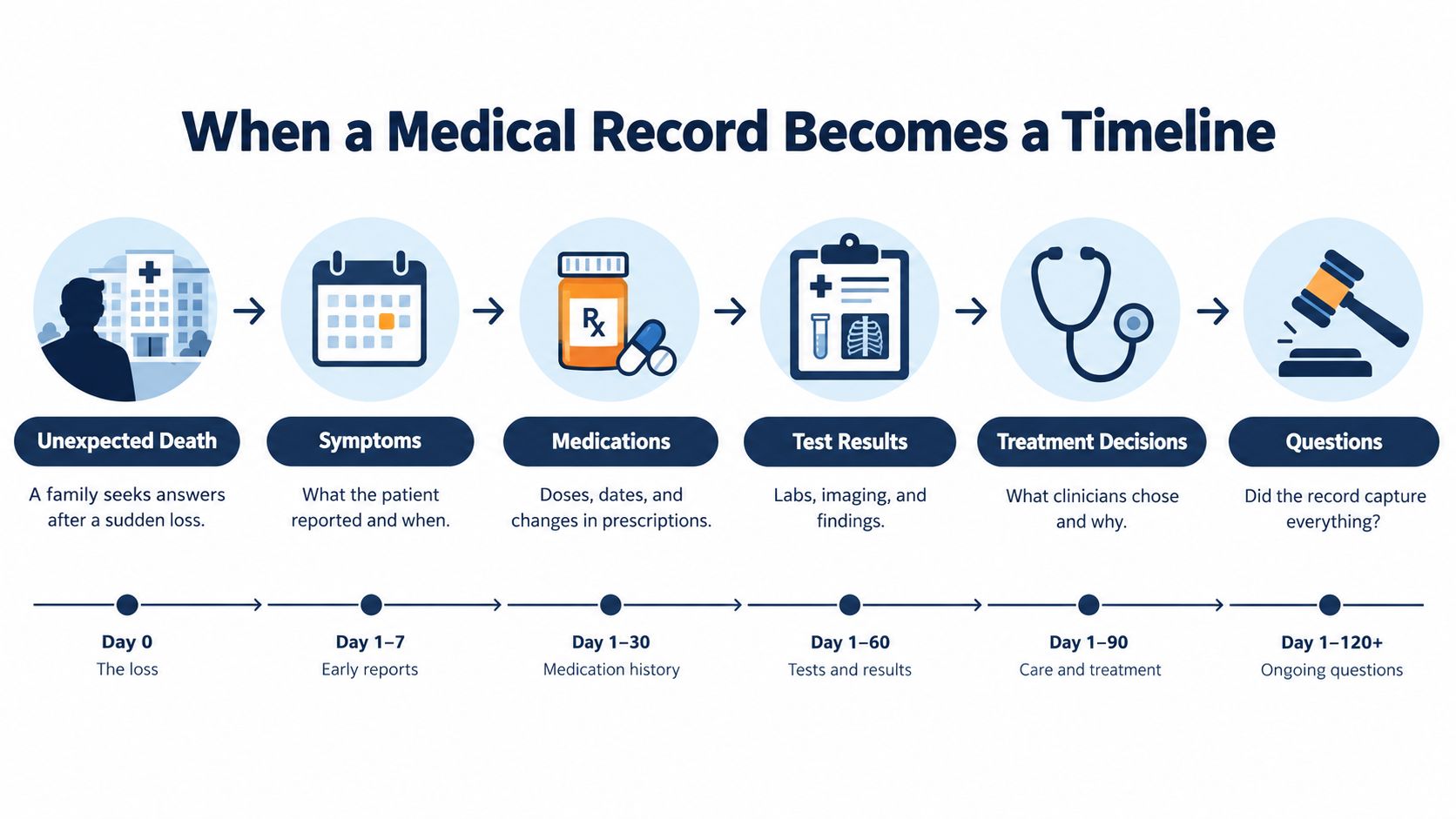
Consider a representative situation we see often, without identifiable details. An adult is treated in an emergency department, discharged, seen again by a specialist, and later dies at home. The family asks simple questions. When did the chest pain start, what medication was changed, was a test result returned, and who decided that follow-up could wait?
No single note answers those questions. The answers, if they exist, sit across hospital notes, specialist records, laboratory reports, imaging, pharmacy records, emergency services records, and earlier examinations. A medical record becomes useful when those pieces can be placed in chronological order.
The timeline below shows the sequence a reviewer tries to rebuild after an unexpected death.
What a Record Is
We describe a medical record as a longitudinal clinical-control system. It preserves the data needed to plan, deliver, evaluate, and coordinate care across clinicians, departments, and time. The World Health Organization identifies the record as a communication instrument for all personnel involved in a patient's care and states that continuous care requires an up-to-date health record, a point set out in the WHO guidance on health records as communication tools for care teams.
In practical terms, a complete record should contain identifiable patient information, dated encounters, clinical findings, diagnoses, interventions, medication history, test results, follow-up plans, and responsible authorship. Each entry should show who documented it and when. Without dates and authorship, a later reader can't tell what was known at the time from what became clear afterward.
That's a distinction we return to often. Documentation is evidence of what was recorded. A conclusion is what a reviewer draws from that evidence. Those two things aren't the same, and confusing them leads to unfair judgments about care and about causation.
Why the Timeline Matters for Safety
Records aren't administrative paperwork added after care ends. They're the factual foundation for medication reconciliation, diagnostic review, referrals, and follow-up while care is happening. When information is missing, inaccurate, delayed, or unavailable during a transition, the next clinician may repeat a test, miss an allergy, or continue a medication that should have stopped.
The scale of that risk helps explain the emphasis on accuracy. The World Health Organization estimates approximately 421 million hospitalizations worldwide each year and about 42.7 million adverse events during those hospitalizations, with roughly 1 in 10 hospitalized patients harmed in high-income countries and inaccurate or delayed diagnoses accounting for approximately 6% to 17% of adverse events in hospitals, figures reported in the WHO patient safety fact file.
A useful way to read a chart: treat it as a case timeline, not as a single diagnosis. Ask what was reported, what was found, what was ordered, what resulted, and what changed next.
Centralizing inpatient, outpatient, preventive, and curative information reduces duplicated history-taking and testing. It also lets clinicians compare prior diagnoses, treatments, responses, and unresolved problems before making new decisions. When those parts stay in separate systems, each clinician sees only a portion of the story.
For families, the same timeline serves a different purpose after death. It can show the sequence from first symptoms through deterioration to the terminal event, and it can identify where documentation stops. A gap doesn't prove that care wasn't given, and a detailed note doesn't prove that a decision was correct. Both require careful, independent review in context.
Clinical Documentation and Administrative Purposes
During active care, the record does several jobs at once. A nurse checks medication administration records before giving a dose. A physician reviews prior test results before ordering imaging. A specialist receiving a referral reads the history, examination, and working diagnosis to decide what to assess first.
When a patient moves between settings, the record carries that information forward. Discharge instructions, follow-up plans, pending results, and medication changes need to reach the next clinician in a form that's clear and retrievable. If that handoff is incomplete, continuity breaks down even when each individual encounter was documented reasonably well.
Different Readers, Different Uses
- Treating clinicians need current findings, allergies, medications, and unresolved problems to make safe decisions.
- Coders and billing staff need documentation that supports the diagnoses and procedures submitted for payment.
- Compliance reviewers need to confirm that documented care, orders, and claims align.
- Patients and families need a readable account they can share with another clinician for a second opinion.
These uses are connected, but they aren't identical. A claim can be payable while the clinical narrative is still unclear about why a decision was made. A detailed progress note can be clinically helpful but still lack the specific elements an auditor expects. Good documentation serves both readers without reducing the chart to a billing form.
Documentation standards also vary by jurisdiction, which is why we're careful to point readers to the rules that apply where care occurred. For readers comparing requirements across states, the overview of Florida medical records documentation requirements from Lawyer in Martin County is a helpful example of how state rules frame what must be documented and retained. Texas readers should still apply Texas law and Texas Funeral Service Commission context where those rules govern.
The practical point for families is straightforward. If a medication list, allergy, or test result is wrong in the record, that error can affect care in real time and reconstruction later. Accuracy during treatment is what makes the record trustworthy afterward.
Research Quality and Public Health Functions
Records also work at population level. When documentation is standardized and retrievable, hospitals and public health agencies can look across many patients to measure quality, review adverse events, and detect patterns that no single chart would reveal. A single missed test result is a clinical problem. Repeated missed results in one workflow are a system problem.
Electronic systems support that work when they're designed well. AHRQ reports that electronic health records improve safety by increasing documentation completeness and supporting durable access, and that embedded clinical decision-support systems can improve medication safety, test-result follow-up, and recognition of patient risks, as described in the AHRQ issue brief on electronic health records and diagnostic safety. The mechanism is direct. Structured data let software and clinicians compare allergies, medications, diagnoses, vital signs, and pending results against safety rules and prompt action before harm occurs.
Where Reuse Can Mislead
A record that's adequate for one clinical visit may not be reliable for research or quality analysis. Population work depends on chronology, source attribution, amendments, medication reconciliation, and abnormal-result follow-up being documented consistently. If diagnoses are copied forward without review, or if results are filed without a recorded response, aggregated data will reflect documentation habits as much as patient health.
AHRQ also identifies hazards that electronic systems can create, including poor information display, complex navigation, workflow mismatch, and system downtime. Those problems matter for forensic review too. A reviewer who doesn't understand how a system displayed information may misjudge what a clinician could reasonably see at the time.
Population data and individual proof aren't the same. Records can reveal patterns across patients, but a pattern doesn't by itself establish what happened to one person.
At public health level, routinely documented emergency and clinical data feed syndromic surveillance that helps detect and monitor outbreaks and other health events. That function depends on ordinary documentation being complete in ordinary cases, long before anyone knows a pattern will matter.
Legal Accountability and Retention Duties
After care ends, the record becomes evidence. It may support an insurance claim, a disability application, a quality investigation, or a medicolegal review. It shows what was documented, by whom, and when, and it allows others to test whether later explanations match the contemporaneous record.
The diagram below summarizes those legal and accountability uses.
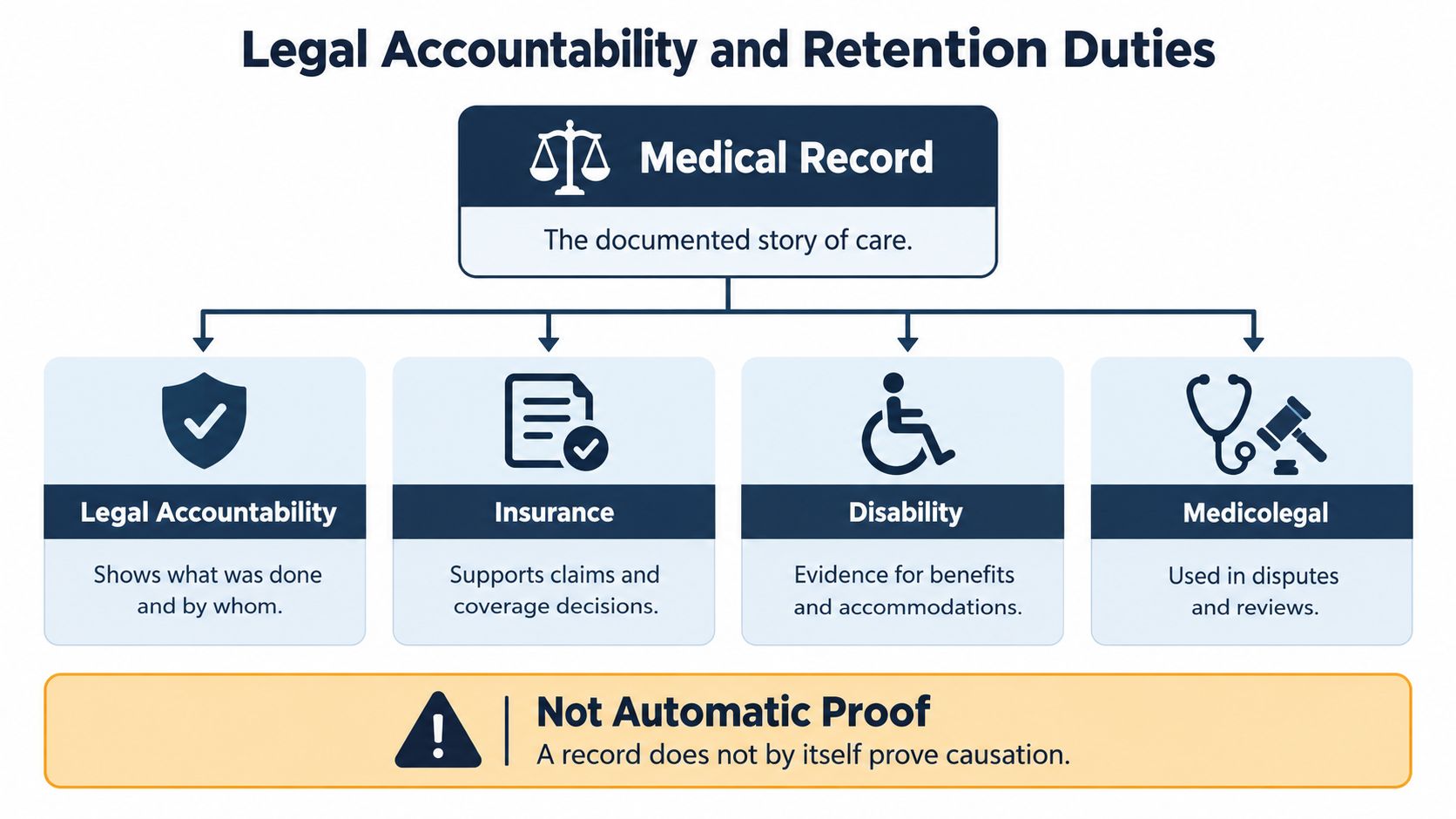
A record isn't automatic proof of causation. It preserves evidence that must be evaluated alongside examination findings, test results, and, after death, postmortem findings. A documented diagnosis may be wrong. An undocumented conversation may still have occurred. Careful reviewers state those limits plainly.
How Long Records Must Be Kept
Retention is governed by specific rules, not by indefinite storage. The Centers for Medicare & Medicaid Services states that applicable providers must maintain medical records for seven years from the date of service, as set out in the CMS guidance on medical record maintenance and access. In Texas, the general physician rule is also at least seven years from the date of last treatment, while records for patients younger than 18 must generally be retained until age 21 or seven years after last treatment, whichever is longer, under that same CMS summary of state requirements.
Texas hospitals operate under a longer disposal timeline. A hospital may generally authorize disposal on or after the tenth anniversary of the date the patient was last treated, and for a minor, only on or after the twentieth birthday or the tenth anniversary of last treatment, whichever is later, according to Texas Health and Safety Code Section 241.103 on hospital record disposal. A special rule bars destruction of a forensic medical examination record for a sexual assault victim until the twentieth anniversary of its creation under that statute.
The following video offers additional context on how retention and accountability fit together in practice.
A retention date doesn't authorize destruction while litigation is pending. Texas hospitals may not destroy records relating to a matter in litigation if the hospital knows it hasn't been finally resolved. For that reason, families and attorneys who anticipate review should request and preserve original documents with audit history, not only a portal summary.
Protecting Privacy Under HIPAA Rules
Confidentiality is a core purpose of the record system, not an afterthought. Records contain diagnoses, medications, and personal history that patients share for care. The system has to protect that information while still allowing controlled disclosure for legitimate purposes, including treatment, second opinions, claims, and lawful death investigation.
HIPAA gives individuals a right to receive an accounting of certain disclosures of protected health information made during the six years preceding the request, as explained in the HHS guidance on the right to an accounting of disclosures. That accounting generally identifies the disclosure date, the recipient, a description of the information, and the purpose.
What an Accounting Doesn't Include
Several ordinary categories fall outside that accounting. They include disclosures for treatment, payment, and health-care operations, disclosures to the individual, disclosures made under an authorization, and certain disclosures for law-enforcement or national-security purposes. Families are sometimes surprised by those exclusions, so it's worth asking a covered entity to explain which category applies to a specific release.
HHS also explains that making an entire record set available for third-party review counts as a disclosure, even if the reviewer doesn't inspect every document, a point covered in that same HHS guidance summarized above. Access, copying, and release are therefore tracked events, not informal favors.
Our own reporting follows the same principle of controlled, documented release, and readers who want the procedural detail can review our explanation of HIPAA-compliant release of information in forensic practice. It outlines how authorization and identity are verified before information moves.
Before records are sent anywhere, ask three questions: what is being released, to whom, and for what purpose. A clear answer protects the patient and the review.
That discipline also protects evidentiary value. When a release is documented, a later reviewer can confirm which version of the record was provided and when.
How Medical Records Support Forensic Reviews
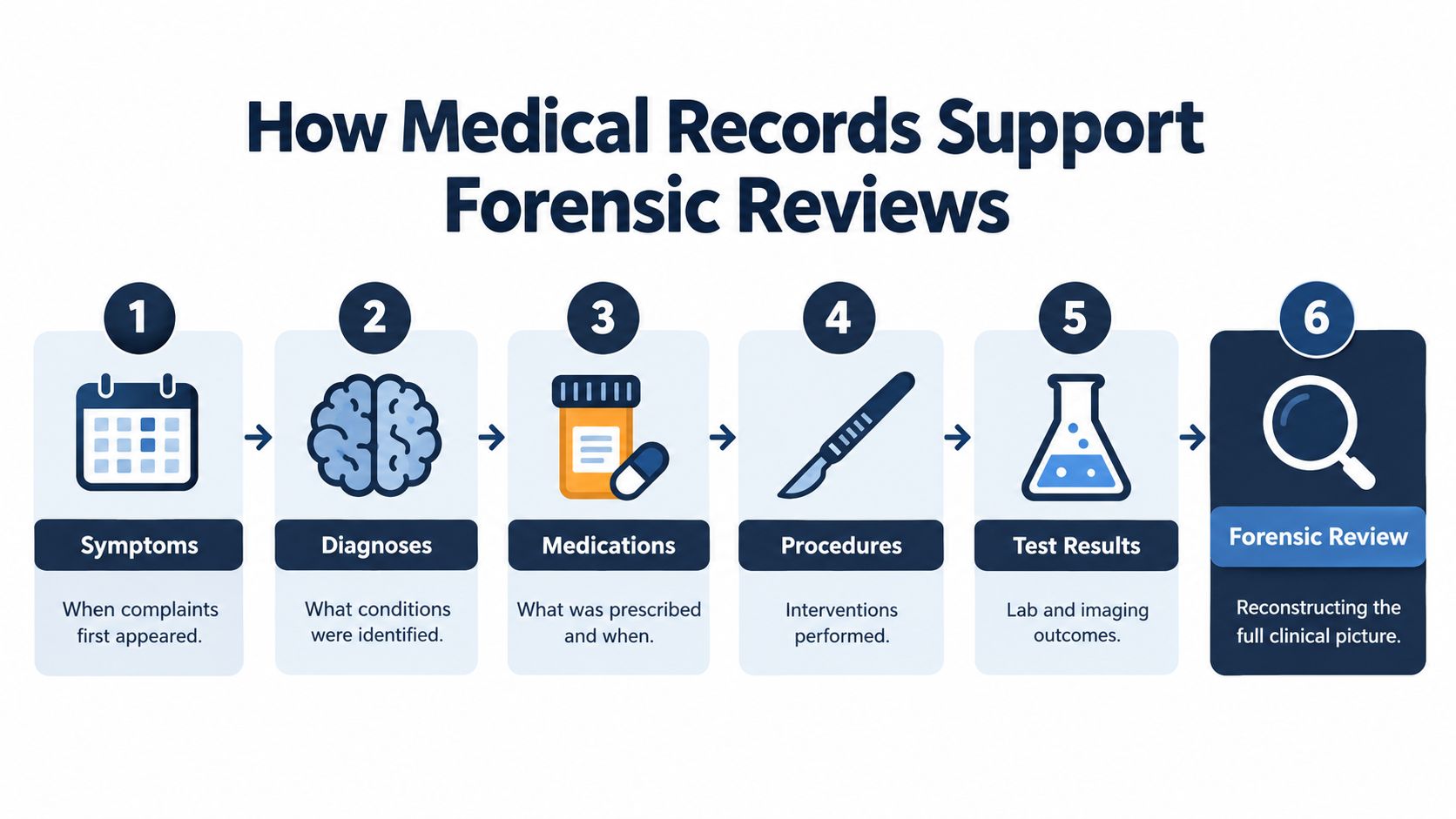
In a cause of death investigation, clinical records provide context that a postmortem examination can't supply on its own. They establish the sequence of symptoms, diagnoses, medications, procedures, test results, injuries, and treatment decisions before death. Our board-certified forensic pathologists compare that documented history with autopsy findings and toxicology rather than treating any one source as determinative.
The steps below show how record elements build toward a forensic review.
Terms We Define for Every Family
- Cause of death is the disease or injury that started the chain of events leading to death.
- Manner of death is the classification of circumstances, such as natural, accident, homicide, suicide, or undetermined.
- Chain of custody is the documented handling of a body, specimens, and records so that each transfer can be accounted for.
Each evidence source answers a different question. Clinical records show what clinicians observed and did during life. An independent autopsy shows anatomical findings after death. Toxicology identifies substances present in tested specimens. Imaging may show injury or disease that isn't visible externally. Agreement among sources strengthens a conclusion, and disagreement requires explanation rather than selection of the most convenient source.
Texas law reflects that forensic use. Certain protected records involving child-abuse investigations may be disclosed to a medical examiner authorized to conduct an autopsy or inquest into a child's death, under Texas Health and Safety Code provisions on disclosure for death investigation. The documented clinical context can then be compared with autopsy and toxicology findings through a lawful pathway.
Our approach to that comparison, including what we look for first in a chart, is described in our guide to the analysis of medical records in forensic casework. In our private autopsy services in Texas, every examination is performed by a forensic pathologist certified by the American Board of Pathology, and findings are reported with the record review kept distinct from postmortem observations. That separation is what makes a second opinion autopsy or record review credible for families, attorneys, and county officials.
Requesting and Using Records After a Death
A common assumption is that a spouse, parent, or adult child can automatically obtain a deceased person's records. In Texas, a family relationship alone does not necessarily grant access. Disclosure may require the deceased person's legally recognized personal representative, an authorization, a subpoena, or another statutory pathway.
That restriction reflects continuing confidentiality after death. It can feel frustrating during grief, but it also ensures that records are released to a person with legal authority and that the release itself is documented. Attorneys can advise on which pathway applies in a specific estate or claim.
What to Request
- Hospital and clinic notes with dates, authors, and any amendments.
- Original laboratory and imaging reports, not only summaries that reference them.
- Medication administration records, which show what was given and when.
- Consent forms, operative reports, and discharge instructions for each encounter.
- Emergency services records, pharmacy records, outside-facility records, and any prior autopsy report.
Requesting that breadth matters because records remain fragmented. More than one-third of patients reportedly experience additional burden because providers cannot effectively exchange information, according to the American Hospital Association brief on interoperability and patient burden. A single portal download therefore rarely represents the whole history.
When a provider requires a written request form, complete it carefully and keep a copy with proof of transmission. Some families ask about practical ways to transmit a signed form, and the option to send medical records via FaxZen from FaxZen is one method readers may evaluate for that step. Whichever method is used, retain the sent form, confirmation, and a log of what was received in response.
Finally, don't confuse receiving records with interpreting them. Provenance, dates, amendments, and missing outside results determine what a set of records can and can't support. Interpretation is a separate step that should be documented as such.
Common Misconceptions and Practical Review Steps
The most persistent misconception we encounter is that a portal export is the complete, authoritative record. Portal access has expanded, and by 2018, 51% of U.S. patients had been offered online access and 30% of those offered had viewed their records at least once, as reported in coverage of the ONC report on online medical record access. Viewing access, however, doesn't guarantee that outside results, amendments, or administration records are included.
Other problems weaken reconstruction. Copied-forward histories can repeat an old error as if it were newly confirmed. Templated notes can make different examinations look identical. Undocumented conversations, delayed updates, and incompatible formats leave gaps that a reviewer must identify rather than fill by assumption.
A Practical Review Checklist
- Compare dates and providers across every source and list missing encounters.
- Verify original laboratory and imaging reports against summaries that cite them.
- Check medication reconciliation at admission, transfer, and discharge.
- Flag errors through the formal amendment process instead of silently replacing entries.
- Preserve original documents, metadata, and the audit trail exactly as received.
Attorneys who manage these reviews for clients may find our discussion of reviewing medical records for attorneys useful for organizing requests and tracking provenance. The same checklist helps families ask focused questions without needing legal training.
A record can be clinically useful and still be insufficient to determine what happened. When that limit is reached, an independent review of the records, and when appropriate an autopsy or second opinion autopsy review, can clarify what's documented, what's missing, and what remains undetermined. We serve all 254 Texas counties from Elgin, and we explain those limits plainly before any examination is authorized.
If you're reviewing records after a death and can't tell whether the file is complete or what it supports, our team at Texas Autopsy Services can review the timeline with you and explain whether an independent autopsy, a second-opinion review of prior reports, or a record-only consultation is appropriate. Every examination is performed by a forensic pathologist certified by the American Board of Pathology, with direct communication and flat-rate, all-inclusive pricing. Call us at (806) 230-1889 when you're ready to discuss your questions.