October 29, 2026 · Texas Autopsy Services
Wrongful Death Settlement Value in Texas
See how a wrongful death settlement is valued in Texas, from lost support and companionship to medical proof, negotiation, and deadlines.

On this page
- What a Wrongful Death Settlement Pays For
- How Texas Builds a Settlement Number
- Two Claims That Can Sit in One Settlement
- Medical Evidence That Holds or Breaks the Number
- Who May Settle and Which Deadline Comes First
- Averages, Negotiation, and Typical Timelines
- Frequently Asked Questions
- Speak With Our Team Before You Decide
After a sudden death, an insurer may ask a family what the case is worth and offer a round number without explaining how it was calculated. A wrongful death settlement isn't a price on someone's life. In Texas, it addresses legally recognized losses suffered by eligible survivors, and its value depends on evidence, applicable law, and the circumstances of the death.
We're Texas Autopsy Services, an independent private autopsy and forensic pathology practice based in Elgin. Our role is to help clarify medical questions about cause, mechanism, and timing of death. We don't provide legal advice or predict a settlement amount.
What a Wrongful Death Settlement Pays For
A wrongful-death settlement compensates eligible survivors for losses they suffered because of the death. Under Texas Civil Practice and Remedies Code Chapter 71, the surviving spouse, children, and parents may bring a claim for their exclusive benefit. Depending on the evidence and applicable law, losses may include financial support and household services, as well as noneconomic harm such as mental anguish and loss of companionship.
The legal structure has a history. Before the 1846 Fatal Accidents Act, commonly called Lord Campbell's Act, common law generally didn't allow civil recovery when a person was killed. That statute created a survivor-based claim for legally recognized losses, a model that American jurisdictions later adopted in different forms, as described in this Vanderbilt Law Review article on the history of wrongful-death claims.
Cause and manner of death are different
Two terms often appear in medical and legal records:
- Cause of death is the disease or injury that produced the death.
- Manner of death is the official classification of how it occurred, such as natural, accident, suicide, homicide, or undetermined.
Neither term alone establishes legal fault. A medical finding may help clarify what happened, while the legal claim still requires proof that another party's actionable conduct caused the death and that survivors suffered compensable losses.
A family looking for an overview of the legal process can also consult this guidance for wrongful death claims from The Law Office of Bryan Fagan, PLLC. Legal eligibility and recoverable damages still depend on the governing law and facts of the case.
A settlement amount therefore turns on proof of cause, documented survivor losses, and the deadlines that apply. The next step is understanding how those losses are developed into a reasoned damages model.
How Texas Builds a Settlement Number
Texas has no fixed schedule or universal percentage of income for calculating a wrongful-death settlement. Chapter 71 measures damages in proportion to the injury resulting from the death, and its framework recognizes economic and noneconomic loss, as set out in the Texas Civil Practice and Remedies Code.
A defensible calculation separates the family's actual losses from the person's gross earnings. A practical analysis commonly follows these steps:
- Establish the earnings baseline. Review tax returns, payroll records, benefits, and work history to identify the income and benefits the person received.
- Project likely future contributions. Estimate the work-life income and support survivors would likely have received, using evidence about the person's age, health, occupation, and family circumstances.
- Subtract personal consumption. A portion of income would have been spent on the decedent's own needs, so gross wages aren't the same as the amount available to the family.
- Value household work. Add non-market contributions such as childcare, transportation, home upkeep, and caregiving, using replacement-cost or opportunity-cost evidence.
- Discount future losses to present value. A lump-sum payment arrives now, not as yearly contributions over time, so future amounts need an appropriate present-value analysis.
- Assess noneconomic harm separately. Evidence about the relationship, shared residence, caregiving, communications, and family routines can help explain the personal impact.
Wages alone can mislead. A parent with modest income may have provided extensive unpaid care, while a high salary may overstate how much money would have reached survivors after personal expenses. Texas law also treats pecuniary loss and loss of inheritance as economic damages, while mental anguish and loss of companionship are noneconomic damages. Those categories shouldn't be blended into an earnings spreadsheet.
| Loss | What it measures | Records that support it |
|---|---|---|
| Lost financial support | Expected wages and benefits, less the decedent's own consumption, discounted to present value | Tax returns, payroll, benefits, and work history |
| Household services and care | Replacement cost of childcare, transport, home upkeep, and caregiving | Household schedules, school or childcare records, and family testimony |
| Advice, counsel, and maintenance | Guidance and practical support survivors likely would have received | Relationship evidence and day-to-day routines |
| Loss of inheritance | Estate the person would probably have accumulated and left | Financial records and savings history |
| Funeral and related bills | Out-of-pocket costs tied to the death | Invoices and estate or family payment records |
| Companionship and mental anguish | Noneconomic loss, not a wage multiplier | Shared residence, caregiving role, communications, and documented effects |
| Pre-death medical loss | Bills and earnings lost before death, usually on a survival claim | Hospital, EMS, and billing records |
A medically supported opinion can affect the model if the cause or timing of death is disputed. For example, evidence about whether death was immediate or followed a period of conscious pain may matter to the separate claims and losses being evaluated. We discuss how records can support that investigation in our article on wrongful-death investigations.
A defensible demand shows its assumptions. It should explain how each figure was developed and include a reasonable alternative projection, not rely on one unexplained total.
Two Claims That Can Sit in One Settlement
One settlement can resolve two legally distinct claims. A wrongful-death claim belongs to eligible survivors and addresses losses they personally experienced. A survival claim preserves claims the person who died could have brought, such as medical expenses or lost earnings before death and, where the governing law allows, conscious pain and suffering. The claims may be resolved together, but each has its own owner and scope.
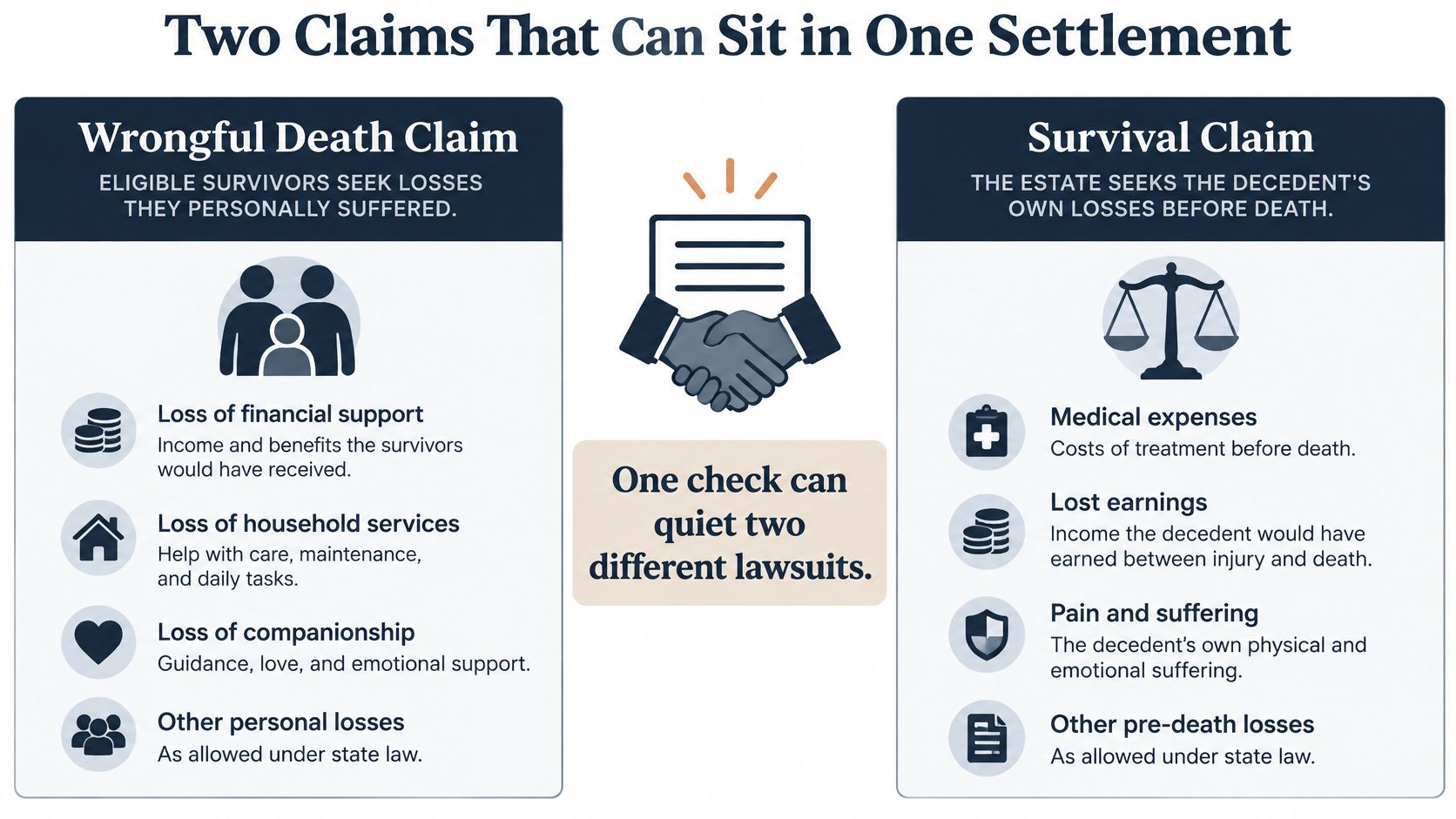
| Question | Wrongful-death claim | Survival claim |
|---|---|---|
| Who is paid | Surviving spouse, children, and parents | The estate, through its representative |
| Main losses | Support, services, companionship, and guidance lost by survivors | Pre-death medical bills, lost earnings, and other claims the decedent had |
| Core proof | Relationship, dependence, and future contributions | What happened medically between injury and death |
| Release risk | A release may leave the estate claim unresolved | A release may waive survivor claims if both aren't named |
Separate claims do not mean the same loss can be recovered twice. A 2025 California Court of Appeal decision addressed the distinction between wrongful-death and survival claims, noting that they may face separate damages limits and cannot count the same loss twice, as explained in the court's decision. California's survival rules have changed recently. That decision concerns California law, not Texas law.
For a Texas family, the practical questions are what happened between injury and death, who owns each claim, which records support each loss, and whether a proposed release addresses both claims. A survival claim may be relevant when death followed hospitalization, alleged malpractice, poisoning, or an accident with a documented interval before death. Medical and emergency records, toxicology, photographs, witness accounts, and independent review can help clarify what occurred during that interval.
Our board-certified forensic pathologist can address medical questions about cause, mechanism, and timing. We do not give legal advice about which claim to file. For a distinct example of how a specific medical history may shape a claim after death, see this overview of a mesothelioma claim after death.
A release that names only one claim may leave the other unresolved or unintentionally waive it. Counsel should review the claims and release language before anyone signs.
Medical Evidence That Holds or Breaks the Number
A careful damages model can't repair weak proof that the event caused the death. Settlement analysis may include detailed estimates of financial and personal loss, but the causal connection still needs support.
Chain of custody means the documented path of the body, samples, and records from receipt through testing and reporting. It helps establish that evidence was handled and tracked in a way that allows others to assess whether it was altered, lost, or confused with other material. Texas law recognizes economic and noneconomic damages as separate categories, with different kinds of proof, under the Texas Civil Practice and Remedies Code.
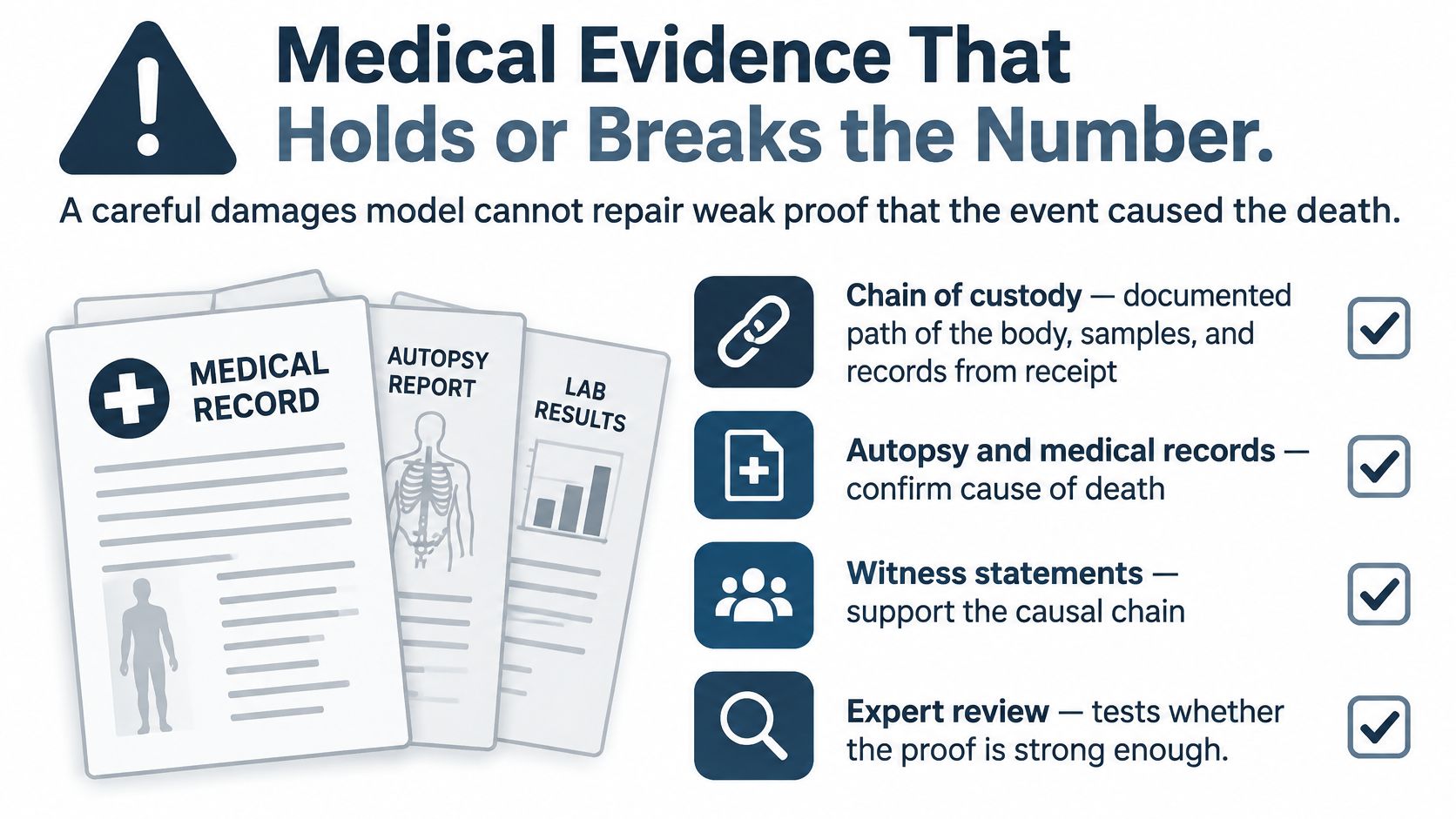
An independent postmortem review may help assess whether an alleged injury, drug, delay, or disease caused the death, whether another mechanism better fits the findings, and whether the evidence supports a period of consciousness. Relevant materials can include the examination, toxicology, histology, imaging, hospital chart, and emergency medical services records. Each answers a different question, and the conclusions depend on the quality and completeness of the evidence.
Official and private examinations serve different roles
For an inquest in Texas, a justice of the peace may seek a physician's opinion on whether an autopsy is needed and may direct an examination or certify that one isn't necessary, subject to applicable law. An official autopsy addresses the county's investigation. It doesn't necessarily resolve every question a family or attorney has, and a private examination doesn't replace an inquest examination ordered by county officials.
Families most often request a private autopsy when the medical examiner declined the case, they want an independent second opinion, or the cause of death remains unclear. The examination is scoped to the family's questions, often how and why the person died and whether something may have been missed. A private autopsy is arranged and paid for by the family or requesting party; an autopsy ordered under county or medical examiner authority is covered by the government.
Texas consent rules under Article 49.33 of the Code of Criminal Procedure make authorization and timing important. The statute provides a limited procedure when, after due diligence, an authorized person can't be identified or reached, including a 24-to-48-hour window tied to death or possession of the body, with the required official authorization, as described in the Texas Code of Criminal Procedure.
For further context on how expert evidence fits into a case, see our explanation of the wrongful-death expert witness role. Postmortem findings are expert medical opinions. They may clarify cause, mechanism, or timing, but they don't guarantee a conclusion about legal fault.
Who May Settle and Which Deadline Comes First
Under Texas law, the wrongful-death action is for the exclusive benefit of the deceased person's surviving spouse, children, and parents. One or more eligible beneficiaries may bring the action for the benefit of all. If none begins the lawsuit within three calendar months after the death, the executor or administrator must bring it unless every eligible beneficiary asks that it not be filed, under Texas Civil Practice and Remedies Code Chapter 71.
Texas generally allows two years from the date of death to file an action for an injury resulting in death. The date of the underlying conduct isn't necessarily the date the limitations period begins, and an examination doesn't extend the filing deadline, according to Texas Civil Practice and Remedies Code section 16.003.
Public-entity cases can involve an earlier notice deadline. Across many states, government-claim notice periods commonly range from 30 to 180 days, and one New York legal resource identifies a 90-day notice requirement for municipal defendants, as described in this guide for grieving families. These are not Texas-wide deadline rules. They illustrate why a family shouldn't assume that the ordinary lawsuit period is the first deadline to consider.
Deaths involving county hospitals, public schools, jails, police custody, or municipal vehicles may require quick identification of the right public defendant and preservation of records. Keep a timeline of the relevant dates:
| Event | Rule or deadline | Why it matters |
|---|---|---|
| Date of death | Generally starts the Texas two-year period for an injury resulting in death | The date of injury doesn't set the start date |
| Date of injury | Record it in the timeline | Earlier conduct can matter but doesn't extend the deadline |
| Date cause was discovered | Record when the cause became known | Supports investigation and records requests |
| Three months after death | Beneficiary filing rule | If none files, the executor or administrator may have to act |
| Public-entity notice date | In many states, often about 30 to 180 days | Can expire long before the lawsuit deadline |
| Filing date for each claim | Track wrongful-death and survival claims separately | Each claim has its own record and deadline |
Preserve autopsy, toxicology, imaging, medication, EMS, hospital, and custody records before they're lost or overwritten. Rules differ by jurisdiction, and Louisiana changed parts of its timing framework in 2025, so a national deadline calculator may mislead. We provide statewide transport, secure storage, and chain-of-custody documentation while counsel evaluates deadlines. We don't calculate legal deadlines for families.
Averages, Negotiation, and Typical Timelines
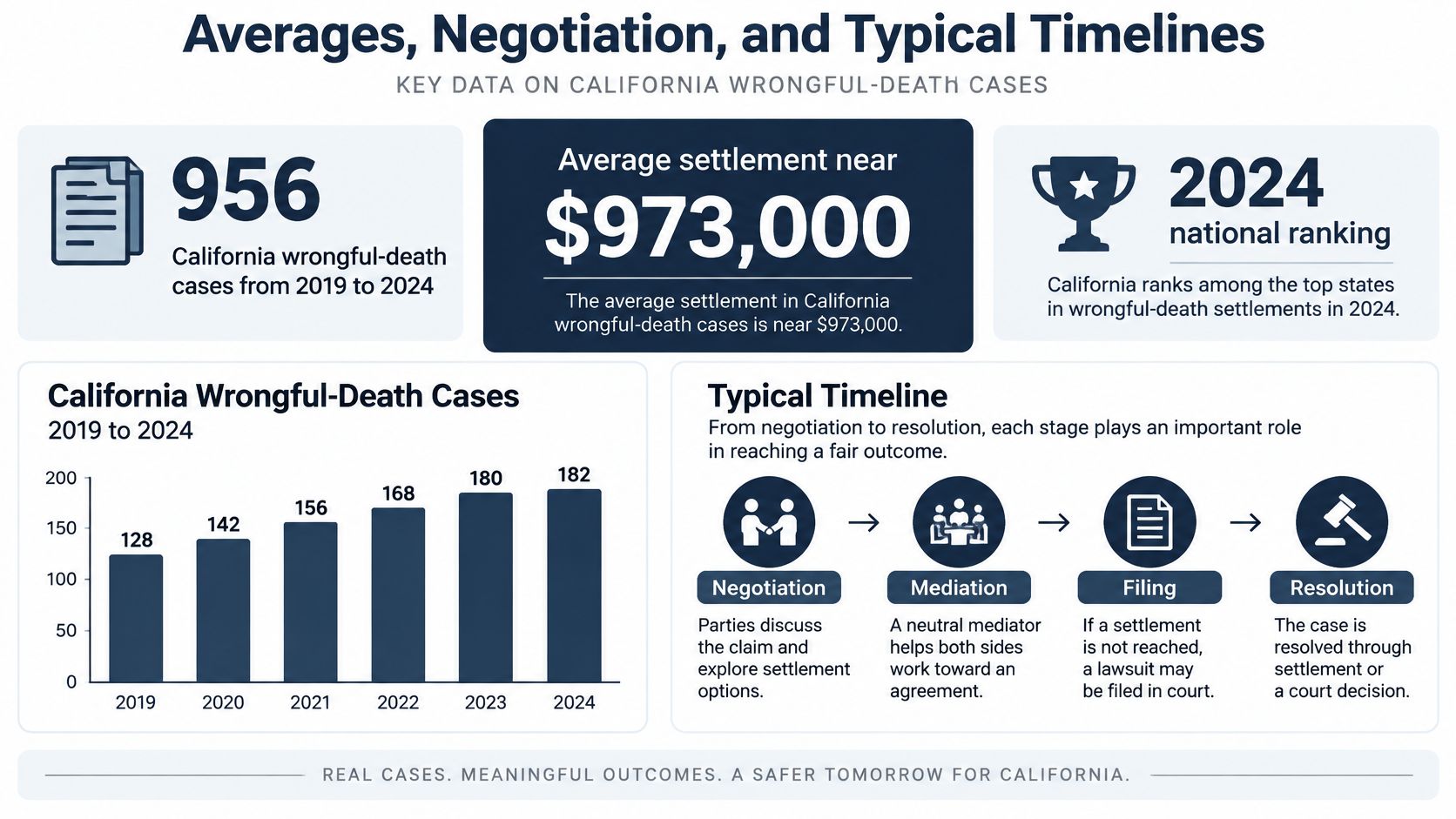
Published settlement averages aren't a Texas schedule or a forecast for a particular family. An analysis of 956 California wrongful-death cases from 2019 to 2024 reported an average settlement of approximately $973,000, according to the analysis published by Personal Injury San Diego. A 2024 national ranking listed reported wrongful-death settlements of $3,015,000 and $8,000,000 among its cases, according to TopVerdict's rankings and separate ranking. Those results come from different cases and jurisdictions, not a Texas valuation formula.
The figures also don't represent every case. They reflect different insurance limits, liability disputes, damage evidence, and decisions about which outcomes were published. A separate measure of trial results isn't a settlement average: in Tennessee fiscal year 2023–24, plaintiffs recovered money in 87 of 260 personal-injury and wrongful-death cases that went to trial, a 33% recovery rate, according to the Tennessee Bar Association.
What shapes negotiations
A damages analysis connects proposed losses to the contributions the deceased person likely would have made over an expected lifetime. Evidence may include income, benefits, household services, age, health, dependents, and the likely duration of support. The Restatement-based discussion in this Harvard torts reading on wrongful-death claims explains why individual evidence matters more than a published average.
Settlement discussions also account for liability risk and available insurance. A clear causal record and well-supported losses may give both sides a firmer basis to negotiate. Disputed fault, uncertain evidence, or unresolved questions about the claims can change how each side assesses trial risk. A trial adds legal costs, delay, and the possibility of no recovery; mediation can provide a structured way to discuss resolution, but it doesn't guarantee agreement.
No single timeline applies. Insurer investigation, completion of medical and investigative records, expert review of a disputed cause, appointment of an estate representative, and court or mediation scheduling can all affect how long a case takes. A case with clear fault, strong support records, and an agreed cause may resolve its damages issues sooner than one with a disputed mechanism or a missed notice requirement.
No ethical practice can quote a likely settlement from the fact of death alone.
Frequently Asked Questions
Who can authorize a private autopsy? The legal next of kin or a designated representative may request one. We confirm the requester's authority before scheduling, and families who are unsure can speak with our team about the authorization process.
Who receives the private autopsy report? The family that requested the examination receives the complete written report, which is kept confidential. The family decides who else may see it.
Does a private autopsy prove who is at fault? No. It provides an independent medical opinion on cause, mechanism, and timing; fault is decided through the legal process with counsel.
Speak With Our Team Before You Decide
A death can leave families with urgent questions and limited time to decide whether another examination would help. Families and attorneys unsure whether an independent examination fits their questions can call Texas Autopsy Services at (806) 230-1889 for guidance. Our team can walk through authorization questions and, once the examination is authorized, coordinate with the funeral home so planned services aren't delayed.
Every examination is performed by a forensic pathologist certified by the American Board of Pathology. From Elgin, we serve all 254 Texas counties with in-house licensed transport. A private autopsy may offer an independent medical assessment, but it doesn't decide legal responsibility or determine what a case will settle for.
This article is educational, not legal advice, and it isn't a prediction of any case's settlement value. Families facing loss deserve clear information and the time to consider what questions remain.
Texas Autopsy Services provides independent private autopsies and forensic pathology support to help clarify cause, mechanism, and timing of death. If you're considering whether an examination fits your questions, contact our team through Texas Autopsy Services or call (806) 230-1889 for guidance.