March 14, 2026 · Texas Autopsy Services
A Guide to Mesothelioma Claims After Death in Texas
Learn how to file a mesothelioma claim after death in Texas. This guide covers wrongful death lawsuits, survival actions, and securing necessary evidence.
On this page
- Securing Justice After a Loved One’s Mesothelioma Diagnosis
- Why an Independent Autopsy Can Make or Break Your Claim
- Gathering the Essential Evidence for Your Mesothelioma Claim
- How to Navigate the Legal Process in Texas
- Beyond a Lawsuit: Exploring All Your Compensation Options
- Frequently Asked Questions About Mesothelioma Claims After Death
- Losing a loved one to mesothelioma is devastating, but Texas law allows families to seek justice through wrongful death claims and survival actions.
- The legal process requires definitive proof linking the death to asbestos exposure, which can be challenging decades after the fact.
- A private, independent autopsy performed by a forensic pathologist provides the irrefutable medical evidence needed to strengthen a legal claim.
- Beyond a lawsuit, compensation may be available through asbestos trust funds and VA benefits for veterans.
- Strict deadlines, known as the statute of limitations, make it crucial for families to contact a specialized asbestos attorney promptly.
Losing a family member to an asbestos-related disease is a profound and often unjust experience. For families in Texas, the path to accountability doesn’t have to end with your loved one’s passing. You have the right to pursue a mesothelioma claim after death, which may include a wrongful death lawsuit, a survival action, or both. This process isn’t about assigning blame in the abstract; it’s about holding negligent companies responsible for the real harm they caused.
Securing Justice After a Loved One’s Mesothelioma Diagnosis
As a forensic pathologist, I often work with Texas families who are grappling with a loss they believe was caused by past asbestos exposure. Their journey begins with grief but must quickly turn toward finding concrete answers. The medical evidence I uncover through an independent autopsy often becomes the bedrock of a strong legal case.
Holding negligent companies accountable is about more than financial compensation. It’s about honoring the person you lost and providing stability for your family’s future.
Understanding Your Legal Options in Texas
In Texas, the law provides two primary legal actions that families can pursue after a death from mesothelioma. A skilled attorney will often file both to ensure the full scope of damages can be recovered.
Wrongful Death Claim: This claim is brought by immediate family members, usually a spouse, children, or parents, for their personal losses. It’s meant to compensate for the loss of companionship, emotional anguish, and the lost income and financial support the family has suffered.
Survival Action: This claim is brought on behalf of the person who passed away. It "survives" their death and allows their estate to recover damages the person could have pursued if they were still alive. This includes their medical bills, lost wages, and the conscious pain and suffering they endured.
Sometimes, a loved one may have already started a legal case before they passed. It's important to understand what happens when the deceased had pending legal claims, as this will guide how the case proceeds through the probate process.
The Purpose of a Post-Death Claim
The decision to file a claim is deeply personal, but it serves several critical functions. First, it establishes a record of accountability. Many companies knew asbestos was deadly for decades but hid that information to protect their profits. A lawsuit brings that history into the light.
A mesothelioma claim after death is not just a legal process. It is an act of advocacy for your loved one and a safeguard for your family's future. It turns grief into a powerful pursuit of justice.
Second, the financial compensation can lift an enormous weight. Mesothelioma treatments are incredibly expensive, and families are often left with staggering medical debt. A successful claim can cover those bills, funeral costs, and the loss of the household's future income.
Ultimately, this is about seeking a measure of justice. While no lawsuit can bring back your loved one, it provides the resources to help your family move forward. My work as a forensic pathologist is to deliver the indisputable medical facts that make this pursuit possible.
Why an Independent Autopsy Can Make or Break Your Claim
When a family loses someone, the death certificate is often the first official document they receive. But for a mesothelioma claim after death, a certificate that simply states "cancer" or "respiratory failure" is not enough. It's a starting point, not the final word.
I’ve spent my career as a board-certified forensic pathologist working with families and legal teams on these exact kinds of cases. I’ve seen time and again how a private, independent autopsy provides the one thing they need most: definitive proof. It’s how we find the irrefutable answers that a court of law demands.
Going Beyond a Standard Hospital Examination
You might wonder why a routine hospital autopsy isn't sufficient. The truth is, they're designed for a different purpose. A hospital autopsy aims to confirm a clinical diagnosis or evaluate how well a treatment worked. It's not focused on finding the microscopic evidence needed for asbestos litigation.
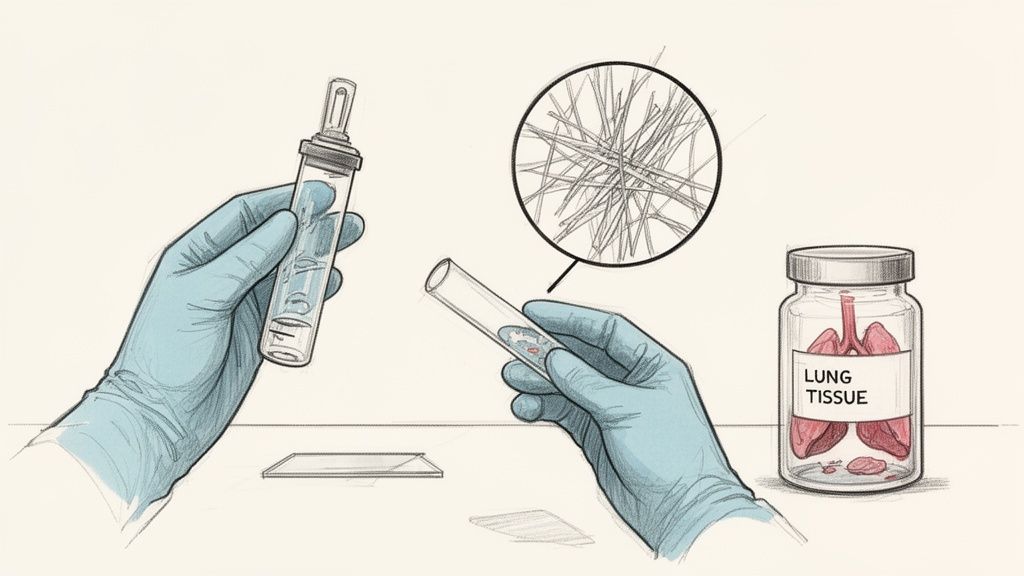
A forensic postmortem for a potential mesothelioma claim, on the other hand, is laser-focused. As the examining pathologist, I know precisely what to look for. This involves a meticulous process of collecting tissue samples from specific areas like the lungs, the pleural lining, and nearby lymph nodes.
We then prepare these samples for microscopic analysis. Under the microscope, the presence of asbestos fibers or the unique scarring they leave behind becomes undeniable. This is how we turn a strong suspicion into the kind of concrete medical evidence that forms the bedrock of a successful claim.
Forging the Scientific Link to Asbestos
Mesothelioma has an incredibly long latency period, often 20 to 50 years between the initial asbestos exposure and a diagnosis. This means many deaths today are tied to workplace conditions from decades ago.
My job is to scientifically bridge that gap in time. The findings from a targeted, independent autopsy give a legal team several crucial pieces of the puzzle:
- A Definitive Diagnosis: I can confirm the cancer is, in fact, mesothelioma, ruling out other conditions that might appear similar. This is non-negotiable for a claim's validity.
- Asbestos Fiber Analysis: We can physically identify and even count the asbestos fibers embedded in the lung tissue. This provides a direct, physical link between your loved one and the toxic substance that caused their illness.
- Proof of Causation: The final autopsy report delivers an expert medical opinion stating that asbestos exposure was the direct cause of death. In legal proceedings, this is incredibly powerful.
An independent autopsy provides the concrete medical evidence that a legal team needs to build a successful claim, turning suspicion into certainty.
A Process Grounded in Dignity and Respect
Families often have concerns about the autopsy process, and that's completely understandable. I want to personally assure you that at Texas Autopsy Services, we conduct every examination with the utmost respect for your loved one.
My team and I hold ourselves to the highest ethical and professional standards, ensuring the process is both thorough and reverent. We coordinate directly with funeral homes to make everything seamless. To give you peace of mind, you can get a clearer picture of the steps of an autopsy in our detailed guide and see how we maintain dignity from start to finish.
The final report we deliver isn't just a medical document. It's the scientific truth of what happened. For a family seeking justice after a mesothelioma death, that truth is everything.
Gathering the Essential Evidence for Your Mesothelioma Claim
Building a successful mesothelioma claim is like assembling a puzzle. From my experience as a forensic pathologist, I can tell you that each document is a critical piece that helps create a clear, undeniable picture of what happened. For families and attorneys pursuing a mesothelioma claim after death, this is the most important work you’ll do.
You aren’t just collecting papers; you’re building a story backed by hard facts. It starts with proving the illness itself, then connects it to asbestos exposure, and finally shows the devastating impact it had on your family.
Medical Evidence: The Cornerstone of Your Claim
The first thing you must establish is the medical diagnosis. While stories from friends and family are important, the objective, scientific proof found in medical records carries incredible weight in a legal setting.
Your legal team will need to track down every record related to your loved one’s illness. This isn’t a short list, and it includes items such as:
- Initial Diagnosis Records: These are the notes and reports from the doctors who first suspected or confirmed mesothelioma.
- Pathology and Biopsy Reports: These are absolutely critical. They contain the microscopic analysis that first identified the cancer.
- Imaging Scans: X-rays, CT scans, and PET scans visually document the tumors and how they progressed over time.
- Treatment Summaries: A full history of the fight, including every surgery, chemotherapy session, and radiation treatment your loved one endured.
Together, these documents paint a stark picture of the medical journey, the pain and suffering involved, and the crushing financial cost of care.
The Autopsy Report: Definitive Proof of Causation
Medical records prove the what, the illness. A forensic autopsy report proves the why, the direct link to asbestos. My job is to perform a detailed examination to find what a doctor treating a living patient cannot: the physical asbestos fibers embedded in the lung tissue.
The final autopsy report, combined with toxicology findings, delivers the scientific certainty needed to connect the death directly to asbestos exposure. It transforms a suspected link into medical fact.
This isn't just another medical report. It’s an expert declaration that becomes the central pillar of the entire legal argument. The details I document, such as the specific type and amount of asbestos fibers found, can even help an attorney zero in on the original source of the exposure. To learn more about getting this crucial document, see our guide on how to request an autopsy report in Texas.
Documenting a History of Exposure
With medical proof in hand, the next step is to show where and how the exposure happened. This part of the process often feels more like detective work, as you’ll need to reconstruct your loved one's entire work history.
A few key documents can unlock this history:
- Work Records: Social Security earnings reports are an excellent starting point. Union membership cards and old tax returns can also help create a clear timeline of employment.
- Military Service Records: For veterans, a DD-214 form is essential. It can show service on Navy ships, in shipyards, or in other roles where asbestos was notoriously common.
- Testimony: Sometimes the best proof comes from people. Sworn statements from old coworkers who can describe the working conditions and the lack of safety gear are incredibly powerful.
An experienced asbestos attorney will take this information and use it to identify the exact companies and products that caused the exposure.
Evidence Checklist for a Mesothelioma Claim
To help you keep everything straight, this checklist breaks down the essential documents you'll need. Think of it as your roadmap for gathering the proof required to build a strong case.
| Type of Evidence | What It Proves | Where to Obtain It |
|---|---|---|
| Medical Records & Diagnosis | Confirms the illness, details treatments, and documents medical expenses and suffering. | Hospitals, cancer centers, and physicians' offices where the deceased was treated. |
| Forensic Autopsy Report | Provides a definitive cause of death and scientifically links it to asbestos fiber exposure. | An independent forensic pathologist like Texas Autopsy Services. |
| Death Certificate | Officially records the death. It can be amended with autopsy findings to list mesothelioma. | The vital records office in the county where the death occurred. |
| Employment History | Establishes a work history at job sites with known asbestos use. | Social Security Administration, past employers, and union halls. |
| Coworker Testimony | Corroborates asbestos exposure conditions at a specific workplace. | An asbestos law firm can help locate and interview former colleagues. |
| Financial Records | Documents lost income, medical debt, and funeral expenses for the damages portion of the claim. | Personal financial statements, medical bills, and funeral home invoices. |
I know that looking at this list can feel overwhelming, especially when you’re already dealing with so much. Remember that every single document you find is a step toward justice for your family and holding the responsible parties accountable.
How to Navigate the Legal Process in Texas
Losing a loved one is devastating, and the thought of navigating a complex legal claim can feel completely overwhelming. My hope is to give Texas families a clear, straightforward roadmap for pursuing a mesothelioma claim after death. Taking this one step at a time can bring a sense of control and clarity during an incredibly difficult period.
First, you must be aware of the clock. In Texas, the law sets a strict deadline for filing these types of claims. It’s crucial that you begin by understanding the statute of limitations. For a wrongful death claim, the family typically has just two years from the date of your loved one's passing to file a lawsuit. If you miss this window, the opportunity to seek justice is lost for good.
Selecting a Qualified Asbestos Attorney
With the timeline in mind, the next critical move is finding the right legal partner. This isn't a job for just any personal injury attorney. Mesothelioma and asbestos cases are a specialized field, and you need someone who lives and breathes this area of law.
When you're speaking with potential attorneys, you should be direct. Ask them about:
- Their specific experience with mesothelioma wrongful death and survival action cases. How many have they handled? What were the outcomes?
- The resources they have to dig into decades-old work histories and pinpoint where the asbestos exposure happened. This requires serious investigative muscle.
- The network of experts they work with. A top firm will have industrial hygienists, medical experts, and economists on call to build the strongest case possible.
A seasoned asbestos lawyer takes the legal burden off your shoulders. They know the playbook, the companies involved, and how to navigate the system, letting your family focus on what truly matters.
Understanding the Discovery Phase
Once your attorney files the claim, the case officially moves into what's called the discovery phase. This is where the real work of building your case happens. Both sides are required to exchange information, evidence, and answers to formal questions, known as interrogatories.
This is where all the evidence you've gathered, the medical records, work history, and autopsy findings, is formally put on the table. Your lawyer will use this process to methodically connect the dots between your loved one's exposure and the companies responsible for it.
The discovery phase is the heart of the legal fight. It’s a meticulous process where we lay out the facts, confirm timelines, and construct a powerful, evidence-backed story for your claim.
This flowchart shows the key pillars of evidence that fuel the entire discovery process.
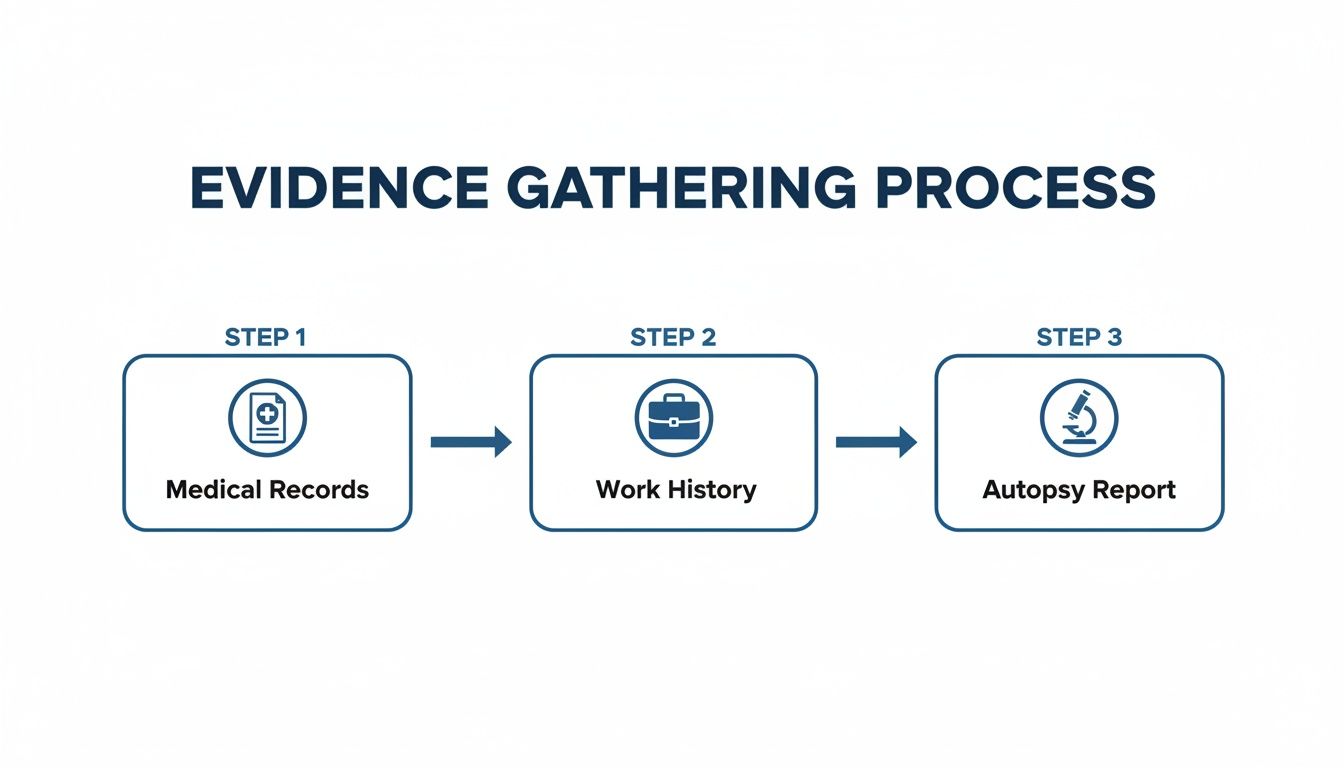
As you can see, the medical records, detailed work history, and a definitive autopsy report are the foundation upon which a successful mesothelioma claim is built.
Settlement vs. Trial: What to Expect
So, what does the end of this process look like? Most of the time, it ends with either a settlement or a trial. It's a fact of asbestos litigation that the vast majority of these cases, well over 90%, are resolved through a settlement long before they see the inside of a courtroom.
A settlement is an agreement reached through negotiation. The defendant company agrees to pay your family a specific amount of compensation to close the case, usually without admitting any fault. Your attorney's job is to fight for a fair settlement that truly reflects the immense loss your family has endured.
If a fair agreement can't be reached, the case might head to trial. Going to trial is a much more public, time-consuming, and uncertain path. A judge or jury will hear all the evidence and make a final ruling. While a successful trial can sometimes result in a larger award, there's also the risk of walking away with nothing. An experienced lawyer will give you honest, practical advice on which path makes the most sense for your family.
Beyond a Lawsuit: Exploring All Your Compensation Options
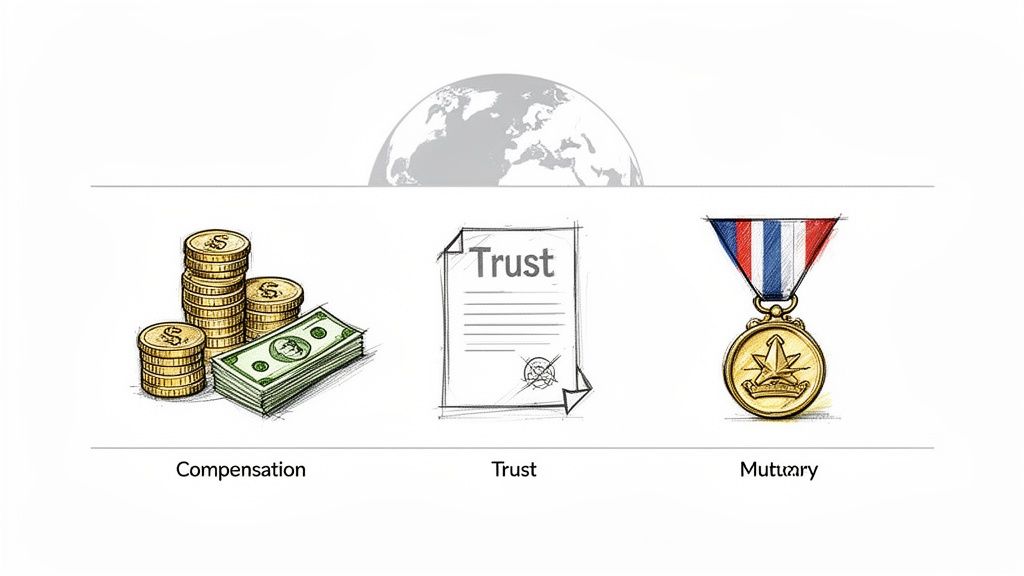
When you're grieving the loss of a loved one to mesothelioma, a lawsuit can feel like the only way to seek justice. While it's certainly a powerful option, it's not the only one. Decades of asbestos litigation have led to the creation of other systems designed specifically to help families like yours.
It’s crucial to know about all these avenues. Doing so opens up more possibilities for securing your family's financial future.
Asbestos Trust Funds: A Direct Path to Compensation
You might hear that the company responsible for your loved one's asbestos exposure went bankrupt years ago. Don't let that discourage you. As part of the bankruptcy process, courts forced these companies to set up massive trust funds, often with billions of dollars.
These trusts were created for one reason: to pay victims and their families.
Filing a claim with an asbestos trust is a completely different process than a lawsuit. There’s no courtroom involved. Instead, your attorney handles everything, submitting a detailed claim package directly to the trust administrators.
Success here hinges on one thing: irrefutable proof. You have to clearly connect your loved one's mesothelioma to a specific company's asbestos products. This is where my work as a forensic pathologist becomes so critical. The findings in a forensic autopsy report provide the definitive medical evidence that trust administrators need to see.
VA Benefits for Veterans Exposed During Service
If your loved one was a veteran, a separate and vital source of support is available through the U.S. Department of Veterans Affairs (VA). Asbestos was used everywhere in the military, particularly on Navy ships and in shipyards built before the 1980s.
If there's a link between their mesothelioma and their military service, your family could be eligible for significant benefits, including:
- Dependency and Indemnity Compensation (DIC): A tax-free monthly payment to a surviving spouse, child, or parent.
- Accrued Benefits: Payments for benefits the veteran earned but didn't receive before they passed away.
- Funeral and Burial Allowances: Financial assistance to help cover final expenses.
Just like with trust funds, a VA claim requires solid proof. You'll need service records (the DD-214) and medical evidence. Again, an autopsy report provides the strongest possible link between their service and the disease that took their life.
Why These Funds Exist: A Legacy of Negligence
These compensation systems didn't just appear out of nowhere. They are the result of a global public health crisis. Mesothelioma is a worldwide problem, with around 30,870 people diagnosed every year. Annually, over 200,000 deaths are linked to asbestos-related diseases, and mesothelioma itself accounts for more than 70% of all occupational cancers across the globe.
You can learn more about the staggering far-reaching impact of mesothelioma statistics to grasp the true scale of the issue.
The existence of asbestos trust funds and VA benefits is a direct acknowledgment of widespread corporate and institutional negligence. These are not handouts; they are reparations your family is owed.
Your family’s pursuit of a mesothelioma claim after death is part of a much larger fight for accountability. As a forensic pathologist, my entire focus is on delivering the scientific certainty needed to anchor your case, whether it's a lawsuit, a trust fund claim, or a VA application.
An autopsy report establishes that definitive cause of death, becoming an essential tool in your pursuit of justice, especially if you need an expert witness to clearly explain the medical facts of your case.
Frequently Asked Questions About Mesothelioma Claims After Death
As a forensic pathologist, I’ve sat down with many families and attorneys navigating the tough road of a mesothelioma claim after a loved one has passed. In those quiet, difficult moments, the same urgent, practical questions often come up. My goal here is to answer some of the most common ones I hear, speaking from my direct experience in providing the medical certainty these cases require.
Can We Still File A Claim If The Death Certificate Doesn't List Mesothelioma?
Yes, absolutely. This is a very common scenario, so please don’t feel discouraged.
A death certificate is often filled out under time pressure, and the initial cause of death might be listed as something general like "cardiopulmonary arrest" or "cancer of unknown primary." Mesothelioma is a highly specific diagnosis that can easily be missed without a detailed, postmortem examination.
This is exactly where an independent, private autopsy makes all the difference. My role is to perform a thorough examination to find the tell-tale cellular and tissue markers of mesothelioma, which provides a definitive diagnosis. With this concrete evidence, the death certificate can be officially amended, giving your legal team the solid medical proof they need to build a strong claim.
A general cause of death on an initial certificate is a roadblock, not a dead end. A forensic autopsy provides the key to updating the record with the correct, specific diagnosis needed for your claim.
How Long Do We Have To File A Claim In Texas?
This is probably the most time-sensitive question, and the answer is dictated by a very strict legal deadline. In Texas, the statute of limitations for a wrongful death claim is generally two years from the date your loved one died.
This deadline is non-negotiable. If you miss it, the courts will almost certainly bar you from ever filing a claim.
That's why I always urge families to speak with an attorney who specializes in asbestos litigation as quickly as possible. Gathering the necessary proof, which can include tracking down employment records from decades ago and compiling a complete medical history, takes an incredible amount of time. Acting fast gives your legal team the breathing room they need to construct the strongest case before that two-year window slams shut.
What If We Don't Know Where The Asbestos Exposure Happened?
This is a huge source of anxiety for many families, and it’s completely understandable. Mesothelioma has a notoriously long latency period, anywhere from 20 to 50 years, so the exposure could have occurred at a job your loved one held a lifetime ago. While it's a challenge, it's a puzzle that experienced legal teams are built to solve.
Attorneys who focus on asbestos cases have incredible resources and investigative tools at their disposal. Their process for pinpointing exposure is meticulous:
- Digging into Work History: They’ll use Social Security records and other documents to piece together a full timeline of your loved one's career.
- Identifying Known Hotspots: They cross-reference that work history against massive databases of known asbestos job sites, including shipyards, refineries, power plants, and construction projects.
- Finding Former Coworkers: They have proven methods for locating former colleagues who can provide sworn testimony about the working conditions and the presence of asbestos dust on site.
This detective work is central to what these lawyers do. Even if all you have are a few fragments of your loved one’s employment history, it’s often more than enough for a skilled team to start connecting the dots.
Is An Autopsy Required To File A Claim?
While an autopsy isn't legally required to simply file a lawsuit, it provides the single most powerful piece of evidence you can possibly have. It moves a claim from the realm of suspicion into the realm of scientific fact. In my professional opinion, choosing not to get an autopsy when pursuing a mesothelioma claim is a major missed opportunity.
Without one, you leave the door wide open for the defense to create doubt. They will argue the death was caused by something else, another type of lung cancer, perhaps, or complications from a smoking history.
An autopsy shuts down those arguments completely. My final, detailed report provides an irrefutable, expert opinion that directly links the death to asbestos. That kind of certainty is invaluable during settlement talks and can be the deciding factor if your case goes to a jury.
Here at Texas Autopsy Services, my entire focus is on providing families and their legal teams with the clear, scientific answers needed to pursue justice. If you have more questions or need to understand how an independent autopsy could strengthen your case, please don’t hesitate to reach out.
For a confidential consultation, you can contact my office at (806) 230-1889 or visit us online at https://www.texasautopsyservices.com.