November 13, 2025 · Texas Autopsy Services
Medical Record Review in a Death Investigation
Discover how medical record review guides cause of death determinations in Texas and helps families seek answers.
On this page
- The Unseen Story Hidden in Medical Records
- What a Private Autopsy Is and When It's Appropriate
- How the Autopsy Process Works
- Connecting the Autopsy to the Cause of Death
- What Families and Attorneys Can Expect in the Final Report
- The Role of Independence and Objectivity in Forensic Pathology
- Frequently Asked Questions About Private Autopsies
- Private autopsies provide independent, objective cause-of-death findings.
- All examinations are performed by a board-certified forensic pathologist.
- Families receive transparent, comprehensive reports.
- The process is confidential, legal, and fully compliant with Texas standards.
- Call our office for guidance: (806) 230-1889.
I've spoken with countless families who are left with more questions than answers after a loved one passes away. The death certificate gives a cause, but it rarely tells the whole story. For those grappling with an official narrative that doesn't feel right, an independent autopsy or a detailed medical record review is often the only way to find the clarity they deserve.
The Unseen Story Hidden in Medical Records

As a forensic pathologist, I know that a stack of medical records holds a story. It's a clinical narrative, written day by day, that can reveal what really happened during a hospital stay.
Consider a situation I've encountered many times with families here in Texas. An elderly parent is hospitalized, a seemingly minor medication is changed, and suddenly, they decline rapidly. The death certificate might list "natural causes," but for the family who saw that sudden shift, that answer feels hollow and incomplete.
They're left wondering: Was it the new medication? Did the care team miss a complication? This is precisely where a professional medical record review comes in. It’s not about finding someone to blame; it's about piecing together a clear, factual timeline to understand the sequence of events.
Reconstructing the Clinical Timeline
My job is to become a medical investigator, meticulously rebuilding the patient’s final days or weeks from the data documented by their caregivers.
The process involves a systematic analysis of:
- Physician and Nursing Notes: These are the daily logs—the real-time narrative of the patient’s condition, the staff's observations, and the thinking behind every treatment decision.
- Medication Administration Records: I scrutinize which drugs were given, the exact dosage, and when. Then, I cross-reference this information with the patient’s vital signs and lab work to see the immediate effects.
- Laboratory and Imaging Results: This is the hard data. Blood work, X-rays, and scans can reveal hidden infections, organ distress, or other problems that might not have been obvious from a physical examination alone.
- Consultation Reports: When specialists are called in, their notes provide critical outside perspectives on how different medical teams were approaching the situation.
By weaving all these threads together, I can spot patterns, uncover overlooked factors, or confirm that the care provided was appropriate.
For that family questioning the medication change, the review might show exactly how the new drug impacted kidney function, setting off a chain reaction that contributed to their loved one's death. That kind of insight doesn't erase the grief, but it can transform painful uncertainty into quiet understanding.
What a Private Autopsy Is and When It's Appropriate
As a forensic pathologist, I perform a private autopsy as an independent medical examination to determine the cause and manner of a person's death. Unlike autopsies ordered by a medical examiner or coroner for legal reasons, a private autopsy is requested directly by a family or their legal representative. It provides definitive answers when the official cause of death is unclear, seems incomplete, or raises questions about medical care.
I sift through everything from toxicology reports to microscopic tissue samples to reconstruct the chain of events that led to death. I'm looking for evidence that the official death certificate might have missed. This detailed approach is crucial, especially when a family needs a trusted second opinion to find peace of mind. Our Private Autopsies are conducted with the utmost respect and scientific precision.
Reconstructing the Patient's Story
A person's medical history tells a story. With the shift to electronic health records (EHRs), that story has become both easier to access and far more complex to interpret. In fact, North America now accounts for about 46% of the global EHR market, thanks to heavy investment in healthcare technology. You can read the full research on the global EHR market to see just how massive it is.
My role is to cut through that digital noise to find the truth, whether through a physical examination or a thorough record review. I connect the dots between a doctor’s order, a nurse's worried observation, and a critical lab result that came back hours later. It’s this kind of analysis that transforms a stack of data into a clear, understandable narrative.
For an attorney, this review builds the factual bedrock for a case. For a family, it brings clarity and peace of mind—answers grounded in objective medical evidence, not speculation.
When an Independent Autopsy Is Necessary
Not every death warrants this kind of in-depth analysis. But in certain situations, an independent autopsy or medical record review is the only way to get real answers.
Here’s a look at some common situations where an independent examination can make all the difference.
| Scenario | Value for Families | Value for Attorneys |
|---|---|---|
| Unexpected Decline in a Hospital | Provides a clear, evidence-based explanation for a sudden change in a loved one's condition. | Establishes a timeline of events and identifies potential deviations from the standard of care. |
| Questions About Medication | Confirms whether a new medication or dosage change contributed to adverse outcomes. | Offers expert analysis on pharmacology and its documented effects on the patient. |
| Death Certificate Lacks Detail | Delivers a comprehensive report that explains the cause of death beyond a single diagnosis. | Supplies a detailed medical opinion that can support or challenge the official findings. |
| Concerns About a Care Facility | Offers an unbiased assessment of the care provided, based solely on documented facts. | Identifies specific points of evidence within the records to support legal claims. |
At the end of the day, a private autopsy turns uncertainty into fact. It provides the context needed to understand not just what happened, but why it happened, giving you definitive answers backed by medical evidence.
How the Autopsy Process Works
When a family needs answers, they deserve a clear, thorough, and defensible examination. It’s not just a procedure; it’s a process of finding the truth. At Texas Autopsy Services, I’ve developed an investigative method that turns a complex medical situation into a clear story of what happened. This includes services for Texas counties, which you can learn more about in our section on County Forensic Autopsies.
The very first step is making sure we have every single piece of the puzzle. This means legally gathering and meticulously organizing all relevant medical documents. For families who want to get a head start, there are resources for organizing medical records effectively on their own.
Document Collection and Organization
This initial phase is all about comprehensive evidence gathering. I work closely with the family or their legal team to track down every document related to the patient’s care.
This often includes a wide range of records, such as:
- Paramedic and first responder reports
- Emergency department notes
- Admission histories and physicals
- All physician progress notes and nursing logs
- Medication administration records (MARs)
- Lab results and imaging scans like X-rays, CTs, and MRIs
- Notes from any consulting specialists
- The final hospital discharge or death summary
Each document is a piece of evidence. Once I have them all, I arrange everything chronologically. This builds the timeline that serves as the backbone for the entire investigation. Our partnership with Waterloo Mortuary Partnership ensures that the entire process is handled with dignity and professionalism.
This infographic shows the three core steps I follow: gathering the information, analyzing the fine details, and finally, putting it all together to reconstruct the sequence of events.
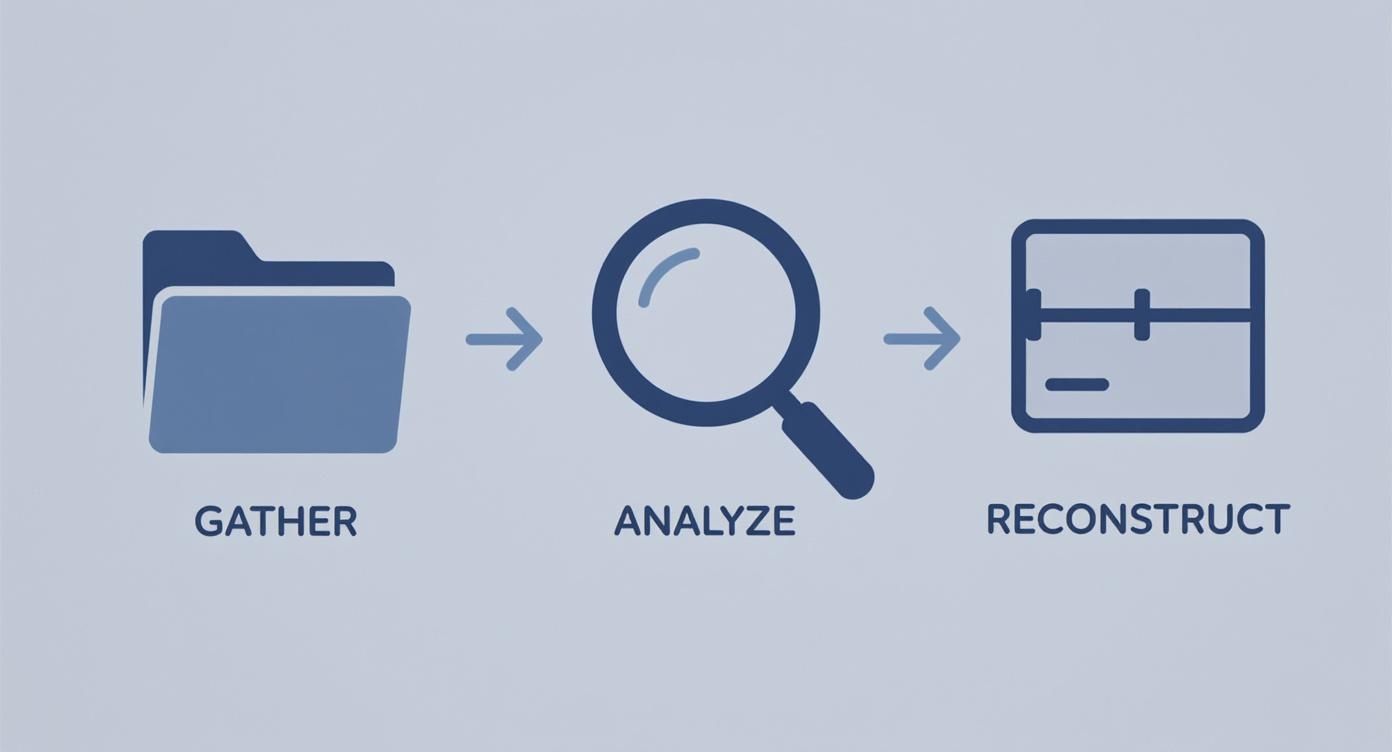
It’s a systematic way of turning raw data and physical findings into a meaningful, evidence-based conclusion.
In-Depth Analysis and Timeline Reconstruction
With all the records in order and the physical examination complete, the real investigative work begins. I don’t just observe; I actively investigate. I look at specific data points and place them within the context of the timeline we’ve built.
For instance, I’ll connect a new medication order directly to the patient's lab values and vital signs that followed. This helps me see its real-time physiological impact. My job is to spot patterns that might have been overlooked during clinical care. A single abnormal lab result might be easy to dismiss, but a trend of rising values over several days tells a different story.
A private autopsy is like examining the black box recorder after a complex system failure. The data and physical evidence are all there, but it requires a trained, impartial eye to reconstruct the sequence of events and identify the critical points that led to the final outcome.
I carefully map out every important clinical event—from a sudden drop in blood pressure to a subtle change mentioned in a nurse’s log. This allows me to connect the dots between seemingly unrelated pieces of information. The result is a detailed medical narrative that forms the core of my final report, providing the definitive answers that families and attorneys need.
Connecting the Autopsy to the Cause of Death
How do physical findings and a stack of patient charts transform into a clear-cut cause of death? As a forensic pathologist, my job is to analyze all the evidence line by line, finding the exact point of failure and tracing back the sequence of events that led there.
This isn't just about spotting the final event. It's about piecing together the entire clinical story to understand the full picture.
Identifying the Cause, Mechanism, and Manner of Death
In my field, we use very precise language to describe a death. A detailed examination is the only way to get these right. We break it down into three key parts:
- Cause of Death: This is the actual disease or injury that started the chain of events, such as a heart attack (myocardial infarction) or a widespread infection (sepsis).
- Mechanism of Death: This is the specific physiological process that caused the body to shut down because of that cause. For a heart attack, the mechanism might be a fatal arrhythmia.
- Manner of Death: This explains how the cause of death happened. There are five official categories: Natural, Accident, Suicide, Homicide, and Undetermined.
An independent autopsy is so important because it’s done without any outside institutional pressure. My findings are based purely on the medical and physical facts in front of me.
Building the Evidentiary Chain
My focus is on building a chain of evidence directly from the examination and the records. I'm poring over trends in lab values, checking the exact timing of medications, and reading every note from every doctor and nurse. Did a person's kidney function start to decline right after a new drug was given? Were there physical signs of an infection nobody caught?
These are the kinds of questions I have to answer. Every data point helps build the final conclusion. The global market for medical records retrieval—a huge part of this work—was valued at USD 1.1 billion in 2024 and is expected to hit USD 2.8 billion by 2034. This shows how vital a thorough analysis has become. Discover more insights about the medical records retrieval market to get a sense of this growing field.
A cause of death listed on a certificate may be medically accurate but contextually incomplete. My goal is to provide the full context, explaining not just what happened, but how and why it happened based on the documented evidence.
By connecting all the dots, I can pinpoint not just the main cause but also any other significant factors that played a role. This in-depth approach gives families and attorneys a clear, medically sound explanation that goes far beyond a simple diagnosis to tell the complete story.
What Families and Attorneys Can Expect in the Final Report
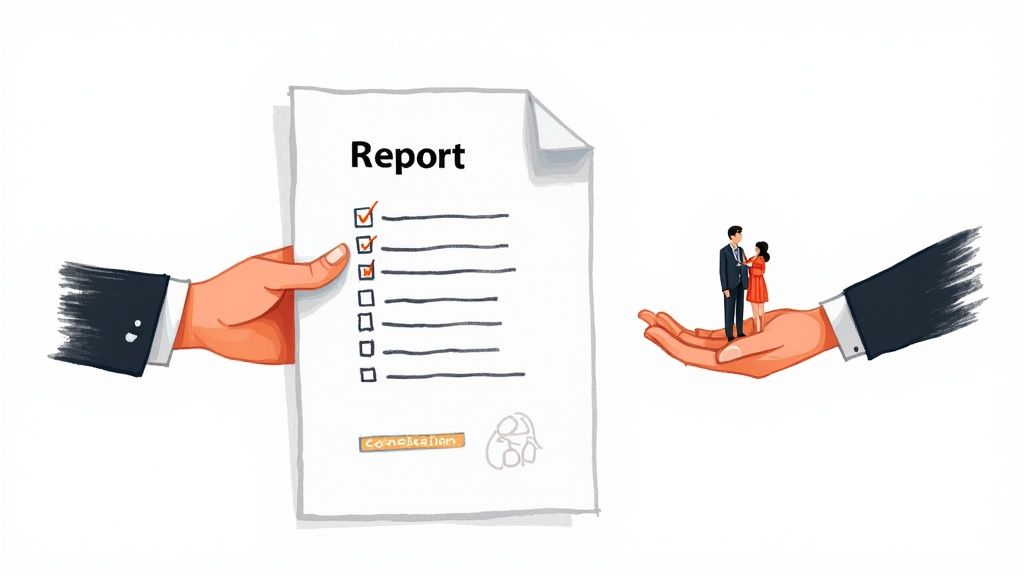
When the examination is complete, you receive a detailed summary report that’s built for one thing: clarity. This isn't just a pile of medical jargon meant for other doctors. It’s a clear story explaining what happened, when it happened, and why, with every conclusion pointing directly back to the evidence.
My goal is to deliver a report that is medically sound enough for legal challenges but also accessible enough for a family looking for real answers.
The Structure of Your Report
Every report I write is organized to walk you through the clinical and pathological events in a logical way. This format makes sure anyone, medical professional or not, can follow the evidence from the raw data to my final opinion.
Your report will typically contain these key sections:
- Case Summary: A quick rundown of the case and the core questions the autopsy set out to answer.
- Chronological Medical Timeline: A detailed summary of the key moments from admission to the final outcome, based on medical records.
- Pathological Findings: A detailed description of the findings from the physical examination, including organ systems and microscopic analysis.
- Evidence-Based Conclusions: Straightforward conclusions that connect the findings to the cause of death and any contributing factors.
This structured approach is all about transparency. You’ll be able to see exactly how I pieced everything together to form my professional opinion.
A Document of Clarity and Precision
I make a point to use direct language in the final report. While it has to include the right medical terms for legal and clinical accuracy, I always take the time to explain them in plain English.
If you want to get a better handle on the format, our guide on how to read a pathology report offers some helpful background. It breaks down the typical sections and terms you might come across.
When it’s time to share the report, we always use secure and HIPAA-compliant data transfer methods to ensure all sensitive information stays protected.
My ultimate goal is to provide a document that stands on its own as a source of truth. It is a factual, unbiased account that gives families the closure they deserve and provides attorneys with the solid medical evidence they need.
The report finishes with my professional opinion on the cause and manner of death, based entirely on the evidence found. It’s the final piece of a careful, impartial investigation designed to bring clarity.
The Role of Independence and Objectivity in Forensic Pathology
When it comes to forensic pathology, objectivity is everything. Families and attorneys who come to me for a second opinion autopsy are looking for a clear, impartial analysis. They need to trust that the findings are based purely on medical facts, without any outside influence.
This is why an independent perspective is so important. When a hospital or care facility investigates a death that happened on their watch, there’s a risk of institutional bias.
As an outside expert, I have no connection to the hospital, the clinic, or the doctors involved. My only allegiance is to the evidence. This freedom allows me to deliver an opinion that is completely unbiased and grounded in science.
Upholding the Highest Ethical Standards
My professional commitment to objectivity is backed by my credentials. As a forensic pathologist with board certification from the American Board of Pathology, my entire reputation is built on the integrity of my work. Every conclusion I reach has to be supported by the medical evidence.
This is especially critical in legal cases where my findings must withstand intense scrutiny. You can learn more about how this works in my role as a forensic pathology expert witness, where impartiality is non-negotiable.
Today's Electronic Health Records (EHRs) are often the foundation of any thorough review, offering a detailed digital timeline. Their role is only growing; the global EHR market was valued at USD 36 billion in 2025 and is expected to hit USD 93 billion by 2035.
An independent review acts as a critical safeguard. It ensures the final cause of death is determined by scientific analysis, not by an institutional point of view.
Ultimately, this process gives families and legal teams the confidence they need. They know the answers they receive are accurate and were reached with the highest ethical standards. My job is to find the truth, and that’s a responsibility I take very seriously.
Frequently Asked Questions About Private Autopsies
Over the years, I've noticed that families and lawyers often come to me with the same set of questions about private autopsies. It’s a process most people are unfamiliar with, so it's only natural to want clear, straightforward answers. I've gathered some of the most common questions I hear at Texas Autopsy Services to help you understand what's involved.
How Long Does a Private Autopsy Take?
The timeline depends on two things: the complexity of the medical history and the scope of the examination required. The physical autopsy is typically completed in one day. However, laboratory tests, such as toxicology and microscopic tissue analysis, can take several weeks.
My focus is always on being thorough, not fast. I'll give you a realistic time estimate once I've had a chance to understand your specific circumstances.
Can Your Report Be Used in Court?
Absolutely. The final report I create is a legal document designed for court proceedings. As a board-certified forensic pathologist, my expert opinion is built on a careful, evidence-based analysis of all medical documentation and physical findings.
My report creates a clear, defensible medical narrative that links the clinical events and pathological findings to the final outcome. For attorneys, this becomes a powerful foundation for building their case.
Because I work as an independent consultant, my findings are grounded in objective medical science and the highest standards of forensic pathology.
Do I Need a Lawyer to Request an Autopsy?
Not at all. You don't need an attorney to request a private autopsy. I often work directly with families who are just looking for answers and a sense of closure. The entire process is confidential, and my main objective is to give you a clear understanding of the medical facts, whether or not you're considering legal action.
What Are the Legal Requirements in Texas?
In Texas, the legal authority to consent to an autopsy is governed by the Texas Health & Safety Code. Generally, the next of kin has the right to authorize the procedure. The process is fully compliant with all state regulations, including those set by the Texas Funeral Service Commission.
If you have other questions or want to talk about your specific situation, please don't hesitate to contact my office. At Texas Autopsy Services, my team and I are here to provide the clear, compassionate, and medically sound answers you deserve. You can learn more by visiting us at https://www.texasautopsyservices.com.