November 9, 2026 · Texas Autopsy Services
How a Medical Malpractice Claim Works in Texas
Learn what a medical malpractice claim requires in Texas, including deadlines, evidence, and how an independent autopsy shows cause of death.

On this page
- What a Medical Malpractice Claim Covers and What It Does Not
- The Four Elements Every Claim Must Prove
- Texas Deadlines and Notice Rules to Know First
- How Autopsy Findings Support or Weaken Causation
- Tracing Diagnostic Errors and Delayed Care in the Record
- Steps Families and Attorneys Take After a Suspicious Death
- Request an Independent Review Before Deadlines Pass
Diagnostic errors represented approximately 20% of asserted liability cases from 2015 to 2024 and carried about $5 billion in losses and potential losses, according to Harvard's malpractice claims analysis. That figure changes the starting question. A medical malpractice claim isn't proven by finding one mistake. It's built by showing that care fell below an accepted standard and that the failure probably changed the outcome.
- A bad outcome alone isn't negligence. Duty, breach, causation, and damages must each be supported.
- Texas deadlines run early. Notice, limitations, and repose rules can end a claim before evidence is reviewed.
- An autopsy tests causation. It can clarify cause, mechanism, and contributing conditions, but it can't decide negligence by itself.
- Records create the timeline. Symptoms, test results, referrals, and follow up show whether a delay mattered.
- Early preservation matters. Samples, imaging, and complete records are harder to recover later.
What a Medical Malpractice Claim Covers and What It Does Not
A common assumption is wrong. A death after treatment doesn't prove negligence, and a treatment that didn't work doesn't automatically support a medical malpractice claim. A claim alleges that a health care provider's care fell below accepted standards and that this failure caused harm, including death. Both parts need evidence.
That distinction shows up in closed claims. The U.S. Bureau of Justice Statistics study of claims closed from 2000 through 2004 covered Florida, Illinois, Maine, Massachusetts, Missouri, Nevada, and Texas. Most claims closed without compensation. About one-third of closed claims in Maine, Missouri, and Nevada resulted in payouts, while approximately 12% of closed claims in Illinois ended with payment.
Terms That Shape the Investigation
Families often meet three terms before counsel can assess a case. Clear definitions prevent confusion later.
- Cause of death: The disease or injury that started the fatal sequence, such as pneumonia, a heart attack, or a head injury.
- Manner of death: The circumstances classification, listed as natural, accident, suicide, homicide, or undetermined.
- Chain of custody: The documented record of who handled the body, samples, and records, and when each transfer occurred.
A claim is a demand alleging liability and seeking compensation. A lawsuit is a formal court filing after required notice steps. A complaint to a licensing board asks a regulator to review professional conduct. Each path uses different procedures, and one doesn't substitute for another.
A poor outcome starts an inquiry. It doesn't answer whether the standard of care was breached or whether that breach caused death.
Before going further, answer three basic questions in writing. What care was given, and by whom. What does the death certificate list as cause and manner. Does the timeline raise a specific question about diagnosis, treatment, monitoring, or follow up.
Those answers don't prove a claim. They show whether records and postmortem findings need closer review, and they help an attorney screen the matter without relying on grief, suspicion, or outcome alone.
The Four Elements Every Claim Must Prove
Every medical malpractice claim rests on four elements in order. 1. Duty means a provider patient relationship created an obligation of care. 2. Breach means care fell below the accepted standard for that situation. 3. Causation means the breach probably caused the injury or death. 4. Damages means measurable harm resulted.
Duty is usually the simplest element. Intake forms, referral records, appointment records, and billing records show who accepted the patient for care. Breach is harder. It requires comparing what happened with what a reasonably careful provider in the same field should have done under similar circumstances.
What Each Element Requires
| Element | What must be shown | Evidence that supports it |
|---|---|---|
| Duty | A provider patient relationship created an obligation of care | Intake forms, referral records, appointment and billing records |
| Breach | Care fell below the accepted standard for that situation | Complete chart, orders, test results, expert review of the record against the standard |
| Causation | The breach probably caused the injury or death | Postmortem findings, toxicology, imaging, and a timeline showing whether the delay changed the outcome |
| Damages | Measurable harm such as death, injury, or added costs | Death certificate, medical bills, records of lost income or care costs |
Causation is where many cases succeed or fail. Say a treatable infection was diagnosed late. It's not enough to show the diagnosis came later than it should have. The evidence must show the delay probably changed the outcome, for example by allowing sepsis to progress past a point where antibiotics and supportive care could have worked.
Postmortem findings often matter here because they identify the actual disease process. Toxicology can test medication effects. Histology can show how advanced an infection, cancer, or organ injury was. Imaging and the clinical timeline then help determine whether earlier action was medically capable of preventing death.
Most claims require qualified expert review on breach and causation, and attorneys screen cases against all four elements before filing. Readers who want to understand that review role can read about medical expert witness work and how opinions are formed from records and findings.
Practical rule: A death certificate proves death occurred and states a cause. It doesn't decide whether any provider was negligent.
Sort available documents under the four headings. Mark what's supported, what's missing, and what conflicts. That simple file shows counsel where expert review, records requests, or a cause of death investigation may be needed.
Texas Deadlines and Notice Rules to Know First
Deadlines come first in practice because a late claim may never reach the medical evidence. Families can have strong questions about care and still lose the right to file if notice or limitations dates pass. That's why counsel usually calendars dates before ordering detailed expert work.
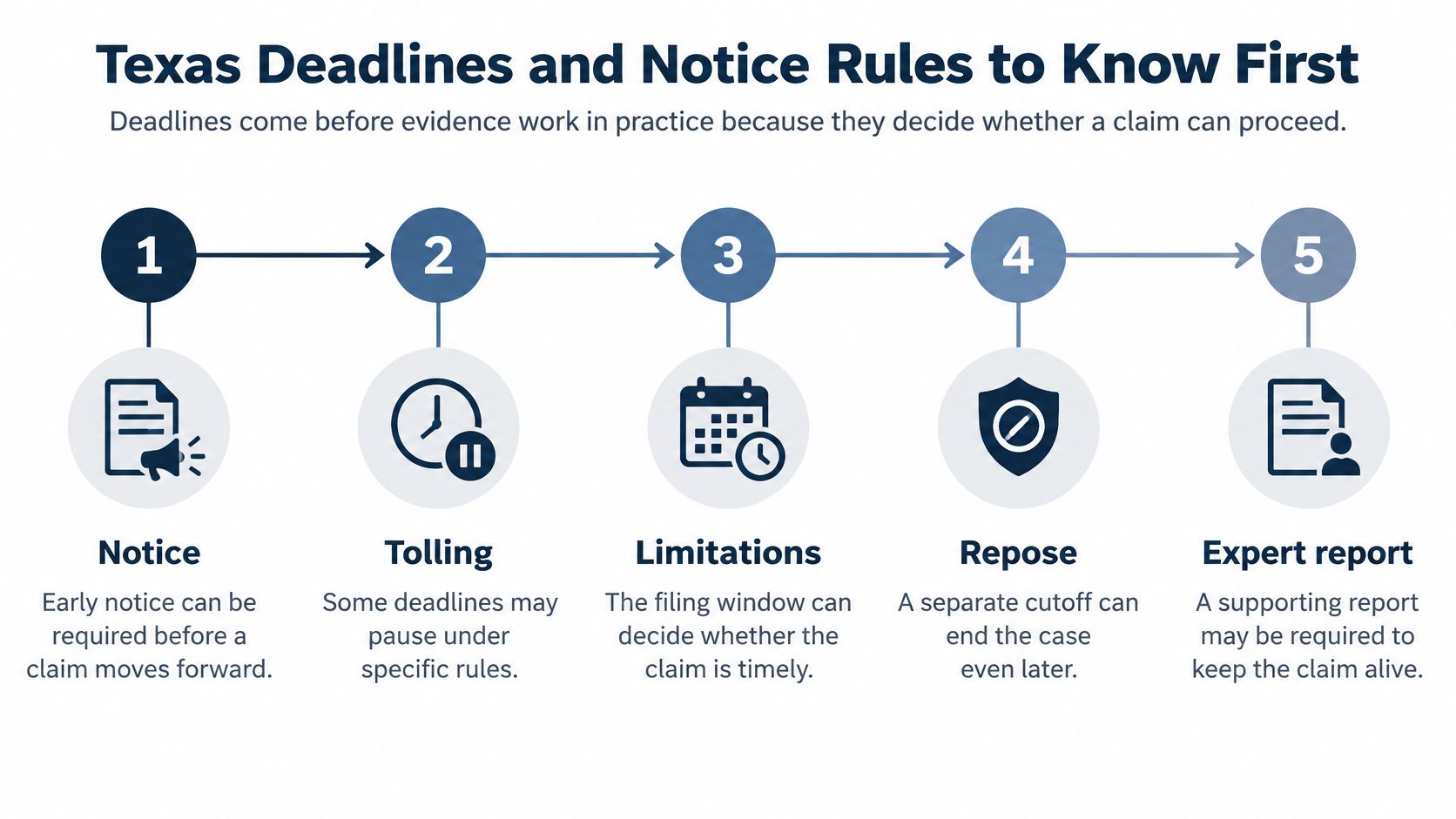
Under Texas medical liability law as set out in the statutory text, a claimant must send written notice by certified mail, return receipt requested, to each physician or health care provider at least 60 days before filing suit. Proper notice tolls the applicable limitations period through 75 days after the notice is given, and that tolling applies to all parties and potential parties.
The Sequence in Order
| Requirement | Texas rule |
|---|---|
| Pre-suit notice | Certified mail, return receipt requested, to each provider at least 60 days before suit |
| Tolling after notice | Limitations period extended through 75 days after notice is given, applying to all parties and potential parties |
| Limitations period | Generally two years from the breach or from completion of the treatment or hospitalization at issue, subject to statutory exceptions |
| Statute of repose | Generally bars claims filed more than 10 years after the act or omission |
| Expert report | A qualifying expert report must be served after the defendant answers, within the period set by Texas Civil Practice and Remedies Code Chapter 74 |
Start by confirming the date of the act or omission and the date treatment or hospitalization ended. Those dates may differ, and the difference matters. Then prepare notice for each provider, keep the certified mail receipts, and calendar the tolling date from the date notice was given.
The limitations rule generally requires filing within two years of the breach or completion of treatment, subject to statutory exceptions. The separate 10-year statute of repose generally bars claims brought more than 10 years after the act or omission. Repose is a cutoff tied to the act itself, not to discovery.
After suit is filed and a defendant answers, Texas law requires an expert report addressing the standard of care, breach, and causation. Missing that requirement can put the claim at risk even when the filing was timely. Exceptions and special rules exist, so dates should be confirmed with Texas counsel rather than calculated from memory.
Evidence preservation can't wait for those steps to finish. Records may be archived, samples discarded, and remains released for burial or cremation while deadlines run. Early requests for records, imaging, toxicology, and postmortem findings protect the material an expert will later need.
How Autopsy Findings Support or Weaken Causation
An autopsy should be treated as a causation test, not a verdict. It examines the body to determine what disease or injury caused death, how that cause led to death, and what other conditions contributed. Those findings can support a medical malpractice claim, weaken it, or redirect the inquiry entirely.
A complete examination includes external examination, internal organ examination, and correlation with imaging and the clinical record. Retained tissue supports histology, which is microscopic tissue study. Blood and other samples support toxicology and, when indicated, microbiology testing for infection.
Complete and Limited Examinations
Under Texas law on medical examiner autopsies, a medical examiner may use either a complete or limited autopsy depending on what's necessary to determine cause of death or whether a crime occurred. If a complete autopsy is unnecessary, a limited autopsy may involve blood samples or other samples of body fluids, tissues, or organs. When an autopsy is necessary, it must be performed by the medical examiner or an authorized deputy, followed by a detailed report.
| Question | What the examination can show | What it cannot show alone |
|---|---|---|
| Cause of death | The disease or injury that started the fatal sequence | Whether the treating team should have identified it earlier |
| Mechanism | How the cause led to death, such as organ failure or blood loss | Whether a specific treatment decision was negligent |
| Contributing conditions | Other disease, medication effects, or injury that affected the outcome | How much each condition mattered without clinical records |
| Timing of the process | Signs of how long a condition had been developing, where tissue findings allow | An exact date when a diagnosis should have been made |
| Sampling and testing | Toxicology, microbiology, histology, and imaging results from retained samples | Results from samples that were not collected or were lost |
Say records describe worsening breathing over several days after surgery. An independent autopsy identifies a pulmonary embolism with a deep vein source in the leg. That finding doesn't prove negligence. It narrows the dispute to documented questions, such as whether clot prevention was ordered, whether symptoms prompted imaging, and whether treatment began in time.
Families most often request a private autopsy when the medical examiner declined the case, when they want an independent second opinion, or when the cause of death was left unclear or unexplained. The request process starts with authorization and record review, not with an assumption about liability.
The limits matter as much as the findings. An autopsy can't establish what a clinician should have done at a particular visit. It also can't replace review of orders, notes, test results, and communications. Its value is objective pathology that can be tested against the record.
Tracing Diagnostic Errors and Delayed Care in the Record
Say a patient is seen twice in one week for chest pain, sent home each time, and later dies at home. The family asks whether a heart attack was missed. That question can't be answered from the outcome alone. It requires reconstructing what was known, tested, communicated, and done at each visit.
Diagnostic failure is a major source of claims. A systematic review in BMJ Open found failure to diagnose or delayed diagnosis accounted for 26% to 63% of primary care malpractice claims. Frequently implicated conditions included cancer, myocardial infarction, and meningitis.
Building the Timeline
A careful review uses the same sequence for hospital, emergency, and office based care.
- List symptoms and vital signs by date. Include pain location, fever, breathing changes, and the patient's own reported concerns.
- List test orders and result times. Record when each lab, scan, culture, or pathology result became available.
- Record acknowledgment of abnormal results. Note who saw the result, when, and what action followed.
- Note referrals and escalation. Include specialist referrals, return precautions, follow up instructions, and documented patient notification.
- Compare condition at each decision point. Ask whether the patient was stable, worsening, or showing signs that required a different response.
Responsibility may be fragmented across several providers and handoffs. One clinician orders a test, another receives the result, an office schedules follow up, and a covering provider gets the weekend call. A claim review must identify each handoff instead of assuming one person controlled the whole course.
Office based care deserves the same attention as hospital care. A Coverys claims analysis of events closed from 2020 through 2024 found 27% involved diagnostic error, office based practices accounted for 34% of diagnosis related events, and 45% of office based diagnostic error events alleged missed cancer. Delayed referrals, unreported results, and weak follow up can matter as much as dramatic hospital errors.
A missed diagnosis alone doesn't prove negligence. The questions are whether care departed from expected standards and whether the delay probably changed the outcome. Families gathering records for that review can use our guidance on a medical records request to request complete files rather than summaries.
Read together, records and postmortem findings test whether the documented diagnosis matched the actual disease. If they don't match, the timeline shows when the correct diagnosis could reasonably have been made and whether treatment at that point offered a real chance to change the result.
Steps Families and Attorneys Take After a Suspicious Death
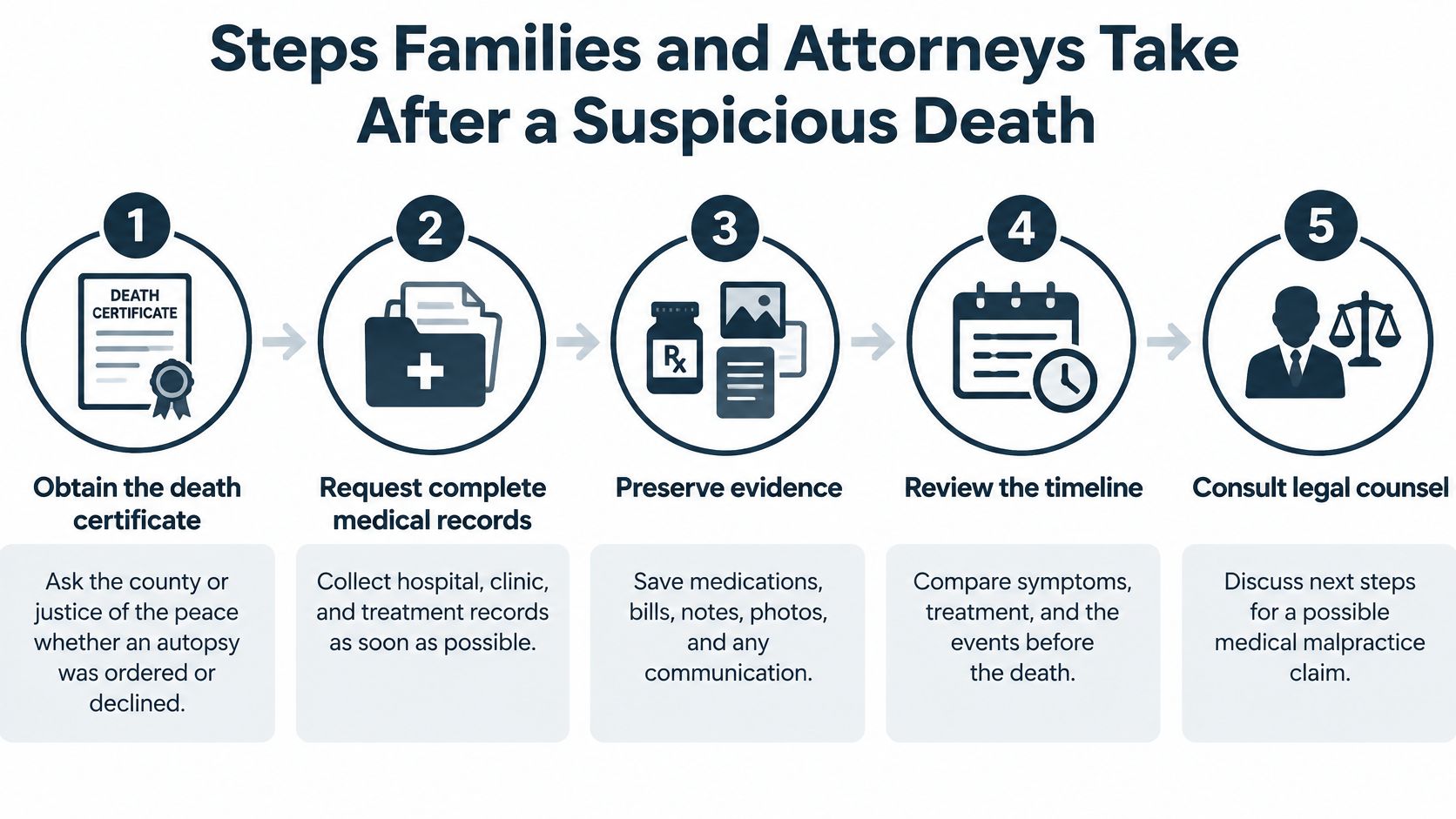
Early steps protect both legal deadlines and medical evidence. The order matters because authorization, county jurisdiction, and preservation decisions may need attention before burial or cremation. A short written log helps everyone track requests and responses.
The visual summary below outlines the first actions families usually take while counsel reviews the legal dates.
A Practical Sequence
- Obtain the death certificate and ask about county action. Ask the county or justice of the peace whether an autopsy was ordered or declined. Under Texas Code of Criminal Procedure Chapter 49, a justice of the peace may obtain an opinion from a county health officer or physician about whether an autopsy is necessary. Counties that need examination support use County Forensic Autopsies through the applicable county process.
- Request complete medical records from every provider. Include hospitals, urgent care, outpatient clinics, imaging, labs, prescriptions, and patient portal messages. Summaries often omit result times, acknowledgment notes, and follow up instructions that matter in a medical malpractice claim.
- Confirm who has authority. A private autopsy is authorized by the legal next of kin or their designated representative. Confirming authority early prevents delay when time, transport, and funeral arrangements are already pressing.
- Ask for preservation of tissue and samples. Request retention of tissue, slides, and toxicology samples where available. Samples that aren't collected or retained can't be tested later.
- Keep a written chain of custody. Document transfers of remains, samples, imaging, and records. Dates, names, and receiving locations should be recorded at each step.
- Consult a malpractice attorney promptly. Counsel should calendar notice and limitations dates from the earliest possible start date. Law offices managing record collection and deadline tracking sometimes use a law firm virtual assistant for administrative support, while legal decisions remain with the attorney.
- Request the complete written report and control distribution. Decide who may receive the report, records, and expert opinions. Clear control avoids confusion among family members, counsel, insurers, and providers.
Common slips include waiting for a county decision before acting, letting record requests lapse, and assuming a declined county case means no examination is possible. When a case has been declined by a county, we can still examine the body and explain the findings to the family. A county decline addresses public jurisdiction. It doesn't remove the family's option to seek an independent autopsy.
The short video below adds a visual overview of how an independent examination is arranged and explained to families.
At the end of this process, a complete file should contain the death certificate, county decision, complete records, imaging, medication list, authorization forms, chain of custody log, autopsy report, lab results, and a dated timeline. That file lets counsel and experts assess duty, breach, causation, and damages from evidence rather than recollection.
Request an Independent Review Before Deadlines Pass
If a death raises a specific question about care, request an independent review before notice and filing deadlines run and before records or remains change. Preserve evidence and build the timeline first. Then arrange a private autopsy services Texas review or a second opinion autopsy review of prior reports and medical records. Families weighing that choice can read our discussion of whether to get a second opinion before deciding.
Every examination is performed by a forensic pathologist certified by the American Board of Pathology. A private autopsy is authorized by the legal next of kin or designated representative. Our team serves families, attorneys, and county officials across Texas from Elgin, with direct communication throughout the process.
The $5,795 price covers the full examination by a board certified forensic pathologist, histology and laboratory analysis by Clinical Pathology Laboratories, a complete written autopsy report, a personal consultation, direct coordination with the funeral home, and transportation within 40 miles of Elgin, Texas. Payment plans are available for private autopsies. Pricing and scope are explained in full at intake.
Call (806) 230-1889 or use the contact page to discuss authority, timing, records, and transport. We understand this decision comes during grief. It belongs to the family, and no examination or review can promise a particular finding or the outcome of any claim.
Texas Autopsy Services provides independent autopsy examinations and second opinion reviews that clarify cause of death and document pathology relevant to a potential medical malpractice claim. Our board certified forensic pathologists serve families, attorneys, and Texas counties with direct communication, complete written reports, and full chain of custody documentation. Visit Texas Autopsy Services to request confidential guidance on the next step.