November 7, 2026 · Texas Autopsy Services
Medical Expert Witness: Role, Qualifications and Testimony
Learn what a medical expert witness does, the qualifications courts check, how opinions are built and what testimony in court involves.
On this page
You may have a death certificate, hospital records, and an autopsy report, yet still lack a clear explanation of how the findings fit together. An attorney may need to know whether those records support a legal claim. A family may want to understand what happened without being given more certainty than the evidence allows.
At Texas Autopsy Services, our approach starts with a distinction: an expert's credentials establish relevant qualifications, but documented reasoning establishes the basis for an opinion.
- Expert testimony explains evidence. It doesn't replace missing observations or decide the case.
- Reliable opinions show their work. Readers should be able to trace conclusions to records, testing, and medical reasoning.
- Records-only reviews have boundaries. A reviewer can evaluate documented findings but can't recreate evidence that was never collected.
- Independence includes uncertainty. An ethical expert identifies what remains unknown, even when a definite answer would be easier to hear.
What a Medical Expert Witness Does in a Case
A medical expert witness is a physician or other qualified specialist who gives opinion testimony to help a judge or jury understand medical evidence. The expert's task is to explain specialized information, not to advocate for a preferred outcome.
A fact witness describes what they observed. For example, a treating physician may describe a patient's symptoms and treatment, while an expert interprets the records and evaluates what those observations support. Like a navigator reading charts for the court, the expert may explain the route without having sailed the ship.
Expert evidence appears in medical malpractice, personal injury, wrongful death, probate, insurance, and criminal matters. A forensic pathology expert addresses postmortem questions, including cause and manner of death.
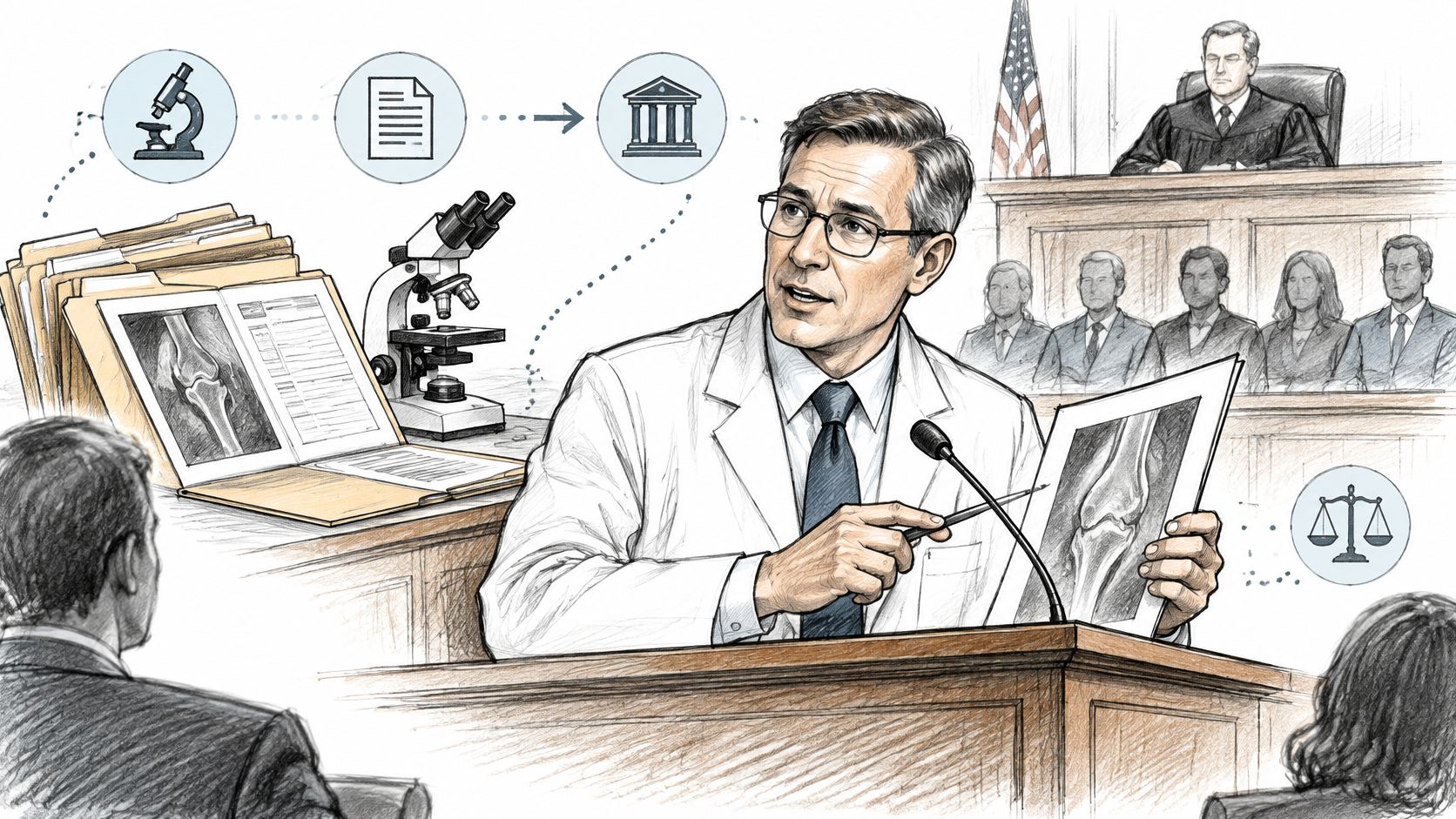
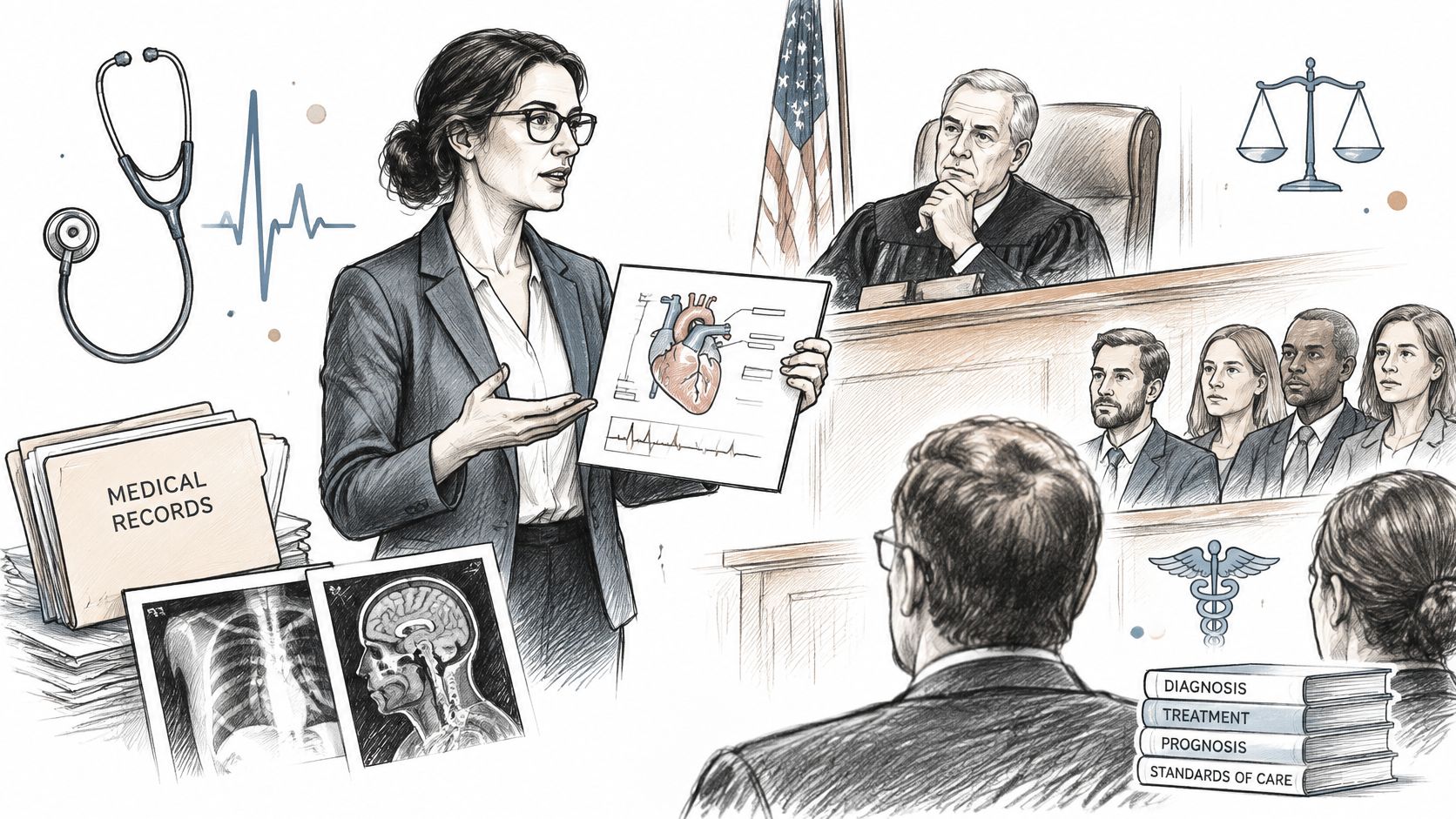
The courtroom illustration shows this explanatory role.
The judge's gatekeeping responsibility
As the Harvard Law Review account of Federal Rule of Evidence 702 explains, Daubert v. Merrell Dow Pharmaceuticals, Inc. in 1993 established the judge's gatekeeping role for scientific testimony, and Kumho Tire Co. v. Carmichael in 1999 extended that responsibility to technical and other specialized testimony. The reliability considerations include:
- Testing: Can the method be tested, and has anyone tested it?
- Peer review: Has the method undergone professional review and publication?
- Error and standards: What errors are possible, and what controls govern the work?
- Acceptance: Does the relevant scientific community generally accept the method?
Texas state courts apply Texas Rule of Evidence 702 and the Texas Supreme Court's decision in E.I. du Pont de Nemours and Co. v. Robinson, which established a similar gatekeeping responsibility. Counsel should identify the standard governing the particular proceeding.
Practical rule: A long résumé doesn't make every opinion admissible. The court examines the reasoning behind the specific conclusion.
Qualifications Courts Check Under Rule 702
Rule 702 requirements and the evidence courts look for
| Requirement | What It Means in Practice | Evidence the Court Looks For |
|---|---|---|
| Qualifications | Knowledge, skill, experience, training, or education relevant to the question | Relevant training, board certification, and case experience |
| Helpfulness | Testimony helps the judge or jury understand a disputed fact | An opinion tied directly to the issue in the case |
| Sufficient facts or data | The opinion rests on an adequately developed case file | Autopsy report, histology, toxicology, imaging, and medical records |
| Reliable methods applied reliably | Sound methods are applied to this case's facts | Documented reasoning, stated limits, and alternative causes considered |
The published federal Rule 702 text connects qualifying knowledge, skill, experience, training, or education with helpful testimony, sufficient supporting information, and reliable methods applied to the case. These aren't interchangeable strengths. Extensive training cannot compensate for an opinion based on inadequate evidence.
Under the current federal rule, the party offering the testimony must establish the admissibility requirements by a more likely than not standard. That concerns whether the testimony meets the admission requirements, not whether the expert's preferred explanation automatically decides the lawsuit.
Matching the specialty to the question
Forensic pathology concerns the investigation of sudden, unexpected, suspicious, and violent deaths, along with other legally defined categories. The American Board of Pathology certification description identifies a one-day, computer-based forensic pathology examination with written, practical, and virtual-microscopy sections, supported by qualifying education and verified competency for practice without direct supervision.
General medical training and forensic pathology certification aren't equivalent. Nor does expertise in death investigation necessarily qualify someone to address every treating specialty's standard of care. The question should match the expert's actual field.
At our practice, every examination is performed by a forensic pathologist certified by the American Board of Pathology. We attribute the work to our team rather than using an individual's reputation as a substitute for explaining the evidence.
A meaningful qualification review therefore asks two different questions: Does this person have relevant expertise, and does this particular opinion meet the evidentiary standard? Both need an answer.
How an Expert Opinion Is Built Step by Step
We build an expert opinion through an ordered review, not by selecting a conclusion and searching for support. Another qualified reviewer should be able to understand the materials, assumptions, and reasoning that produced the result.
The current federal Rule 702 and its amendment notes make that connection important: the 2023 amendment emphasizes that an opinion must remain within what the methodology can reliably support. An uncertain finding shouldn't become an absolute conclusion merely because it appears in a signed report.
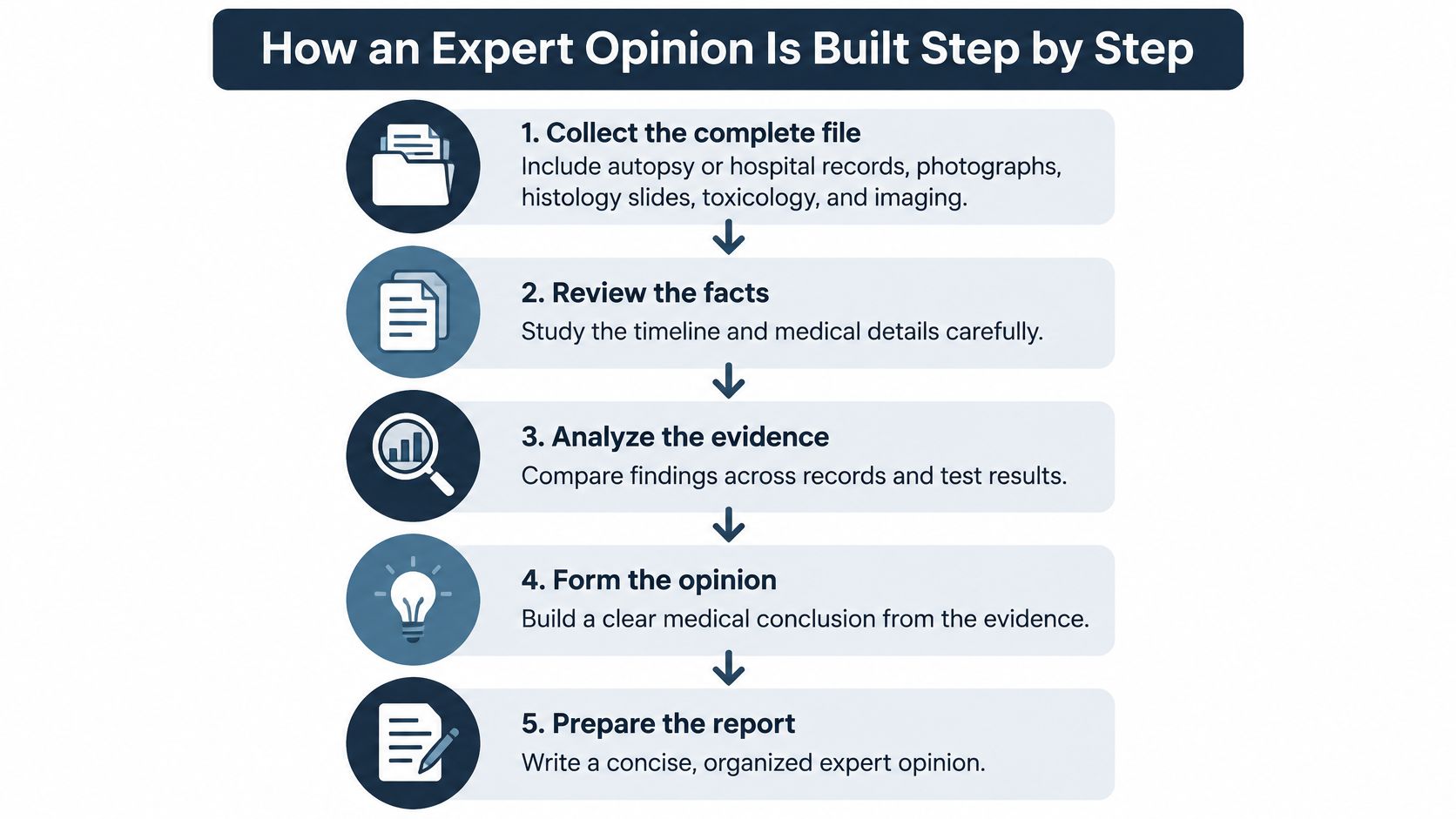
The overview below groups the work into broad stages; the numbered workflow makes the documentation tasks more specific.
From collection to interpretation
Collect the complete file. Obtain autopsy or hospital records, photographs, histology slides, toxicology, imaging, and scene information. A death certificate or summary can identify the recorded conclusion without showing how anyone reached it.
Create a materials-reviewed inventory, with each item's date and source. This allows counsel and the court to identify what was available when the opinion was formed and what remains missing.
Separate observations from interpretations. A documented fracture is an observation; an explanation of how it occurred is an interpretation. Keeping those categories distinct prevents an assumption from being repeated as though someone directly observed it.
Test plausible alternative explanations and record why each was accepted or set aside. For example, a substance detected after death should be evaluated alongside medical history, other findings, and the circumstances, rather than treated as automatically decisive.
Grade the strength of each conclusion. Terms such as established, strongly supported, compatible with, and not supported can communicate different evidentiary strengths when the report explains their meaning. The expert should also identify evidence that could change the assessment.
Write the report with separate headings for cause, mechanism, manner, and contributing conditions. Separating these findings helps readers distinguish the initiating disease or injury from the bodily process and surrounding circumstances.
Terms that shouldn't be used interchangeably
Cause of death is the disease or injury that started the fatal chain of events. Mechanism of death is the physiological process through which death occurred, such as loss of blood circulation following an injury.
Manner of death classifies the circumstances as natural, accident, suicide, homicide, or undetermined; pending indicates that the determination isn't complete. Contributing conditions are other conditions that played a role without being the initiating cause.
Chain of custody is the documented trail of who collected, handled, transferred, and received a specimen. We use accredited forensic laboratories for specimen analysis, but laboratory quality doesn't eliminate the need to verify specimen identity and handling.
A test can establish a finding without establishing its importance to the death. The report must explain that additional reasoning.
These definitions are educational. A case-specific determination requires examination of the available postmortem evidence and circumstances.
Judging an Opinion Based on Records Alone
Opinion bases and what each can support
| Basis for the Opinion | What It Can Support | Main Limit |
|---|---|---|
| Firsthand autopsy by the expert | Cause, mechanism, and manner when supported by directly observed findings | Preservation, sampling, and documentation restrict what can be established |
| Independent review of prior autopsy materials | Whether original findings are supported by the record | Cannot add findings never recorded or sampled |
| Medical-record review only | Whether the clinical timeline is consistent with the conclusion | No direct examination of the body |
| Toxicology interpretation | Whether substances were present at levels relevant to death | A result alone doesn't prove cause of death |
| Postmortem imaging without dissection | Possible injuries or anatomical findings | Doesn't resolve questions requiring tissue examination or dissection |
A records-only opinion can be valuable even when no new private examination occurred. The important distinction is between independently reviewing evidence and independently observing the body. Our guide to medical-record review for law firms addresses the preparation needed for that type of assessment.
A peer-reviewed clinical diagnostic review published in 2024 examined 952 clinical cases, finding a true change in final diagnosis in 17%, while 83% did not change. This concerns clinical diagnostic review, not legal expert testimony, so it isn't an estimate of autopsy error or litigation outcomes.
Audit the file before accepting the conclusion
- Original documentation: Are photographs, specimen descriptions, histology, toxicology, imaging, and retained-tissue information available?
- Evidence identity: Are specimen labels, transfers, and chain-of-custody records documented?
- Missing information: Does the reviewer name gaps rather than assume normal findings?
- Separate conclusions: Does the report distinguish cause, mechanism, and manner rather than combine them into one unsupported statement?
A 2025 academic review in Military Medicine reported about 860 practicing forensic pathologists in 2024, compared with approximately 1,400 needed for medicolegal death investigations. That shortage can increase reliance on outside review and makes clear documentation especially important.
Under Texas Code of Criminal Procedure Chapter 49, a justice of the peace may direct a physician to perform an autopsy or certify that none is necessary, and may instead order fluids, tissues, or organs removed for testing. A limited investigation can therefore leave questions that a later reviewer must explicitly acknowledge.
When a county declines a case, we can still examine the body and explain the findings to the family, subject to appropriate authorization and practical circumstances. The key question for any review remains: What additional evidence would materially change this opinion?
Confirming and Retaining an Expert
Selecting an expert works like selecting a specialist physician: the right choice depends on the question that needs answering. A forensic pathologist qualified to explain cause and manner of death may not be the right witness for a dispute about surgical technique or nursing care. Define the contested question first, then evaluate candidates against it.
Confirmation checklist
- Verify specialty certification. Confirm the relevant credential through the American Board of Pathology or the applicable specialty board.
- Review testimony history. Request prior testimony information and any court rulings that excluded or limited the expert's opinions.
- Read a sample report. Look for findings stated separately, a complete materials list, reasoning explained step by step, and limits stated candidly. The report reveals how the expert reasons in ways a résumé cannot.
- Test independence. Ask what evidence would weaken the proposed interpretation, and listen for whether the expert has already weighed it.
- Clarify the assignment. An initial consultation, a written opinion, a deposition, and a trial engagement each carry different preparation and cost.
- Match the review to the materials. When a case calls for examining an existing file rather than performing a new examination, ask how the expert separates what the records establish from what they leave unresolved.
Retention and preservation
Begin with a conflict check covering the parties, institutions, and relevant prior engagements. An engagement letter should then define the questions the expert will address, the fee structure, how communications will work, and who supplies the records.
Send the complete file rather than a selected summary, and ask which findings the expert can verify independently against source material. Agree on realistic deadlines for the report and any deposition, leaving room for missing materials or additional testing.
Counsel should issue jurisdiction-specific instructions on preserving notes, drafts, communications, slides, tissue, and digital records. Early involvement helps identify evidence that might otherwise become unavailable, though it never replaces consent, custody, or disclosure requirements.
Independence safeguard: Confirm in writing that payment is not contingent on a favorable opinion, settlement, or verdict.
Understanding fees
Many experts combine a retainer with hourly charges for file review, conferences, report preparation, testimony, and travel. The 2024 SEAK Survey of Expert Witness Fees summary reports a $450 median hourly file-review rate among 1,633 experts across disciplines, a cross-specialty benchmark rather than a forensic-pathology-specific quotation.
Median expert witness fees by task
| Task | Median hourly rate | Scope |
|---|---|---|
| File review | $450 | Review of records and case materials |
| Trial testimony | $500 in the same 2024 SEAK survey | Time spent testifying in court |
Fees differ by specialty, region, and assignment. Request written terms for minimum reservations, cancellations, travel, and testimony preparation instead of estimating total cost from a single hourly figure.
When a death investigation also involves collision reconstruction, LA Law Group, APLC's resource on budgeting for crash analysis experts can help counsel organize a separate technical budget. Reconstruction and medical causation remain distinct assignments even when both experts examine the same event.
What Expert Testimony Looks Like in Court
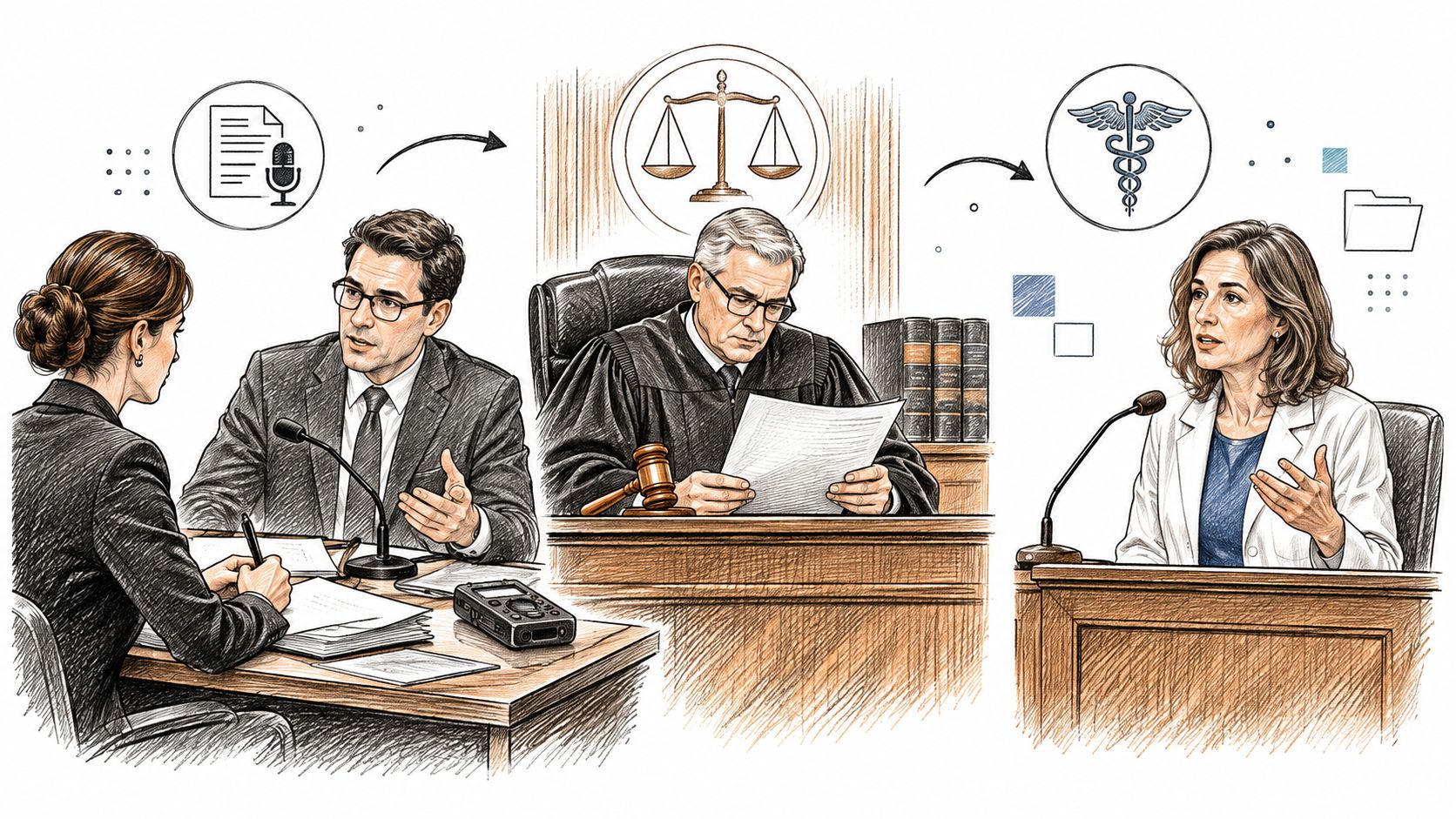
A typical case moves from detailed questioning outside the courtroom to a more structured explanation at trial. The exact order can change with the court's rulings and the parties' motions.
The illustration places the expert within that legal process.
The usual testimony sequence
- Deposition: Attorneys question the expert in a recorded session before trial. Our deposition preparation guide explains practical preparation.
- Admissibility hearing: If challenged, the judge considers whether the proposed opinion meets the governing evidentiary standard.
- Direct examination: The offering attorney develops the expert's qualifications, materials, methods, and conclusions.
- Cross-examination: Opposing counsel tests assumptions, omissions, alternative explanations, and inconsistencies.
- Redirect: The offering attorney may clarify matters raised during cross-examination.
In a Texas state proceeding, counsel applies the state evidentiary framework rather than assuming federal procedure governs. The expert's role remains to answer within the permitted scope.
An effective witness uses plain language, answers the question asked, and distinguishes known findings from assumptions. If a question falls outside the expert's field or the evidence cannot resolve it, the responsible answer identifies that limit instead of guessing.
The following video offers additional context for the discussion.
For families, legal questioning can feel different from a medical consultation. At our practice, the pathologist who performs the examination also writes the report and walks the family through the findings; families aren't handed off to a technician. We explain the results in plain language during the personal consultation.
Counsel should handle scheduling and attendance questions. Courts control their calendars, and deposition attendance arrangements can differ from those for public hearings.
Next Steps for Families and Attorneys
A case often reaches our desk while records are still incomplete and deadlines are already set. The right next step depends on the question: a private examination, a review of an earlier autopsy, or a county-authorized investigation.
From our Elgin, Texas facility, we serve all 254 Texas counties through Private Autopsies and County Forensic Autopsies. We provide court-ready forensic autopsies for justices of the peace, commissioners, medical examiner offices, and sheriff offices, and every examination is performed by a board-certified forensic pathologist.
Brief questions from families and attorneys
Who can authorize a private autopsy?
The legal next of kin or their designated representative authorizes it. If you are not certain you hold that authority, contact our team and we will walk you through it and help arrange the examination quickly.
Does an independent review guarantee a different answer?
No. It may support the original conclusion, identify uncertainty, or justify a different interpretation. An opinion's strength rests on its documented reasoning and stated limits, not on the outcome it produces.
How quickly will we hear findings?
Our team contacts the family with preliminary findings within 24 hours of the examination. Final conclusions depend on tissue processing, laboratory testing, and records access.
What should we send first?
Send the available file, an inventory of records held elsewhere, and the specific questions you need answered. When no new examination is performed, the review is judged the same way: by the reasoning documented in the report and the limits the expert states plainly. Our guidance on working with a medical malpractice lawyer may help organize legal questions, and Mediation & Negotiation Services (M&N) discusses medical malpractice settlement strategies for 2026 for readers weighing dispute-resolution options with counsel.
Autopsy authorization and disposition are separate matters under Texas law. We coordinate directly with the funeral home and handle in-house licensed transport, so families work with one team rather than several.
We offer independent postmortem examinations, second-opinion reviews, and forensic explanations grounded in documented evidence and clearly stated limits. Call our team directly at (806) 230-1889, or visit Texas Autopsy Services when you're ready to discuss the available records and the questions you need answered.