July 20, 2026 · Texas Autopsy Services
Medication History Review: Critical for Forensic Pathology
Our board-certified forensic pathologists provide thorough medication history review for critical context in Texas cause-of-death investigations.
On this page
Medication History Review in Forensic Pathology
- A medication history review is not a simple medication list. In a forensic case, it helps build the pharmacologic timeline around a death.
- One source is never enough. A Best Possible Medication History uses at least two independent sources to verify what was prescribed, dispensed, and on hand.
- Autopsy findings, records, and toxicology must agree or be reconciled. That tripartite review helps prevent an incorrect cause-of-death conclusion.
- Texas law matters. Consent, records handling, and chain of custody all affect whether findings are reliable and usable.
- Families and attorneys often need the same thing. Clear facts, careful documentation, and an objective explanation of what the records do and do not show.
A family may arrive with a pill organizer, a discharge summary, and a firm belief that they already know what happened. An attorney may arrive with the same confidence, but from the opposite direction, focused on whether a medication error, overdose, or missed interaction played a role. In both situations, the medication history review often changes the frame of the case.
A decedent might have a valid prescription on record, but the timing, refill pattern, scene evidence, hospital charting, and toxicology may tell a different story. A medication may be present in the body but not listed in the chart. A drug listed in the chart may not have been taken as prescribed. Those details matter because cause of death is a medical conclusion, not an assumption.
An Essential Step in Determining Cause of Death
A medication history review becomes critical when the known story and the documented story don't match. A person may be reported as stable, compliant with treatment, and only taking a few routine prescriptions. After records are gathered, the case may instead show recent dose changes, multiple prescribers, missed fills, or medications at the scene that never appeared in the chart.
That gap is common enough that it cannot be treated as a minor recordkeeping issue. Reliance on physician-acquired histories alone is often insufficient, because discrepancies between those histories and more detailed histories occur in up to 67% of cases according to a review published through the National Center for Biotechnology Information. In practice, that means a forensic opinion can be weakened if it depends on a single intake note or one hospital medication list.
More than a prescription list
In forensic pathology, a medication history review is the systematic collection and analysis of a decedent's full medication picture. That includes prescribed drugs, over-the-counter products, supplements, recently changed therapies, controlled substances, and evidence that the person may not have taken medications as directed.
It also includes what was available to the decedent. Pill counts, refill timing, medication administration records, nursing notes, and family observations may all speak to use, non-use, or irregular use.
A medication record can look complete and still be wrong for the purpose that matters most, which is explaining the death accurately.
For grieving families, this review often answers a painful question. It helps explain whether a medication likely contributed, whether a treatment gap mattered, or whether a drug that initially seemed suspicious was probably incidental. For attorneys, it helps separate documented fact from assumption.
When legal review is underway after a death, families sometimes also need counsel on the civil side. In that setting, a Houston wrongful death lawyer may help evaluate how medical records, timing, and expert findings fit into a broader claim. That legal role is separate from the forensic role, but both depend on the same foundation. Accurate facts.
Plain-language definitions
A few terms help frame why this process matters:
- Cause of death means the disease or injury that started the fatal chain of events.
- Manner of death means the classification of the death, such as natural, accident, suicide, homicide, or undetermined.
- Chain of custody means the documented handling of evidence and records so their integrity can be shown later.
Without a sound medication history review, each of those conclusions can become less reliable.
Building a Best Possible Medication History
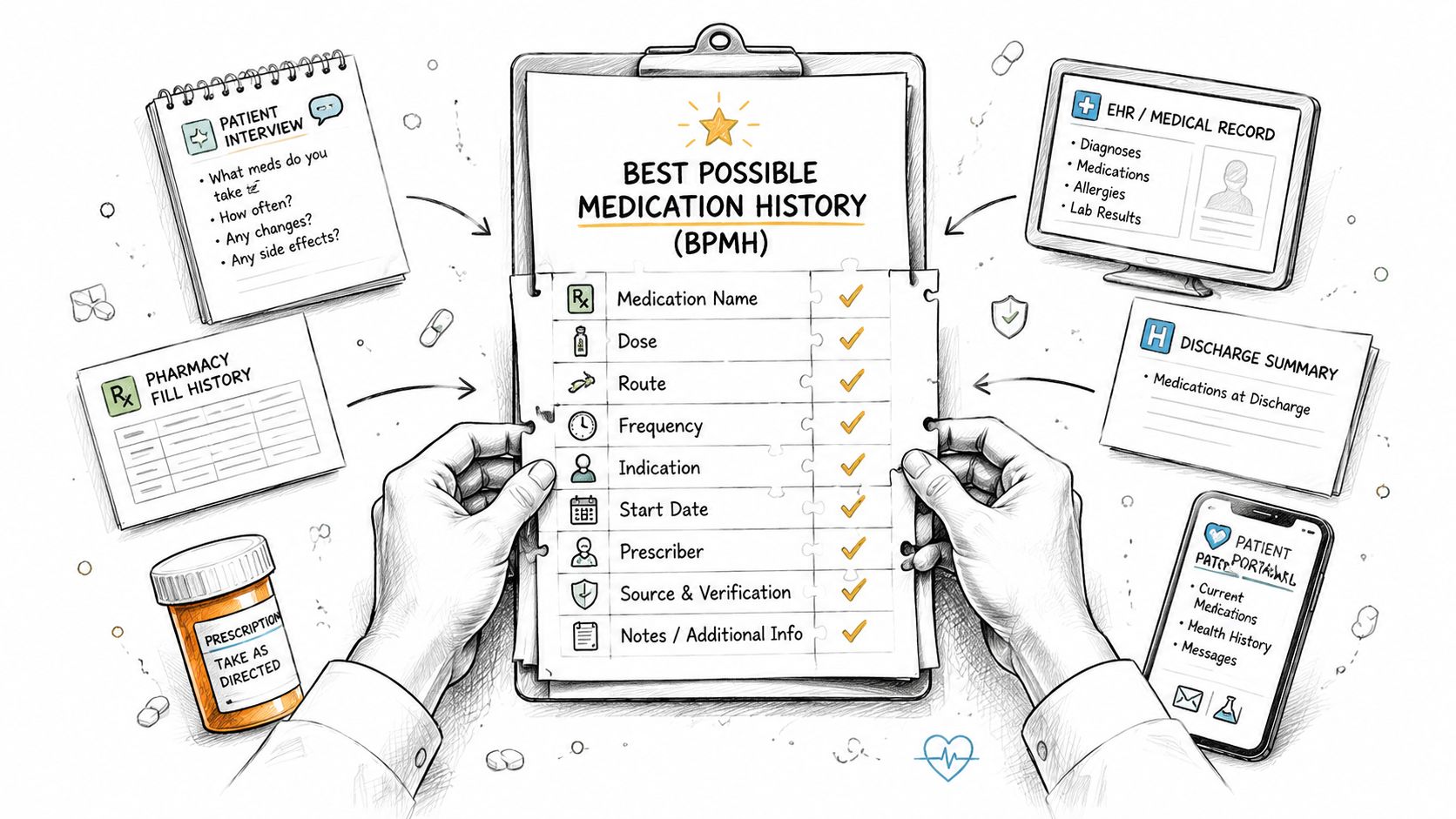
A forensic review has to work from a higher standard than a routine intake list. The benchmark is the Best Possible Medication History, often shortened to BPMH. It is defined as a complete and accurate medication list generated using at least two independent sources of information, such as a patient interview combined with pharmacy dispensing records, as described in this BPMH reference through the National Center for Biotechnology Information.
What BPMH means in a forensic setting
In a hospital, the immediate goal may be safe treatment. In a forensic autopsy, the goal is different. We need to establish what substances were likely present, available, prescribed, administered, or omitted, and then compare that information with the body, the scene, and the laboratory evidence.
That distinction matters because a chart can reflect intent rather than reality. A physician order shows what was prescribed. A pharmacy record shows what was dispensed. A medication administration record may show what staff documented as given. None of those alone proves what the decedent ingested or absorbed.
For attorneys and clinicians interested in the broader safety side of the issue, resources on preventing medication errors in practices can be useful because they show why reconciliation failures begin long before a case reaches autopsy. In forensic work, however, the standard has to go further. We are not just trying to avoid future error. We are trying to reconstruct a past event accurately.
What works and what does not
The methods that work are disciplined and repetitive.
- Cross-checking sources matters more than trusting the neatest record.
- Timeline building often reveals the key issue. Fill dates, discharge dates, dose changes, and collapse timing rarely make sense until they are placed in order.
- Looking for non-prescribed substances is essential. Supplements, borrowed medications, and leftover drugs can change the interpretation of toxicology.
- Screening for adherence gaps is often where the record becomes most informative. A listed medication is not the same as a taken medication.
What does not work is relying on a single summary page, a family recollection without verification, or an electronic medical record list copied forward from visit to visit.
Practical rule: the more important the drug is to the death question, the less acceptable it is to rely on one source.
Our pathologists follow the same logic discussed in our review of analysis of medical records. A forensic opinion becomes stronger when each medication conclusion can be traced to independent documentation instead of assumption.
A short explanation of BPMH methods can also help non-medical readers visualize the process:
In practice, the review is not a hunt for a single dramatic answer. It is a careful effort to build a pharmacologic narrative that can either support or challenge the apparent explanation of death.
Sources We Consult to Ensure Accuracy
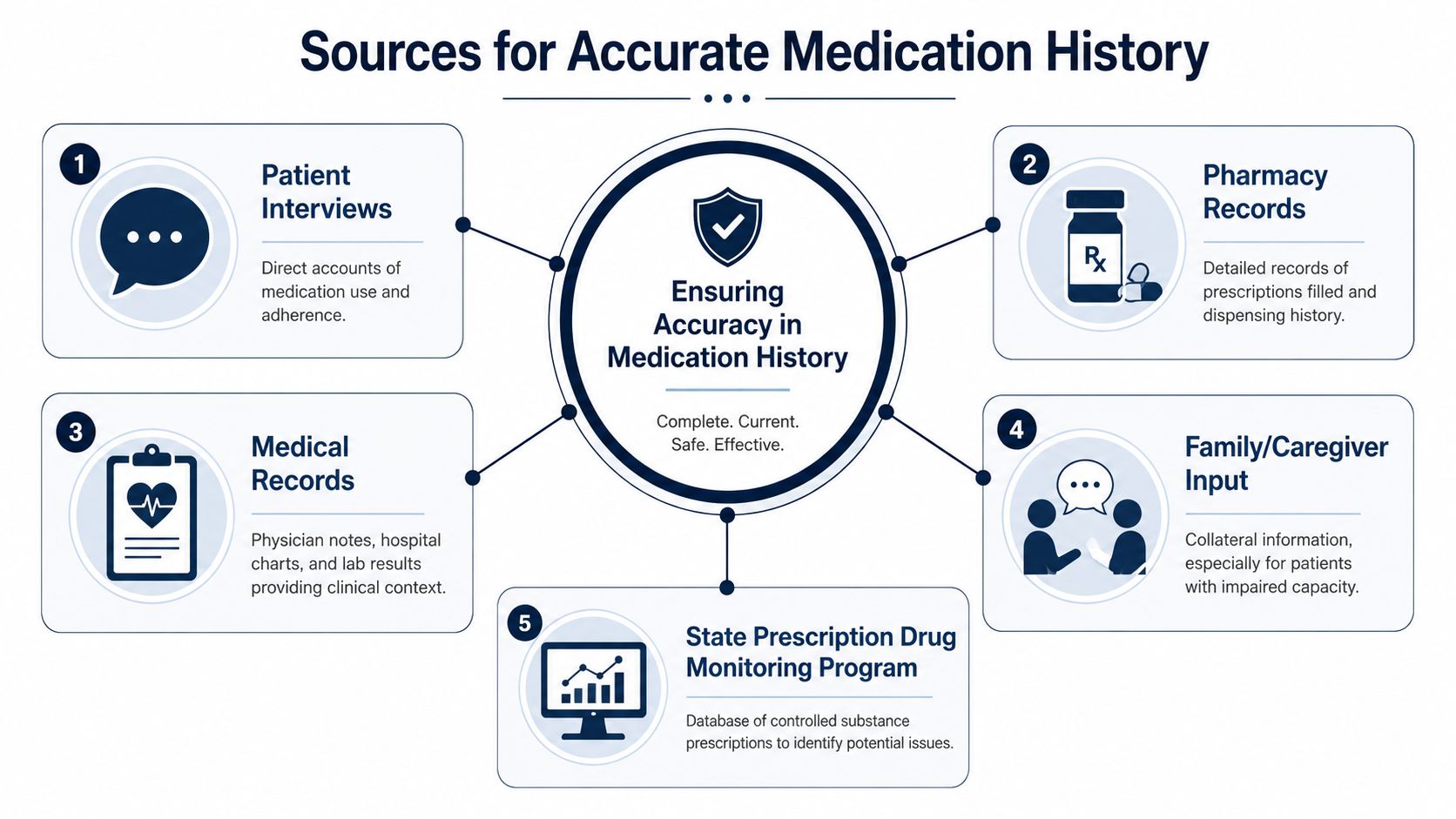
No single source gives a full answer. Each record type has strengths, blind spots, and a different legal or medical significance. The work is in comparison, not collection alone.
Hospital and clinic records
Hospital records provide clinical context. They show diagnoses under treatment, medication orders, allergies, recent admissions, discharge instructions, nursing observations, and medication administration records. They can also reveal whether a symptom was recognized before death and whether treatment changed in response.
Their limitation is that they often contain copied-forward lists. A medication can stay on the chart long after it was stopped, changed, or never taken consistently. That is why these records are starting points, not final answers.
Pharmacy dispensing records
Retail and mail-order pharmacy records are often the backbone of medication verification. They can show the drug name, strength, quantity, prescriber, and dispensing date. That information helps establish access and timing.
A dispensing record still has limits. It shows what was filled, not what was swallowed, injected, or refused. It may also miss samples, cash transactions at another pharmacy, medications obtained from relatives, or products bought over the counter.
We treat pharmacy data as evidence of availability. We do not confuse availability with actual use.
Prescription drug monitoring data
State prescription drug monitoring data is particularly useful when controlled substances are part of the case. It can identify prescribing patterns, overlapping opioid or sedative prescriptions, and the presence of controlled medications that may not appear clearly in ordinary chart review.
This source is valuable, but it is not universal. It does not replace toxicology, and it does not explain clinical intent by itself. It must be read alongside the medical chart, scene findings, and postmortem results.
Family, caregivers, and scene information
Family members, caregivers, and close contacts can identify practical details that records miss. They may know where medications were kept, whether a decedent resisted taking them, whether recent confusion affected dosing, or whether supplements and sleep aids were used without being reported.
These interviews are important, especially when the decedent was incapacitated before death or cannot speak for obvious reasons. But memory has limits. Grief, stress, and incomplete knowledge can affect accuracy.
A useful comparison comes from work outside medicine. Professionals involved in locating individuals or reconstructing missing background facts, such as tracing agents in the UK, also depend on corroboration across separate records rather than trusting one witness account. Forensic pathology applies the same discipline to medication reconstruction.
How we reconcile conflicting sources
When sources conflict, we do not force an answer too early. We rank the records by what they prove.
| Source type | What it can show well | Common limitation |
|---|---|---|
| Hospital chart | Clinical context and documented treatment | May contain outdated medication lists |
| Pharmacy record | Dispensed medication and timing | Does not prove ingestion |
| PDMP data | Controlled substance prescribing history | Limited to monitored drugs |
| Family interview | Daily use patterns and adherence concerns | Memory may be incomplete |
| Scene evidence | Physical availability of medications | May not show long-term pattern |
A careful medication history review often depends on that tension. The contradictions are not noise. They are often the part of the case that matters most.
How Medication History Informs the Autopsy Report
A medication history review matters because it changes what the pathologist looks for, what the laboratory tests prioritize, and how the final opinion is written. In a forensic autopsy, the medication history review, physical autopsy findings, and toxicology results form a tripartite verification process, as discussed in this review of medical records analysis in forensic cases.
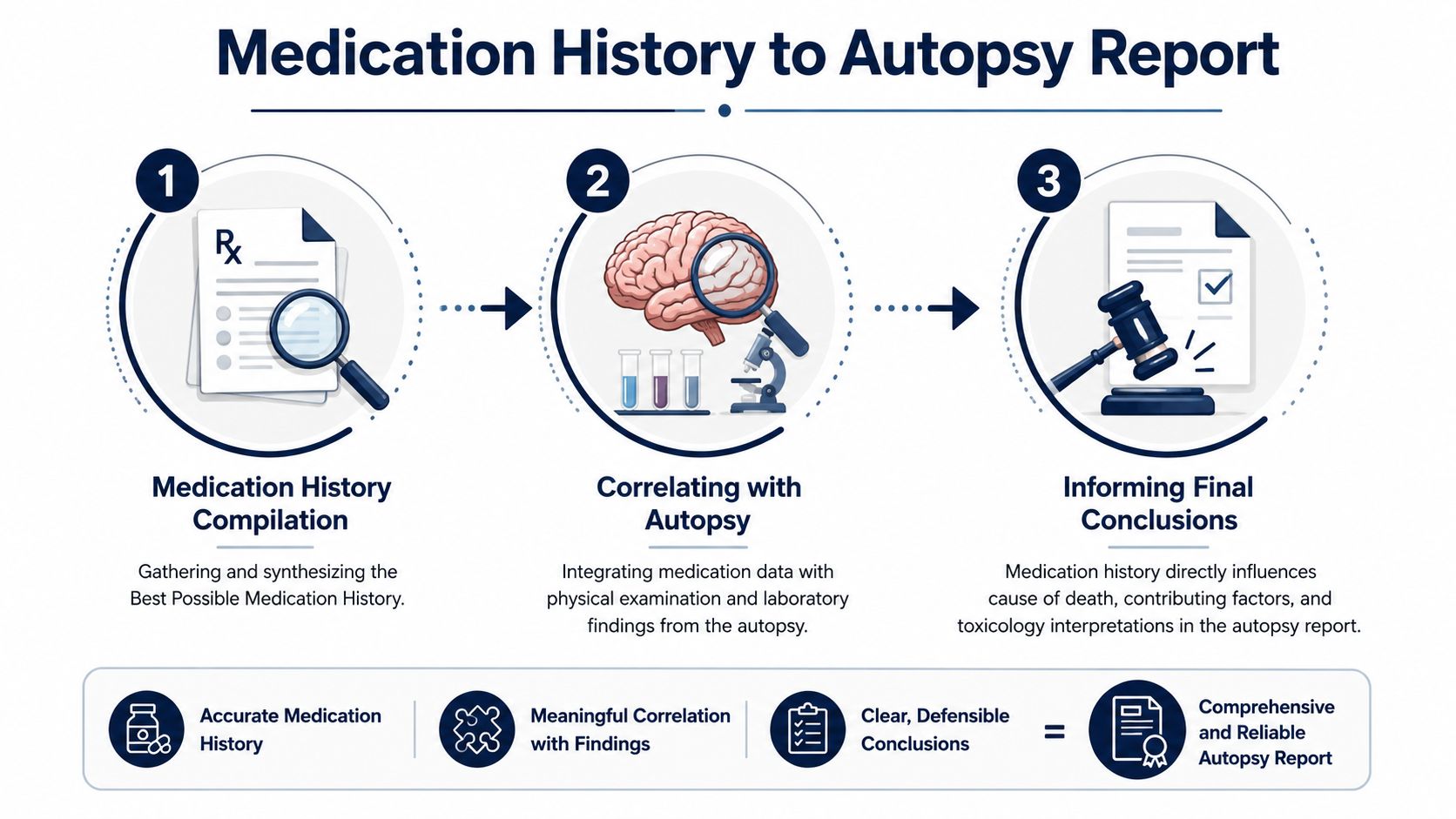
Records guide the examination
The medication history shapes the physical examination from the start. If the records show treatment for heart disease, the heart and vascular findings may take on added significance. If the history suggests recent anticoagulant use, bleeding patterns may require closer correlation with records and toxicology. If insulin, sedatives, opioids, antipsychotics, or seizure medications appear in the history, the interpretation of scene findings and organ changes may shift.
This is one reason a private autopsy or second opinion autopsy cannot be reduced to anatomy alone. The body answers some questions, but not all of them. A pathologist has to know what clinical and pharmacologic questions the body is being asked to answer.
Toxicology answers a different question
Toxicology is not a substitute for medication history. It tells us what substances, metabolites, or classes of substances are present, but it does not automatically explain why they are present, whether they were prescribed, whether they were taken correctly, or whether the detected concentration was central to the death.
That is why medication review and toxicology must be interpreted together. A prescribed opioid found in toxicology can fit a lawful treatment pattern, a misuse pattern, or an unrelated background finding depending on timing, concentration, tolerance, co-ingested substances, and the physical findings.
Families and attorneys often benefit from a plain-language discussion of postmortem laboratory limits before conclusions are drawn. Our overview of post-mortem toxicology addresses that broader issue from the laboratory side.
Toxicology can confirm exposure. It does not, by itself, prove causation.
The final report must reconcile all three
The autopsy report must do more than list findings. It has to reconcile them. If the medication history suggests a dangerous interaction but the toxicology does not support significant exposure, that tension has to be addressed. If toxicology shows an unexpected drug, the report should consider whether it came from a prescription, a scene source, or an undocumented ingestion. If the body shows severe natural disease, the report must decide whether medication findings were causal, contributory, or incidental.
At this juncture, forensic pathology becomes interpretive rather than clerical. The final opinion should explain the relationship between the decedent's medical treatment, actual medication exposure, and the observed anatomic findings.
For families, that explanation often provides clarity. For attorneys, it creates a medically organized record that can be assessed for negligence, product issues, prescribing concerns, or defense against unsupported allegations. In either setting, the value lies in disciplined synthesis, not in any one isolated result.
Upholding Legal and Ethical Standards in Texas
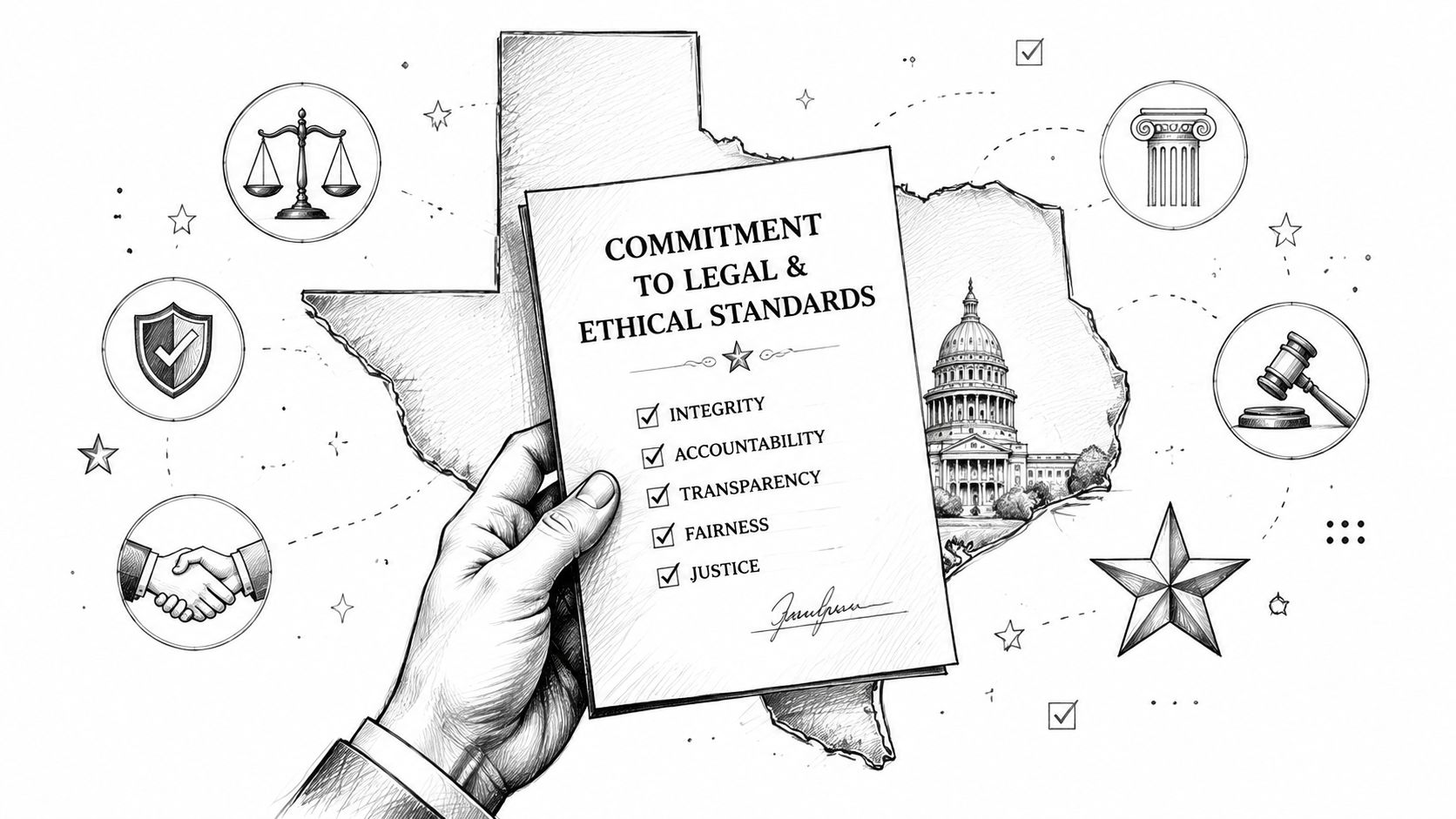
A medication history review has to be medically careful, but it also has to be legally defensible. If records are gathered casually, labeled poorly, or handled without documentation, even accurate information can become vulnerable to challenge later.
Why chain of custody matters
Chain of custody means the documented handling of records, specimens, and related evidence from collection through reporting. In a forensic matter, that protects both the integrity of the evidence and the credibility of the final report.
This is not bureaucracy for its own sake. It allows a court, agency, or reviewing expert to understand where information came from, who handled it, whether it was altered, and how it was incorporated into the opinion. Our overview of chain of custody procedures explains why this documentation is central to court-admissible forensic work.
Texas consent and compliance
Texas law and regulatory requirements affect when and how a private autopsy and related records review can proceed. The practice environment includes the Texas Health & Safety Code and the Texas Funeral Service Commission, along with the practical requirements of transport, authorization, document security, and release procedures.
A medication history review is not a side task. It is a mandatory component of a thorough forensic case analysis, where the data is synthesized with toxicology and histology to form an objective, science-based opinion on cause of death, as outlined in this discussion of the forensic pathology expert witness role.
For families, ethical practice also means clear communication. We explain what records are needed, what the records can and cannot answer, and why some conclusions remain limited until all sources are received. For attorneys, ethical practice means independence. A forensic pathologist should not shape an opinion to fit a theory. The opinion should follow the evidence.
Important point: a sound forensic report is persuasive because it is documented, not because it is forceful.
Every examination should also be performed by a board-certified forensic pathologist certified by the American Board of Pathology. That credential matters because medication review in a death investigation is not just chart reading. It is chart reading tied to postmortem examination, toxicology interpretation, and cause-of-death reporting.
Common Questions About the Review Process
Families and attorneys often ask practical questions first. Those questions deserve direct answers.
Who can authorize the review in Texas
In Texas, authority to consent to a private autopsy and its related medication history review follows a legal priority order that starts with the surviving spouse, as described in this explanation of Texas autopsy authorization and priority. If there is no surviving spouse, the authority moves according to the legally recognized order.
That matters because pharmacies, hospitals, and other record holders may require proof that the requesting party has the legal right to authorize release or review.
What if the records are incomplete
Incomplete records are common. That does not stop the review, but it does change how conclusions are stated. We compare what is available from hospitals, clinics, pharmacies, scene evidence, and collateral interviews. If a gap cannot be resolved, the report should identify it plainly rather than hide it.
A careful forensic opinion distinguishes between what is documented, what is strongly supported, and what remains uncertain. That distinction is often more useful than forced certainty.
Can the findings be used in litigation
Yes, they may be relevant in civil or criminal litigation if the records, specimen handling, and reporting are properly documented. Attorneys often need that documentation for a cause of death investigation involving alleged negligence, product issues, drug exposure, or disputed medical care.
What matters most is that the report remains objective. A useful expert opinion is not an argument dressed as medicine. It is a medical conclusion supported by identifiable records, examination findings, and laboratory evidence.
How long does this part of the process take
The timing depends on how quickly records are released, whether toxicology requires specialized testing, and how many sources must be reconciled. Some record collection begins immediately. Some elements take longer because outside institutions control access.
For the autopsy process itself, most cases are completed within 24 to 48 hours, but the full medication history review and final report depend on the complexity of the case and the speed of incoming records. No ethical forensic practice should promise a fixed timeline before those variables are known.
Families who need an overview of the broader private autopsy process can review the practice's page on Private Autopsies. Attorneys and county officials may also need different pathways depending on whether the matter is private, county-based, or a second opinion autopsy.
If your family, law firm, hospital, or county needs help understanding whether a medication history may affect a death investigation, contact Texas Autopsy Services. We serve all 254 Texas counties, and every examination is performed by a board-certified forensic pathologist. Our team explains the process in plain language, handles records and logistics carefully, and approaches each case with the objectivity, dignity, and respect it deserves.