June 15, 2026 · Texas Autopsy Services
Board Certification Requirements for Pathologists
Understand the board certification requirements for forensic pathologists. Learn about the rigorous education, training, and exams needed for certification.
On this page
- The Search for Answers and the Need for Trust
- What Board Certification Actually Means
- The Rigorous Pathway to Forensic Pathology Certification
- Understanding MD vs DO and Pathology Specializations
- Maintaining Certification A Commitment to Current Expertise
- How to Verify a Pathologist's Board Certification
- Why Certification Is Critical for Autopsy Services
- Frequently Asked Questions About Pathologist Qualifications
- Board certification is different from a medical license. A license allows a physician to practice medicine. Board certification shows advanced, specialty-specific training and successful passage of formal examinations.
- Forensic pathology requires a long training path. The value of that path is practical. It supports careful cause of death investigation, defensible opinions, and reliable testimony when cases reach court.
- Ongoing professional development matters. Certification standards increasingly focus on continued competence, not just initial training.
- Families, attorneys, and county officials can verify credentials. That step is appropriate when a death is disputed, unclear, or legally significant.
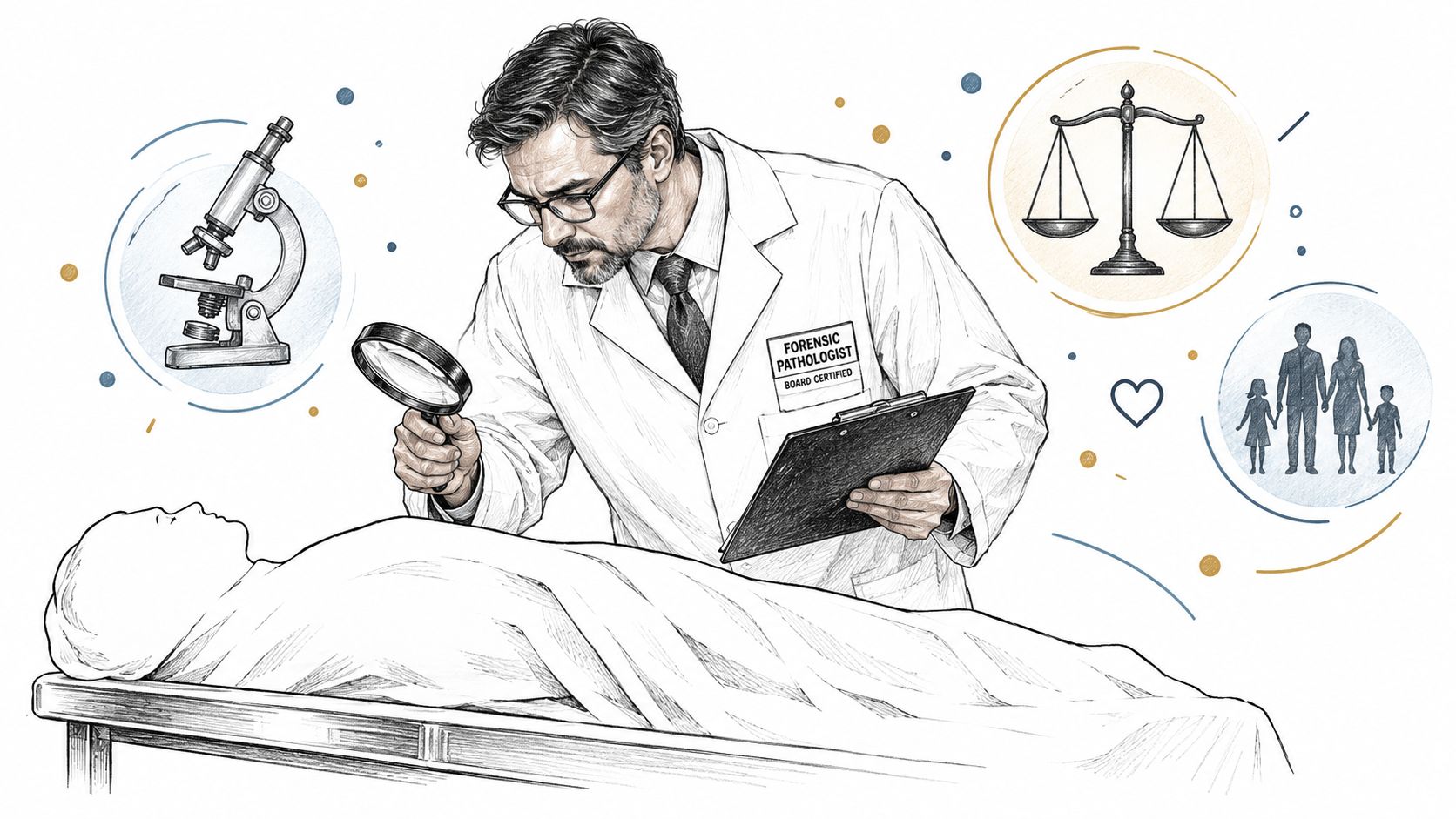
- Every examination we perform is handled by a forensic pathologist certified by the American Board of Pathology. That standard supports objectivity, accuracy, and court admissibility.
A family calls after an unexpected death. They've been told a cause of death may take time, and the wording in early records feels incomplete. An attorney may be looking at the same case from another angle, asking whether the medical findings will hold up under scrutiny. A county official may need an outside forensic autopsy because local resources are limited. In each situation, the same concern appears quickly. Who is qualified to answer the medical questions?
That concern is reasonable. In death investigation, credentials aren't just letters after a name. They affect how an examination is performed, how evidence is interpreted, how clearly findings are documented, and whether the final opinion can stand up in court. Those seeking a forensic pathologist are often trying to separate general medical training from the much narrower expertise required for medicolegal work.
The Search for Answers and the Need for Trust
When a death is sudden or disputed, people often hear medical terms before they understand what those terms mean. Cause of death is the medical reason a person died, such as a disease or injury. Manner of death is the classification used in death investigation, commonly natural, accident, suicide, homicide, or undetermined. Chain of custody means the documented handling of remains, specimens, and evidence so the record stays intact from collection through reporting.
Those definitions matter because autopsy work doesn't happen in a vacuum. A finding may shape a death certificate, an insurance dispute, a civil case, a criminal matter, or a county investigation. If the underlying medical opinion is weak, every later step becomes harder.
What people often need in this moment
Some families want an independent autopsy because the hospital explanation feels incomplete. Some attorneys need a second opinion that is medically grounded and clearly documented. Some counties need a specialist who can perform a forensic examination under proper legal and evidentiary safeguards.
Practical rule: In a cause of death investigation, claimed expertise is not enough. Qualifications should be specific, verifiable, and relevant to forensic work.
That's where board certification requirements become important. They help distinguish general medical training from specialty competence that has been formally assessed. In our field, that distinction affects not only medical accuracy but also whether conclusions are likely to be trusted by courts, agencies, and families who need a clear answer.
A medical degree alone does not tell a non-medical audience whether the physician has completed specialty training in pathology, whether that training was followed by subspecialty work in forensic pathology, or whether the physician passed the examinations tied to that field. Board certification helps answer those questions in a way that can be checked, not merely asserted.
What Board Certification Actually Means
A family may be told, “A doctor reviewed the case,” and assume that answer settles the question of expertise. In forensic pathology, it does not. For a death investigation in Texas, the difference between licensure, board eligibility, and board certification can affect how much confidence a court, agency, or family can place in the final opinion.
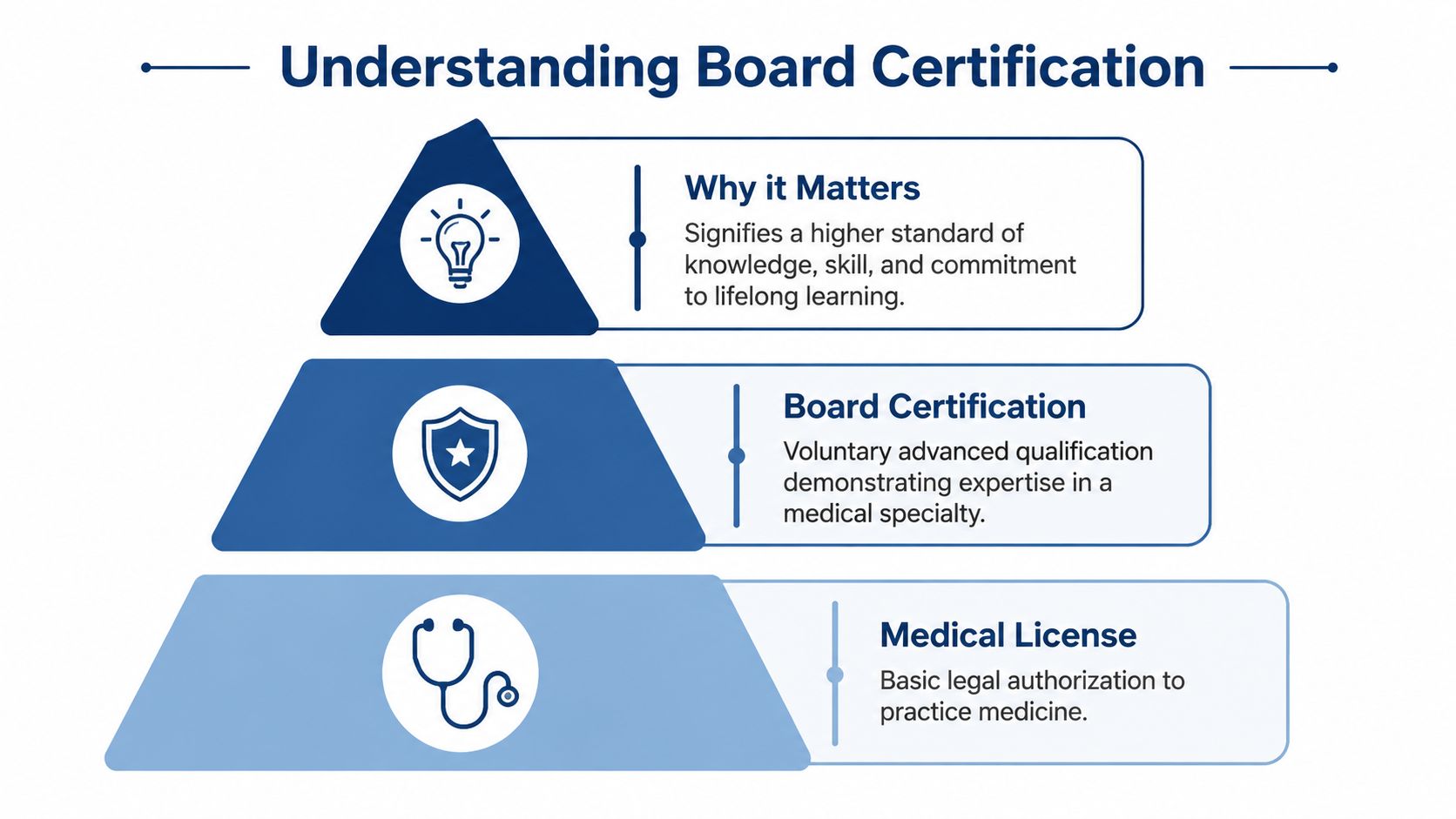
License, eligibility, and certification are not the same
A medical license gives a physician legal authority to practice medicine. It does not, by itself, show specialty training in pathology or subspecialty training in forensic pathology. Board certification is the credential that shows the physician completed that specialty path and passed formal assessment in the field.
That distinction matters because forensic opinions are used outside the hospital. They may be reviewed by law enforcement, probate courts, civil attorneys, criminal courts, insurers, and county officials. In those settings, the question is not only whether a physician is licensed. The question is whether the physician's training and testing are specific enough to support an objective, defensible cause-of-death opinion.
Here is the practical difference:
| Status | What it means | Why it matters |
|---|---|---|
| Medical license | Legal authority to practice medicine | Shows the physician may practice, but does not confirm specialty expertise in forensic death investigation |
| Board eligible | The physician has completed required specialty training and is within the period before final certification | Shows progress toward certification, but not successful passage of specialty-board exams |
| Board certified | The physician has completed training and passed specialty-board assessment | Provides stronger evidence that specialty knowledge has been independently tested |
For non-medical readers, the clearest way to view board certification is as verified specialty qualification, not a title a physician claims without earning. It reflects a sequence of accredited training, supervision, case experience, and examination. If you want a clearer picture of that educational sequence, our guide to the education required for a forensic pathologist explains how physicians reach this point.
Why the extra standard matters
In our field, the value of board certification is practical. It improves the reliability of autopsy findings by tying the physician's opinion to specialty training in disease, injury interpretation, postmortem examination, and medicolegal documentation. That training supports accuracy. The exam process adds external review. Together, they help protect objectivity.
Those protections matter in Texas, where an autopsy opinion may later be scrutinized in deposition or trial. Courts do not admit medical opinions solely because a physician offered them. The physician's qualifications, methods, and specialty background often become part of the dispute. A board-certified forensic pathologist starts from a stronger position because the credential shows the doctor met published standards in the relevant specialty.
There is also a human side to this. Families are often trying to answer basic but painful questions: What happened. Was something missed. Can this conclusion be trusted. Board certification cannot remove that grief, and it does not guarantee unanimity in every difficult case. It does show that the opinion comes from a physician whose forensic training and testing were built for this kind of work.
A licensed physician may have medical knowledge. A board-certified forensic pathologist has specialty qualifications that are more likely to withstand legal scrutiny and provide families with a clearer, more defensible answer.
The Rigorous Pathway to Forensic Pathology Certification
A Texas family may be waiting for answers after an unexpected death while attorneys, insurers, or county officials are asking a different question: will the medical opinion hold up under scrutiny. Board certification matters because it is the training path designed to answer both needs at once. It prepares a physician to reach an objective conclusion, document it carefully, and explain it in a way that can stand in court.
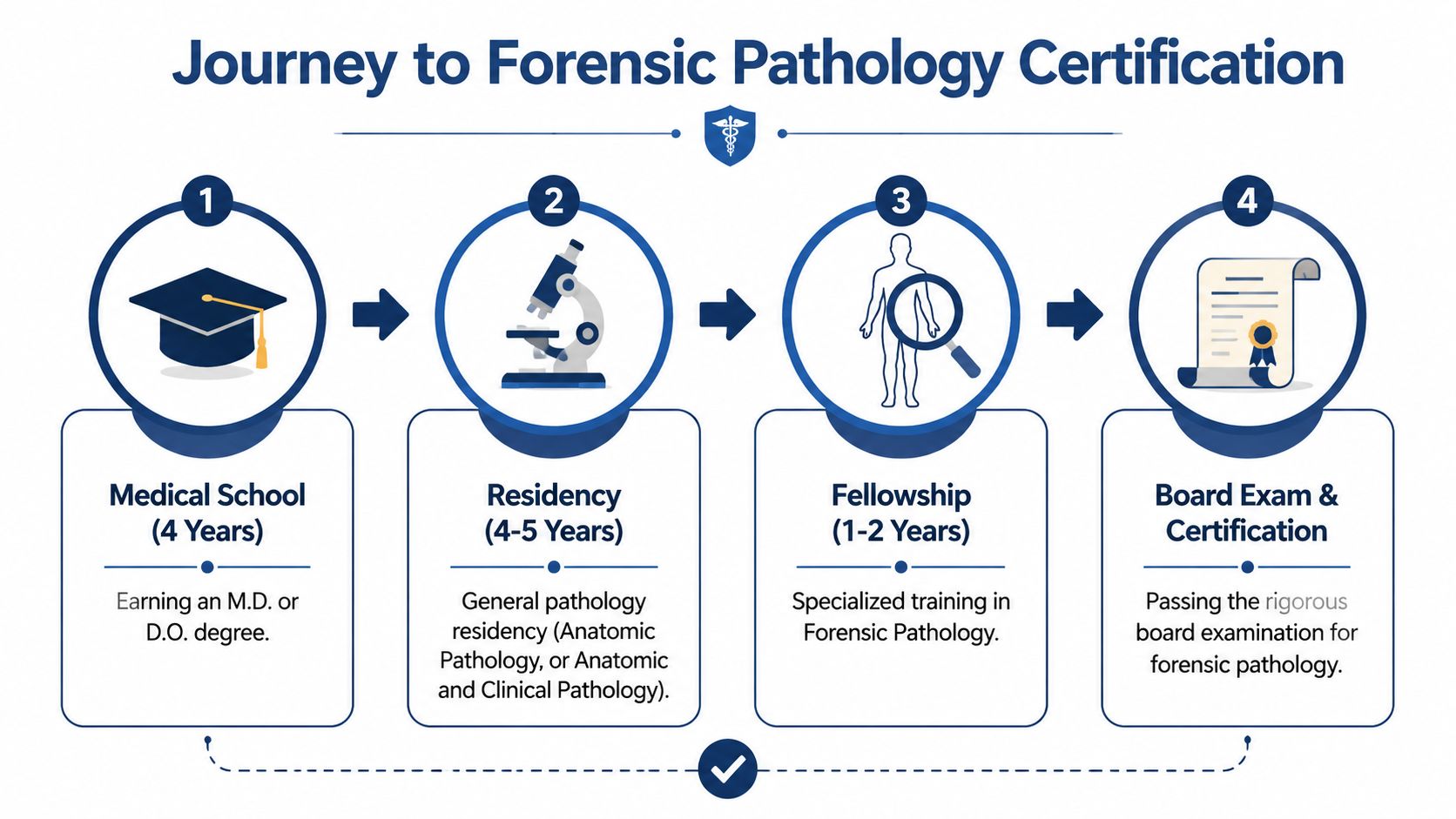
Training builds in layers
The route is long for a reason. A forensic pathologist does not begin with courtroom testimony or autopsy technique alone. The process starts with a broad medical education, continues through pathology residency, and then narrows into dedicated forensic pathology fellowship training. In practice, that means years spent learning how disease behaves, how injuries affect the body, how laboratory findings are interpreted, and how to separate sound conclusions from speculation.
Each layer adds a different safeguard.
Medical school gives the physician a full-body understanding of illness, injury, treatment effects, and the many ways those factors can overlap at the end of life. Pathology residency trains the doctor to diagnose by examining organs, tissues, laboratory data, and postmortem findings rather than by treating a living patient at the bedside. Forensic fellowship training then applies those skills to medicolegal death investigation, where scene information, records, toxicology, injury interpretation, chain of documentation, and testimony all matter.
For readers who want a fuller explanation of that sequence, our guide to the education required for a forensic pathologist explains each stage in plain language.
Why each stage matters in real cases
These requirements are not academic hurdles. They are quality controls that affect the reliability of the final opinion.
- Broad medical training: Helps the examiner recognize whether death is explained by natural disease, trauma, intoxication, medical treatment, or a combination of causes.
- Pathology residency: Builds skill in careful gross and microscopic examination, which reduces the risk of missing subtle disease or misreading postmortem changes.
- Forensic pathology fellowship: Trains the physician to connect autopsy findings with investigative records, scene facts, and legal standards, especially in disputed or high-scrutiny deaths.
- Board examination: Adds outside testing of whether the physician can apply the specialty's knowledge and methods, not just complete the training time.
- Ongoing certification requirements: Reinforce that forensic opinions should reflect current standards rather than outdated practice habits.
In Texas, that structure has practical consequences. Autopsy findings may become part of civil litigation, criminal proceedings, probate disputes, insurance review, or administrative investigation. A report that is medically sound but poorly documented can create avoidable problems. A report that is clearly reasoned, tied to the evidence, and issued by a properly trained forensic pathologist is more likely to be taken seriously by courts, agencies, and opposing experts.
Families also feel the difference. They need more than a technical label on a death certificate. They need an explanation that accounts for the medical facts, addresses uncertainty candidly, and does not drift beyond what the evidence supports.
That is why the pathway is rigorous. It is built to produce opinions that are accurate enough for grieving families, objective enough for contested cases, and disciplined enough for court admissibility.
Understanding MD vs DO and Pathology Specializations
The letters after a physician's name often create confusion for families. In this setting, the more important question is usually not MD versus DO. It is whether the physician has the right specialty and subspecialty training for the case.
What MD and DO mean
Both MD and DO physicians are fully trained doctors in the United States. Both attend medical school, complete postgraduate training, obtain licensure, and may enter specialty practice. When readers see either degree, they should understand that both pathways can lead into pathology and other medical specialties.
For a non-medical audience, this means the degree label alone does not tell you whether the doctor is prepared to perform forensic death investigation. It tells you the person is a physician. It does not answer the specialty question.
Why forensic pathology is its own specialty focus
A general pathologist and a forensic pathologist work in related but different settings. Hospital and laboratory pathology often focus on diagnosing disease from biopsies, surgical specimens, and clinical laboratory material. Forensic pathology applies pathology to deaths that may involve injury, intoxication, neglect, uncertainty, public authority review, or litigation.
That distinction affects daily practice in several ways:
- Case context: Forensic work often requires review of records, scene information, investigative reports, and legal documentation.
- Injury interpretation: The examiner must assess trauma patterns, timing, and possible mechanisms with care.
- Courtroom readiness: The final report may become evidence and the pathologist may need to testify.
This is why board certification requirements matter more than title alone. A physician can be excellent in medicine and still not have forensic-specific training. In autopsy work with legal consequences, the specialty fit matters as much as the medical degree.
Maintaining Certification A Commitment to Current Expertise
Board certification should not be treated as a one-time trophy. In practice, the more important question is whether a physician continues to document competence after training ends.

Certification is not a one-time award
Across professional fields, certification systems increasingly ask for proof of continued development. The American Statistical Association accreditation requirements are a useful example. Applicants must show a minimum of 5 years of relevant work experience, provide a résumé or CV, list degrees and coursework, submit evidence of statistics work, document continuing professional development, provide two referees, and pay an application fee of $120. Even outside medicine, the pattern is clear. Certification is moving toward documented practice and ongoing competence.
That same logic matters in pathology. Medicine changes. Diagnostic standards develop. Laboratory methods improve. Expectations for documentation and testimony also shift over time. A pathologist whose knowledge is not kept current may still be experienced, but experience by itself is not enough.
Why current knowledge matters after death investigation begins
For families, current expertise supports clearer interpretation of disease, injury, toxicology, and records. For attorneys, it supports opinions that are grounded in current standards rather than outdated habits. For county officials, it supports confidence that contracted forensic work reflects current professional expectations.
Why this matters: In forensic pathology, old knowledge can create new problems. A report may be challenged because of the way evidence was interpreted, documented, or explained.
Ongoing development also supports discipline. A pathologist who remains engaged with current practice is more likely to use precise terminology, recognize limits, request appropriate ancillary testing, and avoid overstating certainty. In our field, restraint is part of accuracy.
That is one reason we place such importance on certification and continued professional standards. In medicolegal death investigation, the goal is not speed alone. It is a careful, current, defensible opinion.
How to Verify a Pathologist's Board Certification
Verification is appropriate. It is not confrontational, and it is not unusual. When a death may involve unanswered questions, litigation, or public responsibility, families and professionals should confirm credentials.

What to look for
Start with the certifying body named by the physician or practice. In forensic pathology, the key issue is whether the doctor is certified in the relevant pathology specialty and forensic subspecialty through the recognized board framework for that field.
A practical checklist helps:
- Confirm the board name. The wording should identify the certifying board clearly, not just say "board certified."
- Check the specialty. Certification should match the work being performed.
- Look for the subspecialty when relevant. For a forensic autopsy, subspecialty training in forensic pathology matters.
- Review whether the status is current. A credential should be active and verifiable.
People searching online often begin with broad phrases before narrowing down to specialty qualifications. Our discussion of finding forensic pathologists near you explains how that search can be refined into a credential check.
Why verification helps everyone involved
Verification protects families from confusion, attorneys from avoidable credential disputes, and counties from relying on a specialist whose qualifications are not aligned with the assignment. It also reduces misunderstandings between a medical license, board eligibility, and actual board certification.
At our practice, every examination is performed by a forensic pathologist certified by the American Board of Pathology. We state that standard plainly because it can be checked. In this area of medicine, transparency builds trust more effectively than vague claims of expertise.
If a case may affect a lawsuit, a death certificate challenge, or an official investigation, verifying the examiner's certification status is a sensible first step.
Why Certification Is Critical for Autopsy Services
The practical value of board certification appears in the report itself. It affects how findings are developed, stated, and defended. That is true in both who performs autopsies and how those findings are later used by families, lawyers, and public officials.
For families seeking answers
A private autopsy often begins with uncertainty. The family may want an independent review because the death was sudden, the explanation seems incomplete, or there is concern that an important detail was missed. In that setting, a board-certified forensic pathologist brings specialty training directed at postmortem examination, injury interpretation, and formal cause of death analysis.
That helps support an opinion that is objective rather than speculative. It also improves communication. In our experience, families benefit when complicated findings are translated into plain language without losing medical accuracy.
For attorneys and Texas counties
For attorneys, the issue is often not just whether the opinion sounds reasonable. It is whether the opinion is documented carefully, tied to evidence, and suitable for testimony. A credentialed forensic specialist is better positioned to explain methodology, acknowledge limits, and defend conclusions under questioning.
For Texas counties, the stakes are public as well as legal. Autopsy findings may affect official records, criminal investigations, and public confidence in death investigation. In that environment, board certification supports reliability because it reflects a documented specialty standard rather than a general claim of experience.
Texas law and local procedure still govern the case. Medical expertise does not replace the authority of the Justice of the Peace, the medical examiner where applicable, or other officials. But certification does help ensure that the medical component of the investigation is handled by a physician trained for that exact task.
Frequently Asked Questions About Pathologist Qualifications
Is a hospital pathologist qualified
A hospital pathologist is a fully trained physician, but the training usually centers on diagnosing disease in the living and deceased through tissue review, lab medicine, cytology, and surgical pathology. Forensic pathology is a separate subspecialty with added training in death investigation, injury interpretation, scene and record correlation, and medicolegal reporting.
That distinction matters in Texas when the central questions involve how an injury happened, whether findings fit the reported events, and whether the opinion will hold up in a legal setting. Families seeking an independent examination may review our Private Autopsies if that service is relevant to their situation.
Are reports from a board-certified forensic pathologist more useful in court
Often, yes.
The reason is not the title alone. Board certification shows that the physician completed specialty training, passed formal examinations, and works within the standards used in forensic practice. That helps the court evaluate whether the expert is qualified to address cause and manner of death, injury timing, toxicology interpretation, and related medicolegal questions.
It does not guarantee that a judge will admit every opinion or that lawyers will agree with the conclusions. Courts in Texas still look at methodology, documentation, and case facts. But certification gives the opinion a clearer foundation, which can improve admissibility and make testimony easier to defend under cross-examination.
Why does board certification matter for counties that contract for autopsies
Counties need more than a physician willing to perform an autopsy. They need a forensic specialist whose training matches the public and legal consequences of the work.
A board-certified forensic pathologist is trained to produce findings that support accurate death certificates, careful evidence handling, and testimony that can withstand scrutiny. For Texas counties, that affects criminal cases, inquests, official records, and public confidence in the death investigation process. The practical value is objectivity. The pathologist's role is to follow the medical evidence where it leads, even when the answer is inconvenient for one side.
Does board certification remove the need for legal safeguards
No.
Certification addresses medical qualifications. It does not replace Texas legal requirements for authorization, jurisdiction, evidence preservation, or chain of custody. In practice, both pieces matter. A well-trained physician and a properly handled process are what make an autopsy opinion useful to families, investigators, attorneys, and courts.
If you are facing unanswered questions after a death, our team at Texas Autopsy Services can explain what board certification means, how an independent autopsy works in Texas, and what information may be needed before an examination can proceed.