July 3, 2026 · Texas Autopsy Services
A Guide to Litigation Support Services in Texas
Texas Autopsy Services explains litigation support services for attorneys and families, covering forensic autopsies, expert opinions, and chain of custody.
On this page
- When You Need More Than Just Answers
- The Core Components of Forensic Litigation Support
- The Engagement Process Step by Step
- Ensuring Evidence Integrity and Legal Admissibility
- Deliverables Timelines and Cost Structures
- How to Evaluate a Forensic Pathology Provider
- Frequently Asked Questions about Forensic Support
Understanding Litigation Support Services in Texas
- Litigation support services now extend well beyond expert testimony and often include evidence management, forensic investigation, and data reconstruction as part of modern legal strategy, as noted by FindLaw's discussion of litigation support.
- In civil cases involving death, independent forensic pathology is often the missing piece between a disputed event and court-ready medical evidence.
- A private autopsy or second opinion autopsy can help families and attorneys clarify cause of death, preserve forensic detail, and obtain a report prepared for legal review.
- In Texas, legal authority matters. County medical examiner autopsies under Article 49.25 are different from private autopsies authorized by the next of kin, as outlined in Texas autopsy authority guidance.
- Timing, documentation, and chain of custody can affect whether forensic findings are useful in litigation.
- Clear communication matters just as much as technical rigor when families are grieving and attorneys are working under deadlines.
A family may already have a death certificate, a hospital summary, or even a county autopsy report and still not have a clear answer. An attorney may have records that suggest one sequence of events, while the official findings leave important medical questions unresolved. That gap creates two problems at once. The family is left with uncertainty, and the legal team is left without a strong forensic foundation.
We see this most often after unexpected deaths tied to possible malpractice, wrongful death claims, workplace incidents, or disputed timelines. The issue usually isn't a lack of paperwork. It's that people don't know how forensic pathology evidence fits into civil litigation, or how to obtain an independent review in a form that can help a case. That lack of guidance remains a serious blind spot, especially in wrongful death and malpractice matters, as discussed in this review of access gaps in legal services.
When You Need More Than Just Answers
A family has already buried their loved one. The death certificate gives a cause of death, but not a clear account of what happened in the hours before death, whether treatment delays mattered, or whether trauma set the fatal sequence in motion. Counsel is evaluating a wrongful death claim and needs more than reassurance. The case needs findings that can survive scrutiny from insurers, opposing experts, and the court.
That is where independent forensic pathology often changes the direction of a civil case. In our practice, a second-opinion autopsy, targeted record review, or private postmortem consultation can identify gaps that a routine investigation did not address. It can also preserve time-sensitive evidence before tissue is discarded, records are fragmented, or the medical timeline is framed by assumptions that later prove hard to correct. Attorneys who are sorting early case responsibilities often coordinate that work alongside litigation support staff, and CasePulse paralegal insights gives a useful overview of how that support function fits into case development.
Practical rule: If liability depends on when death occurred, what caused it, or whether earlier care would likely have changed the outcome, get forensic pathology involved while the evidence is still capable of being tested.
Families usually ask for clarity in plain language. Attorneys usually ask for a narrower product: a medically supported opinion tied to records, specimens, scene information, and methods that can be defended under oath. Those are related needs, but they are not the same. Good litigation support in a death case respects both.
Independent forensic pathology is often overlooked because many legal teams associate litigation support with later-stage expert testimony or document management. In death litigation, the pathologist's role can begin much earlier and be more consequential. The work may start with identifying which records matter, whether retained tissue should be requested, whether histology or toxicology needs re-review, and whether the original findings answer the actual legal question. Our forensic pathology consultation services for civil case review are often used at this stage, when the difference between a useful opinion and a speculative one is the quality of the material preserved at the outset.
Delay carries a cost. Once tissue is no longer available, once specimens have changed hands without clear documentation, or once witnesses and providers have fixed themselves to an incomplete timeline, the range of reliable conclusions narrows. In civil litigation, that can affect causation analysis, damages strategy, and settlement posture long before anyone reaches deposition.
The broader field of litigation support covers many disciplines. In death cases, independent forensic pathology fills a specific gap. It connects medical uncertainty to court-admissible proof, especially when a family or attorney needs a second opinion that is scientifically grounded, procedurally sound, and respectful of what is at stake.
The Core Components of Forensic Litigation Support
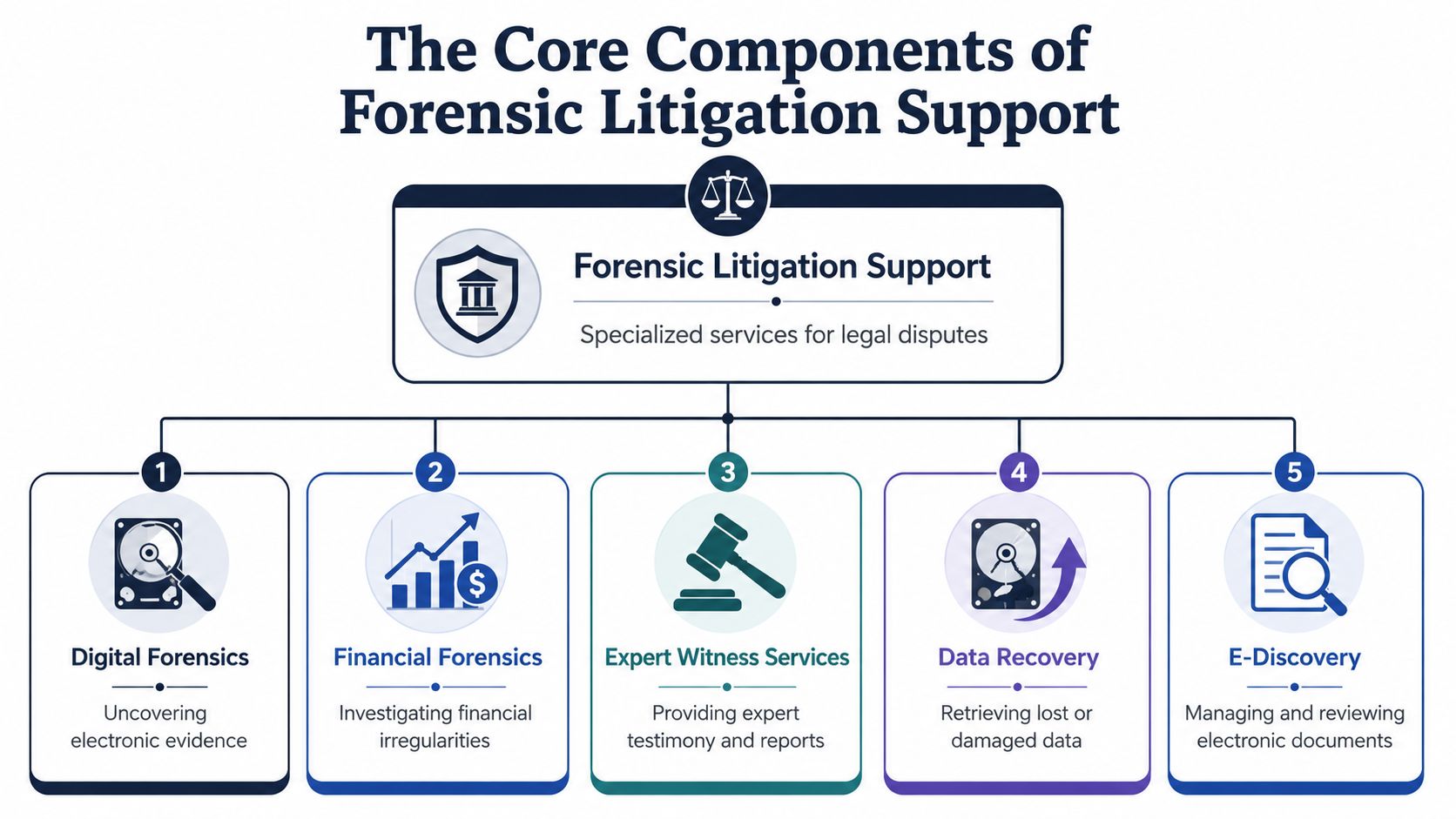
A death case can hinge on details that never appear clearly in the original record. The body may have been examined, but key specimens were not retained. A cause of death may be listed, but the opinion may not answer the legal question in dispute. Independent forensic pathology fills that gap by turning incomplete medical information into evidence that can withstand scrutiny in civil litigation.
That work usually rests on five connected functions: postmortem examination, records-based review, specimen and toxicology interpretation, written expert analysis, and testimony support when the case requires it. Families often come to us looking for clarity. Attorneys often come looking for admissible proof. The same forensic process has to serve both needs without sacrificing objectivity.
Medical findings that answer legal questions
A forensic autopsy is a structured postmortem examination used to determine cause of death and, where appropriate, manner of death. Cause of death refers to the disease or injury that led to death. Manner of death is the forensic classification of how the death occurred, such as natural, accident, suicide, homicide, or undetermined.
In civil litigation, the practical question is usually narrower than "what happened?" Counsel may need to know whether a delayed diagnosis changed the outcome, whether trauma materially contributed to death, whether restraint, intoxication, or a toxic exposure played a causal role, or whether the official conclusion leaves medically important uncertainty unresolved. An independent autopsy or second-opinion review can address those issues in a way that a routine death certificate often cannot.
A second opinion autopsy review may rely on prior autopsy reports, medical records, histology slides, photographs, preserved tissue, or toxicology data when a new examination is not possible. In many cases, that work overlaps with our forensic pathology consultation services for civil case review, especially when the central question is whether the available medical evidence supports the theory being advanced by either side.
Analysis beyond the autopsy itself
The autopsy is only one component. Litigation support in death cases also depends on whether the medical file is complete, whether specimen handling can be documented, and whether later reviewers can trace how an opinion was formed.
Toxicology is a common example. A reported drug level may look significant until the pathologist compares it with the decedent's medical history, treatment timeline, postmortem redistribution concerns, and anatomic findings. The reverse is also true. A result that appears minor in isolation can become important when paired with scene information, witness accounts, or evidence of physiologic stress. Good forensic analysis does not treat a laboratory value as a conclusion.
Written expert reporting turns that analysis into a usable litigation product. A sound report identifies the materials reviewed, explains the examination methods, states the findings plainly, and connects those findings to the final opinions on causation and mechanism of death. It should also address limitations directly. Courts and counsel tend to trust opinions more when the report shows what can be concluded, what remains uncertain, and why.
Testimony support follows the same discipline. The expert should be able to explain the reasoning step by step, defend the chain of interpretation, and stay within the bounds of the evidence. In our field, credibility often depends less on forceful language than on careful method.
Case organization matters too. Record collection, exhibit control, chronology building, and communication with medical providers often determine whether a pathologist receives the material early enough to give a reliable opinion. For legal teams refining that workflow, CasePulse paralegal insights offer a practical overview of how paralegal support fits into litigation preparation.
The strongest forensic opinions come from disciplined preservation, documented review, and a clear link between the medical findings and the legal question.
The Engagement Process Step by Step
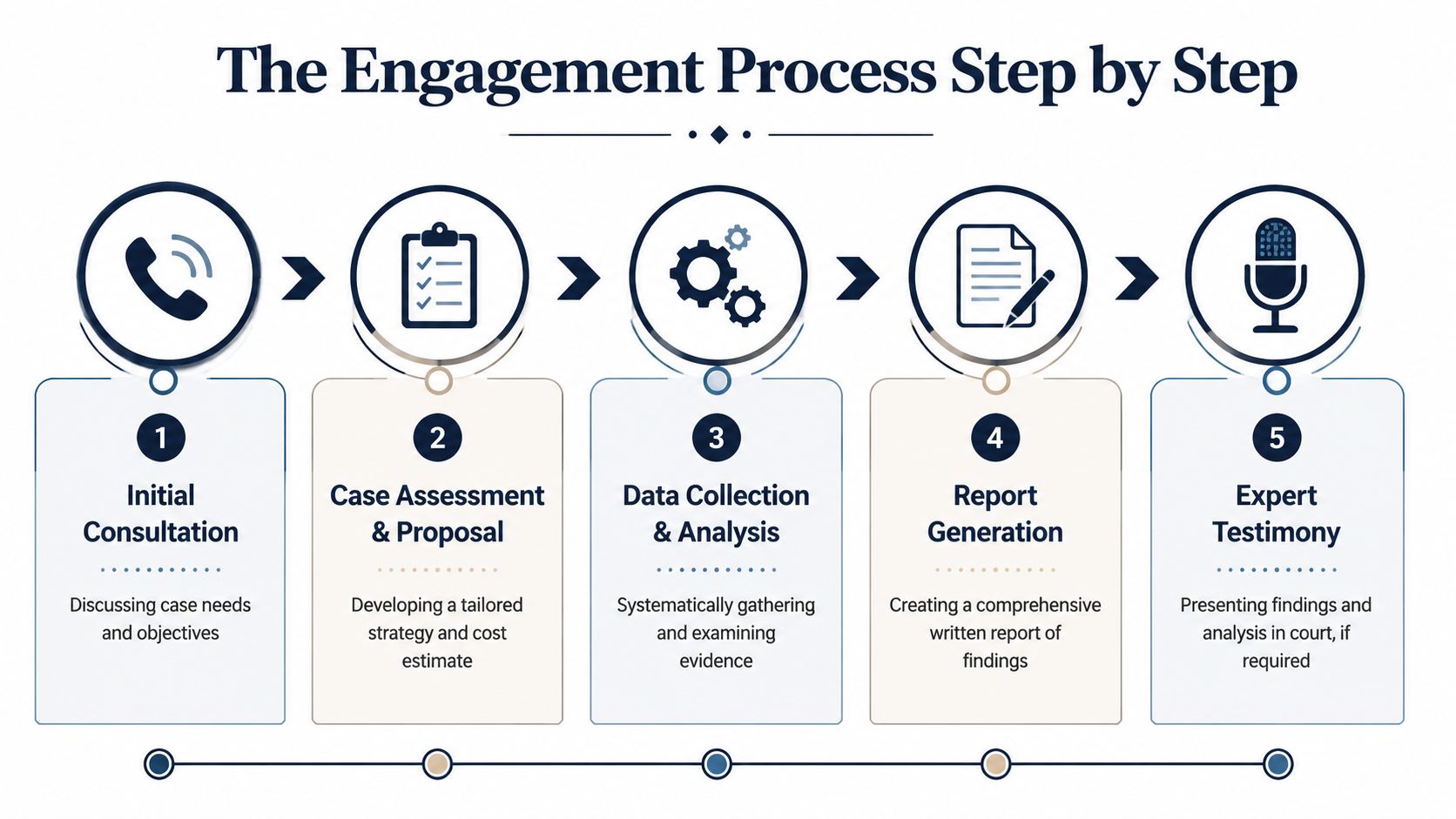
Families often expect the process to begin with a medical decision. In practice, it begins with authority, logistics, and document control. That is where many cases either stay orderly or become difficult to reconstruct later.
What happens first
Step one is an initial conversation that identifies the basic issue. Is the need a full private autopsy, a second-opinion autopsy, a records review, or a litigation-focused consultation. The answer shapes everything that follows.
Step two is authorization. In Texas, private autopsy authority depends on who has the legal right to consent. That issue should be confirmed at the beginning, not treated as paperwork to fix later. If public officials already have jurisdiction, the process may differ from a purely private request.
Step three is transfer and custody. For a case to remain useful in litigation, the movement of the decedent and any related materials must be documented carefully. That includes dates, times, handlers, receiving personnel, and the condition of sealed materials when applicable. When logistics involve funeral homes or partner facilities, coordination needs to be explicit. In some situations, attorneys and families also work with facilities such as the Waterloo Mortuary pathology partnership to streamline practical arrangements.
How the examination and reporting move forward
Once authorization and custody are clear, the forensic work begins. The pathologist reviews the available history, examines the body, documents external and internal findings, and determines what additional testing is needed. Those additional steps may include toxicology, histology, or other specialized review depending on the facts.
A useful process is usually sequential:
Case intake and scope setting
The team defines whether the case is for family clarification, civil litigation, or both.Collection of records and materials
Medical records, imaging, prior reports, and scene information can materially affect interpretation.Examination and specimen retention
Findings are documented in a way that preserves later review.Ancillary testing
The case may require more than gross examination to answer the core dispute.Written report and attorney discussion
The opinion must be clear enough to guide next steps.
A reliable engagement process also leaves room for expert preparation if testimony is likely. Attorneys often benefit from reviewing not just the final opinion, but the file architecture behind it. That practical side of case development is addressed well in expert witness preparation guidance.
What works is a direct line between intake, examination, and reporting. What doesn't work is fragmented communication where the family hears one thing, counsel receives another, and the forensic file develops in pieces.
Ensuring Evidence Integrity and Legal Admissibility
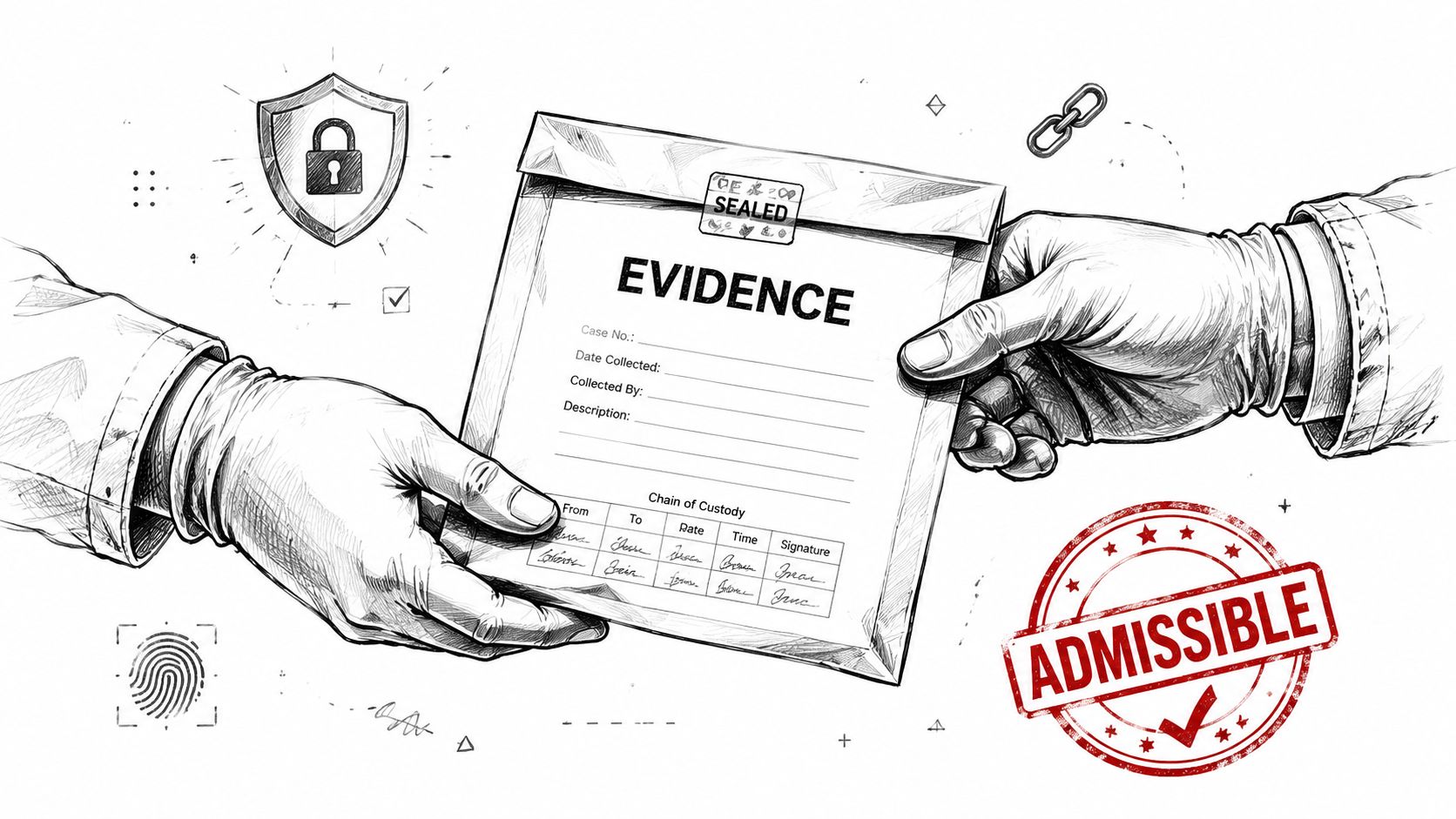
The most persuasive medical opinion can still fail if the evidence behind it was handled poorly. Courts don't only evaluate what a report says. They also examine how the underlying material was received, preserved, tracked, and documented.
What chain of custody means
Chain of custody is the documented history of who had possession of evidence, when they had it, and what happened to it at each transfer point. In a forensic pathology matter, that may include the decedent, clothing, retained specimens, slides, photographs, toxicology samples, and records.
A simple way to understand it is to think of a relay race. If the baton changes hands without documentation, the team may still know where it probably went. A court often needs more than probability. It needs a reliable record.
Key point: In litigation support services, undocumented handling can weaken confidence even when no one alleges bad faith.
Forensically sound processing is essential for preserving evidentiary integrity. The Department of Justice explains that proper forensic workflows help ensure data points and physical samples remain unaltered so courts can verify chain of custody and admissibility under strict standards. Without that process, evidence risks being excluded, as described in the DOJ's discussion of forensic processing and evidentiary integrity.
Why admissibility depends on process
Legal admissibility means the court will allow evidence or opinion testimony to be considered under the applicable rules. In practice, admissibility often depends on whether the methodology was reliable and whether the materials supporting the opinion were preserved appropriately.
That is why the paperwork matters. Intake logs, specimen labels, release forms, transfer records, sealed packaging, and reporting dates are not clerical extras. They help show that the findings are tied to the right decedent and the right materials.
The same principle appears in digital investigations. Teams handling devices and data use strict custody and preservation procedures because altered evidence loses value quickly. For readers who work across both medical and digital matters, cyber forensic investigation for security operations gives a useful parallel to how disciplined handling supports later review.
For a closer look at the medical side of that documentation trail, many attorneys benefit from reviewing chain of custody procedures before they request an independent forensic opinion.
Deliverables Timelines and Cost Structures
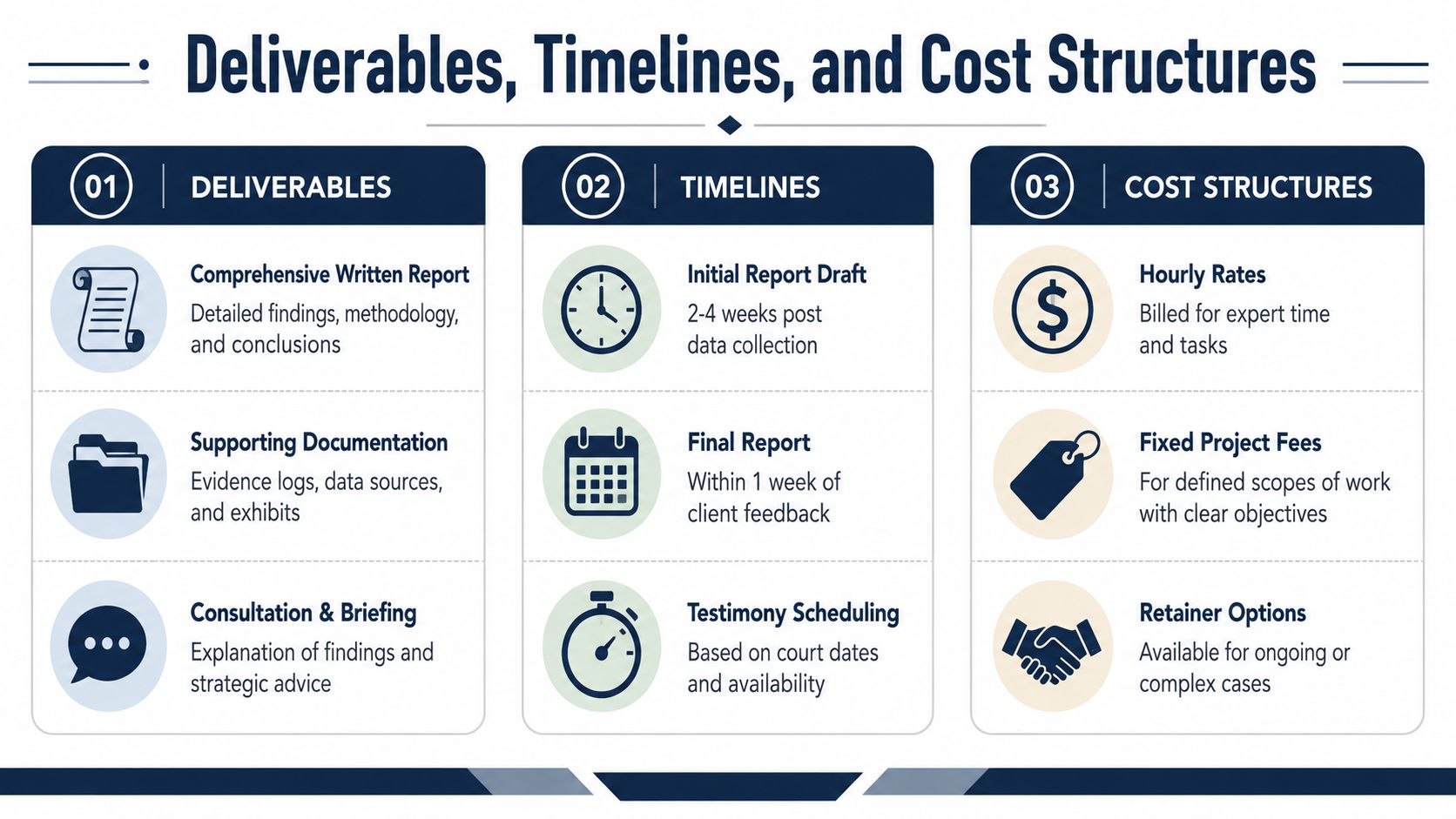
When families and attorneys ask about litigation support services, they usually want three practical answers. What will we receive. When will we receive it. How will the billing be structured. Those questions deserve direct answers.
What the final work product usually includes
The core deliverable is a written forensic report. In a private autopsy or second-opinion case, that report generally explains what materials were reviewed, what examination steps were taken, what findings were documented, and how those findings support the opinion on cause of death and related issues.
A strong report is readable by more than one audience. Lawyers need clear reasoning. Families need plain language. Courts need an opinion anchored to identifiable evidence rather than broad conclusion.
Common deliverables may include:
- Written findings: A formal report describing the examination and conclusions.
- Supporting materials: Depending on the matter, this can include photographs, retained specimen documentation, or testing summaries.
- Conference with counsel or family: The report is often only the starting point. Questions usually follow.
- Litigation support follow-up: If the matter proceeds, the same findings may later inform affidavit work, deposition preparation, or testimony.
For county officials and justices of the peace, the operational context can differ from private civil matters. Public entities seeking forensic services often need process clarity as much as medical review, which is why county forensic autopsies are usually discussed in terms of logistics, jurisdiction, and reporting expectations.
How timing and fees are usually approached
Turnaround depends on the scope of the case and whether toxicology, histology, or outside testing is required. In Texas, private autopsy reports from independent forensic pathologists are often finalized within 30 to 60 days, while government medical examiner reports can sometimes take 8 to 12 weeks or longer, as outlined in this discussion of pathology report timing in Texas. That difference matters when civil litigation deadlines are tight.
Timing should be discussed as an estimate tied to case complexity, not as a promise detached from the science.
Cost structures vary by provider. Some bill each component separately. Others use flat-rate pricing for the core examination and standard reporting, with separate charges only when highly specialized testing or additional legal work becomes necessary. What tends to work best for families is clear scope at the start. What tends to create frustration is layered billing that only becomes visible after the case is underway.
How to Evaluate a Forensic Pathology Provider
The first screening question should be simple. Who is performing the examination. In a field where opinions may be tested in litigation, credentials and independence matter more than polished marketing language.
Qualifications that actually matter
The most important threshold is whether every examination is performed by a board-certified forensic pathologist certified by the American Board of Pathology. That standard matters because it speaks to formal training and recognized qualification in forensic pathology.
A provider should also be able to explain the scope of service with precision. That includes whether the work involves a full independent autopsy, a second-opinion review, toxicology coordination, histology, or expert testimony support. Vague descriptions often produce vague files.
A practical screening list helps:
| What to check | Why it matters |
|---|---|
| Board certification | It confirms the examination is performed by a qualified forensic specialist. |
| Experience with medicolegal death investigation | Civil litigation questions differ from routine clinical review. |
| Clarity about records and specimen handling | Good science can be undermined by weak documentation. |
| Comfort with testimony | The opinion may need to be explained under oath. |
Signs of a process you can trust
Independence is not a slogan. It shows up in how the opinion is formed. The provider should be willing to follow the evidence even when it does not support the theory first presented by counsel or family members.
That objectivity is especially important in malpractice and wrongful death cases. The purpose of forensic review is not to force a result. It is to determine whether the available evidence supports a medically defensible conclusion.
Watch for these signals:
- Clear limits: A trustworthy provider will say when the evidence doesn't permit a firm conclusion.
- Defined procedures: The intake, examination, testing, and reporting process should be explained plainly.
- Respectful communication: Families should be treated with dignity, and attorneys should receive direct, usable answers.
- No inflated promises: Credible forensic work doesn't come with guaranteed outcomes.
Frequently Asked Questions about Forensic Support
Can a family obtain a private autopsy if the county already performed one
Yes, sometimes. The answer depends on what was done, what materials were retained, and how quickly the request is made.
After a county autopsy, a second full examination may no longer be possible. In many civil cases, the more useful step is an independent forensic pathology review of the county autopsy report, photographs, microscopy slides, toxicology, retained tissue, and relevant medical records. That second-opinion process often answers the question families and attorneys are asking: whether the official conclusion is medically supported, incomplete, or open to another defensible interpretation.
This is often the overlooked part of litigation support. A private review can still produce court-focused analysis even when a new autopsy is no longer available.
Who has legal authority to authorize a private autopsy in Texas
Texas law sets an order of priority for consent, usually starting with a surviving spouse, then adult children, parents, and siblings. That private authority is separate from an autopsy ordered under Texas Code of Criminal Procedure Article 49.25, where the county has medicolegal jurisdiction and family consent is not required.
Disputes over authorization should be resolved before arrangements are made. We advise families and counsel to confirm authority early, because delays can affect access to the body, retained specimens, and records.
How is a private autopsy different from a hospital autopsy
The difference is purpose.
A hospital autopsy is usually performed to clarify clinical questions, review care, or contribute to medical education. An independent autopsy for civil litigation is structured around forensic documentation, specimen preservation, chain of custody, and a report that can withstand legal scrutiny. The medical work may overlap, but the documentation standard and the anticipated use are different.
For families, that distinction matters because a private forensic examination may address questions a routine hospital process was never designed to answer. For attorneys, it matters because admissibility often turns on method, documentation, and the examiner's independence.
What do cause of death, manner of death, and chain of custody mean
Cause of death identifies the disease, injury, or complication that produced death.
Manner of death is the forensic classification, such as natural, accident, suicide, homicide, or undetermined.
Chain of custody is the documented record of who collected, transferred, stored, and examined evidence or specimens.
These terms are not just technical vocabulary. In litigation, they shape whether an opinion is persuasive, whether a specimen can be relied on, and whether the medical conclusion answers the legal issue in dispute.
What if the county finding and the private opinion do not match
A difference in opinion does not automatically mean one examiner was careless. Forensic pathology often involves limits in timing, sampling, scene information, and record access. A later independent review may have photographs the family obtained, clinical records that were missing at the time of the original autopsy, or specialized review of histology and toxicology.
What matters is how the opinion is built. Courts and counsel look for a clear explanation of the evidence reviewed, the reasoning used, the limits of the available materials, and why one interpretation is medically stronger than another. That is where independent forensic pathology contributes real value in civil litigation support.
This information is educational and forensic in nature. It is not legal advice, and it does not replace advice from an attorney or direction from the agency with jurisdiction over the death.
If you need guidance about a private autopsy, a second-opinion forensic review, or litigation-related cause of death questions, contact Texas Autopsy Services. Our team can explain the process, authorization issues, and available forensic options with clarity and respect.