June 30, 2026 · Texas Autopsy Services
Annotation of an Autopsy: Process & Purpose
Understand the annotation of an autopsy. Our 2026 guide covers the process, purpose, and use of reports for families, attorneys, & clinicians in Texas.
On this page
Understanding Annotation of an Autopsy
- Annotation of an autopsy means adding explanatory labels, notes, and visual references to autopsy findings so the evidence is easier to follow.
- A standard autopsy report states the medical conclusions. An annotated report adds context that helps families, attorneys, and reviewing professionals understand how those conclusions were reached.
- In forensic work, annotation supports clarity, chain of custody, and court-admissible documentation.
- Not every death requires a full internal autopsy in Texas. In some reportable deaths, an external examination may be sufficient when the available information adequately explains cause and manner of death.
- Every examination and review at Texas Autopsy Services is performed by a forensic pathologist certified by the American Board of Pathology, with service available across all 254 Texas counties.
A family may receive an autopsy report, read every line carefully, and still feel uncertain about what the findings mean. An attorney may have the opposite problem: the report is medically complete, but it doesn't visually connect the conclusion to the underlying evidence in a way that helps a judge, jury, or claims reviewer follow it quickly.
That gap is where annotation matters.
Clarifying the Record After a Loss
Many people who search for annotation of an autopsy are not looking for a new examination. They're looking for help understanding an existing report, photograph set, diagram, or second-opinion review after a death that still doesn't feel fully explained.
That search is made harder by an unusual problem. The query "Annotations of an Autopsy" is also the name of an English death metal band, which creates confusion in search results and leaves families and attorneys with very little useful public guidance on the forensic meaning of the term, as reflected in the band-related search context on Wikipedia. Public resources rarely explain how board-certified forensic pathologists annotate images, reports, and findings for legal and clinical use.
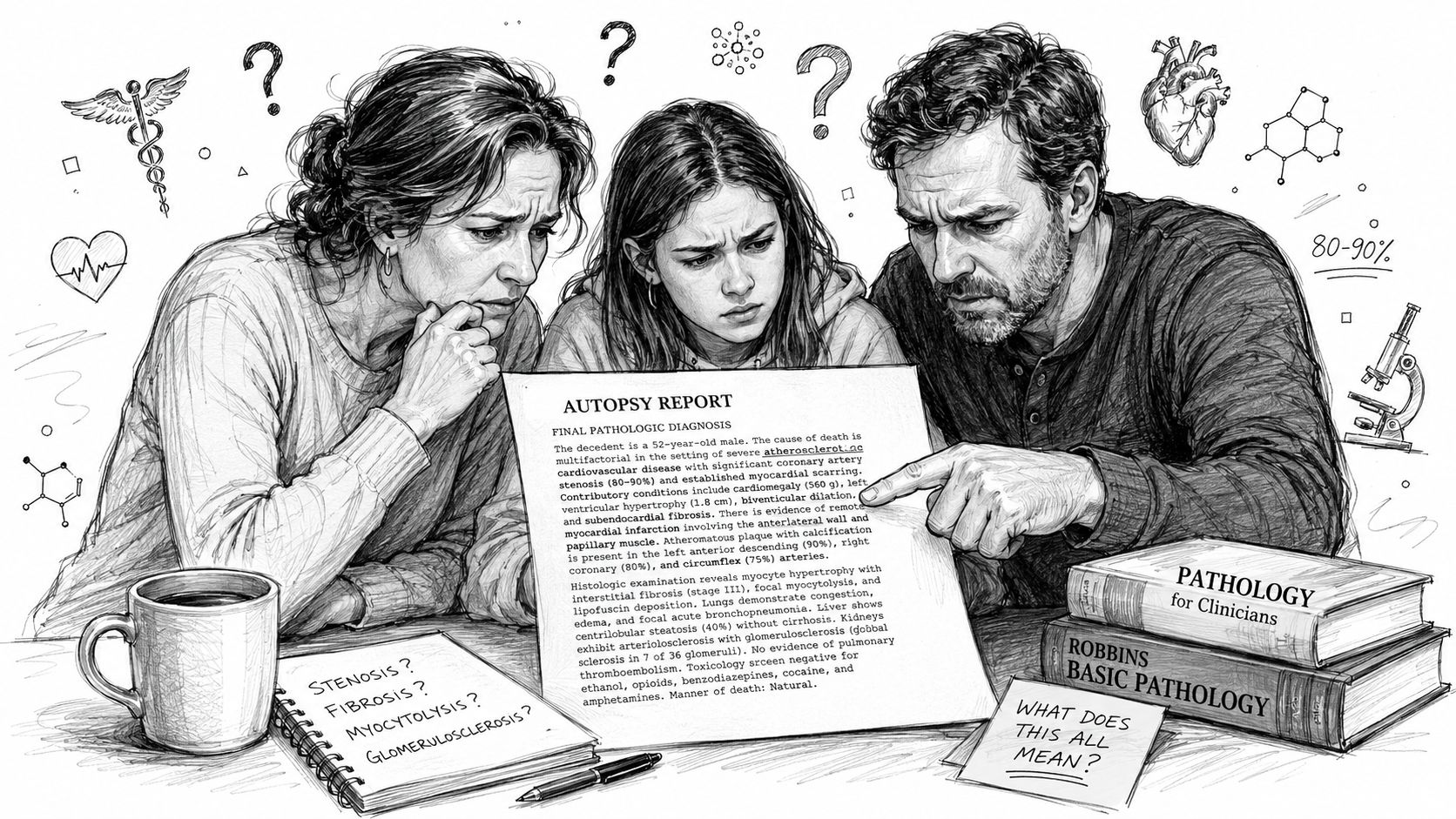
An annotation is best understood as an explanatory layer. The original autopsy record remains the formal medical document. Annotation adds labels, references, plain-language explanations, and visual markers that connect the written conclusions to what the pathologist observed in the body, on tissue slides, in toxicology, or in scene and medical records.
Why this matters during grief
After a death, people often need two things at once. They need accuracy, and they need language they can follow. A technically sound report can still feel inaccessible if it relies on specialized pathology terms without additional explanation.
A report can be medically complete and still be difficult for a non-pathologist to use.
That is especially true when the reader is trying to distinguish cause of death from manner of death. Cause of death means the disease or injury that produced death. Manner of death is the classification of how the death occurred, such as natural, accident, suicide, homicide, or undetermined. Annotation doesn't replace those determinations. It helps explain the basis for them.
What annotation is not
Annotation is not speculation. It isn't a decorative add-on, and it isn't a substitute for forensic judgment. It also isn't always a sign that something was wrong with the first report.
In many cases, annotation is the most responsible way to make a dense medical record easier to understand. Families who are still trying to make sense of a report often benefit from the same kind of plain-language support discussed in guidance on closure after death, especially when the medical record is correct but hard to absorb.
Standard Report vs Annotated Report What's the Difference
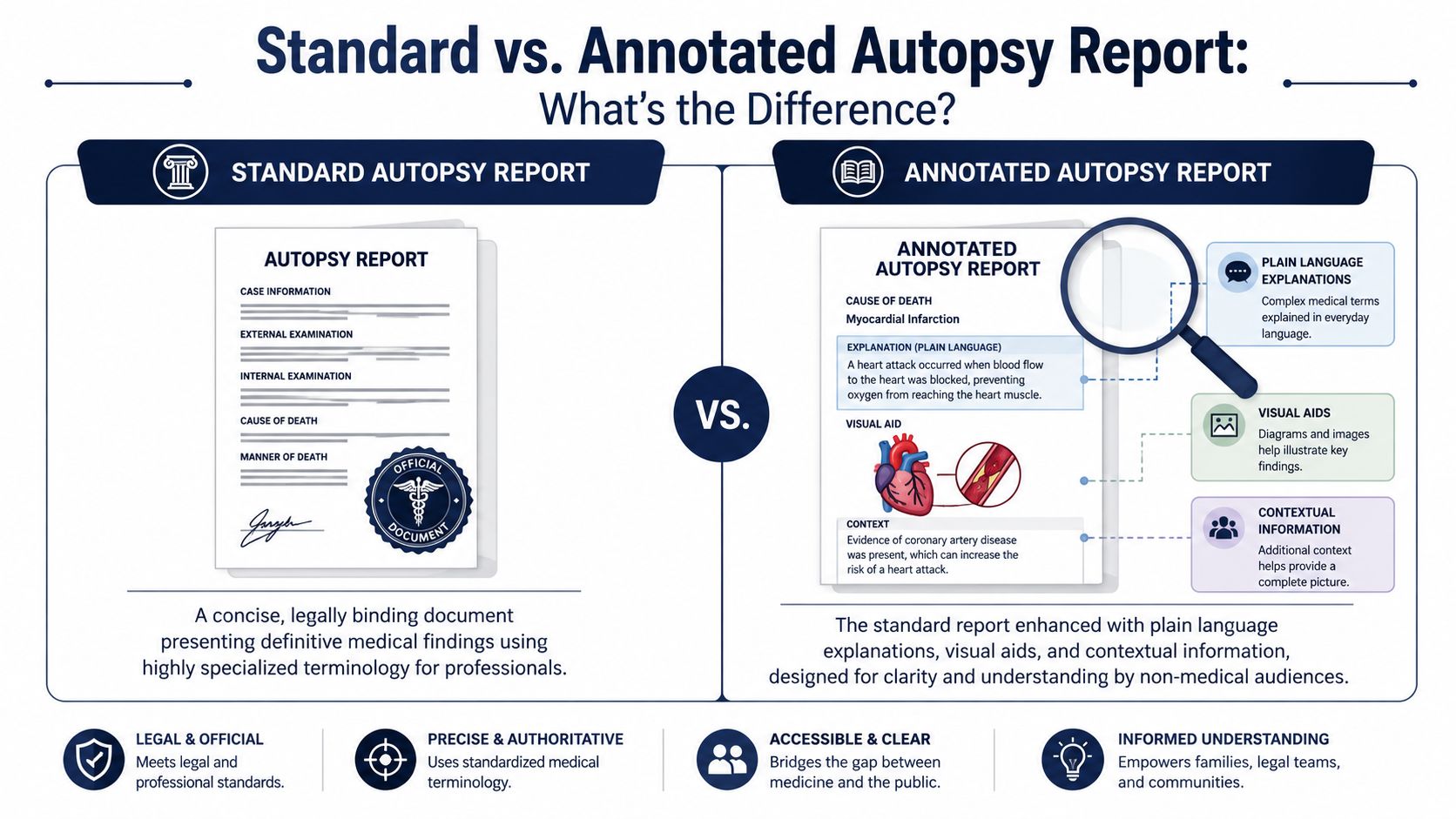
A standard autopsy report is the official medical document. It records the examination, findings, diagnoses, and final opinion. An annotated report uses that same foundation, then adds guided explanation.
The simplest comparison is this: the standard report is the final book. The annotated report is the scholarly edition with notes in the margins, labeled illustrations, and commentary that shows how the conclusions connect to the evidence.
What a standard report does well
A standard report is designed to be formal, concise, and medically precise. In forensic practice, that formality matters because the report may be reviewed by courts, agencies, insurers, or other physicians.
The College of American Pathologists recommends a structured approach to adult autopsy reporting in its Adult Autopsy Reporting Protocol, which supports consistency and completeness even though it isn't required for accreditation. That structure helps organize external findings, internal examination, ancillary testing, and final interpretation.
What annotation adds
Annotation makes the logic visible. It may place a label directly on a photograph to identify an injury, add a note to explain why a finding is old or recent, or cross-reference a toxicology result to the section of the report where it affects the final opinion.
A useful annotation usually does one or more of these things:
- Defines terminology: It translates specialized pathology language into plain English without changing the medical meaning.
- Links evidence to conclusion: It shows how a photograph, tissue slide, or lab result supports the stated cause of death.
- Improves orientation: It identifies body location, injury direction, or specimen source so the reader can follow the record.
- Separates fact from interpretation: It marks what was directly observed and what was medically inferred from those observations.
Practical rule: Good annotation adds clarity. It should never add drama.
What doesn't work
What fails is over-annotation. A report crowded with arrows, color coding, and repeated commentary can become harder to read, not easier. The best annotated autopsy materials are selective and disciplined.
Another common mistake is treating annotation like a rewrite of the whole case. It isn't. If the issue is whether the original conclusions should be reconsidered, that may call for a second-opinion review, not just explanatory markup. Annotation helps readers understand the record. It does not automatically change the record.
Key Elements of an Annotated Autopsy
A properly annotated autopsy follows the same evidence path as the examination itself. It starts with what can be seen externally, moves inward to organ findings, and then integrates laboratory and microscopic studies where they matter.
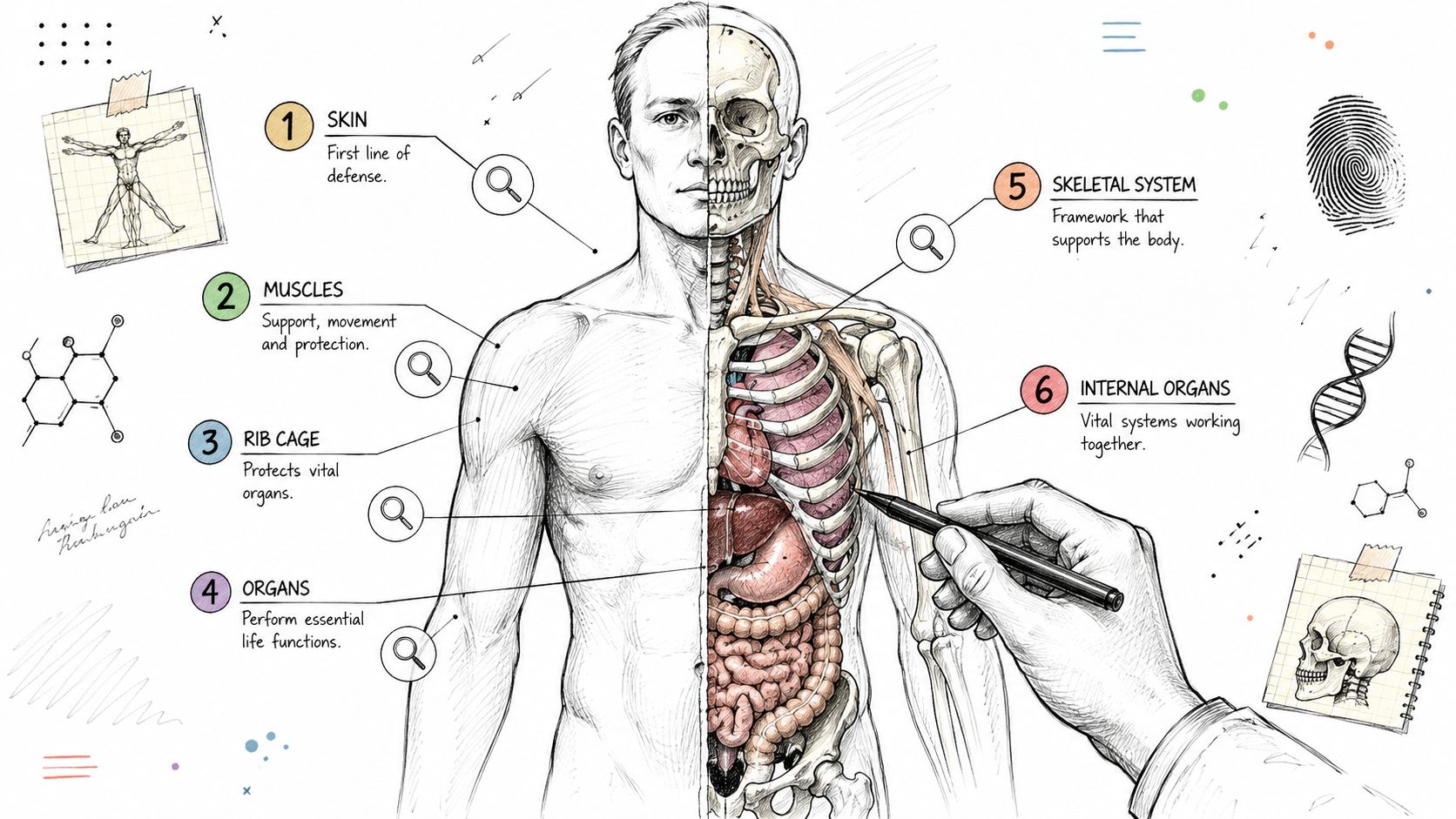
The baseline for this work is not optional. The National Association of Medical Examiners requires every forensic autopsy report to include a written narrative, detailed descriptions of injuries, a list of diagnoses, and a definitive cause of death signed by the pathologist, as set out in the NAME Forensic Autopsy Performance Standards. Annotation builds on that required record.
External findings and injury mapping
External annotation usually begins with orientation. That means identifying where on the body a finding appears, how large or extensive it is, and whether it represents injury, medical treatment, decomposition change, or a normal variant.
In practice, the clearest external annotations often include:
- Body location markers: Right versus left, front versus back, and distance from landmarks.
- Injury labels: Abrasion, contusion, laceration, incision, scar, or patterned injury when supported by the record.
- Context notes: Whether a mark may relate to resuscitation, surgery, transport, or postmortem artifact.
Standardized dissection techniques also matter here. The forensic autopsy overview in StatPearls notes that the I-shaped incision is the most commonly used skin incision for opening the thoracic and abdominal cavities, while Y-shaped and modified Y-shaped incisions are also widely used. It also notes that an X-shaped incision on the back and limbs is used to assess hidden subcutaneous hemorrhage in custodial deaths. Annotation can identify which approach was used and why that matters for interpreting what was found.
A modern example of this visual approach appears in FATAL, a digital forensic autopsy annotation platform that allows injuries to be mapped onto a 3D body model for clearer documentation, as described in the Computer Methods and Programs in Biomedicine report on FATAL.
Internal findings and supporting studies
Internal annotation focuses on significance. Not every organ weight, discoloration, or tissue change needs a margin note. The useful question is whether a finding affects the death investigation.
For internal work, annotation may identify:
| Component | What annotation clarifies |
|---|---|
| Organ findings | The location and meaning of hemorrhage, disease, obstruction, enlargement, or trauma |
| Histology | How a microscopic finding supports or limits the gross interpretation |
| Toxicology | Which results are relevant to impairment, poisoning, treatment, or non-contributory exposure |
| Specimens | Where a sample came from and how it was preserved and tracked |
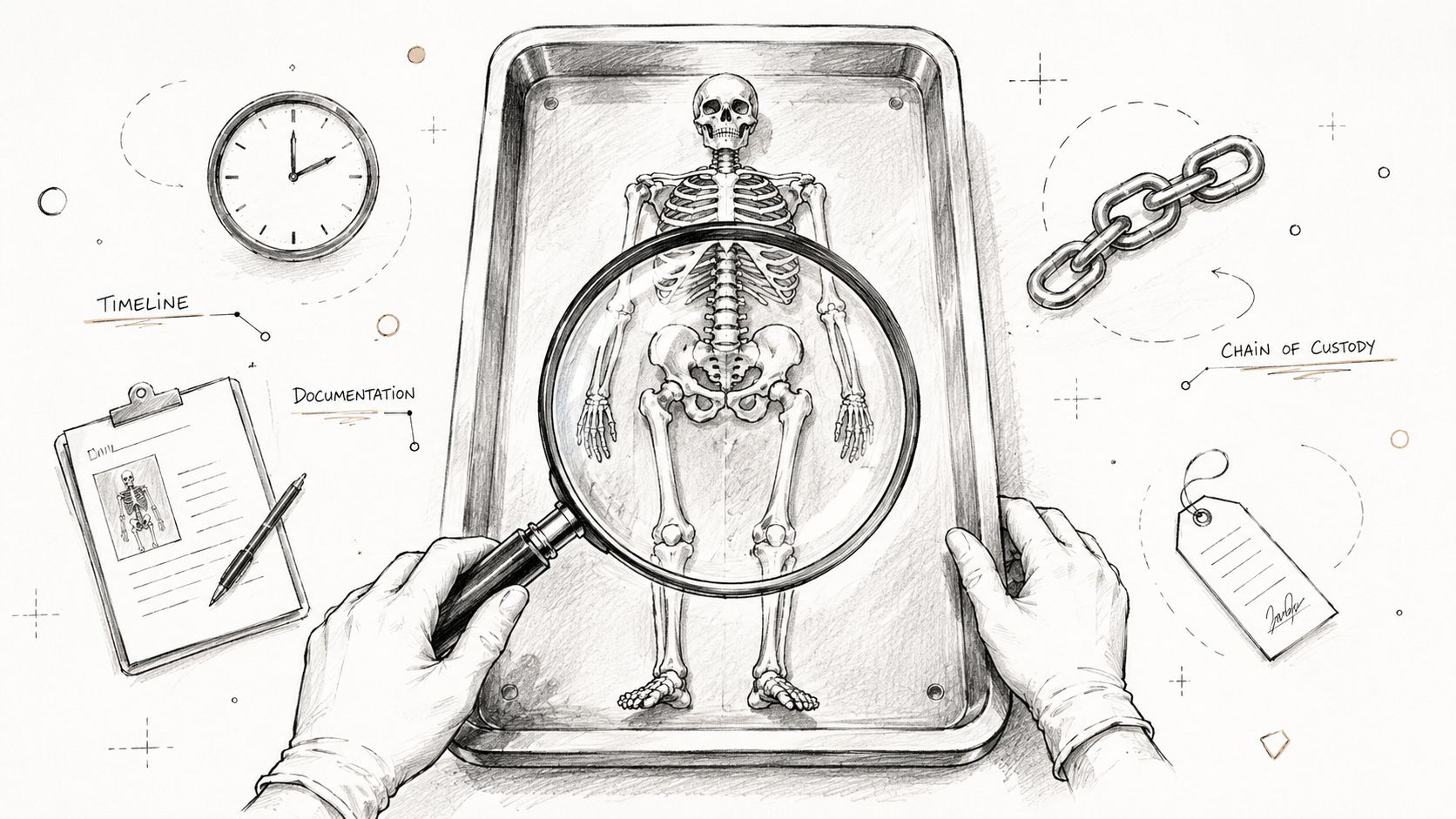
That last point connects directly to chain of custody, which means the documented handling of photographs, specimens, slides, and other evidence from collection through review. If a case may be litigated, chain of custody isn't paperwork for its own sake. It's what allows the evidence to remain reliable and court-admissible.
For readers trying to understand how these sections appear in practice, a blank format can help. Reviewing a sample structure such as this autopsy report blank overview makes it easier to see where annotations usually sit alongside the formal report language.
The Purpose of Annotation Legal Clarity and Peace of Mind
Some readers want annotation because they need a better explanation. Others need it because a case may be challenged. Both needs are legitimate, and they often overlap.
Why families ask for annotation
Families usually aren't looking for ornament. They're looking for a record they can understand without losing medical accuracy. A standard report may answer the formal question of what caused death, but still leave unresolved practical questions about timing, injury sequence, treatment effects, or why one finding mattered more than another.
A clear annotation can slow the record down. It can show that a photographed mark was superficial rather than fatal, or that a significant internal finding had no visible counterpart on the skin. That kind of explanation often reduces confusion because it ties the medical language to something concrete.
For people who want help with the general skill of reading clinical language, a plain-language resource on decoding medical reports for clarity can also be useful, especially before reviewing a pathology report with counsel or a physician.
The most helpful explanation is usually the one that preserves the exact medical meaning while removing avoidable ambiguity.
Why attorneys and reviewers rely on it
In legal settings, annotation serves a different function. It organizes the evidence for readers who weren't present at the examination and who may not be fluent in pathology terminology.
The College of American Pathologists checklist requirement ANP.36025 requires forensic specimens for toxicology, potential DNA analysis, and histologic examination to be routinely collected and retained, with inspectors verifying chain-of-custody procedures for those evidence types, as summarized in CAP Today's discussion of the autopsy checklist requirements. Annotations often clarify how results from that secured evidence relate to the final conclusions.
In case review, annotation works best when it does three things:
- Narrows the dispute: It shows what is contested and what is already well supported.
- Preserves source material: It points back to the original photo, slide, specimen, or page rather than paraphrasing loosely.
- Prepares testimony: It creates a cleaner visual and narrative record for expert explanation.
What doesn't work is using annotation to argue beyond the evidence. The strongest annotated materials are measured. They identify the support for a conclusion and also note where the evidence has limits.
How to Request an Annotated Report in Texas
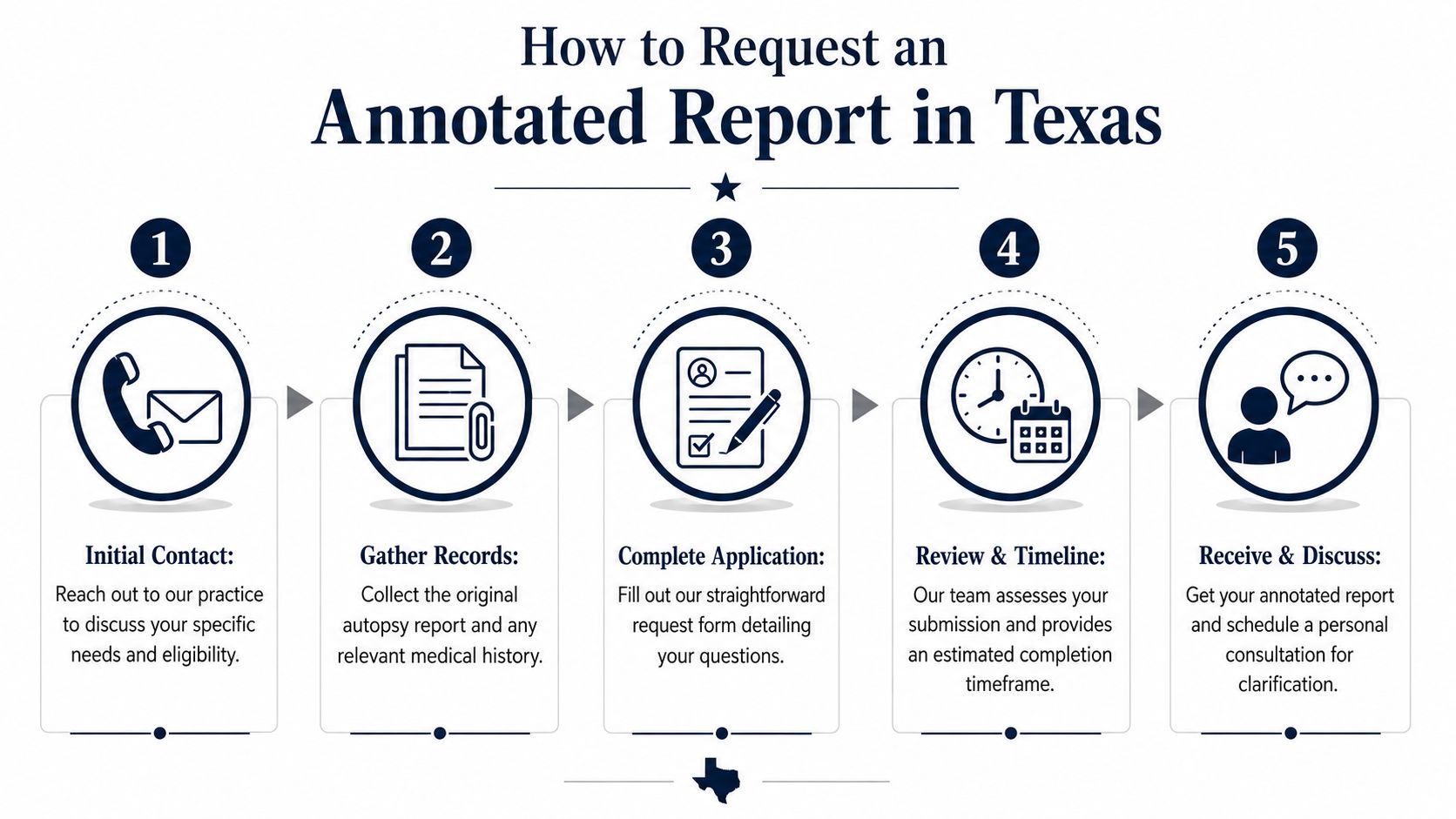
Requesting an annotated review is usually a document-driven process. It begins with the question you need answered, not with a stack of records.
What to gather first
The most useful starting materials are the existing autopsy report, any available amendment or supplemental report, and the records that informed the death investigation. Depending on the case, that may also include hospital records, emergency response records, scene photographs, toxicology, histology slides, and body photographs.
Texas law also matters at the threshold. Under Texas Code of Criminal Procedure article 49.25, an autopsy is not required in every reportable death. A pathologist may determine that an external examination is sufficient if medical records, police reports, and family discussion adequately explain cause and manner of death, as explained in the Harris County Institute of Forensic Sciences FAQ on when an autopsy is required. That means some review requests involve full internal autopsy records, while others involve limited examination records that still need explanation.
A practical intake list usually looks like this:
- The original report so the reviewer can identify the formal findings and any unanswered points.
- Supporting records that show the clinical and investigative context.
- Authority to review from the legal next of kin, attorney, or authorized representative.
- Specific questions written plainly, because focused questions produce better annotated answers.
How the review usually proceeds
Once the materials are assembled, review should be deliberate. Annotation is not a rushed editorial exercise. It requires checking that photographs match the report, that specimen references are consistent, and that any explanatory notes remain faithful to the original record.
Most cases are completed within 24–48 hours, but timing depends on what records exist, whether slides or photographs must be obtained, and whether the request is for simple clarification or broader second-opinion analysis. If you're trying to locate the official records first, guidance on how to get an autopsy report in Texas can help identify where that process begins.
Annotation should answer the question that brought the family or attorney forward. It should not create new confusion by expanding beyond the available record.
A careful review also respects workload limits in forensic practice. NAME standards state that a forensic pathologist should not perform more than 325 autopsies in a year, with a recommended maximum of 250 annually to protect quality and accuracy, according to the 2016 NAME autopsy standards. That principle matters because thoughtful interpretation depends on time, attention, and documentation discipline.
Frequently Asked Questions and Next Steps
Families and attorneys often come to this topic after a report has already been issued, sometimes after burial, cremation planning, or the first round of legal review has begun. The need is usually simple to state: they want the record to make sense without losing forensic precision.
That is a reasonable request. Annotation is often the bridge between a technically correct file and a genuinely understandable one.
FAQ
Is an annotation the same as a second-opinion autopsy?
No. Annotation usually explains an existing record. A second-opinion review evaluates whether the findings and conclusions are supported by the available evidence. The two can overlap, but they are not identical.
Can an annotated report change the cause of death?
Not by itself. Annotation is mainly explanatory. If review of the existing materials raises a substantive disagreement with the original conclusion, that moves beyond annotation into formal review or second-opinion analysis.
Does annotation include photographs or diagrams?
It can. In many cases, the most useful annotations are visual because they identify where a finding is located and why it matters. In other cases, short written notes beside key report sections are enough.
Why does chain of custody matter if the person has already died?
Because forensic evidence still has to be documented, tracked, and preserved properly if it may be reviewed by courts, agencies, or other experts. Chain of custody means there is a reliable record of who handled each specimen, photograph, or document and when.
Who performs this kind of review?
At our practice, Texas Autopsy Services provides private autopsies and second-opinion reviews across all 254 Texas counties. Every examination and review is performed by a board-certified forensic pathologist, ensuring medically sound, court-admissible findings with flat-rate, transparent pricing and full chain-of-custody compliance.
A final point is worth keeping in view. Not every family needs annotation, and not every case needs a new opinion. Sometimes the record is sound but difficult to read. Sometimes the medical language is accurate yet too compressed for a grieving family or a busy legal team to follow. In those moments, careful annotation can provide clarity without changing the underlying science.
If you're facing that kind of uncertainty, it's appropriate to ask direct questions, request a careful review, and expect respectful communication. Grief and legal scrutiny can exist at the same time. The record should be able to withstand both.
If you need help understanding an autopsy report, photographs, or a possible second-opinion review, contact Texas Autopsy Services. Our team handles these matters with confidentiality, medical precision, and respect for the deceased and the people seeking answers.