May 25, 2026 · Texas Autopsy Services
Finding Closure After Death: Private Autopsy Answers
Discover how a private autopsy offers factual answers, helping families find closure after death. We explain the healing process.

On this page
When a death is sudden or disputed, families often tell me the same thing. They can't begin to process the loss because they still don't know what happened.
At Texas Autopsy Services, every examination is performed by a board-certified forensic pathologist experienced in medicolegal death investigations. Our work centers on one principle: follow the evidence carefully, explain it plainly, and treat the deceased and their family with respect.
- Closure after death is usually a process, not a single moment.
- Objective medical facts can reduce uncertainty, especially after sudden, unexpected, or medically complex deaths.
- A private autopsy can help build a factual narrative of what happened, even when emotions remain intense.
- Legal outcomes alone often do not provide emotional resolution, which is why clear medical findings matter.
- In Texas, the process should be handled with dignity, lawful authorization, and clear communication.
The Search for Answers After a Loss
A family loses a loved one overnight. The death certificate language feels brief, the hospital conversation felt rushed, and the questions keep getting sharper instead of quieter.
That is a common starting point for calls to my office. The family is grieving, but they are also trying to solve a problem. They want to know whether the reported cause of death is complete, whether something was missed, and whether an independent review could answer questions that are keeping the loss active in their minds.
Most public discussion of closure after death focuses on emotions. That matters, but it leaves out a practical reality. Many people cannot begin to integrate a loss until they have a medically grounded explanation of what occurred.
Research in grief and bereavement supports that point. Academic literature notes that successful mourning often depends on integrating accurate information about the death into memory and reappraising the loss so it is no longer “insistent and disruptive,” while unresolved questions about the circumstances of the death can complicate grief, as discussed in this academic review of grief, meaning, and unresolved circumstances.
Why unanswered questions matter
Families often carry two burdens at once:
- Emotional pain that comes from the absence of the person
- Cognitive distress that comes from uncertainty about the death itself
Those are not the same burden. Counseling may help with the first. A sound forensic review may help with the second.
Practical rule: Emotional support and factual clarification are not competing responses. In many cases, they work best together.
Attorneys see this from another angle. A family may need answers for probate issues, insurance disputes, possible civil claims, or a professional standard-of-care review. Even when litigation is not planned, the need for a reliable factual record remains. Grief often becomes harder when the death still feels medically undefined.
My role as a forensic pathologist is narrow but important. I do not promise peace, and I do not treat grief. I examine the body, the records, the scene information if available, and any relevant testing so that the family and their counsel have something concrete to work from. In many cases, that objective foundation is the first stable point after a destabilizing loss.
What We Mean by Closure
Closure is often described as if it were a door that shuts. In real bereavement work, that is usually the wrong model.

A more realistic model is a gradual change in how the death is understood and carried. The loss remains real. The pain may remain real too. What changes is that the death becomes less chaotic, less medically mysterious, and less disruptive to memory and daily functioning.
Closure is a trajectory
Bereavement research supports that view. In a study of 67 physicians, 38 physicians (57%) explicitly used the word “closure,” and used it 86 times in total. The authors found that physicians described closure as a trajectory rather than an achievable endpoint, with two recurring pathways toward that trajectory: understanding the causes and circumstances of the death, and reconnecting or resolving relationships between parents and healthcare professionals, as reported in this study on follow-up meetings after a child's death.
That finding matters well beyond pediatric settings. It captures something families tell me often. They are not asking to forget. They are asking for the death to make sense.
What closure is not
Closure after death is not:
- Erasing grief so that the person no longer matters
- Receiving one document and instantly feeling relief
- Being told to move on before the facts are clear
It is closer to integration. Families start to form a coherent narrative. They know what is known, what is uncertain, and what the medical evidence does or does not support.
Some people also benefit from support that addresses the human side of dying, caregiving, and family transition. For readers looking for broader compassionate end-of-life guidance, death doula education can be helpful in understanding non-medical support around loss.
Closure usually begins when uncertainty narrows. It rarely begins when people are told to stop asking questions.
That is why factual review matters. If the death still feels unresolved at the level of cause, sequence, or medical mechanism, the emotional work often stalls.
How a Private Autopsy Provides Objective Answers
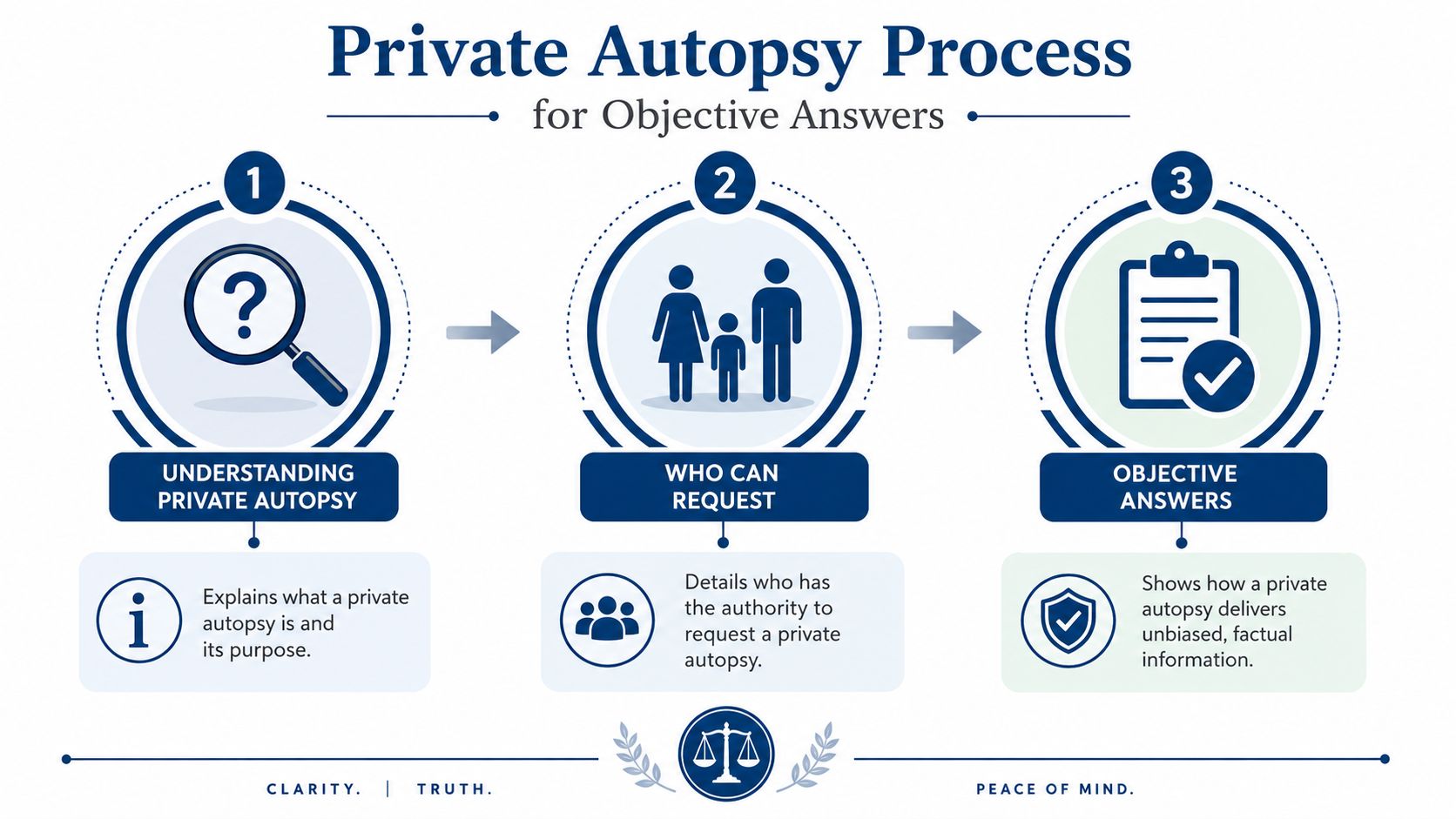
A private autopsy is an independent postmortem examination requested outside the county system when lawful authorization is available. It is usually sought when a family or attorney needs a more complete explanation of the death, wants a second opinion, or has concerns about whether the stated cause of death tells the full story.
When an independent examination is useful
A private autopsy is often most valuable in cases such as:
- Sudden death where the family had no warning and the medical history does not fully explain the event
- Hospital-associated concerns when relatives want an independent review of records and findings
- Medication or toxicology questions when the timing or circumstances raise concern
- Disputed or unclear certification if the stated cause seems broad, incomplete, or inconsistent with what witnesses observed
- Potential legal review when attorneys need medically sound documentation early
The purpose is not to force a preferred conclusion. The purpose is to examine the evidence carefully and independently.
Why facts can help when feelings are overwhelmed
Evidence-based grief guidance explains that adaptive mourning involves integrating the death into a new normal, not forgetting, and that reconciling with a new reality is a more realistic goal than waiting for emotional closure to appear on its own. That same guidance notes that objective clarification, such as autopsy findings, can reduce uncertainty and help families build a durable narrative of what happened, as described in this grief and closure guidance from TAPS.
That is exactly where forensic pathology can help. A careful autopsy may identify disease, injury, complication, intoxication, or the absence of findings that had been assumed. Sometimes it confirms the original explanation. Sometimes it refines it. Sometimes it shows that further review is warranted.
For families researching options, this overview of a private autopsy service gives a useful starting point for understanding how independent review works in practice.
I provide these services through Texas Autopsy Services for families, attorneys, and agencies seeking an independent cause of death investigation in Texas. The key point is not the name of the provider. It is the independence of the examination, the quality of the documentation, and the discipline to follow the evidence where it leads.
The Autopsy Process A Guide for Families
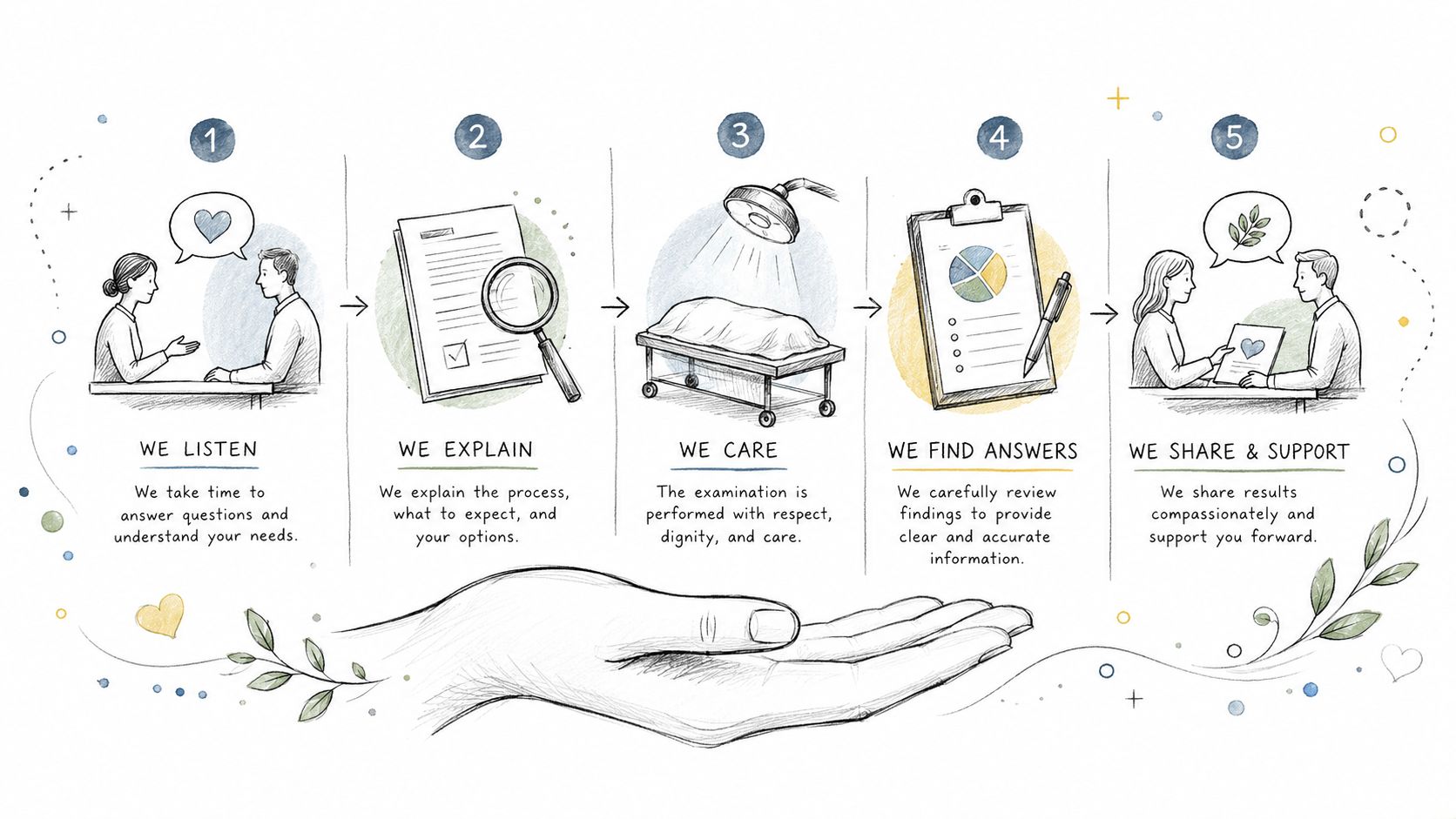
The autopsy process is often harder to imagine than it is to understand. Families usually do better when each step is explained plainly, including what happens, who authorizes it, and how dignity is protected.
Step one involves authorization and records
Before any examination, lawful authority must be confirmed. In Texas, postmortem handling and related decisions exist within a legal framework that includes the Texas Health & Safety Code, and families should expect a legitimate service to verify who may authorize the examination and disposition.
At this stage, I also want records. Hospital notes, emergency medical services reports, medication lists, prior diagnoses, imaging, witness accounts, and any available scene information all matter. A body can answer many questions, but the best forensic work comes from combining examination findings with context.
Step two is transport and respectful intake
Once authorization is in place, transportation is coordinated. In Central Texas, one practical option may involve our Waterloo Mortuary partnership, which supports respectful transfer logistics connected to pathology services.
When the decedent arrives, intake is documented carefully. Identification is confirmed. Personal effects and accompanying materials are logged. If specimens or outside records arrive separately, they must be associated correctly with the case.
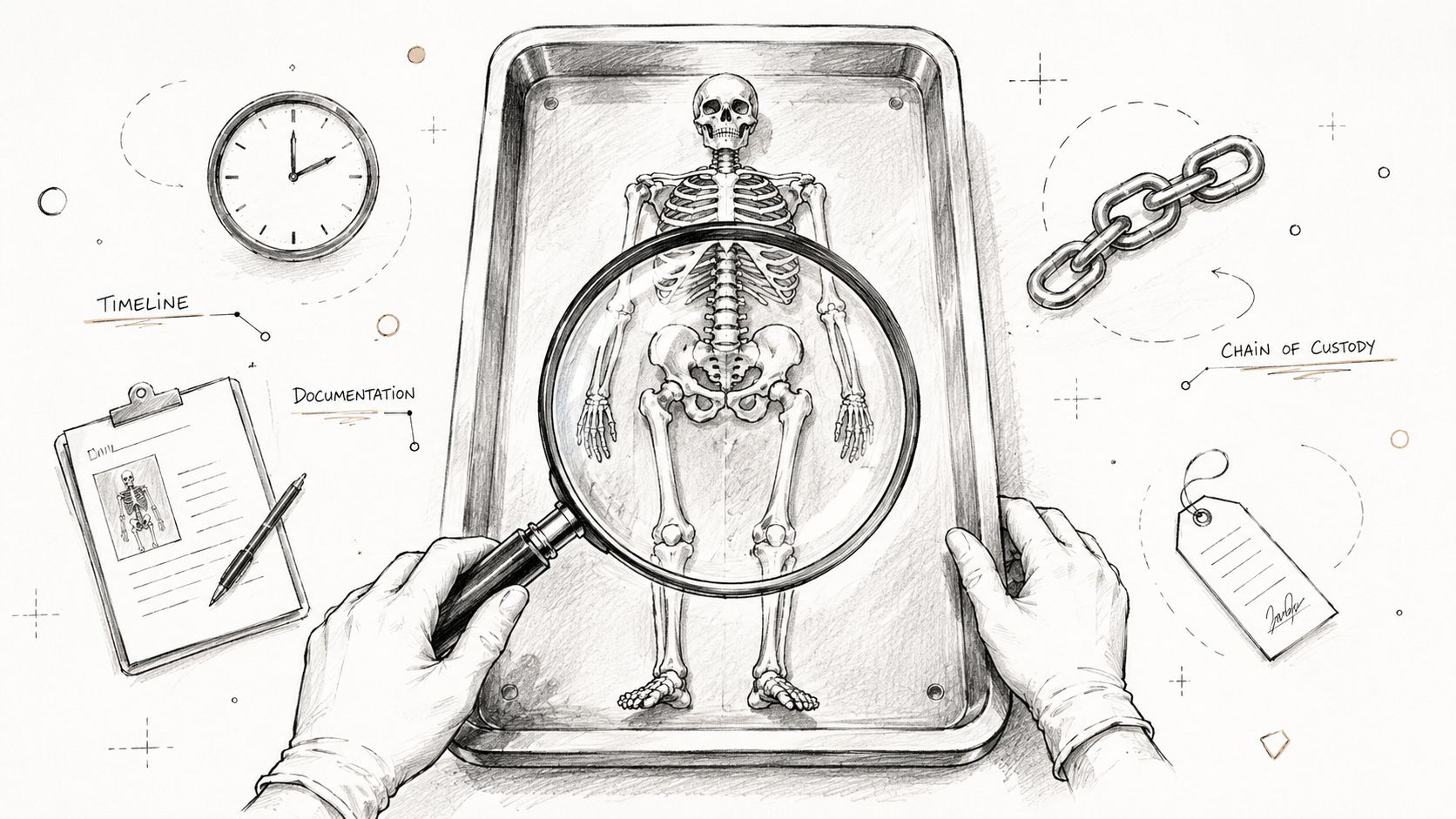
Why chain of custody matters: Chain of custody is the documented handling of the body, samples, and related evidence so that each transfer is recorded and traceable.
That term matters most in contested or legal cases, but it also matters to families because it reflects disciplined handling.
Step three is the examination itself
The examination may include external review, internal examination, specimen collection, and additional testing when indicated. Depending on the case, that can include histology, toxicology, or other laboratory analysis. A second-opinion autopsy may also involve review of slides, retained tissues, photographs, or prior reports from another office.
Families who want more detail about the sequence can review these steps to an autopsy, which explain the process in plain language.
Not every case yields every answer. That is important to say clearly. Decomposition, limited records, delayed reporting, or missing scene information can restrict what medicine can prove. Ethical forensic practice means being honest about both the strengths and limits of the findings.
Step four is reporting and communication
The final report should state findings in precise language and explain how those findings support the conclusion. A family does not just need a technical label. They need a medically coherent explanation.
A sound report typically addresses:
- Cause of death with enough detail to explain the disease or injury process
- Manner of death when that determination can be made from the available evidence
- Contributing conditions that may not be the primary cause but still matter
- Testing performed so readers understand the basis for the opinion
Step five is coordination after the examination
After the examination, the family and funeral professionals still need practical continuity. The body must be released appropriately. Documentation must align with Texas requirements. Communication should remain measured and respectful.
That is where many families feel the difference between a rushed process and a careful one. The science matters. So does the way the process is carried out.
Interpreting the Findings Cause and Manner of Death
Many people receive an autopsy report and go straight to the conclusion line. That is understandable, but a report means more when you know the language.
Cause of death
Cause of death is the specific disease, injury, or physiological event that led to death. It answers the question, “What caused the body to fail?”
Examples in plain language might include a heart disease process, a drug toxicity, a gunshot wound, or complications of infection. In a medically complex case, the cause may be a sequence rather than a single word.
Manner of death
Manner of death is a classification of the circumstances surrounding the death. In forensic practice, that generally places the death into a recognized category such as natural, accident, suicide, homicide, or undetermined.
A short comparison helps:
| Term | Plain meaning | Example type of answer |
|---|---|---|
| Cause of death | What produced death medically | Drug toxicity, coronary artery disease, blunt force injury |
| Manner of death | How the death is classified by circumstance | Accident, natural, undetermined |
Those two terms answer different questions. Families often need both before the death feels anchored in reality.
A precise medical finding does not erase grief. It does remove some of the instability that comes from not knowing which story is true.
That stability also matters in legal settings. Insurance review, civil litigation, agency review, and family decision-making all rely more on documented medical findings than on assumptions. Research on victims' families also shows that legal action is often a poor substitute for factual resolution. In one University of Minnesota study cited in later reporting, only 2.5% of family members reported achieving true closure after an execution, while 20.1% said the execution did not help them heal. The prolonged Texas appeals process was described as creating “layers of injustice, powerlessness, and in some instances, despair,” as summarized in this review of research on closure and legal process.
That does not mean law is unimportant. It means legal milestones and emotional resolution are not the same thing. When families need closure after death, a clear medical explanation is often more useful than waiting for a courtroom event to do emotional work it may never do.
Beyond the Report Legal and Emotional Next Steps
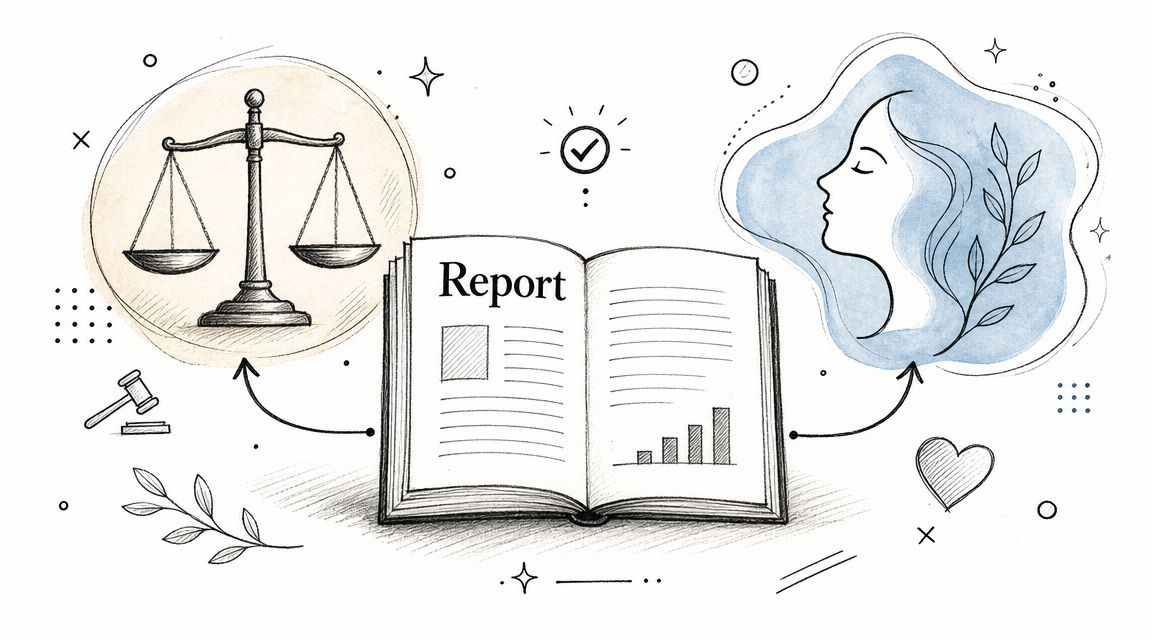
An autopsy report is not the end of the process. It is a tool that helps people make the next decisions with better footing.
How attorneys use the findings
Attorneys usually need the report for one of three reasons. They may be evaluating whether a claim exists, testing whether another medical opinion is supportable, or building a timeline that connects records, witness accounts, and pathology findings.
A careful autopsy can help identify where a legal case is strong, where it is weak, and where the honest answer is still uncertain. That kind of discipline protects clients. It also keeps experts from overstating what the evidence can prove.
For families managing estate and procedural issues, this checklist of legal steps after a death in Texas can help organize the non-medical tasks that often pile up quickly.
When the facts are clear but grief is still stuck
Sometimes the autopsy answers the central medical question, yet the family still feels unable to move forward. That does not mean the report failed. It may mean the grief itself needs targeted support.
Clinical guidance on delayed closure notes that complicated grief can involve intense longing, sorrow, preoccupation with the deceased, difficulty accepting the death, and impaired functioning lasting at least 12 months, and that culturally appropriate support, trusted companions, and targeted therapies can help when the process has stalled, as discussed in this review of rethinking closure and complicated grief.
That distinction matters. Medical uncertainty and prolonged grief can overlap, but they are not identical problems.
Practical next moves after an autopsy
After findings are issued, families and counsel often benefit from a short, concrete plan:
- Review the report with someone qualified so the language is translated into plain terms
- Request supporting materials when appropriate such as toxicology or histology summaries
- Use the findings to narrow the unanswered questions rather than reopening every possibility
- Seek grief support if daily functioning remains impaired even after the medical picture is clearer
If you need the logistics of obtaining documentation, this guide on how to get an autopsy report in Texas explains the practical side.
The report can support legal review. It can support family understanding. It can also support the emotional work that begins only after uncertainty has been reduced.
Frequently Asked Questions
Who can request a private autopsy in Texas
That depends on lawful authority over the decedent's remains and the circumstances of the death. The key issue is not who is most distressed, but who is legally authorized to make that decision. A legitimate forensic service should confirm authorization before proceeding.
How is a private autopsy different from a county autopsy
A county autopsy is performed under government authority when a death falls within that jurisdiction's statutory responsibilities. A private autopsy is independently requested and can be useful when the family or attorney wants an additional examination, a second opinion, or a more detailed review.
Will an autopsy guarantee closure after death
No. An autopsy can provide objective answers, narrow uncertainty, and clarify the medical story. It cannot guarantee emotional resolution. What it often does is remove avoidable doubt, which gives grief less confusion to work against.
How long does it take to get results
Timing depends on the case. The examination itself is only one part of the process. Records review, histology, toxicology, and the complexity of the medical issues can all affect when a final opinion is ready. Any provider who gives a universal timeline without those qualifiers is oversimplifying.
Can a private autopsy help after a fatal crash
It can, especially if there are questions about injury pattern, medical causation, toxicology, or whether preexisting disease contributed to the death. Families dealing with collision-related losses may also find this guide for families after fatal crashes helpful for understanding the legal side that can follow.
If you need medically grounded answers after a death, you can contact Texas Autopsy Services for direct guidance. My office can explain the practical steps, the legal authorization issues, and whether an independent autopsy or second-opinion review is appropriate for your situation.