July 1, 2026 · Texas Autopsy Services
Falling Down the Stairs Injuries: Get Clear Answers
Understand falling down the stairs injuries, forensic red flags, and when a private autopsy is crucial. Our Texas pathologists provide clear answers.
On this page
A family member is found at the bottom of the stairs. There may be blood on a step, a broken handrail, a shoe caught on the edge, or no clear sign of what happened at all. In the first hours after a death or serious injury, people are often told some version of the same sentence: it was an accident.
Sometimes that is true. Stair falls send many people to emergency care each year, and the injuries can be far more serious than a bruise or a twisted ankle. A staircase is not a flat surface. It is a repeating series of hard edges, short drops, and abrupt stops, so the body may strike more than once on the way down. That pattern can produce a mix of head injury, neck trauma, broken bones, and internal blunt force injuries that is difficult to understand without a forensic review. Families who want a plain-language explanation of impact patterns often start with our discussion of blunt force trauma in forensic analysis.
The legal question is often different from the medical one. Attorneys may receive records that list blunt force trauma, skull fracture, or multiple rib fractures, yet the records may not answer whether those findings fit a stair tumble, whether a medical event happened first, or whether another person may have been involved. A stair fall can be accidental and still require careful investigation. It can also be a label applied too early.
That distinction matters because a death investigation has to answer more than how someone was found. It has to address cause of death, manner of death, and mechanism of injury in a way that matches the scene, the history, and the body. In our forensic pathology practice, we often explain this with a simple comparison. The staircase is only one part of the story. The injuries, the medical history, the witness accounts, and the timing have to line up like pieces of the same puzzle. If one piece does not fit, a closer examination may be necessary.
Private autopsy review often fills that gap for families and attorneys. Hospital records are written to guide treatment. Death certificates are often brief. Official investigations may be limited by timing, jurisdiction, or the scope of the initial response. A private forensic autopsy asks a narrower and more focused question. Do the injuries match a fall down stairs, or do they point to another event that came before, during, or after the fall?
For families trying to understand their options after a serious injury or death, outside legal guidance can also help frame the practical questions. The Martin County stair fall injury guide is one example of how attorneys explain liability and claim issues that may arise after a stairway incident.
Our goal is to help families and counsel understand what happened, what remains uncertain, and what can still be examined before those answers are lost.
Understanding Injuries From Falling Down Stairs
A family may hear, “She fell down the stairs,” and assume the event was simple. In medicine and forensic pathology, it rarely is. A stair fall is usually a chain of impacts, body rotations, failed attempts to brace, and sudden stops that happen within seconds.
That is why the injuries can seem scattered or even confusing at first review. One part of the body may strike a step edge, another may twist while the person turns, and the head may hit either a stair, a wall, a handrail, or the final landing. For families and attorneys, this often explains why the records list injuries in several body regions instead of one obvious point of impact.
Why stair falls injure the body differently
Stairs expose the body to repeated contact with hard, narrow surfaces at changing heights. A flat-ground fall often ends after a single strike. A stair fall can continue through several strikes in rapid sequence. The body keeps moving while individual areas absorb force at different moments.
A useful way to picture the mechanics is to compare stairs to a series of edges rather than one floor. The shin may hit first. The torso may rotate next. An outstretched arm may absorb force in an instinctive effort to break the fall. The head may then strike late in the event, or very early, depending on direction, speed, and body position.
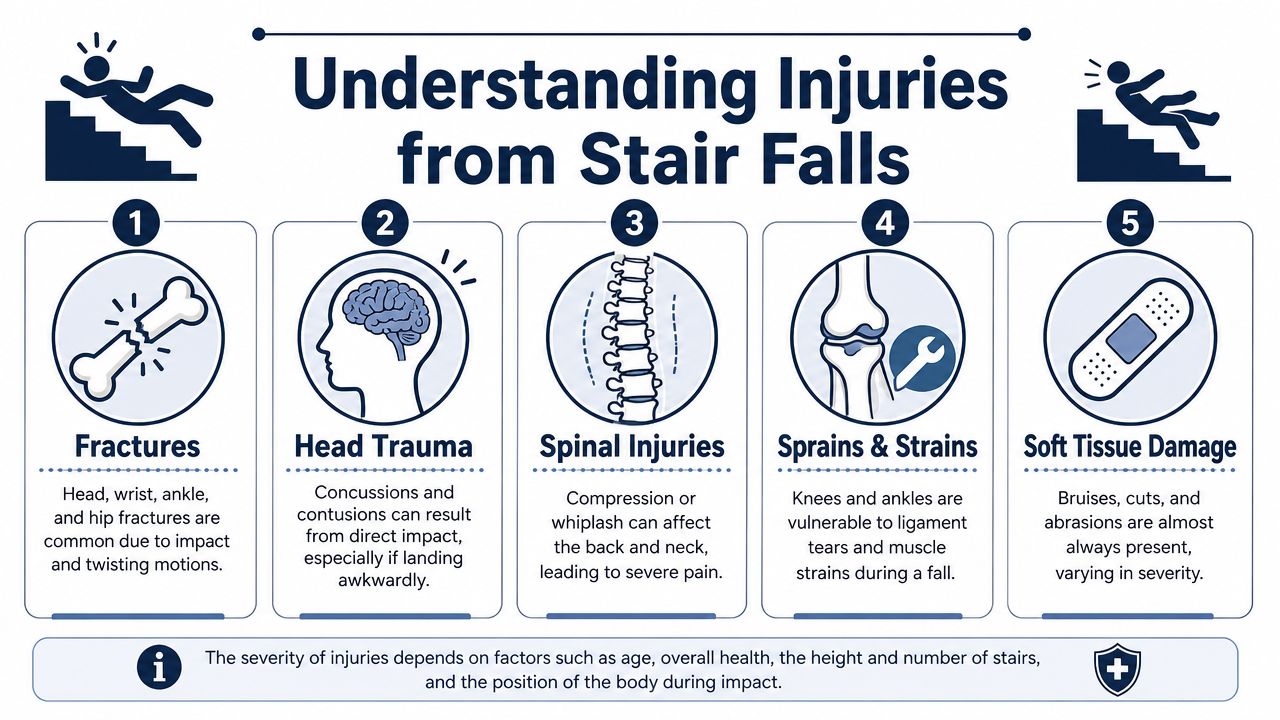
Published summaries of stair-related injuries consistently show a mix of lower extremity trauma, head and neck injury, fractures, sprains, and soft tissue damage. The exact combination varies from case to case, which is one reason stair falls deserve careful reconstruction rather than assumptions based on one bruise or one fracture.
Practical point: A person can have a serious brain injury and multiple limb injuries at the same time. The presence of bruises, scrapes, or fractures elsewhere does not make the head injury less significant.
Common injury patterns families should recognize
Several patterns appear often in medical records after a reported stair fall:
- Lower extremity trauma: Ankles, feet, knees, and lower legs may show twisting injuries, direct blows, or both.
- Head and neck injury: Records may describe concussion, facial trauma, scalp injury, skull fracture, cervical injury, or intracranial bleeding.
- Fractures with sprains or strains: Bone injury and ligament or muscle injury often occur together because different parts of the body absorb force differently.
- Soft tissue injury: Bruises, abrasions, and lacerations can help show where the body contacted steps, railings, walls, or the landing.
Families often expect one dramatic injury site. Stair falls do not always produce that pattern. The injury map may look irregular because the body moved through space and contacted several surfaces in quick succession.
This distinction is important because a scattered injury pattern can be entirely consistent with a real stair fall, but it can also be misread if no one examines timing, body position, and impact sequence carefully. That is where forensic review adds value. A pathologist is not only asking what was injured, but how those injuries were produced and whether they fit the reported event.
For readers comparing medical language with legal framing, the Martin County stair fall injury guide shows how these cases are often described in claims practice. A medical chart, however, may not answer the harder forensic question of mechanism.
Our discussion of how blunt force trauma patterns are analyzed in forensic pathology explains why repeated impacts, body rotation, and contact with multiple surfaces can make a stair fall look straightforward on paper while remaining medically and legally unresolved until a closer examination is performed.
When an Accidental Fall Needs a Closer Look
A staircase death can be reported as a simple accident within hours. By the time a family starts asking harder questions, the scene is gone, memories have shifted, and the medical record may already frame the event as a fall. In forensic practice, that early label is only a starting point. The pertinent question is whether the physical findings, the history, and the sequence of events are consistent.
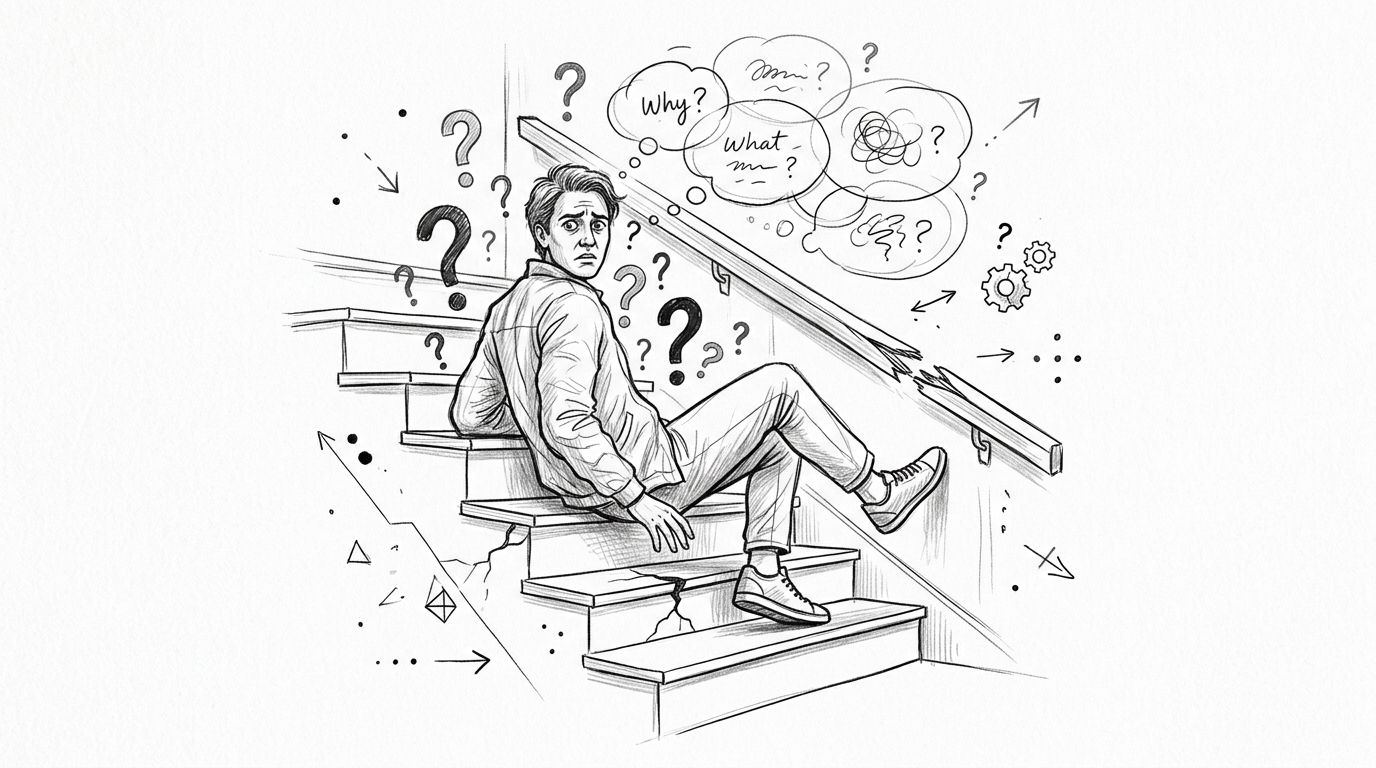
Families often hear some version of, “He must have slipped,” or “She probably lost her footing.” Sometimes that explanation is correct. Sometimes it is incomplete. A person may collapse from a heart rhythm problem and then fall. An intoxication issue may affect balance, judgment, or consciousness. An assault may be mistaken for a tumble. A witnessed “fall” may really begin with a medical emergency that no one recognized in the moment.
When the history and the injuries do not match
Forensic review becomes especially important when the story and the body seem to be describing different events.
Examples include:
- Injuries that do not fit the reported fall path: The pattern may be hard to reconcile with the claimed direction, number of steps, or landing position.
- Conflicting timelines: Witness statements, EMS notes, hospital records, and family accounts may place the person in different conditions at different times.
- Possible incapacity before the fall: A seizure, stroke, arrhythmia, fainting episode, or other sudden medical event may have come first.
- Findings that require exclusion of another mechanism: Certain injuries may raise concern for restraint, inflicted trauma, or a separate blow unrelated to an accidental descent.
A forensic pathologist examines the body the way an engineer studies a failed structure. The question is not only what broke. The question is how it broke, in what order, and whether the reported mechanism can account for the full pattern. In a stair case, that means considering body position, surface contact, rotation, interruption points, and whether the injuries are more consistent with a slip, a collapse, a push, or multiple events close in time.
Injuries need context. Without it, a record can sound definite while remaining medically unresolved.
Why head injuries deserve special caution
Head trauma often creates the greatest confusion. A stair fall can cause fatal brain injury. It can also be the setting in which a different event is mistaken for the cause of death. For example, a person may suffer a natural collapse, strike the head during the fall, and then be found with obvious blunt injuries that draw attention away from the underlying medical trigger.
External appearance can also mislead. Limited scalp bruising does not rule out serious intracranial bleeding. Conversely, dramatic external injury does not automatically prove that the fall alone explains death. That distinction is significant because attorneys are often evaluating causation, while families are trying to understand whether the death was accidental, medically precipitated, or the result of another act.
Our discussion of death from falling down stairs explains how these mechanism questions arise after death. For families considering legal options, CAINE LAW resources can help explain how wrongful death claims are evaluated once causation is in dispute.
In many of these cases, a private autopsy is the first opportunity for an independent physician to test whether "accidental fall" is a supported conclusion or only an assumption.
The Role of a Forensic Autopsy in Death Investigation
A forensic autopsy is a medical examination of the body after death to determine what injuries or diseases are present and how they relate to death. In a stair fall case, that work can clarify whether the fall caused death, contributed to death, or followed another fatal event.
Here, precise terms matter.
Plain language definitions that matter
| Term | Plain-language meaning |
|---|---|
| Cause of death | The specific injury or disease that led to death |
| Manner of death | The classification of death, such as natural, accident, suicide, homicide, or undetermined |
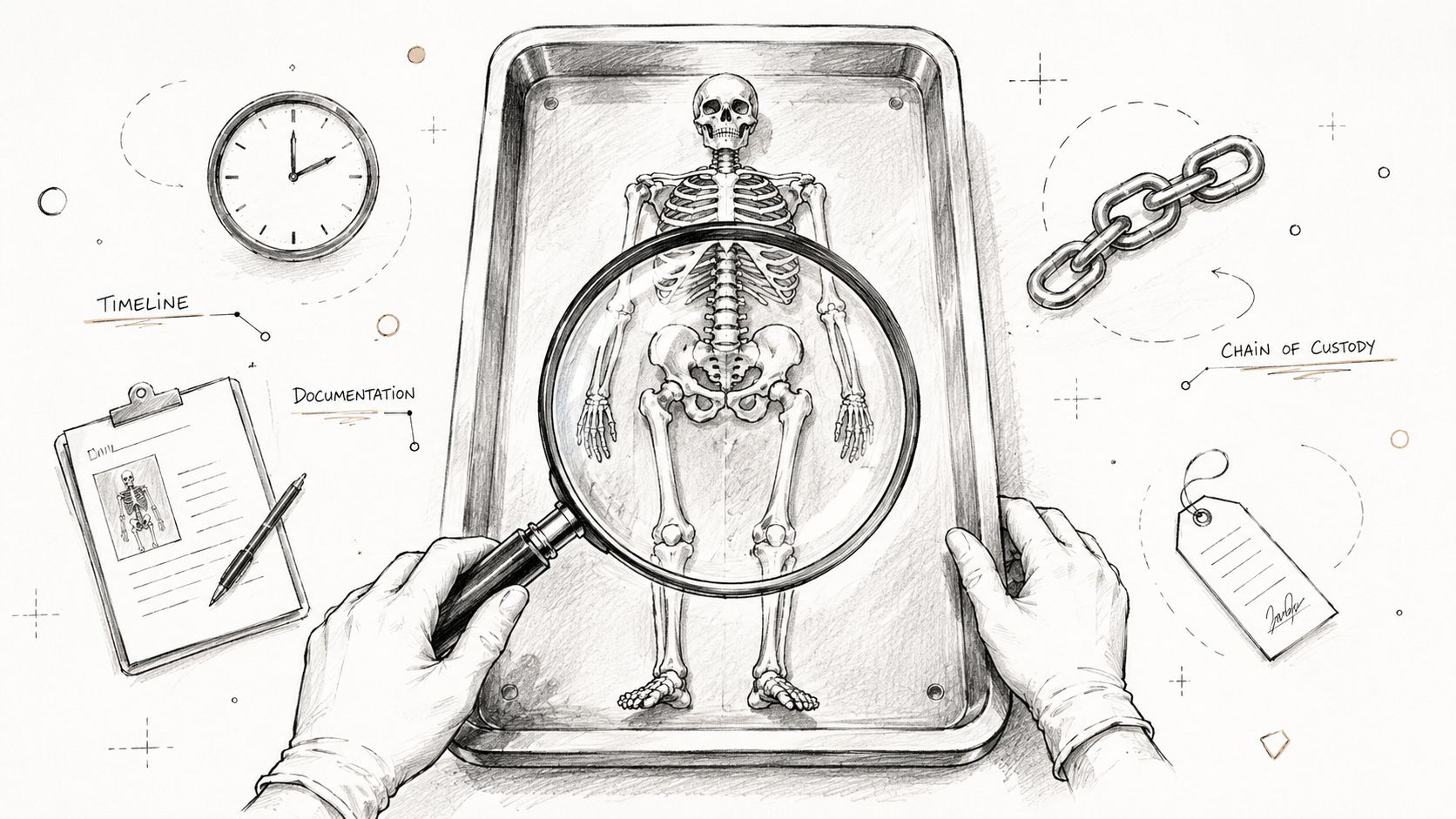
| Chain of custody | The documented handling of the body, specimens, and evidence so the findings remain reliable and legally defensible |
A family may hear “blunt force trauma” and assume that fully explains the death. Often it doesn't. “Blunt force trauma” describes a type of injury, not always the full medical mechanism. A complete cause-of-death opinion may require correlation with toxicology, medical history, scene details, and internal examination findings.
Why death certificates and limited reviews may not answer everything
A death certificate serves an important legal function, but it is not the same as a full forensic explanation. It may summarize the conclusion without laying out the detailed reasoning. In stair fall cases, that can leave unresolved questions about sequence, contributing disease, intoxication, or whether another person played a role.
A private forensic review may also become important when litigation is anticipated. Attorneys handling negligence or wrongful death matters often need a more detailed framework for causation, documentation, and expert interpretation. For a legal overview of how wrongful death claims are generally approached, the CAINE LAW resources can be useful background reading alongside the medical record.
Definition to remember: The autopsy asks what happened inside the body. The legal case asks what that means in the world outside the body. Those are related, but they are not the same task.
Every examination should be objective. For that reason, every examination in our practice is performed by a forensic pathologist certified by the American Board of Pathology. The goal is not to confirm anyone's preferred theory. The goal is to determine what the evidence supports.
Why Families and Attorneys Request a Private Autopsy
A family may be told that a loved one "fell down the stairs," yet the questions start almost immediately. Why were the injuries concentrated in one area. Did a medical event happen first. Could intoxication, neglect, restraint, or an assault have changed what looked like a simple fall. Attorneys face the same problem from a different direction. Before they can assess liability or damages, they need a medically defensible explanation of how the injuries occurred and whether the reported event matches the body.
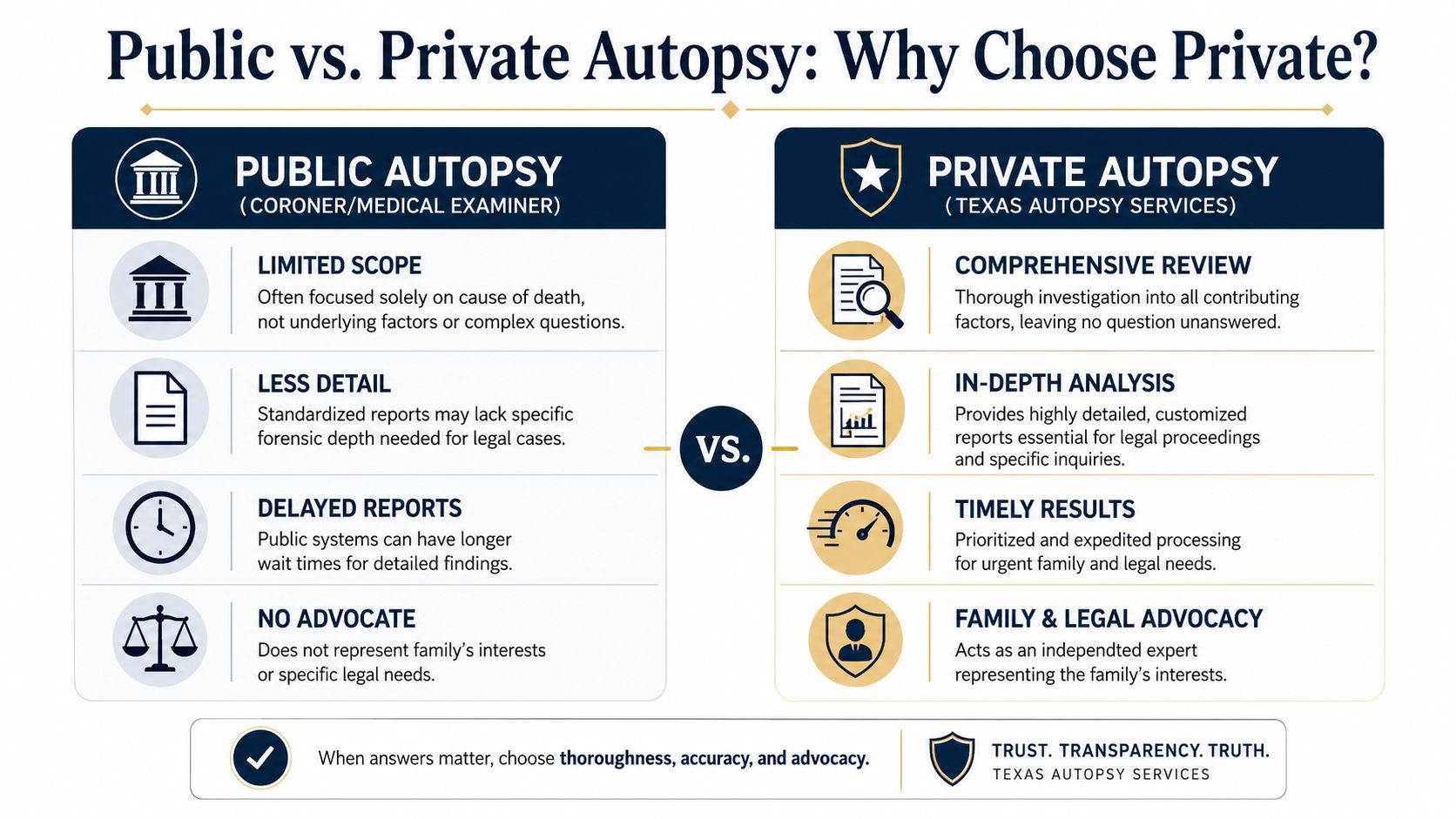
That is one reason private autopsies are requested so often in stair fall deaths. In many cases, no government autopsy is performed. In others, the available records answer the basic legal question of death but not the harder forensic question of mechanism. A hospital chart shows treatment. A death certificate records a conclusion. A private forensic autopsy examines whether the pattern of injuries, disease, toxicology, and circumstances fit together like parts of the same puzzle.
Common reasons a second examination is requested
The request usually comes from uncertainty, but not all uncertainty is the same.
Sometimes the history sounds straightforward while the injuries do not. A single stair fall can cause severe trauma, especially in older adults or medically fragile people, but some findings raise additional questions. Examples include injuries on both sides of the body that do not match the reported movement, neck compression findings, patterned bruises, delayed medical care, or evidence of a collapse from stroke, seizure, or heart disease before the person ever struck the stairs.
Sometimes the issue is missing documentation. If no official autopsy was done, the family may have no internal examination, no retained specimens, and no detailed photographic record. For attorneys, that gap can affect causation analysis, premises liability review, wrongful death claims, or defense strategy. Early forensic evidence collection and specimen preservation can make a meaningful difference because some questions become harder to answer as time passes.
A second examination is also requested when the people closest to the decedent cannot reconcile what they were told with what they observed. That concern deserves objective review. It does not prove foul play, and it does not accuse anyone by itself. It means the case needs a careful medical assessment by someone whose role is to test the explanation against the evidence.
Grief complicates every step of this process. Families are often making decisions while exhausted, shocked, and trying to understand unfamiliar medical terms. Some families seek professional help for coping with grief while they work through forensic and legal questions at the same time.
What independence changes
An independent autopsy creates a separate record. That matters in cases involving a hospital, nursing facility, caregiver, property owner, insurer, or disputed witness account. Independence allows the examination to focus on the medical findings without relying only on the summary already placed in the file.
For families, this can bring clearer answers about cause of death, timing of injuries, and whether a stair fall was the primary event or the final event in a longer medical sequence. For attorneys, it can provide documented findings, specimen review, and expert interpretation that are easier to use in litigation or case evaluation. Our Private Autopsies page explains the scope of these examinations, and our County Forensic Autopsies page explains how forensic services may also support counties that need qualified postmortem expertise.
Our Private Autopsy Process What to Expect
A family may call us within hours of a death on the stairs. The emergency record says "fall." The visible injuries appear to fit that history. Yet the central forensic question often remains open. Did the person die from injuries caused by the fall, or did a medical event, intoxication, assault, neglect, or delayed complication lead to the fall or occur alongside it? Our process is built to answer that question carefully, respectfully, and in a way families and attorneys can use.
From first call through final report
The work begins with orientation. Families usually want to know who can authorize the examination, where the body will go, what testing may be possible, and how quickly decisions need to be made. Attorneys often need the same answers, plus documentation that will hold up under scrutiny.
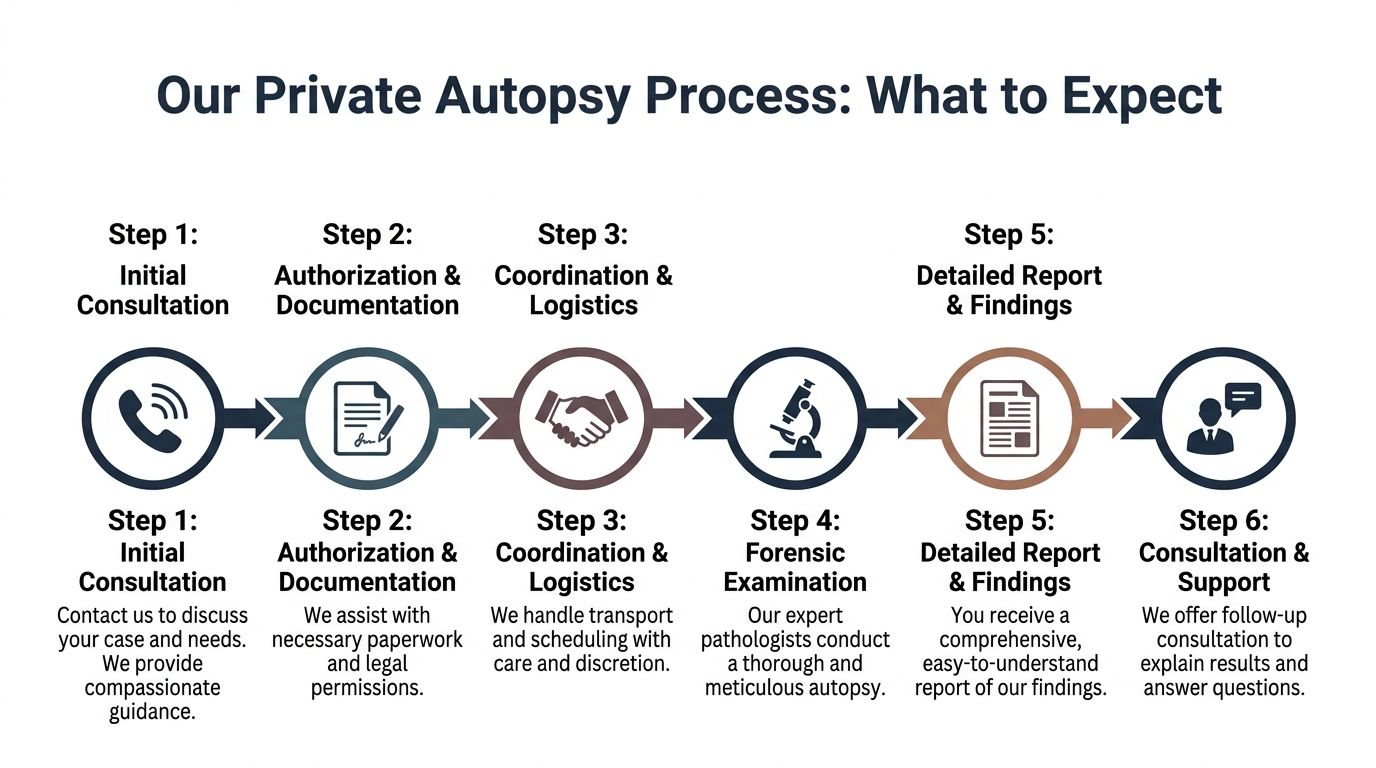
The usual process follows these stages:
Initial conversation
A family member, attorney, healthcare professional, or county representative contacts our team. We gather the known timeline, where the decedent is located, whether any public office is involved, and what question needs an answer. In a stair fall case, that question may be whether the injuries match a fall pattern at all.Authorization and legal documentation
We identify the person with legal authority to consent to the examination and explain the required paperwork. Texas procedures are shaped by the Texas Health & Safety Code, and related handling and funeral matters are also governed by state law and the Texas Funeral Service Commission.Transport and facility coordination
Our practice serves all 254 Texas counties and handles in-house licensed transport. Document control starts here, not later. If you want a clearer picture of how photographs, specimens, and related materials are preserved, our article on forensic evidence collection and documentation standards explains that process.Forensic examination
Every examination is performed by a forensic pathologist certified by the American Board of Pathology. The examination may include an external and internal examination, injury mapping, specimen collection, and review of records or scene information. In stair deaths, pattern matters. A single impact, multiple impacts, defensive injuries, natural disease, and toxicologic impairment can produce very different interpretations even when the reported event sounds simple.Report preparation
Families and attorneys receive a detailed written report. We write for two audiences at once. The report must be medically precise, and it must also be understandable to a reader without medical training.Follow-up discussion
Questions often become sharper after the report is read. A follow-up consultation allows us to explain the findings, the limits of the findings, and what additional records or expert review may still be useful.
Why timing, documentation, and custody matter
A private autopsy is usually most informative when arranged early after death. Delay can reduce what can be seen and tested, especially if there has been significant postmortem change or embalming. The physical examination itself takes a limited period of time, but the full case does not end when the examination ends. Microscopy, toxicology, neuropathology review, record collection, and correlation with the reported stair event can all extend report completion.
That delay is not a sign of inattention. It often reflects caution.
Stair fall cases can be deceptively complex. A bruise may be recent, older, or partly obscured by postmortem change. A head injury may look obvious but still require microscopic review to estimate timing and significance. A fracture may support the reported mechanism, or it may raise the possibility of a different sequence of events. Forensic pathology works like reconstructing a collapse from the broken pieces. The visible damage matters, but so does order, location, and context.
Chain of custody matters for the same reason. It means there is documented control over the body, specimens, photographs, and records from one step to the next. In a medically or legally disputed death, that record helps show that the findings were preserved properly and interpreted from reliable material. Our work is also supported through our Waterloo Mortuary Partnership, which helps families and professionals understand facility coordination in practical terms.
We keep communication direct. Clients speak with our team, not a call center. Families deserve plain answers during a painful time, and attorneys need accurate logistical information without delay.
Frequently Asked Questions About Private Autopsies
Can a private autopsy report be used in court
Yes. A properly documented private autopsy can support litigation and formal review. Its usefulness depends on the quality of the examination, the documentation, the chain of custody, and the expert interpretation that supports the conclusions. A court-admissible report should be objective and medically grounded.
Can an autopsy still be helpful after embalming
Sometimes, yes. The value depends on what question needs to be answered and how much time has passed. Some findings may be less clear after embalming, but an examination can still provide useful information in selected cases. Families should ask as early as possible so the available options can be assessed before more postmortem changes occur.
How much does a private autopsy cost in Texas
Cost depends on scope, transport needs, and whether additional testing is required. Ethical forensic practices should explain pricing clearly in advance. Families and attorneys should ask what is included, whether transport is separate, and whether toxicology or other specialty studies involve added expense.
How do families start the process in Texas
The first step is to contact the practice and explain where the body is located, whether any government office is involved, and who has legal authority to authorize the examination. The team can then explain documentation, transport, timing, and whether the case appears suitable for a private autopsy services Texas request.
What is the difference between cause of death and manner of death
Cause of death is the disease or injury that led to death. Manner of death is the classification of how the death occurred, such as accident or homicide. Both terms matter in stair fall cases because a death can involve blunt injuries while still raising separate questions about how those injuries were sustained.
If your family, law firm, hospital, or county office needs clear answers after a stair fall death, contact Texas Autopsy Services. We provide independent private autopsy and forensic pathology services across Texas with direct communication, respectful handling, and medically precise reporting. Every examination is performed by a forensic pathologist certified by the American Board of Pathology. Families and attorneys can also reach our team at (806) 230-1889 for guidance on next steps.