March 5, 2026 · Texas Autopsy Services
What Families Should Know About Medical Malpractice Reviews in Texas
A forensic pathologist explains the medical malpractice review process, offering clear insights for families and attorneys seeking answers.
On this page
- Why an Independent Medical Malpractice Review Is Necessary
- The Critical Role of a Private Autopsy
- Understanding the Reality of Medical Errors
- The Medical Malpractice Review Process Step by Step
- How Autopsy Findings Strengthen a Legal Claim
- What to Expect: Costs and Timelines
- Common Questions About Malpractice Reviews and Autopsies
When a loved one dies under medical care, families are often left with grief and lingering questions. Was their death preventable? Did the care they received meet the established standard? A medical malpractice review is an independent investigation designed to answer those questions. It provides an objective look at medical records and, when necessary, includes a private autopsy to find the truth that paperwork alone cannot reveal.
- An independent medical malpractice review provides objective answers when you suspect a medical error caused a loved one's death.
- A private autopsy, performed by an unbiased forensic pathologist, is often crucial for uncovering evidence not found in medical records.
- As a board-certified forensic pathologist, my role is to determine the cause of death and connect it to the standard of care provided.
- The entire process is confidential and compliant with Texas law, ensuring your privacy and the integrity of the findings.
- A comprehensive report delivers clear, science-based conclusions to help families find closure or support a legal claim.
Why an Independent Medical Malpractice Review Is Necessary
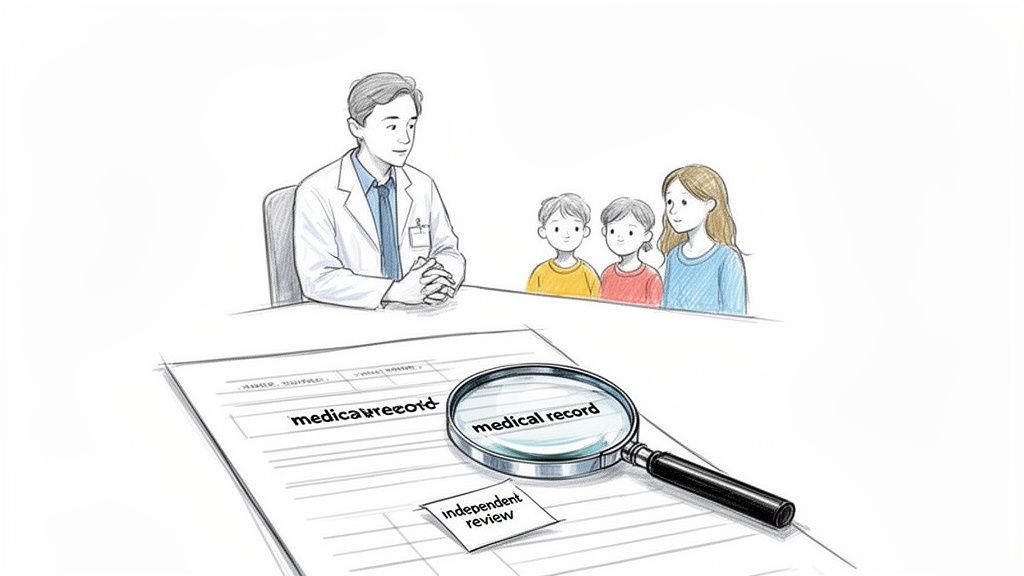
I’ve sat with many families who are struggling with uncertainty after a loved one’s unexpected death. Their story is often the same: the outcome of a medical treatment was tragic and unforeseen. Their central question is always, Could this have been prevented?
While medical records create a timeline, they don't always capture the full picture. An independent medical malpractice review is about a search for truth. As a board-certified forensic pathologist, my purpose is to provide clear, science-based answers through an unbiased and thorough investigation.
Moving Beyond Hospital Explanations
Hospitals nearly always conduct internal reviews after an unexpected death. When negligence is suspected, this is rarely sufficient. A conflict of interest arises when an institution investigates itself. An independent review offers what a hospital cannot.
- True Objectivity: I am not affiliated with the hospital or doctors involved. My duty is to the scientific facts and the evidence.
- Specialized Expertise: Having performed over 1,000 autopsies, I bring a specific skill set to each case. I am trained to identify subtle indicators of medical error that a routine hospital autopsy might miss.
- A Clear Focus on Causation: My work is to connect the facts. I determine if the standard of care was breached and, more importantly, whether that breach directly led to the patient's death.
The ultimate goal is to provide families with solid, definitive answers. This creates a path to closure, whether it confirms their concerns or reassures them that everything possible was done.
A truly independent review can bring critical facts to light that you would never find in medical charts. This could include medication errors that were not documented, unrecognized surgical complications, or a fatal missed diagnosis. For any family considering legal action, this objective evidence is the foundation of a potential case.
This is not just about legal proceedings. Obtaining clear, honest answers is a crucial part of the grieving process itself. You can explore how a forensic pathologist's analysis of medical records plays a key role in these situations. A medical malpractice review gives you the ability to move forward, replacing painful speculation with certainty.
The Critical Role of a Private Autopsy
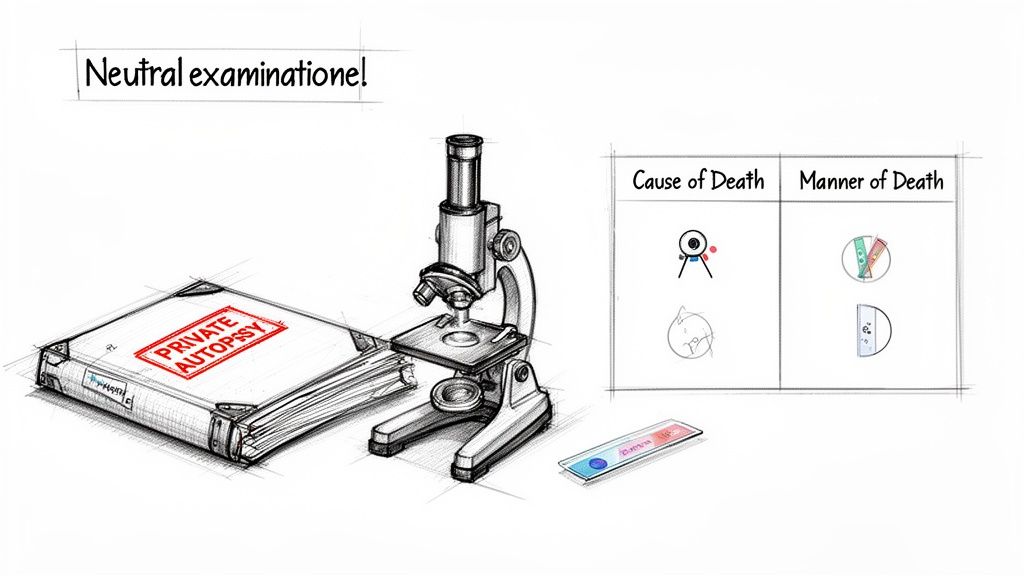
When families suspect a medical error led to a death, one of the first questions is often about a hospital autopsy. It's important to understand the distinction: a hospital’s examination is not the same as a private autopsy. An independent evaluation, conducted by a forensic pathologist with no connection to the hospital, is the only way to guarantee a truly unbiased investigation.
As the founder of Texas Autopsy Services, my sole purpose is to uncover the scientific facts. I am not concerned with institutional reputation or potential liability, only with the truth. That objectivity is the foundation of any credible medical malpractice review.
Distinguishing Cause from Manner of Death
So, what are we actually looking for? In every examination I perform, I must distinguish between two fundamental concepts: the cause of death and the manner of death. They sound similar, but they answer very different questions.
- Cause of Death: This is the specific medical reason for the death. Think of it as the final, fatal event, such as a massive heart attack, a brain hemorrhage, or overwhelming sepsis.
- Manner of Death: This explains the circumstances that led to the cause. There are five official categories: Natural, Accident, Suicide, Homicide, and Undetermined.
In a malpractice investigation, the goal is to see if an action, or inaction, by a medical professional initiated the fatal cause. For example, the cause of death might be a drug overdose, which could be ruled an Accident. But if the autopsy reveals it was the wrong medication or a fatal dosage error, that points toward negligence and can change everything.
An autopsy provides an unfiltered view of what was happening inside the body at the time of death. It can reveal critical evidence that simply doesn't exist in medical records or on scans taken while the patient was alive.
Uncovering What the Charts Don't Show
Medical records are essential, but they provide only one side of the story. They show what doctors and nurses recorded, but they cannot reveal the direct, physical result of their decisions. A private autopsy can fill in those blanks.
Over the years, my examinations have uncovered crucial evidence that was completely missed, such as:
- Undiagnosed Conditions: I've found fatal blood clots (pulmonary embolisms) that should have been recognized and treated.
- Surgical Complications: I have discovered internal bleeding or organ injuries from a procedure that went unnoticed until it was too late.
- Medication Errors: Physical evidence within the body can point to a harmful drug interaction or an incorrect dosage that contributed to the death.
- Infections: I can identify the source of a rampant, untreated infection that led to sepsis and catastrophic organ failure.
As a forensic pathologist with board certification from the American Board of Pathology, I hold every examination to the highest medical and ethical standards. This ensures my findings are not just accurate but also solid enough to be presented in a legal context. For families and attorneys in Texas, a private autopsy delivers the concrete evidence needed to move from suspicion to certainty and build a strong foundation for a medical malpractice review.
Understanding the Reality of Medical Errors
It's difficult to discuss medical errors. No one wants to think that the healthcare system designed to heal can sometimes cause harm. But ignoring this reality does not help anyone, especially families left with devastating questions after an unexpected death.
Facing this issue is the first step. It helps us understand why that gut feeling that something went wrong is often more than just grief. It’s a legitimate concern rooted in a known problem in healthcare.
The Scope of the Problem
How common are these preventable mistakes? The numbers are significant. In the United States, medical errors are a major public health issue. Some studies estimate that preventable errors lead to between 250,000 and 400,000 deaths each year, ranking them as a leading cause of death.
These are not just numbers on a page. Each one represents a family thrown into confusion and grief. The financial toll is also immense, costing the U.S. economy an estimated $20 billion annually. If you would like to look deeper into these figures, you can explore medical malpractice statistics and their implications.
The National Practitioner Data Bank tracked 11,440 malpractice claims in 2023 alone. This confirms that while doctors and nurses do incredible work, preventable harm happens, and an objective review is sometimes the only way to get answers.
Why This Matters for Your Family
While those statistics paint a national picture, your situation is intensely personal. It is not about averages; it is about what happened to the person you love. Was their death an unavoidable tragedy, or was it a preventable mistake that could have and should have been caught?
That is where I come in. As a forensic pathologist, my focus is on finding the objective, medical truth. I step in to bridge the gap between your family's loss and the hard evidence. By performing a thorough, independent review, I can determine if the care provided fell short of the accepted medical standard and if that failure directly led to the tragic outcome.
For families here in Texas, this process provides two things you desperately need:
- Validation: It can confirm whether your suspicions are supported by medical fact.
- Clarity: It gives you concrete answers, helping to end the painful cycle of wondering "what if?"
Ultimately, knowing the reality of medical errors is not about losing faith in medicine. It’s about empowering yourself to demand the truth. It confirms that seeking an independent investigation is a reasonable and necessary step when you have unanswered questions. A private autopsy provides the solid, scientific foundation needed to find closure or pursue justice.
The Medical Malpractice Review Process Step by Step
For a family member or an attorney trying to determine if a medical error led to a death, the path forward can feel uncertain. I want to walk you through how a medical malpractice review works here at Texas Autopsy Services, so you know exactly what to expect. My approach is built on delivering clear, scientifically sound answers with the respect your loved one deserves.
This is a careful, methodical investigation. We start with a conversation and move through a detailed process designed to be thorough. The goal is simple: to give you objective answers you can trust.
Stage 1: The Initial Consultation and Record Gathering
Everything begins with a conversation. This is where you, or your attorney, can explain the situation and share your concerns about your loved one’s care. Before any medical work begins, I take the time to listen and understand the full story.
From there, we gather all necessary paperwork. This is a crucial step and typically includes:
- Complete hospital charts and clinical records
- Notes and orders from the attending physicians
- All lab results and imaging scans like X-rays or CT scans
- Reports from any previous medical procedures or surgeries
Analyzing these records is the first step in identifying where care might have gone wrong. For attorneys, knowing what to look for is key. You can find more on my approach in this guide on reviewing medical records for attorneys.
Stage 2: The Independent Autopsy and Specialized Analysis
The heart of this review is the private autopsy. This independent physical examination is where we can find physical evidence that a stack of medical charts could never reveal. I perform this procedure with the greatest care and respect in a fully equipped, professional facility.
My examination goes far beyond what the eye can see. I use specialized lab tests, like toxicology to check for medication mistakes or histology (microscopic analysis of tissues) to find hidden disease or cellular damage. It’s about building a complete picture.
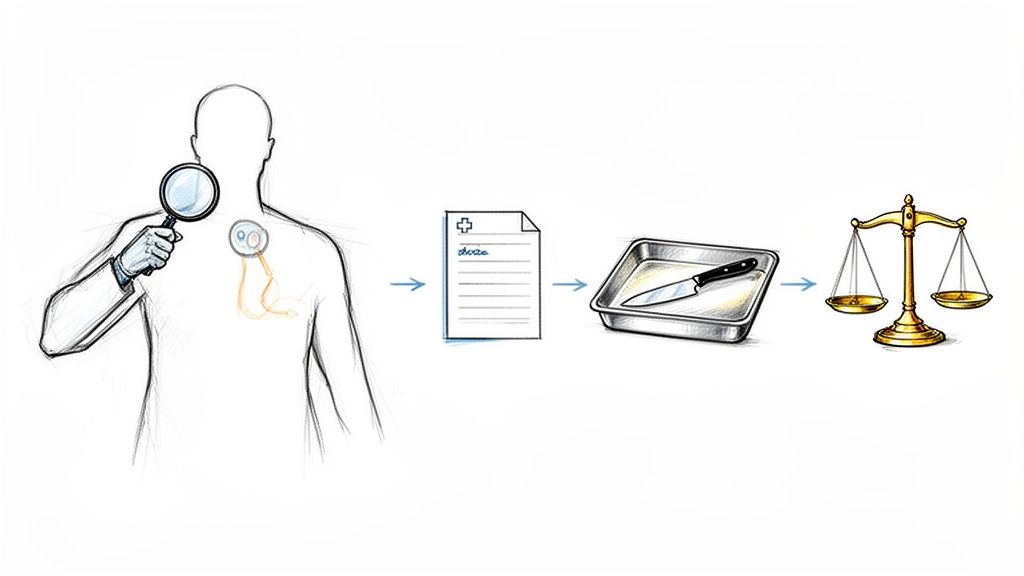
This simple flow chart breaks down our review into three clear stages: consult, examine, and report.
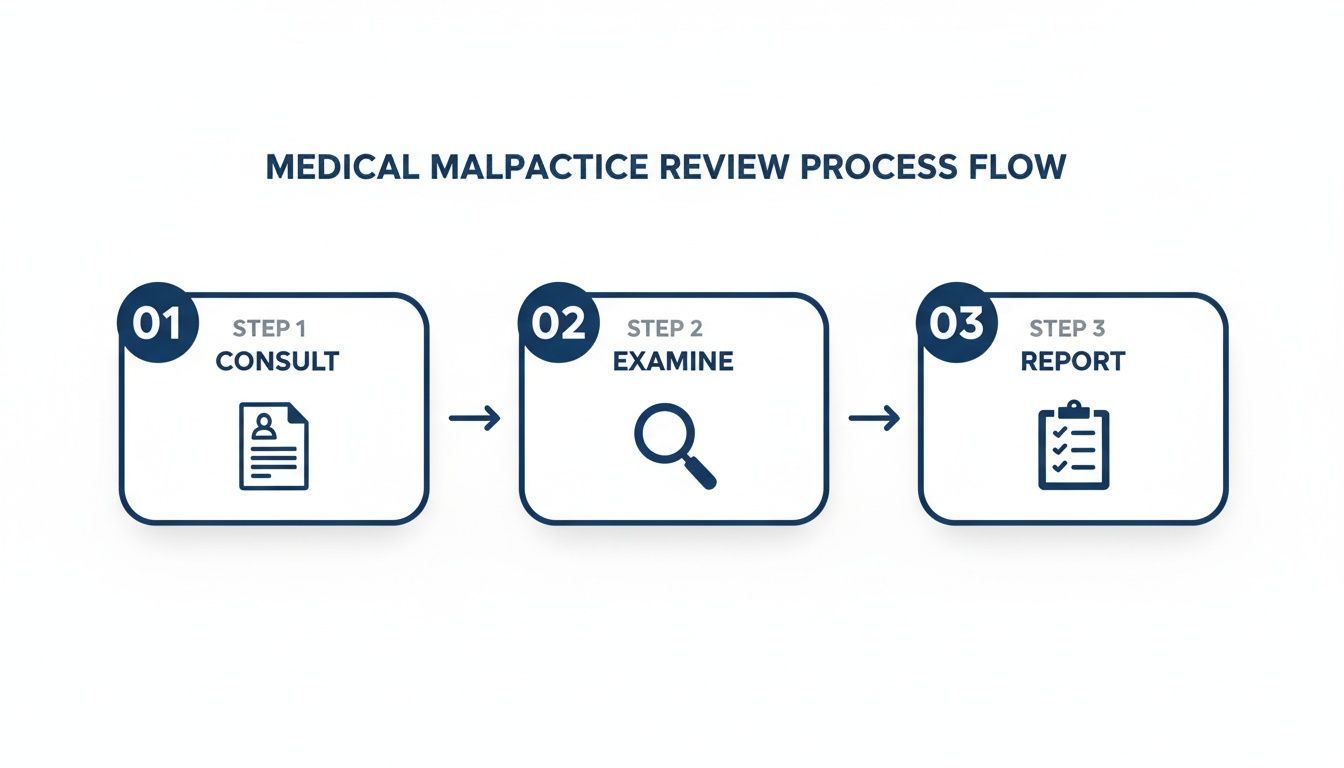
Each step builds logically on the one before it, ensuring we conduct a thorough and scientifically rigorous investigation from start to finish.
Stage 3: The Final Report and Chain of Custody
Once the autopsy and all specialized tests are complete, I compile all the information. The result is a single, comprehensive report that explains my findings in clear, straightforward language. It directly addresses the critical questions about the standard of care and the cause of death.
To ensure this report is legally sound, the entire process follows a strict chain of custody. Every piece of evidence, from the first tissue sample to the final document, is meticulously tracked according to protocols compliant with the Texas Health & Safety Code. This makes the final report a legally defensible document that gives an attorney the solid, scientific foundation they need. After all, knowing how to prove medical negligence is the foundation of any case, and my report provides the hard facts needed to do just that.
How Autopsy Findings Strengthen a Legal Claim
An independent autopsy report is more than just a document determining cause of death. For an attorney working on a medical malpractice review, my findings become the scientific backbone of the legal claim. They provide objective evidence that can draw a direct line from a medical mistake to a patient’s death.
In legal terms, this connection is called "causation." It is often the most difficult element to prove in a malpractice case. A detailed autopsy report moves the discussion from speculation to established medical fact, giving the legal team the concrete proof needed to build their case.
Establishing Causation and Refuting Alternatives
My primary job is to pinpoint the exact injury, condition, or chain of events that led to the death. Consider a patient who died from a pulmonary embolism after surgery. An autopsy can confirm the clot was present. More importantly, a deep analysis of the findings can show whether this was an unforeseeable complication or a predictable risk that should have been managed with preventative care.
The report also serves as a strong defense against a hospital's counterarguments. A hospital's legal team will almost always suggest other reasons for the death, such as pre-existing health issues. A thorough, unbiased autopsy can scientifically dismantle those alternative theories, leaving a clear path from the medical error to the tragic outcome.
An autopsy report provides a powerful, unbiased narrative of what occurred physiologically. It grounds legal arguments in verifiable science, making it much more difficult for opposing counsel to create doubt.
This impartial evidence is often what decides a case by keeping the focus on medical facts, not competing stories. To see how critical this can be, you can read my guide on the role of a medical malpractice expert witness.
Navigating Modern Medical Challenges
Medicine is constantly evolving, as are the types of malpractice we see. We are now dealing with cases involving complex technologies, including diagnostic artificial intelligence. Since 2022, there has been a 14% increase in malpractice claims related to AI tools, especially in radiology and cardiology where algorithms are used to read scans.
When an AI misses a tumor on a CT scan or misinterprets a cardiac test, determining fault becomes complex. This is where a forensic pathologist's expertise is essential. I provide the human analysis needed to interpret the data and explain exactly how an error led to a fatal outcome.
It’s also important to remember that a small number of providers are often behind a large number of incidents. National data shows that just 1.8% of doctors are responsible for more than half of all malpractice payments. My work provides the objective clarity needed for accountability, whether the error was human or technological.
Once an autopsy strengthens the case, the next step is often to understand its potential value. A tool like a Personal Injury Settlement Calculator can help clarify the financial side of a claim built on solid evidence.
What to Expect: Costs and Timelines
When families and attorneys contact me, two questions almost always come up: "How much will this cost?" and "How long will it take?" These are fair questions. When you're dealing with so much uncertainty, you deserve clear answers about the investment of time and money.
At Texas Autopsy Services, we believe in all-inclusive pricing. The quote I provide is the full price. There are no surprise fees for standard procedures. Everything from the examination to toxicology testing and the final, detailed report is covered, so you can plan without worrying about hidden costs.
Understanding the Cost as an Investment
Consider a private autopsy and review as an investment in truth. While the exact cost can change depending on case complexity or the need for highly specialized tests, its real value is in the clarity it provides. It can be difficult and expensive to pursue a legal case built on speculation, only to discover later the evidence isn't there. A thorough review establishes the facts from the start.
The financial stakes in these cases are high. In 2025, the national average for a medical malpractice payout was around $450,000 per claim, a 4.65% increase from previous years. These numbers show how important it is to have evidence-based answers. If you're interested in the data behind these trends, you can learn more about medical malpractice payout data.
The goal here is certainty. An independent review gives you the solid answers you need to either build a strong legal claim or find the closure to move forward without a long and costly lawsuit.
Setting a Realistic Timeline
A proper, careful investigation cannot be rushed. While the physical autopsy is usually completed in a day, the detailed work happens in the weeks that follow. My priority is to get you answers as soon as possible, but never at the expense of accuracy.
Several factors affect the timeline:
- Reviewing Records: First, I must go through all existing medical records. This can take a few days depending on the volume.
- Lab Work: Specialized tests like histology (microscopic tissue analysis) and toxicology screenings are precise scientific work. It can take several weeks to get these results back.
- Analysis and Reporting: Once all data is in, I personally analyze every piece of information and write the final report, carefully explaining how the medical evidence connects to the events.
I can typically provide a preliminary report with initial findings within a few business days of the autopsy. The final, comprehensive report usually takes between 60 and 90 days to complete, though this can shift based on your case's specific needs. I will keep you updated throughout the process so you always know where things stand.
Common Questions About Malpractice Reviews and Autopsies
When families and attorneys contact me, they often have similar questions. It's an unfamiliar and stressful time, so my goal is to answer some of the most common concerns and give you a clearer picture of what a medical malpractice review involves.
Is it too late for an autopsy if my loved one was embalmed?
This is a frequent worry, but in most cases, the answer is no, it's not too late. While the embalming process changes tissues and fluids, a skilled forensic pathologist can still uncover vital evidence.
Some tests, like detailed toxicology for medications, become more difficult. However, the physical examination of organs can still reveal things like surgical mistakes, hidden internal injuries, or undiagnosed conditions. I can review the specifics of your case and explain what a post-embalming autopsy could still accomplish.
Does the hospital know we are conducting a private review?
No. A private autopsy is exactly that: private. You are in complete control. No laws require you to notify the hospital or the doctors involved.
My findings and the completed report are shared only with you or your attorney. This confidentiality is one of the main reasons families choose to work with an independent pathologist. It gives you the space to get straight answers without outside influence.
My highest priority is treating the deceased with dignity and respect. Every examination follows strict ethical and professional standards, and our partnership with Waterloo Mortuary ensures a dignified environment from start to finish.
What happens if the autopsy finds no malpractice?
My job as a forensic pathologist is to find the objective, scientific truth, whatever that may be. If an autopsy shows that death was due to natural causes or an unavoidable complication, that finding is just as important.
It provides the family with definite answers and a sense of closure. It can also save you from the emotional and financial turmoil of pursuing a legal case that is not supported by the facts. The goal is always clarity, and a report that rules out negligence provides that just as powerfully as one that confirms it.
How is the deceased treated during the autopsy?
We always remember that we are caring for someone's family member. Once the examination is finished, we perform all necessary restorative work with the utmost care. This is done to ensure your loved one can be returned to you for funeral services, allowing for an open-casket viewing if that is your wish. Every step is handled with deep respect for both the deceased and the grieving family.
If you are an attorney or a family in Texas with unanswered questions about a loved one’s death, please do not hesitate to get in touch. I am here to provide the clear, compassionate, and expert answers you deserve.
For a confidential consultation, please contact Texas Autopsy Services directly.