December 3, 2025 · Texas Autopsy Services
The Medical Examiner in Texas: Role and Jurisdiction
Discover the role of a medical examiner texas, the autopsy process, and when a private autopsy may be needed for your case.
On this page
- When a county medical examiner declines jurisdiction, a private autopsy provides independent, objective cause-of-death findings.
- My examinations are performed by me, our forensic pathology team, a board-certified forensic pathologist with experience in over 1,000 autopsies.
- Families and attorneys receive transparent, comprehensive reports written in clear language.
- The process is confidential, respectful, and fully compliant with Texas legal standards.
- I can provide guidance on whether an independent autopsy is the right path for your family.
When a loved one passes away suddenly, the official cause of death might be listed as "cardiac arrest" or another general term. While medically accurate, this often leaves families with more questions than answers. You may wonder what specific condition led to the event or if there were underlying factors that went unnoticed. This is a situation I encounter frequently in my work as a forensic pathologist. A county medical examiner’s role is to serve the public by investigating deaths that are suspicious or unnatural, but they often must decline cases that fall outside this narrow legal scope, leaving families in a painful state of uncertainty.
As a board-certified forensic pathologist and the owner of Texas Autopsy Services, my role is to provide definitive medical answers when the public system cannot. I speak for the deceased by interpreting medical evidence with precision and care. This work is about providing truth for families, clarity for legal matters, and a complete picture for those left behind.
The Role of a Medical Examiner in Texas
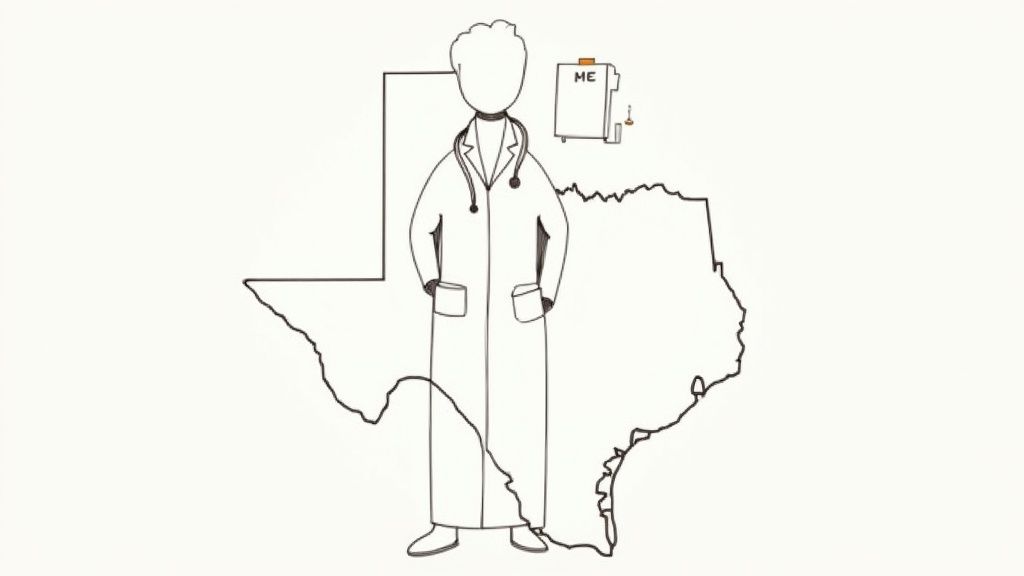
In Texas, a medical examiner is a licensed physician, specifically a pathologist with specialized training to investigate deaths that are violent, suspicious, or without a clear medical reason. My responsibility as a forensic pathologist is to determine the cause and manner of death through an objective, science-based investigation. This system is established by Texas law to ensure any death affecting the public interest receives a proper medical review.
This serves several critical purposes:
- Protecting Public Safety: Identifying deaths from violence, contagious diseases, or environmental hazards helps keep the community safe.
- Providing Legal Clarity: Our findings are essential for the justice system, used in criminal cases, insurance claims, and estate settlements.
- Giving Families Answers: Above all, we provide families with facts. A clear, medically sound explanation for a loved one's passing is a crucial part of the grieving process.
The data gathered from these examinations is also invaluable. Detailed findings can contribute to broader public health studies, with tools like an AI agent for healthcare medical research helping to uncover patterns that advance medical knowledge.
Medical Examiner vs. Justice of the Peace
A common point of confusion in Texas is the distinction between a medical examiner and a Justice of the Peace (JP). While both can pronounce a death, their qualifications are very different.
A medical examiner is always a physician, usually a highly trained forensic pathologist appointed for their medical expertise. In contrast, a Justice of the Peace is an elected official who may have no medical background. In many Texas counties, the JP acts as the coroner, but their investigative capacity is limited by their lack of medical training. The medical examiner system ensures an investigation is guided by science, not just legal procedure.
When the Medical Examiner Gets Involved
Not every death requires a government investigation. However, under specific circumstances outlined in the Texas Code of Criminal Procedure, Article 49.25, a medical examiner is legally required to take jurisdiction. My work begins when one of these deaths is reported. The central question is whether the death was sudden, unnatural, or suspicious.
Legal Triggers for a Medical Examiner Investigation
The law is specific about when a medical examiner must investigate. These triggers include:
- Unnatural Deaths: This broad category covers deaths from violence, such as homicide or suicide, as well as accidents like car crashes or falls.
- Sudden or Unexplained Deaths: When a person who appeared healthy dies without an obvious medical reason, an investigation is required.
- Suspicious Circumstances: If any evidence suggests foul play, the case falls under the medical examiner’s authority.
- Deaths Without a Doctor Present: An investigation is necessary if someone dies without being under the recent care of a physician who can confidently sign the death certificate.
These rules ensure that every questionable death receives a thorough, unbiased review. For a deeper look at these scenarios, our guide on when an autopsy is required provides more detail.
The Initial Investigation Process
Once a death is reported to a medical examiner's office, a methodical process begins. A field investigator typically goes to the scene to document the surroundings, perform an external examination of the body, speak with family or witnesses, and review the person’s medical history.

Based on these initial findings, a decision is made on whether to transport the body for further examination. If the cause isn't clear or the case meets a legal trigger, transport is authorized to allow for a more detailed evaluation, which may or may not include a full autopsy. The goal is always to reach an accurate, evidence-based conclusion.
Why Families Consider a Private Autopsy
County medical examiners provide an essential public service. However, their work is defined by legal statutes and limited resources. Their primary mission is to investigate deaths that affect public health and safety. If a death appears to be from natural causes, even if sudden, a county office may legally decline to perform an autopsy once it has determined there is no threat to the public.
This is the correct decision from a legal and resource standpoint, but it can leave families with profound and unanswered questions.
When Official Answers Aren't Enough
A county medical examiner's office often has a heavy caseload, forcing pathologists to prioritize deaths that fall strictly within their legal jurisdiction. This reality means some deaths, while tragic and confusing for a family, do not meet the legal threshold for a government-funded autopsy.
This is where a private autopsy becomes a vital option. Families often contact me in one of these situations:
- Jurisdiction is Declined: The ME’s office has reviewed the case and determined it does not fall under their legal authority to investigate further.
- A Desire for a Second Look: Even when a county performs an autopsy, a family may want a second, independent expert to review the findings and ensure no detail was missed.
- Unanswered Medical Questions: A death certificate might list a general cause like "cardiac arrest," but families often need to know the specific condition for peace of mind and to understand potential genetic risks.
- Concerns About Medical Care: Questions about the quality of medical care a loved one received can be addressed through a private autopsy, which can clarify if a condition was missed or improperly managed.
The Role of an Independent Autopsy
A private autopsy service is not adversarial to the public system; it’s a parallel service that answers personal questions the public system isn't designed to address. The investigation focuses entirely on the family's specific concerns. This independence is key. An independent autopsy serves the family directly, providing a dedicated, unbiased examination focused solely on finding definitive medical answers, free from the jurisdictional and caseload constraints of a public office. In cases involving civil lawsuits or insurance disputes, a clear, objective examination by a board-certified forensic pathologist provides scientifically solid evidence.
When the official process ends but questions remain, a private autopsy offers a confidential and compassionate path to finding answers.
What to Expect from an Independent Autopsy
https://www.youtube.com/embed/rinvGpUwaTo
When a family contacts me, they are navigating grief while seeking clarity. A private autopsy is a meticulous process designed to find the specific answers a family needs. From our first conversation, I explain every step, starting with the legal authorization required from the next-of-kin. The entire process is transparent and compliant with Texas law.
Initial Steps and Focused Examination
Once a family decides to proceed, they sign an authorization form, giving legal permission for the examination. My team and I then coordinate directly with the hospital, medical examiner’s office, or funeral home to arrange for dignified transport. We partner with Waterloo Mortuary to ensure this is handled respectfully.
Unlike a government autopsy serving the public interest, a private autopsy serves your family. This allows for a more comprehensive investigation. I review the complete medical history, consider contributing factors, and speak with family members to get a full clinical picture. This detailed approach is critical. In 2018, U.S. medical examiner offices only accepted jurisdiction in about 36% of reported cases, according to a Bureau of Justice Statistics report. A private autopsy closes that gap for families left without answers.
The examination includes:
- A complete external and internal physical examination.
- Collection of tissue samples for microscopic analysis (histology).
- Collection of fluid samples for toxicology testing.
The Final Report: Comprehensive and Clear
After all analyses are complete, I personally write the final report in plain English, not dense medical jargon. My goal is to deliver a document that is both scientifically rigorous and genuinely useful. The final autopsy report is more than a medical document; it's the definitive story of what happened, told through objective, scientific evidence.
The report breaks down all findings into clear sections:
- Gross Findings: A description of what was observed in each organ system.
- Microscopic Findings: Lab results revealing disease or injury at a cellular level.
- Toxicology Results: A list of any substances found and their concentrations.
- Final Anatomic Diagnoses: A summary of all identified medical conditions.
- Cause of Death Opinion: My final conclusion, explaining the precise medical reason for the death, backed by all evidence.
This report provides the concrete, unbiased answers needed for legal proceedings, insurance claims, or the peace of mind that comes from knowing the truth. The high standards for this work were established in Texas as far back as 1956 with the Bexar County Medical Examiner's Office, the first in the state. You can learn more by reading the history of the BCMEO.
Choosing a Qualified Forensic Pathologist

The credibility of an autopsy depends entirely on the expertise of the person performing it. Choosing the right forensic pathologist is the most important decision you'll make. This isn’t just about hiring any doctor; it’s about finding an expert whose work will be unbiased, scientifically sound, and able to withstand legal scrutiny.
The Gold Standard: Board Certification
When a pathologist is board-certified by the American Board of Pathology, it signals the peak of specialization. As a board-certified forensic pathologist, my qualifications include:
- Anatomic Pathology: The study of disease in tissues and organs.
- Clinical Pathology: The analysis of bodily fluids.
- Forensic Pathology: The specialized application of medical knowledge to legal investigations.
Achieving these certifications requires years of dedicated training and rigorous examinations. This proves a pathologist has an integrated understanding of disease, toxicology, and the legal standards death investigation demands.
Why Experience Matters
Credentials establish a foundation, but hands-on experience builds the insight needed for complex cases. Having personally performed over 1,000 autopsies, I have handled cases spanning adult, pediatric, and complex forensic scenarios. This volume of experience helps a pathologist identify subtle clues that others might miss and deliver clear, confident conclusions. Major public offices like the Harris County Institute of Forensic Sciences, which managed over 13,000 cases in 2020, rely on rigorously certified staff. The same high standard is critical for a private pathologist. You can see more in their 2020 HCIFS Annual Report.
The pathologist you choose should be an objective medical expert dedicated to finding the truth. Their role is to interpret the evidence dispassionately and present the facts.
Key Questions to Ask
Before hiring a forensic pathologist, ask these direct questions:
- Are you board-certified in Forensic Pathology by the American Board of Pathology? This is the single most important credential.
- How many autopsies have you personally performed? Look for substantial, direct experience.
- Will you be the one performing the autopsy? Ensure the expert you hire does the work themselves.
- What is included in your final report? Confirm you'll receive a comprehensive document explaining all findings.
Asking these questions ensures you select an expert who can deliver the unbiased, scientifically sound answers your family deserves.
Frequently Asked Questions About Texas Autopsies
Over my career, I've answered many questions from families and attorneys. Here are clear, direct answers to some of the most common ones.
Can our family refuse a medical examiner's autopsy?
No. If a death falls under the legal jurisdiction of a Texas medical examiner, the family cannot refuse an autopsy. The ME has a legal mandate to investigate certain deaths for public health and safety. While religious objections are always considered respectfully, the legal requirement to investigate typically takes precedence.
How much does a private autopsy cost in Texas?
The cost varies because each case is unique. The final price depends on factors like the complexity of the medical history, the need for specialized testing, and transportation logistics. I provide a transparent, all-inclusive quote after an initial consultation so families understand all costs upfront.
Does an autopsy interfere with funeral arrangements?
Not at all. An autopsy is a surgical procedure and will not prevent an open-casket viewing. I perform every examination with the utmost respect for the deceased. All incisions are made discreetly and are not visible once an individual is dressed by the funeral home. We work closely with funeral directors to ensure a dignified transition.
How long does it take to get the final autopsy report?
While I can often provide a preliminary cause of death within a day or two, the final, comprehensive report takes longer. A final report can take several weeks or even a few months to complete. This timeline is necessary to include results from specialized lab tests like toxicology and histology, which cannot be rushed.
If you have more questions or need to understand your options, please don't hesitate to reach out. My role at Texas Autopsy Services is to provide clear, compassionate answers when you need them most.