May 29, 2026 · Texas Autopsy Services
A Career Guide to Jobs with Coroners Offices
Explore jobs with coroners offices in our expert career guide. Learn about roles, education, and how to find positions as a pathologist, investigator, or tech.

On this page
- Understanding the World of Death Investigation
- The Core Roles Inside a Coroner or Medical Examiner's Office
- Education and Certification Pathways for Your Career
- A Day in the Life Typical Duties and Responsibilities
- How to Find Coroner Office Jobs in Texas
- Building Your Career From Entry-Level to Expert
- Frequently Asked Questions About This Career Path
- Coroner and medical examiner work is team-based. Individuals entering this field do not typically start as forensic pathologists. They start in investigation, autopsy support, records, transport coordination, or administration.
- The system varies by jurisdiction. Coroner offices and medical examiner offices serve the same public need, but leadership structure, hiring standards, and daily workflows differ from county to county.
- Many backgrounds can fit. Nursing, mortuary science, biology, criminal justice, medical technology, and related experience can all translate into real eligibility for certain positions.
- Texas job seekers need a county-by-county strategy. Hiring is increasingly centralized through digital government portals, and larger counties often recruit differently than rural jurisdictions.
- This work demands both precision and composure. Scientific rigor matters. So do documentation, respectful communication, and the ability to work around grief without becoming careless or detached.
Job seekers interested in coroners offices are not looking for abstract career inspiration. They want to know whether their background fits, whether they need a medical degree, and what the work feels like on a Tuesday morning when a call comes in before dawn.
I understand that question from the inside. I'm our forensic pathology team, a board-certified forensic pathologist. My work centers on cause-of-death investigation, but no office functions on the strength of one physician alone. The field depends on investigators, technicians, records staff, transport partners, and administrators who can do difficult work carefully and consistently.
For the right person, this can be a deeply meaningful career. It's also procedural, demanding, and specific. Good intentions help, but they aren't enough. Offices need people who can follow legal process, document details, and treat the deceased and their families with dignity.
Understanding the World of Death Investigation
The first point of confusion for many applicants is the difference between a coroner and a medical examiner. That distinction matters because it changes who supervises the office, what qualifications leadership must hold, and how other jobs are structured under that system.
In the United States, coroners are often elected lay officials depending on state law, while medical examiner systems are generally staffed by appointed physicians. One county government summary also notes that over half of the U.S. population is currently served by medical examiner systems rather than coroner systems, as outlined in Washoe County's explanation of coroner and medical examiner systems.
If you're new to the field, that difference answers an important practical question. Searching only for “coroner jobs” may cause you to miss openings in counties that operate under a medical examiner model. A better first step is to learn what forensic pathology is and then match that knowledge to the structure of the county where you want to work.
Why this distinction affects hiring
A coroner system may rely on contracted physicians for autopsy services, while office staff handle intake, scene response, family communication, and records. A medical examiner office may place more work directly under physician supervision with clearer subspecialty separation.
That means the same applicant might be viewed differently in different places. A strong emergency-services background might fit one office well. In another, a candidate with morgue operations or hospital documentation experience may be more competitive.
Practical rule: Don't apply to a title alone. Apply to a system you understand.
What all systems share
Despite these structural differences, the public purpose is the same. These offices investigate certain deaths, preserve evidence, document findings, and support courts, families, and public health functions. The mission is serious and often quiet. It isn't built around television-style drama. It's built around accurate, defensible work.
The Core Roles Inside a Coroner or Medical Examiner's Office
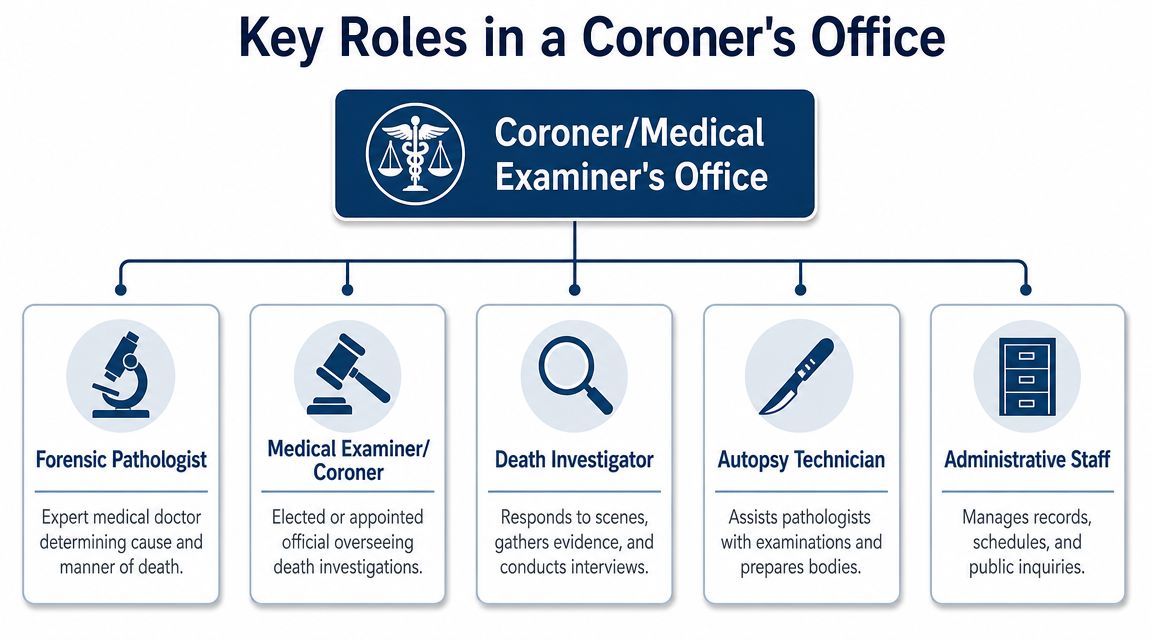
A coroner or medical examiner office is not a one-job workplace. Nationally, nearly 2,040 medical examiner and coroner offices employed almost 11,000 full-time equivalent staff in 2018, including about 890 autopsy pathologists, and accepted over 605,000 cases for further investigation, according to the Bureau of Justice Statistics report on medical examiner and coroner offices.
That staffing picture matters because it shows the field's real shape. Pathologists are essential, but they are only one part of the operation.
The physician role
As a forensic pathologist, my role is to examine the body, review available investigative and medical information, and determine the cause of death and manner of death when the evidence supports a conclusion.
Cause of death means the disease or injury that led to death. Manner of death is the classification, such as natural, accident, suicide, homicide, or undetermined. Those decisions have medical and legal consequences, which is why they rest on careful review rather than assumption.
Anyone considering this route should also understand the organizational difference between physician-led and nonphysician-led systems. A useful primer is this discussion of the difference between coroner and medical examiner.
The investigator role
Medicolegal death investigators are often the first professionals to gather the factual framework of a case. They respond to scenes, speak with law enforcement and witnesses, review circumstances, collect records, and document what the physician later relies on.
A strong investigator notices what is present and what is absent. They don't fill gaps with speculation. They build a reliable case file.
The technician role
Autopsy technicians and morgue technicians keep the examination environment functional, safe, and orderly. In some offices, they assist with body handling, evidence management, specimen labeling, preparation of the autopsy suite, and post-examination procedures.
This role is more skilled than many outsiders realize. A technician who handles chain of custody poorly can create downstream legal problems. A technician who handles remains carelessly undermines trust and dignity.
The records and administrative roles
Administrative staff often become the office's operational backbone. They manage intake, records release, scheduling, phone communication, document routing, and coordination with funeral homes, hospitals, attorneys, and families.
These jobs are often underestimated by applicants who only picture field investigation. That's a mistake. Offices need calm, organized staff who can protect confidentiality and move information correctly.
The strongest offices I've seen are rarely defined by one star employee. They function because each person knows where their responsibility begins and where it ends.
The office works as one system
A death investigation is only as strong as the handoff between roles. If scene notes are incomplete, the physician starts with a weak foundation. If documentation is accurate but records are delayed, conclusions may be slowed. If the final report is sound but records staff mishandle release procedures, the office creates avoidable confusion.
That is why jobs with coroners offices appeal to different kinds of professionals. Some people are suited to scene work. Others are better in laboratory-adjacent support, records control, or case coordination. The field needs all of them.
Education and Certification Pathways for Your Career
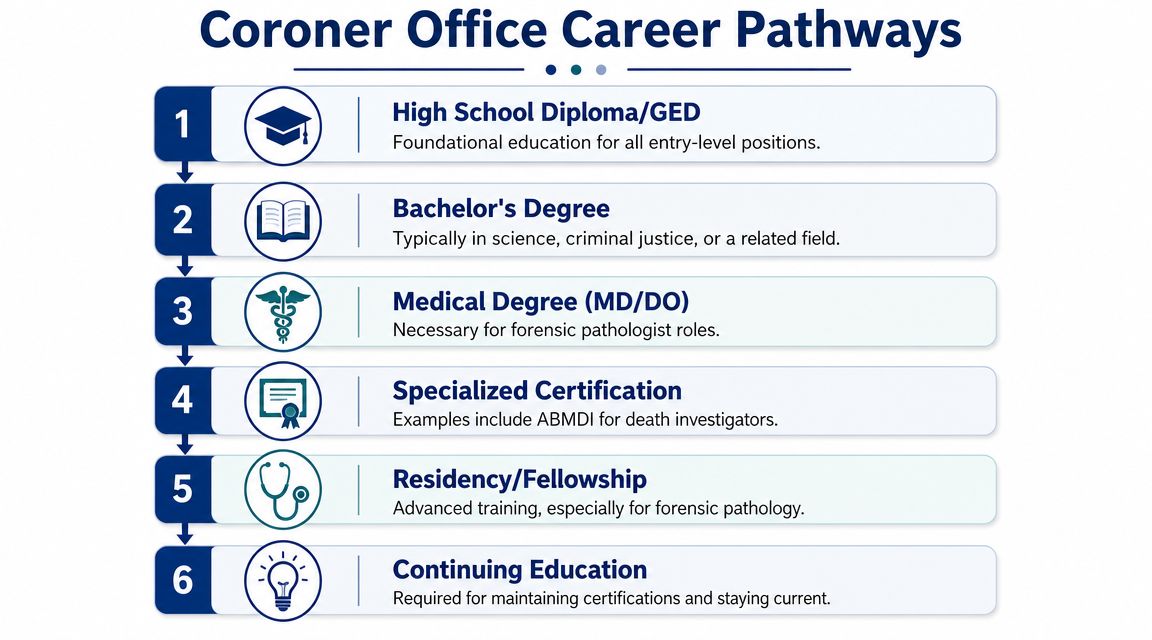
The educational path depends on the role you want, not on a single universal formula. That's good news for applicants who assume the only doorway is medical school.
The longest pathway
If you want to become a forensic pathologist, the route is extensive. It requires a medical degree, residency training in pathology, and fellowship training in forensic pathology, followed by board certification through the American Board of Pathology.
That route is demanding, but it is clear. Students who need a broad overview of the complete medical career journey often benefit from seeing the sequence laid out before they commit to it. If you want a role-specific explanation, this guide on the education required for forensic pathologist work is a practical starting point.
The more accessible entry routes
Many office roles are open to applicants with more varied backgrounds. An Illinois deputy coroner posting shows applicants may qualify with an associate degree in fields like mortuary science or criminal justice, or as a registered nurse, plus one year of death-investigation experience, as described in the Peoria County deputy coroner job posting.
That example matters because it reflects a reality I wish more people understood. The field often values a combination of education, direct exposure, judgment, and documentation skill.
Backgrounds that often transfer well
Some applicants are stronger candidates than they realize. Commonly relevant foundations include:
- Nursing experience because chart review, family communication, and clinical terminology already feel familiar.
- Mortuary science training because body handling, professional decorum, and postmortem procedures are already part of the work.
- Criminal justice education because reporting structure, courtroom awareness, and evidence sensitivity align with office needs.
- Biology or medical technology training because specimen handling, laboratory process, and scientific discipline translate well.
What certifications and experience really do
Credentials can help, but they don't replace maturity. Offices want proof that you can work under supervision, follow protocol, and maintain confidentiality. In some technician tracks, practical morgue or autopsy experience becomes especially important as responsibility increases.
Career advice: If you don't yet qualify for your target title, don't treat that as rejection. Treat it as a map. Find the missing experience and go get it deliberately.
A candidate who has worked in emergency services, histology, surgical pathology support, funeral service operations, or hospital decedent affairs may be much closer to eligibility than a generic online guide would suggest.
A Day in the Life Typical Duties and Responsibilities
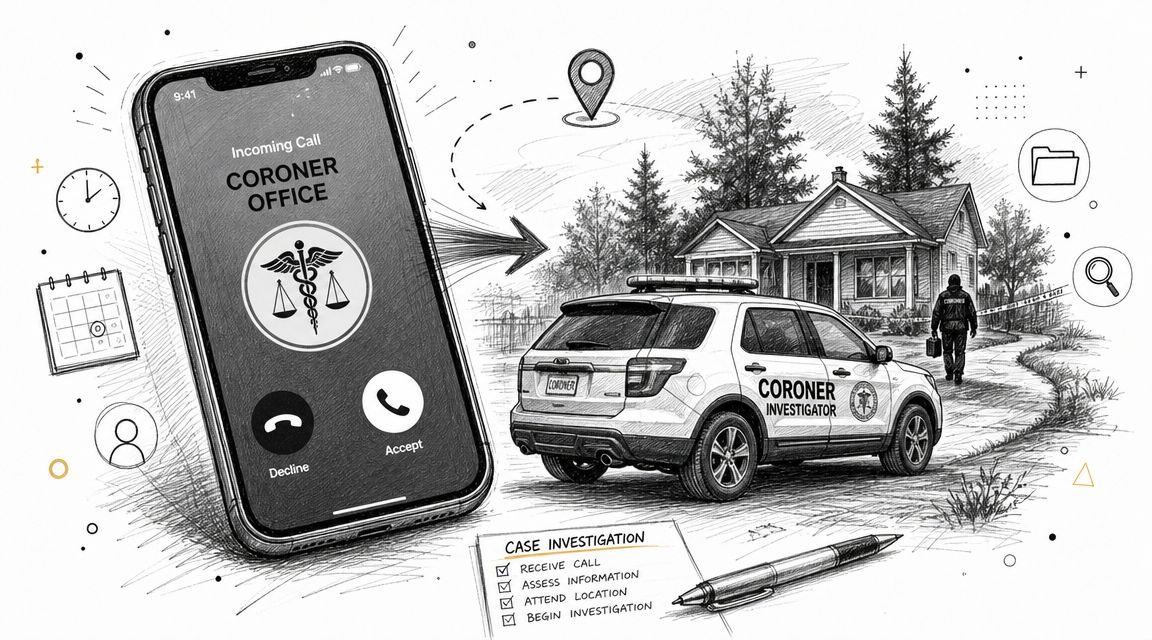
The daily work is procedural from the first phone call. In many offices, investigators and forensic technicians handle distinct workflows. Investigators determine jurisdiction and manage scene response, while technicians prepare the case for the physician who ultimately assigns the cause and manner of death, as described by Orange County, Florida's medical examiner operations overview.
The case starts before the body reaches the office
A typical case begins with an initial report. Someone must determine whether the office has jurisdiction. That decision may depend on the circumstances of death, available medical history, scene findings, and local legal framework.
If the case falls within jurisdiction, an investigator may respond to the scene, speak with law enforcement, document body position and surroundings, collect identifying and medical information, and arrange transport. The quality of those first observations can shape everything that follows.
Three terms matter here:
- Cause of death means the medical reason the person died.
- Manner of death means the category assigned to the death based on investigation and examination.
- Chain of custody means the documented handling of evidence or specimens so that integrity is preserved from collection through review.
The office phase is methodical
Once the decedent arrives, office staff, technicians, and physicians work in sequence. Identification, property handling, evidence tracking, record requests, imaging when available, specimen collection, and postmortem examination all require consistency.
The public often imagines a single dramatic autopsy. In reality, much of the work involves careful documentation, waiting for records, and reconciling physical findings with the scene and medical history.
This short video gives a visual sense of the setting and workflow many people are trying to imagine before they enter the field.
Collaboration is part of the job
No office works in isolation. Investigators interact with police, hospitals, and funeral homes. Transport and body-care logistics often require dependable outside partners. In Texas practice, coordination with providers such as the Waterloo Mortuary Partnership reflects how much this field depends on respectful, competent collaboration.
Some of the most important work in death investigation looks ordinary from the outside. A complete scene note, a correctly labeled specimen, or a well-documented property transfer can matter as much as any single examination finding.
The people who do well in this environment are usually steady rather than flashy. They can tolerate routine, repetition, and the weight of detail.
How to Find Coroner Office Jobs in Texas
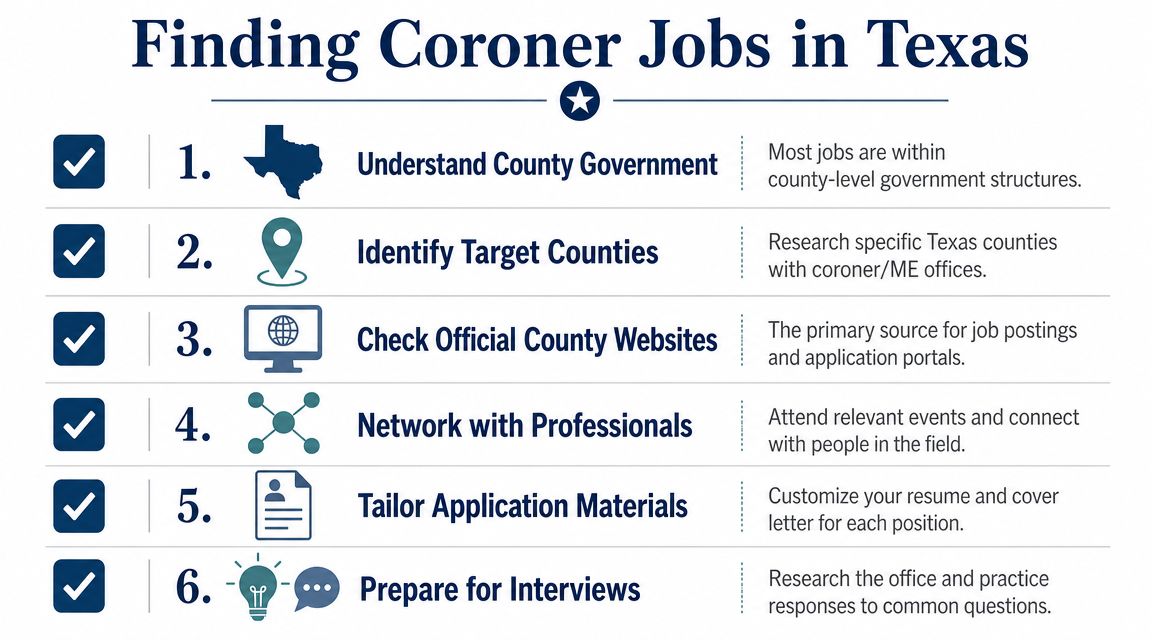
Texas applicants need to think in terms of county government structure, not just job title. That's the practical starting point.
The hiring market is shifting toward centralized digital systems, with some counties launching new job portals while others direct applicants to city-county employment sites, indicating a move away from scattered individual office listings, as reflected in current Indeed listings for coroner office jobs.
Start with the county, not the keyword
Large Texas counties may have more formalized medical examiner operations and structured human resources systems. Smaller counties may handle death investigation through different local arrangements and may contract for portions of forensic service rather than staff every specialty in-house.
That means your search terms should vary. Try combinations tied to county employment pages and local government portals. Looking only for “coroner” may miss roles listed under medical examiner, morgue operations, medicolegal investigator, decedent affairs, pathology assistant support, records specialist, or forensic technician.
A useful reality check is that some Texas counties rely on outside forensic resources for postmortem examination needs. If you want to understand that county-facing side of the system, review how county forensic autopsies fit into broader service coverage.
A workable Texas search strategy
Use a layered approach rather than browsing job boards casually.
- Choose your geography first. Decide whether you want a major metro county, a mid-sized county seat, or a rural jurisdiction. The work environment and hiring pace differ.
- Read the county employment portal carefully. Many government systems classify jobs under public safety, health services, or criminal justice support rather than under a simple coroner heading.
- Track support roles as seriously as investigative ones. Records, dispatch-adjacent positions, intake coordination, and morgue support can be valid entry points.
- Review professional organizations. NAME and ABMDI can help you understand the field's standards, language, and professional expectations, even when the actual posting is on a county site.
- Keep a spreadsheet. Record county, title, closing date, required education, and preferred experience. This prevents rushed, generic applications.
What works and what doesn't
What works is targeted preparation. Read the posting line by line. Match your résumé language to the office's actual duties when that's honest and accurate.
What doesn't work is sending the same application packet to every county in the state. Hiring managers can see when an applicant doesn't understand whether the job is scene-based, morgue-based, or records-based.
A serious applicant studies the office before the interview. They know who the public authority is, what the likely workflow looks like, and why they want that specific role.
Building Your Career From Entry-Level to Expert
Few people enter this field at the final stage of their career. Most build into it one step at a time.
A common path starts with support work. Someone may begin in records, decedent transport coordination, morgue operations, funeral service, emergency medical services, or hospital-based postmortem support. Over time, that person develops enough exposure to move toward technician or investigator roles.
Early experience that carries real value
Relevant experience doesn't have to come from a perfect title. Useful starting points often include:
- Hospital work where documentation, specimen handling, and professional communication are routine.
- Funeral home or mortuary work where dignity, logistics, and family contact are already part of daily practice.
- EMS or law enforcement support roles where scene discipline and stress tolerance are tested regularly.
- Laboratory environments where labeling, chain of custody habits, and procedural consistency matter.
Advancement usually follows trust
Promotion in this field often comes after supervisors trust your judgment. They want to see that you arrive on time, write clearly, protect confidentiality, and don't become careless when the workload increases.
That's why entry-level applicants should invest real effort in presentation. A focused résumé is not superficial. It shows that you understand the seriousness of the role. For candidates who need help framing adjacent experience, this guide on tailoring resumes like a pro is worth reviewing before you apply.
Reliability is a career skill in death investigation. Offices can teach workflow. It's much harder to teach discretion, steadiness, and follow-through.
Keep building, even after you're hired
Once you enter the field, growth usually comes from added responsibility, stronger documentation, more exposure to casework, and continuing education. Some professionals remain in support roles and become excellent specialists. Others use those roles as a bridge into investigation, supervision, or advanced forensic training.
Both paths are respectable. What matters is competence.
Frequently Asked Questions About This Career Path
Do I need to be a doctor to work in this field
No. You need to be a physician to become a forensic pathologist, but many jobs with coroners offices do not require a medical degree. Investigators, technicians, administrative staff, and support personnel often enter through other educational and professional routes.
Is this work mostly science or mostly law enforcement
It sits at the intersection of medicine, law, and public service. Some roles are more scene-focused. Others are more medical or administrative. The office must still function as one coordinated system, so even narrowly defined jobs often require awareness of legal process and evidentiary handling.
How do I know whether I'm suited for the emotional side of the work
The best sign is not whether you feel comfortable around death immediately. Many people do not. The better question is whether you can remain respectful, observant, and calm in difficult settings.
Emotional resilience in this field usually looks quiet. It means you can keep standards high while dealing with grief, trauma, and uncertainty. It also means knowing when to use peer support, supervision, faith community, counseling, or personal boundaries to stay healthy.
Are public offices different from private forensic work
Yes. Public county office work is tied to jurisdiction, statutory duties, and government process. Private forensic work often centers on independent review, second opinions, or examinations requested by families, attorneys, or agencies. The underlying science must remain objective in either setting, but the workflow, reporting audience, and operational structure can differ.
For families comparing those settings after a loss, Private Autopsies can serve a different purpose than a county investigation. For job seekers, that distinction matters because the daily responsibilities are not identical.
What should I do if I don't yet meet the listed requirements
Close the gap strategically. If a posting asks for death-investigation exposure, seek adjacent work that develops documentation, evidence awareness, medical terminology, or decedent handling experience. If the office values communication with grieving families, build experience in a setting where professionalism under stress is expected.
A good first move is often smaller than people expect. It may be records work, hospital coordination, funeral service support, or technician assistance rather than a direct investigator title.
If you need guidance about forensic pathology, independent autopsy questions, or county-level forensic service support in Texas, contact Texas Autopsy Services. My office aims to provide clear information with the same standards I believe every death investigation career should be built on: accuracy, dignity, and respect for the people affected by loss.