November 12, 2026 · Texas Autopsy Services
Fetal Autopsy Protocol Steps and Documentation Guide
Learn each stage of a fetal autopsy protocol, from consent and external measurements to placental review, testing and the final report.
On this page
- Fetal Autopsy Protocol Stages at a Glance
- Who Must Authorize and What Consent Covers
- External Examination and Standard Measurements
- Internal Examination, Radiographs and Placental Review
- Ancillary Tests and Their Diagnostic Yield
- Documentation and the Final Cause of Death Report
- Explaining Findings to Families Compassionately
- Common Questions About Fetal Autopsy
- Confirm Authorization and Options Before You Schedule
You may be trying to decide about an examination while the hospital asks where to send your baby and whether the placenta should travel with them. Those decisions can feel urgent before anyone has explained what the examination involves. At Texas Autopsy Services, we approach a fetal autopsy protocol as a connected record, from authorization to the final explanation, so missing information is identified before it limits the investigation.
- Consent sets the boundaries. Families should understand the examination, testing, photography, and tissue-handling decisions before transport.
- The placenta matters. Findings outside the baby's body can help explain the loss.
- Tests answer specific questions. Imaging, tissue examination, and laboratory studies contribute different evidence.
- Documentation connects the findings. A useful report explains both the conclusions and their limits.
- Uncertainty deserves a clear explanation. An examination may provide important information without establishing a definite cause.
Fetal Autopsy Protocol Stages at a Glance
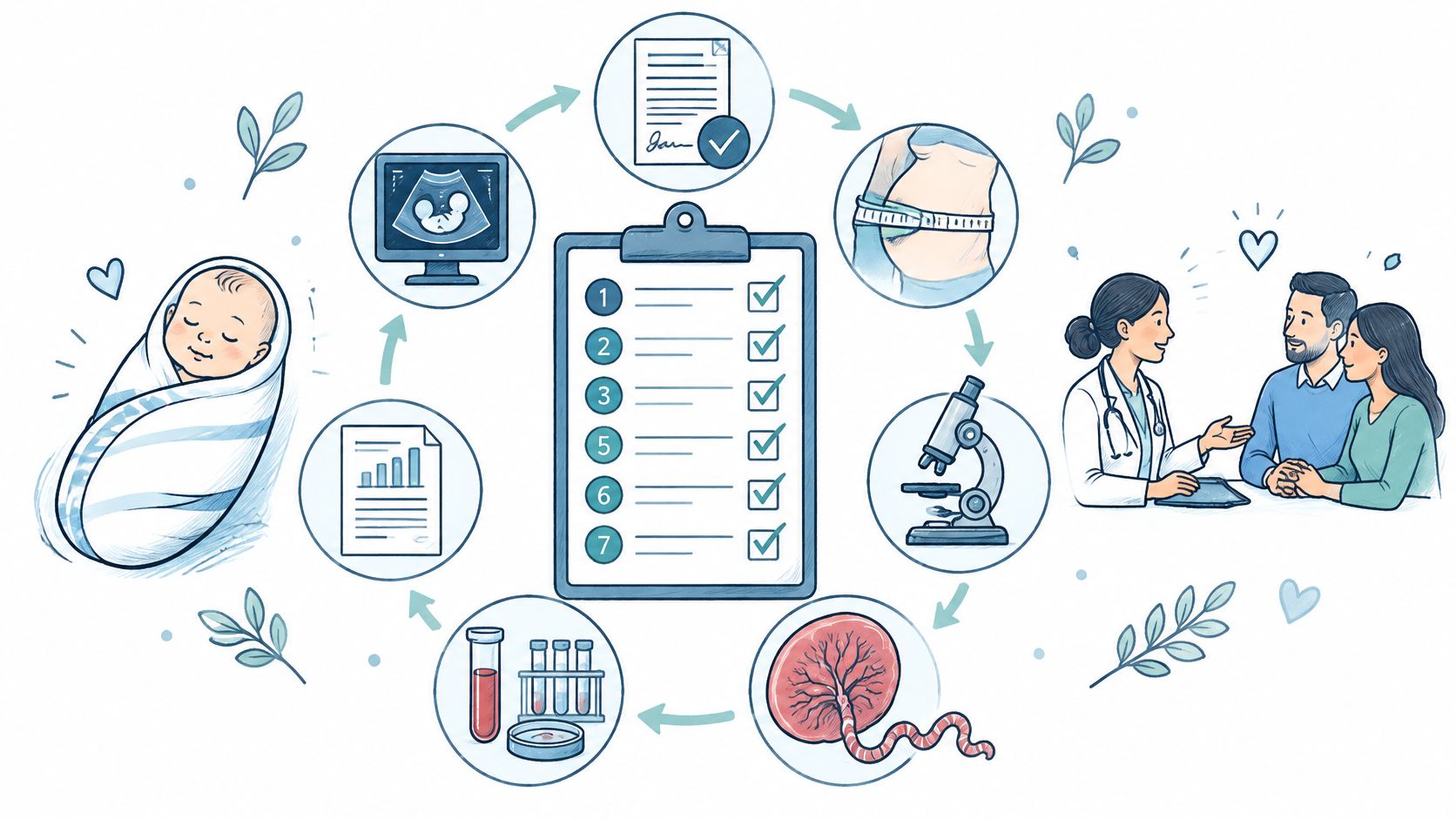
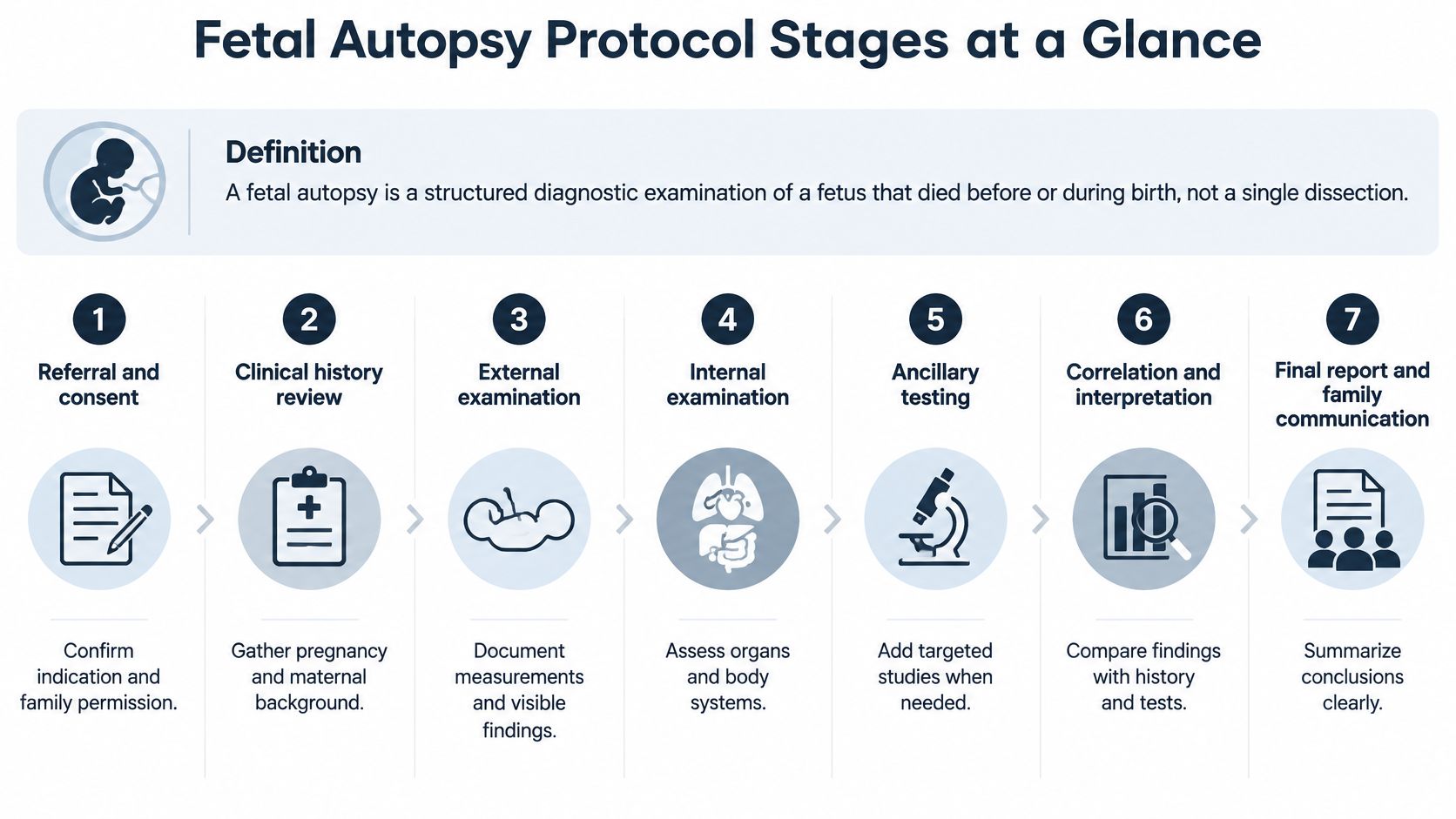
A fetal autopsy is a structured diagnostic examination of a fetus that died before or during birth, not a single dissection. The following checklist separates the work into stages and identifies the record that should show what was done.
Fetal autopsy protocol stages in order
| Stage | Key actions | Record produced |
|---|---|---|
| 1. Identification and consent | Confirm identity, gestational age, and consent scope | Signed consent form and case history |
| 2. Clinical history and imaging review | Review prenatal imaging and set the examination questions | Written list of examination questions |
| 3. External examination | Standard measurements, whole-body photographs, and radiographs | Measurement sheet and image set |
| 4. Internal examination | Systematic dissection, organ weights, and tissue sampling | Gross findings and organ weights |
| 5. Placental and cord review | Gross and microscopic review of placenta, membranes, and cord | Placental report |
| 6. Ancillary testing | Genetic, microbiological, metabolic, or toxicological tests when indicated | Laboratory reports |
| 7. Final integrated report | Correlate every finding with the cause-of-death opinion | Final signed report |
This sequence reflects the connected approach described in the review of fetal autopsy protocols published by Springer, which includes clinical review, measurements, imaging, internal examination, placental assessment, tissue sampling, and reporting.
Why the sequence matters
The examination questions guide the preparation. If prenatal imaging suggests an abnormal skeleton, the pathologist needs suitable radiographs and a plan for evaluating the bones. If infection is suspected, the team must consider appropriate samples before routine tissue processing.
Some work happens alongside other stages rather than strictly afterward. Placental assessment and laboratory testing may proceed while tissue slides are prepared, but the pathologist must bring their results together before issuing an integrated opinion.
Practical rule: A stage isn't complete merely because it was planned. The record should show whether it was performed, declined, unavailable, or limited.
Using the checklist before transport
Families and clinicians can use the table to compare the proposed examination with the questions they need answered. A request to investigate poor growth, for example, should prompt discussion of pregnancy dating, prenatal growth assessments, fetal measurements, and availability of the placenta.
The consent, measurement, internal examination, and reporting sections below describe the records behind those decisions. Before an examination starts, our team works to distinguish missing documents from material that cannot be obtained. That distinction prevents an unavailable placenta or an unsigned testing authorization from becoming an unexplained gap in the final report.
Who Must Authorize and What Consent Covers
The legal next of kin or their designated representative authorizes a private autopsy. We confirm that authority before proceeding, rather than assuming that the person arranging transport also has authority to approve the examination.
Consent should describe choices, not merely record a signature. The Royal College of Pathologists guidance on fetal autopsy consent requires consent for a hospital post-mortem examination at any gestation and separate consent for genetic testing, including testing of placental samples.
Separate decisions deserve separate explanations
- Complete examination. Authorization should identify the extent of internal examination permitted.
- Limited or partial examination. The document should name the body regions or procedures included and excluded.
- Imaging. The proposed imaging should be explained, including radiographs where planned.
- Placental examination. Permission and arrangements should address the placenta, membranes, and cord.
- Genetic testing. Families should understand what testing is proposed and what samples it requires.
- Clinical photographs. The purpose and authorized handling of photographs should be clear.
- Tissue or organ retention. The consent should address what may be retained, why, and how retained material will ultimately be released or otherwise handled.
Our explanation of the autopsy consent form provides additional context for reviewing authorization. Families should be able to decline a proposed component without being left uncertain about what remains authorized.
Texas rules require careful distinctions
The Texas Anatomical Gift Act treats a stillborn infant as a decedent and includes a fetus within that definition, subject to other legal restrictions; it also permits a procurement organization to conduct a reasonable examination, including records review, to assess suitability for an intended donation. Donation authorization isn't a substitute for private-autopsy consent. These provisions concern a distinct legal purpose.
Unclaimed remains follow another pathway: the Texas statute governing unclaimed bodies assigns autopsy permission to the state commission identified in the statute, upon a specific request showing sufficient evidence of medical urgency. Custody status must therefore be resolved before anyone assumes ordinary family authorization applies.
Before signing, families need clear answers to these practical questions:
- Scope. What exactly does this consent authorize?
- Choice. Which procedures may we decline?
- Return and release. Where will our baby, the placenta, and any retained material go afterward?
External Examination and Standard Measurements
Standard external measurements and records
| Measurement | What it shows | Documented as |
|---|---|---|
| Body weight | Growth and gestational context | Measurement sheet |
| Crown-rump length | Gestational age estimate | Measurement sheet |
| Crown-heel length | Overall body length | Measurement sheet |
| Foot length | Growth and gestational age comparison | Measurement sheet |
| Occipitofrontal circumference | Head growth, where appropriate | Measurement sheet |
| Whole-body photography | Entire body and every abnormality | Image set |
| Whole-body radiograph | Gestational age and occult malformations | Radiology report |
The Royal College of Pathologists fetal autopsy guideline supports standardized measurements, systematic photography, routine whole-body radiography, and documentation that connects findings to the final opinion.
Establishing the record before measuring
We begin with identification and the accompanying documents. The record should include demographic information, gestational age, meaning the pregnancy's developmental age, relevant clinical history, circumstances of delivery or death, and the authorized examination limits.
A measurement must remain attached to the correct case and clinical context. Body weight alone doesn't establish whether growth was appropriate. The pathologist compares it with pregnancy dating, other measurements, prenatal findings, and the condition of the body.
Crown-rump length extends from the top of the head to the buttocks. Crown-heel length records overall length, while occipitofrontal circumference measures around the head. Our guide to fetal autopsy measurements explains how these observations contribute to interpretation.
Preserving visible and hidden findings
Photography records the whole body and provides closer views of abnormalities. Images should be identifiable, clear, and taken in a way that allows another reviewer to understand the anatomy rather than infer it from an isolated close-up.
Radiographs answer a different question. They allow assessment of the skeleton and abnormalities that aren't apparent on the surface, including hidden malformations. CT or MRI may provide alternative or complementary imaging where available and appropriate, but they shouldn't be treated as interchangeable choices without considering the clinical question.
A measurement is an observation. Its meaning comes from comparison with the rest of the examination, not from the number alone.
Our documentation distinguishes a measurement that couldn't be obtained from one that was intentionally excluded. Tissue changes, physical condition, or a consent restriction may each create a different limitation, and the report should identify the actual reason.
The measurement sheet and images remain part of the evidence supporting the written opinion. Preliminary observations are communicated separately from the final interpretation, so an early description of small size doesn't become an unsupported conclusion about why the death occurred.
Internal Examination, Radiographs and Placental Review
Internal examination follows external documentation and review of available imaging. That order allows the pathologist to compare the anatomy with findings already recorded, rather than approaching dissection without the prenatal or radiographic context.
The purpose isn't just to look at each organ. We assess how organs developed, their relationships to one another, and whether visible changes require microscopic investigation. Histology, the examination of thin tissue sections under a microscope, can clarify findings that appearance alone cannot resolve.
Examining organs and the brain
A systematic internal examination records organ position, structure, weights, and abnormalities. Tissue samples are selected to investigate the case questions and document relevant organs, with additional sampling directed by unexpected findings.
Neuropathological assessment, meaning examination of the brain and nervous system, is a core part of a detailed fetal examination. The pathologist considers development, structural abnormalities, and the limits created by tissue condition. Fragile or altered tissue may restrict what can be interpreted confidently.
Radiographs remain available during this work. If external proportions or prenatal images raise concern about skeletal dysplasia, a disorder of bone development, the pathologist compares the skeletal survey with the dissection findings. Dissection alone may not preserve or reveal the overall skeletal pattern.
Why the placenta receives its own examination
The placenta is the organ through which the pregnancy supports fetal exchange of oxygen, nutrients, and waste. Its vessels, membranes, and attached umbilical cord can contain evidence of infection, impaired circulation, or processes associated with poor growth.
The American Board of Pathology certification rules specify that the fetus should be intact and that the autopsy report must include gross and microscopic examination of the placenta; they also require signed autopsy consent rather than an anatomic-disposal permit. These are certification requirements, not a substitute for determining applicable legal authority.
- Vascular findings. A placenta with suspected vascular compromise prompts closer assessment of its circulation and correlation with growth and pregnancy history.
- Possible infection. Membrane or placental changes may guide microscopic review and consideration of microbiological testing.
- Unavailable material. If the placenta has already been discarded or cannot be obtained, the report should state the resulting limitation.
Clinicians reviewing records after delivery may also need to distinguish fetal death from a death following live birth and attempted resuscitation. For that separate clinical context, they can find neonatal resuscitation decision pathways through ProMed Certifications. Those pathways concern care at birth, not the postmortem protocol or a determination that care was appropriate.
Samples taken during internal and placental examination support the targeted testing described next. Their selection should follow a documented question, not an assumption that every available test will be useful.
Ancillary Tests and Their Diagnostic Yield
Diagnostic yield of common stillbirth tests
The figures below come from the Stillbirth Collaborative Research Network cohort of 512 stillbirths receiving complete evaluation, as cited in the American College of Obstetricians and Gynecologists guidance on management of stillbirth.
| Test | Useful in share of cases | Notes |
|---|---|---|
| Placental pathology | 64.6% (95% CI 57.9% to 72.0%) | Highest yield in the cited study |
| Fetal autopsy | 42.4% (95% CI 36.9% to 48.4%) | Yield rises with dysmorphic features, abnormal growth, anomalies, hydrops, or growth restriction |
| Karyotype or microarray | 11.9% (95% CI 9.1% to 15.3%) | Low yield in morphologically normal fetuses |
| Antiphospholipid testing | 11.1% | Confidence interval not provided in the cited summary |
Here, useful means the test helped establish a cause. These aren't independent probabilities that can be added together, and they don't predict what an individual family will learn. A confidence interval describes uncertainty around the study estimate, not the certainty of a particular diagnosis.
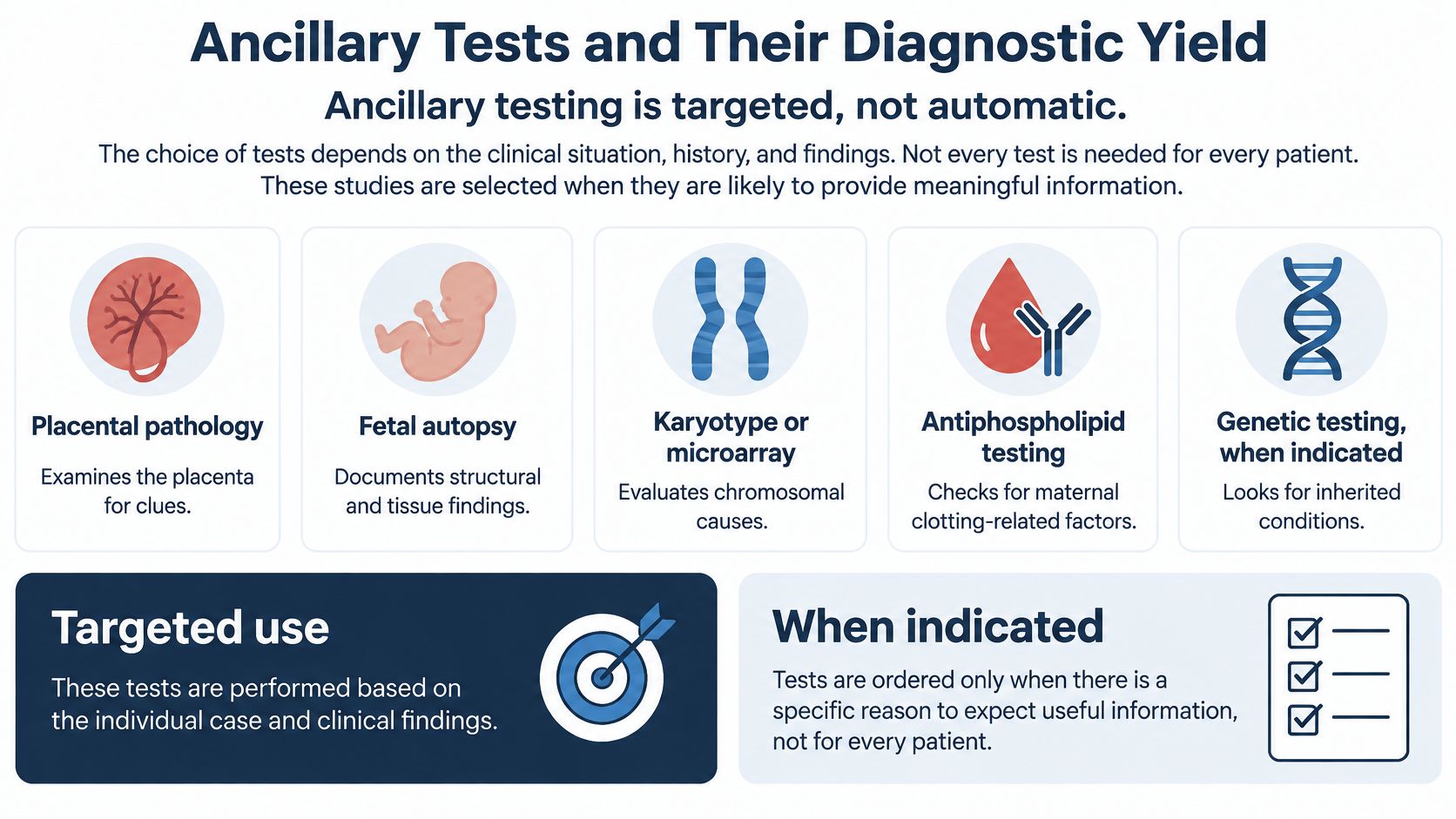
The visual below distinguishes common investigation components from tests selected for a particular indication.
Matching testing to the findings
Ancillary tests are additional investigations that help answer a defined question. They may include chromosome testing, microbiology for suspected infection, metabolic studies, or toxicology when the history and findings justify it.
Karyotype and microarray evaluate chromosomal abnormalities in different ways. They don't describe every structural or tissue abnormality, and broad genetic testing doesn't automatically replace pathological examination. A fetus without visible morphological abnormalities may require a different testing discussion from one with a recognizable pattern of anomalies.
Maternal antiphospholipid testing belongs to the clinical investigation of the mother, rather than being a test performed on the baby. Our stillbirth information provides context for understanding the broader investigation.
Keeping different kinds of evaluation distinct
A Canadian guideline summarized in the stillbirth guidance reports that fetal and perinatal autopsy can add clinically meaningful information about cause and recurrence risk in approximately 25% of cases. That measure isn't identical to usefulness for establishing a cause in the cohort above.
Families may encounter the word diagnostic in unrelated settings. Uptown Psychology's explanation of comprehensive child evaluations in Florida concerns assessment of living children, not fetal pathology; those services don't substitute for a postmortem investigation.
Before testing, we explain what the proposed study may answer, what it cannot establish, and whether the consent authorizes it. The final interpretation combines fetal, placental, maternal, imaging, and laboratory findings rather than treating any result as a complete explanation by itself.
Documentation and the Final Cause of Death Report
Cause of death means the disease, condition, injury, or event that began the chain leading to death. The final report should explain how the evidence supports that opinion, including when the available findings don't establish a definite cause.
Manner of death is a broad classification, such as natural or undetermined, where that framework applies. It isn't interchangeable with cause of death, and fetal cases require attention to the applicable reporting context rather than automatic use of adult death-investigation categories.
Connecting observations to conclusions
The report begins with the case foundation: identification, gestational age, clinical history, circumstances of delivery or death, consent scope, and examination restrictions. It then presents the external, internal, microscopic, imaging, placental, and laboratory findings that were available.
A reader should be able to distinguish what the pathologist directly observed from what the pathologist concluded. For example, a visibly abnormal membrane may raise concern for inflammation, but that interpretation can remain tentative until histology establishes what changes are present.
Chain of custody is the documented record of who handled the body, specimens, or evidence and when. It supports reliable identification and handling, but it doesn't establish a diagnosis by itself.
- Observed finding. Record the anatomical or laboratory result.
- Interpretation. Explain what that result supports in the clinical context.
- Qualification. State competing explanations or missing evidence.
- Integrated opinion. Describe the conclusion supported by the combined record.
Reporting standard: Confidence should follow the evidence. A report shouldn't turn a possibility into a certainty because a definite answer would be easier to understand.
What families and legal reviewers should expect
Preliminary findings and the final integrated report are separate documents. The final report incorporates results unavailable at the initial examination and explains whether they changed the early interpretation.
At our practice, the same forensic pathologist who performs the examination produces the written report and walks the family through the findings. We confirm in advance who is authorized to receive copies and discuss the consent restrictions that may limit the report.
An independent opinion must remain unbiased, even when an attorney commissions the work. Families considering legal options after delivery negligence can consult the Law Office of Bryan Fagan, PLLC for legal information, but an autopsy finding alone doesn't establish negligence or liability. Courts determine admissibility, and legal conclusions require analysis beyond the pathological findings.
Explaining Findings to Families Compassionately
The loss of a baby deserves a careful, unhurried conversation. Families need understandable choices and a clear point of contact, not pressure to authorize procedures they haven't had explained.
Consider a family who wants information but is uncomfortable with internal examination. Before transport, we would discuss what a complete examination could investigate, what a partial examination would exclude, and whether an imaging-based approach could address their specific questions.
Decisions before transport
A complete examination permits a broader anatomical and tissue assessment. A limited examination addresses only the authorized areas, while imaging alone cannot provide microscopic tissue findings.
The review of perinatal postmortem investigation in the NCBI Bookshelf explains that imaging-based approaches depend on gestational age, tissue condition, suspected abnormality, image quality, and complementary testing. A family should understand those limits before choosing the scope.
- Time with the baby. Discuss opportunities to hold the baby and observe cultural or religious practices before transport.
- Written decisions. Record the agreed examination, testing permissions, and handling arrangements.
- Communication preferences. Identify who should receive updates and take part in the final discussion.

Explaining results without overstating them
We agree on communication arrangements and distinguish early findings from completed conclusions. Timing depends on the examination scope, gestational age, tissue preparation, requested laboratory studies, and laboratory schedules, not the date of transport.
During the final discussion, we explain what each finding means and what it doesn't show. If results may affect recurrence-risk counseling, the family's obstetric or genetics team can interpret that information for future pregnancy care.
An unresolved cause doesn't mean nothing was learned. The examination may document development or clarify a suspected abnormality without explaining the death. A clear conversation doesn't change the findings; it helps families understand and use them.
Common Questions About Fetal Autopsy
Questions about examination options
Can MRI replace a fetal autopsy?
Sometimes an imaging-based investigation can answer major anatomical questions, but it isn't a universal replacement. Its usefulness depends on gestational age, the suspected abnormality, image quality, complementary tests, and maceration, meaning tissue changes that occur when a fetus remains in the uterus after death.
Is a placental examination part of a fetal autopsy?
Yes, a thorough protocol includes examination of the placenta, membranes, and cord. American Board of Pathology certification rules require gross and microscopic placental examination in the report and specify that the fetus should be intact.
Questions about answers and limitations
How often does a fetal autopsy give a useful answer?
In the Stillbirth Collaborative Research Network cohort described in the diagnostic-yield table, fetal autopsy helped establish a cause in a substantial share of cases. The likelihood of useful information is higher when there are unusual physical features, growth abnormalities, congenital anomalies, or hydrops, an abnormal accumulation of fluid.
Can a family limit the examination?
Yes. A family may authorize only specific parts of the examination and decline proposed components such as genetic testing or tissue retention, with those decisions documented before proceeding.
- Medical context. This is general educational information, not medical advice.
- Individual limits. Results depend on the case, the condition and availability of material, and the tests performed.
- Practical preparation. A written question list helps our team explain which proposed procedures address each concern.
Confirm Authorization and Options Before You Schedule
Before scheduling, establish who can authorize the examination, what examination is requested, and who will receive the final report. Those answers guide transport, records collection, specimen handling, and communication.
A family may have been told that the medical examiner declined the case without being told what an independent examination involves. That decision doesn't itself establish who may sign private-autopsy consent or which records and specimens remain available.
Preparing a confidential request
Our team in Elgin, Texas, helps families who aren't certain about their authority understand the steps that must come first. We serve all 254 Texas counties, including Central Texas, with in-house licensed transport and direct team communication.
- Identify the authorized person. Tell us the relationship to the baby and whether a representative is involved.
- Describe the questions. Explain what remains unclear and identify relevant prenatal or delivery records.
- Locate the materials. Confirm where the baby and placenta are being held.
- Name the recipients. Clarify who should receive findings and the final written report.
For background on arranging an independent examination, our Private Autopsies page explains the process. Every examination is performed by a forensic pathologist certified by the American Board of Pathology.
Coordinating the examination and farewell
We perform private examinations carefully and respectfully, with the viewing and funeral that follow in mind. A private autopsy doesn't itself prevent an open-casket funeral, although the baby's condition and individual circumstances remain important to discuss.
Call (806) 230-1889 to speak directly with our team about authorization, available materials, and your questions before transport is arranged. You don't need to have every document ready to begin that conversation. We recognize the loss your family is facing.
At Texas Autopsy Services, we offer independent fetal and perinatal examinations with documented authorization, careful evidence handling, and a plain-language explanation of the findings. Visit us or contact our team to discuss which examination options may address your questions and what needs to happen before scheduling.