November 11, 2026 · Texas Autopsy Services
What a Chain of Custody Affidavit Proves in Court
A chain of custody affidavit records every handoff of evidence from collection to court. Learn the required fields, Texas rules and common gaps.
On this page
- What a Chain of Custody Affidavit Does
- Fields Every Affidavit Should Record
- How Custody Moves From Collection to Court
- Following One Specimen Through Custody
- The Five Risks Custody Records Prevent
- What Texas Law Lets the Affidavit Do
- Questions Families and Attorneys Ask
- Confirm the Custody Record Before You Rely on It
An attorney sets a sealed blood tube on the counsel table during a hearing about an independent autopsy. The label carries a name, a time, and a case number. Opposing counsel asks who touched that tube between the examination and the laboratory that reported the toxicology result.
A chain of custody affidavit is the sworn answer to that question. It lists every person, transfer, and storage step for one item of evidence, from collection until the item is offered in court. Texas law lets a compliant affidavit establish that history for physical evidence without calling every handler to the witness stand.
Autopsy specimens make the rule concrete. A blood tube, a tissue cassette, or a toxicology aliquot may leave the examination room, sit in a refrigerator, and travel to an accredited forensic laboratory. Each handoff should already be written down: who released the item, who received it, when the move happened, and where it was stored.
The affidavit works like a cover sheet clipped to a file. It points back to labels, receipts, and a log filled in while the specimen moved. A sworn summary of that careful log gives a court something to compare line by line. A sworn summary of a thin log is a page of confident sentences with nothing behind it to check.
What a Chain of Custody Affidavit Does
A gray-top blood tube leaves the autopsy table, sealed and labeled. A technician signs it out. A courier signs it in. A laboratory clerk logs it into a refrigerator. Months later, someone may ask whether that tube is the same blood the report describes. The chain of custody is the running record of those handoffs. The affidavit is the sworn summary of that record, signed by a person who knows it.
A courier log for a signed parcel works the same way. The parcel rides in a van, waits in a depot and lands at a front desk. Each handoff adds a time, a name and a signature. The log already tells the trip, so nobody has to rebuild it from memory.
Three roles show up whenever an autopsy specimen moves. A custodian is any person who holds the item, even briefly: a technician, a courier, a laboratory accessioning clerk or a storage supervisor. A transfer is any handoff between two custodians, across a counter, through a courier or between hospital departments. The affiant is the person who swears the record is accurate, and what they sign has to match what they personally know.
The affidavit restates labels, receipts, storage entries and a log that already exist. A court reads those sentences against the underlying papers, line by line. An affidavit written from memory months later carries less weight than a plain log filled in while the sample was still moving. That gap matters for blood, tissue and other autopsy specimens, which may be retested years after a death in a criminal case, a civil suit or a medical-legal review.
Family lawyers test a different kind of record. This custody evidence guidance for Humble parents covers documents in a Harris County child-custody case, not the path of a laboratory specimen.
A stranger should be able to rebuild the item's journey from the paperwork alone.
Fields Every Affidavit Should Record
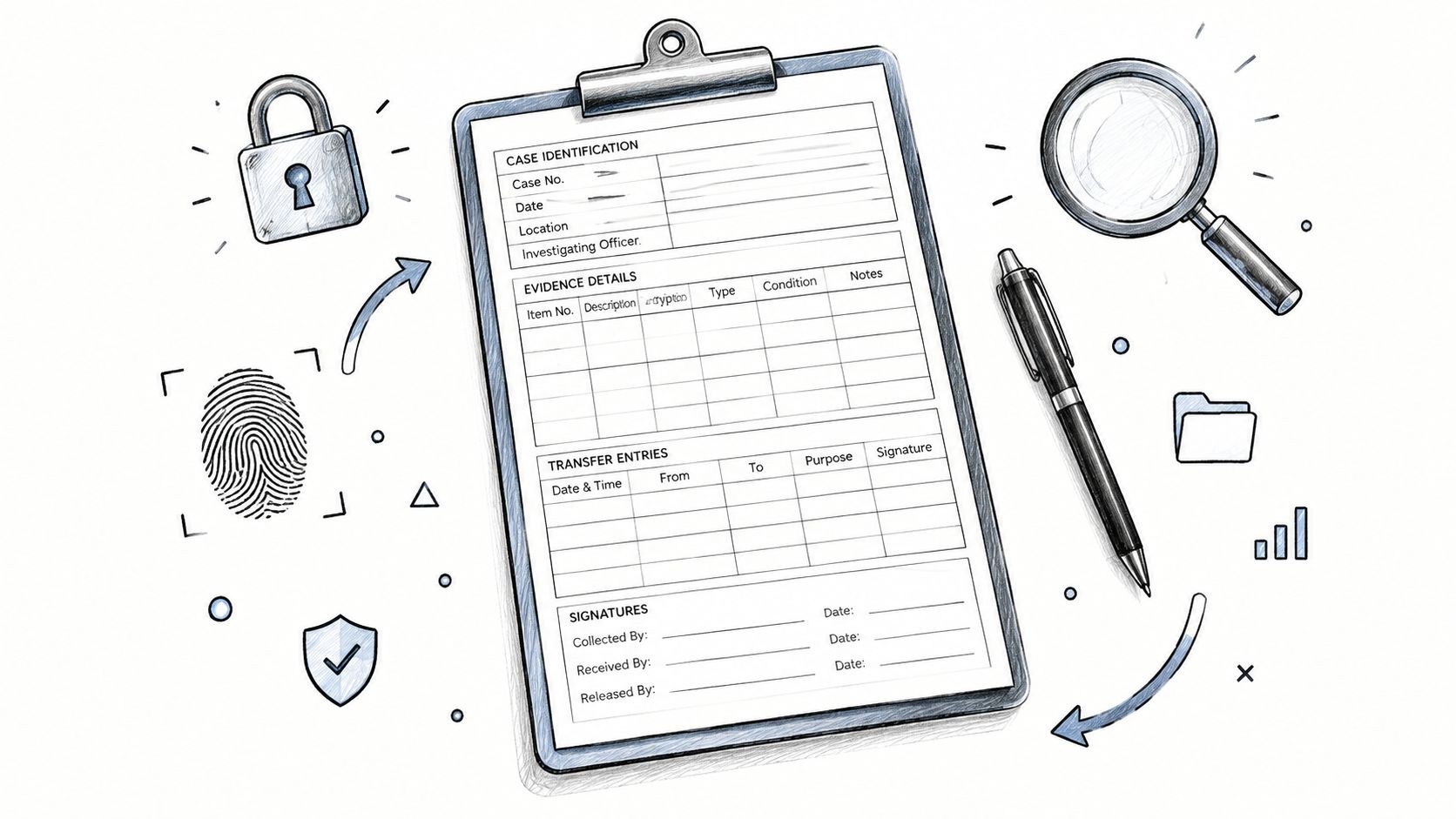
An affidavit is only as useful as the fields behind it. Each row below answers one question that a judge, an opposing attorney or a laboratory reviewer will eventually ask about a single specimen.
| Field | What to Write | Example Entry |
|---|---|---|
| Unique item number | One number per item, repeated on every label and form | BLD-01, written on the tube, the bag and the receipt |
| Description | Specimen type, container and quantity | Blood, 10 mL gray-top tube |
| Collection location, date and time | Where and when the item was taken | Draw at the facility, date and 24-hour time on the collection form |
| Collector | Name and role of the person who collected the item | Forensic technician, printed name above the signature |
| Condition and packaging | Container type, seal status and condition | Sealed, tamper seal intact and initialed |
| Each transfer | Date, time, method and receiving party | Courier handoff at 14:20, receiving laboratory named |
| Storage conditions | Temperature and location while the item was held | Refrigerated 2-8°C, cold room B |
| Examination purpose | Test or analysis performed and who performed it | Toxicology panel at an accredited outside laboratory |
| Final disposition | Return, retention or destruction and who approved it | Retained portion returned to storage, receipt on file |
| Affiant employer | Employer at the time custody was obtained | Pathology practice or receiving laboratory |
The identifier carries the rest. Every other row leans on the item number, because it's what ties a tube in a refrigerator to a line on a form. Repeat it on the label, the bag, the transfer sheet and the laboratory receipt, then check the characters match instead of assuming they do.
The middle rows carry the chronology. Collection location with date and time marks where the record starts. The collector's name and role identify the first custodian, and a printed name above a signature keeps an illegible scrawl from becoming an unexplained entry. Condition and packaging follow, including the seal type and whether it arrived intact.
Transfers fill most of any real record. Each one needs a date, a time, a method such as hand delivery or courier or laboratory intake, and the receiving party's name, because a transfer with no recipient is a gap dressed up as an entry. Storage conditions belong alongside, written while the item was held rather than reconstructed afterward.
Examination and disposition close it out. Note what testing was performed, who performed it, and where the remainder went, whether back to retained stock, to a second laboratory or to approved destruction. Add the affiant's employer at the time custody was obtained, a field Texas law calls for and one that places the evidence inside an institution.
Write a Value in Every Row
Practical rule: Mark a field not applicable only when it truly doesn't apply. A blank tells the other side that something was skipped, and it invites exactly the question the affidavit was meant to answer.
The same fields apply whether the item is blood, urine, vitreous fluid, a tissue block, a slide, a swab or a retained medical device. Each carries its own number, because folding two specimens onto one line makes them impossible to trace apart later. Before signing, checking the custody report against the source documents means matching every field to the original label, collection form and receipt, not to a summary of them.
How Custody Moves From Collection to Court
The sequence reads the same for a blood tube drawn in a hospital and for a tissue specimen released to an outside laboratory. What changes is the number of hands, not the order of events.
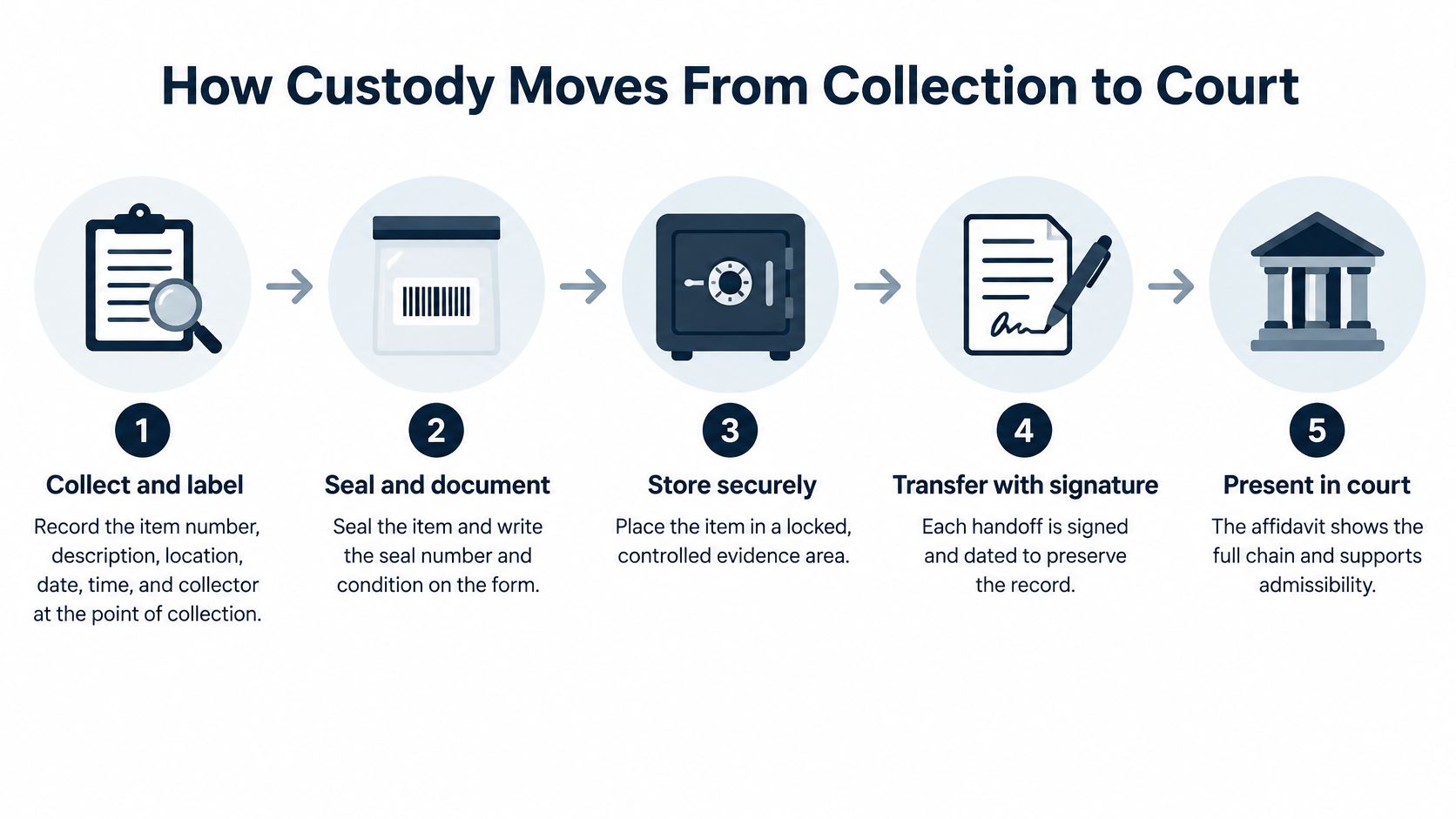
Seven Steps That Build the Record
- Collect and label. Write the item number, description, location, date, time and collector while the sample is still in the room. Memory fills gaps badly, and a time written two days later is an estimate, not a record.
- Seal and package. Place the item in its container, apply a tamper seal, and initial across the seal onto the container. A broken or undocumented seal is usually the first thing an opposing attorney questions.
- Hand off in transit. Log each transfer on a signed form or a secure electronic record showing the method, the time and the person receiving it. The courier's own run sheet should match the custody line hour for hour.
- Receive at intake. The receiving facility checks the labels against the form and issues a written receipt. That receipt closes the first leg of the journey.
- Store under controlled conditions. Record the location, the temperature and every removal, including short ones. A sample that left the refrigerator for a re-draw has to show that trip.
- Examine and split. Note who tested what, and give each aliquot a sub-number tied back to the original item number. Splits with no link home are where derivative samples drift out of the chain.
- Release or return. Record the final disposition and the person who approved it, whether the remainder returns to retained stock, travels to a second laboratory or is destroyed.
The paperwork that supports a specimen often travels with it. Hospital charts, imaging and prior laboratory results become part of the file, and knowing medical record retrieval costs and sources helps an attorney budget for that side of a case before a hearing date is set.
Here is a short walkthrough of the same sequence when an item moves through a laboratory.
Testing the record is simple. Pick any step above and look for its matching entry. Collection should have a form, transit should have a signed transfer, intake should have a receipt, storage should have a log, and release should have an approval. Our team keeps documented chain of custody at every step of the process, which is the same discipline this sequence describes, applied to autopsy casework where the specimen may be the only remaining evidence of what happened.
Following One Specimen Through Custody
Consider a hypothetical case, not drawn from any real family. A blood sample for toxicology is collected during an autopsy at a facility.
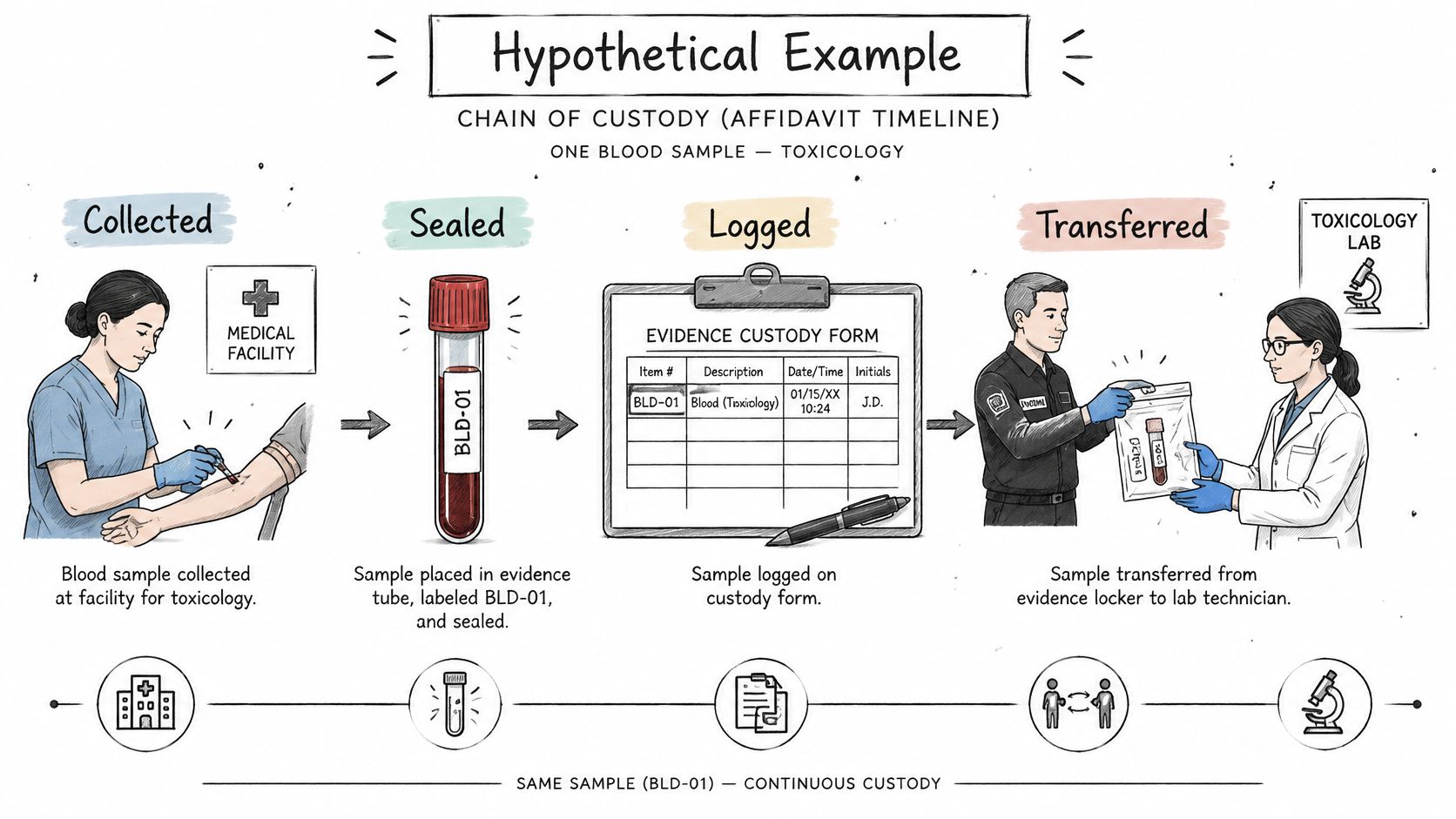
The technician labels the tube BLD-01, seals it, and writes the collector's name and the time on the collection form. A courier handoff is logged with the method and the clock time, and the laboratory issues a receipt when the tube arrives. The sample sits in refrigerated storage at 2-8°C with a temperature log running the whole time. Inside the laboratory it's split into two aliquots, and each one gets a sub-number that points back to BLD-01.
Months later, the defense asks for retesting. A toxicology result can shape the cause of death, meaning the injury or disease that ended life, and the manner of death, the category a death falls into such as natural, accident, homicide or undetermined. So the request matters. The retained portion is found in the location the log names, the temperature record shows storage stayed in range, and the access log lists every removal. The retest proceeds on a clear foundation.
Now the contrast. Suppose the transfer sheet instead showed a two hour stretch with no receiving name. The result might still be correct, but before anyone relies on it the affidavit needs a written explanation of that gap, prepared by someone who can account for it.
Three questions sort a good record from a shaky one. Does each entry match the label on the container? Is every hand off signed by both sides? Does any gap carry an explanation on file? If a specimen has been bagged, sealed and resealed along the way, the same test applies to the custody record behind those bags.
The Five Risks Custody Records Prevent
Custody paperwork exists to close off specific failures. National guidance on evidence handling names five principal risks the process is designed to prevent, including substitution, tampering, mistaken identity, damage or alteration, and contamination, as described in the NIJ chain of custody guidance.
| Risk | What Goes Wrong | Record That Prevents It |
|---|---|---|
| Substitution | A different item replaces the original | Unique item number matched to labels at each transfer |
| Tampering | Contents are altered or opened without notice | Seal status recorded at each handoff |
| Mistaken identity | Item is linked to the wrong person or case | Identifiers checked against the case file at intake |
| Damage or alteration | Specimen degrades or changes during transit or storage | Storage temperature log and transfer method |
| Contamination | Foreign material enters the sample | Packaging record and list of everyone who handled the item |
Read the table by starting with the risk the other side is most likely to raise, then check the matching record first. Substitution and mistaken identity usually turn on identifiers, so matching numbers and labels answer both. Tampering turns on seals, which is why seal condition gets its own line at every handoff rather than one note at collection. Damage and alteration depend on the storage log and the transport method, while contamination depends on how the item was packaged and who opened it.
A missing record for one risk doesn't prove the risk happened. It gives the other side a reason to question reliability, and that's enough to change how a fact finder weighs a result. Evidence handling is studied closely for this reason, and in 2025 the National Institute of Standards and Technology and the National Institute of Justice published results from a national survey of evidence handlers examining retention, preservation, integrity and disposition practices, summarized in NIST's announcement of the report.
Those five risks become the questions a court asks when it reviews the affidavit.
What Texas Law Lets the Affidavit Do
A sealed toxicology tube leaves the autopsy table, travels to a forensic laboratory, and months later a lawyer asks who touched it. Texas law allows a sworn chain of custody affidavit to establish custody of physical evidence without requiring every handler to testify. Both the state and the defense may offer that affidavit.
The same route covers the kinds of items an autopsy produces: a tissue block, a toxicology sample, a medical device, a clothing item, or a photographic record. The affidavit can describe movement from collection through storage, examination, and transfer toward court. Its strength still matches the log written while the item moved. A later oath cannot fill a handoff nobody recorded at the time.
A Chronological Record, Not a Signature Page
Custody works like a package-tracking history. The summary printout only means something if each scan already exists. Personal delivery, courier transport, laboratory intake, secure storage, and release for testing each need their own entry. One sentence that the item was handled properly leaves the gaps a court will ask about.
One decedent can produce blood, urine, vitreous fluid, tissue, swabs, and a retained medical device. Each is a separate item, with its own number, container, and travel history. If the blood tube's log stops after collection and the tissue block's log continues into the laboratory, those are two records. The affidavit for each item can only retell the transfers the contemporaneous entries already support.
What the Affidavit Still Has to Prove
Texas Rule of Evidence 901 requires the proponent to produce evidence sufficient to support a finding that an item is what the proponent claims it is, according to the Texas Rules of Evidence. Matching identifiers, documented seals, and a named custodian for every interval between collection and court are what make the affidavit useful. A disputed record is not automatically enough.
A short log written as the sample moved, with matching identifiers and signed transfers, usually reads better to a court than a long affidavit assembled months afterward.
A signature shows who held the item. It does not show that a laboratory's methods were sound. Where a cause of death turns on a toxicology result, the custody record and the laboratory's own quality records answer different questions.
Questions Families and Attorneys Ask
Does a chain of custody affidavit make evidence admissible? No. It's one route to proving custody, and it can spare the parties from calling every handler. Authentication and integrity can still be contested, and a gap or a dispute about how an item was handled can pull live testimony back into the case.
Who may use it? Either side. Defense counsel can prepare one for a retained specimen as readily as a prosecutor can for a collected one, which is why the record quality matters to families who expect to challenge a finding.
Can it support retesting years later? Only when storage, testing, splits and retained material are all documented. A 2025 review covering 48 years of field experience identified traceability failures, calibration problems, contamination, reporting errors, discovery violations and chain-of-custody breaches, with some errors persisting for more than a decade and affecting thousands of cases, as reported in this review of forensic laboratory error. In the BLD-01 example, retesting rests entirely on the temperature log and an access log for every removal.
What does the affidavit add beyond the log? A sworn account of receipt and each transfer, with the date, method, identity or location, the affiant's employer, names, addresses, and a description of the item and its container. The log, labels and receipts stay the contemporaneous record to match before signing. If a case is heading toward testimony, preparing a medical expert witness for deposition starts with that same file.
Does one affidavit cover the whole autopsy? No. Blood, urine, vitreous fluid, tissue, swabs and retained devices each keep a separate item number and a separate history.
Confirm the Custody Record Before You Rely on It
An attorney opens the file a week before a hearing. The affidavit states that a blood tube stayed in documented custody from collection through testing. The log for that same tube ends at intake. No one is named as the person who carried it to the lab. A sworn summary cannot fill a blank line that should have been written on the day the tube moved.
Four checks settle most of those doubts. Each one takes minutes when the file is complete.
- Request the full custody log, not only the affidavit. Read them side by side. The sworn summary should match the entries made when the specimen moved.
- Match every item number to its label, container and receipt. One mismatched digit breaks the link between a tube of blood or a tissue cassette and the result that cites it.
- Confirm each transfer has a signed or secure electronic entry with a time, a method and a named receiving party. A transfer with no recipient is the gap opposing counsel will find first.
- Ask who examined the item, what was split off, and whether retained material is documented and still stored under the conditions the log describes.
Texas Autopsy Services keeps a documented chain of custody at every step. Our team handles transport, intake and documentation, and every examination is performed by a board-certified forensic pathologist certified by the American Board of Pathology. Questions about the log are separate from legal strategy. Questions about a pending criminal case belong with the attorney handling it, including what Texas defendants face before trial.
If a loss has left you holding records you do not fully understand, call our office at (806) 230-1889. We will walk through how custody was documented, at your pace. To start a confidential conversation about an independent autopsy, or about records you already have, visit Texas Autopsy Services.