November 6, 2026 · Texas Autopsy Services
Autopsy Consent Form Requirements in Texas
Learn what an autopsy consent form must include, who can sign it in Texas, and which permissions to check before authorizing an examination.
On this page
- Required Fields Every Autopsy Consent Form Needs
- Who Can Legally Sign in Texas
- Permissions and Who Receives the Findings
- Texas Consent Rules Under the Code of Criminal Procedure
- When Consent Does Not Control the Examination
- Changing, Withdrawing or Objecting to Consent
- Questions Families Ask Before Signing
- Sample Checklist Before You Sign
You're sitting at a funeral home table, or standing in a hospital hallway, and someone hands you a form at the hardest moment. The paper asks for a signature, but it doesn't feel like one simple decision. You're choosing who may authorize an examination, what the pathologist may examine, whether tissue may be kept for testing, and who may receive the findings later.
That's the right way to read an autopsy consent form. It isn't one blanket yes. It's a set of separate permissions, each with a different effect on the examination, the specimens, the timing, and the final report.
Key points to hold in mind as you read each line:
- Authority comes first: The signer must be legally allowed to consent in Texas.
- Each component is separate: A full exam, toxicology, photographs, and tissue retention can be decided one by one.
- Release is separate from consent: Allowing the exam doesn't automatically allow anyone to receive the results.
- Some examinations don't depend on family consent: A medical examiner or justice of the peace may have legal authority over certain deaths.
We offer this as general information from Texas Autopsy Services, not legal advice. Cause of death is the disease or injury that led to death. Manner of death is the classification of how that cause came about. Chain of custody is the written record of who held a specimen, image, or record at each step.
Required Fields Every Autopsy Consent Form Needs
An autopsy consent form is both an authorization record and an informed consent document. It shows who gave permission, under what authority, and for which examination. Professional guidance in a peer reviewed guide to autopsy consent practice describes this dual role and lists the same core fields below.
Read the table in order. Each field closes a gap that could otherwise create confusion later about identity, authority, or what was permitted.
| Field | What to Enter | Why It Matters |
|---|---|---|
| Decedent | Full legal name, date of death, date of birth if known | Ties the authorization to one specific person |
| Consenting person | Full name and contact information | Records who gave permission |
| Legal relationship or authority | Spouse, adult child, parent or other legal representative | Shows the signer is allowed to consent |
| Facility and examining pathologist | Facility name and the board-certified forensic pathologist performing the exam | Names who performs the exam and where |
| Scope of examination | Full autopsy, external exam or limited exam | Defines exactly what the signer is allowing |
| Tissue and organ retention | Whether retention is allowed and the purpose | Prevents unexpected retention of materials |
| Disposition of retained material | How retained parts are returned, disposed of or kept | Explains the final handling of organs and tissue |
| Release of findings | Named recipients for the report and related records | Limits disclosure to people the family chooses |
| Limitations | Any restrictions the signer adds | Records restrictions that can affect the conclusions |
| Signatures, date and witness | Signer signature, date and witness signature | Makes the document complete as a record |
Identity and Authority Fields
The decedent line anchors the form to one person. A misspelled legal name or wrong date can delay records matching, transport paperwork, and release to the funeral home. Check it against identification and the information the facility already holds.
The consenting person and legal relationship or authority lines answer a different question. They don't just record a name. They state why that person may sign, whether as legal next of kin or a designated representative.
Examination and Retention Fields
The facility and examining pathologist field names accountability. With our practice, every examination is performed by a forensic pathologist certified by the American Board of Pathology. The scope field then defines the work, whether a full autopsy, an external examination only, or a limited examination focused on specific questions.
Retention needs plain language. The form should address fluids, tissues, organs, prosthetic devices, and implants when they're needed for diagnostic, scientific, educational, or therapeutic purposes, and it should explain how retained material will finally be handled or disposed of. A signer shouldn't learn about retention after the examination is finished.
A form written in understandable language protects the family and the record. Written translations should be available where language access is relevant.
The form should reflect governing state law, institutional policy, and local practice, with review by counsel familiar with the jurisdiction. Keep the signed original or a verified electronic equivalent in the case file. If authorization comes by telephone, document it using the recording and witness procedures the jurisdiction permits.
Before you sign, check each field rather than scanning for the signature line. A blank limitation field, an unnamed recipient, or an unstated disposition choice becomes harder to correct once the examination begins.
Who Can Legally Sign in Texas
A family gathers in a hospital conference room. One person is closest to the deceased, another is paying for the funeral, and a third has the deceased's advance directive in a tote bag. The form asks for one signature. Texas law asks a different question first: who holds authority to give that signature?
For a private autopsy in Texas, the answer starts with the legal next of kin or that person's designated representative. Texas Code of Criminal Procedure Article 49.33 sets out who may consent, so the signer's relationship must match that framework. Authority works like a key ring. The closest relationship may hold a key, but only the key that matches Texas's order opens the form.
State laws commonly use a hierarchy. Cornell Law School's legal reference on autopsy rights explains that hierarchy generally: the deceased's documented wishes come first, followed by a surviving spouse and other next of kin. Government authorities may also order an autopsy despite family objections. Do not transplant another state's order onto a Texas case, because the details differ by jurisdiction.
Situations That Need Extra Care
Competing relatives are the most frequent complication. If two people at a similar level disagree, the facility must confirm who holds authority before proceeding. Families should ask how competing claims are resolved under Texas law and facility policy.
An absent or estranged spouse raises a similar issue. Estrangement does not automatically remove a spouse's legal standing, so an adult child should not assume they can step in without verification. A minor or incapacitated decision maker generally cannot serve as the authorizing person, and the facility will need documentation showing who may act instead.
An advance directive or other document showing the deceased's own wishes should come forward early. It may designate a representative or express preferences that shape the authority analysis. Consent language appears in many professional settings. For a plain-language look at how permission, understanding, and documentation work together in another consent setting, see research consent guidance for academic researchers. The legal rules for autopsy authorization in Texas remain separate.
Use a short practical sequence:
- Gather documents. Bring the death certificate information, any advance directive, and documents proving the relationship.
- Identify priority. Determine who ranks first under Texas law for this death.
- Confirm before signing. Ask the facility to verify the signer's authority and record it on the form.
Our guidance on who can request an autopsy covers the request process in more detail. Families who are not certain they have authority to request private autopsy services in Texas can contact our team. We will walk through the question and help arrange the examination quickly.
Keep the state's required authorization separate from the practical permissions that follow: transport, examination scope, toxicology, tissue retention, photographs, and records release. A valid signature for the examination is not blanket authority over every postmortem service. This is general information, not legal advice for a specific family dispute.
Permissions and Who Receives the Findings
Consent isn't one yes or no. A signer can permit a full autopsy but limit retention, or permit an external examination while declining internal dissection. Those choices change what our board-certified forensic pathologists can conclude, so each component deserves its own line.
| Component | Choice to Mark | What It Changes |
|---|---|---|
| Full autopsy | Permit or decline | Decides whether an internal examination is done |
| External examination only | Permit or decline | Limits findings to what can be seen without internal dissection |
| Organ and tissue retention | Yes, no or limited | Controls whether specimens are kept after the exam |
| Tissue sampling for microscopic review | Yes or no | Affects the histology used in cause-of-death findings |
| Photographs and digital imaging | Yes or no | Determines whether images are taken and who may receive them |
| Toxicology and molecular testing | Yes or no | Controls whether samples go to a laboratory for testing |
| Release to attorneys or other parties | Named recipients only | Sets who may receive the report |
| Return or destruction of retained tissue | Return or destroy, as written | Sets how retained material is finally handled |
What Each Restriction Changes
Declining a full autopsy and choosing an external examination only means findings rest on visible evidence, records, and any permitted testing. That may answer a narrow question, such as documenting external injury, but it may not resolve internal disease. A limited examination can still be useful when it's built around the family's specific concern and the limits are understood in advance.
Restrictions on tissue sampling affect histology, the microscopic review that often supports a cause of death investigation. Declining toxicology means drug or chemical questions may stay unanswered. Declining photographs removes images that could later matter for a second opinion autopsy, an attorney review, or court proceedings.
Modern examinations use digital imaging, toxicology, and molecular testing more often, so don't assume each service is included under a general signature. Some federal and veterans rules separate consent for an autopsy from consent for tissue removal, which is one reason a component by component checklist is clearer than a single permission.
Practical rule: If a restriction could narrow the findings, ask the pathologist to explain that effect before you mark the box, not after the report is written.
Release of Findings Is a Separate Permission
A signature allowing the examination doesn't allow anyone to receive the results. The form should separately authorize release of the autopsy report, photographs, toxicology, histology, genetic or molecular findings, and retained medical information to named recipients. Broad verbal permission is a weak substitute for named designations.
Under HIPAA, as the U.S. Department of Health and Human Services HIPAA guidance explains, individually identifiable health information remains protected for 50 years after death. A decedent's personal representative may exercise relevant access and authorization rights, and HIPAA permits disclosures to coroners and medical examiners when authorized by law for official functions.
Forensic examinations required by law follow the governing statutory process rather than ordinary family consent. A private report is different. Our private autopsy report belongs to the family who requested it, is kept confidential, and is delivered directly to that family, who decides who else sees it. Our separate guidance on HIPAA compliant release of information explains release documentation in more depth.
Work through four steps:
- Read each component and what permitting or declining it changes.
- Mark each choice as permitted or declined, with no blanks.
- Name each recipient with a role and an end date or revocation term where applicable.
- Ask about effect and whether a limited exam can still answer your main question.
Keep a chain of custody record for every specimen or image transferred. That record protects family autonomy and gives attorneys a clearer evidentiary trail when findings are later reviewed in litigation.
Texas Consent Rules Under the Code of Criminal Procedure
A signed autopsy consent form carries a short stack of permissions: permission to examine, permission to retain specimens, permission to test, and permission to release findings to named people. Texas law controls the first signature, the one that authorizes the autopsy at all.
Under the Texas Code of Criminal Procedure, a physician generally must obtain written informed consent before performing or assisting with a postmortem examination or autopsy. The consent must come from a person the statute authorizes to give it, and it must use the standard form the statute prescribes. Article 49.32 sets the written-consent rule and the standard form, as shown in the current text of Article 49.32.
For families comparing providers, the form is the record that separates a documented request from an informal conversation. A verbal request or a generic hospital release may not satisfy the statutory consent rule. The signed standard form is the formal record the physician can check.
Why the Standard Form Matters
The rule reaches physicians who take part in the examination. Before work begins, the pathologist on the Texas Autopsy Services team uses the signed form to confirm three things: the decedent's identity, the signer's legal authority, and the scope the family chose. If any element is unclear, the examination should not proceed on assumptions.
Standard wording also reduces variation between facilities. Families get a consistent statement of what they are authorizing, and the facility gets a record that can be checked against the statute. That consistency helps when an attorney, an insurer, or another forensic pathology expert later reviews the report.
Treat each blank as a separate permission. Who signs is one. What may be examined is another. Whether tissue or fluids may be retained for testing is another. Who receives the report is another. A signature at the bottom does not automatically answer those questions. A blank can invite a later dispute about what the family allowed.
Obtain the current form from the statute text or a qualified source. Forms copied from an old packet can drift away from current requirements. Small wording differences can create avoidable disputes about retention, scope, or release.
Limits of the Consent Rule
Meeting the consent requirement does not remove separate restrictions that may apply when a death falls within a medical examiner or justice of the peace investigation. A family's signed form authorizes a private or hospital examination. It does not override a government office's jurisdiction over the same death.
This distinction affects timing and custody. If a county office holds jurisdiction, release of the body and any independent autopsy arrangements must account for that office's process first. Confirm jurisdiction before transport is arranged or an examination time is promised.
A specific death, a disputed signer, or a form already signed needs a Texas attorney who can review the facts. For the general framework, Article 49.32 is the starting point for any Texas private examination.
When Consent Does Not Control the Examination
A consent form is a stack of separate permissions: permission to examine, permission to keep tissue, permission to release a report. Every one of them assumes the family has a say in the first place. For some deaths, that assumption fails before anyone picks up a pen. The form still matters, but it stops being the document that decides whether an examination happens.
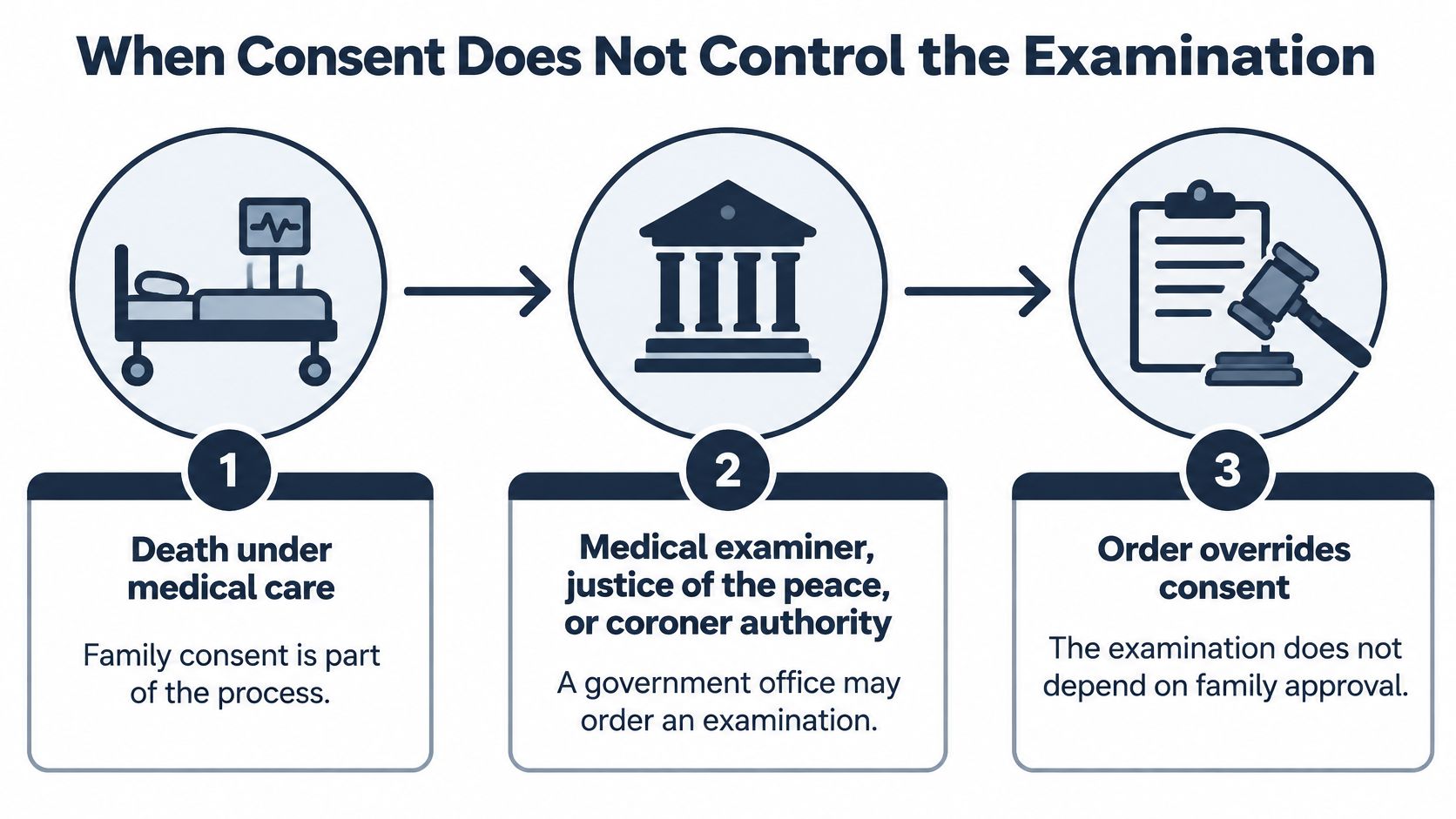
Some deaths fall under the authority of a medical examiner, justice of the peace, or coroner. In those cases, a government office may order an examination that doesn't depend on family consent. Certain deaths may require a medical examiner autopsy without next of kin consent, while hospital or private autopsies need written informed family consent.
The infographic below separates these paths.
The Limited Exception When No One Can Be Reached
Texas law also allows a narrow exception for the situation where a physician cannot identify or contact an authorized consenting person after due diligence. Under the consent provisions in Articles 49.33 and 49.34, that exception depends on authorization from the appropriate official, such as a medical examiner, justice of the peace, or county judge. Which official depends on the circumstances and the jurisdiction.
Two things need to line up before the exception applies: a documented effort to find a decision-maker and a signature from the official who holds authority over the death. The process is like a locked door with two keys. The due diligence record shows why the family door could not be opened. The official authorization is the second key that lets the examination proceed anyway.
This matters when evidence needs prompt preservation and no legally authorized family representative can be reached. The due diligence record and the official authorization belong in the case file, so the record shows who was contacted, when, and who approved the examination. If those two elements are missing, an examination performed under the exception is on weak footing later.
When the County Declines a Case
A county decision not to perform an examination doesn't end a family's options. A private autopsy can still be requested when a county declines a case, and families can choose to have it performed independently. Our article on when an autopsy is required by law explains the mandatory categories further.
Cost responsibility follows who orders the work. Private autopsies are arranged and paid for by the family or requesting party. County or medical examiner autopsies ordered under that office's jurisdiction are covered by the government. That single distinction explains most of the confusion families feel when they are told "the county won't do it" and then handed a private consent form the next day.
Ask three questions early:
- Which office has jurisdiction over this death?
- Who ordered the examination, the family or a government official?
- If the county declined, can an independent autopsy proceed once the body is released?
Clear answers keep a family from signing private paperwork for an examination the county controls, or waiting on a government examination that will not occur. The permissions on the form only do work where the family's authority does.
Changing, Withdrawing or Objecting to Consent
A signed consent can be changed, but timing controls what's possible. Before the examination begins, a signer can usually narrow permissions, add a restriction, or withdraw consent. Put the change in writing on the form and confirm it with the facility before the examination proceeds.
After the examination is performed, a later change can't undo work already completed. The remaining decisions shift to retained material and report release. At that point, the return or destruction terms and any end date for release matter most.
How to Record a Change or Objection
Use these steps:
- Write the change with the date and the signer's printed name and signature.
- Confirm receipt with the facility before the examination begins.
- Ask about specimens and how the change affects tissue already collected.
- File the revised form so the case record shows the current permissions.
A relative who objects should state the objection in writing and identify their legal relationship to the decedent. The facility will check the objection against the authority rules before proceeding. A verbal objection from an unnamed caller gives the facility little to verify.
Write any end date for release of findings as a specific date or a named event, such as delivery of the final report, rather than an open ended term. Open terms invite disagreement about when a recipient's access should stop.
A change that conflicts with a government ordered process follows that process. A family can't withdraw a county ordered examination by revising a private form. Families facing a dispute about authority, objection, or withdrawal should seek legal advice on the specific case promptly, ideally before the examination is scheduled.
Questions Families Ask Before Signing
Why do families request a private autopsy?
Families most often request one when the medical examiner declined the case, when they want an independent second opinion, or when the cause of death was left unclear. A private autopsy is an independent examination performed at the family's request rather than by a county or government office. It's scoped to the family's specific questions, most often how and why the loved one died and whether anything was missed.
Will an autopsy affect viewing or the funeral?
The examination is performed carefully and respectfully so the loved one can still be viewed, and an open casket funeral isn't affected by a private autopsy. We coordinate the examination with the funeral home so family services aren't delayed. Still ask how scheduling affects your planned service date before dates are finalized, rather than assuming timing will align on its own.
How long does the autopsy process take?
Most cases are completed within 24 to 48 hours, depending on the tests needed. Toxicology, histology, or outside records review can extend the final report even when the examination itself is prompt. Treat that range as typical practice, not a guaranteed timeline.
Can a decision be changed after signing?
Yes, within the timing limits covered in the section on changing or withdrawing consent. Write the revised terms on the form, date them, and confirm receipt before the examination. Don't rely on a phone conversation alone when the change affects scope, retention, or release.
What should families ask about cost?
We use flat rate, all inclusive pricing for private autopsies, and payment plans are available. Request the quote in writing and confirm what it covers, including transport, testing, and the written report, before signing the consent form. A written quote prevents confusion between the examination fee and separate funeral home or county charges.
Who explains the results?
Our team explains what the autopsy results mean in plain language after the consultation. Families can ask which findings are certain, which are limited by the permitted scope, and which questions remain unanswered. Those distinctions matter when findings will be shared with an attorney or another clinician.
These answers describe general practice. They don't replace advice from an attorney about authority, release, or a disputed examination.
Sample Checklist Before You Sign
Use this checklist as a final review before any signature goes on the form. Read each item against the actual document in front of you, not against what was discussed verbally.
The image below summarizes the review in a shorter visual form.
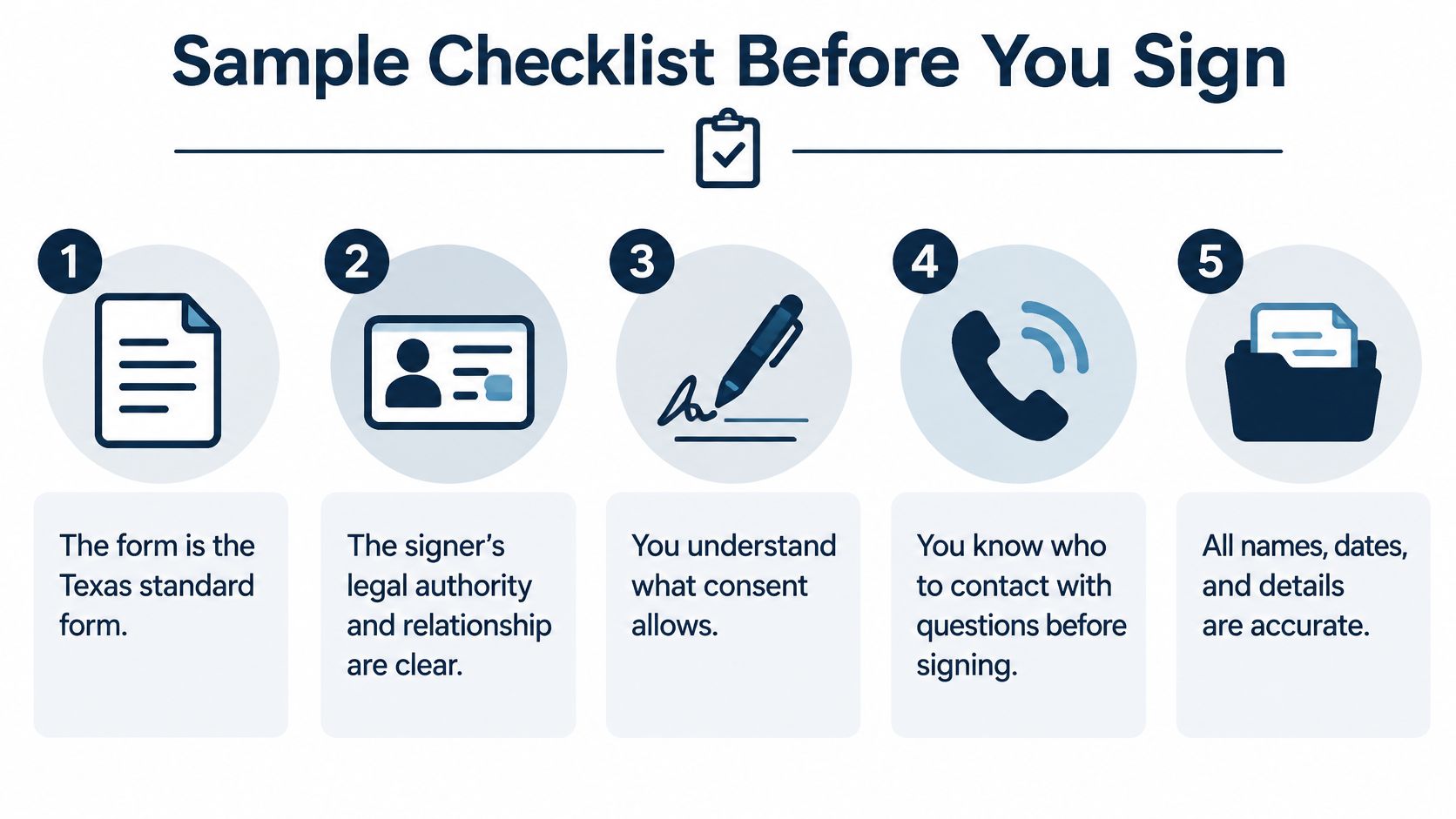
Seven Checks Before Signing
- Texas standard form: The document is the prescribed Texas form, not a generic release.
- Signer authority stated: The signer's legal authority and relationship are written on the form.
- Each component marked: Every permission in the list is marked permitted or declined, with no blank lines.
- Recipients named: Every release recipient is named with a role and an end date or revocation term.
- Scope and retention match: The examination scope and tissue retention terms match the family's choices.
- Lines complete: Signature, date, and witness lines are filled in.
- Copy secured: The signed original or a verified electronic copy is placed in the case file, and the family keeps a copy.
If any check fails, pause and correct the form before signing. Corrections are simple before the examination. They're far harder after specimens are collected or a report has been released.
A private autopsy request starts with a confidential request. Families who want an overview of our Private Autopsies process can review the service page, then call our team at (806) 230-1889 to talk directly about authority, scope, and next steps. Payment plans are available for families who need them.
Every examination is performed by a board-certified forensic pathologist, and the same pathologist who conducts the examination produces the written report and walks the family through every finding. Families aren't handed off to a technician. We serve all 254 Texas counties from our Elgin facility and coordinate licensed transport and funeral home communication as part of that process.
We know this decision comes during grief, often with time pressure from funeral planning and unanswered medical questions. You deserve a form you understand, permissions you chose deliberately, and a clear record of who will receive the findings. Call with questions before you sign, and take the time needed to read each line with care.
If your family needs a private autopsy, a second opinion review, or guidance on who may legally authorize an examination in Texas, contact Texas Autopsy Services or call (806) 230-1889 to speak directly with our team. We provide independent examinations by forensic pathologists certified by the American Board of Pathology, clear written reports, and respectful communication across all 254 Texas counties.