August 30, 2026 · Texas Autopsy Services
Is an Overdose Considered Accidental Death
Is an overdose considered accidental death? Learn how manner of death is determined, what coroners consider, and when a second opinion helps.
On this page
- What Counts as an Accidental Overdose Death
- The Five Manners of Death and How They Apply to Overdoses
- How Coroners Decide Between Accident Suicide and Undetermined
- A Look at How the Same Death Can Be Classified Differently
- What an Accidental Classification Means for Families and Legal Cases
- When a Second Opinion or Private Autopsy Review Makes Sense
- Texas Rules Families Should Know Before Requesting a Review
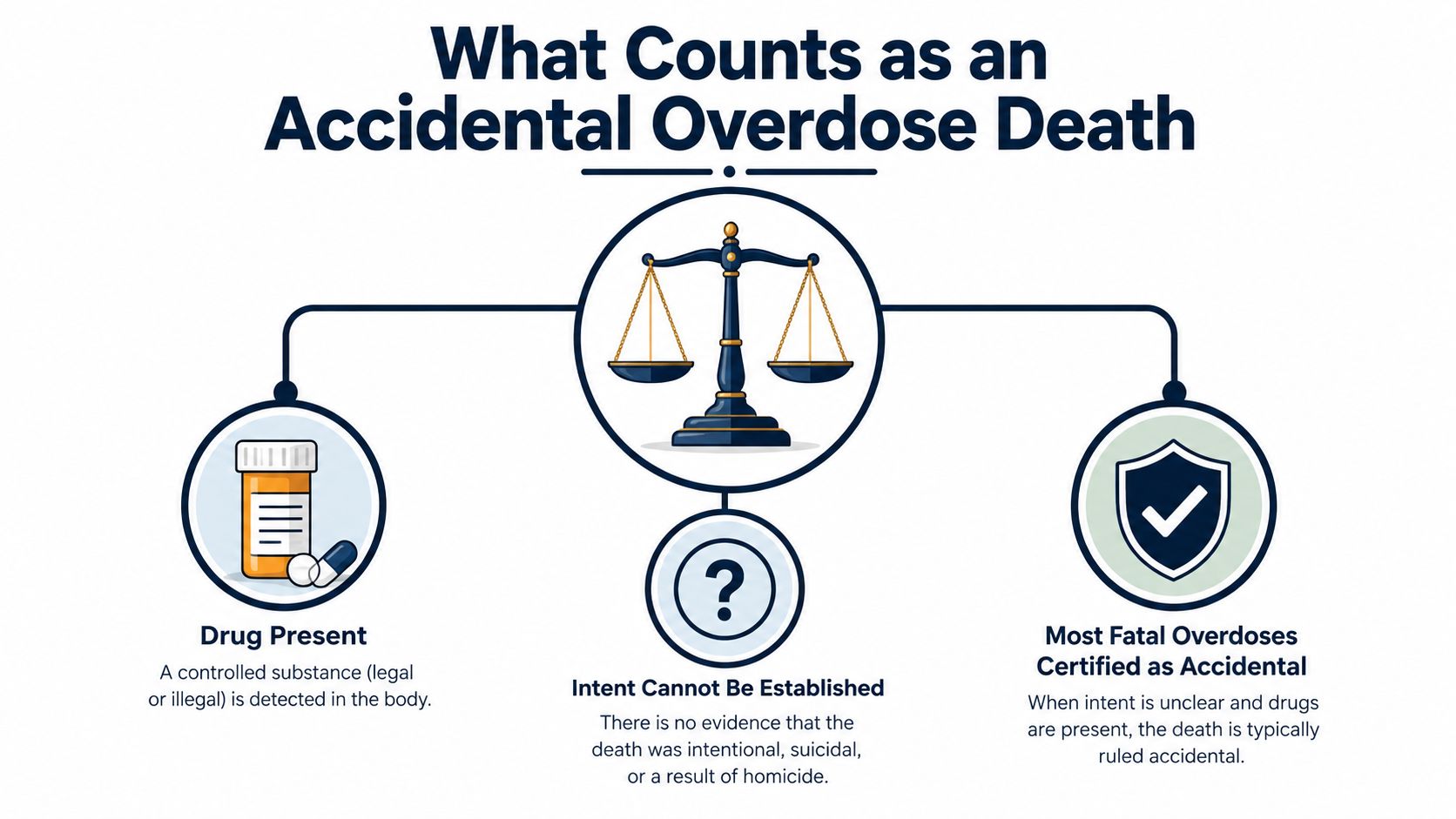
Most fatal drug overdoses are classified as accidental deaths because the standard requires little or no evidence of intent to harm or cause death. Suicide, undetermined, and homicide classifications remain possible when the evidence points elsewhere.
A family may hear that toxicology found fentanyl, opioids, or several substances and assume the manner of death is settled. It isn't. Toxicology helps establish what caused the death, while the scene, medical history, autopsy findings, and evidence of intent help determine how the death occurred. That distinction matters to families, attorneys, insurers, and agencies reviewing a death certificate.
At Texas Autopsy Services, our team approaches these questions through forensic pathology, careful documentation, and plain communication. Every examination is performed by a forensic pathologist certified by the American Board of Pathology. We serve families, attorneys, healthcare professionals, and county officials throughout Texas, including Central Texas and all 254 Texas counties.
- Most fatal overdoses are certified as accidents when drug use was unintentional and evidence doesn't establish an intent to die.
- Cause of death and manner of death are different findings. A drug toxicity may be the cause, while accident, suicide, homicide, or undetermined describes the manner.
- Investigators review multiple evidence streams, including the scene, medical history, autopsy, toxicology, and witness information.
- The same drug finding can support different manners of death when the surrounding evidence changes.
- A second-opinion autopsy review can help identify missing information, explain conflicting findings, or evaluate whether a classification is supported.
What Counts as an Accidental Overdose Death
The direct answer to “is an overdose considered accidental death” is usually yes when the fatal drug use was unintentional and there's little or no evidence that the person meant to harm themselves or cause death. Federal CDC guidance defines an accident as a poisoning with little or no evidence of intent to harm or cause death, and drug poisoning deaths are treated as non-natural deaths rather than natural deaths (CDC death investigation guidance).
The word accidental has a specific forensic meaning. It doesn't require that the drug use was sensible, safe, or completely unforeseeable. Repeated misuse, substance use disorder, combining drugs, or taking more than prescribed may still be classified as an accident when the evidence doesn't establish suicidal intent. Guidance from the National Association of Medical Examiners states that deaths from opioid misuse or abuse without apparent self-harm intent are best classified as accidents (National Association of Medical Examiners recommendation).
Cause and manner are separate findings
Cause of death identifies the disease, injury, or toxic exposure that produced death. In an overdose case, it may be acute fentanyl toxicity, opioid toxicity, mixed-drug toxicity, or another specific poisoning finding supported by autopsy and toxicology.
Manner of death describes how that cause arose. The standard categories are natural, accident, suicide, homicide, and undetermined. An overdose is generally not certified as natural merely because a person had a prescription or an underlying medical condition. Tennessee medical examiner guidance states that acute drug intoxication should not be certified as a natural death and that most overdose deaths are best classified as accidents (Tennessee drug overdose certification guidance).
Families also benefit from understanding the difference between recognizing an overdose in an emergency and classifying a death after investigation. For immediate safety information, the overdose recognition and response guide addresses emergency warning signs and response considerations. For the forensic classification itself, our explanation of what makes an overdose accidental provides additional context.
Practical rule: A positive toxicology result identifies exposure. It doesn't, by itself, prove intent.
The Five Manners of Death and How They Apply to Overdoses
Medical examiners and coroners generally choose among five manner-of-death classifications. The classification depends on the complete evidence, not solely on the substance identified in the body. More detail about the meaning of these categories appears in our guide to the manner of death definition.
| Manner | Definition | Typical overdose example |
|---|---|---|
| Natural | Death results from disease or an internal medical process. | A medication may contribute to death in a medically complex case, but acute intoxication itself generally isn't certified as natural. |
| Accident | Death results from an unintended exposure or event, without evidence of intent to die. | A person takes drugs for recreation, pain, or dependence and dies from the resulting toxicity without evidence of self-harm intent. |
| Suicide | A person causes their own death with evidence of an intent to die. | A note, deliberate preparation, statements of intent, or other reliable evidence supports intentional self-poisoning. |
| Homicide | Another person's act causes the death. | Evidence may show that another person deliberately caused or delivered a lethal exposure, subject to the governing jurisdiction and facts. |
| Undetermined | The evidence doesn't support one manner clearly enough to select it. | The available facts support both accidental and suicidal explanations, or the investigation can't resolve the conflict. |
Why accident is common
The accident category doesn't mean investigators believe nothing risky happened. It means the evidence supports unintended use rather than a deliberate attempt to cause death. Expert guidance recommends accident for most misuse or abuse deaths without apparent self-harm and reserves undetermined for uncommon cases where more than one determination remains reasonably supported (forensic drug death guidance).
Suicide requires more than the presence of a lethal concentration. A high drug level can occur after tolerance changes, an unexpected combination, or a contaminated product. Investigators need reliable evidence connecting the ingestion to an intent to die.
Homicide is also distinct from an accidental supply or delivery event. Whether another person's conduct satisfies a criminal homicide statute is a legal question for prosecutors and courts. The forensic pathologist's role is to interpret medical and investigative evidence and certify the medical manner under the applicable system.
How Coroners Decide Between Accident Suicide and Undetermined
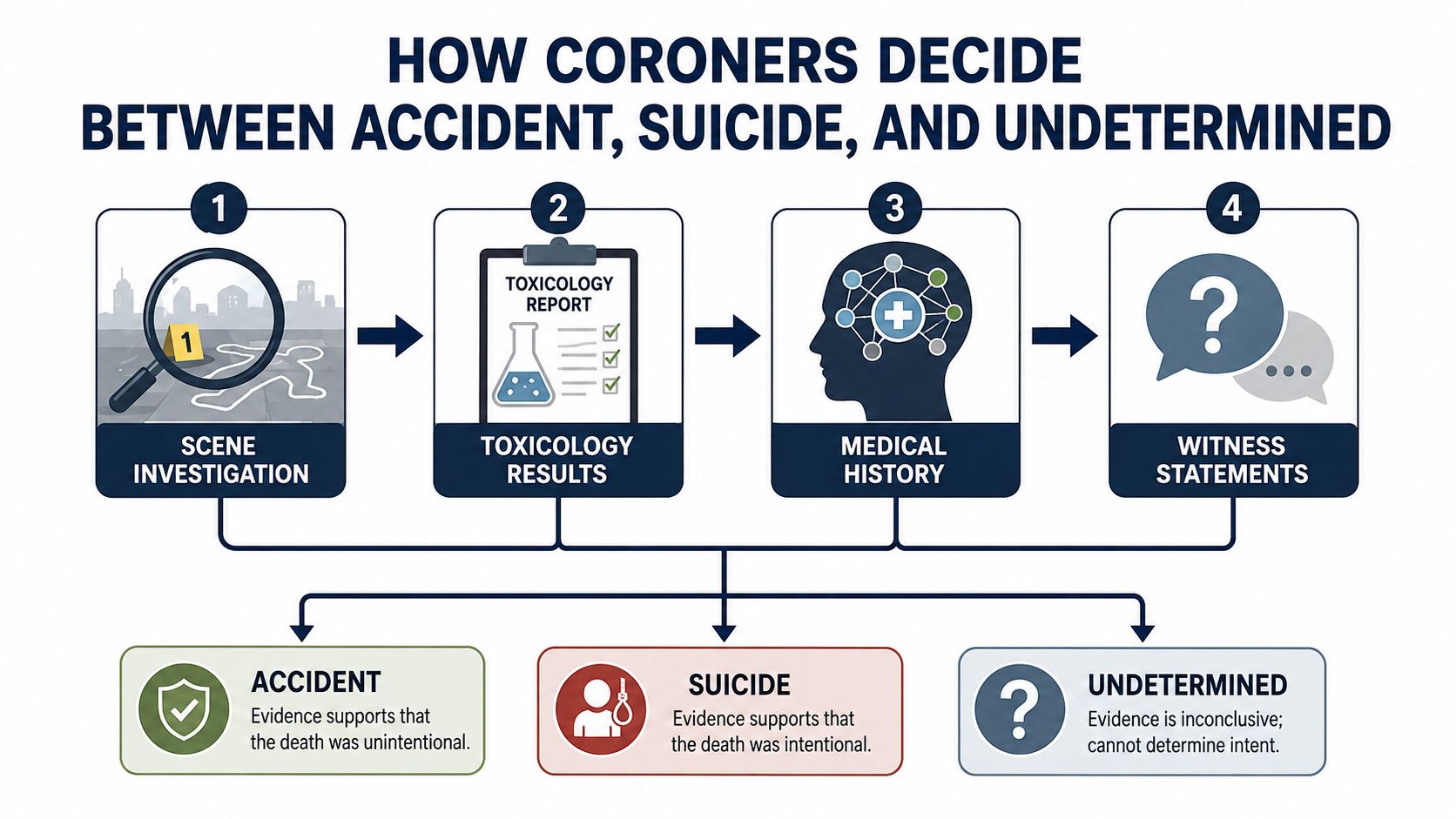
Intent rarely appears in a single laboratory result. Our board-certified forensic pathologists evaluate the evidence as a connected record, because the meaning of a toxicology result can change when the scene or medical history supplies additional context.
The four main evidence streams
Scene investigation may document drug containers, paraphernalia, the location of the body, messages, witnessed resuscitation, locked or open doors, and whether a note or other planning material exists. The absence of a suicide note doesn't prove an accident, just as the presence of a note requires careful authentication and interpretation.
Medical history may show prior self-harm, psychiatric treatment, substance use, prescriptions, recent crises, or statements about intent. A history of depression or addiction doesn't establish suicide by itself. It becomes one part of the larger evidence record.
Autopsy findings help confirm or challenge possible explanations. The examination may document injection sites, pill material, pulmonary edema, injuries, disease, and signs that support or rule out trauma or another cause. Autopsy findings don't automatically reveal a person's state of mind.
Toxicology identifies drugs, metabolites, and combinations that may have contributed to death. Concentrations must be interpreted with the postmortem examination, known tolerance, treatment history, and circumstances. A single substance or a mixture can be fatal, but the laboratory result alone doesn't establish whether the ingestion was intentional.
The National Association of Medical Examiners' position favors accident for opioid misuse or abuse when apparent self-harm intent is absent. It recommends using undetermined sparingly, when the evidence supports more than one possible manner rather than because a family finds the result difficult to accept (NAME recommendation on drug-related deaths).
A review may be appropriate when the report doesn't explain how these evidence streams were reconciled. Families seeking background on uncertainty can also read our discussion of an undetermined cause of death. That designation isn't a conclusion that nothing is known. It indicates that the available evidence doesn't support one manner clearly enough.
A Look at How the Same Death Can Be Classified Differently
Consider a representative, anonymized scenario. An adult is found unresponsive at home, and toxicology later identifies multiple substances. The laboratory findings establish exposure, but they don't decide the manner by themselves.
In the first evidence package, investigators find no suicide note or reliable statement of intent. The scene shows drug use and empty containers, while the available history documents relapse without evidence of planning for death. The pathologist may certify the cause as mixed-drug toxicity and the manner as accident, because the evidence supports unintended use.
The second package contains different information. Investigators recover a reliable suicide note, records showing deliberate preparation, and communications expressing an intent to die. The same general toxicology result could support suicide when those facts provide clear evidence that the ingestion was intentional.
A third package may remain unresolved. Suppose a partial note has uncertain authorship, witnesses provide conflicting accounts, and the toxicology findings can't establish whether the substances were taken together intentionally or during an uncontrolled episode. The manner may be undetermined if both accident and suicide remain supported after the investigation.
The classification follows the totality of the evidence, not the drug name alone.
This distinction explains why two deaths involving the same opioid can receive different manners. It also explains why a later review must examine the original scene documentation, witness interviews, medical records, autopsy photographs, toxicology methods, and chain of custody rather than focusing on one isolated result.
What an Accidental Classification Means for Families and Legal Cases
A manner-of-death finding can affect the way an insurer, employer, attorney, or government agency evaluates a claim. The certificate doesn't answer every legal question, and it isn't a substitute for policy language, employment records, or a court's decision. It does, however, provide an important medical finding that other decision-makers may consider.
| Manner of death | Life insurance impact | Workers' compensation impact | Criminal exposure |
|---|---|---|---|
| Accident | A policy may treat accidental and intentional deaths differently. The controlling terms and exclusions must be reviewed. | Eligibility depends on whether employment caused or contributed to the injury or exposure and whether statutory requirements are met. | An accidental finding may affect how investigators assess another person's conduct, but it doesn't eliminate possible criminal questions. |
| Suicide | Self-inflicted injury exclusions and policy conditions may affect payment. An insurer's review depends on the contract and applicable law. | A suicide classification may complicate causation and compensability, but the result depends on the facts and governing rules. | Evidence of another person's role may still be examined separately from the manner certification. |
| Homicide | Policy payment may depend on exclusions, beneficiaries, and the underlying facts. | Work-related causation remains a separate issue. | The finding may prompt investigation of the acts that caused or contributed to death. |
| Undetermined | The insurer may request additional records because the manner doesn't resolve intent. | Investigators must still evaluate the employment connection independently. | Prosecutors may seek more evidence before deciding whether charges are supported. |
| Natural | Policy and employment consequences depend on the contract and medical facts. | A natural classification generally requires a different causation analysis than an external injury. | The classification doesn't ordinarily describe an external act causing death. |
Families often question an accidental ruling when the scene investigation was incomplete, a witness account surfaced later, or the report doesn't explain a conflicting medical history. Attorneys may also challenge a classification when the manner affects a civil claim, insurance dispute, estate matter, or criminal investigation.
The practical point is restraint. An accidental manner doesn't decide coverage, workers' compensation, civil liability, or criminal responsibility on its own. Those decisions involve different legal standards and decision-makers. A forensic review can clarify the medical reasoning without promising a particular legal result.
When a Second Opinion or Private Autopsy Review Makes Sense
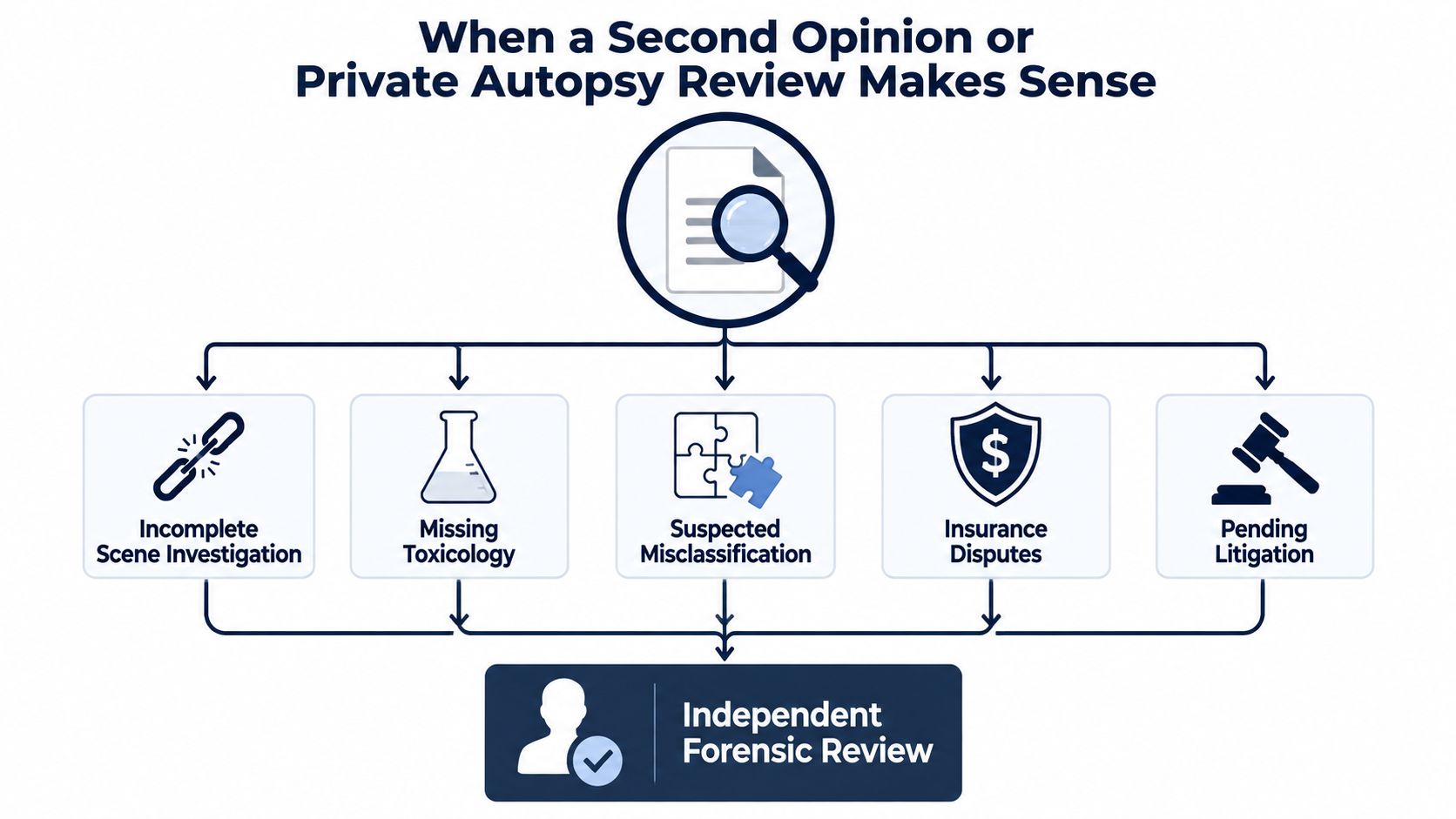
A second opinion may help when the existing record leaves an important question unanswered. Common triggers include incomplete scene documentation, missing or limited toxicology, a suspected misclassification, an insurance dispute, or pending litigation.
Two forms of independent review
A second-opinion consultation examines records already available. Our team may review the death certificate, autopsy report, toxicology report, photographs, medical records, investigative materials, and witness information. This approach can identify whether the stated cause and manner are supported, whether terminology is clear, and what additional evidence would be needed.
A private autopsy is a new postmortem examination, when legally and practically possible. It may include external and internal examination, retained specimens, photography, histology, toxicology, or molecular testing. The scope depends on the condition of the remains, prior examination, authorization, available specimens, and the questions presented.
Families and attorneys should ask about authorization, transport, storage, specimen preservation, chain of custody, reporting, and fees before proceeding. Costs and turnaround depend on the requested examination, testing, location, condition of the remains, and records available. Most cases may be completed within 24 to 48 hours, but that is not a guarantee and laboratory testing or records collection can take longer.
Preparing the review
Request the available records from the responsible medical examiner, justice of the peace, or other investigating agency. Depending on the record, the request may involve public-records procedures, vital-statistics procedures, agency policies, authorization requirements, or a lawyer's formal request. Ask specifically whether toxicology specimens remain available and whether they can be preserved for independent testing.
Prepare a clear packet:
- Timeline: Document the last known well time, discovery, emergency response, hospitalization, and death.
- Medical history: Include prescriptions, treatment records, substance-use history, and relevant diagnoses.
- Witness material: Preserve statements, messages, photographs, and records of communications.
- Focused questions: Identify whether the concern involves cause, manner, toxicology interpretation, scene evidence, or chain of custody.
Texas Autopsy Services provides private autopsy services and independent reviews of prior autopsy reports and medical records. Every examination is performed by a board-certified forensic pathologist certified by the American Board of Pathology, with licensed transport available across Texas and reporting designed for medical, family, and legal use.
Texas Rules Families Should Know Before Requesting a Review
Texas families should first identify which authority handled the death. A medical examiner's office may investigate deaths within its jurisdiction, while a justice of the peace may conduct inquest duties in a county without a medical examiner. The governing authority, the county's procedures, the type of death, and the status of the remains all affect how a review request should proceed.
Texas Health and Safety Code provisions govern important death-record and disposition matters, including Chapter 716. Families should also consider the role of the Texas Funeral Service Commission and applicable provisions in Chapters 711 and 651 when funeral, cemetery, cremation, or professional-service questions overlap with the investigation. These laws should be applied to the specific facts, and legal counsel may be appropriate.
Texas law requires the person completing a death certification to state whether a death from external causes was probably accidental, suicidal, or homicidal. Texas Health and Safety Code also requires the medical certification to use “Fentanyl Poisoning” or “Fentanyl Toxicity” when toxicology and autopsy findings support an opioid-overdose cause of death (Texas Health and Safety Code Chapter 193).
Practical steps for a Texas review
- Identify the certifying authority. Confirm whether the county medical examiner, justice of the peace, or another authorized office handled the case.
- Request the available report. Ask for the autopsy report, toxicology report, investigative materials, photographs when available, and death certificate.
- Preserve specimens early. Ask whether retained blood, urine, tissue, or other toxicology specimens remain and whether a preservation request is possible.
- Document the concern. State the specific issue, such as an unexplained intent finding, incomplete history, conflicting toxicology, or missing scene evidence.
- Obtain an independent review. A forensic pathologist can assess whether the cause and manner are medically supported and identify additional records or testing needs.
A request for reconsideration should include the death certificate, reports, medical history, medication information, witness statements, and any newly discovered evidence. No review can guarantee a changed classification. The value lies in testing the reasoning against the complete record, preserving relevant evidence, and explaining the conclusion in terms families and attorneys can understand.
When an overdose manner-of-death finding remains unclear, Texas Autopsy Services offers independent forensic record reviews and private autopsy services performed by a board-certified forensic pathologist certified by the American Board of Pathology. Visit Texas Autopsy Services to discuss the available records, evidence-preservation needs, and the appropriate next step with our team.