January 17, 2026 · Texas Autopsy Services
Understanding The Texas Cause Of Death Certificate
A Texas forensic pathologist explains how a cause of death certificate is determined, its legal importance, and what families should do if it seems inaccurate.

On this page
- Distinguishing Cause From Manner Of Death
- Who Signs the Death Certificate in Texas?
- How I Uncover the Cause of Death A Step-by-Step Scientific Process
- When To Consider A Private Autopsy For A Second Opinion
- How to Correct an Inaccurate Texas Death Certificate
- Answering Your Questions About Texas Death Certificates
My name is our forensic pathology team, and as a board-certified forensic pathologist, I work with one of the most important documents a family ever receives: the death certificate. It’s far more than a piece of paper. It’s the official record that provides closure, allows a family to settle an estate, and even helps protect public health. The accuracy of this document hinges on understanding two key terms that are often confused: the cause of death and the manner of death.
- The cause of death is the specific medical reason—a disease or injury—that led to death.
- The manner of death is a legal classification describing the circumstances (natural, accident, suicide, homicide, or undetermined).
- In Texas, a death certificate is signed by an attending physician for natural deaths or a Medical Examiner/Justice of the Peace for unexpected or unnatural deaths.
- A private autopsy provides an independent, second-opinion investigation to confirm or clarify the cause of death.
- New medical evidence from a private autopsy is required to amend an official cause of death on a Texas death certificate.
Distinguishing Cause From Manner Of Death

When families look at a death certificate, their eyes usually go straight to the medical terms. But the certificate is designed to tell a very specific story, and learning its language is the first step toward finding clarity during a difficult time.
Although they sound similar, the cause and manner of death answer two completely different questions. Getting this distinction right is one of my most critical responsibilities, as it lays the groundwork for everything that follows.
What Is The Cause Of Death
The cause of death is the specific medical reason—a disease or an injury—that started the chain of events that led to death. Think of it as the medical explanation. It’s what a doctor or pathologist determines based on the person's medical history, a physical examination, or an autopsy.
For instance, the cause of death might be a "myocardial infarction" (a heart attack). Or, if someone passed away from injuries in a car crash, the cause might be listed as "blunt force trauma." This part of the certificate is purely about medicine and biology.
What Is The Manner Of Death
The manner of death is different. It’s a legal classification that describes the circumstances surrounding the death. It doesn't answer "why" from a medical standpoint, but rather "how" the death came about.
In Texas and across the United States, there are only five official categories for the manner of death:
- Natural: Caused exclusively by disease or the aging process.
- Accident: The result of an unintentional act or event.
- Suicide: A death caused by a purposeful, self-inflicted act.
- Homicide: The death of one person at the hands of another.
- Undetermined: Used when there isn’t enough evidence to confidently choose one of the other four categories.
A medical examiner or Justice of the Peace determines the manner of death after considering the entire investigation, which can include police reports, witness statements, and my own forensic findings.
Let's put it together. If the cause of death was a gunshot wound, the manner could be homicide, suicide, or even an accident. The medical fact (the wound) is distinct from the legal classification (how it happened).
Cause Of Death Vs Manner Of Death At A Glance
Here’s a simple table to help make the distinction crystal clear.
| Concept | What It Answers | Example |
|---|---|---|
| Cause of Death | "Why did the person die, medically?" | A gunshot wound to the chest |
| Manner of Death | "How did the death occur, legally?" | Homicide |
Understanding this difference is crucial because it affects everything from insurance claims to legal proceedings. The cause explains the biology, while the manner tells the story of the circumstances.
Who Signs the Death Certificate in Texas?
In Texas, the person responsible for completing and signing a death certificate isn't always the same. It comes down to the specific circumstances surrounding the death. This is a crucial distinction, as it separates a death that was expected and natural from one that requires an official investigation.
When someone passes away from a known illness while being treated by a doctor, things are usually straightforward. The attending physician who was managing their care is legally required to certify the death. Using the patient's medical records, they can confidently list a natural cause and complete the medical section of the death certificate.
But the process changes completely when a death is sudden, unexpected, or happens under violent or suspicious circumstances.
When an Official Investigation is Required
Any death that isn’t clearly from natural causes falls into the hands of a government official. Depending on the county in Texas, this will be either a Medical Examiner or a Justice of the Peace. I dig into the specifics of these roles in my article on the difference between a coroner and medical examiner.
These officials are legally required to step in and investigate deaths that meet certain criteria defined by state law.
An official investigation is triggered for deaths where:
- The person dies within 24 hours of being admitted to a hospital.
- The cause is unknown, unnatural, or seems suspicious.
- The death appears to be an accident, suicide, or homicide.
- The person was not under a doctor's care before they died.
This system is in place to protect the public, uncover potential crimes, and make sure every death is accounted for accurately. It’s at this point that my work as a forensic pathologist usually begins.
The Role of the Forensic Pathologist
While a Medical Examiner or Justice of the Peace holds the legal authority, they depend on medical science to reach a conclusion. As a board-certified forensic pathologist, I am brought in to perform a forensic autopsy, providing them with objective, scientific evidence. My job is to supply the specific medical findings they need to pinpoint the exact cause of death.
Think of it this way: a Justice of the Peace might be called to a home where someone died alone. They can gather facts at the scene, but they don't have the medical training to determine if the person had a heart attack, a stroke, or some other hidden condition. My autopsy report delivers those definitive answers, which the official then uses to certify the death certificate.
The accuracy of a death certificate goes far beyond being just a record for one family. This data is the bedrock of public health, allowing us to track disease trends, calculate life expectancy, and identify safety issues.
These certificates are the primary source for understanding mortality patterns all over the world. In the United States, the National Vital Statistics System collects data from about 2.8 million deaths each year, which is vital for making public health decisions. The World Health Organization relies on similar data to assess mortality trends on a global scale.
Ultimately, the person who signs the death certificate is the one with the legal authority and the best information available. For an expected death, it's the attending physician. For all others, it's the investigating official—whose conclusion is very often built on the detailed scientific work of a forensic pathologist.
How I Uncover the Cause of Death A Step-by-Step Scientific Process
Figuring out why someone died is a careful, methodical process rooted in medical science. It doesn't matter if I'm performing a forensic autopsy for a county or a private one for a family seeking answers—the approach is always the same. Each step is designed to build a complete and accurate picture of what happened.
The real work doesn’t start on the examination table. It begins with piecing together the story of the person's life and the circumstances of their death.
Starting with the Full Story Medical and Circumstantial History
The very first thing I do is gather and analyze the decedent’s history. This means a deep dive into their medical records to look for known illnesses, recent hospital stays, medications they were taking, and any past surgeries. Tools like medical chronology templates can be helpful here, organizing a complex medical history into a clear, understandable timeline.
Just as crucial are the circumstances surrounding the death. I review reports from law enforcement and paramedics and listen carefully to what family members can share. This helps create a timeline and points to factors that medical records alone might miss. This groundwork is the foundation for the entire physical examination.
The Autopsy A Detailed Physical Examination
The autopsy itself has two main parts: an external and an internal examination. Each one offers a unique set of clues.
- The External Examination: I start by carefully inspecting the body for any signs of injury, disease, or unique identifying marks. I document everything, from the faintest bruise to more obvious trauma, which helps connect what I see with the known circumstances.
- The Internal Examination: This is a respectful and systematic procedure to examine the internal organs. I assess each organ system for evidence of disease, injury, or other abnormalities that weren't visible on the outside.
Throughout the internal exam, I collect small tissue and fluid samples. These are incredibly important for the next stage, as they let us see things that are invisible to the naked eye.
Looking Deeper with Ancillary Testing
The physical exam provides a ton of information, but it's often the specialized lab tests that give us the final, definitive answer.
Toxicology screens blood, urine, and tissue for alcohol, prescription drugs, illegal substances, or poisons. Another key test is histology, which involves looking at tissue samples under a microscope. This can reveal cellular damage from things like heart disease, infections, or cancer. In some cases, I might also order microbiology tests to check for infections or genetic testing to identify inherited conditions that could have played a role.
This flowchart shows how the different roles—the attending physician, a government official, and a forensic pathologist—work together in the death certification process.

As you can see, while a family doctor often certifies a natural death, a pathologist's scientific investigation is essential when the cause isn't clear or seems unnatural.
My job is to bring all the pieces of this complex puzzle together—the medical history, the physical findings, and the lab results—into a single, scientifically sound conclusion. This final report gives the family and officials the objective evidence needed to accurately complete the death certificate.
Worldwide, chronic, non-communicable diseases are the leading causes of death. The Institute for Health Metrics and Evaluation (IHME) uses data from sources like death certificates to identify a single underlying cause for each death, which helps make sense of complex cases with multiple contributing factors. Here in the United States, the ten leading causes of death were responsible for 72.3% of all deaths in 2022.
When To Consider A Private Autopsy For A Second Opinion
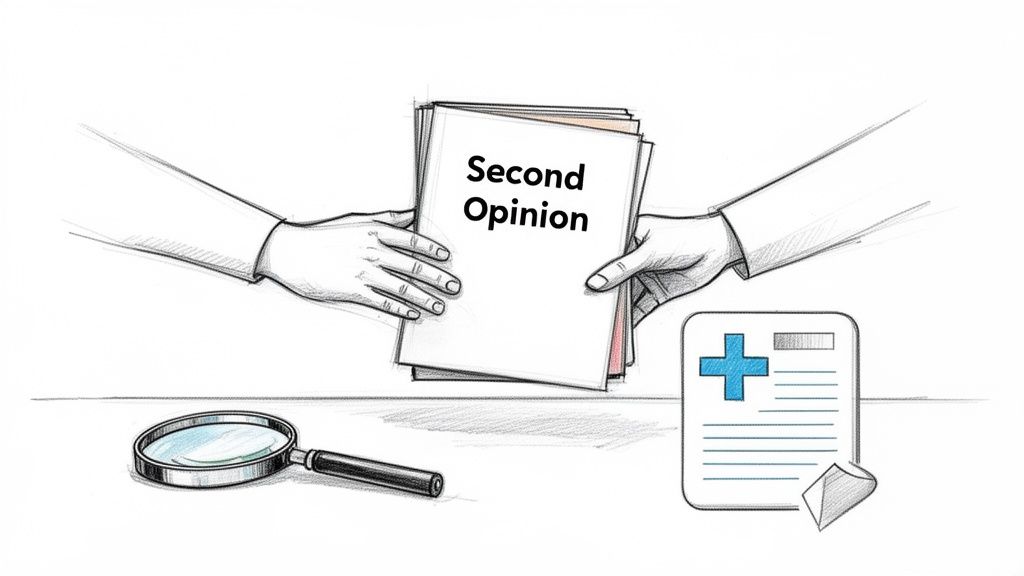
Sometimes, the official cause of death just doesn’t feel right. It might not line up with what you knew about your loved one’s health or the circumstances surrounding their final days. In these difficult and deeply personal moments, a private autopsy can offer a crucial second opinion and a path toward the clarity you deserve.
This is an option completely separate from a county-mandated exam. You might consider it if the medical examiner declined to perform an autopsy—which often happens if the death doesn't fall under their specific legal jurisdiction. It's also for families who feel the initial investigation left critical questions unanswered, perhaps because the full medical history wasn't available at the time.
Common Reasons Families Seek A Second Opinion
The decision to seek a private autopsy almost always comes from a profound need for certainty. After performing over a thousand autopsies, I’ve seen a few key motivations come up time and time again.
These reasons often include:
- Peace of Mind: An "undetermined" cause of death can leave a painful void. Getting a definitive, science-based answer can provide the closure needed to begin healing.
- Concerns About Medical Care: If you have lingering questions about the quality of medical treatment your loved one received, an independent autopsy offers an objective review of the facts.
- Uncovering Genetic Conditions: Identifying a hereditary illness, like a genetic heart defect or a rare disease, can be life-saving information for children, siblings, and other relatives.
- Legal Clarity: For attorneys, an independent examination provides unbiased expert evidence that is vital for civil lawsuits, insurance claims, or criminal cases where the cause of death is a central issue.
How A Private Autopsy Differs From A County Examination
It's important to know that a state-ordered autopsy and a private one serve very different purposes. A county forensic autopsy has a public and legal function. It’s triggered by law to investigate deaths that are sudden, violent, or otherwise unexplained. Its primary goal is to serve the interests of the state.
A private autopsy, on the other hand, is initiated by you. Its purpose is entirely personal—to answer your specific questions and deliver a detailed, medically sound report directly to your family or legal counsel.
The core value of a private autopsy is its independence. It provides a fresh, unbiased perspective focused solely on the medical evidence, free from any external pressures or administrative limitations that can sometimes affect a jurisdictional investigation.
As a board-certified forensic pathologist, I offer these private and second opinion autopsy services across Texas to deliver an impartial, thorough, and compassionate investigation. The entire process is designed to bring much-needed clarity during an incredibly difficult time. My role isn’t to challenge a previous finding, but to conduct a completely new and comprehensive examination based on all available evidence. I make sure no detail is overlooked, providing the definitive answers families and attorneys need to move forward.
How to Correct an Inaccurate Texas Death Certificate
It’s a tough situation, and frankly, a gut-wrenching one. Finding an error on a loved one’s death certificate feels like a final injustice when you’re already grieving. This isn't just a piece of paper; it's the official story, and getting it right is crucial for legal reasons, insurance, and your own peace of mind.
The good news is that Texas has a system in place to fix these records. Simple typos are one thing, but changing the actual cause of death is a much higher hurdle. It’s a serious legal step that absolutely requires solid, new medical evidence to back it up.
This is precisely where an independent, second-opinion autopsy becomes so powerful. It provides the objective, scientific proof needed to formally request a correction and set the record straight.
The Formal Amendment Process In Texas
The official process for correcting a death certificate runs through the Texas Department of State Health Services (DSHS) Vital Statistics Section. The key document is the VS-172 Application to Amend Certificate of Death.
Here’s the catch: you can’t just fill this out yourself. The application has to be submitted by the person who originally certified the death—that means either the attending physician or the Medical Examiner/Justice of the Peace. Sometimes the funeral director who filed the record can help.
When we’re talking about changing the cause of death, the original certifier must be the one to initiate it based on new information. My job as a private pathologist is to arm them (and you) with the undeniable evidence that makes that change necessary.
The Critical Role Of Supporting Medical Evidence
You can’t just tell the state you think the cause of death is wrong. You have to prove it with compelling medical evidence that wasn't available the first time around.
Changing a cause of death is a major legal and medical event. State officials won't even consider it unless there's new, definitive proof on the table. This is why the detailed findings from a private autopsy are so essential—they provide that proof.
The reports I create are built specifically for this purpose. They lay out a clear, step-by-step analysis of all the medical findings, from the big picture down to the toxicology and microscopic cell-level details. This gives the original certifier the scientific foundation they need to confidently submit the amendment. Essentially, I deliver a self-contained package of evidence ready for official review.
Navigating The Steps For Correction
So, if you’re facing an inaccurate death certificate, what do you do? The path forward involves a few logical steps. Many families start by talking to an attorney to get a handle on the legal side of things.
To help you see the whole process, here is a simplified breakdown of how to amend a death certificate in Texas.
| Step | Action Required | Key Consideration |
|---|---|---|
| 1 | Gather New Evidence | Commission a private, independent autopsy to obtain an objective medical report. |
| 2 | Contact the Original Certifier | Provide the new autopsy report to the physician, ME, or JP who signed the original certificate. |
| 3 | File the Official Amendment | The certifier uses your new evidence to complete and submit the VS-172 form to the Texas DSHS. |
| 4 | Undergo State Review | The DSHS Vital Statistics Section will carefully review the application and all supporting documentation. |
| 5 | Receive the Corrected Certificate | Once approved, the state will issue a new, amended death certificate reflecting the accurate information. |
This structured approach ensures that any change to such an important record is based on hard science. It protects the integrity of state records while giving families like yours the accuracy and the answers they deserve.
Answering Your Questions About Texas Death Certificates
When families and attorneys come to me, they often have a lot of the same questions about death certificates and autopsies in Texas. It's a confusing process, and my goal as a board-certified forensic pathologist is to give you clear, straightforward answers you can trust.
Can a Texas Death Certificate Be Changed or Corrected?
Yes, but how you go about it depends entirely on what needs fixing.
Simple typos, like a misspelled name or an incorrect date of birth, are fairly easy to correct. You'll typically need to submit a formal application to the Texas Vital Statistics office along with documents that prove the correct information.
Changing the official cause of death, however, is a much bigger deal. This isn't just a clerical fix; it's a major medical and legal revision. To even attempt it, you need compelling new evidence—information that wasn't available when the certificate was first signed. The most powerful tool for this is a detailed report from a private, independent autopsy. The original certifier (the doctor or medical examiner who signed the document) will need that new information to file an official amendment.
What Does It Mean If the Cause of Death Is Listed as "Pending"?
Seeing "pending" on a death certificate can be unsettling, but it's actually a sign that a thorough investigation is underway. It simply means the medical examiner needs more information before they can make a final call. It doesn't mean something is wrong; it means they're being careful.
This is very common in cases that require specialized lab work, which can take several weeks or more to come back.
These tests often include:
- Toxicology reports to check for drugs, alcohol, or other substances.
- Microscopic tissue analysis to look for signs of disease at the cellular level.
- Microbiology cultures to see if a hidden infection played a role.
Once all the results are in and the investigation is complete, the medical examiner will issue an amended death certificate with the definitive cause and manner of death.
A "pending" status, while understandably hard on a grieving family, is a commitment to accuracy. It ensures the final answer is based on solid scientific evidence, not a premature guess.
How Long Does It Take to Get a Final Death Certificate?
The timeline really depends on the situation. If the cause of death is straightforward and no extensive investigation is needed, the funeral home can often get you certified copies within a week or two.
But when a case is more complex and involves an autopsy or those "pending" lab results, the process naturally takes longer. It’s not unusual for it to take anywhere from six weeks to several months to get the final, amended document. The delay is almost always tied to the time needed for specialized testing. The best way to get updates is to stay in touch with the office of the official who signed the certificate.
What Is the Cost of a Private Autopsy in Texas?
A private autopsy is paid for by the family or their attorney, unlike a forensic autopsy ordered by the county, which is covered by the state. The cost can vary quite a bit depending on how complex the case is and what kind of extra tests—like toxicology or genetic analysis—are needed.
At Texas Autopsy Services, I believe in being completely transparent about costs. My fees are typically all-inclusive, meaning they cover transporting your loved one, the full examination, all standard testing, and the comprehensive final report. This way, you know the full cost upfront without any surprise fees later. I always provide a detailed quote after an initial consultation to go over the specifics of your situation.
Who Is Authorized to Order a Private Autopsy?
In Texas, the law establishes a clear legal hierarchy of next-of-kin to determine who has the authority to consent to a private autopsy. The person with the highest priority on that list is the one who has the legal right to make the decision.
Generally, the order of priority is:
- A surviving spouse.
- Any surviving adult child of the decedent.
- The surviving parents of the decedent.
- Any surviving adult sibling.
If you’re not sure who has the legal authority in your family’s situation, it’s a good idea to speak with an attorney. This helps ensure the entire process is handled respectfully, ethically, and on solid legal ground.
The time after losing a loved one is filled with tough questions. At Texas Autopsy Services, my mission is to provide clear, compassionate, and scientifically sound answers to help you find certainty and peace of mind. If you have questions about a cause of death or need guidance, please contact my office directly. I am our forensic pathology team, and my team and I are here to help you navigate this process with the professionalism and respect you deserve.
Learn more at https://www.texasautopsyservices.com