October 19, 2025 · Texas Autopsy Services
A Forensic Pathologist's Guide: How to Get an Autopsy Report in Texas
Learn how to get an autopsy report Texas with our straightforward guide. Discover official steps for families and legal professionals today.

On this page
- Your First Steps to Obtaining an Autopsy Report
- Navigating County Systems: Medical Examiner vs. Justice of the Peace
- How to Formally Request the Autopsy Report
- Managing Timelines and Expectations
- Making Sense of the Autopsy Report
- When to Consider a Private Autopsy
- Frequently Asked Questions About Texas Autopsy Reports
Obtaining an autopsy report in Texas is a formal, structured process, but it is one that families and their legal representatives can navigate successfully. As a forensic pathologist, I have seen firsthand how this document provides crucial answers during a difficult time. The process boils down to identifying the correct jurisdictional authority, submitting a formal request with the necessary documentation and associated fees, and understanding the timeline for completion.
- Identify the Authority: Determine if the death occurred in a county served by a Medical Examiner's Office (large urban areas) or a Justice of the Peace (smaller, rural counties). This dictates the entire process.
- Confirm Eligibility: Under Texas law, only the legal next-of-kin (spouse, adult child, parent) or an authorized legal representative may request the report.
- Submit a Formal Request: You will need to provide proof of identity and relationship, along with a completed official form and the required fee, to the correct office.
- Understand the Timeline: A final, certified report often takes 90-120 days, or sometimes longer, to complete due to the detailed scientific analyses required, such as toxicology and histology.
Your First Steps to Obtaining an Autopsy Report

Navigating administrative procedures is undoubtedly the last thing one wishes to do after losing a loved one. My purpose here is to demystify the process and provide a clear, factual path to securing this vital report.
Everything begins with a single, critical question: who holds jurisdiction over the death investigation? The answer will guide every subsequent step you take.
Identifying the Correct Authority
Texas does not have a centralized, statewide system for death investigations. The office responsible for ordering an autopsy and maintaining its records is determined entirely by the county where the death occurred.
- In large, metropolitan counties, you will almost invariably interact with a dedicated Medical Examiner's Office.
- In smaller or more rural counties, the local Justice of the Peace typically holds the authority to order autopsies and is the custodian of the resulting reports.
Establishing this from the outset prevents significant delays and frustration. A simple online search for "[County Name] Medical Examiner" or "[County Name] death records" is usually sufficient to identify the correct office. This is not a trivial detail; it dictates who you must contact, which forms you must complete, and how the process will unfold. As you manage these tasks, you may find that a practical guide on what to do when someone dies offers helpful context for other immediate steps.
Who Can Request an Autopsy Report in Texas
Access to an autopsy report is legally restricted. Texas law is quite specific regarding who is eligible to receive a copy, a measure designed to protect the privacy of the decedent and their family.
| Requesting Party | Eligibility Basis | Common Requirements |
|---|---|---|
| Spouse | Legal next-of-kin | Marriage certificate, proof of identity. |
| Adult Children | Legal next-of-kin | Birth certificate, proof of identity. |
| Parents | Legal next-of-kin | Deceased's birth certificate, proof of identity. |
| Siblings | Legal next-of-kin | Birth certificates for both, proof of identity. |
| Attorney | Legal representative | Letter of representation, proof of identity. |
| Executor of Estate | Fiduciary duty | Letters Testamentary or court order. |
This table serves as a general guideline. It is always wise to verify the exact requirements with the specific county office, as minor variations can exist.
Understanding the Legal Framework
The entire process is governed by state law, primarily the Texas Code of Criminal Procedure, Article 49.25. This statute mandates that a medical examiner investigate any death that is sudden, unexplained, or occurs under unnatural circumstances.
A tangible example is the Tarrant County Medical Examiner’s Office, which serves a population of over 2 million residents. Their system, which includes publishing certain case records online, exemplifies a structured approach that balances thorough investigation with public transparency. This framework ensures that while investigations are comprehensive, families still have a clear, albeit controlled, pathway to access essential information.
Once you have identified the correct office and confirmed your eligibility, you are prepared to gather the required documents for a formal submission.
Navigating County Systems: Medical Examiner vs. Justice of the Peace
Before a request can be submitted, one must first determine whom to ask. This is the foundational step. Texas operates not as a single, unified system for death investigations, but as a jurisdictional patchwork where the location of death dictates all subsequent actions.
Having performed autopsies and consulted on cases in all 254 Texas counties, I can say with certainty that this distinction is the most common point of confusion for families. Your entire experience—from the specific forms to the official you speak with—is contingent on whether the death occurred in a metropolitan or a rural county.
The Medical Examiner System in Big Cities
In Texas’s major urban centers—such as Harris (Houston), Dallas, Tarrant (Fort Worth), and Travis (Austin)—you will work with a dedicated Medical Examiner's (ME) Office. These are established institutions staffed by forensic pathologists and equipped with streamlined procedures for records management.
If the death took place in a county with an ME system, the process is typically more direct. You can generally expect:
- Online Access: Most ME offices provide downloadable forms on their websites, and some offer online portals for direct submission of requests.
- Transparent Fees: The cost for a certified copy of the report is almost always clearly stated online.
- Clearer Timelines: While each case is unique, these larger offices are often able to provide a more reliable estimate for when a report will be finalized.
The Justice of the Peace System in Rural Areas
The procedure is quite different in the majority of Texas counties. In smaller and more rural communities, an elected Justice of the Peace (JP) possesses the legal authority to order an autopsy. The JP then contracts with a forensic pathologist—such as myself—to perform the examination.
This is a critical distinction that is often overlooked. Although a pathologist authors the report, the Justice of the Peace is the official custodian of that record. Your request must be directed to the JP’s office, not to the physician who conducted the autopsy.
In these counties, the process may feel more traditional. It will likely involve paper forms that must be mailed or delivered in person, and timelines may be longer. The key is to know which path to follow from the very beginning.

This difference between county systems significantly impacts the speed at which you receive the information you need. With over 250 counties operating under the Justice of the Peace model, experiences can vary widely.
For instance, a large county like Tarrant provides a searchable online database for recent cases, offering families and law enforcement near-instant access. You can learn more about how the Tarrant County system works via their official website. In contrast, obtaining a report from a rural county might necessitate a formal written application with an average wait time of 30 to 60 days for a response.
How to Formally Request the Autopsy Report

Once you have determined whether to contact the Medical Examiner or the Justice of the Peace, the next step is to assemble a formal, written request. This is not an informal inquiry; it is an official procedure requiring meticulous attention to detail.
Think of it as preparing a small but complete file. Your objective is to provide the office with all necessary information in a single submission, demonstrating your eligibility and enabling them to locate the record efficiently. In my experience, the most common delay is an incomplete request. Taking a few extra minutes to ensure accuracy from the start can save weeks of correspondence.
Getting Your Paperwork in Order
Before completing any forms, you must gather the documents that verify your identity and your legal right to this information. While the precise list can vary slightly between Texas counties, it almost always centers on proving your relationship to the decedent.
Here is what you will almost certainly be required to provide:
- Proof of Your Identity: A clear, legible copy of your government-issued photo ID, such as a driver's license or passport.
- Proof of Your Relationship: This is the most critical element. Depending on your connection, you will need a marriage certificate (for a spouse), a birth certificate (for a parent or child), or other legal documentation officially establishing you as next-of-kin.
- Official Authorization: If you are an attorney representing the family or the executor of the estate, you must include a formal letter of representation or court-issued documents, such as Letters Testamentary.
From a forensic pathologist's perspective, these requirements are not bureaucratic hurdles. They are essential safeguards that protect the privacy of the deceased and their family, ensuring that profoundly personal medical information is disclosed only to those with a clear legal and ethical right to it.
Filling Out and Sending Your Request
Most government offices will have a specific form for requesting public records, which can usually be downloaded from their website. It is imperative to complete every required field.
The non-negotiable information you must provide includes:
- The deceased's full legal name
- Their exact date of birth and date of death
- The county where the death occurred
- The case number, if known
That case number is invaluable. If you have any document from the ME or JP office, check it for this number. Providing it can dramatically reduce the time it takes for them to locate the file.
Submission methods vary. Major metropolitan counties may have a sophisticated online portal for uploading documents and payment. However, many jurisdictions still rely on traditional methods: mail, fax, or in-person delivery.
You should also anticipate a nominal fee, which typically covers the administrative costs of copying and certifying the document. These fees generally range between $25 and $100. The exact amount and payment instructions will be detailed on the request form or the office’s website.
Managing Timelines and Expectations
After you submit your request for an autopsy report, a period of waiting begins. I understand from my work with families that this is often the most difficult phase, as you are seeking answers and a sense of closure. It is helpful to understand that an autopsy report is not a simple form; it is the culmination of a detailed, multi-layered scientific investigation.
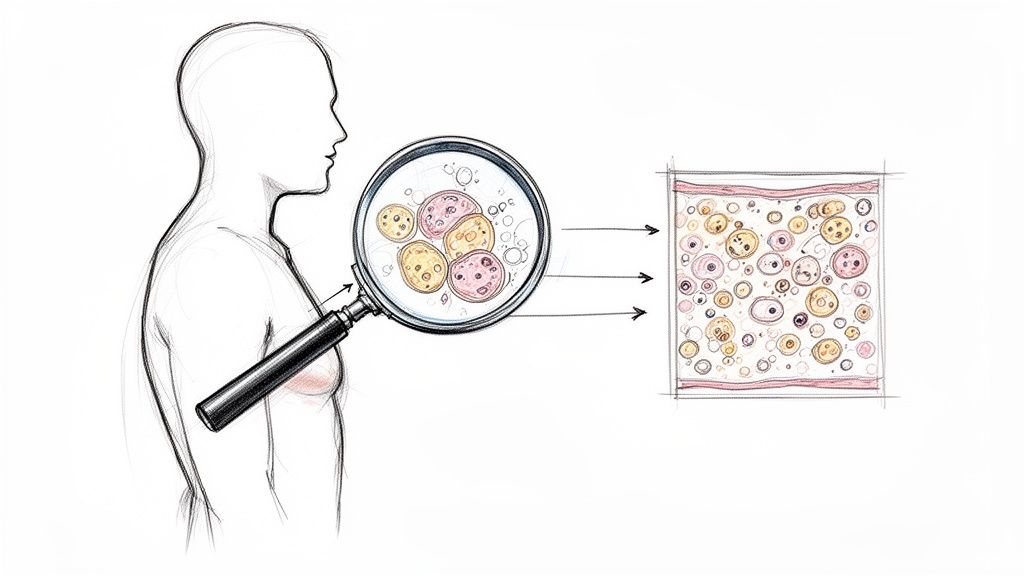
The process extends far beyond the initial examination. It involves meticulous microscopic evaluation of tissues (histology) and, in many instances, complex toxicology analyses to screen for medications, drugs, or other substances. These vital tests are often performed by specialized laboratories, which adds considerable time to the overall process but is absolutely essential to forming a complete picture.
Factors Influencing the Timeline
What causes one report to take longer to finalize than another? Several factors can extend the timeline.
- Case Complexity: A death from unequivocal natural causes will almost always have a faster turnaround than a complex case involving significant trauma, a suspected poisoning, or a subtle disease process requiring extensive ancillary testing to diagnose.
- Toxicology and Specialized Testing: If toxicology, genetic, or microbiology studies are necessary, you can expect an additional six to twelve weeks, and sometimes longer, to be added to the timeline. These tests simply require time to be performed correctly.
- Agency Caseload: It is a fact that Medical Examiner's offices in Texas, particularly in major metropolitan areas, operate under immense caseloads. Backlogs are not uncommon and can unfortunately create delays at every stage, from testing to final administrative review.
Preliminary vs. Final Reports
It is also crucial to distinguish between a preliminary and a final report. You may be able to obtain a preliminary report relatively quickly, sometimes within a few business days. This document provides a provisional, unconfirmed cause of death based solely on the initial gross anatomic findings.
However, for any official purpose—such as insurance claims or legal proceedings—you absolutely must have the final, certified report. This is the official, legally binding document. It incorporates the complete findings from all microscopic examinations, toxicology screens, and any other specialized tests that were conducted. As the pathologist, I will not sign off on it until every piece of scientific evidence has been received and thoroughly analyzed.
The final report is the legally definitive document. While a preliminary finding offers early insight, the final cause of death cannot be determined until all scientific evidence has been received and analyzed. Rushing this process risks inaccuracy.
To provide a clearer picture of what to expect, here is a general breakdown of the timelines for different components of the report.
Typical Timelines for Autopsy Report Components
| Report Component | Estimated Availability | Key Details |
|---|---|---|
| Preliminary Findings | 2-5 business days | Provides an initial, unconfirmed cause of death. Not for legal use. |
| Toxicology Results | 6-12 weeks | Can be longer if highly specialized tests are required. |
| Histology (Microscopic) Results | 4-8 weeks | Examines tissues to identify disease or injury at a cellular level. |
| Final Certified Report | 90-120 days (or more) | The complete, official document signed by the pathologist after all tests are in. |
Setting realistic expectations is perhaps the most helpful thing you can do for yourself during this period. The wait can feel exceptionally long, but it exists for a critical reason: to ensure the report you ultimately receive is as thorough, accurate, and scientifically sound as possible.
For a deeper look into what occurs during this waiting period, you may wish to read our guide on how long it takes to get autopsy results.
Making Sense of the Autopsy Report

When the autopsy report finally arrives, often after a long wait, it can be an overwhelming document. You are presented with a dense, clinical text filled with medical terminology that can feel like a foreign language at a time when you need clarity most.
Let us deconstruct its structure so you can understand the narrative it conveys. It is best to view it not as a single, monolithic document, but as a series of chapters, each building upon the last to reach a final, evidence-based conclusion. It is authored for scientific precision, but once you understand its layout, it becomes far more approachable.
The Core Components of the Report
While formatting may vary slightly between Texas counties, nearly every autopsy report is structured around the same fundamental sections. Knowing these sections in advance provides a roadmap.
- Pathological Diagnosis: This is the executive summary, often located at the beginning of the report. It is the "bottom line"—a concise, itemized list stating the cause and manner of death. If you read nothing else, this is the most critical section.
- External Examination: This section details everything observed on the exterior of the body. It includes basic data like height and weight, as well as identifying features like scars or tattoos and any evidence of injury.
- Internal Examination: This section proceeds organ by organ, documenting the condition of the body’s internal systems. The pathologist records weights, physical appearances, and notes any signs of disease, abnormality, or injury found during the dissection.
- Toxicology Report: If toxicology testing was performed, the results will be detailed here. It will list all substances tested for—from therapeutic medications and alcohol to illicit drugs—and quantify the concentration of any detected substances.
One of the most important concepts to grasp is the distinction between cause of death and manner of death. The cause is the specific medical disease or injury that resulted in death, such as "coronary artery disease" or "blunt force trauma." The manner is the legal classification of how the death occurred: Natural, Accident, Suicide, Homicide, or Undetermined.
Putting the Pieces Together
The volume of death investigations in a state as large as Texas is immense. In Tarrant County alone, the Medical Examiner's office may conduct approximately 5,000 autopsies annually as part of roughly 17,000 total death investigations. This workload underscores the critical role these documents play in public health and the justice system. For a broader perspective on national trends, particularly regarding overdose fatalities, the CDC offers provisional data for review.
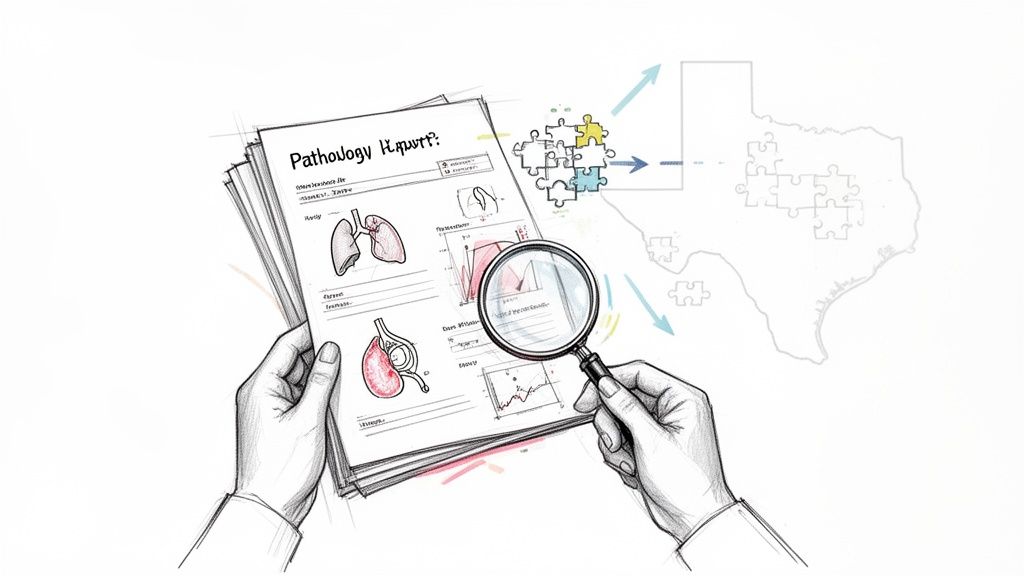
Each section of the report contributes a piece of the puzzle. An internal examination might reveal severe, previously undiagnosed heart disease. If the toxicology report is negative, those findings together would strongly support a natural death. Conversely, if the external examination notes injuries that correlate with internal damage, a very different conclusion would likely be reached.
The language is technical, but the underlying logic is typically direct. For a more detailed explanation of the specific terms you will encounter, our guide on understanding the meaning of a pathology report can be a valuable resource. My hope is that by understanding how the report is constructed, you will feel better equipped to find the answers you seek within its pages.
When to Consider a Private Autopsy
Not every death in Texas requires a mandatory, government-ordered autopsy. Medical Examiners and Justices of the Peace operate under specific jurisdictional criteria; if a death does not meet these criteria, an official examination will not be performed. This reality can leave families with profound, unanswered questions.
In other instances, you may receive the findings from a government-performed autopsy and feel that the conclusion is incomplete or inconsistent with what you knew about your loved one’s health or the circumstances of their death.
This is precisely where a private autopsy serves as a critical option. Arranging for a second, independent examination by a board-certified forensic pathologist can help confirm official findings, uncover new information that may have been overlooked, or simply provide the peace of mind that comes from a thorough, focused review.
Situations That Justify a Private Examination
Over my years of practice, I have found that a few key scenarios frequently lead families and attorneys to seek a private autopsy:
Unclear Cause of Death: An official autopsy is not performed, and the cause of death on the certificate is non-specific, such as "cardiac arrest," without explaining the underlying disease process.
Concerns About Medical Care: You have unresolved questions regarding the quality of treatment a loved one received in a hospital, nursing home, or other care facility prior to their death.
Hereditary Disease Screening: A private autopsy can be utilized to screen for genetic conditions—such as certain cardiomyopathies or cancers—that could have significant health implications for surviving family members.
In my experience, the most compelling reason families seek a second opinion is to achieve definitive closure. A private examination provides a focused, detailed investigation tailored to a family's specific concerns, often moving beyond the scope of a standard public inquiry.
The objective is to provide you with a comprehensive, medically sound report that can be used for legal purposes, for informing future medical decisions, or simply for your own understanding. If you are considering this option, you can learn more about our approach to private autopsies in Texas.
Frequently Asked Questions About Texas Autopsy Reports
When families and legal counsel contact my office, they often share similar questions about the process of obtaining and interpreting an autopsy report. It can be a complex and unfamiliar path, so I have compiled the most common inquiries here to provide some clarity.
Can I Get a Copy if I'm Not the Next-of-Kin?
The short answer is typically no. Texas law is quite stringent in protecting the privacy of the decedent and their family.
Access is almost exclusively limited to the legal next-of-kin, which includes a spouse, adult child, or parent. An authorized legal representative, such as an attorney with proper documentation, may also request a copy on behalf of the family.
If you are not the next-of-kin but have a legitimate need for the report—for example, in relation to civil litigation—you will generally need to obtain a court order or subpoena.
What if I Find an Error in the Report?
Discovering a potential error in such a critical document is deeply unsettling. Your first step should be to contact the issuing office—the Medical Examiner or Justice of the Peace—and inquire about their specific process for amending an official record.
Simple clerical errors, such as a misspelled name or incorrect date, can often be corrected with relative ease. However, if you are questioning the substantive medical findings, the situation is more complex. Correcting a diagnostic conclusion is an involved process that typically requires new, compelling evidence. You will likely need to consult with an attorney or obtain a second opinion from an independent forensic pathologist.
I know that managing these details while grieving is an immense burden. For those navigating the emotional impact of a loss, exploring strategies for dealing withgrief may offer a source of comfort.
How Much Does an Autopsy Report Cost in Texas?
Fortunately, the cost for a copy of a government-ordered autopsy report is not prohibitive, as it is intended to cover administrative and copying fees.
Most county offices in Texas charge a fee in the range of $25 to $100.
You can usually find the exact fee schedule on the agency’s website or listed directly on the request form. It is important to note that this fee is for a copy of a report from a county-mandated examination; it is entirely separate from the cost of commissioning a private autopsy.
At times, an official report may not provide the depth of answers a family is seeking. In these situations, a private autopsy can offer a crucial second opinion and a more detailed investigation. If you require a compassionate and thorough review of your case, my team at Texas Autopsy Services is here to assist. Please feel free to call us at (888) 368-9415 to discuss your situation.