February 27, 2026 · Texas Autopsy Services
Understanding Pathology Results in Texas
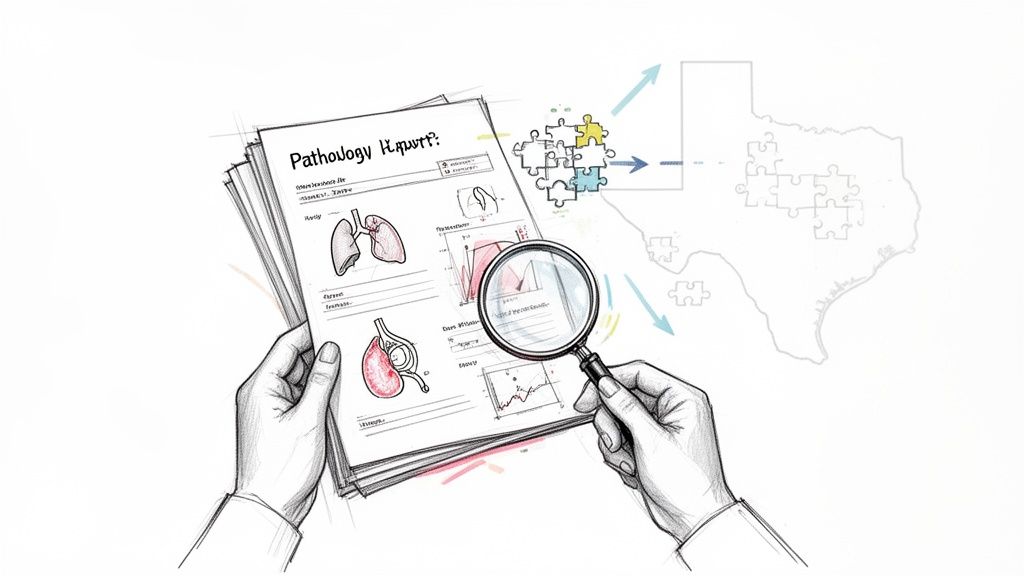
Pathology results meaning explained: a concise guide to reading pathology reports in Texas. Understand what pathology results meaning means for your case.
On this page
- Your Guide to Reading an Autopsy Report
- Decoding the Language of a Pathology Report
- Distinguishing Between Normal and Significant Findings
- What Toxicology and Lab Tests Really Tell Us
- Determining the Cause and Manner of Death
- When to Request a Second Opinion Autopsy
- Common Questions About Pathology Results in Texas
As a forensic pathologist, my work extends beyond the examination itself. It’s my responsibility to translate complex medical science into clear, meaningful answers for families and legal teams who need them. When you receive a pathology report, the meaning of your pathology results isn’t hidden in jargon; it's presented in a structured document where each section tells a vital part of the story. My goal is to help you understand it.
Your Guide to Reading an Autopsy Report
An autopsy report is a methodical document. It’s designed to build a complete picture of a person's health at the time of their death, starting with a broad overview and moving into specific details.
Think of it as a logical progression. Once you understand the layout, you can navigate the information with more confidence. For families in Texas seeking closure or attorneys building a case, getting familiar with this structure is the first step toward finding clarity.
This visual guide shows the typical flow of information, from the case summary to the external and internal examinations.
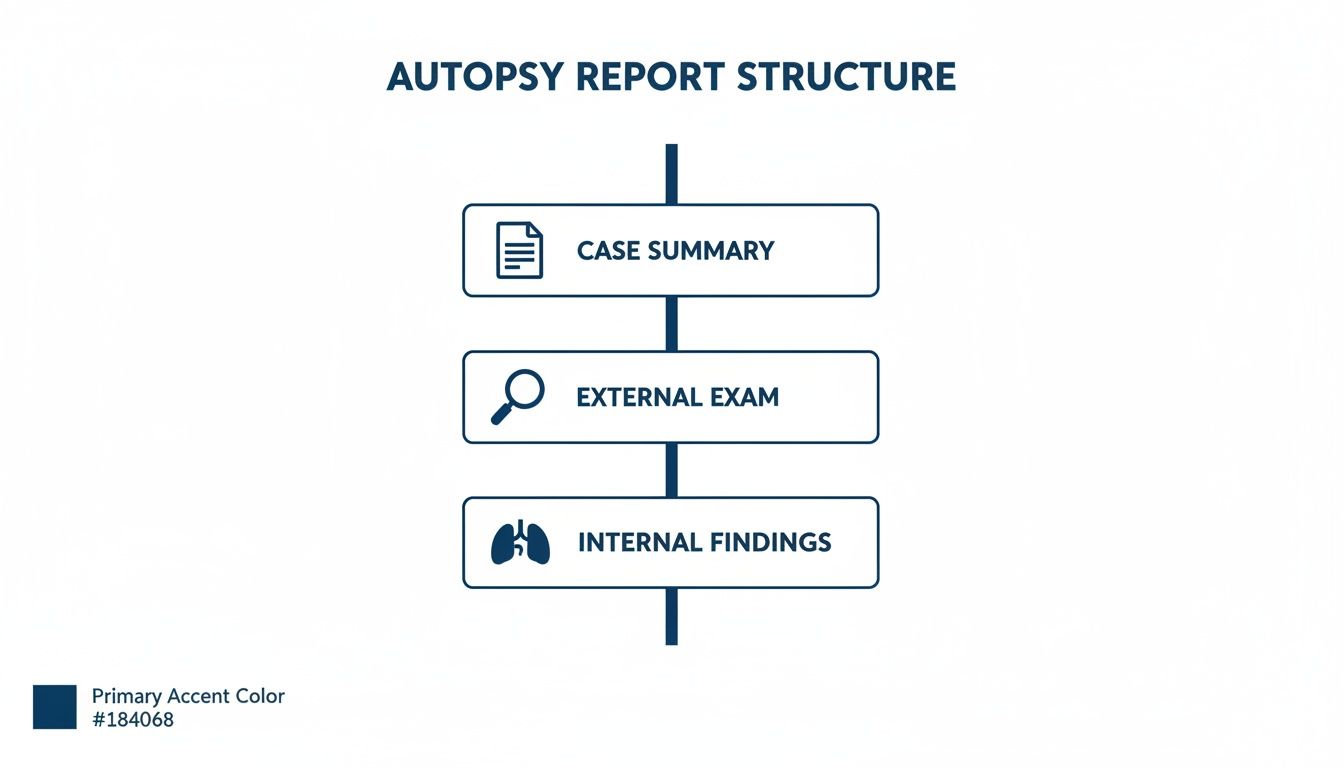
As this shows, each section builds on the one before it, creating a comprehensive path to the final conclusions.
The Three Core Components
Every report I prepare at Texas Autopsy Services contains a few fundamental parts. While the exact layout might differ slightly, you can always expect to find these core sections.
Here’s a reference table to help you understand what each part does.
| Key Sections of a Standard Autopsy Report | | :--- | :--- | :--- | | Section Name | What It Contains | Why It's Important | | Case Summary and History | The decedent's details, a summary of known circumstances, and key medical history. | It provides essential context and sets the stage for the physical findings. | | External Examination | Detailed observations of the body's exterior, including height, weight, scars, tattoos, and any signs of injury. | This creates a physical record and documents external clues related to trauma or disease. | | Internal Examination | A systematic description of each organ's condition, including visual and microscopic abnormalities. | This is often where the direct cause of death is identified, such as a heart condition or illness. |
Let's break down what you'll find in these sections.
Case Summary and History: This introduction provides crucial context, including the decedent’s name, age, a brief summary of the circumstances of death, and relevant medical history. It sets the stage for everything that follows.
External Examination: Here, I document everything observable on the body's exterior. This includes objective measurements like height and weight, unique identifying marks such as scars or tattoos, and any evidence of injury. This part gives a complete physical description and notes any external signs that might point to trauma or disease.
Internal Examination (Gross and Microscopic Findings): This is the heart of the report. I describe the condition of each major organ system—its weight, general appearance, and any abnormalities I find. It's often in this section that the direct cause of death, like a blocked artery or a hidden tumor, becomes clear.
A well-organized report is about clear communication. The structure isn't just for medical professionals; it’s designed to walk any reader through a complicated process in a logical, transparent way. By breaking down the pathology results meaning into these manageable parts, the report becomes less of an intimidating document and more of what it's meant to be: a source of answers.
For a deeper dive into this topic, you can learn more about how to read a pathology report in our detailed guide.
Decoding the Language of a Pathology Report
The words a pathologist chooses are incredibly important. Each term is selected to convey a precise degree of medical certainty. Think of it less like a conversation and more like a legal document where every word matters.
I’ve seen firsthand how easily misinterpretations happen when phrases that sound similar actually carry different weights. This can cause unnecessary confusion for a family or create significant issues in a legal case. That's why I believe it’s important to translate complex medical observations into the clear answers you need.
The Weight of Words in a Diagnosis
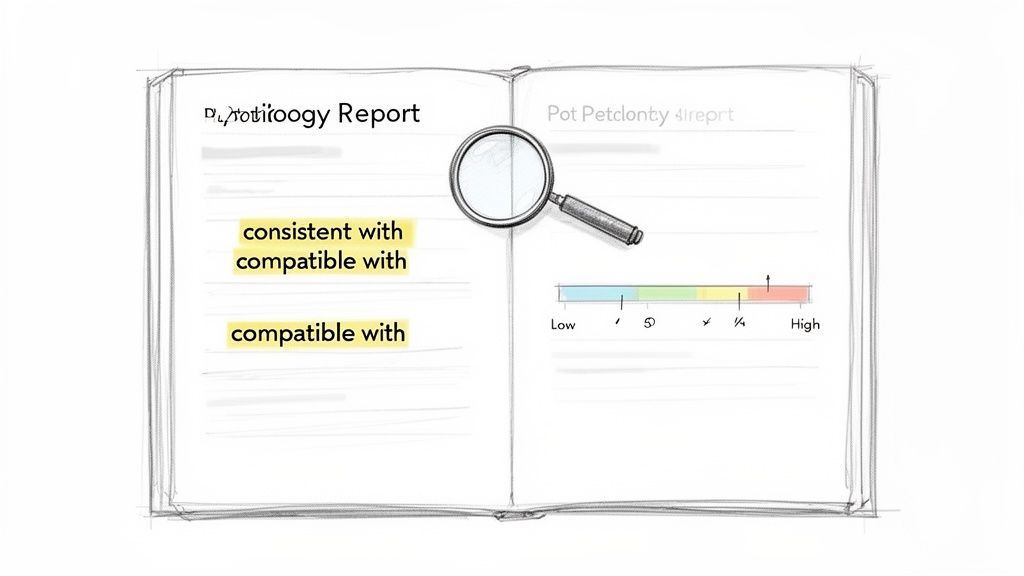
When I describe a finding, the words I use reflect my diagnostic confidence. Phrases like "consistent with" and "suggestive of" aren't used interchangeably; each one signals a different probability based on the available evidence.
This isn’t just semantics; it’s a critical distinction. For example, a 2024 study showed how even medical professionals can interpret these phrases differently. Researchers discovered that clinicians often viewed the term "compatible with" as indicating a higher level of certainty than pathologists intended, a statistically significant gap. This highlights why precise, intentional language is essential to avoid misunderstanding. You can review the full research on diagnostic phrase interpretation to see just how deep these nuances go.
Let's break down some of the most common terms you'll likely see.
Common Pathological Descriptors Explained
A report often uses descriptive terms to detail the condition of tissues and cells. They might sound technical, but they paint a clear picture of what was observed under the microscope.
Here are a few common examples:
- Hypertrophy: This means individual cells have grown larger, causing the organ to swell. A classic example is cardiac hypertrophy, where the heart muscle thickens, often from high blood pressure.
- Hyperplasia: This is an increase in the number of cells. It can be a normal response, but it can also signal an abnormal process.
- Metaplasia: This describes when one type of mature cell is replaced by another, usually as a defense against chronic irritation. We often see this in the airways of smokers.
- Dysplasia: This points to abnormal cell growth. The cells aren't cancerous yet but are on a path that could lead to malignancy if the cause isn't addressed.
- Necrosis: In simple terms, this is tissue death. It happens when an area is deprived of blood flow, which can be caused by an injury, radiation, or chemicals.
As a forensic pathologist, my job is to report objective findings without guesswork. The language I choose must be a direct reflection of the evidence. Cautious wording isn't a sign of uncertainty; it’s a mark of scientific and ethical responsibility. It ensures my conclusions are built on a solid foundation of fact.
Gross vs. Microscopic Findings
You will also notice that findings are split into "gross" and "microscopic" categories. This is a fundamental way of organizing observations in any pathology report.
- Gross Examination: This covers everything I can see with my own eyes. It includes the size, weight, color, and texture of organs and tissues. This is where I document large-scale issues like tumors or visible organ damage.
- Microscopic Examination (Histology): This is where we go deeper. By analyzing thin slices of tissue under a microscope, I can see what’s happening at a cellular level, things that are otherwise invisible. This is often where I can pinpoint specific diseases, infections, or cellular changes that explain the gross findings.
By combining the big-picture (gross) and detailed (microscopic) observations, I can construct a complete, evidence-based narrative. This methodical approach ensures the final pathology results meaning is accurate, clear, and defensible, providing the solid answers that families and legal experts are counting on.
Distinguishing Between Normal and Significant Findings
An autopsy report is designed to be thorough, documenting everything found, but not every observation is equally important. One of the biggest challenges for families and attorneys is figuring out what actually matters.
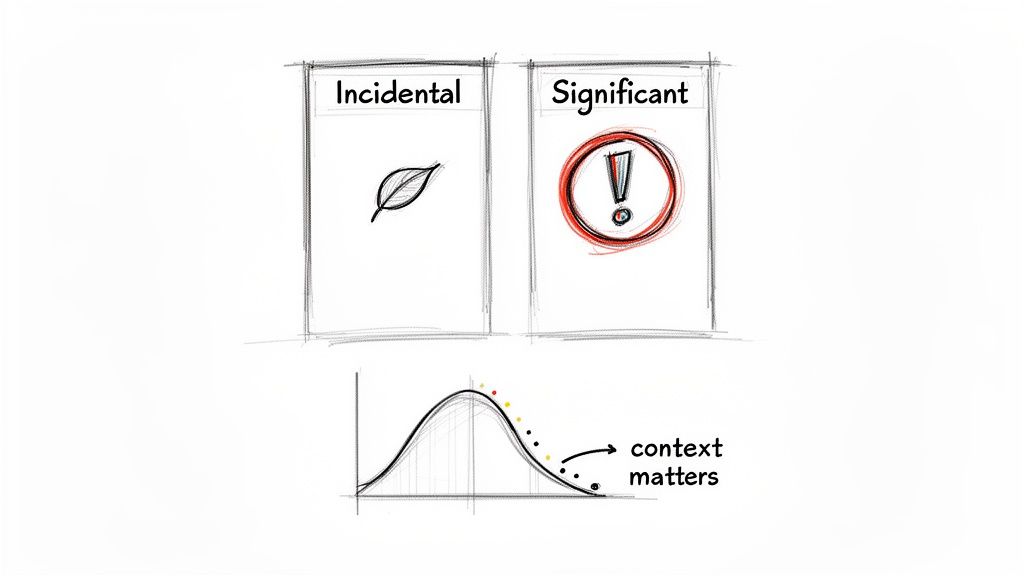
Many findings are incidental—normal, age-related changes or old, healed injuries that had no bearing on the cause of death. The skill lies in separating background noise from a truly significant finding. Getting this right is crucial for understanding the report's true meaning.
Not All "Abnormalities" Are Abnormal
It's important to remember that the human body isn't built to exact specifications. We all have variations. An organ might be slightly larger or smaller than average, or a tissue sample might show minor inflammation from a long-gone infection. These are common findings.
My job is to put these observations into the right context.
For example, almost every adult has some degree of atherosclerosis (hardening of the arteries). In one person, a small amount is an incidental finding, completely expected for their age. But in another person, a severe blockage in a key artery is the direct cause of a fatal heart attack. The presence of the condition isn't the point; its severity and location are what make it significant.
What "Normal" Means in Lab Tests
This same principle applies to lab results from toxicology or blood work. A value flagged as "abnormal" on a report doesn't automatically mean it’s a problem.
Labs interpret results using reference intervals. These are statistical ranges designed to include the results of 95% of the healthy population. By definition, this means 5% of perfectly healthy people—one in twenty—will have a result that falls outside the “normal” range.
Large-scale studies, like the Nordic Reference Interval Project, help establish these limits. You can learn more about the interpretation of laboratory test results and their statistical basis. The key isn't just whether a number is outside the range, but how far outside it is and what it means in light of all other evidence.
The art and science of forensic pathology lie in synthesis. A single "abnormal" finding is just one piece of data. Only by integrating it with the physical examination, medical history, and circumstances of death can I determine if it is a red herring or a crucial piece of the puzzle.
Why Context Is Everything
Without context, an autopsy report is just a collection of medical facts. The person's medical history, their lifestyle, and the specific circumstances of their death provide the framework I need to connect the findings.
Here are a couple of examples:
Finding: A low level of a prescription sedative is found in the blood.
- Context A: We know the person had a prescription for anxiety, and the amount is consistent with a therapeutic dose. This is likely an incidental finding.
- Context B: The person had no prescription, and other drugs are also present. Now, this becomes a highly significant finding that could point to an overdose.
Finding: A healed fracture is seen on an old rib.
- Context A: The medical records show a car accident a decade ago. This is an old injury, unrelated to the death.
- Context B: There’s no known history of major trauma, but there are other, more recent injuries. This could become part of a pattern of abuse and would be critically important.
In my final report, I emphasize the findings directly linked to the cause of death. Everything else is documented for completeness, but it doesn't carry the same weight. This careful, context-driven analysis is how we at Texas Autopsy Services turn a complex medical document into a source of clear, reliable answers.
What Toxicology and Lab Tests Really Tell Us
A modern autopsy goes deeper than what the eye can see. While the physical examination provides the initial roadmap, the most critical clues are often hidden at the microscopic or chemical level. This is where specialized lab work provides a definitive, science-backed conclusion.
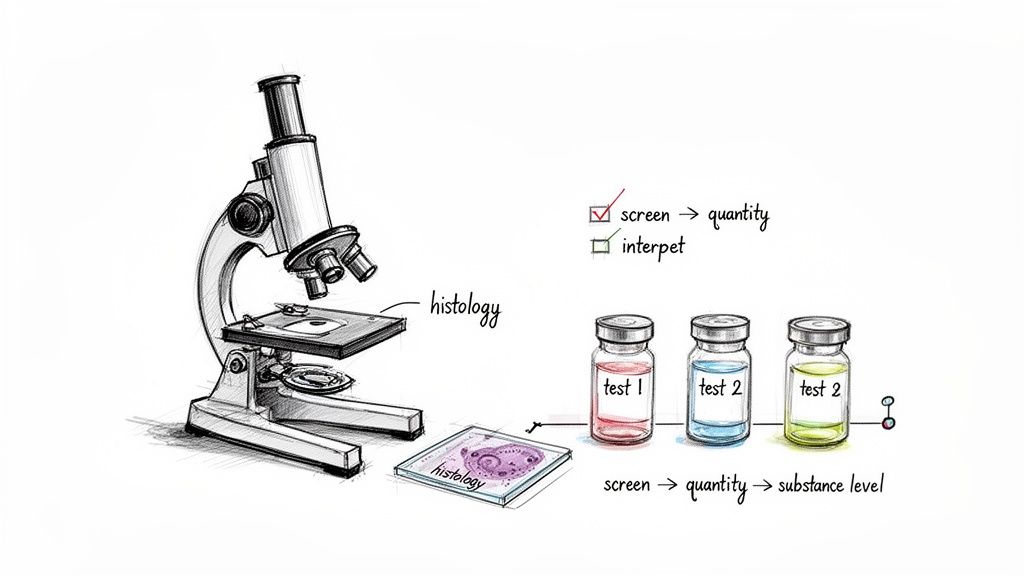
These tests—toxicology, histology, and microbiology—are essential to understanding the full pathology results meaning. They allow a forensic pathologist like me to answer questions that a physical exam alone cannot.
Decoding the Toxicology Report
Toxicology examines how substances affect the body. A toxicology screen searches for alcohol, prescription drugs, over-the-counter medications, and illegal substances. But the results aren't just "yes" or "no." They tell us how much of a substance was in the system, which is where the real story lies.
Finding a drug doesn't automatically mean it was the cause of death. Context is everything.
- Therapeutic Levels: The amount found is what you'd expect for someone taking medication as prescribed.
- Toxic Levels: The concentration is high enough to cause serious harm or impairment.
- Lethal Levels: An amount this high is known to be fatal.
Interpreting these levels is a nuanced process. I must weigh the results against the person's medical history, prescriptions, and potential tolerance. A dose that might be lethal for a new user could be therapeutic for a long-term patient. For a deeper dive, I suggest you learn more about how to read a toxicology report on our blog.
The Microscopic Clues in Histology
While the gross examination is what I see with my own eyes, histology is the view through the microscope. By examining very thin slices of tissue, I can see what's happening at a cellular level. It's one of the most powerful tools in my toolbox, revealing diseases and injuries that are otherwise invisible.
With histology, I can uncover:
- Evidence of a recent heart attack: I can see the specific damage to heart muscle cells starved of oxygen.
- Signs of chronic disease: Conditions like cirrhosis of the liver or long-term lung damage leave behind tell-tale cellular patterns.
- Hidden infections or inflammation: Pneumonia or other inflammatory processes become clear under the microscope.
- Undiagnosed cancer: It’s not uncommon for an autopsy to reveal an unknown cancer that silently spread.
Histology is the bridge between the visible and the microscopic. It helps confirm what I suspect, uncovers hidden conditions, and often provides the final piece of evidence needed to determine an exact cause of death. Without it, many puzzles would remain unsolved.
Microbiology and Other Specialized Testing
Sometimes, I need to dig even deeper. Microbiology tests tissues and fluids for specific bacteria, viruses, or fungi. This is crucial in cases where a severe infection like sepsis is suspected.
Depending on the case, we might also use genetic testing to look for inherited conditions known to cause sudden death. Here at Texas Autopsy Services, my commitment is to use every tool available to provide clear, complete answers. These specialized tests are fundamental to a thorough investigation, ensuring the final report is as accurate as possible for the families and legal professionals we serve.
Determining the Cause and Manner of Death
The final page of an autopsy report contains the two most important conclusions I draw: the cause of death and the manner of death. People often use these terms interchangeably, but in forensic pathology, they mean very different things.
Understanding this distinction is crucial to making sense of the entire report. All the evidence—the external and internal exams, microscopic analysis, and toxicology tests—funnels into these final determinations. At Texas Autopsy Services, my job is to weave that evidence into a clear, logical story of what happened, grounded entirely in medical fact.
Cause of Death: The Medical Reason
The cause of death is the medical diagnosis for why a person died. It’s the specific injury or disease that started the chain of events that led to their passing. This is a purely scientific conclusion based on physical evidence.
For instance, if someone had a heart attack, the cause of death would be listed as "acute myocardial infarction." If a toxicology screen found a fatal level of a substance, the cause would be "drug toxicity." It’s the direct, biological reason life ended.
Manner of Death: The Circumstantial Classification
The manner of death is different. It’s not about the what but the how. This is a classification based on the circumstances surrounding the death, providing context to the medical findings.
In Texas, we use five standard categories for the manner of death:
- Natural: Death resulted from a disease process or natural aging. This is the most common manner of death.
- Accident: An unintentional act led to the death, such as a car crash, fall, or accidental drug overdose.
- Suicide: The person intentionally took their own life.
- Homicide: The actions of another person resulted in the death. This is a medical finding, not a legal one—it doesn’t automatically imply a crime was committed.
- Undetermined: There isn't enough information to confidently place the death into one of the other four categories.
The best way to see the difference is to put them side-by-side.
Cause of Death vs. Manner of Death
| Concept | Definition | Example |
|---|---|---|
| Cause of Death | The specific disease, injury, or substance that led directly to death. | Gunshot wound to the chest. |
| Manner of Death | The classification of how the death occurred based on circumstances. | Homicide. |
As you can see, one describes a medical condition, while the other describes the events that led to it.
Why a Death Might Be Ruled Undetermined
Sometimes, after looking at all the evidence, I simply can't make a definitive call. That’s when I use the "undetermined" classification. This is not a failure to do my job; it’s an honest assessment of the available evidence.
For example, imagine finding someone who has drowned. Was it an accident where they slipped and fell into the water? Did they jump in on purpose? Was someone else involved? If the evidence doesn't point clearly in one direction, the most responsible conclusion is "undetermined."
An undetermined ruling is not a failure of the investigation. It is an honest and ethical conclusion that reflects the limits of the available evidence. Forcing a conclusion without sufficient proof would be a disservice to the family and the legal system.
This classification is vital for legal and insurance matters because it prevents speculation from becoming part of the official record. My role as a forensic pathologist is to follow the evidence, and sometimes, that means acknowledging what we don't know.
When to Request a Second Opinion Autopsy
An autopsy report is supposed to bring closure. But sometimes, it does the opposite, leaving a family or legal team with more questions and uncertainty.
Maybe the official cause of death doesn’t line up with what you know about the person’s health or the circumstances. Or perhaps the report is frustratingly vague, lacking the concrete details you need for legal proceedings or an insurance claim.
When that doubt sets in, getting a second opinion is often the most responsible next step. As an independent forensic pathologist, I can offer a fresh, objective analysis, whether that means reviewing the original case files or conducting a new examination.
Common Reasons for a Second Look
Most requests for a second opinion come from a need for clarity and confidence. Here in Texas, families and attorneys usually contact me when they’re facing one of these issues:
- Vague or Unclear Conclusions: The report might use ambiguous terms for the cause of death or leave critical questions unanswered.
- Contradictory Evidence: Sometimes the findings don't square with the person's known medical history or the situation surrounding the death.
- Suspected Negligence or Misconduct: In cases where medical malpractice, neglect, or foul play is a concern, an unbiased expert review is critical.
- Legal or Insurance Disputes: A clear, independent report often provides the specific medical evidence needed for civil litigation or to appeal a denied insurance claim.
The goal isn't to find fault with another pathologist. It's to ensure every piece of evidence has been examined with the highest level of scrutiny.
The Process and Potential Outcomes
A second opinion can unfold in a couple of ways. The first option is a deep review of the original case files—the autopsy report, photos, and tissue slides. The second, when possible, involves performing a completely new, independent autopsy.
The goal of a second opinion is to achieve certainty. It is a methodical process of re-examination and verification, aimed at providing families and legal professionals with a solid, defensible answer they can trust.
Either path leads to one of two outcomes. It can confirm the original findings, which provides peace of mind and allows everyone to move forward with confidence. Or, it might uncover new information or offer a different medical interpretation, correcting the official record and giving you a much more accurate picture of what really happened.
To explore this further, you can learn more about our process for a second opinion autopsy and how it can provide the clarity you need.
This is a powerful tool for anyone who feels the first answer wasn't the complete answer. You have a right to seek the truth, and an independent review makes sure every stone has been turned.
Common Questions About Pathology Results in Texas
Over the years, I've found that families and their legal representatives often share the same core questions. When you're handed a pathology report during a time of grief, it can feel overwhelming. My goal here is to answer some of those common questions in plain English.
How Long Does It Take to Get Autopsy Results?
This is the most frequent question I get, and the answer varies. A preliminary report on the cause of death can often be ready quickly, but the final, detailed report takes more time. You can typically expect the full report, with all microscopic and toxicology findings, in several weeks.
The wait is due to the meticulous, time-consuming lab work that happens behind the scenes. Tissue samples must be carefully processed and mounted on slides before I can look at them under a microscope. Toxicology testing is its own detailed science. At Texas Autopsy Services, we work to balance that necessary precision with the urgency families feel, getting you answers as soon as we can without compromising on accuracy.
What Does It Mean If the Cause of Death Is “Pending”?
Seeing "pending" on a death certificate can be frustrating, but it’s a normal part of the process. It means the cause of death wasn't obvious from the physical exam alone and we need to wait for more specialized test results to come in.
Most of the time, a "pending" status is because we're waiting for:
- Toxicology reports: These screen for the presence of drugs, alcohol, or other substances.
- Histology results: This is the microscopic examination of tissues to look for evidence of disease not visible to the naked eye.
- Microbiology tests: These check for specific infections, like viruses or bacteria.
Once that information is back, I put all the pieces of the puzzle together—the physical findings, lab results, and medical history—to determine the definitive cause of death and issue a final, amended report.
How Has the Pandemic Affected Pathology Timelines?
The COVID-19 pandemic disrupted nearly every part of the healthcare system, and pathology labs were hit hard. A 2023 analysis revealed just how significant that disruption was. In the early months of the pandemic, the number of biopsy and surgery pathology reports dropped dramatically, 25.5% for biopsies and 17.4% for surgeries, compared to what was expected. This created a system-wide backlog that affected all kinds of diagnostics. You can read the full study to learn more about the impact on pathology report volumes during the pandemic.
For families in Texas, these systemic delays can add another layer of stress. Because I operate a private service, I'm often able to sidestep some of those larger institutional bottlenecks and deliver results more efficiently.
If you're still wrestling with questions or need someone to walk you through a report, please don't hesitate to get in touch. The team at Texas Autopsy Services is here to offer the support and expert guidance you're looking for.