May 1, 2026 · Texas Autopsy Services
Donating Your Body to Science in Pennsylvania: A Guide
A complete guide to donating your body to science in Pennsylvania. Learn about eligibility, the Humanity Gifts Registry (HGR), and what your family can expect.
On this page
- Pennsylvania uses one statewide system for whole-body donation, the Humanity Gifts Registry, so families need to understand that process clearly.
- Most donations are planned in advance by willed donors, not drawn from unclaimed remains, according to Pennsylvania data.
- Paperwork and family communication matter as much as intent. A donor’s wishes can still fail if documents aren’t available or next of kin oppose the donation.
- The body is usually away for an extended period, and many families have questions about memorial services, cremation, and when remains may be returned.
- This is both a medical and family decision. The practical details after death often determine whether donating your body to science in pennsylvania goes as intended.
I’ve had many conversations with families who want to plan carefully and spare their loved ones confusion later. The discussion often starts tentatively. A parent says they want to help medical education after death. An adult child agrees in principle, then asks the questions that matter in real life. What happens when the time comes? Who do we call? Can we still have a service? How long will they be gone?
Those are the right questions.
As a forensic pathologist, I work in a field where the handling of the human body after death carries legal, medical, and emotional weight. Whole-body donation is different from an autopsy, and it serves a different purpose, but the same principle applies. Good outcomes depend on clear consent, careful documentation, and realistic expectations for the family.
A Final Gift of Knowledge An Introduction
A decision about body donation rarely feels abstract when it’s your own family. It usually comes up around a kitchen table, during estate planning, or after someone has seen illness narrow the horizon and wants to leave something useful behind. In that moment, donating your body to science in pennsylvania can sound both meaningful and intimidating.
The official materials usually focus on forms, transportation, and eligibility. Families need that information, but brochures often leave out the part people struggle with most. They want to know what the experience will feel like once death occurs and the practical work begins.
That gap is real. Many families report confusion about how long the body will be away and whether they can still hold a service. A Pennsylvania donor program overview from PCOM notes that a 2023 survey of Pennsylvania medical school donor programs found that fewer than half had written family support policies beyond the initial consent form, leaving many next of kin feeling uninformed and unsupported.
What families usually need most
In my experience, the hardest part isn’t deciding that donation is a generous act. This understanding often comes immediately. The hard part is managing the time between that generous decision and the final return of remains.
Families usually need clarity on questions like these:
- Timing after death: Who makes the first call, and how quickly does it need to happen?
- Memorial plans: Can the family still hold a funeral, visitation, or celebration of life?
- Return of remains: Will cremated remains come back, and if so, under what arrangement?
- Last-minute problems: What happens if the donor is not accepted when death occurs?
Practical rule: A good donation plan is not just a signed form. It’s a signed form, informed family members, and a backup understanding of what happens if circumstances change.
Whole-body donation is a profound act of generosity, but it’s also a process with gatekeepers, timelines, and limits. Families deserve to know that in plain language. When they do, the decision becomes steadier and less frightening.
Understanding Pennsylvania's Unique Donation System
Pennsylvania handles whole-body donation through a centralized statewide model. That structure is unusual enough that families should understand it early. In practical terms, if you’re considering donating your body to science in pennsylvania, your path runs through one organization.
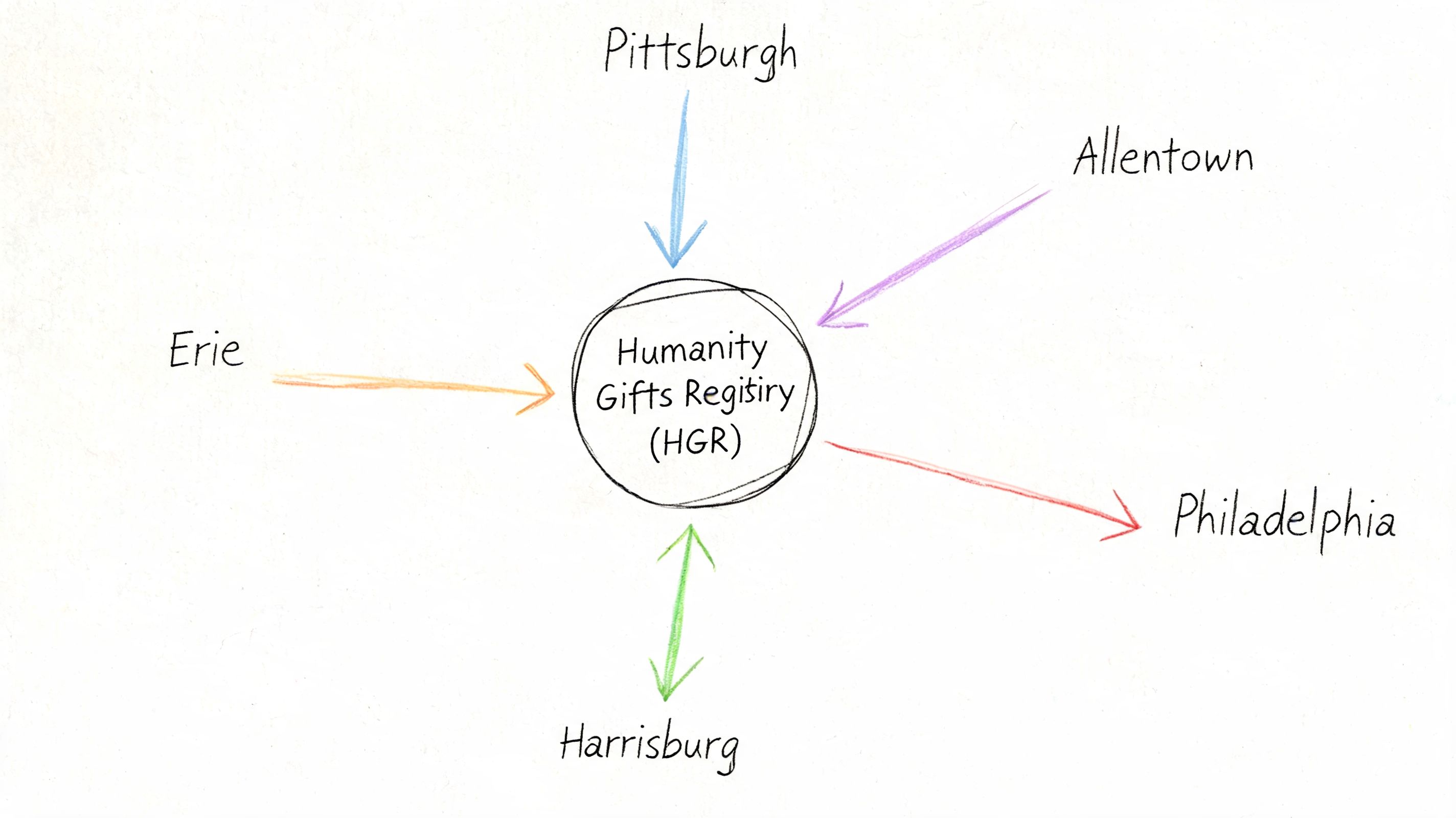
That organization is the Humanity Gifts Registry, or HGR. It is the only nonprofit with legislative authority in Pennsylvania to receive and coordinate donated bodies for medical and dental education. Major institutions in the state operate their anatomical gift programs through this centralized system rather than through separate independent pipelines.
What the centralized model means for families
A single-agency system has advantages. It creates one set of forms, one screening process, and one statewide framework. For families, that can reduce confusion about where to start.
It also means the details of HGR’s process matter a great deal. When one organization serves as the statewide coordinator, families can’t assume a local hospital, funeral home, or medical school has a separate route that bypasses the registry.
A few practical consequences follow:
- One main point of coordination: Families should expect HGR to be the key body donation contact in Pennsylvania.
- One acceptance framework: Medical and administrative screening is centralized rather than fragmented by institution.
- One set of expectations: The family’s experience is shaped by HGR procedures, not by a patchwork of unrelated local programs.
A common myth about where donated bodies come from
Some people assume programs depend heavily on unclaimed remains. In Pennsylvania, that is not what the data show. According to Pennsylvania reporting on unclaimed body donation and HGR activity, HGR received an average of 641 bodies annually between 2018 and 2022, and counties contributed only 60 unclaimed bodies during that five-year period, representing less than 2% of all bodies received.
That matters because it clarifies the ethical reality of the system. Pennsylvania’s body donation infrastructure relies overwhelmingly on people who intentionally chose donation, not on bodies that went unclaimed after death.
Most whole-body donation in Pennsylvania is a planned gift. It is not a default disposition for people without family.
This also helps families think about the decision correctly. The process is best approached as part of end-of-life planning, much like advance directives or other written wishes. It works best when the donor chooses it clearly, documents it properly, and talks about it openly before death.
The Path to Enrollment Eligibility and Consent
The enrollment process is where a good intention becomes a usable legal and medical instruction. This is the stage where I most strongly advise people to slow down, read carefully, and avoid assumptions. A verbal statement to family is helpful, but it is not enough by itself.
Who may be eligible
Pennsylvania’s centralized system requires prospective donors to complete HGR forms and undergo screening. Some medical conditions can disqualify a person from donation. The screening process evaluates for conditions including Hepatitis B, Hepatitis C, HIV/AIDS, Tuberculosis, Creutzfeldt-Jacob disease, and Syphilis, based on PCOM’s body donor program FAQs describing the Pennsylvania process.
At the same time, families should not assume that common chronic illness automatically makes donation impossible. The available Pennsylvania guidance notes that many people with conditions such as cancer, heart disease, arthritis, or diabetes may still meet criteria.
That distinction matters. People often exclude themselves prematurely when they hear the word “screening.” Screening is real, but it does not mean only perfectly healthy people qualify.
The enrollment steps that actually matter
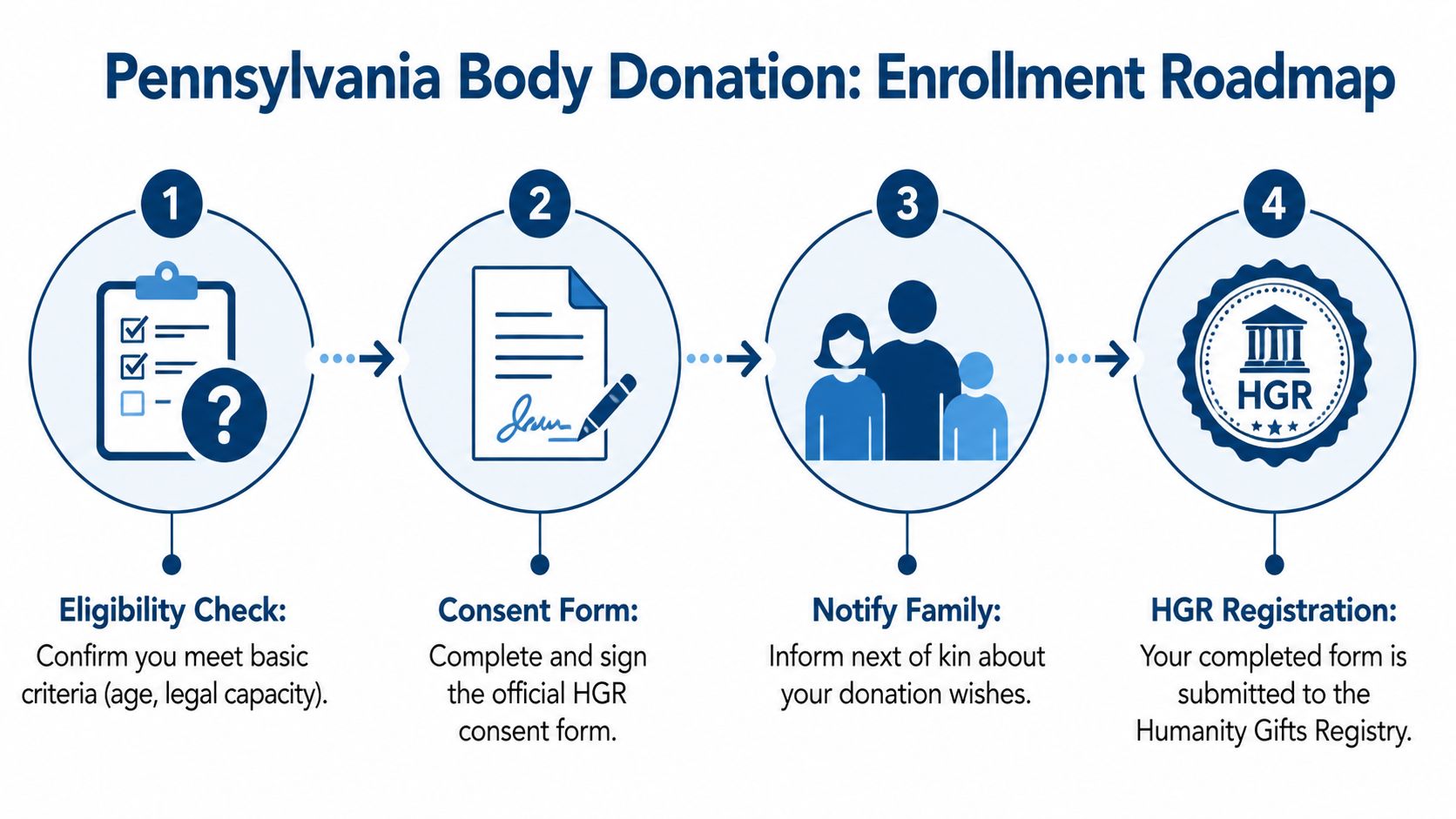
I prefer to describe enrollment in practical terms rather than bureaucratic terms. The core steps are straightforward:
Get the correct HGR donor forms.
The official forms need to be completed as HGR requires.Fill them out completely and accurately.
Missing information creates trouble later, especially when families are under stress.Submit the forms by the accepted method.
Pennsylvania guidance states that prospective donors must mail or fax HGR donor forms for screening.Store copies with other legal health documents.
This is one of the most overlooked steps and one of the most important.
For readers who want more context about the statewide registry itself, the Humanity Gifts Registry overview gives a useful plain-language summary of how that system functions.
What works and what does not
Here is where families often go wrong. They treat registration as the end of the process instead of the beginning of family preparation.
A stronger approach looks like this:
- Keep documents accessible: Put the paperwork with advance directives, health care documents, or other end-of-life records.
- Tell the right people: Next of kin, health care agents, and close family should know the decision was made.
- Use exact records: Names, signatures, and submitted forms should match the donor’s legal information.
- Expect a second review at death: Pre-registration helps, but final acceptance still depends on circumstances at the time of death.
A signed form in a drawer is less useful than a signed form that family members can actually find when they need it.
The same Pennsylvania guidance notes that the anatomical study phase typically lasts 24 months, followed by cremation, and it warns that next-of-kin opposition can sometimes prevent donation despite prior consent when communication and records are poor. That is why I consider family discussion part of the consent process, not an optional extra.
Procedures at the Time of Death
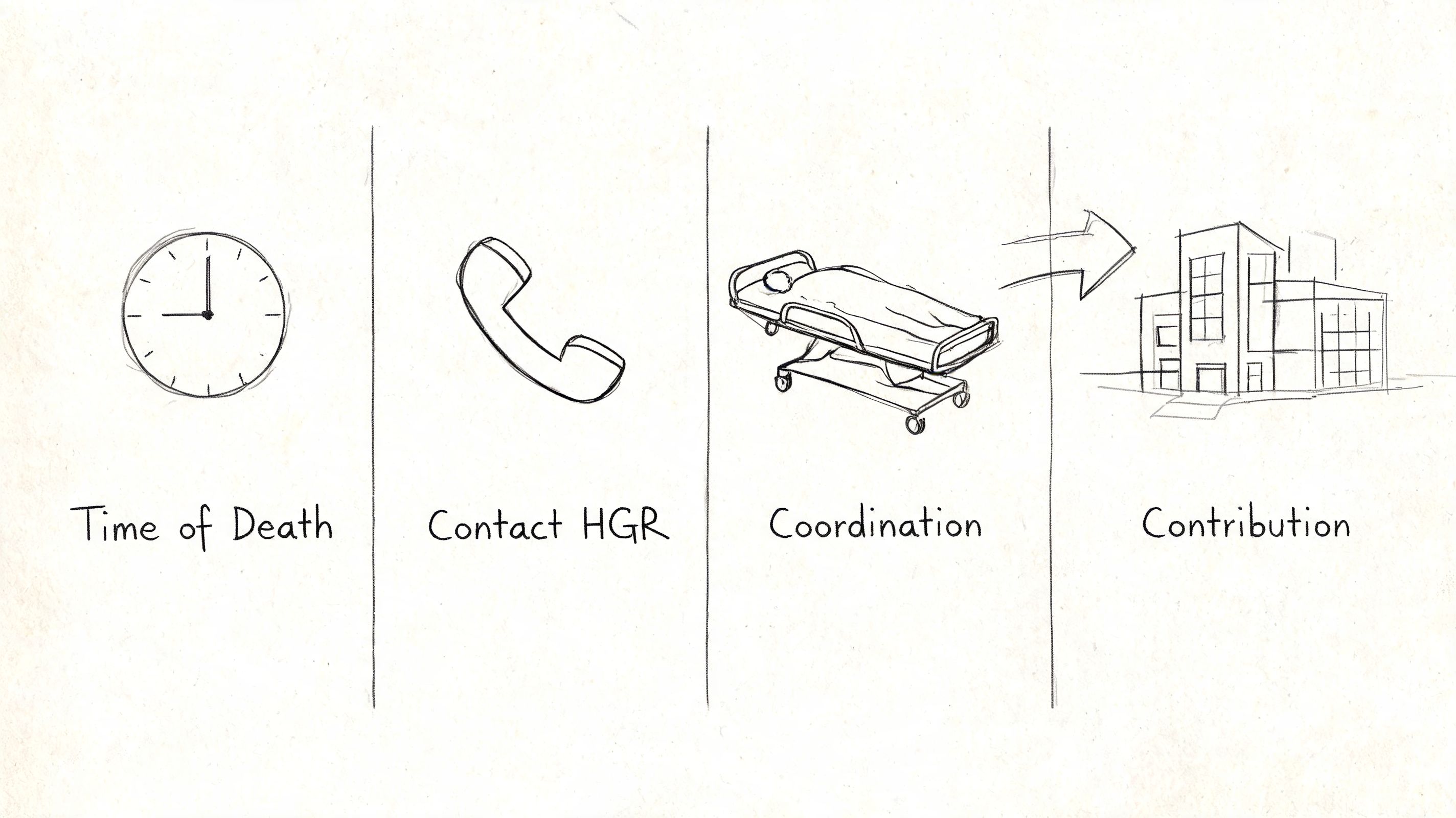
When death occurs, families are often exhausted, grieving, and trying to make decisions quickly. That is exactly why a calm sequence matters. The body donation process becomes very practical at this point. Delay, uncertainty, and incomplete records can change the outcome.
The first call matters
After death, the donor program needs to be notified immediately. Authorization may come from the donor’s own written consent, a named appointee, or next of kin, as outlined in Mayo Clinic’s explanation of body donation authorization and notification.
That principle applies even though Pennsylvania uses its own centralized registry. In real life, the first people involved may be family members, hospice staff, hospital staff, or law enforcement, depending on where the death occurs. Everyone should understand that prompt notification is not a technicality. It is part of whether the donation can proceed.
The common failure points
From a medical-legal perspective, body donation can fail at the time of death for reasons that are often preventable. The most common are administrative rather than philosophical.
These are the weak points I’d want any family to anticipate:
- Documents can’t be located: If HGR consent forms aren’t available, people may hesitate or act without confidence.
- Family members disagree: Conflict among survivors can slow or block action.
- A medical or investigative issue arises: Some deaths involve circumstances that require further review before disposition.
- People assume someone else already called: No one confirms the notification, and time is lost.
The Mayo Clinic guidance also makes an important point that applies broadly. Incomplete documentation is a significant pitfall, and failure to have consent forms filed and accessible greatly increases the risk that donation cannot be completed.
Why timing and disposition decisions can collide
Families sometimes ask whether donation and later forensic review can both remain possible. The answer depends on the circumstances, the jurisdiction involved, and what happened medically before death. That is why sequence matters.
If you’re trying to understand how postmortem decisions can affect later examination options, the discussion of whether an autopsy can be performed after embalming illustrates why disposition choices should be made with care.
Don’t rely on memory during a death call. Keep the donor paperwork, identifying information, and family contacts together in one place before they’re needed.
A family that handles this moment well usually has three things in place. They know the donor’s wishes. They can reach the right program quickly. They can produce the relevant paperwork without searching through boxes, drawers, and old files.
The Family's Role After Donation
Once the donation is accepted, families move into a different kind of waiting. The urgency of the immediate death call gives way to a quieter uncertainty. This is the stage that many official guides address too briefly.
The first practical point is emotional as much as logistical. Families can still mourn publicly and meaningfully even though the body is not present for a traditional funeral. In many cases, a memorial service, celebration of life, church gathering, or private family ceremony works better than postponing remembrance until the end of the anatomical study period.
Memorialization without the body present
People often worry that donation takes away the chance to honor the person properly. It doesn’t. It changes the format.
I usually suggest that families think in terms of presence rather than remains. A service can include photographs, letters, music, military or civic honors where appropriate, and spoken remembrance. The absence of the body doesn’t diminish the significance of the ceremony.
Some families choose to hold one event soon after death and a second, smaller gathering after cremated remains are returned or interred. Others prefer a single memorial and no later formal event. Either approach can be appropriate if the family understands the likely timeline in advance.
The family does not need to wait for final cremation to begin grieving, gathering, or honoring the donor’s life.
What to expect during the study period
Pennsylvania guidance indicates that the body is typically used for anatomical study for a substantial period before cremation. That means families should expect a separation measured in months or longer rather than days or a few weeks.
This long interval can affect practical matters that families don’t always anticipate:
- Funeral planning: A traditional body-present visitation usually won’t fit the donation process.
- Emotional rhythm: Some people feel comforted by the donation. Others feel unsettled by the extended timeline.
- Family communication: Relatives who were not involved in the original decision may need a clear explanation.
- Final paperwork: Death certificate and disposition questions may still arise in ordinary estate administration.
For readers trying to understand how death records fit into the broader process of post-death arrangements, this overview of what is on a death certificate can help frame what families will see in official documentation.
Cremation and return of remains
After the study phase ends, cremation follows according to program procedures. In Pennsylvania’s centralized framework, disposition details should be reviewed carefully at the consent stage and discussed with family in advance. If the donor self-registered, written wishes about cremated remains become especially important.
Often, families wish they had asked more questions earlier. They want to know whether ashes will be returned, where interment may occur if not privately arranged, and how long the final stage may take. Those questions should be part of planning from the start, not left for after death.
What works best is simple. Put the family’s expectations in writing where possible. Discuss memorial plans before there is grief and fatigue. Treat body donation as one part of end-of-life planning, not as a standalone gesture.
The Broader Impact of Your Anatomical Gift
Whole-body donation has a practical purpose that is difficult to overstate. Medical students, physicians, surgeons, dentists, and other trainees learn anatomy in a way no textbook can fully reproduce. A donated body teaches variation, spatial relationships, and the physical reality of disease and treatment in a direct way that models and screens cannot replace.
That educational mission also depends on a system that treats donors with dignity and distributes gifts where they are needed. Nationally, whole-body donation programs receive more than 26,000 donations annually, but supply is not evenly matched to institutional need. A national study of whole-body donation programs indexed on PubMed found that 13% of programs face shortages, while Pennsylvania routes all whole-body donations through HGR to institutions including Drexel University College of Medicine and Penn State Health.
Why the gift matters beyond one institution
A centralized system does more than process paperwork. It creates a pathway from a donor’s private decision to medical education across the Commonwealth. That link is easy to miss when a family is focused, understandably, on consent forms and final arrangements.
The broader impact includes:
- Training future clinicians: Donors help students learn anatomy with precision and respect.
- Supporting procedural education: Clinicians refine techniques in a setting grounded in real human structure.
- Strengthening medical teaching across institutions: A statewide registry can direct donations where educational need exists.
The ethical side families should know
Families often want reassurance that body donation is not casual or commercialized in the way popular media sometimes suggests. The ethical framework matters. Consent, lawful custody, screening, and controlled educational use are the backbone of a legitimate donation system.
There is also a demographic issue worth acknowledging openly. The same national study reported that over 85% of registered donors are white, showing that donor populations do not yet reflect the full diversity of the communities served. That does not lessen the value of any individual gift, but it does remind us that trust, education, and access are not evenly distributed.
A body donation is both intimate and public. It begins with one person’s values and ends by teaching people they will never meet. Few final decisions carry that combination of humility and reach.
If your family is considering this path, slow the process down enough to get the details right. Ask direct questions. Keep the paperwork accessible. Make sure the people closest to you understand your wishes and the practical realities that come with them.
If you’re facing questions after a death, or you need clear postmortem guidance from a forensic perspective, Texas Autopsy Services provides independent, compassionate support for families, attorneys, and professionals seeking medically sound answers.