November 10, 2026 · Texas Autopsy Services
What Is Perinatal Mortality Rate and How Is It Calculated
Learn what is perinatal mortality rate, how to calculate it, and how it differs from neonatal and fetal death rates, with worked examples.

On this page
The perinatal mortality rate is the number of stillbirths at 28 or more completed weeks of gestation plus deaths of live-born infants during days 0 through 6, per 1,000 total births.
You may be reading a hospital report, reviewing records after a loss, or comparing figures that don't seem to agree. Before interpreting the number, we recommend checking what the reporting agency counted. A difference in definitions can change the result without explaining anything about an individual death.
- What it counts: Fetal deaths meeting the reporting threshold and deaths shortly after a live birth.
- How it's calculated: Qualifying deaths are divided by total births, then expressed as a rate.
- Why comparisons need care: Reporting thresholds, denominators, and years must match.
- What it cannot establish: A population rate doesn't determine the cause or preventability of one loss.
What the Perinatal Mortality Rate Measures
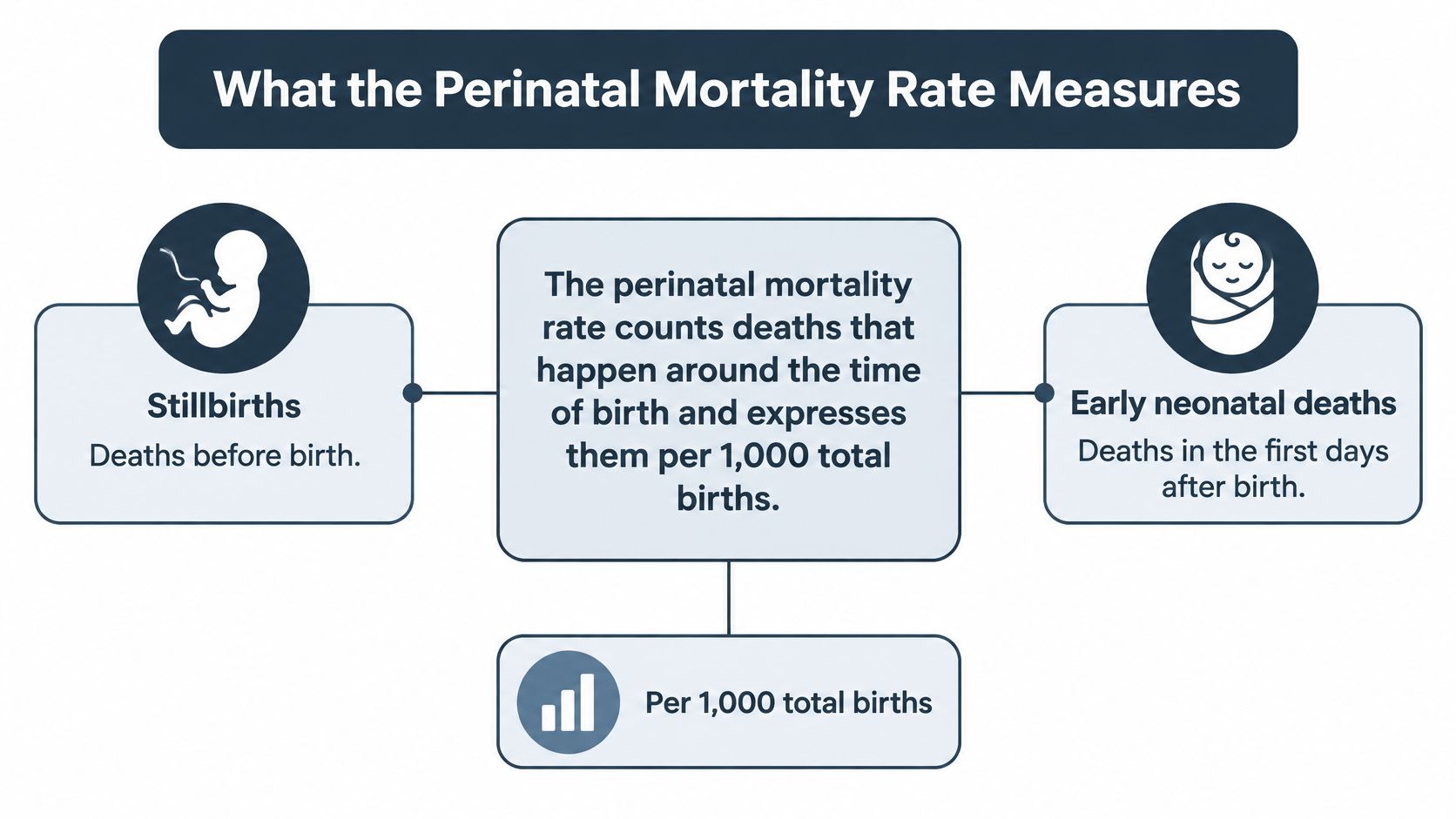
Perinatal means around the time of birth. The perinatal mortality rate, often shortened to PMR, combines deaths before birth with deaths shortly after birth rather than treating them as unrelated categories.
The World Health Organization's indicator definition includes stillbirths at 28 or more completed weeks and deaths of live-born infants during days 0–6, expressed per 1,000 total births. The denominator includes live births and qualifying fetal deaths, not live births alone.
Components of the perinatal mortality rate
| Component | What It Includes | Time Window | Role in Rate |
|---|---|---|---|
| Stillbirths | Fetal deaths at 28 or more completed weeks of gestation | Before birth | Numerator |
| Early neonatal deaths | Deaths of live-born infants | Days 0 to 6 | Numerator |
| Live births | Infants born alive | Not applicable | Denominator |
| Total births | Live births plus stillbirths | Not applicable | Denominator |
Although the table lists stillbirths as a numerator component, they also form part of total births in the denominator. An infant who is born alive and later dies remains included in the live-birth count. The death is then counted in the numerator if it falls within the eligible age window.
The diagram shows how these components fit together.
The reporting window needs its own definition
WHO also identifies a broader ICD-11 perinatal period beginning at 22 completed weeks and ending after the first 6 completed days. That broader period isn't identical to the threshold used for its internationally comparable PMR indicator. Countries can use different reporting thresholds, so the word perinatal alone doesn't tell you exactly which events were included.
An everyday comparison is a classroom attendance rate. It tells you how much absence occurred during a defined period, but it doesn't explain why each student was absent.
Interpretation rule: Read the rate as a measure of events within a defined window, not as a diagnosis.
Because the measure spans fetal and early newborn outcomes, public-health teams use it to assess prenatal care, obstetric services, delivery safety, newborn stabilization, and the completeness of death reporting.
How the Perinatal Mortality Rate Is Calculated
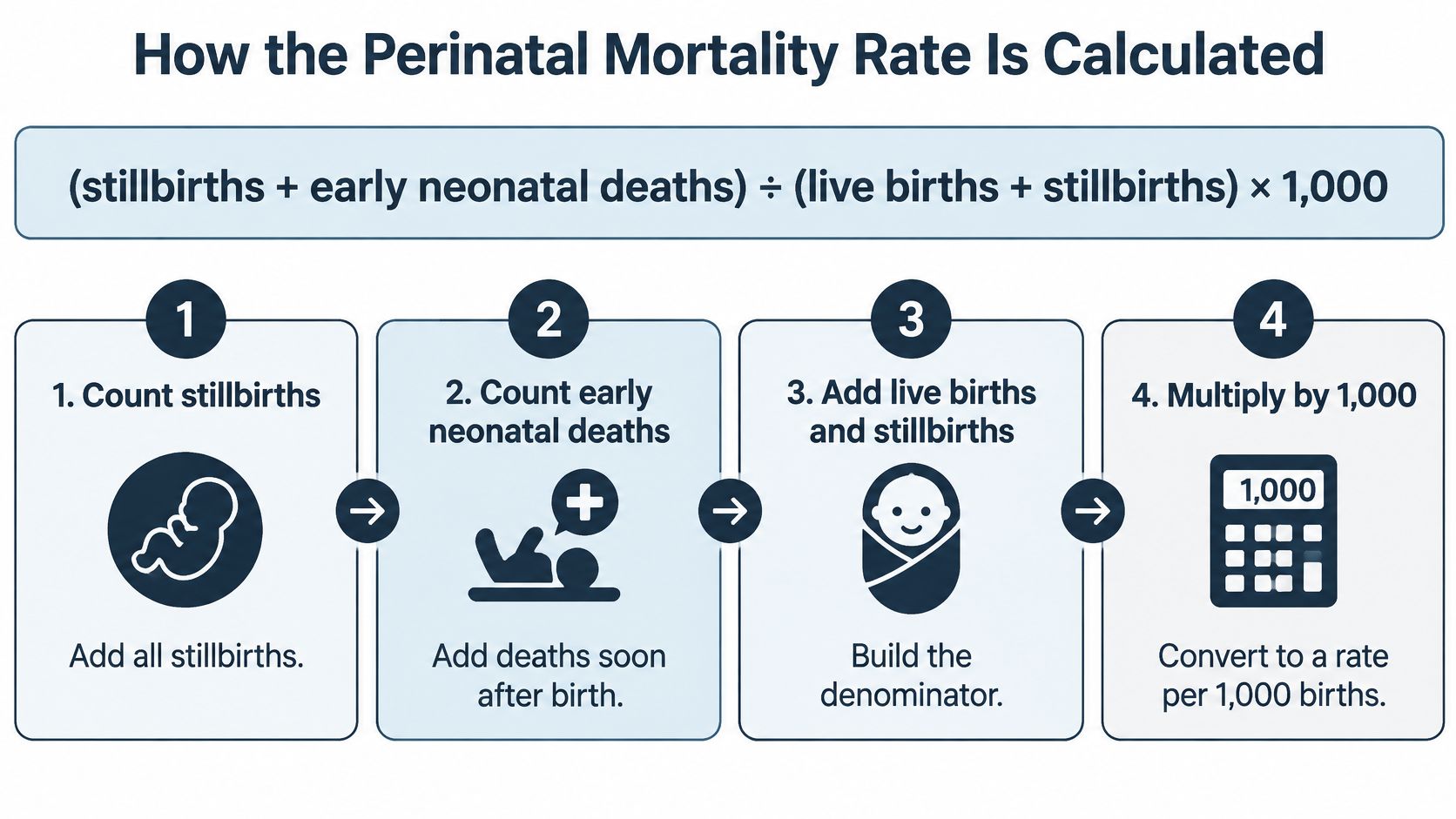
Perinatal mortality rate = (stillbirths + early neonatal deaths) ÷ (live births + stillbirths) × 1,000, using the eligibility rules specified in the report, as described in WHO's neonatal and perinatal mortality guidance.
The formula separates the numerator, the deaths being counted, from the denominator, the births used as the population base. Both must cover the same reporting population and observation period.
This visual summarizes the calculation.
Work through the counts in order
- Count qualifying stillbirths. Use the gestational-age threshold in the report rather than choosing a threshold yourself.
- Count early neonatal deaths within the specified age window. Check that these are deaths following a live birth, not fetal deaths.
- Add the death counts to obtain the numerator. Keep the components available separately so readers can understand the combined result.
- Add live births and qualifying stillbirths to obtain total births. Don't subtract infants who subsequently died from the live-birth count.
- Divide and convert. Divide the numerator by the denominator, then apply the multiplier shown in the formula.
For a hypothetical population, use 12 stillbirths, 8 early neonatal deaths, and 1,980 live births. Following WHO's formula gives 20 perinatal deaths ÷ 1,992 total births × 1,000, or approximately 10.0 per 1,000 births.
That worked result is roughly 1 in 100 births, not one in every hundred live-born infants. The distinction matters because qualifying stillbirths belong in the total-birth denominator.
Check the source note before using the answer
WHO advises reports to identify whether they used live births alone or total births. Changing that choice changes the answer, even when the death count stays the same.
For readers locating original publications, Statlyst's guide can help you browse reliable sources of official data. Use a directory to locate the issuing agency, then read the agency's own methods and footnotes before comparing figures.
The accompanying video offers another format for reviewing the topic.
Before copying a rate into a report or legal summary, retain its definition, reporting period, population, and denominator. A number separated from those details is easy to misinterpret.
How It Differs from Neonatal and Fetal Death Rates
Perinatal mortality, neonatal mortality, and fetal mortality are related but distinct measures. They answer different questions about when deaths occurred and which births form the comparison population.
The CDC's fetal-death definitions distinguish neonatal mortality, deaths among infants younger than 28 days per 1,000 live births, from fetal-death rates, which use live births plus fetal deaths as their denominator. Perinatal mortality combines qualifying fetal deaths with deaths during the early neonatal window.
Perinatal, neonatal and fetal death rates compared
| Measure | Numerator | Denominator | Age or Gestation Window |
|---|---|---|---|
| Perinatal mortality rate | Stillbirths plus early neonatal deaths | Live births plus stillbirths | 28 or more weeks gestation to day 6 under the WHO indicator |
| Neonatal mortality rate | Infant deaths | Live births | Under 28 days of age under CDC definitions |
| Fetal death rate | Fetal deaths | Live births plus fetal deaths | Gestational threshold set by the reporting system |
The most common misunderstanding involves the neonatal denominator. Because neonatal mortality concerns infants born alive, stillbirths aren't part of that denominator. Perinatal mortality includes a fetal component, so its population base is different.
Similar labels can describe different events
Suppose a hospital publishes both a neonatal rate and a perinatal rate for the same reporting period. The neonatal measure includes deaths later in the newborn period that fall outside the perinatal measure. The perinatal measure includes qualifying stillbirths that aren't neonatal deaths.
Neither rate is a replacement for the other. A higher numerical value doesn't automatically identify a greater problem because the measures count different events against different population bases.
Match the question to the measure before interpreting the result.
Families and attorneys may encounter all these terms across birth records, death certificates, clinical summaries, and public-health reports. We recommend preserving the exact label rather than shortening every measure to infant death rate.
A sound comparison requires alignment of the population, observation period, infant-age window, gestational threshold, and denominator. A fetal death rate alone, for example, cannot describe deaths that occurred after a live birth.
Why Definitions Change the Reported Number
Two reports can print the same words, perinatal mortality, and still be counting different deaths. One may begin at 28 completed weeks. Another may begin at 20. The year, the gestational threshold, and the denominator decide who is in the rate. That figure describes a defined population. It is not a cause for any one death.
A reporting agency can widen the gestational threshold and count additional deaths even when care and outcomes have not changed. The higher number is a definition change. Worsening mortality is a separate question.
The National Center for Health Statistics report on perinatal mortality gives a traditional U.S. rate of 5.54 per 1,000 live births and late fetal deaths in 2021, compared with 5.64 in 2020, using fetal deaths from 28 completed weeks and infant deaths before 7 days. Beginning with 2023 data, NCHS adopted expanded Definition III, counting fetal deaths from 20 completed weeks; that measure was 8.36 in 2023, compared with 8.27 in 2022, a statistically nonsignificant difference.
Those expanded figures should not be set beside earlier publications that used the traditional definition. A lower threshold works like a finer net. Earlier fetal deaths now qualify, so both the numerator and the denominator change. The pond of later pregnancies can look much the same while the published rate rises.
Reported perinatal rates by place and year
| Place and Year | Rate per 1,000 | Definition Used |
|---|---|---|
| Michigan, 2024 | 9.0, Michigan Department of Health and Human Services | Births and fetal deaths as denominator |
| United Kingdom, 2024 | 4.77, MBRRACE-UK surveillance | Extended perinatal mortality rate |
| United States, 2023 | 8.36 | Expanded Definition III, fetal deaths from 20 weeks |
| United States, 2021 | 5.54 | Traditional measure, fetal deaths from 28 weeks |
These are published figures, not a ranking of care quality. Michigan's rate uses births and fetal deaths as the denominator. The United Kingdom figure is an extended perinatal measure. A shared unit, deaths per 1,000, does not make the measures the same.
What the change means for record interpretation
A comparison across places has to match gestational threshold, infant-age window, denominator, and year. If one of those pieces differs, the smaller number may only mean a narrower rule.
An explanation of fetal autopsy measurements shows why gestational age and physical measurements matter in a postmortem assessment. Those findings belong with the clinical record for that pregnancy. They do not stand in for the surveillance definition that built the population rate.
For a trend over time, look for an agency series recalculated under one definition. Without that series, an apparent increase may be broader inclusion rather than a change in outcomes.
What a Perinatal Rate Cannot Tell You
A perinatal mortality rate cannot explain why an individual death occurred or establish that it was preventable. It's an epidemiologic measure, meaning it describes events in a population over a defined period. It doesn't assign responsibility.
The CDC's provisional fetal mortality report recorded a 2% decline, from 5.53 in 2023 to 5.41 per 1,000 live births and fetal deaths in 2024, while early fetal mortality remained unchanged and late fetal mortality declined 4%. These are fetal mortality findings, not a combined PMR, but they demonstrate why a headline trend can hide different patterns within gestational groups.
Separate population patterns from individual findings
Observed rates can be affected by incomplete registration, differences in ultrasound dating, access to prenatal and emergency care, socioeconomic conditions, and classification practices. Maternal health, infection, placental disease, and congenital abnormalities also matter when interpreting outcomes.
Those factors don't establish what happened in a particular pregnancy. A population trend cannot show whether a specific condition was present, whether it caused death, or whether a different intervention would have changed the outcome.
A statistical association isn't an individual cause-of-death determination.
Our overview of infant death investigation explains the separate task of evaluating case-specific evidence. We approach that work through records, examination findings, and an assessment of what the available evidence can support.
A checklist for reading a published rate
- Confirm eligibility. Identify the gestational-age or birth-weight threshold.
- Establish whether stillbirths and early neonatal deaths were reported separately, as well as combined.
- Check the denominator. Determine whether it includes live births alone or total births.
- Note the reporting year and any definition change from earlier publications.
- Flag missing definitions. If the source gives no definition, mark the figure as unverified for comparison rather than assuming it matches another report.
These checks help readers assess the statistic without implying blame. Questions about cause, care, or preventability require evidence directed to the individual circumstances.
When a Record Review Adds Information
A parent reads a perinatal mortality rate in a published report and asks whether that figure explains one pregnancy. It does not. The same published rate can mean different things depending on the gestational threshold, the denominator, and the year. It describes a population, the way a season's rainfall total describes a region rather than the storm that struck one street.
A detailed review may help when families or attorneys need to understand the medical sequence behind a loss. Relevant materials can include gestational dating, birth weight, prenatal and delivery records, placental findings, laboratory results, and prior postmortem reports. Each contributes a different part of the clinical timeline.
Our stillbirth overview provides related context for families considering further evaluation. Depending on the available material, options may include records review, a fetal or perinatal examination, or a second opinion autopsy review of an earlier report.
What an independent review involves
We begin by identifying the question and determining which records or specimens are available. Our board-certified forensic pathologists can assess whether the findings support a proposed explanation, identify limitations, and describe unresolved questions. Further examination or testing is not appropriate or possible in every case.
Readers often mix three terms that do different jobs:
- Cause of death means the disease, injury, or condition responsible for death.
- Manner of death describes the circumstances category assigned through medicolegal assessment, distinct from the medical cause.
- Chain of custody is the documented record of who collected, transferred, received, and handled remains or specimens.
Every examination is performed by a board-certified forensic pathologist (American Board of Pathology). Our Private Autopsies information describes examination options and the autopsy process without promising a particular finding.
Authorization, custody, and disposition require separate attention, and cremation adds its own requirements that we explain before any step is taken. Permission for an examination is not permission for every later procedure.
Common questions about further review
Can an autopsy always establish the cause?
No. Available records, tissue preservation, testing limitations, and the nature of the condition can leave uncertainty.
Can prior findings be reviewed independently?
Yes. A review can assess existing reports and medical records, although missing specimens or documentation may limit conclusions.
Is this medical or legal advice?
No. We provide postmortem examination and forensic interpretation, not treatment advice or a legal determination of liability. Families can ask questions and take the time they need to consider available options.
We offer independent fetal and perinatal examinations and reviews of prior autopsy reports and medical records when a population statistic cannot answer a family's specific questions. Visit Texas Autopsy Services to speak directly with our team about available information, authorization requirements, and whether further review may be appropriate.