November 8, 2026 · Texas Autopsy Services
Stillbirth Causes and What Testing Can Reveal
Learn the main stillbirth causes, how placental and autopsy findings help, what unexplained means, and when a second opinion may be worth requesting.
On this page
- Main Causes of Stillbirth at a Glance
- How Placental Problems and Growth Restriction Lead to Loss
- Infections and Maternal Health Conditions That Raise Risk
- Labor, Cord and Congenital Causes, and Preventability
- How Autopsy and Testing Work Together to Find the Cause
- What an Unexplained Stillbirth Really Means
- Common Questions About Stillbirth Causes
- Decide Whether a Second Opinion Is Worth Requesting
Approximately 1.9 million stillbirths occurred worldwide in 2021, according to the World Health Organization, which defines these deaths as occurring after 28 completed weeks of pregnancy. That scale challenges the idea that stillbirth has one unusual cause. At Texas Autopsy Services, we approach each cause of death investigation by separating the biological explanation from warning signs, clinical decisions, and barriers to care.
- Several pathways can overlap. Placental disease, infection, maternal illness, fetal conditions, and delivery complications aren't always separate explanations.
- Testing works best together. Placental examination, fetal autopsy, medical records, and genetic testing answer different questions.
- A cause finding doesn't establish preventability. That requires a separate review of what clinicians knew and when.
- Unexplained doesn't mean anyone is at fault. It describes the limits of the explanation available.
- Preservation matters. Decisions about the placenta, tissue samples, and consent can affect what investigators can examine later.
Main Causes of Stillbirth at a Glance
Major stillbirth cause groups and reported shares
| Cause group | What it means | How it is identified | Share reported |
|---|---|---|---|
| Placental dysfunction | Reduced oxygen and nutrient delivery to the fetus | Placental histology and pathology | Placental changes are common findings, but aren't automatically the sole cause |
| Infection | Infection of the mother, placenta, membranes, or fetus | Prenatal records, microbiology, placental and fetal testing | Different estimates apply to different income settings |
| Maternal conditions | Hypertension, diabetes, autoimmune disease, and related vascular stress | Prenatal history and medical records | No separate combined share established here |
| Fetal growth restriction | Impaired growth linked to placental or other causes | Growth records, placental and fetal examination | Often overlaps with placental disease rather than forming a separate share |
| Labor and delivery complications | Problems such as prolonged or obstructed labor | Labor and monitoring records | Occurrence during labor isn't the same measure as a specific cause |
| Umbilical cord problems | Compression, knots, or other cord events | Cord and placental examination | Requires supporting evidence rather than attribution from appearance alone |
| Congenital abnormalities | Structural or genetic fetal conditions | Fetal autopsy and genetic testing | A smaller reported category in high-income countries |
| Unexplained | No sufficient cause identified after evaluation | Review of completed investigations and their limitations | Classification reflects the setting and completeness of evaluation |
Cause of death means the condition that started the chain of events leading to death. Manner of death is a broader classification, such as natural or undetermined. These terms answer different questions, and neither should be treated as a finding about legal responsibility.
The table separates categories for clarity, not because each loss fits neatly into one row. A maternal blood-pressure disorder can damage placental circulation, restrict fetal growth, and reduce oxygen delivery. An investigation may identify that connected sequence rather than several unrelated causes.
Why reported shares aren't interchangeable
Countries differ in access to prenatal screening, placental pathology, autopsy, and genetic testing. Investigators also use different classification systems. A finding counted as placental disease in one study may be recorded under maternal hypertension or growth restriction in another.
This matters when families encounter a percentage online. The number may describe tissue changes, a condition associated with death, or the final assigned cause. Those are different measures.
Interpretation rule: A finding can contribute to the explanation without being sufficient to explain the death on its own.
We use stillbirth causes to describe the medical pathways evidence can support. A cause determination is the best explanation available from the records and examination, not a guarantee that every contributing event can be reconstructed.
How Placental Problems and Growth Restriction Lead to Loss
The placenta transfers oxygen and nutrients from maternal blood to the fetus. When its blood vessels narrow, clots form, or it separates from the uterine wall, the supply can be reduced. The effects depend on how severe the change is and how long it lasts.
The diagram shows how reduced placental flow can affect growth.
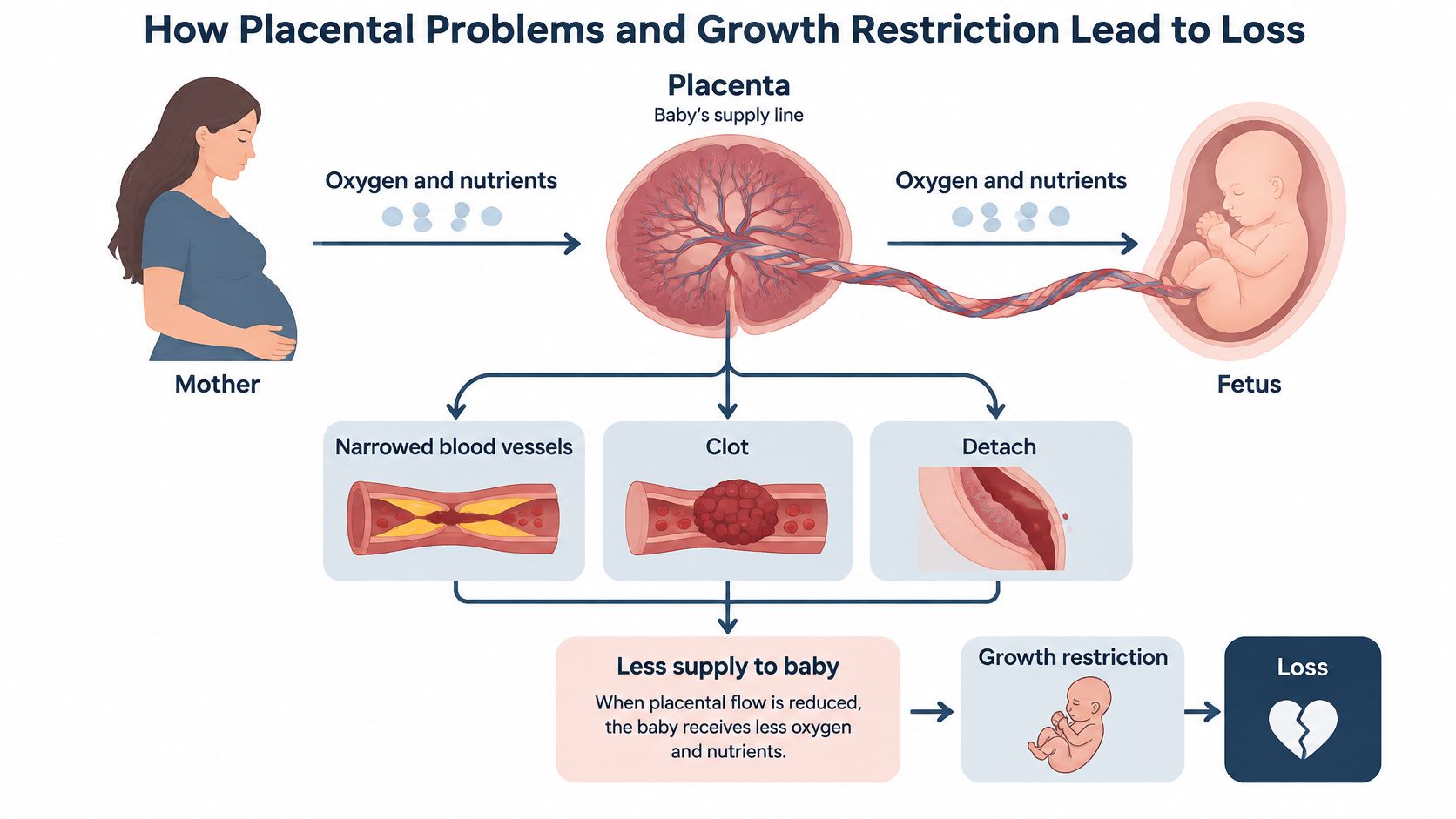
Placental examination is one of the most informative parts of a stillbirth evaluation. It can reveal changes that help explain how oxygen or nutrient delivery may have been affected. An abnormality alone, however, does not prove that it caused the death; its extent, location, and fit with other findings matter.
What the main placental findings mean
- Maternal vascular malperfusion means maternal blood isn't reaching the placenta adequately.
- Placental infarction describes areas of tissue damaged by loss of blood supply.
- Thrombi are blood clots that can obstruct circulation.
- Abruption means the placenta separates from the uterine wall before delivery.
A small, isolated lesion may have a different significance from widespread injury that aligns with poor fetal growth and evidence of prolonged low oxygen. Chronic hypoxemia means persistently reduced oxygen in the blood. A fetus may adapt for a time, but sustained inadequate supply can impair growth and eventually become fatal.
Growth restriction is more than small size
Fetal growth restriction means a fetus has not reached its growth potential. A naturally small fetus is not necessarily growth-restricted, and a size measurement alone does not establish why growth was limited.
Placental insufficiency is one possible explanation. Chromosomal conditions, infection, maternal hypertension, autoimmune disease, obesity, and diabetes can also be involved. Investigators compare growth patterns with fetal anatomy, placental tissue, and pregnancy records to assess which explanation best fits.
For example, declining growth measurements alongside extensive placental vascular injury support a different explanation from poor growth accompanied by structural abnormalities. Families can ask their care team: Was the placenta examined? Was fetal growth tracked throughout pregnancy? The answers help clarify what evidence is available and what it can support.
Infections and Maternal Health Conditions That Raise Risk
Infection's contribution differs across settings because infection exposure, screening, treatment, laboratory resources, and postmortem testing differ. Limited testing can leave an infection undetected. It doesn't establish that infection was absent.
A Lancet review61712-8/fulltext) estimated that infections probably cause at least 50% of stillbirths in low- and middle-income countries, compared with approximately 10% to 25% in high-income countries. These are population estimates, not probabilities that can be assigned to an individual family's loss.
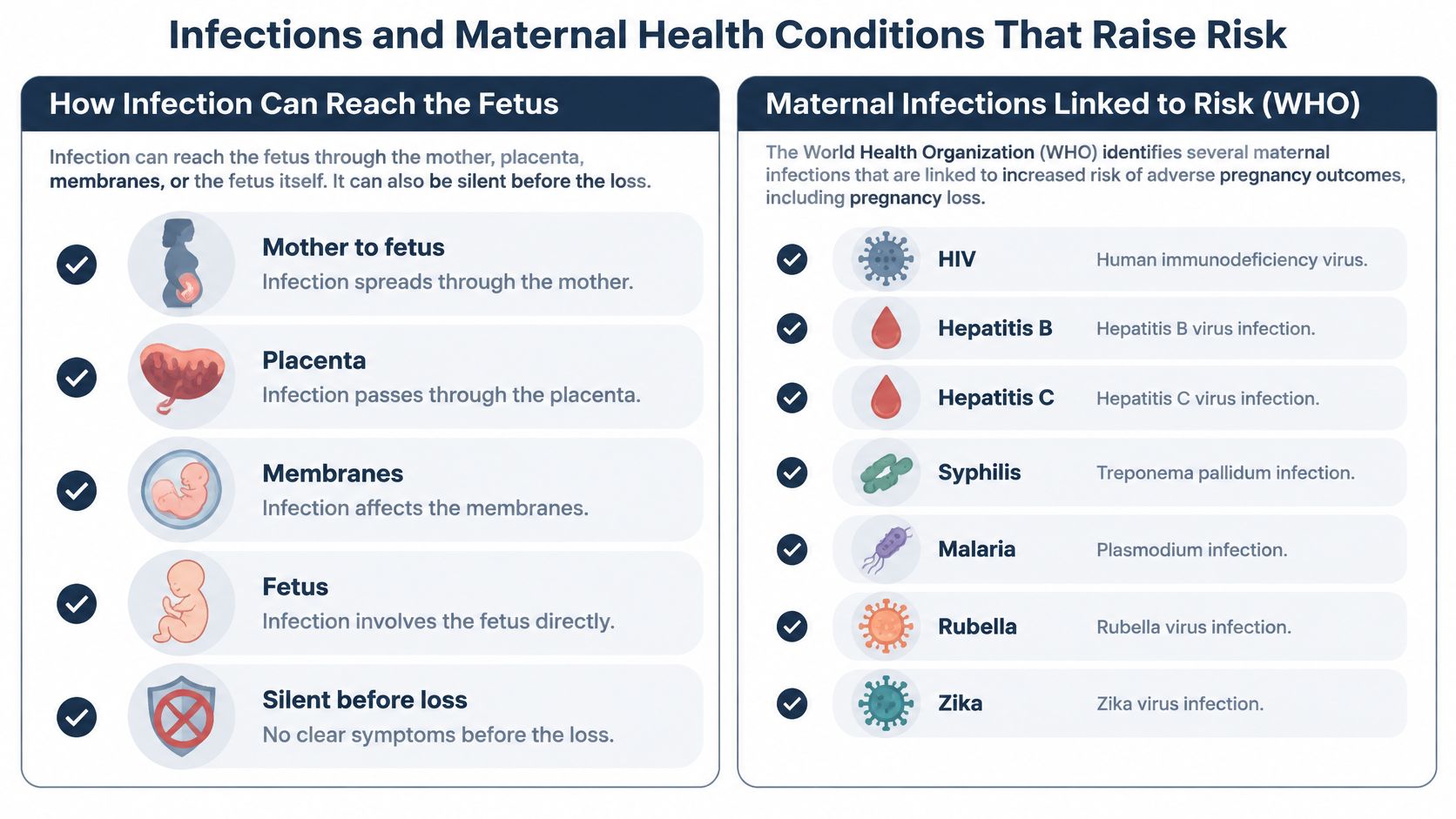
Infection can involve maternal blood, the placenta, the membranes surrounding the fetus, or fetal tissues. Some infections are clinically silent before death. WHO identifies malaria, syphilis, and HIV among maternal infections associated with stillbirth.
The illustration separates the sites investigators may need to examine.
Maternal conditions need a documented pathway
Hypertension can impair placental circulation. Diabetes can affect fetal development and pregnancy physiology. Autoimmune disease may contribute to vascular injury, while obesity and smoking can add placental or metabolic stress.
A diagnosis in a prenatal chart isn't enough to establish causation. We look for a connection between the condition, its course during pregnancy, and the examination findings.
Useful records include:
- Infection screening: Prenatal results, confirmatory testing, and relevant symptoms.
- Treatment history: Medication records and documentation of follow-up.
- Blood pressure and glucose: Measurements over time, not just an isolated result.
- Specimen testing: Available placental or fetal microbiology and tissue findings.
Social and access-related risk factors aren't direct causes
Population studies also identify associations involving maternal age at the extremes, substance use including tobacco and alcohol, and limited or late prenatal care. Housing instability, transportation difficulties, and language barriers can affect whether screening and follow-up occur.
These are risk factors, not individual cause-of-death findings. Like the smoking and obesity factors noted here, they may operate through medical pathways, and they shouldn't be used to assign blame.
In higher-income settings, placental disorders, maternal conditions, congenital abnormalities, and unexplained losses remain important considerations alongside infection. An investigation should test the possibilities supported by the case rather than assume that one category dominates everywhere.
Labor, Cord and Congenital Causes, and Preventability
Identifying a cause doesn't automatically establish that a stillbirth was preventable. The medical mechanism and the opportunity to change the outcome are separate questions. Both require evidence.
WHO reports that approximately 45% of late stillbirths occur during labor, often in connection with infection, prolonged or obstructed labor, or lack of timely intervention, in its global child-death and stillbirth update. The same source notes that congenital abnormalities account for less than 10% of stillbirths reported nationally in high-income countries. Their contribution in low-income settings remains uncertain because diagnostic capacity is limited.
Cord findings need more than a visual explanation
Cord compression can reduce blood flow. A tight knot may obstruct circulation, and a prolapsed cord can become compressed after slipping ahead of the fetus into the birth canal.
However, seeing a knot or a cord around the neck doesn't establish that it caused death. Investigators need to consider cord and placental findings, fetal evidence of oxygen deprivation, and the clinical timeline. Some events leave limited lasting evidence, which makes careful documentation important.
Congenital conditions require similar discipline. A structural or genetic finding may explain death, contribute to vulnerability, or be incidental. Its significance must match the rest of the case.
Reviewing preventability without assuming negligence
ACOG notes that nearly 25% of stillbirths in one large U.S. cohort were potentially preventable, in its Management of Stillbirth guidance. Potential preventability is not a legal conclusion that a particular clinician acted negligently.
A structured review examines:
- Symptom timing: What was reported, to whom, and when.
- Growth measurements: What the available examinations showed at the time.
- Intrapartum monitoring: The recorded fetal response during labor and the clinical response.
- Placental findings: Whether tissue evidence supports an acute event, longstanding disease, or both.
A postmortem finding can clarify what happened without proving that clinicians could have recognized it before death.
For families and attorneys, hindsight has limits. A fair review separates information available during care from information discovered only afterward, then considers clinical decisions and system barriers without presuming fault.
How Autopsy and Testing Work Together to Find the Cause
Investigation tools and what each reveals
| Tool | What it can show | What it cannot show on its own |
|---|---|---|
| Placental examination | Infarcts, thrombi, abruption, inflammation, and infection | Reliably establish every fetal genetic or structural cause |
| Fetal autopsy | Congenital, infectious, traumatic, or hypoxic findings | Establish placental mechanisms that leave no fetal sign |
| Chromosomal microarray | Chromosomal gains and losses | Detect every small single-gene change |
| Exome or genome sequencing | Selected single-gene and wider genetic changes | Independently establish placental, intrapartum, or environmental causes |
| Maternal records review | Growth, blood pressure, glucose, and infection-screening history | Prove a biological cause without supporting evidence |
| Microbiology and infection testing | Organisms and infection markers in sampled tissue | Exclude infections that weren't sampled or are no longer detectable |
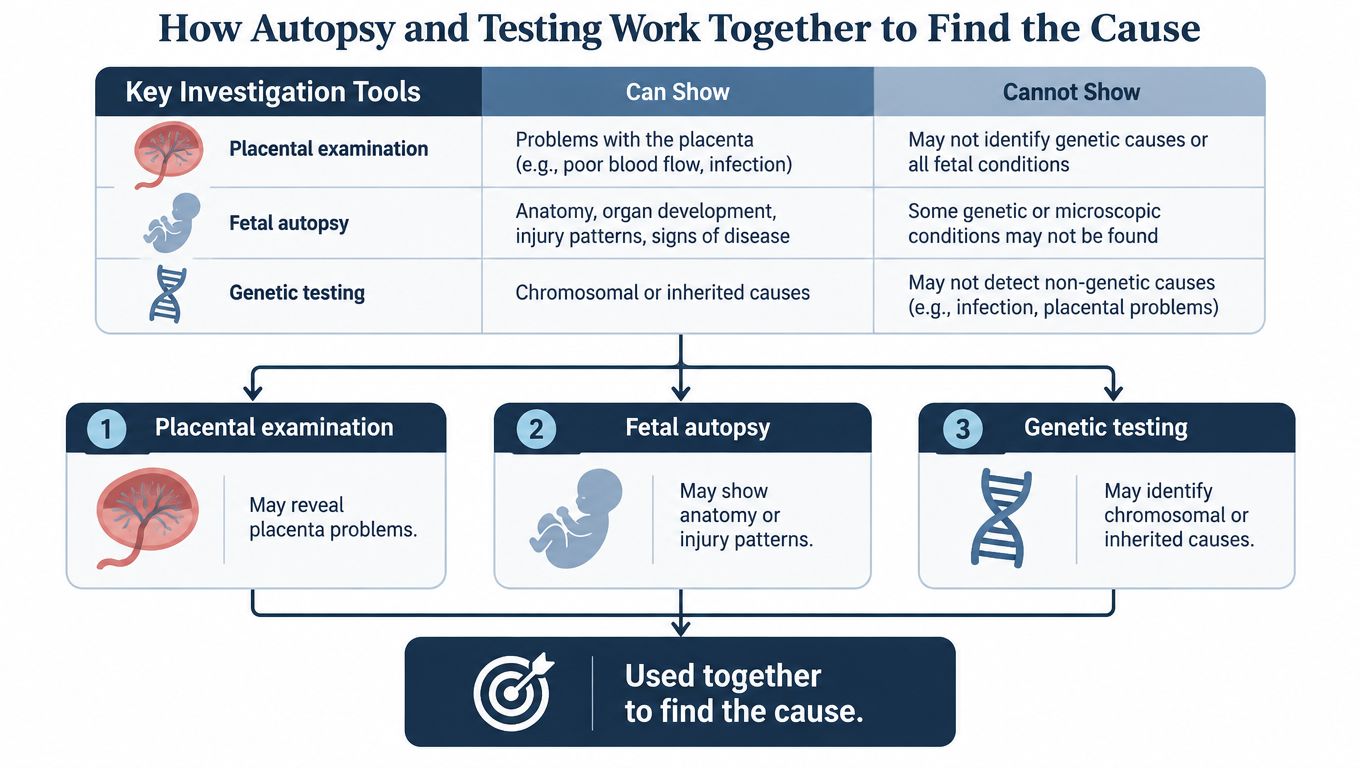
The American College of Obstetricians and Gynecologists identifies placental examination, fetal autopsy, and genetic testing as the most useful components of post-stillbirth evaluation. Their value comes from combining evidence, not choosing a single test to answer everything.
The graphic shows how these examinations complement one another.
Begin with records and preserve the specimens
We first identify the questions and review available prenatal, ultrasound, labor, delivery, and laboratory records. These establish the context for the physical examination and help guide additional testing.
The placenta should be submitted intact and promptly, with its cord and membranes, through the facility's specimen-handling process. Pathologists document weight, dimensions, cord insertion, vessel number, infarcts, hematomas, thrombi, bleeding behind the placenta, and inflammatory lesions.
Prompt preservation helps protect tissue quality and keeps structures available for examination. Families should ask whether the placenta is retained and request that testing needs be considered before disposal or release.
Match additional testing to the findings
Fetal autopsy evaluates anatomy, internal organs, growth, and tissue changes. Measurements provide context for developmental findings, as explained in our guide to fetal autopsy measurements. Imaging may supplement the examination when appropriate.
Microbiology and other infection studies should be selected according to the history and tissue findings. Chromosomal microarray is commonly a first-line genetic test; exome or genome sequencing may be considered when standard testing is nondiagnostic and clinical or family-history clues remain. More testing doesn't necessarily produce a clearer answer.
Chain of custody is the documented record of who collected, transferred, received, and handled each specimen through examination and reporting. It protects specimen identity and supports review of the findings.
Expect an explanation, not just terminology
Every examination we perform is conducted by a forensic pathologist certified by the American Board of Pathology. The pathologist who performs the examination also prepares the written report and explains the findings to the family.
A useful report distinguishes established causes, contributing conditions, incidental findings, and unresolved questions. It should also identify limitations, including unavailable specimens or incomplete records. These explanations are educational and concern postmortem evaluation, not individualized advice about pregnancy care.
What an Unexplained Stillbirth Really Means
Unexplained is a classification, not an accusation. It means the evaluation hasn't established a sufficient explanation. It doesn't mean nothing happened, and it doesn't mean the family caused the loss.
A discussion of the completed evaluation can help distinguish unanswered questions from findings that were excluded.
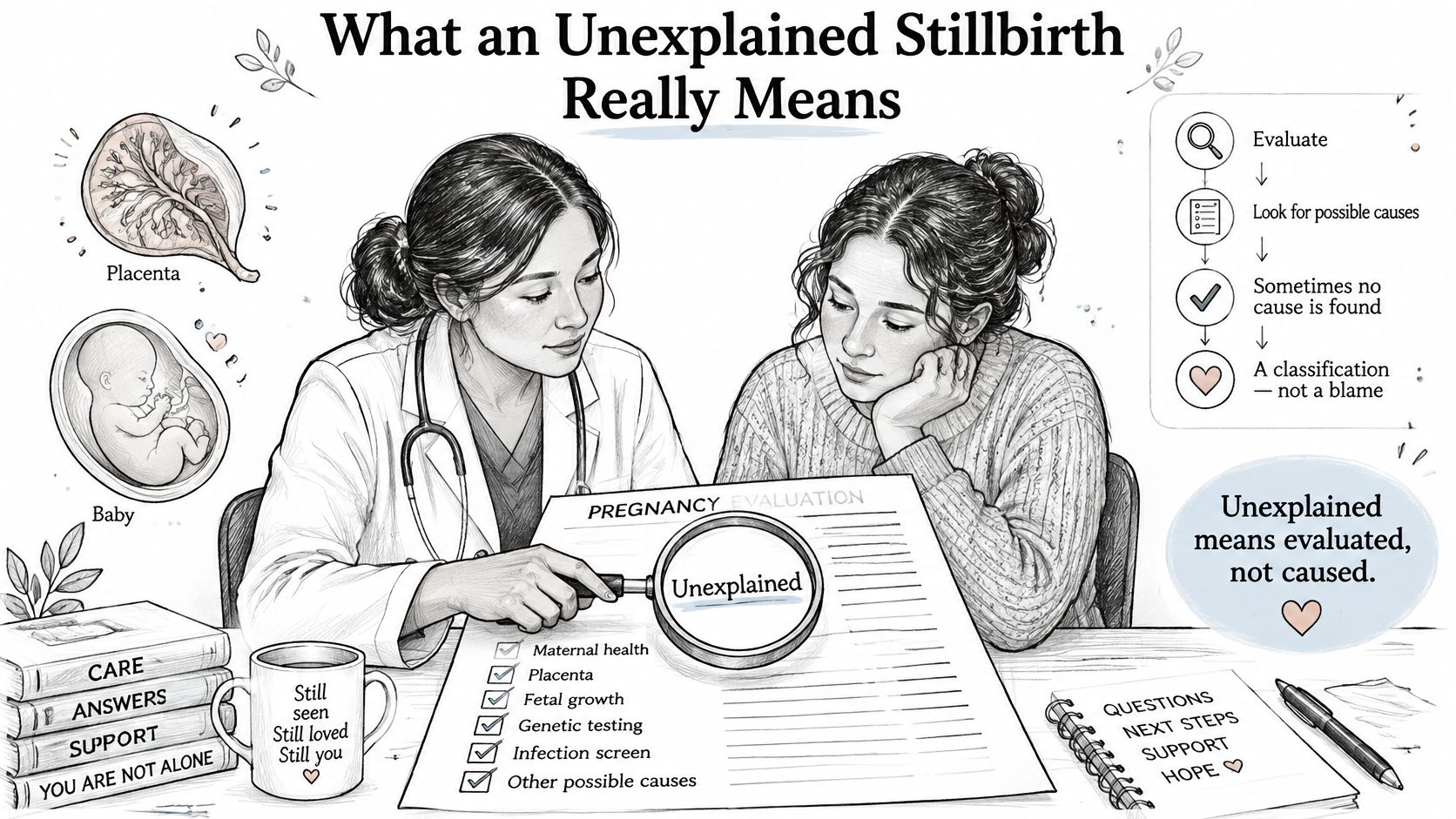
A fetus can appear externally typical while the placenta contains evidence of vascular disease, inflammation, infection, abruption, or impaired growth support. That is why a normal external examination doesn't end the investigation.
The CDC's guidance for conversations after stillbirth supports clear discussion of evaluation options and uncertainty. No single test identifies every death, and a negative genetic result doesn't exclude placental, intrapartum, or combined mechanisms.
Separate incomplete evaluation from unresolved biology
An unexplained classification can follow a thorough investigation. It can also reflect missing tissue, unavailable records, declined testing, or methods that couldn't resolve the suspected condition. Families deserve to know which situation applies.
Consent should address what testing is proposed, which specimens are needed, and what the results may or may not establish. Specimen preservation also matters because not every test remains possible after tissue has been processed or discarded.
Our explanation of molecular diagnostic testing provides additional context for discussing test selection and limitations. Genetic findings sometimes require specialist interpretation before they can inform recurrence counseling.
This video provides another format for discussing stillbirth evaluation.
Questions that make uncertainty more specific
- Completed tests: Which examinations were performed, and which weren't?
- Placental review: Were the placenta and membranes examined microscopically?
- Genetic interpretation: What can the result establish, and what remains outside the test's scope?
- Future counseling: Which findings should an obstetric clinician or genetic counselor review?
An honest explanation of uncertainty is more useful than a confident conclusion unsupported by the evidence.
We don't treat unexplained as a reason to stop communicating. A careful explanation can still clarify what was investigated, what remains unknown, and whether additional review is likely to answer a specific question.
Common Questions About Stillbirth Causes
Can a stillbirth happen again?
Recurrence depends on the cause and the family's medical and pregnancy history. Some findings suggest an increased chance of recurrence, while others don't establish a recurring condition. An obstetric clinician or genetic counselor should interpret the report before the family makes decisions about another pregnancy.
Can a family ask what happens to the placenta?
Yes. Ask the hospital directly, preferably in writing, about retention, preservation, release, and any testing already ordered. Facility policies differ, so request confirmation of the specimen's current location and whether a decision is needed before it becomes unavailable.
Does a private autopsy replace a county investigation?
No. A private examination is a separate review and doesn't override the authority of the responsible Texas county medical examiner or justice of the peace. Ask that office how supplemental findings may be submitted and whether they can affect the official record; our County Forensic Autopsies information explains our work with county officials.
Does an autopsy report prove medical negligence?
An autopsy can provide medical evidence, but it doesn't independently resolve whether care met the applicable legal standard. Attorneys may need a separate clinical review that considers the records, timing, and information available to treating professionals. A forensic pathology expert should distinguish supported medical conclusions from questions outside the examination's scope.
Decide Whether a Second Opinion Is Worth Requesting
A second opinion may help when a medical examiner has declined a case, the cause of death remains unclear, or a family wants an independent review of existing findings. Sometimes the first step is reviewing prior autopsy reports, placental pathology, and medical records. A new examination may not be necessary to address every question.
A private autopsy is authorized by the legal next of kin or their designated representative. The examination can be scoped to the family's questions, such as how and why the death occurred or whether a finding may have been missed. A county's decision not to examine does not prevent a family from requesting an independent examination.
Clarify the question and the available evidence
Start by asking what a second opinion might clarify. A missing placental examination raises different questions from a disagreement about an existing tissue finding. What can be assessed depends on the available specimens, prior procedures, preservation, and records.
Our guide to deciding whether to request a second opinion can help frame that discussion. Texas Autopsy Services offers private autopsies and independent reviews, with direct communication from our team and flat-rate pricing.
We serve all 254 Texas counties from our Elgin, Texas facility, with in-house licensed transport. Our findings follow the available evidence, even when it does not support the explanation a family expected.
Keep Texas documentation separate from the investigation
The Texas Department of State Health Services Fetal Death Registration Handbook states that a Certificate of Fetal Death is required for fetal deaths weighing 350 grams or more, or at least 20 weeks' gestation when weight is unknown, and must be filed with the local registrar within five days. The funeral director or other person first taking custody must also file a Report of Death within 24 hours of taking custody.
Registration requirements are separate from authorization for an autopsy. The responsible Texas agency and legal authority should be confirmed for the specific procedure.
Take concrete next steps
- Gather records. Request prenatal, labor, delivery, hospital, and existing pathology reports.
- Confirm authority. Establish who can authorize the examination. Our team can help clarify the documentation needed.
- Ask about the placenta in writing. Confirm its location and preservation status.
- Call our team at (806) 230-1889. We can discuss the available evidence and options without promising a particular finding.
These decisions follow a loss. Families deserve clear information and room to decide without pressure.
Texas Autopsy Services offers fetal and perinatal examinations and independent reviews to help families understand evidence related to possible stillbirth causes. Contact our team through Texas Autopsy Services to discuss available records, specimen preservation, and whether further evaluation could address your questions.