October 16, 2026 · Texas Autopsy Services
Medical Examiner Corpus Christi TX: A Local Reference Guide
Medical Examiner Corpus Christi TX. How medical examiner and death investigation services work in Corpus Christi, TX. Covers agency roles, private autopsies
On this page
- How Death Investigations Work in Corpus Christi
- When the Medical Examiner Steps In
- The Path of a Private Autopsy in Texas
- County Forensic Autopsy vs Private Second Opinion
- Family Consent and the Limits of Objection
- Cause of Death vs Manner of Death in Texas
- What to Do in the First 24 to 48 Hours
- Regional Capacity and When Outside Help Is Needed
- Records, Exhumation, and Second-Opinion Reviews
- Child Deaths, Fetal Loss, and DFPS Coordination
- Common Misconceptions and Ethical Safeguards
- Frequently Asked Questions and How to Reach Our Team
When a loved one dies suddenly in Corpus Christi, the first confusion is usually procedural, not medical. Families want to know who has authority, whether the county will take the case, and whether they need to wait before arranging anything else. In Nueces County, those answers depend on whether the death belongs to the medical examiner, the justice of the peace, or a private forensic pathologist working outside the county system.
A local death investigation is not one single process. Texas uses a county-based system, and Corpus Christi sits inside a region where official authority changes with the facts of the death. That is why the words cause of death, manner of death, autopsy, and family consent need to be separated before anyone makes a decision that can affect records, transport, or later review.
Key takeaways
- Nueces County's medical examiner handles deaths that require medical-legal investigation, not every death in the county.
- Texas does not use one statewide medical-examiner office, and only 14 of Texas's 254 counties had a medical examiner in a 2023 statewide review, about 5.5% of counties with that structure, according to Nueces County's summary of the system. Nueces County Medical Examiner
- Family consent and official authority are not the same thing under Texas law.
- A private autopsy can help answer medical questions, but it does not replace an inquest or transfer official jurisdiction.
- The safest first step is to identify the right county authority before moving the body, signing broad releases, or agreeing to cremation.
A family might be sitting at the kitchen table after a hospital death, a workplace death, or an unexplained death at home, trying to decide whether the county is involved at all. The right answer depends on the legal category of the death, not just on the family's wishes.
How Death Investigations Work in Corpus Christi
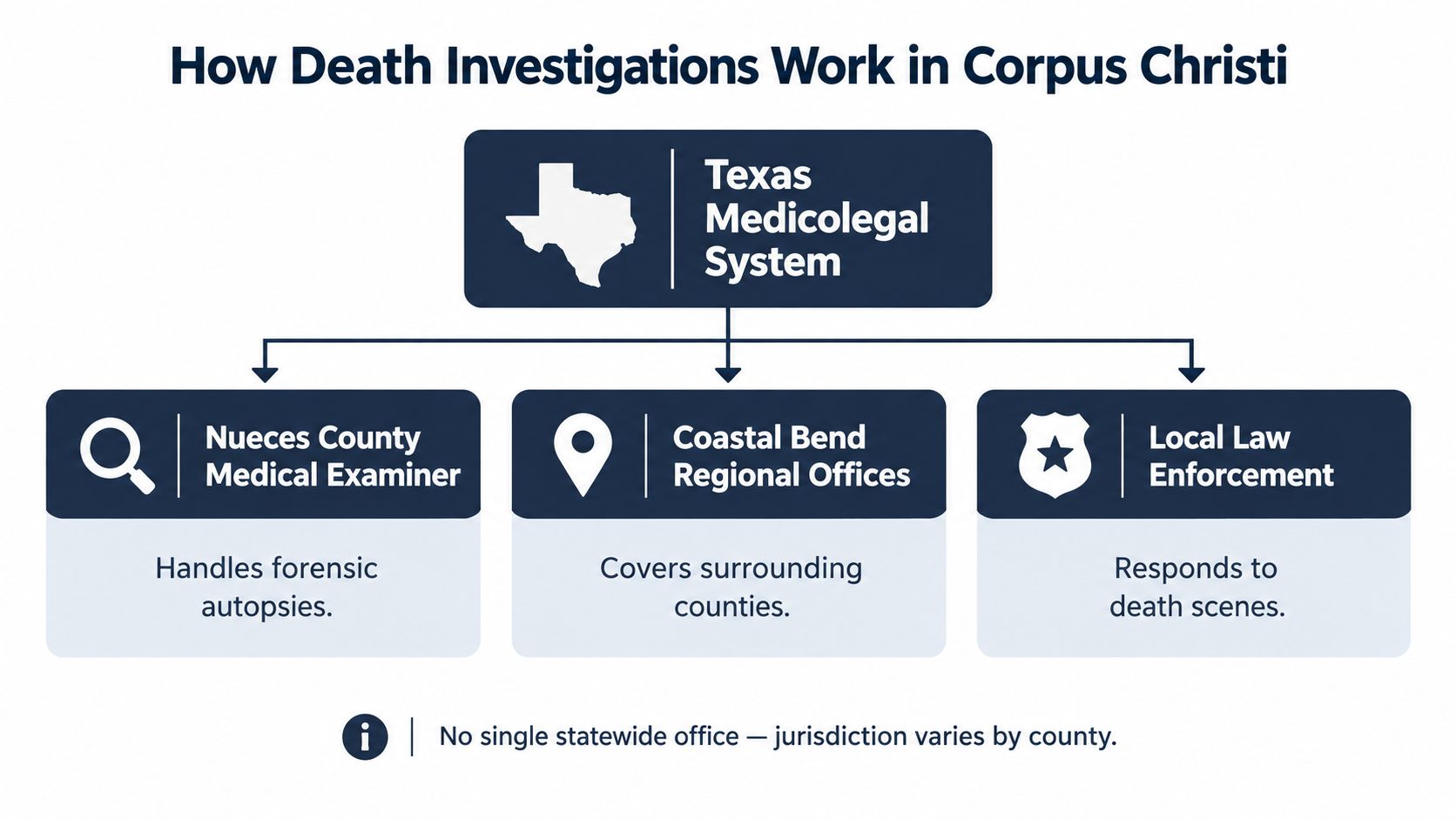
A family can be sitting at the kitchen table after a sudden death and still not know who has the legal authority to act. In Corpus Christi, that answer depends on the type of death and on which county official has jurisdiction. The Nueces County Medical Examiner's Office handles deaths that require medical-legal investigation, not every death in the county. Its role is narrower than routine hospital certification or funeral-home paperwork. Nueces County Medical Examiner
Texas also does not rely on one statewide death-investigation office. County authority is spread out across the state, and the local system in Nueces County functions as one part of that larger framework. A 2023 review of the state system found that only 14 of Texas's 254 counties had a medical examiner, which is roughly 5.5% of counties with centralized physician-led death investigation. Nueces County Medical Examiner
Who holds legal authority
The first question is not what the family wants to do, but who has lawful authority over the death at that moment. If a county has a medical examiner, that office may direct the investigation. If it does not, the justice of the peace may conduct the inquest under Texas law. Texas Code of Criminal Procedure Article 49A
The county judge can also have duties in certain settings, especially where organ donation or authorized postmortem examination issues arise. Those duties do not replace the medical examiner or justice of the peace role, they sit beside them in specific legal situations. Texas Department of State Health Services guidance
Practical rule: before a family or attorney arranges transport, burial, cremation, or an independent exam, the first job is to identify the official authority already attached to the case.
| Official | Statutory Basis | Typical Trigger | Can Order Autopsy? |
|---|---|---|---|
| Medical examiner | County medical-examiner authority | Deaths needing medicolegal review | Yes, when legally needed |
| Justice of the peace | Texas inquest law | Deaths in counties or cases without a medical examiner | Yes, in qualifying cases |
| County judge | Texas health and safety provisions | Certain county-level legal safeguards | In limited situations |
| Law enforcement | Scene investigation duties | Death scene response and evidence protection | No, but they preserve the scene |
When the Medical Examiner Steps In
A family may hear several terms at once, but the county does not treat them as the same thing. The medical examiner decides whether the death needs medicolegal review. The autopsy is the examination that may follow. Family consent matters for private examinations, but it does not control every county case.
Texas law requires an inquest when a death is unnatural, violent, suspected suicide, unknown in cause or circumstance, found in the county, or tied to certain custodial deaths. If a physician cannot certify the cause of death, the matter must be reported to the proper justice of the peace for inquest. Texas Code of Criminal Procedure Article 49.04
What that means in plain language
A death does not enter medicolegal review because the family wants more answers. It enters that track because the law asks the county to answer a public question about identity, cause, and manner of death. That answer shapes the death certificate, and it also affects police work, insurance, employment questions, and court records.
In a hospital death, attorneys and families sometimes need to coordinate several outside services at once. A healthcare marketplace can help organize those supporting services while the county investigation continues, but it does not replace the authority handling the case.
If you are trying to decide whether a death has been released or is still being reviewed, that status matters. Transport, records, and burial or cremation decisions can change once the county finishes its work.
For families who want a broader explanation of why some deaths become medicolegal cases and others do not, this guide on when autopsies are done gives a useful overview.
| Trigger | Why It Matters | First Agency to Contact |
|---|---|---|
| Death within 24 hours of hospital admission | Often requires medicolegal review | Appropriate county official |
| Death in custody | Raises legal scrutiny | County authority |
| Unknown cause or circumstances | Official investigation may be needed | Justice of the peace or medical examiner |
| Body found in the county | Inquest may be required | Justice of the peace |
| Physician cannot certify death | The law requires referral | Appropriate county official |
The Path of a Private Autopsy in Texas
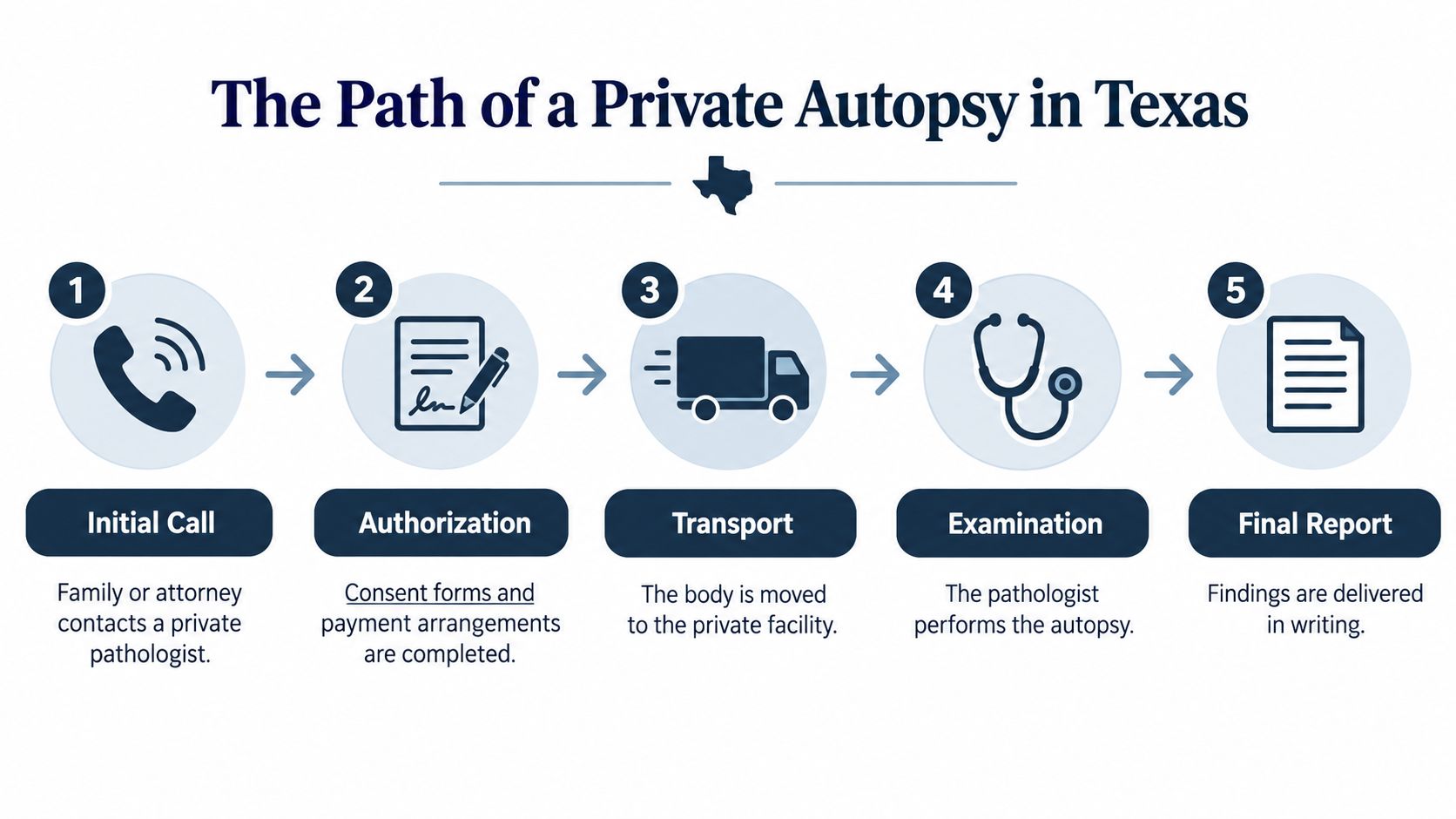
A private autopsy begins with permission, then examination. In a Texas inquest case, the body cannot be examined by a physician or assistant unless the right person gives written informed consent and the county authority has also cleared the case, when that clearance is required. Chapter 49A also sets the timing window, with the authorized postmortem examination generally taking place between 24 and 48 hours after death, subject to the statute's conditions and exceptions. Texas Code of Criminal Procedure Chapter 49A
Once the county file no longer blocks the work, the medical review can begin. That process may include transport, secure storage, review of records, external and internal examination, specimen collection, and extra testing such as toxicology or imaging when the facts call for it. A sound review is specific to the case, not a fixed checklist. The pathologist chooses what the body and the records require. NAME Forensic Autopsy Standards
What chain of custody looks like
Chain of custody is the written record showing who handled the body, samples, slides, images, and documents at each stage. If the case may later be used in civil litigation, a criminal proceeding, an insurance dispute, or a second-opinion review, that trail matters. The standards also call for specimen retention and for documenting the reasoning that connects findings to cause and manner of death. NAME Forensic Autopsy Standards
Practical rule: if the record cannot show who touched the evidence, when they touched it, and why they touched it, the report is harder to defend later.
A final report should tell the reader what was found, what testing was done, what evidence was transferred, and how the conclusion was reached. Families and attorneys can review our Corpus Christi private autopsy page to see how the service is organized, then compare it with the county process before deciding how to proceed. For a broader overview of timing and case selection, see when autopsies are done.
County Forensic Autopsy vs Private Second Opinion
A county forensic autopsy and a private second opinion do different jobs. The county case answers the legal questions raised by the inquest. The private case gives a family, attorney, or insurer an independent medical review, and it can happen after the county file is finished.
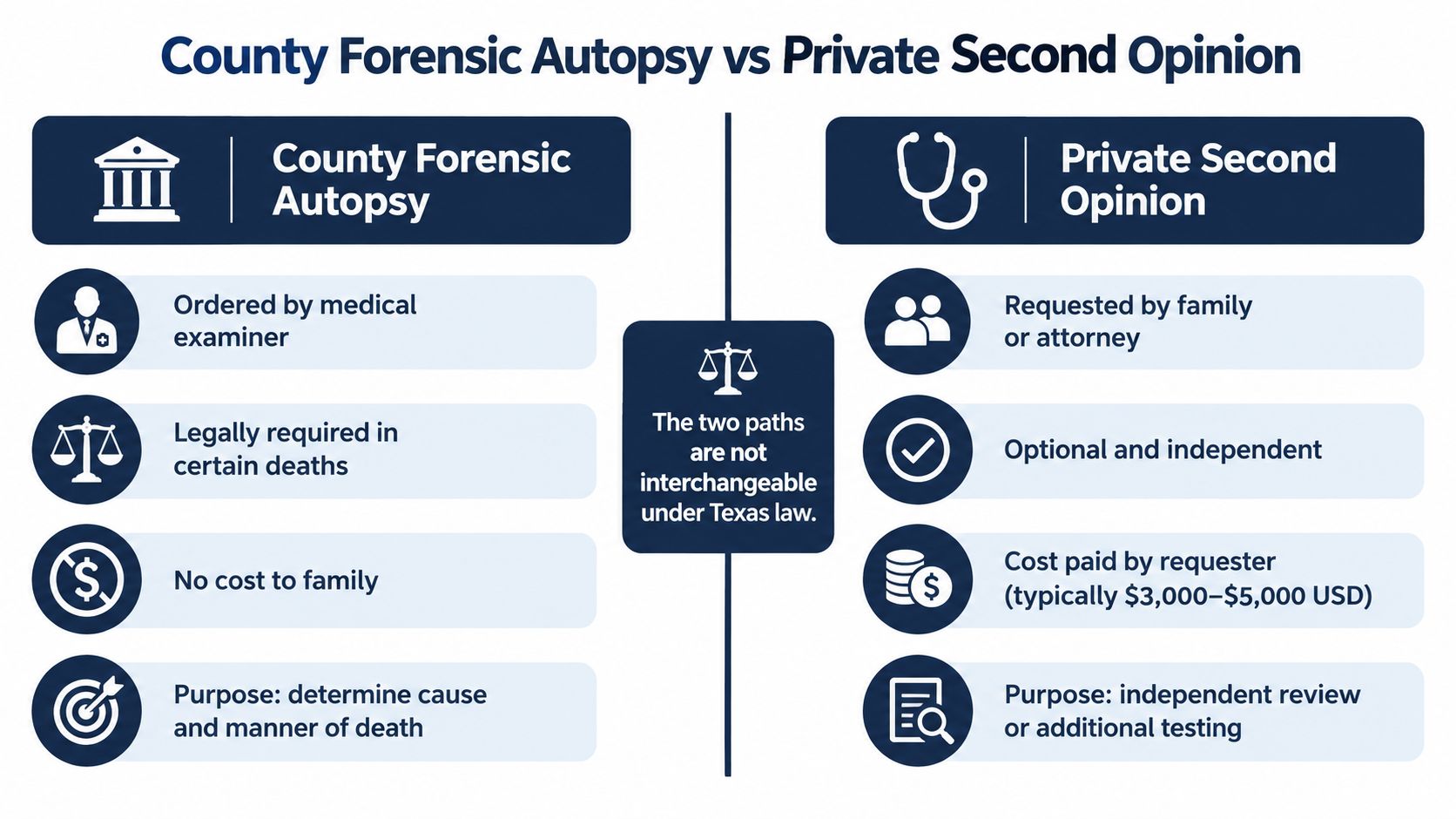
| Factor | County Forensic Autopsy | Private Autopsy |
|---|---|---|
| Authority | Medical examiner or justice of the peace | Family or attorney request, with required authorization |
| Purpose | Determine cause and manner of death | Independent review or additional testing |
| Effect on official record | Feeds the official investigation | Does not replace the official inquest |
| Use in dispute | Official evidence | Can support litigation or insurance review |
| Case control | Public authority | Private requester |
The difference matters because a private report cannot change the county's legal role. It can still find missed details, add testing, or answer questions the first exam did not resolve. Under Texas law, that is an added medical process, not a change in jurisdiction. Texas Code of Criminal Procedure Chapter 49A
A useful example is a family that receives a county report listing cause of death, but the toxicology section is limited or absent. A private second opinion may request that testing if the medical questions remain open. That kind of review can help explain medication levels, possible poisoning, or another finding the county case did not address.
Family Consent and the Limits of Objection
A family can object, and the objection should still be heard. In a Nueces County medicolegal case, though, family objection does not automatically stop an autopsy. The county's FAQ explains that an inquest may proceed without an autopsy, and an autopsy may still be performed when the law calls for it. Nueces County Medical Examiner FAQ
Private and hospital autopsies follow a different rule. Texas authorization law sets a priority list that includes the spouse, certain estate representatives, adult children, parents, and adult siblings. In practice, “certain estate representatives” means the person named in a will or an appointed executor, or another person legally placed in charge of the estate. That order governs who may consent to a private examination, while the county keeps its separate authority in a medicolegal case. Texas Health and Safety Code Chapter 693
What families can document
If you disagree with a county decision, put the concern in writing and stay factual. Keep names, dates, times, and the office that gave the instruction. That record helps preserve your position without interfering with the investigation.
If organ donation is also part of the case, the legal rules are separate again. Texas law requires the official authority to coordinate organ removal with the investigation and, in some cases, the autopsy. Texas Health and Safety Code Chapter 693
Family preference matters, but in a medicolegal case it does not always control the next step.
Cause of Death vs Manner of Death in Texas
A death certificate uses terms that sound alike but serve different jobs. Cause of death is the disease, injury, or condition that led to death. Manner of death is the legal category, usually natural, accident, suicide, homicide, or undetermined. Mechanism of death is the last physical process, such as respiratory failure. It describes how the body failed, not why the death occurred.
In Corpus Christi, that difference can affect more than wording. If a certificate lists the manner as undetermined, an insurer may ask for more records before paying a claim, because the label leaves room for uncertainty even when the medical facts are real. The certificate may still be complete, but the family may need a clearer explanation of what was found and what was not.
Texas also recognizes that counties without a medical examiner may use a justice of the peace or county judge as a medical certifier for certain death-record functions. That is why the same death can be processed differently from one county to another. Texas Department of State Health Services guidance
Reading the certificate correctly
A private autopsy can add medical detail to the record, but it does not change who had authority over the inquest. Its value is practical. It can show whether the listed cause of death fits the body, the records, and the circumstances the family knows.
| Term | Plain Meaning | Can a Private Autopsy Affect It? |
|---|---|---|
| Cause of death | The condition or injury that led to death | Sometimes, if new medical findings appear |
| Manner of death | Legal classification of how death occurred | No, not by itself |
| Mechanism of death | Final body failure | May be described, but not used alone as the cause |
What to Do in the First 24 to 48 Hours
A sudden death in Corpus Christi can leave families dealing with phone calls, paperwork, and questions at the same time. Start by finding the right county contact before making other arrangements. If the death may fall under Texas inquest law, the body may already be under official authority, and moving ahead too quickly can create problems later.
Keep every record together. Hospital notes, EMS reports, scene photos, and any written messages from police or the county can help explain what happened if a second opinion is needed. A hospital chart is often only part of the story.
Avoid these mistakes
- Don't move the body until the proper authority says it is allowed.
- Don't sign broad releases until you know what they cover.
- Don't agree to cremation before jurisdiction is settled.
- Don't throw away records that may matter in a later review.
If organ donation is being considered, bring it up early, before transport is scheduled, so the official authority can coordinate the timing under Texas law. Families who are also handling property, bills, and notices can use a guide for families managing a Texas estate to organize the non-forensic steps while the county process is still pending.
Regional Capacity and When Outside Help Is Needed
A county medicolegal office can do the right work and still run out of room. In July 2020, the Corpus Christi morgue had internal capacity for 12 bodies, and a FEMA-provided refrigerated trailer could hold up to 40 additional bodies. In the same period, Corpus Christi and Nueces County reported 42 COVID-19 deaths since the pandemic began, including 29 deaths from Monday through Friday, which was nearly 70% of that total. Texas morgue capacity and referral reporting
The strain also showed up in outside referrals. Hidalgo County paid the Nueces County Medical Examiner's Office $489,600 between January 2021 and March 2022, and more than 100 autopsies were performed for Hidalgo County over 15 months. Dividing those reported figures gives roughly 6.7 referred autopsies per month and about $4,896 per case in billed services, before transportation costs. The math is simple, but the point is practical, regional offices can become overloaded with local deaths and outside cases at the same time.
Why outside help becomes necessary
When a regional office is already stretched, it may stop accepting out-of-county work. Smaller counties then need independent forensic pathology support to keep cases moving. For attorneys and county officials, statewide private coverage with in-house transport matters because a crowded regional queue can delay the next decision.
| Metric | Value | Period |
|---|---|---|
| Corpus Christi morgue internal capacity | 12 bodies | July 2020 |
| FEMA trailer capacity | Up to 40 additional bodies | July 2020 |
| Corpus Christi and Nueces County COVID-19 deaths reported since pandemic began | 42 | July 2020 |
| Monday through Friday deaths in that period | 29 | July 2020 |
| Hidalgo County payments to Nueces County ME office | $489,600 | January 2021 to March 2022 |
| Hidalgo County autopsies performed | More than 100 | 15 months |
Records, Exhumation, and Second-Opinion Reviews
A second-opinion review usually starts with records, not with another autopsy. That means requesting the county report, hospital chart, imaging, toxicology results, and any available scene information. If the original work included retained specimens or digital images, those materials can often make a review much more useful than the narrative alone.
If the body was buried and the family later needs a new physical examination, exhumation becomes a separate legal and logistical process. It takes coordination, time, and authorization, and it depends heavily on whether the original chain of custody was preserved. The more complete the original documentation, the easier it is to know whether a second opinion can answer the question without disturbing the remains again. Texas Autopsy Services review resources
What to gather first
- Obtain the county report if one exists.
- Request hospital records and any discharge or emergency notes.
- Save imaging and toxicology results if they were done.
- Keep every letter or email about authorization or release.
A records review is different from a new physical examination, and that difference matters in court, in insurance disputes, and in family decision-making. A review can clarify whether the original conclusion was well supported, while a new exam may require the body or retained material.
Child Deaths, Fetal Loss, and DFPS Coordination
A child death can move faster than the family expects because the reporting rules move fast too. Texas Department of Family and Protective Services guidance says the investigator must notify the medical examiner or justice of the peace in the county where the death occurred immediately, or within 24 hours of learning about it, and should pass along the known medical and circumstantial facts. The same guidance says the supervisor should send the Child Death Records Request letter as soon as possible, or within 24 hours when that can be done. DFPS child death guidance
For families, that means the county case is only one part of the record. The scene report, hospital chart, and investigator notes can all matter later, especially if a lawyer, insurer, or another doctor needs to understand how the county reached its conclusion. One office may handle the legal inquiry, while another may hold the medical records.
Fetal and perinatal loss can require a different path. A private fetal examination may be possible when the pregnancy loss occurred outside the county medicolegal case, but the family should keep discharge papers, prenatal records, ultrasound reports, and any pathology or hospital paperwork. Those records help show what was seen, what was tested, and whether the case needs outside review.
Why these cases need extra care
A medical autopsy is not the same as the official cause-and-manner finding. The exam may support the death certificate, but it does not replace the county's legal determination. Families should make sure the file shows who authorized each step and whether the examination was part of the county case or a separate review.
Common Misconceptions and Ethical Safeguards
A family may assume a private autopsy can begin as soon as everyone agrees. In Corpus Christi, the sequence matters. The county process has to finish its legal role first, and only then can a private review move ahead if the body is released for that purpose. A private examination can add detail, but it cannot interrupt the county's work or change who has authority over the case.
Another point that causes confusion is the difference between a forensic exam and a second opinion. The county examines the death for legal purposes, while a private path is usually meant to answer medical questions for the family or counsel. Those roles can overlap in the same death, but they do not merge into one record.
Safeguards that should always be present
- Clear authorization from the right person or office.
- Documented chain of custody for every specimen and record.
- Respect for retained evidence in case of later review.
- Compliance with Texas Funeral Service Commission and Texas Health and Safety Code requirements where applicable.
- A written report that explains the reasoning, not just the conclusion.
The Texas Funeral Service Commission, the Texas Health and Safety Code chapters tied to death care, and the NAME forensic-autopsy standards all point to the same basic duty, the decedent must be handled carefully, and the family should get clear findings they can understand.
Frequently Asked Questions and How to Reach Our Team
A family in Corpus Christi often reaches this point with the same two questions: who still has the case, and who can do a private review if the county is finished. The answers are separate. The county handles the legal death investigation, while a private autopsy is a different service used to answer medical questions for the family or counsel.
How much does a private autopsy usually cost?
Private autopsies at Texas Autopsy Services are flat-rate and all-inclusive. The current price depends on the case, so call (806) 230-1889 for the rate that applies to your situation.
Can a private autopsy be used in court?
Yes, if it is performed and documented correctly. The report, photographs, specimen handling, and chain of custody all affect how useful it is later.
How long do most cases take?
Most cases are completed within 24 to 48 hours after the authorized postmortem examination begins, although records, testing, and case complexity can extend that timeline. The timing also has to fit the county process already described under Texas law.
What should we have ready when we call?
Have the death certificate if one exists, hospital records if available, the county contact information, and any written directions you have already received from the medical examiner or justice of the peace. Those papers help show where the case stands and what can happen next.
Can we speak directly with your team?
Yes. Texas Autopsy Services works directly with families, attorneys, and officials, and we can review the situation before anyone commits to a service path. For Corpus Christi cases and other Texas matters, reach us at (806) 230-1889, available 24/7.
If you are sorting out a death in Corpus Christi or anywhere else in Texas, we can help you understand whether the county still has the case, whether a private autopsy makes sense, and what records to protect first. Visit Texas Autopsy Services to review our services, then call if you want a direct conversation with our team about the next step.