October 26, 2025 · Texas Autopsy Services
How to Request an Autopsy Report in Texas
As a forensic pathologist, I guide you through how to request an autopsy report in Texas, explaining who is eligible, the steps, and what to expect.

On this page
When a loved one dies, the need for answers can be overwhelming. As a forensic pathologist, I often speak with families who are unsure how to navigate the process of obtaining an autopsy report. Before you fill out a form, the first question is simple: am I legally allowed to request this report? In Texas, autopsy reports are confidential medical records, and the law is clear about who gets access. Understanding this from the start is the most important part of the process.
Who Can Legally Request an Autopsy Report?
You must confirm your legal standing before you can move forward. Texas law establishes a specific hierarchy to protect the privacy of the deceased and their family. If you try to request a report without the proper authority, your request will be denied, adding unnecessary frustration to an already difficult time.

The Legal Hierarchy for Next of Kin
The people with the primary right to the report are the legal next of kin. The state defines this hierarchy in a specific order:
- Surviving Spouse: The deceased's husband or wife is always first in line.
- Adult Children: If there's no living spouse, the adult children can make the request.
- Parents: With no spouse or adult children, the parents of the deceased are next.
- Adult Siblings: Finally, if none of the above are available, adult brothers or sisters can request the report.
When Others Have Authorization
It’s not just immediate family who might need access. Other individuals and entities can be authorized, but usually under specific legal circumstances. For example, the legally appointed executor of the decedent's estate has the right to request the report as part of settling the estate's affairs.
An attorney representing the family or the estate can also submit the request, but they must have a signed authorization form from the legal next of kin. This is a common scenario. Many law firms now rely on cloud solutions for legal professionals to manage these sensitive documents securely.
Government bodies like a police department or a District Attorney's office can get these reports when they're part of an official investigation. Their access falls under different rules tied to legal proceedings.
This legal framework exists for a good reason. Autopsies are far less common than they used to be. A CDC report noted the national autopsy rate was just 7.4% in 2020, a significant decline from past decades. This makes the information in each report that much more valuable, which is why ensuring it gets into the right hands is so critical. You can read the full National Vital Statistics Report for 2020 for more detail.
For families seeking answers, knowing these rules is the first step. To learn about the entire process, you can read my guide on requesting an autopsy.
Finding the Right Autopsy Report
Before you can get a copy of an autopsy report, you have to figure out who performed it. This sounds simple, but it’s the most important first step, as not all autopsies are the same. In Texas, they fall into two main categories, and knowing which one you need will determine where you go and who you talk to.
The two types are medicolegal autopsies and private autopsies. Each one is done for different reasons, ordered by different people, and the final reports are held by entirely separate organizations.
Medicolegal Autopsies from Government Offices
When a death is sudden, violent, suspicious, or otherwise unexplained, the government is required to investigate. A medicolegal autopsy is the official examination required by law to determine the cause and manner of death in these cases.
These are carried out by county Medical Examiner's offices or, in more rural counties, by a Justice of the Peace. This isn't an optional procedure; it's mandated by the state to protect public health and safety. You'll typically see a medicolegal autopsy in situations like:
- Suspected homicides, suicides, or accidents.
- Deaths that happen in jail or police custody.
- Cases where someone is found dead and the cause is unknown.
If the death you're investigating fits this description, the report you need is with a government agency. Your task is to find the specific Medical Examiner’s office that serves the county where the person passed away.
Private Autopsies Commissioned by Families
A private autopsy is an autopsy requested and paid for by the family or their legal representatives. This is the work I do at Texas Autopsy Services. It's a path families take when a government autopsy isn't legally required, but they still have unanswered questions. Often, a family wants a second opinion, or they have lingering concerns about the medical care a loved one received leading up to their death.
As a forensic pathologist, I see the value in both systems. Medicolegal autopsies serve the public interest, while private autopsies serve a family's personal need for truth and closure. The latter provides an independent, focused investigation into specific questions the family may have.
Getting the report from a private autopsy is much simpler. Because it’s a confidential document, it goes directly to the person who authorized the examination, usually the legal next of kin or their attorney.
The distinction between these two types of autopsies has become more critical over the years. We've seen a massive decline in hospital autopsies, which were once common. Globally, clinical autopsy rates have plummeted from around 40% in the mid-20th century to less than 5% today. You can read more about this worldwide trend in medical practice and what it means for families. This shift has left families with two main options for getting answers: the official medicolegal system or independent services like mine.
Understanding the key differences is crucial before you start making calls or sending emails. Here's a quick breakdown to help you figure out which path you're on.
Medicolegal vs Private Autopsy Report Requests
| Attribute | Medicolegal Autopsy (Medical Examiner) | Private Autopsy (Independent Pathologist) |
|---|---|---|
| Purpose | Serves public interest; determines cause/manner of death for legal purposes. | Serves the family's private interest; answers specific questions about illness, medical care, or cause of death. |
| Who Authorizes It | The state, through the Medical Examiner or Justice of the Peace. Family consent is not required. | The legal next of kin or a designated legal representative. It is entirely voluntary. |
| Where to Request Report | The government office (Medical Examiner or JP) with jurisdiction over the county of death. | The private pathology group or independent pathologist who was hired to perform the autopsy. |
| Who Has Access | Often considered a public record, though access may be restricted for next of kin or during an active investigation. | A confidential medical record. Access is strictly limited to the person who authorized it and anyone they designate. |
| Cost | No cost to the family. It is funded by taxpayers. | Paid for by the family or estate. Costs can vary depending on the scope of the examination. |
This table should make it clear which type of report you're looking for. Once you've identified that, you'll know exactly which office to contact.
Getting Your Paperwork Together and Sending It In
Once you’ve figured out which office has the report, it’s time to formally request it. I can't stress this enough: be precise. In my experience, simple mistakes like missing documents or an incorrectly filled-out form are the number one reason for delays.
Every agency, from a county Medical Examiner's office to a private pathologist like myself, has its own process. Your first move should always be to check their website or call their records department. Get their most current forms and instructions directly from the source.
The Key Documents You'll Need
While the specific forms can look a little different, the core paperwork you’ll need is fairly consistent across Texas. Having these items organized and ready will make a world of difference.
- The Official Request Form: This is the agency’s document. Make sure you fill out every single field legibly. Don't leave anything blank.
- A Government-Issued Photo ID: They need to verify your identity. A clear, unexpired copy of your driver's license or another state ID is required.
- Proof of Your Relationship: This is absolutely critical. You have to provide a legal document that proves you're the next of kin. This could be a marriage certificate if you're the spouse, a birth certificate for a parent or child, or legal paperwork like a will that names you as the executor.
Getting these three things together before you start the submission process can prevent your request from being rejected immediately. Think of it as putting together a complete package for the records clerk.
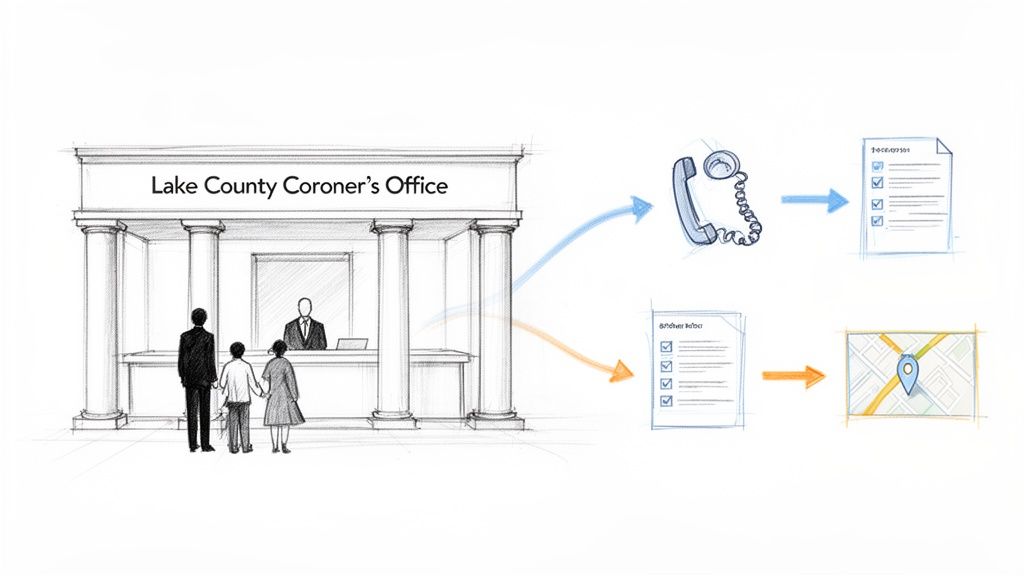
This infographic lays out the two different paths you might take, one for a government-run medicolegal report and the other for a private one.

As you can see, the government route follows a public, standard process. In contrast, requests for my private reports are handled as a direct and confidential matter between my office and the family or attorney who authorized it.
How to Actually Submit Everything
With your documents in order, you'll have a few ways to send them. The method you pick can impact how quickly things move and how easily you can track your request's progress.
Most of the larger Medical Examiner's offices now have an online portal. This is almost always the fastest and best way to do it. You get an instant confirmation, and it creates a digital paper trail.
If there's no online option, email is your next best bet. I recommend scanning all your documents into a single PDF file. It keeps everything neat and ensures no pages get separated or lost. After you send it, follow up to confirm they received it.
You can also use certified mail. It’s the slowest option, but it gives you a formal, physical receipt that your package was delivered. Lastly, if you live nearby, you can always deliver it in person. This lets you speak directly with a clerk and get immediate confirmation that they have everything they need.
My practical advice from years of experience is to double-check everything before you click send or seal the envelope. A single missing signature or a blurry copy of an ID can push your request to the bottom of the pile and delay the process by weeks. If you're unsure about a question on the form, just call the office and ask. A quick phone call is much better than a frustrating delay.
What Happens After You Submit the Request
Once you’ve submitted all the paperwork, the process moves out of your hands. I know from my work with families and legal teams that this waiting period can be the hardest part. You've done your part, and now it's a matter of letting the professionals complete their work.
So, what can you really expect? It comes down to understanding timelines, potential costs, and what the final report will actually look like when it arrives.
The biggest factor influencing how long you'll wait is the complexity of the case. A straightforward examination might wrap up quickly. But if the pathologist needs to run extensive toxicology screens, send out tissues for microscopic analysis, or consult with other specialists, the timeline naturally extends.
Another thing to remember is the Medical Examiner's caseload. These offices are often incredibly busy, and a sudden spike in cases can create a backlog that affects everyone waiting for a report.
Managing Timelines and Expectations
The question I get asked most often is, "How long is this going to take?" And the honest answer is: it varies a great deal.
You could have the final report in as little as six to eight weeks. On the other hand, it's not unusual for it to take three to six months, especially for more involved cases. I've seen highly complex investigations take longer. We break this down further in my article on how long it typically takes to get autopsy results.
My best advice is this: when you submit your paperwork, ask for an estimated timeframe. Just remember that it’s truly an estimate. Unexpected findings can easily add weeks or months to the process.
This isn't just a Texas issue; it's a reality everywhere. Looking at broader trends, European health statistics show that national policies can have a huge impact. In Sweden, autopsy rates are around 11%, while in other countries, they drop below 1%. These differences in procedural volume and administrative capacity directly affect how quickly reports are processed and delivered.
Associated Costs and Fees
Here’s some good news: if the autopsy was ordered by a Justice of the Peace or Medical Examiner, the family doesn't pay for the procedure itself.
However, you will almost certainly have to pay a fee to get a copy of the report. This is standard practice in most Texas counties to cover administrative and copying costs. The fees are generally reasonable, usually falling somewhere in the $25 to $100 range.
Be sure to ask about the exact fee and what payment methods they accept when you file your request.
Receiving the Final Report
When the report finally arrives, be prepared for a dense, technical document. It’s a medical-legal record, not a simple summary, and it’s filled with clinical language. It will be broken down into sections detailing everything from the external examination to the internal findings and microscopic analyses.
A quick but important note on digital security: autopsy reports contain highly sensitive personal health information. If you're sending or receiving the report via email, it's wise to have a basic understanding of HIPAA compliant email encryption to ensure that privacy is protected every step of the way.
How to Understand the Autopsy Report
When you finally get the autopsy report, it can feel like trying to read a foreign language. It's packed with medical jargon and can be incredibly intimidating, especially during a difficult time. My goal here is to break it down for you, so you can make sense of the document and find the answers you need.

The best way to approach it is to think of the report as a story told through science. Each section is a chapter, building on the one before it, all leading to the final conclusion. You don't need a medical degree to understand the core findings if you just know what to look for.
Where to Look First: The Key Sections
I always tell families and attorneys to start with a few specific sections. These parts give you the "bottom line" and provide the most critical information right up front.
- Final Anatomic Diagnoses: This is your summary. It’s a numbered list of every single disease, injury, or abnormality the pathologist found.
- Narrative Summary: Think of this as the plain-English version. It usually provides a brief history of the case, highlights the most significant findings, and leads directly to the cause of death.
- Opinion: This is the most crucial part. It spells out the official cause of death (the specific disease or injury that started the chain of events) and the manner of death, which is classified as one of five categories: natural, accident, suicide, homicide, or undetermined.
Understanding the language a pathologist uses is a big part of this. For a deeper dive, my guide on the meaning behind a pathology report can be a huge help.
Deconstructing the Rest of the Report
To help you navigate the entire document, it's useful to know what each section covers. An autopsy report is meticulously organized, with each part serving a specific purpose.
The table below gives you a quick overview of what to expect in a standard report.
| Key Sections of a Standard Autopsy Report |
| :--- | :--- | :--- |
| Section Name | What It Contains | Why It's Important |
| Final Anatomic Diagnoses | A summary list of all medical findings, from major diseases to minor abnormalities. | This is the quickest way to see a high-level overview of the physical evidence found. |
| Opinion (Cause & Manner) | States the specific cause and manner of death (e.g., Natural, Accident). | This is the ultimate conclusion of the report and often the most legally significant part. |
| Narrative Summary | A short, plain-language paragraph summarizing the case and the key findings. | It connects the dots and explains how the pathologist reached their conclusion. |
| External Examination | A detailed description of the body's exterior, including height, weight, scars, and any visible injuries. | Provides crucial evidence of external trauma or identifying features. |
| Internal Examination | A system-by-system description of the internal organs, including their weights and appearance. | This is where hidden diseases or internal injuries are documented in detail. |
| Toxicology Report | A list of any drugs, alcohol, or poisons found in the body and their concentrations. | It can be the key to explaining the cause of death, especially in sudden or unclear cases. |
Breaking down the report section by section makes the information much more manageable and helps you understand how the final conclusions were reached.
An autopsy report is a scientific document. It’s objective and factual, completely stripped of emotion. The clinical language can be jarring, but it’s necessary for an accurate and unbiased record.
If the findings are complex, or if something just doesn't sit right with you, getting a second opinion is often the best next step. An independent forensic pathologist can review the report, photos, and slides to give you a fresh perspective and the clarity you deserve.
Common Questions About Autopsy Reports in Texas
Navigating this process for the first time brings up a lot of questions. I hear many of the same ones from families and attorneys, and the uncertainty can be overwhelming. Here are some straightforward answers to the most frequent inquiries I get.
How Long Does It Take to Get an Autopsy Report in Texas?
This is the question I'm asked most often. The honest answer is: it depends. There’s no single, set timeline.
If the examination is relatively straightforward with clear, immediate findings, you might see a final report within 6 to 8 weeks. That's a best-case scenario.
However, many cases are more complex. We might need extensive toxicology testing, detailed microscopic analysis of tissues, or even consultations with outside specialists like neuropathologists. When those extra steps are necessary, the timeline stretches. It’s not uncommon for a report to take 12 weeks to six months, and in some very complex investigations, it can be even longer.
Another big factor is simply the caseload of the Medical Examiner's office. I always recommend asking for an estimated timeframe when you submit your request, but know that it’s just an estimate. The science of the case ultimately dictates the schedule.
Can I Request a Report if I Am Not Next of Kin?
Generally, the answer is no. Texas law is strict about protecting the privacy of the deceased and their family. Access is tightly controlled and reserved for the legal next of kin. The state has a clear hierarchy for this: spouse, then adult children, then parents, and finally, adult siblings.
There are a few specific exceptions to this rule.
- An attorney can request the report, but only with a signed release from the family.
- The court-appointed executor of the deceased's estate can also obtain it.
- The only other way is through a subpoena or a court order, which typically only happens for significant legal reasons during an official investigation or court case.
Is There a Fee to Get an Autopsy Report?
The cost depends on who performed the autopsy.
Medicolegal Reports: If you're getting the report from a county Medical Examiner's office, expect a fee. This covers their administrative and copying costs. It’s usually a nominal amount, somewhere in the ballpark of $25 to $100.
Private Autopsy Reports: For a private autopsy, like the ones my practice performs, the cost of the report is already built into the overall service fee for the person who authorized it. If that person needs extra certified copies down the road, we might charge a small administrative fee.
My best advice is to call the specific agency you're dealing with and ask about their current fee schedule before you send anything in.
What Can I Do if I Disagree with the Report's Findings?
It's not uncommon for families to have questions or even serious concerns about the official findings. If you find yourself in this situation, you have options. You can try to schedule a meeting with the pathologist who performed the original examination, but their availability can sometimes be limited.
This is precisely why many families reach out for a second opinion autopsy. An independent forensic pathologist can conduct a thorough review of everything from the original report, the photos, the lab results, and the microscopic slides. My job in these reviews is to offer a fresh, unbiased look at all the evidence and bring clarity to confusing or disputed conclusions.
If you are facing unanswered questions or need help making sense of a complex medical-legal finding, I am here to provide the clarity you need. Please contact my office at Texas Autopsy Services for a confidential consultation. https://www.texasautopsyservices.com