December 14, 2025 · Texas Autopsy Services
What Inconclusive Means on an Autopsy Report
A forensic pathologist explains what does inconclusive mean on an autopsy, why some findings are undetermined, and what steps families can take next.
On this page
When a family receives an autopsy report, they are looking for answers. Seeing the word “inconclusive” can be deeply frustrating, suggesting a failure to find the truth. As a forensic pathologist, I want to clarify what this finding actually means. An inconclusive report isn’t a failure of the process. It’s an honest, specific conclusion that the available evidence doesn’t meet the strict scientific standard required to name a definitive cause of death. My findings must be based on what I can prove, and I cannot speculate.
- An inconclusive result means the evidence doesn't meet the high standard of certainty required to state a definitive cause or manner of death.
- It is an honest finding reflecting the limits of the evidence, not a failure of the pathologist or the examination.
- Key reasons for an inconclusive finding include advanced decomposition, lack of medical history, or a cause of death that leaves no physical trace (like a cardiac arrhythmia).
- A second opinion from an independent forensic pathologist can review the original findings and may provide new clarity.
- Advanced testing, such as comprehensive toxicology or molecular autopsies, can often resolve cases that were initially inconclusive.
The Reality of an Inconclusive Autopsy Finding
In my work, I’ve had many difficult conversations with families navigating a profound loss. Receiving an autopsy report marked "inconclusive" often feels like a devastating blow, creating more questions than answers at an already unbearable time. I want to make one thing clear: an inconclusive result is a precise scientific conclusion. It means that after my meticulous examination, the evidence doesn’t meet the high bar of certainty required to name a cause of death. As a board-certified forensic pathologist, I cannot guess. My duty is to the evidence.
Understanding Key Autopsy Terms
To understand an inconclusive finding, it helps to know the language I use in a death investigation. My final report always breaks down three key elements.
- Cause of Death: This is the specific disease or injury that initiated the chain of events leading to death. Examples include a heart attack (myocardial infarction), a gunshot wound, or lung cancer. It’s the direct medical reason.
- Mechanism of Death: This describes the physiological process that occurred because of the cause. For instance, the mechanism of a gunshot wound might be exsanguination (severe blood loss).
- Manner of Death: This is the legal classification of how the death occurred. In Texas, as in most states, there are five options: Natural, Accident, Suicide, Homicide, or Undetermined.
An autopsy can be inconclusive on the cause, the manner, or sometimes both. For example, if I find no anatomical reason for death in a healthy young person, the cause would be undetermined. This doesn’t signal a flawed investigation; it means the answer, with current scientific tools, could not be found.
A Clear Breakdown of Autopsy Terms
To help families and legal professionals make sense of these reports, I often provide a simple breakdown of the terms they will encounter.
| Term | What It Means in Plain Language | A Simple Example |
|---|---|---|
| Cause of Death | The specific injury or disease that started the process of dying. | A gunshot wound to the chest. |
| Mechanism of Death | The body's physiological response that resulted in death. | Severe bleeding (hemorrhage) caused by the gunshot wound. |
| Manner of Death | The legal classification of how the death occurred. | Homicide. |
| Inconclusive/Undetermined | When the evidence is not sufficient to definitively state the cause or manner. | An individual is found with no signs of injury or disease, and toxicology is negative. The cause is undetermined. |
Ultimately, a forensic pathologist's duty is to the evidence.
An inconclusive finding represents an adherence to that principle, acknowledging that sometimes the puzzle pieces needed for a definitive conclusion are simply not there.
This commitment to scientific integrity is paramount. While providing families a clear answer is always my goal, my primary responsibility is to provide an accurate one. An inconclusive report is an honest assessment of the available facts. In my practice at Texas Autopsy Services, explaining these nuances is a crucial step in helping families and attorneys determine their next steps.
What 'Inconclusive' Means in a Forensic Context
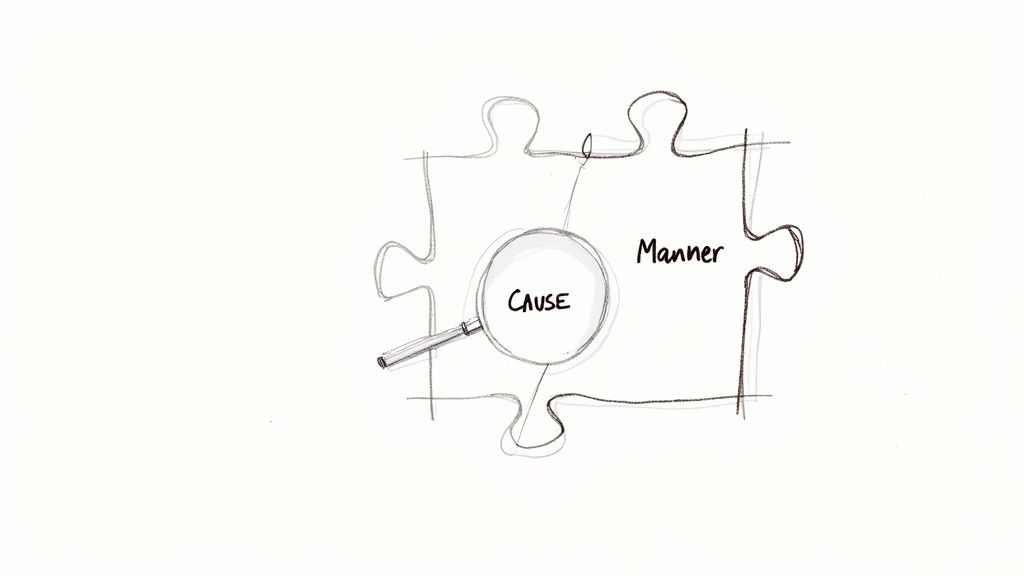
In my field, words have specific, critical meanings. When you see "inconclusive" or "undetermined" on an autopsy report, it’s a formal conclusion stating that there isn't enough evidence to name a cause or manner of death with medical certainty. It’s a declaration of the honest limits of the evidence itself. My name is on that report, and I must be able to defend every conclusion. If the proof isn’t there, I cannot guess.
Cause of Death vs. Manner of Death
To grasp what an inconclusive autopsy means, you must understand two key concepts: cause of death and manner of death. They are different parts of the same story, and sometimes one part can be solved while the other cannot.
Cause of Death: This is the medical reason someone died. It's the specific injury or disease that started the chain of events leading to death, like a gunshot wound or a drug overdose. It's based entirely on findings from the body and laboratory tests.
Manner of Death: This is the legal classification of how the death happened. As I mentioned, in Texas we have five official categories: Natural, Accident, Suicide, Homicide, and Undetermined. To determine this, I combine the autopsy findings with the context and circumstances of the death.
It’s entirely possible to know the cause of death (e.g., drowning) but not the manner. Was it an accident, or was it intentional? If we can't tell, the manner is undetermined. Conversely, if a person dies with no clear anatomical or toxicological reason, the cause of death itself is undetermined, which almost always makes the manner undetermined as well.
A Commitment to Scientific Integrity
I often view a death investigation as assembling a complex puzzle. My role is to gather and fit together all the pieces: the physical exam, toxicology reports, tissue samples, medical records, and information from the scene. An inconclusive finding means that crucial puzzle pieces are missing. Perhaps decomposition has obscured evidence, there's no medical history for context, or the person died from a sudden event, like a cardiac arrhythmia, that leaves no physical trace.
An "undetermined" conclusion is not a failure of the examination. It is a reflection of a pathologist's commitment to scientific accuracy and ethical responsibility. It signifies that the evidence does not support a definitive conclusion, and guessing is not an option.
Adherence to the facts is the foundation of my profession. I know how frustrating this can be for families seeking closure, but an undetermined finding is the only truthful conclusion when the evidence isn’t there. For a deeper look, you can read my guide on what an undetermined cause of death truly signifies. In these complex situations, a second opinion from an independent pathologist can sometimes offer a fresh perspective.
Common Reasons an Autopsy May Be Inconclusive

An "inconclusive" finding isn’t a failure; it’s an honest reflection of the evidence. It means that despite a thorough examination, the science can't point to a single, clear cause of death. It’s important for families and attorneys to understand that this is sometimes the most responsible conclusion.
The Challenge of Advanced Decomposition
Time is the greatest challenge in a death investigation. Decomposition, the body’s natural breakdown, begins quickly, especially in the Texas heat, and can erase the very evidence needed for answers. As tissues degrade, they can obscure or destroy crucial clues. For example, subtle injuries like a small brain hemorrhage or the early signs of a heart attack can become impossible to identify. Decomposition also complicates toxicology, as bacteria can produce alcohol and other substances, making it difficult to determine what was in the person's system at the time of death.
Incomplete Medical and Scene History
I never perform an autopsy in a vacuum. The examination is one part of a much larger puzzle, and I rely on context from medical records and information from the death scene. When that background is missing, it leaves significant gaps. Without medical records, I might not know about a pre-existing seizure disorder or a heart condition that could explain a sudden death.
A lack of information doesn't just make the investigation harder; it removes essential context needed to connect physical findings to a logical cause of death. The autopsy itself is one piece of the puzzle, and without the surrounding pieces, the full picture may remain unclear.
Scene details are equally important. Information about the environment, medications present, or the position of the body can provide vital clues. Without that context, determining the manner of death can become pure guesswork.
The Limitations of the Examination Itself
Sometimes, the cause of death is a physiological event that leaves no physical trace. A classic example is a sudden cardiac arrhythmia, an electrical problem that stops the heart. The heart itself might look perfectly healthy, leaving no anatomical explanation for the death.
Other "invisible" causes include:
- Sudden Unexpected Death in Epilepsy (SUDEP): This is a tragic reality for some with seizure disorders, but autopsy findings are often completely normal.
- Metabolic Disorders: Certain genetic issues can cause a fatal cascade in the body without changing organ structure.
- Early-Stage Infections: A person can die from a rapidly progressing infection before it creates visible damage.
In these cases, even the most comprehensive examination may not find a clear reason for death.
Pending Ancillary Test Results
An initial report is often classified as "pending" or "inconclusive" because we're waiting on lab results. The gross examination is just the beginning. The real story often unfolds under a microscope or in a toxicology lab, which takes time.
These critical tests include:
- Toxicology: Screens for drugs, alcohol, and poisons. This is a common reason for a pending report and can take several weeks.
- Histology: Microscopic examination of tissue samples. This is how we find conditions like myocarditis (heart muscle inflammation) or microscopic tumors.
- Microbiology: Cultures to test for bacterial or viral infections.
Once these results are complete, I can combine them with my physical findings to reach a final conclusion. The initial "inconclusive" status is often a placeholder.
Frequency of Undetermined Cases
An inconclusive or undetermined finding is an accepted, though uncommon, outcome in forensic pathology. Studies show that undetermined deaths typically account for 0.01% to 5% of all forensic cases. The exact percentage often depends on the depth of the investigation. Centers that perform more comprehensive testing, like genetic analysis, can lower that figure significantly. You can learn more about the factors influencing undetermined death rates in this detailed study of forensic cases. My goal is to use every available tool, but when the evidence simply isn't there, an undetermined finding is the only ethical conclusion.
How We Dig Deeper to Find Answers
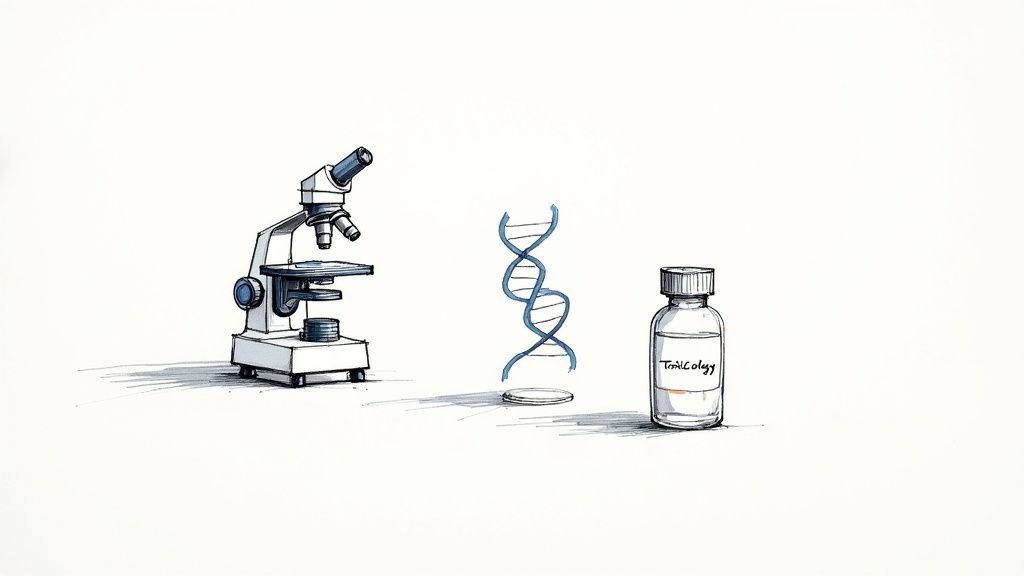
An "inconclusive" finding doesn't have to be the final word. While a standard physical examination provides a great deal of information, some of the most critical clues are invisible to the naked eye. This is where advanced diagnostic tools come into play, allowing us to analyze what's happening at a microscopic and molecular level. When I’m retained for a comprehensive private autopsy, I can bring these powerful methods to the table to turn an "undetermined" cause of death into a definitive answer.
Uncovering Hidden Factors with Toxicology
A comprehensive toxicology screen is one of our most essential tools. This isn’t just a simple test for alcohol; it’s a deep analysis that can screen for hundreds of substances, including prescription medications, over-the-counter drugs, and illicit substances. A death that appears natural can sometimes be the result of an accidental overdose or a harmful drug interaction. Understanding what is in a toxicology report is vital, as these results often provide the missing piece of the puzzle. The integrity of biological samples for this testing depends on specialized equipment, like ultralow temperature freezers, to keep them viable.
Finding Clues in the Cells with Histology
Histology is the study of tissues under a microscope. During an autopsy, I take tiny samples from major organs to examine on a cellular level. This can reveal diseases that are completely invisible during a standard exam.
Here are a few examples of what histology can uncover:
- Myocarditis: A subtle inflammation of the heart muscle that can trigger sudden cardiac arrest.
- Early-Stage Infections: We can spot the first signs of pneumonia or meningitis in the tissue.
- Microscopic Tumors: Tiny, undetected cancers that may have led to a fatal complication.
This detailed microscopic review is a standard part of my process, helping me rule out hidden conditions.
Looking for Answers in Our DNA
In cases of sudden, unexplained death, especially in young people, a "molecular autopsy" can be a game-changer. This involves genetic testing for inherited conditions that can cause a fatal event without leaving physical evidence. The most common reason is to search for inherited cardiac channelopathies, which are genetic flaws in the heart's electrical system that can cause it to suddenly stop.
A molecular autopsy does more than just provide an answer for the person who has passed. It can have life-saving implications for the entire family. If we identify a heritable condition, living relatives can get screened and take preventative steps.
The use of these advanced tests directly impacts how many cases remain unresolved. Research shows a clear link between thorough testing and definitive answers. One review of sudden deaths in young individuals found an initial cause couldn't be determined in nearly 11% of cases. However, only 21% of that group had received a full panel of diagnostics like toxicology and histology. This highlights how crucial these supplementary tests are.
What Families and Attorneys Should Do Next
When an autopsy report comes back marked "inconclusive" or "undetermined," it can feel like hitting a wall. For families, the promise of closure feels out of reach. For attorneys, it complicates legal cases that hinge on a definitive cause of death. My role in these situations extends beyond the examination; it’s about guiding you through the report and helping you figure out what to do next. An inconclusive result isn't a dead end; it's a signal that we need to investigate further.
Your Initial Plan of Action
The first step is to carefully read the full autopsy report, toxicology results, and any notes from the original death investigator. Pay close attention to what was tested, what was found, and what wasn't examined. Then, gather any other information that might fill in the gaps.
This could include:
- Complete Medical Records: These documents can reveal pre-existing conditions not obvious during a standard autopsy.
- Family Health History: Information about genetic conditions or sudden deaths in other family members can provide crucial clues.
- Circumstantial Details: Information about the person's activities or mood right before their death can be valuable context.
The Value of a Second Opinion
Getting a second opinion is often a smart move. An independent, board-certified forensic pathologist can bring a fresh perspective to the case. This process involves a meticulous review of the original autopsy report, photographs, tissue slides, and toxicology results. You can learn more about how a second opinion autopsy works in my detailed guide. Sometimes, a new set of eyes can interpret existing evidence differently or identify opportunities for more specialized testing. My job is to provide an objective analysis to either confirm the original findings or uncover new information.
Legal and Public Health Implications
For attorneys, an inconclusive finding can complicate everything from insurance claims to wrongful death lawsuits. Building a strong case often depends on establishing a clear, scientifically defensible cause of death. Resources are available that offer essential steps and legal guidance after an accident, which can provide helpful context.
The push to solve inconclusive cases has real-world benefits. By investing in advanced techniques like molecular autopsies and more comprehensive toxicology, we can resolve a significant number of previously unexplained deaths.
This work does more than provide legal clarity; it has a significant impact on public health. Research shows that when these advanced methods are used, many unexplained deaths are ultimately solved, often revealing a hidden heritable heart condition. This information helps living family members understand their own potential genetic risks and improves our national health data, turning a private tragedy into an opportunity for prevention.
Frequently Asked Questions About Inconclusive Findings
When families and attorneys face an inconclusive autopsy report, the same questions almost always arise. To provide some immediate clarity, I’ve answered the most common questions based on my experience as a board-certified forensic pathologist at Texas Autopsy Services.
Can We Get a Second Autopsy if the First Was Inconclusive?
Yes, a second autopsy is often an option, but timing is critical. The sooner, the better. The value of a second examination depends on the condition of the body. If embalming has occurred, it can alter tissues and make toxicology testing more difficult, though not always impossible. If a full second autopsy isn't practical, an independent pathologist can still perform a thorough review of the original case file, including every photo, report, lab result, and microscopic slide.
Does an Inconclusive Report Mean the Pathologist Made a Mistake?
Absolutely not. An "inconclusive" or "undetermined" finding can be a sign of the highest scientific and ethical integrity. It means the pathologist followed the evidence as far as it would go and, instead of guessing, made the honest call that a cause of death couldn't be proven with medical certainty. A pathologist’s first duty is to the facts. The report simply means key pieces of the puzzle are missing due to factors like decomposition, a lack of medical history, or a cause of death that leaves no physical trace.
Reaching an "undetermined" conclusion is an ethical obligation when the evidence does not meet the standard of medical certainty. It protects the integrity of the investigation by refusing to guess when the facts are not sufficient.
How Does an Inconclusive Finding Affect a Life Insurance Claim?
An inconclusive autopsy can complicate a life insurance claim. Most policies have clauses that exclude payout for specific situations, like suicide. Without a clear manner of death, the insurance company might delay or deny the claim pending further investigation. This is often when obtaining a definitive answer becomes a financial necessity. A second opinion or further testing through a private autopsy can provide the scientific evidence needed to clarify the manner of death and allow the claim to move forward.
What if the Body Has Already Been Cremated or Buried?
If cremation has occurred, a second autopsy is impossible. If the body was buried, exhumation is legally possible but requires a court order and is an emotionally difficult process. However, the investigation isn't necessarily over. A great deal of information can be uncovered by meticulously reviewing the original case materials. As a consulting pathologist, I would analyze all available evidence, including retained tissue samples, original reports and photos, and toxicology data.
Can an Inconclusive Report Ever Be Changed?
Yes. A death certificate can be amended if new, compelling evidence emerges. An "inconclusive" or "pending" finding is often a placeholder until all test results are finalized. Once toxicology or histology reports are complete, the report is typically updated. Even months or years later, new information, like the discovery of medical records or findings from a second-opinion review, can be enough to officially amend the cause of death. My role in these situations is to provide the clear, scientific justification required for that change.
Finding answers after a loss is never easy, and an inconclusive report adds another layer of pain and confusion. If you are a family member or attorney in Texas who needs clarity, my team at Texas Autopsy Services is here to help you figure out the next steps with both expertise and compassion. Please don't hesitate to reach out for a private consultation to talk about your case.