January 10, 2026 · Texas Autopsy Services
What Families Should Know About an Autopsy of the Brain
Forensic pathologist We explain what an autopsy of the brain reveals, why it's done, and how it provides clear answers for families.

On this page
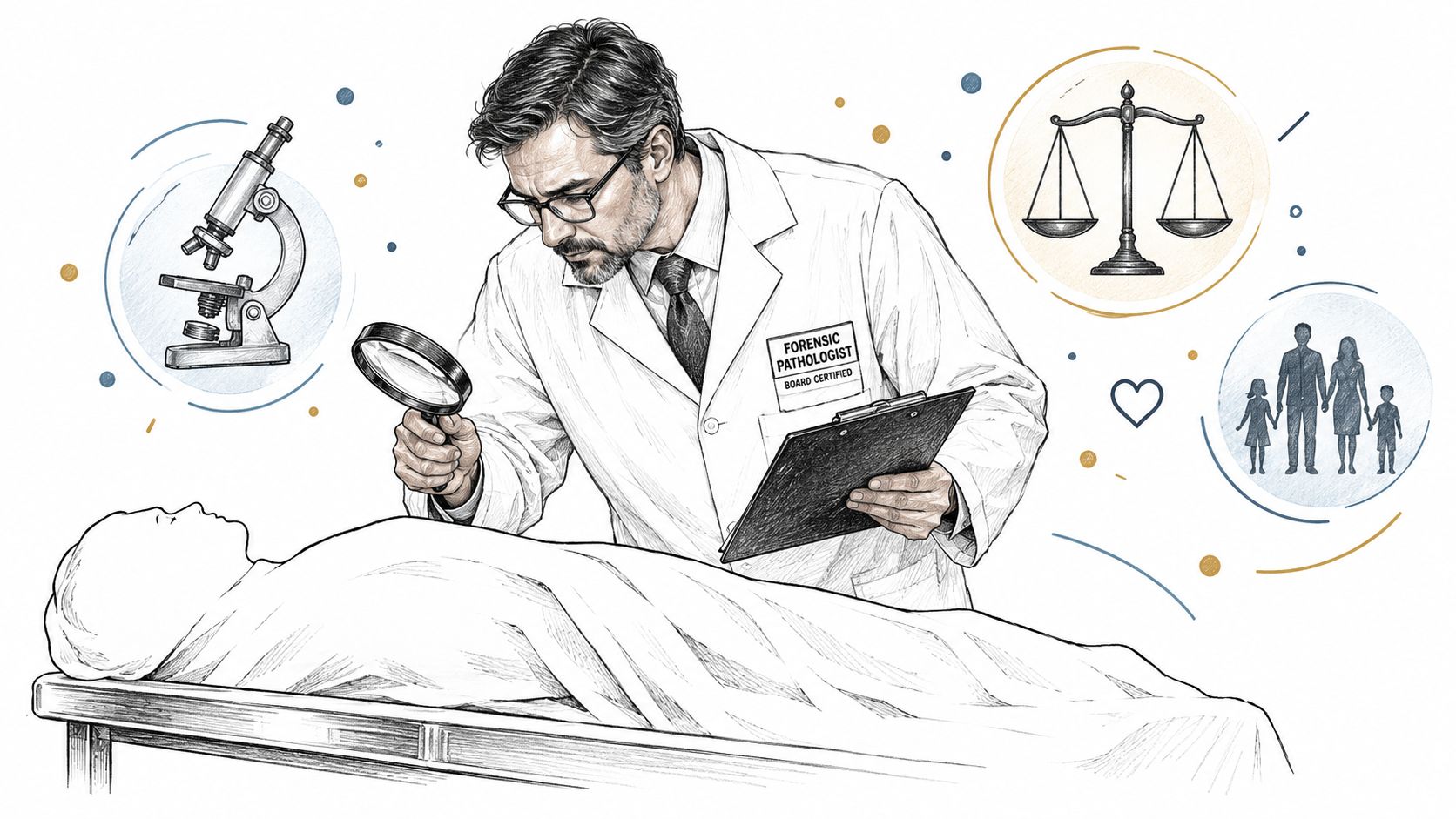
A brain autopsy is a meticulous investigation. It is often our last and best opportunity to find the truth when clinical tests and imaging couldn't provide a final answer. As a forensic pathologist, I have spent my career examining this incredibly complex organ, which often holds the definitive clues to understanding conditions like dementia, a sudden neurological decline, or the cause of an unexpected death.
My work is about providing families and their legal teams with the closure and clarity they need during a difficult time.
- A private brain autopsy provides an independent, objective cause of death determination.
- It is the only way to definitively confirm certain neurodegenerative diseases like Alzheimer's or CTE.
- The process is performed by a board-certified forensic pathologist.
- All examinations are confidential, respectful, and fully compliant with Texas law.
- Families receive a comprehensive report and a clear explanation of the findings.
Searching for Answers Inside the Brain
I often work with families who are left with agonizing questions after a loved one passes away, especially when neurological symptoms were never fully explained. At Texas Autopsy Services, my role is to deliver clear, science-based answers during these incredibly difficult times.

The brain is the body’s command center, and it frequently holds the key to understanding exactly what went wrong. While modern diagnostic tools like MRIs and CT scans are excellent, they have their limits. Think of them as high-level maps; they show major highways and landmarks but can’t reveal the subtle, microscopic changes happening on the backroads that define many neurological diseases.
Why a Direct Examination Is Necessary
An autopsy of the brain gives us a level of detail that is simply impossible to get any other way. It allows for a direct, hands-on, and cellular-level examination of the tissue itself. That’s why it remains the undisputed gold standard for confirming certain diagnoses.
A focused brain examination becomes critical in several key situations:
- Confirming Neurodegenerative Diseases: Conditions like Alzheimer's, Parkinson's, or Chronic Traumatic Encephalopathy (CTE) can only be 100% confirmed after death through direct tissue analysis.
- Investigating Sudden Neurological Events: When a stroke, aneurysm, or brain bleed is suspected, an autopsy can pinpoint the exact location and show the full extent of the damage.
- Uncovering Hidden Conditions: Sometimes, the real culprit is an undiagnosed tumor, a subtle infection, or an inflammatory condition that only becomes obvious when we can look at the brain directly.
As a board-certified forensic pathologist who has performed over 1,000 autopsies, I've seen firsthand how a careful brain examination can provide families with irrefutable facts and finally put an end to uncertainty.
My entire approach is built on a foundation of medical precision and genuine compassion. An independent evaluation ensures that the findings are completely objective, focused only on the evidence at hand. For families and attorneys here in Texas, this process is about one thing: finding the truth.
This guide will walk you through what a brain examination involves, step-by-step, helping you understand how it can provide the answers you’re searching for.
What a Brain Autopsy Can Uncover
When a person's death might be linked to a neurological issue, we often need to look directly at the brain to get the full story. As a forensic pathologist, I perform a specialized autopsy of the brain to pinpoint the exact cause, whether it's a well-known neurodegenerative disease like Alzheimer's or the subtle, cumulative damage from repeated head injuries.
Modern imaging like MRIs and CT scans are fantastic tools, giving us a window into the brain's structure. But they have their limits. They can't see what's happening at a microscopic, cellular level. For that, nothing beats a direct examination. It remains the gold standard for diagnosing many neurological conditions with absolute certainty.
Seeing Beyond the Scans
Many brain disorders leave behind tiny, microscopic clues—fingerprints that are completely invisible on a scan. We can only find them by preparing and studying the brain tissue itself under a microscope. This is a process called histopathology.
Here are a few examples of what we can only see this way:
- Chronic Traumatic Encephalopathy (CTE): This devastating condition, often linked to repetitive head trauma in athletes and veterans, can only be diagnosed after death. An autopsy is the only way to identify the unique patterns of protein deposits that define CTE.
- Hidden Tumors or Infections: Sometimes, small tumors or low-grade infections like meningitis or encephalitis don't show up clearly on scans. During an autopsy, they become obvious.
- Vascular Dementia and Strokes: We can uncover evidence of widespread small vessel disease or countless tiny strokes (microinfarcts). Individually, they're small, but together they can cause severe cognitive decline, a fact that might have been missed while the person was alive.
- Toxic or Metabolic Damage: If poisoning or a metabolic disorder is suspected, we can see specific patterns of cell damage in the brain tissue that confirm what happened.
The hard truth is that even with the best medical care, the ultimate cause of a person's decline isn't always clear. A direct brain examination is often the only way to finally connect the dots between their symptoms, medical history, and what was actually happening inside their head.
A brain autopsy is often recommended when families or legal teams need to understand the true nature of a neurological condition, especially when it might be linked to an injury, medical care, or environmental exposure.
When a Brain Autopsy is Recommended
| Clinical Scenario or Concern | What a Brain Autopsy Can Determine | Relevance for Families & Attorneys |
|---|---|---|
| Dementia or Cognitive Decline | Confirms Alzheimer's, Lewy Body Dementia, Vascular Dementia, or FTD. | Provides definitive closure for families and clarifies the medical history. |
| History of Head Trauma | Diagnoses Chronic Traumatic Encephalopathy (CTE) or other traumatic brain injuries. | Crucial for workers' compensation, personal injury, or veterans' disability claims. |
| Suspected Medical Error | Identifies undiagnosed strokes, infections, or effects of medication. | Provides objective evidence for potential medical malpractice litigation. |
| Sudden, Unexplained Death | Uncovers hidden causes like a brain aneurysm, encephalitis, or seizure disorder. | Answers the fundamental question of "why" for grieving loved ones. |
| Workplace or Toxin Exposure | Reveals specific patterns of brain damage linked to chemical or heavy metal poisoning. | Can establish a direct link for legal cases related to occupational safety. |
This examination provides a level of detail and certainty that simply isn't available through other means, turning questions and suspicions into concrete, factual answers.
The Importance of Getting it Right
Even with all our modern technology, a clinical diagnosis isn't always the final word. Despite incredible advances in CT, MRI, and intensive care, brain autopsies consistently find major diagnostic errors.
Large-scale reviews of general autopsy data have found that in 21–32% of cases, there are "major discrepancies" between the clinical diagnosis and what the autopsy actually finds. Think about that for a moment—the true cause of death was missed or misunderstood in roughly one out of every three to five patients. You can explore further research on these diagnostic gaps to see why this detailed look is so critical.
For families seeking answers or attorneys building a case, this process is absolutely fundamental. Whether dealing with potential medical malpractice, a workplace injury, or an accident involving head trauma, the autopsy provides the objective evidence needed to establish what really happened. It creates a direct, factual link between an event and the brain's condition, which is the cornerstone of achieving a just resolution.
A Step-by-Step Guide to the Brain Examination
When I walk families through the process of a brain autopsy, my goal is to demystify the science and show them the immense care and respect involved. It’s not just a procedure; it’s a meticulous investigation designed to find clear, evidence-based answers. Think of it as putting together a complex puzzle, piece by piece, to reveal the full picture of what was happening inside the brain.
Every step is deliberate, from securing legal consent to the final, detailed look under the microscope. My commitment is to scientific precision, ensuring families and legal professionals get the definitive answers they need.
The Initial Examination and Preservation
Before anything begins, we must have explicit legal authorization from the next-of-kin, a firm requirement under Texas law. Once that’s in place, I start with a careful external check of the head, noting any signs of trauma or other visible issues. Then, I respectfully remove the brain for what we call a gross examination.
This initial look gives us our first set of clues. Here’s what I do:
- Weigh the Brain: The brain's weight alone can point toward certain conditions, like shrinkage (atrophy) or swelling (edema).
- Document Surface Features: I thoroughly inspect the entire surface, searching for any visible evidence of a stroke, bleeding, tumors, or physical injury.
- Assess Blood Vessels: I carefully examine the arteries at the base of the brain for any hardening (atherosclerosis) or weak spots that could form an aneurysm.
After this hands-on assessment, the brain is placed in a formalin solution to "fix" it. This is a critical step where the naturally soft tissue is preserved and firmed up over several weeks. Without proper fixation, it would be impossible to slice the tissue thinly and accurately for a detailed analysis. The right environment is key, which is why we rely on specialized laboratory workstations and tables to handle this delicate work safely and precisely.
The fixation period is often the most misunderstood part of the process. It's not a delay; it's a necessary requirement for accuracy. Rushing this step would compromise the entire investigation and could lead to missed or incorrect findings.
This infographic gives you a simple visual of the journey from scan to final diagnosis.

As you can see, we move from a wide view down to a microscopic one. Each stage builds on the last, creating a complete and thorough picture.
Sectioning and Microscopic Analysis
Once the brain has firmed up, the deep analysis begins. I methodically slice, or "section," the brain in a standardized way. This allows me to see all the deep structures—like the hippocampus (crucial for memory), the brainstem (the control center for basic life functions), and the cerebellum (which handles coordination).
As I section the tissue, I’m hunting for abnormalities that weren't visible on the surface. These could be the hidden signs of old strokes, the tell-tale plaques and tangles of Alzheimer's disease, or the subtle changes associated with Parkinson's. I document everything with photos and detailed notes.
The final step is the most powerful. I take small, representative tissue samples from key areas of the brain. These tiny pieces are processed, embedded in wax, sliced thinner than a human hair, and placed on glass slides. After adding special stains that highlight different cell structures, I examine them under a microscope. This is histology, and it's where the definitive diagnosis is almost always found. To see how this fits into the broader picture, you can learn more about how an autopsy is performed.
Why an Independent Pathologist Is Essential
When investigating a cause of death, objectivity isn't just important—it's everything. For families or attorneys seeking concrete answers from a brain autopsy, the pathologist's independence is the only way to guarantee those answers are free from bias and based strictly on medical evidence.
When an autopsy happens inside the same hospital system where the person was treated, a potential conflict of interest is almost unavoidable, even if it's unintentional. Questions about the quality of care or the accuracy of a diagnosis can put institutional pressure on the process. As an independent, board-certified forensic pathologist, my only obligation is to the scientific truth I find during the examination.
The Value of Unbiased Expertise
At Texas Autopsy Services, my work is completely separate from any hospital or healthcare network. This independence is critical for families who have doubts about a clinical diagnosis or for attorneys who need impartial medical facts to build a solid case. An outside examination provides a fresh set of eyes on the evidence.
This is particularly true when a second opinion is needed. A family might feel the official cause of death just doesn't add up, given their loved one's health history. You can learn more about how we clarify these situations by requesting a second opinion autopsy.
My job isn't to point fingers or assign blame; it's to establish medical fact. By working independently, I can ensure that every conclusion in my final report comes from a careful, objective analysis of the tissue, without any outside influence.
This freedom from institutional ties builds a level of trust and accountability that’s often hard to find within a closed system.
A Necessary Resource in Today’s Healthcare Landscape
Decades ago, most hospitals routinely performed autopsies. That’s not the world we live in anymore. Hospital autopsy rates in the U.S. have plummeted from around 50% of all deaths in the 1950s and 60s to just 7–9% today.
Since a direct examination of tissue is the gold standard for determining cause of death, this decline means over 90% of deaths in many hospitals are certified without that definitive final step. This trend has significant implications for diagnostic accuracy, as you can discover more about this decline in autopsy rates.
This is precisely why independent private autopsy services have become so vital. We fill a major gap, giving families a path to get the clear, scientific answers the hospital system often no longer provides. When it comes to a brain autopsy, this independent verification is the only way to be certain the conclusion is truly unbiased.
How to Read Your Brain Autopsy Report
Receiving a brain autopsy report can feel overwhelming. The medical language is dense, the format is unfamiliar, and you're likely going through a difficult time. My job as a forensic pathologist doesn't stop once the examination is finished; I am here to help you, your family, and your legal team make sense of the findings.

Think of the final report as a detailed story of a complex investigation. It’s structured to build a complete picture, starting with broad observations and zeroing in on microscopic details. At Texas Autopsy Services, I make sure you’re never left alone to decipher this document during a time of grief.
Understanding the Key Sections
Every report I write is organized into distinct sections, with each part building on the one before it. While the exact layout might differ slightly, these are the core components you’ll almost always see.
Here's a quick tour of what to expect:
- Clinical Summary: This is the backstory. It’s a brief overview of the person’s medical history, the symptoms they had, and the circumstances leading up to their death. This context is absolutely vital for guiding my examination.
- Gross Findings: In pathology, "gross" just means what’s visible to the naked eye. This is where I'll describe the brain's overall appearance—its weight, size, and any obvious abnormalities like bleeding, tumors, signs of a stroke, or physical injury.
- Microscopic Findings (Histology): Here, we zoom in to the cellular level. This section details what I found when I examined thin slices of brain tissue under a microscope. It’s often in this part of the report that we can definitively diagnose conditions like Alzheimer's disease or Chronic Traumatic Encephalopathy (CTE).
My commitment is to deliver a report that is more than just a list of medical facts; it's a clear, understandable narrative. I am always available to walk you through it, line by line, and translate the clinical jargon into plain English.
Cause of Death and Manner of Death
Two of the most critical—and often confused—parts of any autopsy report are the cause of death and the manner of death. They have very specific, distinct meanings, and understanding the difference is key.
The Cause of Death is the specific disease or injury that directly resulted in the body shutting down. In a brain autopsy, this might be something like an "acute intracerebral hemorrhage" (a bleed inside the brain) or "complications of Alzheimer's disease." It is a strictly medical conclusion.
The Manner of Death, on the other hand, is the legal classification of how the cause of death came about. There are only five official categories:
- Natural: Caused solely by disease or the aging process.
- Accident: The result of an unintentional event.
- Suicide: A death caused by a deliberate, self-inflicted act.
- Homicide: A death caused by another person.
- Undetermined: When the evidence isn't strong enough to support one of the other four manners.
For instance, the cause of death could be a "subdural hematoma" (bleeding on the brain's surface). That same cause could have a manner of "accident" if it was from a fall, or "homicide" if it was from an assault. Untangling these two is a fundamental part of the investigation, and the brain often holds the evidence that makes the distinction clear. To learn more about the structure of these documents, take a look at our guide on how to read a pathology report.
Your Brain Autopsy Questions, Answered
Families and legal professionals often have pressing questions about how a brain autopsy works. It's completely normal to feel uncertain, and my job is to give you clear, straightforward answers so you can move forward with confidence. Let's walk through some of the most common concerns.
Will This Interfere With Our Funeral Plans?
This is usually one of the first things people ask, and it’s a perfectly valid concern. I want to assure you that every examination is conducted with the deepest respect for the person who has passed away.
All incisions are carefully placed and are not visible after the examination is complete. You can absolutely proceed with your planned funeral arrangements, including an open-casket viewing. We work closely with facilities like Waterloo Mortuary to ensure your loved one is treated with dignity every step of the way.
How Long Does It Take to Get the Results?
While the initial hands-on examination is over in a matter of hours, the real investigative work takes more time.
The brain tissue needs to "fix" in a formalin solution for at least two weeks before it's firm enough for a detailed study. This is a critical step we simply can't rush if we want accurate results. After that, preparing and analyzing the microscopic slides adds more time. I can often share preliminary thoughts much sooner, but a final, comprehensive report typically takes several weeks. That timeline ensures a truly thorough investigation.
Is Family Consent Always Required?
Yes, absolutely. For any private autopsy, Texas law requires legal authorization from the next-of-kin. We simply cannot begin without it.
We will walk you through all the required paperwork to make it as simple as possible. The only time this doesn't apply is in a forensic case ordered by a Justice of the Peace or Medical Examiner, such as a criminal investigation. For every private case I handle, your consent is the first and most critical step.
Your explicit permission is the foundation of the private autopsy process. It ensures that the examination is performed ethically and in full compliance with the Texas Health & Safety Code.
What's the Difference Between a Hospital and a Private Autopsy?
This is a really important distinction. A hospital autopsy is done by a pathologist who works for the hospital where the death occurred. They're often performed for internal quality control or teaching purposes.
A private autopsy, which is the service I provide, is arranged directly by you—the family or your legal counsel. The single biggest difference is independence. My investigation is entirely objective, focused solely on finding answers for you, with no potential conflict of interest from an institution. This impartiality is vital, especially when you need a second opinion autopsy or are gathering unbiased facts for a legal case.
My commitment is to provide clear, impartial, evidence-based answers.
If you have other questions, or if you feel an independent brain autopsy could bring you the clarity you're searching for, please don't hesitate to reach out. At Texas Autopsy Services, we're here to guide you with both clinical expertise and genuine compassion. Contact our office for a confidential consultation.