December 21, 2025 · Texas Autopsy Services
Understanding Synoptic Pathology Reports in Forensic Cases
Discover how synoptic pathology reports use a structured format to provide clear, objective results for families and legal teams in forensic cases.
On this page
- Why Clear Answers Matter After a Loss
- What Is a Synoptic Pathology Report
- A Look Inside the Sections of a Synoptic Report
- How a Well-Structured Report Can Make or Break a Medico-Legal Case
- The Future of Pathology Is Structured Data
- How to Request and Read Your Report
- Your Questions About Synoptic Reports Answered
When a family loses someone, their greatest need is for clear, unambiguous answers. As a forensic pathologist, my most important job is to provide those answers through a detailed autopsy report. This document is far more than a collection of medical findings—it’s a source of closure and a critical record for legal proceedings. That’s why I’ve built my practice on a modern, structured system to ensure every family and legal team gets the objective facts they deserve.
- Synoptic reports use a structured, checklist-style format to ensure every critical detail is documented consistently.
- This format increases accuracy and completeness compared to traditional narrative-style reports, reducing the risk of accidental omissions.
- The objective, data-driven nature of these reports makes them highly defensible in legal proceedings.
- Standardized data is crucial for second-opinion autopsies, allowing for direct, apples-to-apples comparisons.
- My process includes a follow-up consultation to review the report and ensure you understand every finding.
Why Clear Answers Matter After a Loss

During a time of immense grief, ambiguity is the last thing a family needs. For years, traditional autopsy reports were written in a narrative style. While well-intentioned, this format could sometimes leave room for interpretation or even accidental omissions. I believe my duty as a forensic pathologist is to eliminate that uncertainty and deliver objective, verifiable facts. This is exactly why I use synoptic pathology reports in my practice at Texas Autopsy Services.
Think of it as the difference between a descriptive paragraph and a detailed checklist. The paragraph might tell a story, but the checklist guarantees every single required point is addressed with a specific, recorded answer. This structured, checklist-style format is the foundation of a synoptic report.
The Power of a Structured Format
By using a standardized template, synoptic reporting ensures that every crucial detail is documented the same way, every time. This systematic approach is essential for several key reasons:
- Completeness: The format demands specific data points, making it nearly impossible to overlook critical information.
- Clarity: It presents findings as discrete facts, which is much easier for families, attorneys, and other doctors to understand.
- Consistency: The standardized structure allows for direct, apples-to-apples comparisons—invaluable for second-opinion autopsies.
- Objectivity: It strips away subjective language and focuses solely on empirical evidence, strengthening the report's credibility in legal situations.
A well-structured report provides the factual grounding families and legal professionals need during an incredibly difficult time. It transforms a complex medical examination into a clear, defensible record.
This method isn't just a preference; it represents a higher standard of care in pathology. The goal is a final document that is not only medically precise but also fundamentally useful and clear to those who rely on it for answers. Understanding the meticulous process behind a cause of death determination is a key part of appreciating why this structured approach is so important.
By presenting information in such an organized manner, the report becomes a powerful tool for truth and resolution.
What Is a Synoptic Pathology Report
A synoptic report is a highly organized checklist for a postmortem examination. It's the difference between a pilot telling a story about a flight and them meticulously working through the mandatory pre-flight checklist. The story is a narrative, full of detail but open to interpretation. The checklist, on the other hand, is structured, objective, and ensures nothing critical gets missed. That's exactly what a synoptic pathology report does for an autopsy.
Instead of writing long, descriptive paragraphs, I use standardized templates with required fields for every essential piece of information. This means entering specific organ weights, precise measurements, and definitive findings from the microscope. This structure turns complex medical information into clear, verifiable facts, which is incredibly helpful for families and attorneys.
A Higher Standard for Accuracy
This isn't just about making things look neat; it’s a recognized standard for quality control in pathology. This methodical approach leads to far more accurate and complete reports than the old narrative style. When every crucial data point has its own dedicated spot, the chance of accidentally leaving something out drops dramatically. This is absolutely vital when determining a clear cause of death or providing answers in a forensic investigation.
Major pathology organizations, like the College of American Pathologists (CAP), have championed this approach for years because it works. CAP began publishing templates in 1998 to standardize data collection for cancer cases, and research has consistently shown that this structured format leads to much better completion of key information.
The real power of a synoptic report lies in its objectivity. It forces the pathologist to document specific, required data, which strips away the potential for subjective language or vague descriptions that can weaken a medico-legal case.
Narrative Reports vs Synoptic Reports at a Glance
Understanding the difference between these two report styles is key to appreciating modern pathology. While a detailed pathology report definition covers many document types, the table below highlights the structural differences.
| Feature | Traditional Narrative Report | Synoptic Pathology Report |
|---|---|---|
| Structure | Free-form paragraphs | Standardized, template-based checklist |
| Consistency | Varies between pathologists | Uniform and consistent across all cases |
| Data | Often descriptive and estimated | Discrete, required, and measurable |
| Completeness | Risk of accidental omissions | Ensures all critical fields are addressed |
| Clarity | Requires interpretation | Factual and easily scanned for key data |
| Legal Use | Can contain subjective language | Objective data strengthens expert testimony |
At the end of the day, my goal at Texas Autopsy Services is to give families the clearest, most accurate answers possible. The synoptic format is one of the most important tools I have to make good on that promise, ensuring the final report is a source of truth and clarity.
A Look Inside the Sections of a Synoptic Report
When you first open a synoptic report, you'll notice it's not a story. It's a blueprint. Its power comes from this highly structured format, which makes every critical piece of information easy to find, understand, and use. Let’s walk through the key sections you'll typically find.
This diagram helps visualize the core idea behind a synoptic report: it’s built to be structured, objective, and complete.
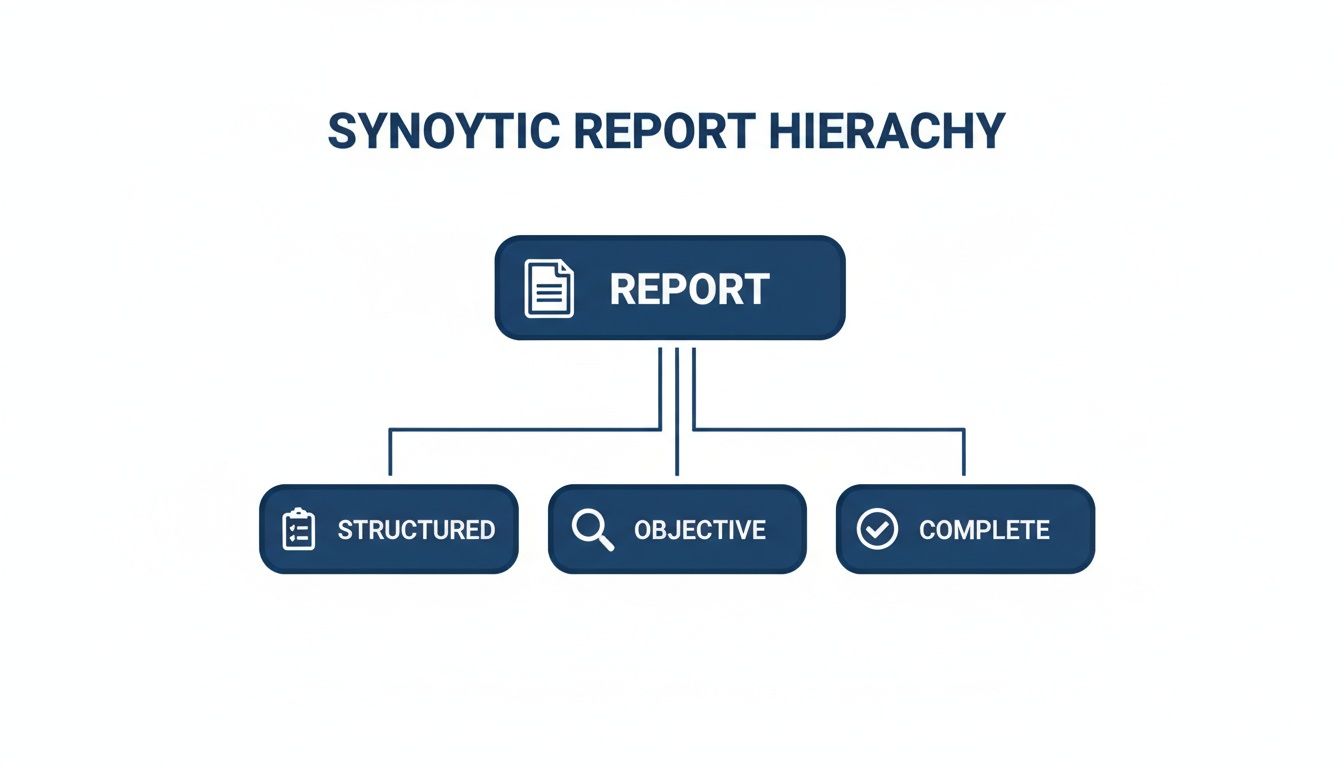
Each of these principles—structure, objectivity, and completeness—is reflected in the specific sections of the report itself.
Gross Description
This first part covers everything I can see with the naked eye. Instead of a long descriptive paragraph, a synoptic report uses clear, separate data fields for each observation.
- Organ Weights and Measurements: Every organ is weighed and measured, with the numbers entered into specific fields (e.g., Heart Weight: 350 grams). This gives us objective data we can easily compare against normal ranges.
- External Examination Findings: Details like body weight, height, and any visible injuries or identifying marks are logged in a consistent way.
- Internal Organ Systems: Here I note the appearance of internal organs, documenting any abnormalities like fluid, masses, or signs of disease. Each finding gets its own entry, keeping the record clean and organized.
Think of the gross description as the high-level map of the body's condition. It's the foundation we build on before zooming in to the cellular level.
Microscopic Findings
After the initial examination, small tissue samples are prepared and put under a microscope. This section is where the cellular-level evidence is recorded with the same structured precision.
This part of the report is all about translating complex microscopic views into straightforward data points. It’s where we confirm or rule out conditions that are completely invisible to the naked eye. For families and attorneys wanting a more detailed breakdown, our guide on how to read a pathology report can provide more context.
A huge advantage here is consistency. A general finding like "inflammation" would be broken down further into fields for its type (acute, chronic) and severity (mild, moderate, severe). This removes the guesswork and subjective language.
Final Pathologic Diagnosis
This is the bottom line. This section pulls together all the data from the gross and microscopic exams into a final, conclusive summary. In a synoptic format, this isn't just one sentence; it’s a series of required, distinct fields that answer the most important questions.
You can expect to see separate lines for each of these crucial components:
- Immediate Cause of Death: This is the final disease, injury, or event that directly resulted in death (e.g., "Pulmonary Thromboembolism").
- Underlying Cause of Death: This is the condition that started the chain of events leading to the immediate cause (e.g., "Deep Vein Thrombosis of the Lower Extremity").
- Contributing Factors: These are other significant conditions that played a role in the death but didn't directly cause it (e.g., "Obesity," "Coronary Artery Disease").
- Manner of Death: This is the legal classification of the death, determined from all the evidence. In Texas, the official options are Natural, Accident, Suicide, Homicide, or Undetermined.
This structured breakdown delivers an unambiguous conclusion. It lays out the final answers clearly, making the report defensible and easy for families, legal teams, and other doctors to review.
How a Well-Structured Report Can Make or Break a Medico-Legal Case
In forensic pathology, the structure of an autopsy report is just as critical as the medical findings it contains. When I’m called to give expert testimony, the clarity of my report is everything. This is where the synoptic format truly shines.
It creates a consistent and complete document that serves as the foundation for my testimony, reinforcing the integrity of the whole investigation. Because every key finding has its own required data field, there’s almost no chance of an accidental omission or ambiguous phrase that a sharp attorney could challenge in court. It turns a complex medical examination into a straightforward piece of evidence.
Creating a Record That Can Withstand Scrutiny
Standardization is the bedrock of a report that can hold up under intense legal pressure. This isn't just my personal preference; it's a principle that leading medical organizations have been championing for years. The Commission on Cancer (CoC), for example, has long pushed for synoptic reporting in cancer surgery because it creates complete and consistent records.
The core principle is the same for my postmortem work: structured data creates a more reliable, defensible record. This systematic approach produces a document that is inherently verifiable. Every conclusion I draw is directly supported by a specific data point listed clearly in the report. There are no gaps left for speculation.
The Advantage for Attorneys and Families
For an attorney building a case, a synoptic report is a game-changer. It lays out the facts in a clean, organized way that’s easy to pull from during a deposition or in front of a jury. You don’t have to sift through dense paragraphs to find a specific organ weight or a key microscopic finding—it’s all right there in its designated spot.
The structured format allows for a direct, apples-to-apples comparison between reports. This is especially crucial for families seeking a second-opinion autopsy to challenge a previous finding or clarify an uncertain cause of death.
When I perform a second-opinion autopsy, I can place my synoptic report right next to the original one and compare them line by line. This direct comparison makes any discrepancies immediately obvious, providing objective evidence instead of just a competing narrative.
- For Attorneys: The report delivers clear, citable facts that make legal arguments stronger and simplify how complex medical evidence is presented to a judge or jury.
- For Families: It offers clarity during a difficult and confusing time, helping them understand exactly how a conclusion was reached and giving them a solid foundation for any next steps.
A synoptic structure serves the pursuit of truth. It ensures that the final report from my work at Texas Autopsy Services isn't just a medical opinion, but a robust, factual document that provides clear answers and stands up to the demands of the legal system.
The Future of Pathology Is Structured Data
Synoptic reports aren't just a better way to organize information; they're the building blocks for the future of medicine. The structured data inside these reports isn’t meant to be trapped in a static PDF. It’s designed to be read, shared, and understood by computer systems, flowing seamlessly into electronic health records and research databases.
This is where the real power of this approach comes into focus. When data is standardized, it becomes computable. Different computer systems can talk to each other and actually understand the information being shared, all without a human having to step in and translate.
Building a Foundation with Technical Standards
For computers to communicate, they need a common language. In healthcare, technical standards provide that universal language. Two of the most important for pathology are:
- SNOMED CT (Systematized Nomenclature of Medicine – Clinical Terms): This is basically a massive, meticulously organized medical dictionary. It gives every clinical term a unique code, ensuring everyone means the same thing when they use a term.
- FHIR (Fast Healthcare Interoperability Resources): Think of FHIR (pronounced "fire") as the set of rules for shipping that medical data back and forth. It defines how structured information can be packaged and exchanged between different computer systems securely and efficiently.
When these two work together, the individual data points from a synoptic report can be pulled out, understood, and used by countless other platforms.
The principle is pretty simple: standardized data leads to more reliable information for everyone. It turns an individual report into a single, crucial piece of a much larger, interconnected puzzle.
This isn't just a theory. Researchers have already proven that SNOMED CT has the right terms to handle complex cancer reporting and that FHIR is perfectly capable of encoding and sharing that information. This work confirms that synoptic reporting is the practical foundation for everything from automated medical registries to AI-driven tools. You can dive into the nitty-gritty of this research on data exchange and interoperability.
How a Single Report Contributes to the Greater Good
For families coping with a loss, I know all this talk about data standards can feel distant and abstract. But it has a very real, very human impact. When the findings from a loved one's autopsy are captured in a structured synoptic format, they become part of something much bigger.
Imagine thousands of these reports being brought together. Researchers can suddenly see the forest for the trees—spotting disease trends, understanding how illnesses progress, and even paving the way for new treatments. For instance, if autopsies across Texas consistently report a specific type of heart defect using the same standardized data, public health officials can spot a regional problem early on.
The meticulous work that goes into one examination, done to give a family answers, doesn't end there. It becomes a permanent, valuable contribution to medical science. This ensures the report’s value continues long after the case is closed, honoring the individual by helping advance knowledge for the entire community. To me, that’s a critical part of my ethical responsibility as a board-certified forensic pathologist.
How to Request and Read Your Report

Dealing with the autopsy process is a heavy burden, especially when you're also navigating personal loss. My aim is to lift some of that weight by making things as clear and straightforward as possible. Here, I'll walk you through how to request a report from my office and what to expect when you receive it.
The first step is simply getting in touch. Whether you're considering a private autopsy or need a second opinion, a call to my office starts the process. We’ll guide you through the necessary authorizations, making sure every step is handled correctly according to Texas Health & Safety Code regulations.
After the examination, the timeline for the final report can differ from case to case. Factors like the case's complexity or the need for specialized tests, such as toxicology, play a big role. I’m committed to delivering a report that is both thorough and accurate, and my team will keep you updated along the way.
Understanding the Document You Receive
When the synoptic report arrives, you'll notice its structured, checklist-like format. It’s built for clarity. While it is a technical medical document, I want to give you the confidence to understand its most important findings. My job isn't just to perform the examination—it's to make sure you understand what it all means.
I always tell families to start with one specific section.
Begin with the ‘Final Pathologic Diagnosis’ section. This is the bottom line, the conclusion of the entire examination. It provides the most critical information, like the cause of death, in a direct, easy-to-follow format.
Once you’ve reviewed that, you can explore the more detailed parts of the report, like the Gross Description and Microscopic Findings. These sections contain the specific evidence and data that led to the final diagnosis. Don’t worry if you run into medical terms you don't recognize; that's completely normal.
Preparing for Our Follow-Up Discussion
A key part of my service is our follow-up consultation, where we sit down and go through the report together. To get the most out of our conversation, a little preparation can make a world of difference.
- Read the Report: Spend some time looking over the document before we meet.
- Highlight Unfamiliar Terms: Circle or jot down any words or phrases that aren't clear. We can go through them one by one.
- Prepare a List of Questions: Write down anything you're wondering about, no matter how small it seems. There are no bad questions when you're looking for answers.
This preparation helps us make sure our discussion covers everything on your mind. My commitment is to give you more than just a document; it's to provide clear, definitive answers. Whether you need an initial private autopsy or are seeking a second opinion to find closure, I'm here to offer objective, expert analysis.
Your Questions About Synoptic Reports Answered
When you're dealing with the loss of a loved one, the last thing you need is a confusing medical document. My goal here is to answer some of the most common questions I hear from families and attorneys about synoptic pathology reports, so you know exactly what to expect.
Is a Synoptic Report Usable in Court?
Yes, absolutely. In my experience as a board-certified forensic pathologist, legal teams often prefer the synoptic format. Its structured, checklist-style layout removes the guesswork and ambiguity that can creep into narrative reports.
Everything is presented in a clear, field-by-field format. This creates a powerful piece of evidence that’s easy to reference during testimony. When I'm on the stand, I can point directly to a specific data point in the report that backs up every conclusion. This direct link between data and conclusion makes the findings incredibly difficult to challenge under cross-examination.
Why Does This Report Look So Different From a Typical Doctor's Note?
That’s a great question. A synoptic report is built for precision, not for storytelling. Think of it less like a story and more like a detailed, factual ledger. It uses a specific template to make sure every critical piece of information is recorded the same way, every single time.
While it might seem a bit clinical compared to a traditional medical summary, that structured format is precisely what makes it so reliable and accurate. It’s a feature, not a bug, especially when the details matter in a medico-legal case.
Can We Get a Plain-English Summary Along With the Technical Data?
Of course. While the synoptic data forms the backbone of the report, I always include a summary that explains the final diagnosis in clear, understandable language. I feel it’s my duty to provide both the hard data and a clear explanation of what it all means.
The synoptic portion gives us the objective, verifiable evidence. The summary gives us the context. This two-part approach makes sure the report holds up under intense legal scrutiny while still being accessible to the family.
The whole point of any report I write is to bring clarity. Combining the detailed synoptic format with a clear summary helps everyone involved, from grieving family members to courtroom attorneys, understand the findings.
What if I Don't Understand Something in the Report?
Just ask me. A follow-up consultation to go over the report with you and your attorney is a standard part of my service. My job isn't just to hand you a document; it's to make sure you understand it.
I always encourage families to read through the report and circle or list anything that seems unclear. That way, when we meet, we can go through your questions one by one. There are no silly questions when you’re seeking answers after a loss. My work isn’t done until you have the clear, factual information you came for.
If you have more questions or need to arrange for an independent autopsy, my team at Texas Autopsy Services is here to help. Please contact us for guidance and expert analysis.