February 16, 2026 · Texas Autopsy Services
What Does Deferred Mean on a Death Certificate
Learn what does deferred mean on a death certificate from a forensic pathologist. Understand why a cause of death is pending and what it means for families.

On this page
When a loved one passes away, the last thing a family expects to see on their death certificate is an unfamiliar word, especially one that sounds as uncertain as "deferred." From my experience as a forensic pathologist, I've seen how jarring this can be. It often leads to confusion and worry during an already difficult time.
Let me be clear: seeing "deferred" is not a sign of a problem. It is a standard and necessary part of a careful, thorough investigation. It simply means the medical examiner requires more time and information before they can state the exact cause of death with scientific certainty.
What "Deferred" on a Death Certificate Really Means

A deferred death certificate is essentially a "pause," not a full stop. My highest priority as a forensic pathologist is to provide accurate answers, and that often means waiting for specialized laboratory tests to return. Rushing to a conclusion doesn't help anyone and can lead to serious errors.
This "deferred" status is designed to help families. It allows for the issuance of an initial death certificate so funeral homes and cemeteries can move forward with arrangements.
A deferred certificate allows families to proceed with funeral and burial services while the detailed cause-of-death investigation continues.
When a medical examiner or coroner lists the cause of death as "deferred," they are signaling that a final determination cannot be made with the information currently available. This isn't a sign of a mistake; it’s a reflection of the high standards we maintain in forensic pathology. Accuracy must always come before speed.
Common Reasons for a Deferred Status
Deferring a cause of death is a commitment to accuracy. It ensures every piece of evidence is examined before a final conclusion is documented.
Here are the most common reasons I might use this status in my work at Texas Autopsy Services:
- Waiting on Toxicology: These tests check for drugs, alcohol, or other substances that might have contributed to the death. They are precise but require time.
- Histology is Needed: This involves examining tissue samples under a microscope. It’s the only way to identify certain diseases or subtle injuries not visible during the initial exam.
- More Information Required: Sometimes, I need to gather more context from medical records, police reports, or family interviews to assemble a complete picture of what happened.
This intentional pause ensures a complete and accurate investigation without delaying a family's ability to plan services. For more details on what's included in the final document, you can learn about the cause of death certificate in our related article.
Understanding a Deferred Death Certificate at a Glance
Navigating this process can be overwhelming. This table breaks down the key takeaways for families and legal professionals who encounter a deferred death certificate.
| What 'Deferred' Means | What It Does Not Mean | What Families Can Do |
|---|---|---|
| The cause of death is still under investigation. | That something is wrong or suspicious. | Proceed with funeral and burial plans. |
| More tests (like toxicology) are needed for accuracy. | That the investigation has stopped. | Gather any relevant medical records. |
| It’s a temporary status. | A final determination will not be made. | Stay in touch with the medical examiner's office for updates. |
In short, "deferred" is a procedural step that prioritizes accuracy. While the wait can be difficult, it’s a necessary part of ensuring the final answer is correct.
Why Accuracy Matters More Than Speed
In my work as a forensic pathologist, one principle stands above all others: getting the cause of death right. A rushed conclusion can lead to significant errors, and those errors have lasting consequences for families and sometimes for public health.
When I mark a death certificate as "deferred," it's not a sign of a delay. It's a commitment to diligence. It tells everyone involved that the investigation is being handled with the care it deserves. My duty is to provide an unbiased, evidence-based conclusion, and sometimes, that takes time.
The Consequences of an Inaccurate Death Certificate
An incorrect cause of death is not a simple clerical error. It can alter a family's understanding of their loved one's health history and create issues that affect community health and safety.
This is why a methodical approach is so critical. The final death certificate is a permanent legal document used for important matters:
- Life Insurance Claims: A precise cause of death is often required to process benefits for beneficiaries.
- Legal Proceedings: In cases involving potential negligence or liability, the accuracy of the cause of death is paramount.
- Public Health Data: Researchers and officials rely on this information to track disease trends and allocate resources.
- Family Medical History: Knowing the true cause of death can be a critical warning for surviving family members about potential genetic risks.
A "deferred" status is an active choice to protect the integrity of the medical record. It's about prioritizing accuracy over speed because, ultimately, it protects a family's right to know the truth.
It's unsettling, but research shows that errors on death certificates occur with concerning frequency. These documents are the authoritative source for state and national mortality statistics, the very data used to set public health goals. The stakes couldn't be higher.
My Commitment as a Forensic Pathologist
As a board-certified forensic pathologist, I’ve performed over 1,000 autopsies. I have seen how a meticulous investigation can bring clarity to the most complex situations. Every step, from toxicology screens to microscopic tissue examination, adds a necessary layer to the final determination.
This process ensures that when an amended certificate is issued, it reflects the most accurate conclusion possible, backed by all available evidence. A core part of this is the careful distinction between the manner and cause of death, which is fundamental to forensic pathology.
I understand that the wait can be incredibly difficult for families. It is an essential part of a process designed to provide definitive, trustworthy answers.
Common Reasons a Cause of Death Is Deferred
When I meet with a family, explaining why we can't provide an immediate answer is challenging. That uncertainty is agonizing. What I try to convey is that this waiting period is a time for careful, methodical work happening behind the scenes.
A deferred finding isn't an indefinite pause. It's a sign that I am taking the dedicated time needed for detailed tests that cannot be performed during the initial examination. Each test is designed to find a specific piece of the puzzle, making sure our final conclusion is built on a solid foundation of scientific proof.
Pending Laboratory Analysis
The most common reason for deferring a cause of death is the need for specialized lab work. The initial autopsy provides a "big picture" view. Often, the real answers are at the microscopic or chemical level.
These critical tests usually fall into two main categories:
- Toxicology: This is a deep analysis of what substances were in the body. It’s not just about illegal drugs; we're looking for everything from prescription medications to alcohol and other chemicals. A toxicology report tells us if a substance was present and whether the amount was normal, harmful, or fatal.
- Histology: This is the study of tissue samples under a powerful microscope. It allows me to spot things like a silent heart attack, early-stage cancer, or signs of an infection that were not otherwise visible. It’s a detailed look that reveals clues hidden from the naked eye.
A deferred status is a clear signal that the investigation is moving forward with precision. It means we are actively pursuing every available scientific pathway to provide a definitive and accurate answer.
Waiting for these results is almost always the longest part of the process, but it’s non-negotiable for getting the cause of death right.
Gathering Additional Information
Sometimes, lab results alone don't tell the whole story. A thorough investigation often requires more context about the person's life and health. An autopsy gives us the medical facts, but to understand them fully, we need to place them within a personal history.
This means we might need to formally request and review medical records from doctors and hospitals. These documents can be crucial, providing a timeline of past diagnoses and treatments. In other cases, we may need to review law enforcement reports or talk with family members to better understand the circumstances surrounding the death.
This comprehensive approach ensures we leave no stone unturned. Every piece of information helps us assemble the complete picture.
The table below breaks down the most common tests that lead to a deferred status and why they take time.
Key Tests in a Deferred Death Investigation
| Test Type | Purpose of the Test | Typical Timeframe |
|---|---|---|
| Toxicology | To screen for medications, alcohol, drugs, or other substances that may have caused or contributed to death. | 4 to 8 weeks, sometimes longer |
| Histology | To examine tissue samples under a microscope for signs of disease, infection, or microscopic injury. | 2 to 4 weeks |
| Medical Record Review | To gather a comprehensive health history and understand pre-existing conditions and treatments. | Varies depending on provider response |
I know the wait can be frustrating. These steps are the essential building blocks for determining a cause of death that is sound and accurate.
What to Expect While You Wait
One of the first questions families ask me is, "How long will this take?" It's a completely understandable question, and I believe in being upfront about what you can expect during this difficult period.
The wait can be anywhere from a few weeks to several months. That range is tied directly to the complexity of the case and the turnaround times at various labs. If extensive testing is needed, or if forensic labs are backlogged, it naturally extends the timeline.
Understanding the Timeline
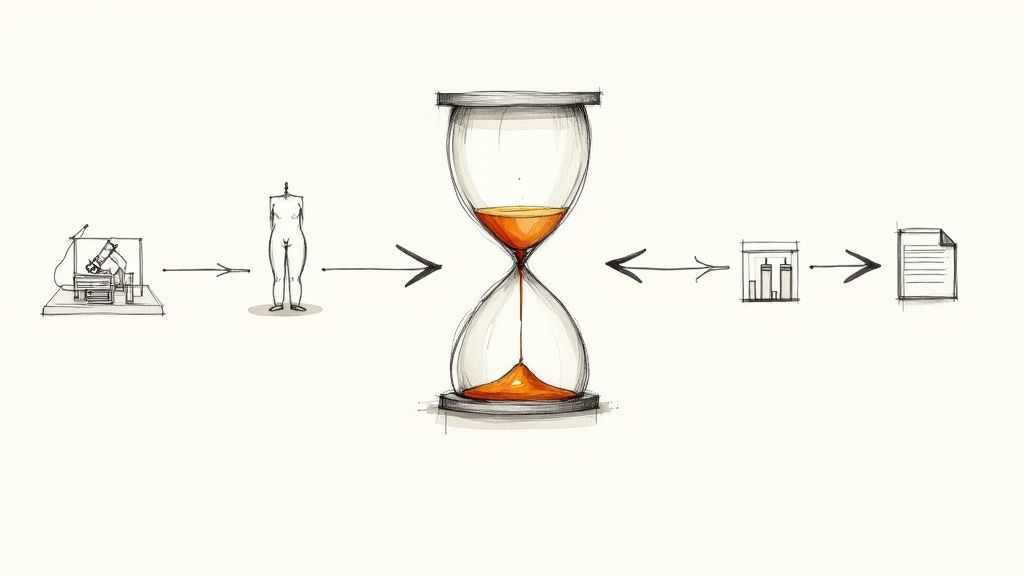
Every situation is different, but the process usually follows a logical sequence. Each test builds on the last to reach a scientifically sound conclusion. This visual gives you a good idea of the typical steps and why they're necessary.

As you can see, it’s a methodical process. Each step provides a crucial piece of the puzzle, and that detailed work can't be rushed.
When we're dealing with a complex autopsy, things can take longer. Almost always, the biggest delays are waiting for toxicology reports and the microscopic tissue analysis (histology). These tests are critical for accuracy.
Different states have their own legal deadlines for finalizing death certificates. This can create a conflict between meeting a legal requirement and the time it takes to conduct a thorough investigation. The "deferred" status is the solution, it provides the necessary time to get the answers right.
Communication and Getting the Final Document
Once all tests are back and the investigation is complete, the medical examiner’s or coroner’s office will file an amended death certificate. This new document officially replaces the one marked "deferred" and will state the final cause and manner of death. At that point, you or your attorney can get certified copies.
While you're waiting, it is perfectly acceptable for you or your attorney to check in with the medical examiner's office for a status update. My advice is to approach these calls with patience. The staff are working hard to be meticulous, and a respectful conversation will always be more productive. If you'd like to know more about the final reports, our guide explains how long a pathology report takes.
My commitment is to give families answers that are correct, not just timely. The waiting period is tough, I know, but it's a necessary part of ensuring the final report is accurate and complete.
Your Options for Gaining More Clarity
Even after the medical examiner issues an updated death certificate, I know families can still have questions. Sometimes the final cause of death doesn't align with what you knew about your loved one’s health. Other times, you simply need a clearer explanation of the medical findings.
If you find yourself in this situation, you are not stuck. You have options for finding certainty. I founded my private practice, Texas Autopsy Services, to give families in Texas a path to those answers when they need them most.
The Role of an Independent Autopsy
A private autopsy provides a fresh, unbiased look at the medical evidence. It’s less a challenge to the work of the medical examiner and more a way to get a second set of expert eyes on the case. The goal is to either confirm the official findings or explore other possibilities, giving your family the complete story.
A second look can accomplish a few key things:
- Confirmation: It can verify the original cause of death, which often brings a sense of reassurance.
- Clarification: It might uncover new details or contributing factors that weren't initially obvious.
- Correction: In some cases, an independent autopsy may lead to a different conclusion, which can be critical for legal or personal reasons.
My role in a private autopsy is to be an objective, independent expert. As a board-certified forensic pathologist, my only commitment is to provide medically sound, unbiased answers based strictly on the evidence.
An independent examination is a family's right. Its purpose is to provide certainty and answer lingering questions so you can move forward with confidence in the facts.
This process is always handled with complete discretion and respect for your loved one. Every step, from transportation to the final report, is managed according to Texas law and with the dignity your family deserves.
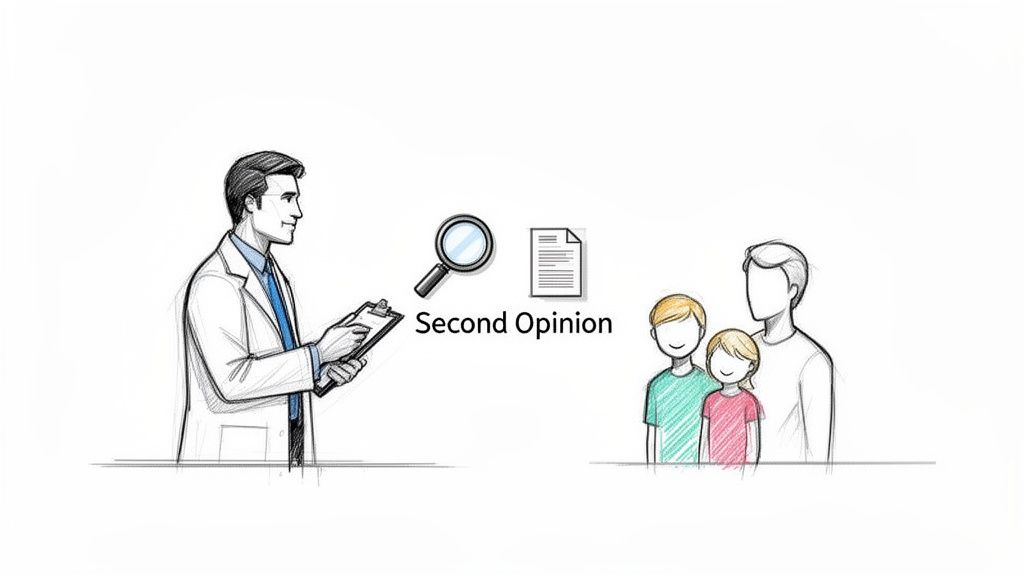
Second Opinion and Record Reviews
Sometimes, a full second autopsy isn't practical or necessary. In these situations, a detailed review of the existing records can be a powerful tool. This is a service I frequently provide for families and attorneys across Texas.
A second-opinion review means I conduct a thorough analysis of all case documents, which might include:
- The original autopsy report
- Toxicology and histology (tissue slide) results
- Photographs from the examination
- Investigative notes
- Complete medical records
This review lets me evaluate the initial investigation, explain complex medical terms in plain language, and offer my professional opinion on the official cause of death. Often, relief comes just from having another expert walk you through what the findings actually mean.
Whether it’s a full Private Autopsy or a detailed records review, the goal is always the same: to empower your family with the clear, definitive information you deserve.
A Pathologist’s Final Thoughts on Deferred Findings
Losing someone is one of the hardest experiences in life, and waiting for answers only makes a difficult time feel heavier. When you see the word "deferred" on a death certificate, it’s easy to feel alarmed, but I hope this guide has shown it’s a sign of a careful investigation. It is our commitment to getting it right.
My colleagues and I understand that the wait is tough. That time is spent ensuring we have every piece of the puzzle, so the final answer we provide your family is the correct one. That diligence is what makes the final death certificate a reliable, accurate record and brings clarity to a confusing time.
A deferred death certificate isn't a dead end—it's a pause. It means the investigation is ongoing to make sure the final cause of death is based on solid scientific evidence, not guesswork.
This step-by-step process is the bedrock of forensic pathology. Our goal is to give your family certainty and a clear understanding of what happened.
If you still have questions or feel you need another perspective on a cause of death, please know that you have options. An independent forensic pathologist can provide support and help you find the clarity you deserve. My team at Texas Autopsy Services is here to help you find those answers with compassion and precision.
Frequently Asked Questions
When a death certificate is marked "deferred," it brings up many questions for families and their attorneys. Here are straightforward answers to common concerns.
Can We Still Have a Funeral if the Death Certificate Is Deferred?
Yes, absolutely. A deferred death certificate won't stop you from planning a funeral, burial, or cremation.
This is by design. The funeral home receives the preliminary documents needed to proceed, allowing you to honor your loved one without extra delays while the medical examiner's investigation concludes.
How Do We Get the Final Death Certificate?
Once the medical examiner or coroner has a definitive cause of death, they will file an amended death certificate with the vital records office.
The funeral home that assisted with arrangements can usually obtain certified copies for you. You can also request them directly from the appropriate Texas state or county agency. For more generalized inquiries about official documents or administrative processes, you might find answers in these general FAQs.
The most important thing to remember is that the "deferred" status is temporary. A final, amended certificate will be issued as soon as all tests and reviews are finished, giving you a conclusive cause of death.
What if We Don't Agree With the Final Cause of Death?
If the official cause of death doesn't align with what you know about your loved one's health, you have options. Many families choose to get a second opinion.
This usually involves a private autopsy or having an independent forensic pathologist review the existing medical records and reports. An independent review can confirm the original findings or uncover new information, giving you the clarity and closure you deserve.
Does a "Deferred" Status Mean the Death Was Suspicious?
Not necessarily. While a deferral is common in cases involving a police investigation, it's also used in many situations that aren't suspicious at all.
For instance, if someone had a complicated medical history, a deferred status gives the medical examiner time to determine which condition was the primary cause of death. It simply means a careful investigation is underway to get the most accurate answer possible.
If you have more questions or feel a second opinion could bring your family clarity and peace of mind, the team at Texas Autopsy Services is here to help. Please reach out to our office to talk about your specific situation.