December 22, 2025 · Texas Autopsy Services
What Families Should Know About Private Autopsy Services in Texas
What is an autopsy? As a forensic pathologist, I explain its purpose, the step-by-step process, and how it provides clear answers for families and legal cases.
On this page
As a forensic pathologist in Texas, I’ve often sat with families who are trying to make sense of a profound loss. In these moments of grief, a central question arises: "What exactly is an autopsy?" My role is to provide a clear answer. An autopsy is a detailed medical examination performed after death to establish the cause and manner of death with certainty. It is the final chapter in a person’s medical story, a careful and methodical process designed to uncover objective truth with the deepest respect for your loved one.
- A private autopsy provides an independent, objective cause-of-death investigation when a hospital or county does not perform one.
- The process involves a thorough external and internal examination, along with specialized lab tests, all performed by a board-certified forensic pathologist.
- Families receive a comprehensive, confidential report that can provide medical closure, identify hereditary conditions, or support legal matters.
- All procedures are conducted with respect for the deceased and are fully compliant with the Texas Health & Safety Code.
A Clear Look at the Autopsy
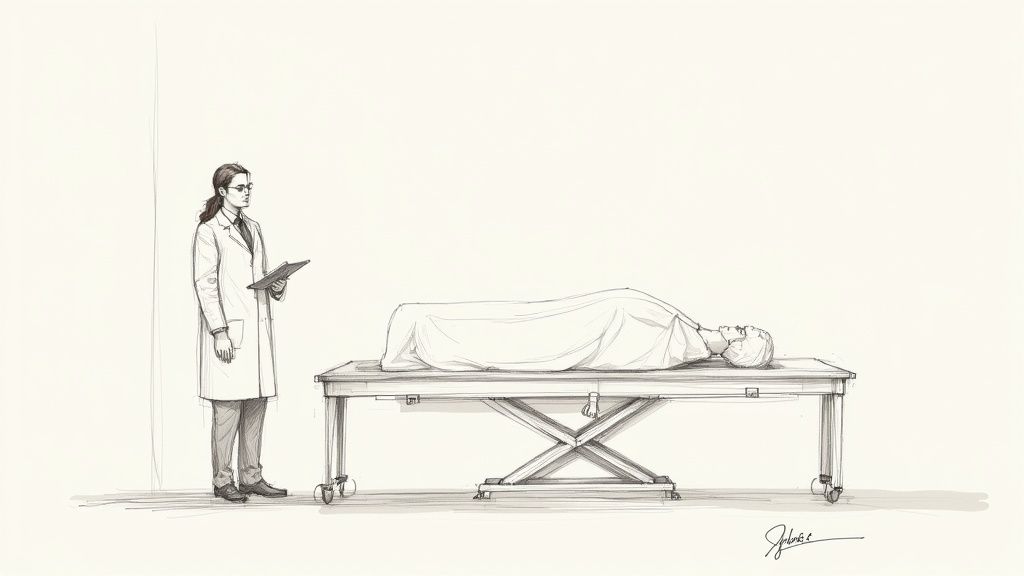
When most people hear the word "autopsy," their minds often go to crime television. While that is one aspect of my work, the reality is much broader. An autopsy is a powerful tool for understanding disease, injury, and the precise circumstances of a person's final moments. My job is to use this examination to provide objective facts. Sometimes, that means confirming a long-suspected illness, which brings a measure of peace to a grieving family. Other times, it might reveal an undiagnosed genetic condition that could affect other family members or provide crucial evidence for a legal case.
The findings from an autopsy can offer closure, protect public health, and ensure that justice is served. Not all autopsies are the same. They generally fall into two main categories, each serving a very different need.
Forensic vs. Clinical Autopsies
The primary difference between the two is the reason the examination is being performed.
A forensic autopsy is a medico-legal investigation. It's usually required by law when a death is sudden, violent, suspicious, or unexpected. These are performed by medical examiners on behalf of the state to answer legal questions. You can learn more in our detailed guide on what a forensic autopsy is.
A clinical autopsy, on the other hand, is requested by the family or a doctor for medical reasons. This includes the private autopsy services my team and I perform at Texas Autopsy Services. Families often turn to us to understand the true extent of a loved one's illness, get answers when a hospital autopsy isn't an option, or address concerns about the medical care they received.
To make this distinction clearer, here’s a quick comparison.
The Two Primary Types of Autopsies
This table breaks down the two main categories of autopsies to help you quickly understand their purpose and context.
| Feature | Forensic Autopsy (Medico-Legal) | Clinical Autopsy (Hospital or Private) |
|---|---|---|
| Purpose | To investigate deaths for legal reasons (e.g., crime, public safety). | To understand disease, confirm diagnoses, or address family questions. |
| Who Authorizes It | The state (Medical Examiner or Coroner). Family consent is not required. | The next of kin or legal representative. Consent is mandatory. |
| Who It Serves | The legal system and the public. | The family and their medical providers. |
| Common Scenarios | Homicides, suicides, accidents, unexpected deaths in healthy individuals. | Deaths from known diseases, concerns about misdiagnosis, understanding genetic conditions. |
In every case I handle, whether it's a private or county forensic autopsy, the core principle is the same. I provide an unbiased, medically sound determination of the cause and manner of death. The process is meticulous, grounded in science, and guided by ethical standards.
The autopsy has always been the gold standard for determining cause of death, but its frequency has changed dramatically. In the mid-20th century, hospitals performed autopsies in nearly 50% of all deaths. Fast forward to 2020, and that rate plummeted to just 7.4% in the United States. This sharp decline is one of the main reasons why independent, private autopsy services Texas families can rely on have become so vital for those who need and deserve answers.
The Critical Reasons an Autopsy Is Performed
In my years of experience as a board-certified forensic pathologist, having performed over 1,000 autopsies, I've learned that the decision to request an autopsy boils down to one fundamental need: answers. The unknown can be a heavy burden during a time of grief, and a postmortem examination is a powerful way to replace uncertainty with objective, medical facts. My job is to provide that clarity, whether it's for a family's peace of mind, a legal case, or the well-being of future generations.
The reasons for seeking an independent autopsy are always deeply personal. For some, it’s about finding a sense of closure after a sudden loss. For others, it's about making sure justice is served.
Providing Closure and Medical Insight for Families
A family's grief is often tangled with unanswered questions. Not knowing why a loved one died can make it incredibly difficult to process the loss. An independent autopsy can cut through that confusion. One of the main reasons families come to me is to simply confirm the cause of death. Was it a silent heart condition? An undiagnosed illness? Getting a definitive answer can bring a much-needed sense of finality.
An autopsy is not just about understanding why a life ended; it’s also about protecting the lives that continue. My findings can provide critical health information for surviving family members.
Sometimes, a family has lingering doubts about the medical care a loved one received or suspects a misdiagnosis. An independent examination provides an unbiased, third-party review of the person's health, which can either confirm the known medical history or bring new information to light. Perhaps most importantly, an autopsy can reveal hereditary conditions no one knew about. For example, identifying a genetic heart defect can be a life-saving discovery, prompting living relatives to get screened. This is a profound and lasting benefit that extends far beyond a single examination.
Establishing Facts for Legal and Insurance Matters
For attorneys, autopsy findings aren't just answers, they're evidence. Objective medical facts are the bedrock of any legal strategy in cases involving wrongful death, medical malpractice, or disputed insurance claims. The final report I produce is a detailed, factual document designed to stand up to intense scrutiny in a legal setting. It’s an unbiased account of my findings, which can be the deciding factor in determining liability or causation in court.
An autopsy can also clarify the exact sequence of events surrounding an accident. For example, did a driver have a heart attack before a crash, or did the injuries from the collision cause their death? The difference has huge legal and insurance implications. The report from an independent forensic pathologist ensures that these critical decisions are based on sound medical science, not speculation.
Serving the Greater Good of Public Health
Beyond helping individual families and legal teams, autopsies play a quiet but crucial role in protecting the entire community. They often serve as the first line of defense in identifying emerging public health threats. Consider these scenarios:
- Disease Outbreaks: An autopsy might be the first to identify an infectious disease, giving public health officials a critical head start on containing a potential outbreak.
- Environmental Hazards: A strange pattern of deaths in a specific area could be the first sign of environmental toxins or workplace dangers that would otherwise go unnoticed.
- Product Safety: Examinations can uncover deaths caused by faulty medical devices or undiscovered side effects of medications, triggering recalls that improve safety for everyone.
Every single autopsy contributes to our collective medical knowledge, deepening our understanding of disease and injury. Whether the purpose is personal, legal, or public, the goal is always the same: to deliver the truth with precision, care, and integrity.
A Step-by-Step Guide to the Autopsy Process
For many families and even legal professionals, the thought of an autopsy can be intimidating. Part of my job is to demystify the process. I want to walk you through the careful, methodical steps I follow in every examination to reduce any uncertainty and show you how we find clear, objective answers. An autopsy is a systematic investigation, a structured search for the truth that follows established medical protocols. Throughout the entire process, I maintain meticulous documentation and a strict chain of custody to ensure the absolute integrity of the findings.
Authorization and Document Review
Before any physical examination can begin, we start with paperwork and analysis. This foundational stage is critical. It involves two key components: getting legal consent and digging into all available records. We cannot proceed without explicit, verified authorization from the legal next-of-kin, a requirement under the Texas Health & Safety Code.
Once consent is in place, I perform a comprehensive review of the deceased’s medical history—hospital records, physician’s notes, lab results, and anything else available. This gives me crucial context, helping me understand the person's health baseline and guiding my focus during the physical examination. For a deeper look at this first stage, you can read our guide on the first step in an autopsy.
The External Examination
The physical part of the autopsy always starts with a detailed external examination. This is a head-to-toe visual inspection where I document the body's condition with clinical precision. It's non-invasive but provides a wealth of information.
I carefully document things like:
- Identifying Features: Height, weight, hair and eye color, and any unique marks like scars or tattoos.
- Signs of Medical Intervention: I look for evidence of recent surgeries, IV lines, or other life-saving efforts.
- Evidence of Injury: Any bruises, cuts, or other signs of trauma are carefully measured, photographed, and described.
This external review creates a complete physical record. It often provides the first real clues about the circumstances of the death and helps build a more complete picture when combined with what we find inside.
The Internal Examination
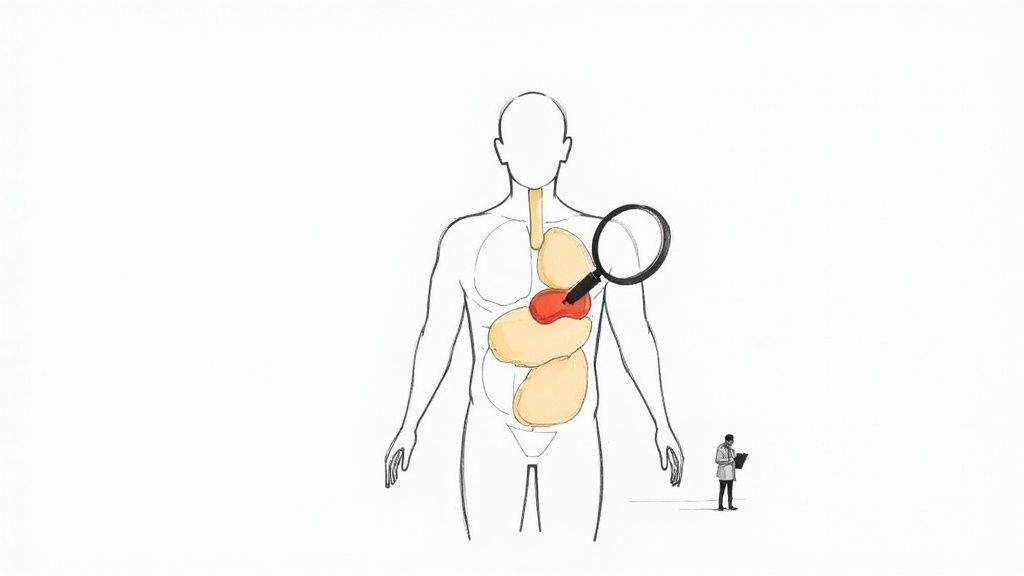
After the external review, I move to the internal examination. This is where the internal organs are examined to find evidence of disease or injury, and it’s always performed with surgical precision and the utmost respect. A Y-shaped incision is made on the torso, which allows for the careful removal and inspection of the organs in the chest and abdomen. Each organ is weighed, measured, and visually inspected for any abnormalities like tumors, infections, or signs of chronic disease. I also take small tissue samples from each organ for later microscopic analysis, which allows me to see what was happening inside the body at a cellular level.
The internal examination isn't just about finding a single "cause" of death. It's about understanding the full picture of what was happening in the body, documenting both the acute problems and any chronic conditions that may have contributed to the final outcome.
To provide a clearer overview, here is a summary of the key phases of the examination process.
Stages of the Autopsy Examination
| Stage | Purpose and Key Activities |
|---|---|
| 1. Authorization & Review | Confirm legal consent from next-of-kin. Analyze medical records, police reports, and other documents to establish context and guide the examination. |
| 2. External Examination | Perform a head-to-toe visual inspection. Document height, weight, identifying marks (scars, tattoos), injuries, and signs of medical intervention. |
| 3. Internal Examination | Make a Y-shaped incision to access the chest and abdominal cavities. Remove, weigh, measure, and visually inspect each organ for disease or injury. |
| 4. Sample Collection | Collect small tissue samples from major organs for microscopic analysis (histology). Collect fluid samples (blood, urine, etc.) for toxicology testing. |
| 5. Ancillary Studies | Send collected samples to specialized labs for toxicology, histology, and other tests. These studies can take several weeks to complete. |
| 6. Final Report | Integrate all findings from the external, internal, and laboratory examinations into a comprehensive, final report that states the cause and manner of death. |
Each of these stages builds upon the last, creating a thorough and evidence-based conclusion.
Ancillary Studies and Analysis
The final piece of the puzzle involves specialized laboratory tests. The samples collected during the internal exam are sent out for detailed analysis, which can take several weeks to complete. These tests are essential for uncovering evidence that isn't visible to the naked eye.
Key ancillary studies often include:
- Toxicological Analysis: Samples of blood, urine, and tissues are tested for prescription medications, illegal drugs, alcohol, and other substances. This is critical for determining if intoxication or poisoning played a role.
- Microscopic Analysis (Histology): The small tissue samples from each organ are processed and examined under a microscope. This helps me identify diseases at a cellular level, like inflammation, infection, or cancer.
- Other Specialized Tests: Depending on the case, I might also request microbiological cultures to check for infections or genetic testing to identify hereditary conditions.
The combined findings from the external, internal, and laboratory examinations all come together to form the basis of the final autopsy report. Every step is a piece of the puzzle, and together, they provide the comprehensive, fact-based answers that families and legal professionals need.
Your Options for Private and Second Opinion Autopsies
Not every death automatically triggers a cause of death investigation by the county medical examiner. A hospital might decline to perform an autopsy, or a loved one might pass away at home from what appears to be natural causes. When this happens, families are often left with lingering questions and no clear path to answers. This is exactly where a private autopsy can make all the difference. It gives a family the power to find answers on their own terms, bringing clarity when the official system can't or won't step in.
A second opinion autopsy serves as an essential quality check. If you or your attorney feel that the results of a state-ordered autopsy don't add up, an independent review can either confirm the original findings or, in some cases, correct them.
Why Choose a Private Autopsy
The decision to arrange for a private autopsy is always deeply personal. It almost always comes from a profound need for certainty when no one else is offering it. You might have unanswered questions about a loved one's final illness, serious concerns about the medical care they received, or a need to know if a genetic condition was involved. As a board-certified forensic pathologist, I provide a completely objective, independent autopsy. Because I'm not tied to a hospital or government agency, my work is free from any potential institutional bias. My only focus is the truth the evidence reveals.
Here are some of the most common reasons families in Texas come to me for help:
- A hospital has declined to perform an autopsy, which is happening more often as institutions look to cut costs.
- The death happened at home or outside a hospital, and the situation doesn't legally require the medical examiner to get involved.
- There are nagging questions about a potential misdiagnosis or the quality of medical treatment.
- A family needs to know if a hereditary disease played a part, which could have life-saving implications for living relatives.
The Value of a Second Opinion
A second opinion autopsy isn't about pointing fingers; it’s about ensuring absolute accuracy. This service is critical when the conclusions of an initial autopsy seem incomplete or questionable. To conduct a second opinion, I meticulously go over all the evidence from the first autopsy, reviewing everything from tissue slides and photographs to the original report. Sometimes, if new questions arise, a limited re-examination of the body might be needed.
An independent second opinion provides an unbiased perspective grounded in forensic science. Its purpose is to verify the cause of death determination and ensure that no detail was overlooked, giving families and attorneys confidence in the final conclusions.
This process flow shows the three core stages of any autopsy, from the initial external look to the final in-depth analysis.
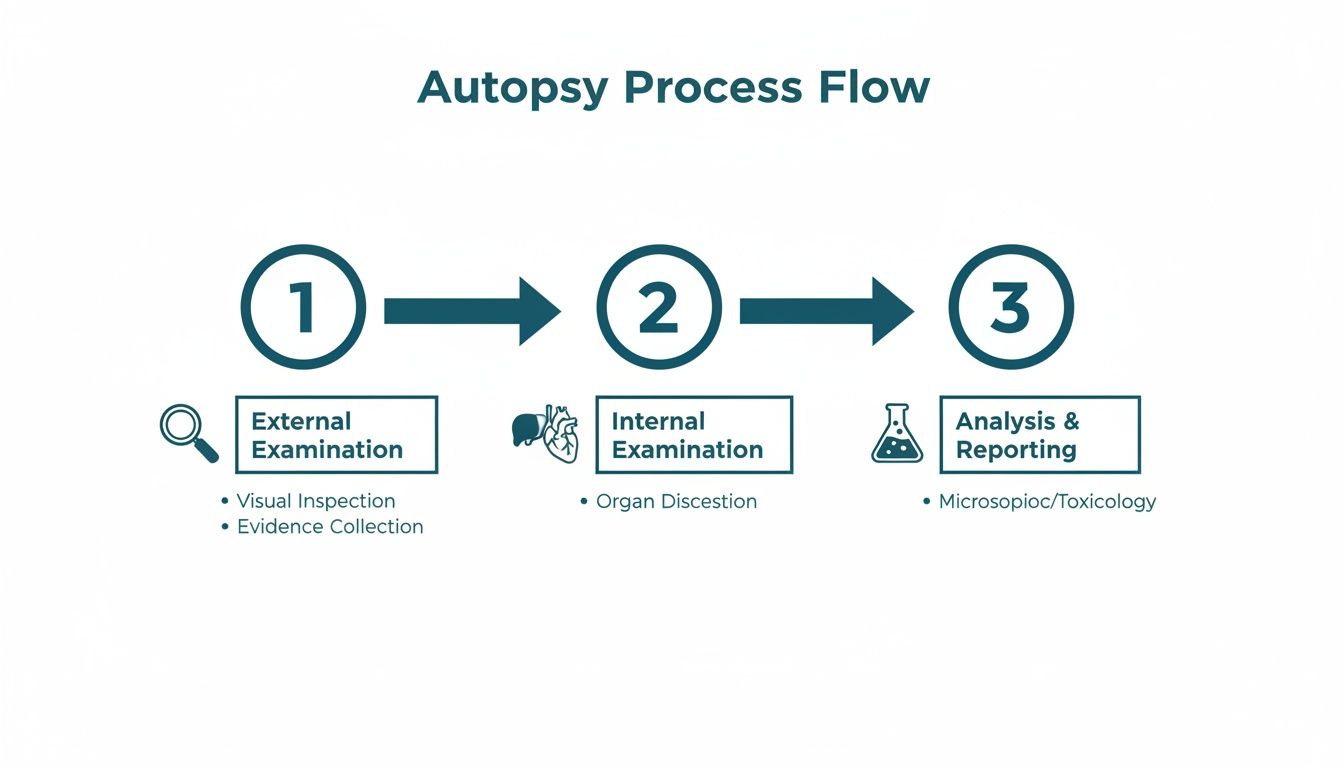
As the infographic shows, each step systematically builds on the last to ensure nothing is missed. My goal is to give you a clear, evidence-based report that either confirms the original findings or explains why my independent analysis led to a different conclusion. For an attorney, this can be the key to building a solid wrongful death or medical malpractice case. For a family, it provides the peace of mind that comes from knowing you've done everything possible to find the truth.
If you're considering an independent autopsy in Texas, I can walk you through the options and explain exactly what to expect.
Navigating Legal and Ethical Requirements in Texas
When you're dealing with the loss of a loved one, the last thing you want to worry about is legal red tape. That's why understanding the legal and ethical rules around autopsies in Texas is so important. It isn't about jumping through hoops; it’s about making sure everything is done correctly, protecting everyone's rights, and giving you peace of mind. At Texas Autopsy Services, I'm not just a pathologist. I'm also a guide through this process, ensuring every examination is handled with strict adherence to state law.
Consent and Authority in Texas
The first and most important step in a private autopsy is getting proper consent. The law is very specific about who has the authority to make that call. In Texas, the Texas Health & Safety Code lays out a clear order of priority for who can give consent. This authority usually starts with a spouse, then moves to adult children, parents, and so on. Getting this part right is absolutely critical. To see a full breakdown of the hierarchy, take a look at our detailed guide on who can request an autopsy in Texas.
It’s also crucial to know the difference between a case that the Medical Examiner must handle and one where the family gets to choose. If a death is sudden, violent, or suspicious, the Medical Examiner is required by law to investigate. But for most deaths from known diseases or natural causes, the decision to seek an autopsy is entirely up to the family.
The legal framework is not a barrier; it's a safeguard. It ensures that the deeply personal decision to proceed with an autopsy is made by the correct individual and that the examination itself is performed with integrity and legal standing.
Upholding Ethical Standards
Following the law is the baseline, but my commitment goes much deeper. As a physician who is board-certified by the American Board of Pathology, I hold myself to the highest possible standards in medicine. This ethical foundation is a promise I make to every family and attorney I work with, and it's built on a few core principles:
- Objectivity: My job is to find the medical truth. My conclusions are based only on the evidence, without any outside influence or bias.
- Confidentiality: Your family's privacy is paramount. All details of a case are kept completely confidential and are only shared with the person who authorized the autopsy.
- Respect for the Deceased: Above all, every person is treated with the utmost dignity and respect. I never lose sight of the fact that I am caring for someone's loved one.
On top of this, my practice strictly follows the regulations of the Texas Funeral Service Commission (TFSC). This means every procedure meets the state’s high standards for postmortem care. This dual commitment to the law and to my professional ethics is the foundation of trust for every single case I handle.
The Role of Autopsy in Modern Medicine
Even with all the incredible advances in medical technology, the traditional, hands-on autopsy is still the gold standard for determining the cause of death. You might hear about newer methods like postmortem imaging, sometimes called a 'virtopsy,' which uses tools like CT and MRI scans to look inside the body. These imaging techniques are valuable and can provide important clues without a full internal examination. But they don't replace the incredible detail I can get from a direct physical and microscopic look at the tissues themselves.

Combining Technology with Foundational Methods
In my work, I always blend modern knowledge with these proven, foundational methods to get the most accurate picture possible. When it comes to finding subtle signs of disease, identifying microscopic evidence, or giving the justice system a definite answer, there’s no substitute for a hands-on examination by a forensic pathologist.
It's interesting to see how different parts of the world approach this. In Japan, for example, postmortem imaging has become a more standard approach. Their national autopsy rate is only 2 percent, and even in suspicious deaths, a conventional autopsy is performed in just 11 percent of cases. They rely heavily on CT scans and MRIs as their primary tools. You can learn more about the long history of autopsies from this piece in Discover Magazine. This gets to the heart of the matter: imaging is great for spotting major issues like broken bones or internal bleeding, but it has its limits.
A CT scan can show me a mass on the liver, but it can’t tell me for sure if it’s cancer. Only by looking at a tissue sample under a microscope can I get that definitive answer.
Why Direct Examination Remains Crucial
The traditional autopsy offers a depth of detail that technology, for all its power, just can't match yet. It’s a comprehensive evaluation that’s absolutely critical in complex cases. Here's what a hands-on examination provides that imaging alone often misses:
- Microscopic Cellular Detail: We can spot infections, inflammation, or the earliest stages of cancer at a cellular level, which requires taking tissue samples.
- Subtle Toxicological Clues: Recognizing the faint signs of poisoning or drug interactions often comes down to direct observation and knowing exactly where to take samples for toxicology tests.
- Confirmation of Disease: It gives us the final word on the true extent and severity of conditions like heart disease or Alzheimer's.
As long as there are unexplained deaths that demand clear answers, forensic autopsies will be necessary. My job as a forensic pathologist is to use the most reliable and effective methods out there to provide families and the legal system with the certainty they deserve.
Common Questions About the Autopsy Process
Over my years as a forensic pathology expert, I've noticed that families and attorneys often circle around the same handful of questions. These aren't abstract medical queries; they're the practical, real-world concerns that pop up when you're faced with the decision to have a private autopsy performed. My goal here is to give you direct, clear answers to help you navigate this process with more confidence.
How Long Does an Autopsy Take to Complete?
The physical examination itself is typically finished in a single day, often lasting only a few hours. I handle every examination with meticulous care and with an efficiency that prevents any unnecessary delays for your family. The final report, however, takes longer. A truly thorough analysis relies on specialized lab tests, like toxicology reports and microscopic tissue examinations. These studies are essential for getting the full picture, and they can take several weeks to come back from the lab. As a general rule, you can expect the final, comprehensive report within 30 to 60 days.
Will an Autopsy Affect Funeral Arrangements?
Many families worry that an autopsy will delay their funeral plans or prevent an open-casket viewing. I can assure you, this is almost never the case. I perform every procedure with the deepest respect for the deceased, using techniques specifically designed to be mindful of funeral preparations. Once the examination is over, we coordinate directly with your chosen funeral home. My work is done in a way that does not interfere with the embalming or viewing process, allowing your family to move forward with your arrangements without disruption from us.
What Is the Cost of a Private Autopsy in Texas?
The cost of a private autopsy can change based on the complexity of the case and what specific tests are needed. At Texas Autopsy Services, I believe in complete transparency. I’ll provide you with a clear, all-inclusive quote right from the start, so you never have to worry about hidden fees or surprises. Our fee typically covers transportation, the complete professional examination, all standard laboratory and toxicology testing, and a comprehensive final report. While it is an investment, it provides definitive answers that can bring peace of mind or serve as crucial evidence in legal proceedings.
Who Receives the Final Autopsy Report?
Confidentiality is the bedrock of my practice. The final autopsy report is a private medical document and is protected as such. The report is released only to the legal next-of-kin or the specific person who legally authorized the examination. If you are working with an attorney, you can give them written authorization to receive a copy. We will never share information with any outside parties without your explicit, written consent. This ensures your family’s privacy is respected every step of the way.
If you have more questions or want to talk about how these answers apply to your specific situation, I understand. My team and I are here to provide the guidance and clarity you need. Please feel free to Contact our pathologist at Texas Autopsy Services for a direct consultation.